
Your Guide to the Best Exercise and Yoga Mat
When you’re setting up for a workout, the mat you roll out is more than just a piece of gear—it’s the interface between your anatomy and the floor. The biggest difference between an exercise and a yoga mat boils down to how each one is designed to support your body's structure and movement.
Yoga mats are designed for grip and stability, keeping your musculoskeletal system aligned and engaged during poses.
Exercise mats prioritize thick cushioning to absorb impact, protecting your spine, joints, and bones during dynamic movements.
Understanding this anatomical distinction is fundamental for both your performance and your physical well-being.
Your Foundation for Fitness and Flow
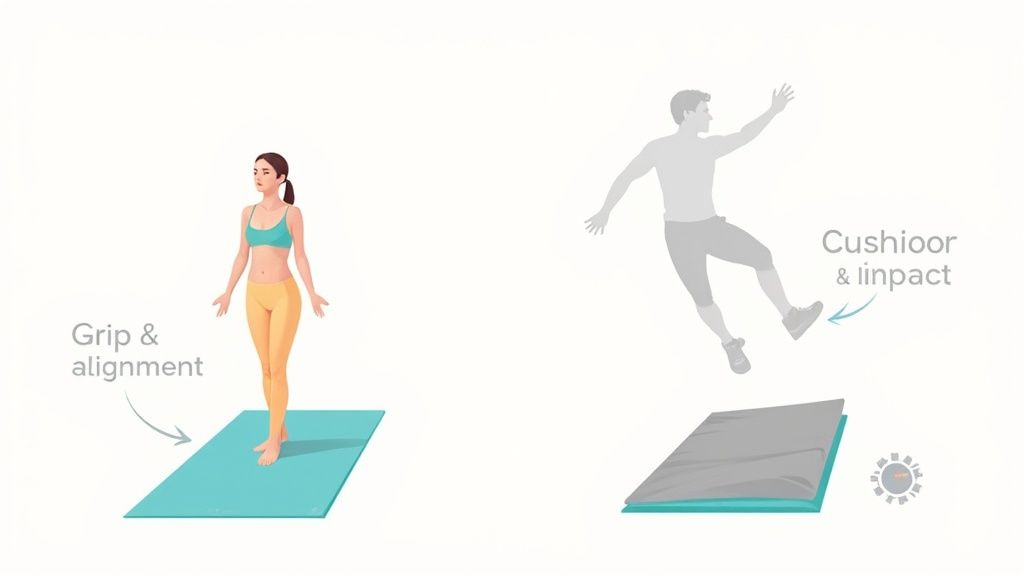
Think of it like choosing the right shoes for an activity. You wouldn’t wear running shoes to play basketball because they lack the lateral support your ankles need. Each shoe is built to protect the specific anatomical structures involved in the sport. Your mat works the same way; it’s the critical interface connecting your body to the ground.
An exercise mat is your personal shock absorber. Its main job is to create a thick, forgiving barrier between you and a hard floor. When you're doing HIIT or core work, you put significant compressive force through your joints—especially your spine, knees, and wrists. A good, thick mat diffuses that force, reducing stress on your cartilage and ligaments during moves like burpees and mountain climbers.
A yoga mat, on the other hand, is engineered for stability and traction. It creates a grippy, non-slip surface so the sensitive mechanoreceptors in your hands and feet receive clear feedback from the ground. This is essential for maintaining proper joint alignment and activating the correct muscle groups in poses like Downward-Facing Dog or Warrior II. A mat that is too thick and squishy disrupts this feedback loop, compromising your balance and stability.
The Purpose-Built Design
These functional differences are rooted in their distinct, anatomy-focused designs. Let's get straight to the point.
- Yoga Mat Purpose: Built for grip, proprioception (your nervous system's sense of your body's position), and stability. The thinner profile enhances the sensory connection between your feet and the floor, which is vital for balancing poses.
- Exercise Mat Purpose: Built for cushioning, joint protection, and impact absorption. Its thicker foam construction is there to shield your skeleton from the repetitive stress of high-energy workouts.
This isn’t just gear-nerd talk; it reflects a huge shift in how we approach fitness. As more of us build workout routines at home, the demand for specialized, purpose-built equipment has skyrocketed. In fact, the global yoga mat market was valued at around USD 16.0 billion and is expected to climb to USD 24.2 billion by 2033. This shows just how much people value having the right foundation for their practice.
For a quick breakdown, here’s how the two stack up side-by-side.
Yoga Mat vs Exercise Mat Quick Comparison
| Feature | Yoga Mat | Exercise Mat |
|---|---|---|
| Primary Function | Grip & Stability | Cushioning & Impact Absorption |
| Typical Thickness | 3mm - 6mm | 10mm - 25mm |
| Material Focus | Non-slip, dense materials (rubber, PVC, cork) | High-density foam (NBR, TPE, PVC) |
| Ideal Use Cases | Yoga, Barre, mobility work | HIIT, Pilates, core workouts, general fitness |
This table makes it clear: they are two different tools for two very different jobs.
Why Your Choice Matters for Your Body
Using the wrong mat isn't just awkward—it can genuinely compromise your form and your anatomical safety. Picture yourself trying to hold Tree Pose on a thick, spongy exercise mat. Your foot would sink into the foam, forcing the small stabilizer muscles in your ankle and foot to work overtime just to keep you upright, increasing the risk of a strain.
An exercise mat is designed to protect you from the floor. A yoga mat is designed to connect you to it. Understanding this difference is the first step toward a safer and more effective practice.
On the flip side, trying to do a set of crunches or Pilates roll-ups on a super-thin yoga mat can put painful pressure on the spinous processes of your vertebrae. Our guide on how to start Pilates at home stresses how important proper support is for these kinds of spinal articulation movements.
That’s why having the right mat isn't a luxury. It’s a core piece of equipment tailored to what your anatomy needs to move well.
Understanding Your Mat's Core Materials
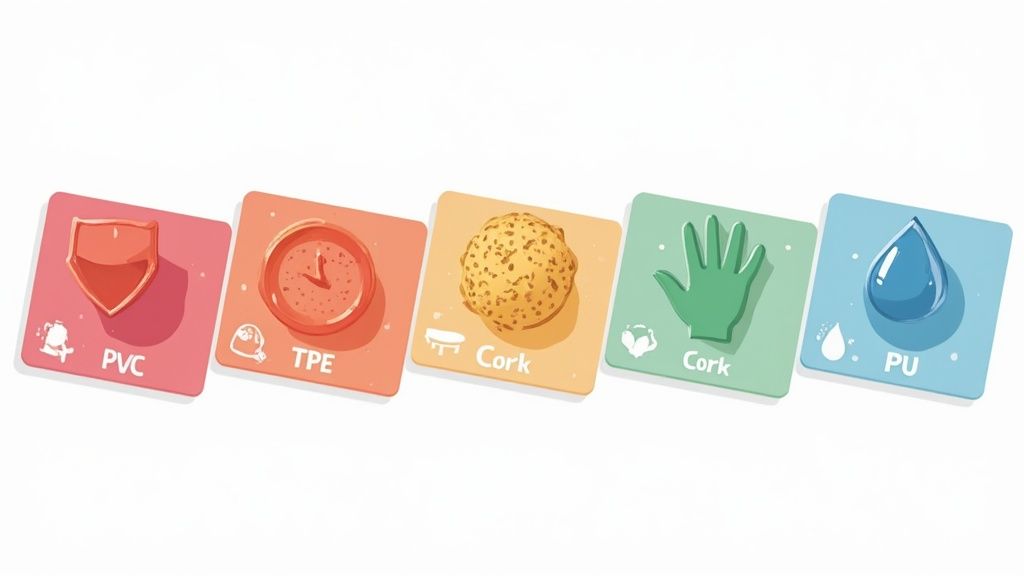
The material of an exercise and yoga mat is its DNA. It dictates everything from the proprioceptive feedback your hands receive to how much your joints are cushioned and even its hygienic properties. Just like a chef picks specific ingredients to create a certain dish, manufacturers choose materials to deliver a specific anatomical benefit.
Once you understand the "anatomy" of your mat, you can pick one that truly supports your body and your practice. Each material has its own personality—some are rugged and built to last, while others are all about sustainability or incredible grip for sweaty sessions. Let's break down the most common options to see how they feel and function under your body.
PVC The Durable Workhorse
Polyvinyl Chloride, better known as PVC, is a classic in the fitness world for one simple reason: it’s incredibly durable. A well-made PVC mat can stick with you for years of daily practice without flaking or falling apart. This makes it a go-to for busy studios and anyone with a demanding home workout routine.
The secret to its longevity is its closed-cell structure. Think of it as being made of tiny, sealed bubbles that don't let anything in. This non-porous surface stops sweat, dirt, and bacteria from penetrating the mat, which makes it super hygienic. The one catch? That same structure means moisture sits on top, which can reduce friction and make it slippery once you really start sweating.
As you consider the materials in your fitness gear, it's always smart to be mindful of what you're bringing into your home. For example, learning about BPA-free plastics and their importance can give you a broader perspective on making conscious consumer choices.
TPE The Eco-Friendly Hybrid
Thermoplastic Elastomer (TPE) is often seen as the more environmentally friendly cousin to PVC. It’s a synthetic mix of plastic and rubber that’s recyclable and takes less energy to produce. TPE mats are also wonderfully lightweight, making them a great choice if you’re constantly carrying your mat to and from class.
Like PVC, TPE has a closed-cell construction, so it’s hygienic and moisture-resistant. It offers a unique "bouncy" cushion that provides a different type of feedback to your body compared to PVC, though it might not be quite as durable over the long haul. TPE hits that sweet spot for anyone looking for a balance between performance, portability, and a smaller environmental footprint.
Natural Rubber The Grip Champion
For practitioners whose main anatomical concern is preventing slips, natural rubber is the undisputed king of grip. This material, sourced from rubber trees, has an open-cell structure. Imagine it’s like a sponge with millions of microscopic pores. When you start to sweat, these pores absorb the moisture, maintaining a high-friction surface that keeps your hands and feet locked in place even during the most intense hot yoga flow.
That incredible grip gives you a huge sense of security, letting you hold challenging poses and engage your muscles correctly without fear of injury. But there are a few trade-offs to keep in mind:
- Weight: Natural rubber mats are almost always heavier than their synthetic counterparts.
- Hygiene: That absorbent, open-cell structure can also hold onto bacteria if you don’t clean it regularly and thoroughly.
- Allergies: If you have a latex allergy, this material can cause a reaction and should be avoided.
Cork The Antimicrobial Choice
Cork is another amazing natural material, harvested from the bark of cork oak trees without harming the tree itself. It's naturally antimicrobial and antibacterial, which means it actively resists the growth of organisms that can cause skin irritation or odors. This makes it a perfect pick for anyone who practices in hot, humid places or just wants a low-maintenance, clean surface.
Just like rubber, cork’s grip actually gets better with a little moisture, making it fantastic for sweaty workouts. The surface has a smooth, earthy feel that provides a unique tactile feedback to your skin. Cork is typically bonded to a rubber base for extra cushioning, creating a sustainable and high-performing mat.
PU The Moisture-Wicking Pro
Polyurethane (PU) is a premium material, often layered on top of a natural rubber base. It’s famous for its incredible moisture-wicking ability and its "grippy-when-wet" performance that rivals even natural rubber. The surface of a PU mat feels silky and almost velvety smooth, yet it provides phenomenal traction from the very first moment you step on it.
This unique combination of a sleek feel and powerful grip makes it a favorite among dedicated practitioners. It actively channels sweat away, ensuring you have a stable foundation for your entire practice. PU represents the peak of modern mat technology, giving you the best of both worlds: a smooth, comfortable surface with an unbeatable, moisture-activated grip.
How Mat Thickness Impacts Your Body
Choosing an exercise mat isn't just about color or texture—the thickness is a direct conversation between your anatomy and the floor. It’s the single most important factor that dictates the balance between protective cushioning for your joints and the grounded stability you need for precise neuromuscular control.
Think of it like the suspension in a car. A luxury sedan with soft suspension glides over bumps, protecting your body from every jolt. A sports car has a stiff, responsive suspension that lets you feel every detail of the road. Neither is better; they're just engineered for different experiences. The same is true for your mat.
Getting this right means you're supporting your skeletal structure, preventing injury, and enhancing your performance. Get it wrong, and your mat could actually work against you. Let's break down how to choose the thickness that is right for your body and your movement style.
Thin Mats For Maximum Stability
Thin mats, usually between 1mm to 3mm, are the sports cars of the mat world. They're designed to give you maximum connection to the floor, offering minimal cushioning but incredible feedback. This is essential for developing your proprioception—your nervous system's ability to sense the position and movement of your body.
When you’re holding a tricky balancing pose like Tree Pose or Warrior III, a thin mat lets the tiny muscles and nerves in your feet and ankles make lightning-fast micro-adjustments. There’s no squishy foam absorbing those subtle movements, so you get raw, unfiltered information from the ground up. This sharpens your stability and helps you fine-tune your alignment.
But that direct connection comes at a cost.
- Joint Pressure: Bony prominences like your knees, wrists, and vertebrae have very little protection from a hard floor.
- Impact Discomfort: Even simple exercises like crunches can feel abrasive on your spine, let alone anything high-impact.
- Best Use Case: Perfect for seasoned yoga practitioners, travel, or anyone who prioritizes proprioceptive feedback over comfort.
A thin mat gives you an honest, direct line to your foundation. It challenges your stability and refines your balance by forcing your muscles to engage more deeply, but it offers very little forgiveness for sensitive joints.
Standard Mats The All-Around Performer
This is the sweet spot. The most common thickness for a truly versatile exercise or yoga mat is right in the 4mm to 6mm range. Here, cushioning and stability strike a perfect balance, making these mats the go-to choice for everything from a flowing Vinyasa class to a bodyweight circuit.
A mat in this range has enough padding to protect your patella in a low lunge and cushion your spine during Pilates roll-ups, but it's not so thick that it disrupts your balance. It absorbs just enough impact for comfort while staying firm enough to support standing poses without that wobbly, sinking sensation.
This is why it's such a great choice if you need one mat that can do it all. For instance, the WundaCore Movement Mat was specifically designed in this range to provide that ideal blend of support and stability for anatomy-focused workouts like Pilates. It gives you the confidence to flow between different exercises without having to second-guess your foundation.
To help you visualize this balance, here's a breakdown of how mat thickness corresponds to different anatomical needs and exercise types.
Mat Thickness and Its Anatomical Impact
| Thickness Range (mm) | Anatomical Benefit | Stability Level | Best For |
|---|---|---|---|
| 1mm - 3mm | Maximum ground feedback, enhances proprioception. | High | Advanced yoga, balancing poses, travel. |
| 4mm - 6mm | Balanced cushioning and support for joints. | Medium | Vinyasa yoga, Pilates, bodyweight exercises, general fitness. |
| 8mm+ | Superior joint protection and impact absorption. | Low | High-impact workouts (HIIT), restorative practices, sensitive joints. |
This table shows the clear trade-off: as cushioning increases for joint protection, the stability needed for precise balancing work decreases. Finding your ideal mat means identifying where your personal needs fall on this spectrum.
Thick Mats For Ultimate Cushioning
Once you get into the 8mm+ category, the mat’s purpose shifts almost entirely to joint protection. These are the luxury sedans of the fitness world. They’re built to absorb significant impact and create a soft, comfortable barrier between your skeleton and the floor.
For high-impact interval training (HIIT), intense core workouts, or restorative practices where you’re holding floor poses for a while, this level of cushioning is a lifesaver. It shields the delicate carpal bones in your wrists during planks, protects your tailbone during sit-ups, and makes any kneeling exercise feel completely pain-free.
But all that plush comfort comes with a compromise. The thick foam can feel unstable during balancing poses because it muffles the sensory feedback your feet need to find a solid footing. It’s a deliberate design choice that puts anatomical protection far ahead of proprioceptive feedback.
Why Grip and Texture Are So Critical for Your Safety
While the inside of your mat provides the cushion, the surface is where the real connection happens. The grip and texture of an exercise and yoga mat aren't just nice-to-have features; they are absolutely essential for your safety, dictating your stability and protecting you from musculoskeletal injury.
Let’s be honest: a slippery mat is a recipe for disaster. One misplaced hand in Downward-Facing Dog or a sliding foot in a lunge can easily lead to a pulled muscle or a sprained ligament. Grip is your first line of defense, ensuring that when you plant your hands and feet, they stay right where you put them. This stability allows you to engage the right muscles and hold your alignment without your body trying to compensate for a weak foundation.
But not all grip is created equal. The way a mat holds you in place comes down to the anatomy of its surface. Understanding the difference between grip types is the key to finding a mat that truly has your back, especially when your workout starts to heat up.
The Two Faces of Grip: Sticky vs. Absorbent
The "grip" you feel can come from two very different properties: a surface that is naturally tacky, or one that absorbs moisture to maintain high friction.
A 'sticky' grip is that classic feel you get from most PVC mats. It works by creating a slightly adhesive surface that your skin can almost cling to. In dry conditions, it’s fantastic, giving you a secure, locked-in feeling. But the moment sweat enters the picture, that stickiness can become a slick hazard as moisture pools on top of its non-porous surface, reducing the coefficient of friction to dangerously low levels.
On the other hand, an 'absorbent' grip is the signature of materials like natural rubber and polyurethane (PU). These mats have a special surface structure, often called open-cell, that actively pulls moisture away from your skin.
Think of it like the difference between a puddle on asphalt versus a patch of dry soil. The asphalt (your sticky mat) becomes treacherous when it gets wet. The soil (your absorbent mat), however, soaks up the water, keeping the surface safe enough to walk on. This is exactly why absorbent-grip mats are the gold standard for hot yoga and any intense, sweaty workout.
How Texture Gives Your Body Feedback
Beyond just grip, the physical texture of your mat plays a huge role. Those little patterns—subtle waves, raised dots, or bumpy surfaces—are more than just decoration. They provide crucial tactile feedback to the nerves in your hands and feet, which heightens your body's awareness of its position in space.
This feedback helps you make tiny adjustments to your form without even thinking about it. A slightly raised pattern can give your fingertips something extra to press into, deepening muscular engagement and making you feel more stable. For instance, the texture on a Jade mat is famous for this exact quality, offering a physical sensation that many people find incredibly grounding.
This connection between the surface and your body is powerful. A secure grip and a responsive texture work together, creating a complete feedback loop between your nervous system and your foundation.
Linking Your Mat's Surface to Your Alignment
Let's put this into a real-world anatomical scenario: holding Downward-Facing Dog. This foundational pose puts significant load through your upper body and core.
- With Poor Grip: If your hands are slowly sliding forward, your body will instinctively compensate. You’ll dump more weight into your wrists and shoulders to fight the slip, creating strain in the joint capsules and throwing off your spinal alignment. Over time, this can lead to chronic wrist pain and rotator cuff issues.
- With Secure Grip: When your hands are firmly planted on a grippy, textured surface, you can confidently press through your palms and lengthen your spine. This lets you distribute your weight correctly, engage your core musculature, and protect your joints. Your focus shifts from "please don't slip" to "let's perfect this pose."
Ultimately, the surface of your exercise and yoga mat is the bridge between you and the floor. A secure grip gives you the safety net you need to move with confidence, while a smart texture refines your body’s own awareness. Together, they create a foundation that doesn’t just prevent falls—it actively improves your biomechanics from the ground up.
Matching Your Mat to Your Movement Style
Okay, so we've broken down the anatomy of a good mat—the materials, the thickness, and the all-important surface grip. Think of that as knowing your ingredients. Now, it's time to apply that knowledge. Let's match the right mat to your specific movement style.
Just like you wouldn’t use a butter knife to chop vegetables, your mat should be the right tool for the job. The perfect mat can make all the difference, whether you're flowing through a Vinyasa sequence or powering through various bodyweight exercises. We'll look at the ideal setup for yoga, Pilates, and HIIT to ensure you find the perfect partner for your body.
For the Yogi: Grounded Stability and Superior Grip
Yoga is all about precise alignment and connection. It’s a practice built on the relationship between your anatomy and the floor, so a mat that prioritizes grip is non-negotiable. For most yogis, a standard thickness of 4-5mm is the sweet spot. It offers just enough cushion for your knees in a low lunge but won’t throw off your balance in Tree Pose or Warrior III.
And a lot of people are looking for that balance. With an estimated 300 million people practicing yoga worldwide, the demand for high-performance mats has exploded. If you're one of them—especially if you love a sweaty Vinyasa or hot yoga class—a mat with serious, absorbent grip from materials like natural rubber or PU is an absolute must. Slipping is not an option.
This simple decision tree shows you how to think about your mat's surface when things get slippery.
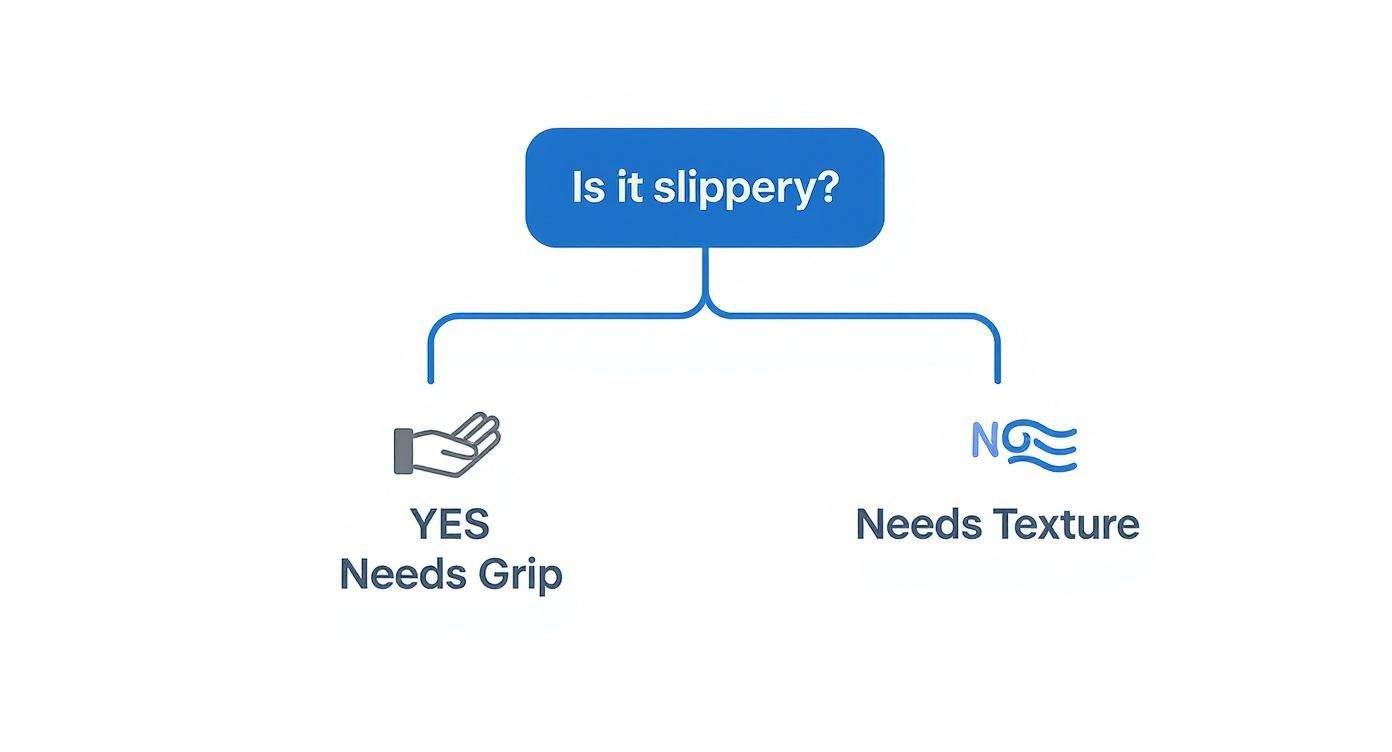
The bottom line? A slippery surface is a safety issue that grip solves. A non-slippery surface can still feel better with a bit of texture, giving the nerves in your hands and feet more feedback.
For the Pilates Devotee: Spinal Protection and Deep Cushioning
Pilates is a completely different animal. It’s all about controlled movement, core strength, and spinal articulation. Think about hallmark Pilates exercises like the roll-up, rolling like a ball, or the hundred. They all involve lying on your back and moving through your spine one vertebra at a time.
Trying to do those moves on a thin yoga mat can feel like you’re rolling directly on a hardwood floor—ouch. This is where extra cushioning isn't just a luxury; it's an anatomical necessity.
For a dedicated Pilates practice, you need a thicker mat, usually 8mm or more. This generous padding creates a protective barrier that cradles your spine, hips, and shoulders. It allows you to focus on your form and control, not on the discomfort of a hard floor against your bones. While that thickness might make standing balances a bit wobbly, it’s a worthy trade-off for a practice focused on spinal health. For more ideas on creating the perfect setup, check out our guide on Pilates equipment for home use.
For Pilates, think of your mat as an extension of your body’s support system. Its primary role is to protect your spine and joints, enabling you to execute precise, controlled movements with confidence and comfort.
For the HIIT Enthusiast: Durability and Impact Absorption
Now let's talk about High-Intensity Interval Training (HIIT) and general fitness. These workouts place a whole new set of demands on your body. We’re talking explosive, high-impact moves like burpees, jumping jacks, and mountain climbers—often done while wearing sneakers. Your average yoga mat just wasn't built for that kind of biomechanical stress.
For HIIT, your mat needs to be a triple threat:
- Extreme Durability: The surface has to be tough enough to handle the friction from athletic shoes without tearing or shredding. High-density PVC is often a great choice here.
- Maximum Cushioning: Just like with Pilates, a thickness of 8mm or more is crucial. It’s all about absorbing shock and protecting your joints—knees, hips, ankles—from the repetitive impact of all that jumping.
- Easy-to-Clean Surface: HIIT means sweat. A lot of it. A non-porous, closed-cell surface is essential for hygiene, letting you wipe down your mat in seconds after a tough session.
Choosing the right mat is a real investment in your body and your performance. When you align your mat's features with the specific anatomical needs of your workout, you're creating a foundation that keeps you safe and helps you get more out of every single movement.
A Few Common Questions About Your Mat
You've got the full rundown on what makes a mat tick, from its core materials to its surface texture. But the journey doesn't end when you buy it. Let's tackle some of the practical questions that pop up once you bring your new mat home.
Getting these details right is the key to making sure your mat supports your practice for years to come.
How Do I Clean My Mat Properly?
Keeping your mat clean is about more than just hygiene—it preserves its grip and feel. The right way to clean it really comes down to whether your mat has a closed-cell or open-cell structure.
Closed-cell mats, like those made from PVC or TPE, are the easiest to care for. Since they don't absorb sweat or moisture, a quick wipe-down after your workout is usually all it takes. Just use a damp cloth or a simple DIY spray to get the job done.
Simple DIY Mat Cleaner: In a small spray bottle, mix three parts water to one part white vinegar. For a little something extra, add a few drops of tea tree essential oil for its natural antibacterial properties and maybe some lavender for a calming scent. Mist your mat, wipe it down, and let it air dry completely before you roll it up.
Open-cell mats, like natural rubber or those with a grippy polyurethane (PU) top layer, need a bit more TLC. Their absorbent nature is what gives them that incredible grip, but it also means they can trap dirt and oils. It’s best to avoid vinegar-based cleaners here, as the acid can break down these materials over time.
For these mats, just stick with water and a tiny drop of a gentle, pH-neutral soap. Wipe the surface, then go over it again with a cloth dampened with plain water to make sure there's no soap residue left behind. For a deep clean, you can submerge it in a tub of cool, soapy water, but rinse it thoroughly and give it several days to dry completely, away from direct sunlight.
When Is It Time to Replace My Mat?
Your mat doesn't come with an expiration date. Its lifespan is measured in performance and support, not just time. A worn-out mat isn't just less comfortable; it can actually become a safety risk by failing to provide a stable foundation.
Here are the tell-tale signs that it’s time for an upgrade:
- Pitting or Thinning: If you see permanent depressions where your hands and feet usually go, the mat's cushioning has given out. It's no longer protecting your joints.
- Losing Grip: Finding yourself slipping and sliding in poses that once felt secure? The surface texture has likely worn smooth, which can compromise your stability and lead to an injury.
- Tearing or Flaking: If your mat is literally falling apart—shedding little pieces or showing visible rips—its structural integrity is gone. It's definitely time to say goodbye.
A high-quality mat can last for years, but if you're using it for daily, intense workouts, you'll likely need to replace it sooner. The bottom line is to pay attention to how it feels. When your foundation no longer feels stable and supportive, it's time to invest in a new one.
Can I Use My Yoga Mat for HIIT?
This question comes up all the time, and from an anatomical perspective, the answer is a firm no. Using a yoga mat for a high-impact workout with sneakers on is like trying to chop an onion with a butter knife. It’s the wrong tool for the job, and it puts your body at risk.
First off, yoga mats are designed for the grip of bare feet and hands, not the rough soles of athletic shoes. The friction from your sneakers will quickly shred and tear the delicate surface of most yoga mats. You could easily ruin a premium mat in just a few HIIT sessions.
Even more importantly, the typical 4-5mm thickness of a yoga mat just doesn't offer enough cushioning to protect your joints from the repetitive impact of burpees, jump squats, or lunges. You need the shock absorption of a thicker, more durable exercise mat to keep your knees, ankles, and spine safe. For any high-impact training, a dense, closed-cell mat that is at least 8mm thick is the anatomically correct choice.
Ready to find a mat that truly understands your body's needs? The WundaCore Movement Mat is engineered for the perfect balance of cushioning and stability, providing the ideal foundation for anatomy-focused workouts like Pilates. Discover how the right support can change your practice.