
How to Build Functional Strength: An Anatomical Guide
Ever helped a friend move and felt that familiar, unwelcome tweak in your back, even though you’re a regular at the gym? Or maybe you’ve wrestled a heavy suitcase into an overhead bin and wondered why it felt so awkward. These are the moments that reveal the gap between looking strong and being functionally strong.
Functional strength is all about training your body's integrated anatomical systems for the messy, unpredictable demands of real life. It’s your body’s ability to coordinate muscle groups and stabilize joints to perform everyday activities with power and grace, without getting hurt.
It’s not about isolating one muscle, like doing a bicep curl to target only the biceps brachii. It’s about teaching your entire neuromuscular system—from your deep core stabilizers like the transverse abdominis to your larger limb muscles like the quadriceps and latissimus dorsi—to work together as one smart, coordinated system. Think of it as building a body that’s ready for anything life throws at it, not just for the controlled, predictable movements of a gym machine.
This shift in thinking is catching on in a big way. In fact, functional fitness is now one of the top global fitness trends for 2025. People are realizing that how we move matters. Studies are backing this up, showing that while any kind of training can build muscle, functional resistance training is way better at improving your overall movement efficiency. You can dive into the research from SAGE Journals to see why so many people are making the switch.
Training Movements, Not Just Muscles
The biggest difference between functional training and old-school bodybuilding is its focus on integrated muscle chains, often referred to as kinetic chains.
A bicep curl, for example, primarily isolates the biceps brachii and brachialis. It’s great for building arm size, but that single-joint movement has almost nothing to do with how you’d actually lift a heavy box. That real-world task requires a symphony of muscular contractions: your glutes and hamstrings for hinging, your deep core muscles for spinal stabilization, your erector spinae to maintain posture, and your entire upper back and arms to lift and carry.
Functional exercises are designed to copy and strengthen these natural, multi-joint patterns. Here’s a quick breakdown of the different mindsets:
- Traditional Focus: Centers on one muscle at a time (think: chest day, leg day). The goal is usually aesthetics and hypertrophy of specific muscles like the pectoralis major or quadriceps.
- Functional Focus: Centers on primal movement patterns we all use, like pushing, pulling, squatting, and hinging. The goal is better performance—improving your ability to move with strength and control by training entire muscle systems.
This approach builds a body that’s resilient and adaptable. Instead of having a collection of strong parts that don't really know how to work together, you develop one cohesive unit where every muscle understands its job in the bigger picture.
The Anatomy of Everyday Power
Functional strength builds you up from the inside out, and it all starts with your deep core. Muscles you can’t see, like the transverse abdominis, diaphragm, and pelvic floor, act like a natural corset. They stabilize your spine and create a solid foundation for every single move you make. From that stable center, it connects to all the major muscle groups that power you through your day.
A functionally strong body doesn't just have powerful engines (like your quadriceps and glutes); it has a sophisticated guidance system—your central nervous system—that coordinates every action for maximum efficiency and minimal strain.
When you bend down to pick up a child, your body goes through a whole chain of events: you hinge at the hips to engage your gluteus maximus and hamstrings, your deep core muscles fire to protect your spine, and your latissimus dorsi, rhomboids, and biceps work together to pull and lift.
Functional training is the only thing that directly prepares your muscles and your nervous system for these kinds of synchronized efforts. It’s the ultimate upgrade for your body’s operating system, helping you move better and reduce the risk of chronic pain that so often comes from poor mechanics and muscle imbalances.
The Seven Primal Movements Your Body Was Built For
If you want to build strength that actually shows up in your daily life, you have to think differently about exercise. It’s not about isolating one muscle at a time; it’s about moving the way your body was designed to move.
Our bodies are built on a blueprint of seven primal movements. These are the fundamental patterns that underpin everything you do, from picking up your kids to putting groceries away. Mastering them is the secret to a stronger, more coordinated body.
It’s all about teaching your muscles to work together as a team—a concept we call the kinetic chain. When you perform one of these movements, your brain doesn't just fire up one muscle. It activates entire sequences, from the big power-movers to the tiny stabilizers, all in perfect harmony.
The infographic below shows the difference between this integrated approach and old-school, muscle-by-muscle training.
As you can see, functional strength is about training interconnected systems, not just parts. This is what prepares your body for the dynamic demands of real life. Let's look at what's happening under the hood for each of these core patterns.
The Squat and The Lunge
The squat is the absolute bedrock of human movement. Think about it: it's just sitting down and standing back up. Anatomically, it’s a lower-body powerhouse, firing up your quadriceps, glutes, and hamstrings. But what most people miss is the core demand. A good squat requires incredible stabilization from your erector spinae (lower back) and rectus abdominis (your "six-pack" muscles).
The lunge is the squat’s dynamic, single-leg cousin. It adds the critical ingredients of balance and stability. When you step into a lunge, you’re challenging your body’s sense of its position in space. This one-sided movement forces the gluteus medius (the side of your hip) on your standing leg to work overtime to keep your pelvis level. This is a huge factor in preventing knee and low back pain down the road.
The Push and The Pull
Pushing and pulling motions govern nearly every interaction you have with your upper body. A push, like shoving a heavy box or doing a push-up, recruits all the muscles on the front of your body.
- Pectoralis Major and Minor (Chest): The primary movers for pushing things away.
- Anterior Deltoids (Front Shoulders): They help the chest with any forward press.
- Triceps: The muscles on the back of your upper arm that straighten your elbow.
- Serratus Anterior: This unsung hero wraps around your ribs and keeps your shoulder blades stable and secure.
On the flip side, a pull motion—think starting a lawnmower or doing a row—lights up the entire back side of your upper body. This brings in the big, powerful latissimus dorsi, the rhomboids and trapezius that control your shoulder blades, and the biceps. Strengthening your pull is non-negotiable for good posture; it’s the antidote to the forward slump so many of us get from sitting all day.
The secret to powerful, pain-free movement isn’t just about strong arms and legs. It's about a rock-solid center. Every one of these primal movements starts from your deep inner core—the transverse abdominis, diaphragm, and pelvic floor. This provides the stable platform for everything else to work from.
The Hinge and The Twist
The hinge is what you do when you pick something heavy off the floor correctly—bending at the hips while keeping your back straight. It's a pattern dominated by your posterior chain, which takes the pressure off your vulnerable lower back. Your gluteus maximus and hamstrings work together to drive your hips forward with power, while your deep core muscles lock everything down to protect your spine.
The twist, or rotation, is where athletic power comes from. It's also how we navigate our three-dimensional world. This movement is driven by your obliques (both internal and external) working in sync with your hips. True functional rotation isn’t just twisting your waist; it's about transferring force from the ground, up through your legs and hips, across your core, and out through your arms.
The Gait or Carry
Finally, we have gait. This is simply walking, running, or carrying something from point A to point B. It’s the ultimate integrator, combining every other pattern into one fluid motion.
When you do a loaded carry, like a farmer's walk, you are challenging your entire system at once. Your grip strength (forearm flexors), shoulder stability (rotator cuff), core rigidity (transverse abdominis and obliques), and hip stability (gluteus medius) are all firing on all cylinders to keep you upright and moving forward.
This simple act teaches your body to maintain tension and coordination while in motion, which is the very heart of what it means to build functional strength.
Mastering the Foundational Functional Exercises
Knowing the theory behind primal movements is one thing, but putting it into practice is where you’ll really feel the change. Let's get into the core exercises that build true functional strength, broken down by the movement patterns we just talked about.
Don't worry about getting these perfect on day one. The goal is to focus on the details, feel the right muscles firing, and build a rock-solid base. That precision is what will keep you progressing safely for the long haul.
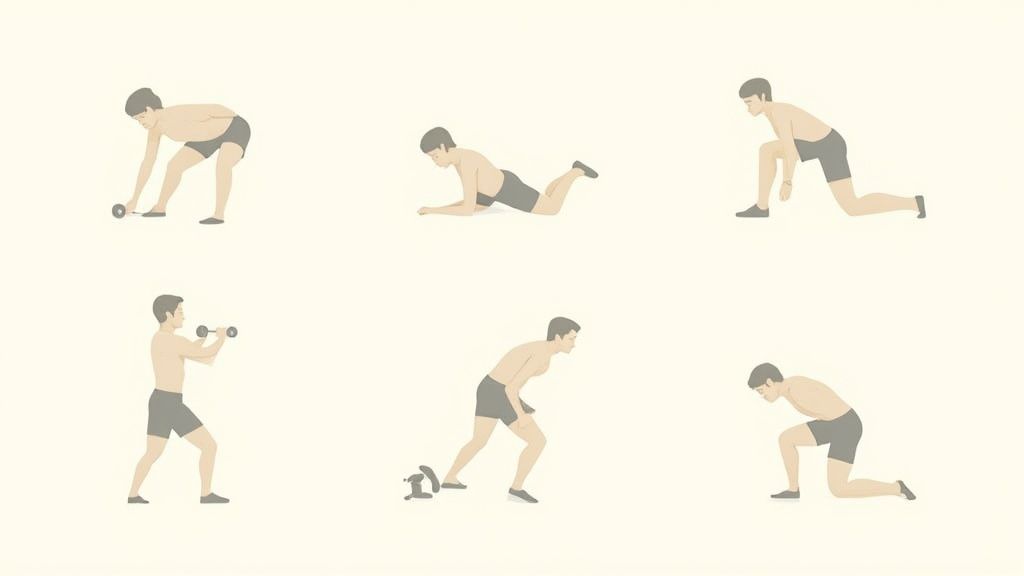
The Squat: Your Lower Body Cornerstone
The squat is arguably the most essential movement pattern we have—we do it every single time we sit down and stand back up. A simple bodyweight squat is the perfect place to start training your lower body and core to work together.
Stand with your feet about shoulder-width apart. As you lower, think about sending your hips back and down, like you’re aiming for a chair. Your quadriceps and glutes are the big movers here, but your hamstrings and adductors (inner thighs) are working hard to keep you stable. Meanwhile, your core—specifically the transverse abdominis and erector spinae—has to stay braced to keep your spine neutral and your chest up.
If you notice your knees caving inward (a really common issue!), actively push them out. This fires up your gluteus medius, a key muscle for stabilizing your hips. For a deeper dive into the mechanics, check out our guide to master the dynamic squat and build a stronger foundation.
The Push: Building Upper Body Power
A classic push-up is a masterclass in creating total-body tension. Yes, it’s great for your chest (pectorals), the front of your shoulders (anterior deltoids), and the back of your arms (triceps), but its real functional magic is in the demand it places on your core.
For a perfect push-up, your body needs to form a straight, rigid plank from head to heels. This requires a ton of stability from your rectus abdominis, obliques, and even your glutes. The most common mistake I see is sagging hips, which immediately puts stress on the low back. The fix? Squeeze your glutes and draw your navel in toward your spine to lock your pelvis in place.
If a full push-up isn't happening yet, start on an incline. Use a wall or a sturdy bench. This reduces the amount of body weight you have to lift, letting you nail the form without compromising your back.
The Pull: Crafting a Stronger Back
For every push, you need a pull. The dumbbell row is my go-to for counteracting that "desk slump" posture we all fall into. It strengthens the entire back of your upper body.
The big latissimus dorsi muscles do most of the heavy lifting here. But the smaller muscles around your shoulder blades—the rhomboids and mid-trapezius—are just as critical. They pull your shoulder blades back and together, which is vital for good posture and shoulder health. Your biceps and rear deltoids also pitch in.
A key cue here is to start the movement from your back, not by yanking the weight with your arm. Imagine you’re trying to squeeze a pencil between your shoulder blades as you row. This ensures the right muscles are doing the work.
The Carry: The Ultimate Full-Body Integrator
The farmer's walk seems almost too simple, but it’s one of the most effective exercises you can do. Just picking up heavy weights and walking challenges your body from your hands to your feet.
Here’s what’s happening anatomically:
- Grip Strength: Your forearm flexors and extensors are on fire, working hard to hold the weight.
- Shoulder Stability: Your rotator cuff and trapezius muscles are firing to keep your shoulder joints from being pulled out of their sockets.
- Core Rigidity: Your entire core, especially the obliques, contracts isometrically to stop you from leaning side-to-side with each step.
- Hip Stability: The gluteus medius on your standing leg has to work overtime to keep your pelvis level.
The farmer’s walk teaches your body to maintain tension and stability while moving—the very essence of functional strength.
The Twist: Resisting Rotation with the Pallof Press
While twisting is a primal movement, learning to resist rotation is even more important for protecting your spine. The Pallof press is a fantastic anti-rotation exercise that trains your core to do exactly that.
You set up by holding a resistance band or cable at your chest and pressing it straight out in front of you. This creates a rotational force trying to pull you sideways, and your core has to fight to keep your torso facing forward. This specifically trains the obliques and transverse abdominis in their crucial stabilizing role. The real work is in the hold, when you have to resist the urge to let the band twist you. This builds the kind of reflexive core strength you need to protect your back during everyday life.
How to Progress Your Functional Strength Safely
Once you’ve got a solid feel for the foundational movements, your body and nervous system are ready for the next layer. Real progress in functional strength isn’t about endlessly piling on more weight—it’s about challenging your body in smarter, more dynamic ways. This is where we bring in the principle of progressive overload, but with a functional twist.
Instead of just adding another plate to the bar, we're going to play with variables that look a lot more like the complex challenges of daily life. This approach doesn't just build stronger muscles; it sharpens the neurological pathways that control them. The result is more coordinated, powerful, and injury-resistant movement.
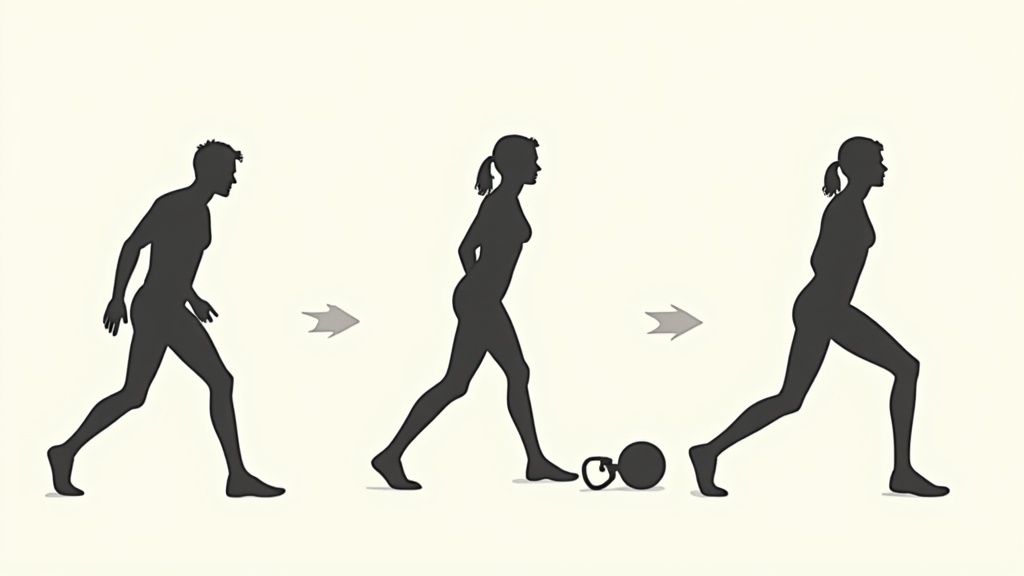
Beyond Adding Weight Increase the Challenge
The most obvious way to progress is to increase the load. But in functional training, we have far more interesting and effective tools in our toolbox. Each one places a unique demand on your anatomy and nervous system.
-
Increase Instability: Take a stable, two-footed squat and evolve it into a single-leg variation, like a split squat. This immediately forces the small stabilizer muscles around your hips and ankles—think the gluteus medius and tibialis anterior—to fire up and work overtime to keep you balanced. You're building joint stability and body awareness (proprioception) in real-time.
-
Add Complexity: Start combining two movements into one fluid motion. A great example is taking a standard lunge and adding a torso twist with a medicine ball. This integrates the rotational power of your obliques with the lower-body strength of your glutes and quads, teaching your kinetic chain to transfer force efficiently across different planes.
-
Manipulate Tempo: Try slowing down the eccentric (or lowering) phase of an exercise. In a push-up, for instance, taking three to four seconds to lower your body dramatically increases the time under tension. This is a fantastic way to stimulate muscle growth and strengthen connective tissues in your chest, shoulders, and triceps without needing a single extra pound of weight.
As you get more advanced, knowing how to build muscular endurance becomes key. It’s what allows you to tackle these more complex movements and longer sets without your form falling apart—a critical defense against fatigue-related injuries.
Introducing Advanced Multi-Planar Exercises
Once you feel confident with the basics, it’s time to bring in exercises that challenge your body across multiple planes of motion at once. These movements are really the pinnacle of functional training, demanding strength, stability, coordination, and power all at the same time.
The Turkish Get-Up is a perfect example. It's a slow, deliberate exercise that takes you from lying on the floor to standing up, all while holding a weight overhead. Anatomically, it’s a full-body symphony: your rotator cuff has to stabilize the shoulder, your glutes and hamstrings power the hip bridge, and your entire core—from the transverse abdominis to the obliques—is working nonstop to maintain spinal alignment.
Another fantastic multi-planar movement is the Kettlebell Swing. This isn't a squat or a lift; it's an explosive hip hinge. All the power comes from a forceful contraction of your gluteus maximus and hamstrings, creating momentum that ripples up the kinetic chain. This is how you train your posterior chain to generate explosive power, which is fundamental to athletic activities like jumping and running.
The real magic of these advanced exercises is neurological. They train your central nervous system to coordinate complex muscle-firing sequences, making your movements more efficient and powerful in any activity you do.
Distinguishing Between Strength and Power
As you move forward, it’s really helpful to understand the difference between strength and power. Strength is your ability to exert force. Power is your ability to exert that force quickly. Building a solid base of strength is the foundation, but developing power is what makes you truly athletic and capable.
- Strength Development: This is all about moving heavier loads through a full range of motion, usually at a controlled pace. Picture a heavy Goblet Squat.
- Power Development: Here, the focus shifts to moving a moderate load as fast as you possibly can. Think of a box jump or a kettlebell swing.
By adding explosive movements, you're training your Type II (fast-twitch) muscle fibers, which are responsible for generating those rapid, forceful contractions. And this isn't just for athletes. Research clearly shows that power training offers huge benefits for physical function, especially as we age. A detailed review of multiple studies found that greater training frequency was linked to enhanced benefits, showing how consistent power work can improve our ability to react quickly and move confidently.
By combining strength-focused lifts with explosive, power-based movements, you create a beautifully balanced program. You’ll build a body that isn't just strong, but also quick, agile, and resilient. If you're looking to add an explosive element to your lower body routine, our guide can show you how to safely and effectively master the dynamic squat.
Programming Your Functional Strength Workouts
Consistency is everything. But just showing up isn't enough—having a smart, structured plan is what truly turns effort into results. Knowing how to build functional strength is less about punishing, all-out sessions and more about crafting a sustainable routine that actually fits into your life.
The real goal here is to design a program that builds you up without burning you out. This means moving beyond random workouts and adopting an approach that hits all the primal movement patterns, gives you time to recover, and consistently (but safely) challenges your body.
Designing Your Weekly Schedule
How you map out your week really comes down to your fitness level and how much time you can realistically commit. If you're just starting, two solid full-body sessions are fantastic. If you're more advanced, you might handle three or four. The key is always balance and recovery.
Here are a few ways you could structure your week:
-
The Beginner Blueprint (2 days/week): Keep it simple and effective with two full-body workouts. On Day 1, you could hit squats, push-ups, and farmer's walks. For Day 2, maybe you do lunges, dumbbell rows, and a Pallof press. This gives your body plenty of time to recover and adapt between sessions.
-
The Intermediate Integrator (3 days/week): Once you have a solid base, you can add a third day to the mix. This lets you split your focus a bit more. For example, you could have a "push" day (squats, push-ups, overhead press), a "pull" day (deadlifts, rows, pull-ups), and a full-body dynamic day (kettlebell swings, lunges with a twist, carries).
-
The Advanced Athlete (4 days/week): This schedule allows for more specialization. Think an upper-body push day, an upper-body pull day, a lower-body day centered on squats and hinges, and a fourth day for full-body conditioning and core work.
The best program is the one you actually stick with. It’s far better to nail two workouts every single week than to attempt four and burn out after a month.
Making It Work in the Real World
Let's be honest: life is busy. Sticking to a plan can feel like a huge challenge, but the beauty of functional training is how adaptable it is. You absolutely do not need an hour every day to see progress.
A well-designed 20-minute workout can be incredibly powerful. Imagine a quick circuit of Goblet Squats, Renegade Rows, and Kettlebell Swings with minimal rest between moves. This approach gets your heart rate up while challenging major muscle groups. For those days when you need something gentler, a low-impact workout routine can deliver similar benefits without stressing your joints.
If you need some inspiration for structuring your training, exploring various workout programs can provide a clear roadmap and fresh ideas. It's all about finding a rhythm that feels sustainable for you.
This adaptability is a huge reason why people stick with functional training. One meta-analysis found that functional training has an adherence rate of approximately 82.5% among older adults—a number that rivals traditional methods. It just goes to show how effective this style of training is at keeping people engaged while delivering fantastic results. You can dive into the participant engagement findings from this meta-analysis yourself.
Ultimately, building functional strength comes down to listening to your body, treating recovery as seriously as you treat your workouts, and creating a plan that serves your life—not the other way around.
Your Top Functional Training Questions, Answered
Once you get the hang of the core principles behind functional strength, the real-world questions start popping up. Let's dig into some of the most common ones I hear from clients, so you can train with confidence and get the results you're after.
How Often Should I Be Doing This?
For most people, aiming for 2 to 4 functional strength sessions per week is the sweet spot. It gives your body enough of a challenge to adapt, but also gives your muscle fibers, connective tissues, and nervous system crucial time to recover and get stronger.
If you’re just starting out, 2 full-body workouts a week can create fantastic results. As you get more experienced, you might bump that up to 3 or 4 sessions, maybe even splitting your focus between different movement patterns, like a push/pull day and a hinge/squat day. The most important thing is consistency and learning to listen to your body’s signals for rest.
Can I Build Real Strength with Just My Bodyweight?
Absolutely. In fact, bodyweight training is one of the best ways to build functional strength because it forces you to master control over your own body. You can't cheat your way through a perfect push-up or squat—they are foundational for a reason.
And you don’t need to add weight to make things harder. You can challenge your body in new ways by changing other variables. Slowing down the tempo, for example, increases time under tension and forces more muscle fibers to get involved. Or, you could try single-limb variations, like a pistol squat. That move dramatically increases the demand on your stabilizer muscles, like the gluteus medius, which has to work overtime to keep your pelvis from dropping.
What's the Difference Between Functional Strength and Getting Bigger Muscles (Hypertrophy)?
This is a great question. The main goal of functional strength is to make your movements more efficient and resilient, reducing your risk of injury. It's about training your brain and muscles to work together seamlessly. We're focused on the quality of your movement patterns.
On the other hand, hypertrophy is the specific process of making muscle fibers grow larger, so the muscle itself looks bigger. While functional training often leads to some muscle growth, its primary purpose is to improve how your body performs, not just how it looks.
How Do I Know if My Form Is Actually Correct?
Proper form is everything. It ensures you’re working the right muscles and, most importantly, keeping your joints safe. A great place to start is by filming yourself on your phone and comparing it to a video of a qualified coach.
Your body also gives you feedback. You should feel the work in the target muscles—like your glutes and hamstrings firing up during a hinge—without feeling any sharp pain in your joints. If you're ever unsure, investing in a few sessions with a certified personal trainer can be a game-changer. They'll give you personalized cues that will set you up for success for years to come.
Ready to put all this into practice with expert guidance? The WundaCore collection and our Wunda On Demand classes are designed to build that deep, functional strength from the inside out. Come see how our anatomy-first approach to Pilates can completely change the way you move.