
7 Effective Menopause Belly Fat Exercises You Can Do At Home
If you've noticed your midsection changing during menopause, you're not just imagining it. And it's definitely not a personal failure. This shift is rooted in deep physiological and anatomical changes that go far beyond what you can see on the surface. Understanding the specific muscles and hormonal mechanisms at play inside your core is the first step toward finding exercises that actually make a difference.
Understanding Your Changing Core Anatomy
When we talk about effective exercises for menopausal belly fat, we're not talking about endless crunches. The best approach goes deeper, focusing on strengthening your transverse abdominis and pelvic floor to build support from the inside out. This helps manage the very real anatomical shifts happening during this stage of life.
As estrogen levels decline during perimenopause and menopause, your body's sensitivity to insulin can decrease, and your adrenal glands can produce more cortisol. This hormonal cascade sends a new signal for fat storage. Instead of distributing fat primarily on your hips and thighs (a pattern known as gynoid fat distribution), your body starts to favor your abdominal area (android fat distribution). This hormonal shift is the main driver behind that frustrating accumulation of fat around your middle.
The Two Types of Belly Fat
It's so important to know that not all belly fat is created equal. Your exercise strategy needs to account for the two very different types of adipose tissue you're dealing with.
- Subcutaneous Fat: This is the soft, pinchable fat located between your skin and your abdominal wall muscles. While it can be a cosmetic concern for many, it's less metabolically active than its deeper counterpart.
- Visceral Fat: This is the fat that's far more concerning from a health perspective. It's stored deep within your abdominal cavity, surrounding vital organs like your liver, pancreas, and intestines. This type of fat is hormonally active, releasing inflammatory proteins called cytokines that are linked to a higher risk of health issues.
This diagram shows exactly how those hormonal shifts impact both your core muscles and the buildup of visceral fat.
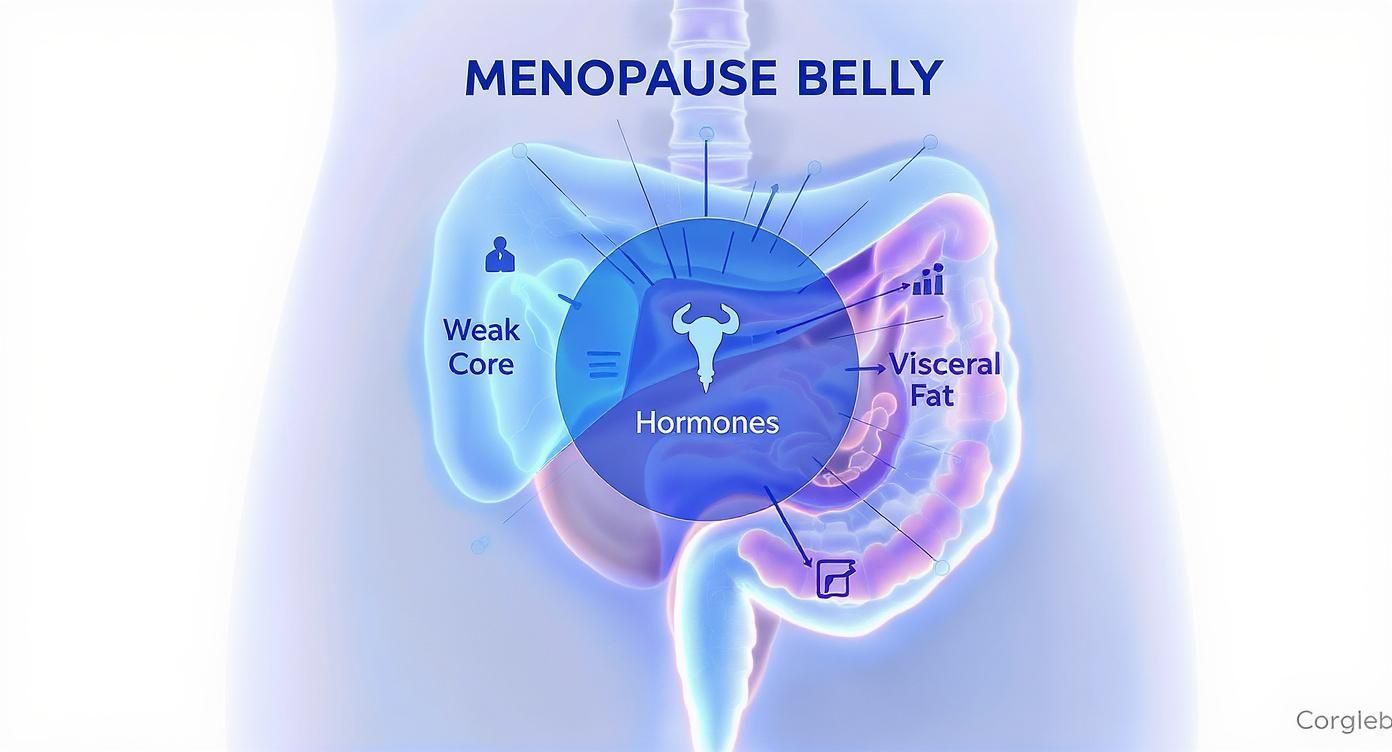
As you can see, weakened core stability and an increase in visceral fat are direct results of the hormonal changes happening during the menopausal transition.
The Role of Your Deep Core Muscles
Your core is so much more than the "six-pack" muscles (rectus abdominis) on the surface. The real powerhouse is your deep core system, a muscular cylinder that provides stability and support for your entire torso. During menopause, these crucial muscles can lose their tone and function due to hormonal changes affecting muscle mass and collagen integrity.
The transverse abdominis (TVA) is your deepest abdominal muscle, and its fibers run horizontally, wrapping around your midsection like a girdle. Its primary function is to stabilize the lumbar spine and pelvis before movement of the limbs occurs. A strong TVA helps flatten the abdomen, support your lower back, and compress the abdominal contents. When it weakens, you might notice that your lower belly protrudes more, or you might experience more back discomfort.
Another critical piece of the puzzle is your pelvic floor, a sling of muscles that forms the base of this core "cylinder." It supports your pelvic organs, including the bladder, uterus, and rectum. Declining estrogen can weaken these muscles, contributing to issues with bladder control and reducing your overall core stability. Learning how to properly engage these muscles is foundational.
The combination of hormonal shifts, a natural decline in muscle mass (sarcopenia), and lifestyle factors creates a perfect storm for abdominal weight gain. This isn't just about how you look; it's about your internal health and functional strength.
Research backs this up. It's a widespread trend, with nearly 70% of post-menopausal women experiencing central obesity, which is characterized by excessive fat around the midsection. One long-term study even found that during menopause, the rate of visceral abdominal fat increases by about 8% every year—even if overall weight stays the same.
This anatomical reality is precisely why generic ab workouts often fall short. They don't address the deep, stabilizing muscles or the underlying hormonal influences. By shifting to an anatomy-aware approach, you can build a stronger, more functional core that truly supports your body through this transition and beyond.
When you first see that little shift in your midsection, what's the first thing you do? For most of us, it's an automatic dive to the floor for crunches. It's what we’ve been told for years: want a flat stomach, do sit-ups. Simple, right?
But for a menopausal body, this old-school advice can actually backfire, sometimes making your belly look even more pronounced.
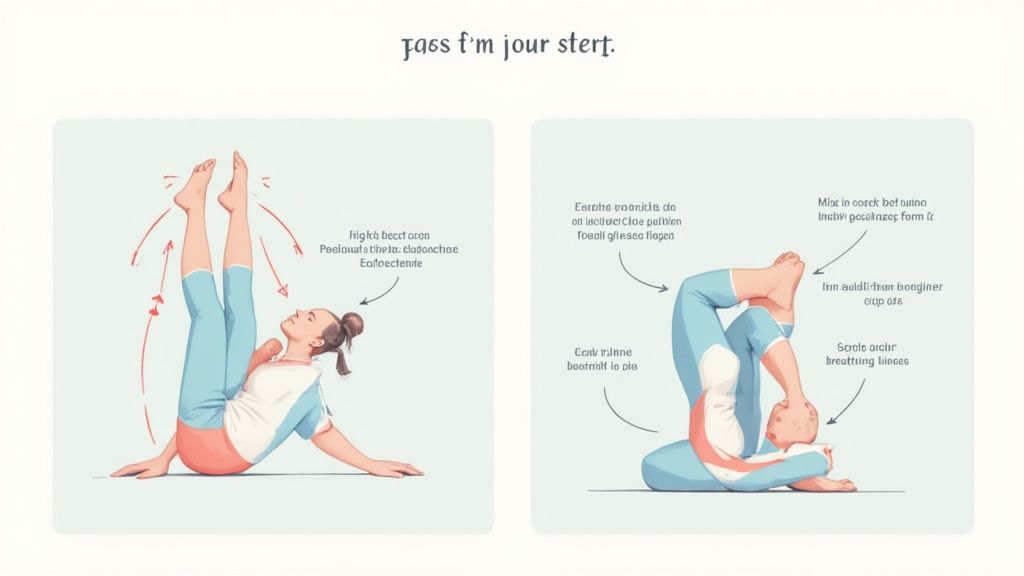
The issue isn't about working hard; it's about working smart and understanding what's really going on inside your core. Your core isn’t just that top "six-pack" layer. It’s a deep, intricate system of muscles. Crunches hammer away at the most superficial of these, the rectus abdominis.
Strengthening these muscles isn't necessarily a bad thing, but they aren't the ones that cinch your waistline and provide deep stability. I like to think of them as the drywall in a house, while your deeper transverse abdominis is the structural frame. Crunches are like redecorating the walls while ignoring a shaky foundation.
The Pressure Problem, Explained
Here’s what happens every time you do a traditional crunch: you create a massive amount of intra-abdominal pressure.
Picture squeezing a water balloon right in the middle. The pressure has to go somewhere, so it bulges out at the top and bottom. That’s exactly what's happening inside your abdomen. This pressure pushes forward against the connective tissue at your midline (the linea alba) and presses down on your pelvic floor.
During menopause, both of these areas are already more vulnerable. Hormonal changes can weaken collagen, making the linea alba prone to stretching. This can create or worsen diastasis recti—a separation of the abdominal muscles that contributes to that "poochy" look.
At the same time, all that downward force puts a ton of strain on your pelvic floor, which may already be weakened from hormonal shifts and age. This can lead to issues like incontinence or a feeling of heaviness.
Trying to fix menopause belly with high-rep crunches is like constantly pushing on an already strained support system. You end up in a frustrating cycle where you're putting in the effort but not addressing the root cause, so you don't see the results you want.
Shifting Focus From Superficial to Deep Support
The key is understanding the difference between the muscles you see and the muscles that truly function to support you. A smarter approach to exercise during menopause turns the focus inward.
- Rectus Abdominis (The "Six-Pack"): This muscle's main job is to flex your spine forward (spinal flexion). When you over-rely on it without engaging the deeper layers, you get that "doming" or "coning" effect down the middle of your belly.
- Transverse Abdominis (The "Corset"): This is your deepest core muscle. It literally wraps around your midsection like a natural girdle, holding in your organs and stabilizing your spine. When you learn to activate it, it naturally flattens your abdominal wall from the inside out.
Traditional crunches almost completely ignore this deep corset muscle.
Our goal isn't to build a bulky outer layer. It’s to reconnect with and strengthen the deep internal support system that has become less active over time. This approach creates a flatter, more toned appearance and builds a genuinely functional core that supports every move you make.
That's why a gentle, anatomy-aware approach isn't just safer—it’s infinitely more effective.
Building a Foundation with Pilates
After figuring out why old-school ab exercises just don't work for menopausal belly fat, it's time to shift our approach. We need a method that rebuilds your core from the inside out, and that’s where Pilates shines. The entire philosophy is built around strengthening the deep, internal muscles that give you true stability and help create a naturally flatter, more supported midsection.
Forget about forceful, high-impact movements that put pressure on your pelvic floor. Pilates is all about controlled, precise actions that reconnect your brain to your muscles. This isn't about feeling a superficial "burn" in your six-pack. It's about waking up the deep transverse abdominis (TVA)—your body’s own internal corset—and teaching it to work in harmony with your pelvic floor and diaphragm.
Think of it as laying a brand-new, much stronger foundation for your entire core. The principles below are the essential building blocks for every single exercise in this guide. Get these right, and everything else falls into place.
Mastering the Pilates Breath
The first, and most important, technique is learning how to breathe correctly. I'm not talking about the shallow chest breathing most of us do all day long. The Pilates breath, or lateral breathing, is a powerful tool that automatically switches on your deepest core muscles.
Imagine your rib cage is an accordion. When you inhale through your nose, focus on expanding your ribs wide to the sides and into your back. This recruits the intercostal muscles between your ribs. Your shoulders should stay relaxed and down, away from your ears. Now, as you exhale forcefully through pursed lips (like you're blowing out a candle), feel your rib cage gently close as your deep abdominal muscles draw in and up.
That specific exhale is what activates your TVA. It's a subtle but powerful feeling, almost like you're zipping up a pair of high-waisted jeans from the inside.
- Inhale: Breathe into the sides and back of your ribs, feeling them expand laterally.
- Exhale: Purse your lips and audibly blow the air out, feeling a gentle scooping or hollowing sensation deep in your lower belly.
Practicing this breath is an exercise in itself. You can do it sitting at your desk or waiting in line at the grocery store. This mindful breathing is the engine that will power every movement to come, making your workouts significantly more effective.
The Pilates breath is your secret weapon. It transforms a simple movement into a deep core-strengthening exercise by ensuring your TVA and pelvic floor are engaged throughout the entire range of motion.
Finding Your Neutral Spine
Our second foundational concept is understanding and maintaining a "neutral spine." This is simply the natural, gentle curve in your lower back when all your vertebrae are stacked in their optimal alignment. It's the safest and most efficient position for your body, protecting your spine from strain and allowing your core muscles to fire up properly.
To find your neutral spine, lie on your back with your knees bent and feet flat on the floor, about hip-distance apart.
- Place the heels of your hands on your hip bones (the anterior superior iliac spine, or ASIS) and let your fingertips point toward your pubic bone, forming a small triangle with your hands on your lower abdomen.
- First, gently press your lower back flat into the floor (we call this an imprint or a posterior pelvic tilt). Notice how that triangle of your hands tilts up toward your face.
- Next, arch your back away from the floor, creating a big space underneath it (an anterior pelvic tilt). Now your triangle will tilt down toward your feet.
- Finally, find the sweet spot right in the middle of those two extremes. The triangle formed by your hands should now be perfectly level, parallel with the ceiling. You’ll have a tiny, mouse-sized space under your lower back (your lumbar spine).
That is your neutral spine. Holding this position during exercises ensures you’re stabilizing with your deep core muscles instead of straining your back or gripping with other muscles.
Nailing this breath and alignment will fundamentally change how you approach core work, setting you up for real, lasting results.
Alright, we've covered the "why" behind menopause belly fat and tuned into our deep core with Pilates breath and a neutral spine. Now, it's time to put that knowledge into practice.
This routine is built specifically for the menopausal body. We're focusing on gentle, low-impact movements that build real strength from the inside out. Forget about power and quantity; our goal here is precision and quality.
Each one of these exercises is designed to wake up your deep abdominal muscles—especially that all-important transverse abdominis (TVA)—and your pelvic floor. These are the muscles that act like your body's natural corset, providing true stability and helping to create a supported, flatter-looking midsection. Pay close attention to the breathing cues—they're the engine that drives every single movement.
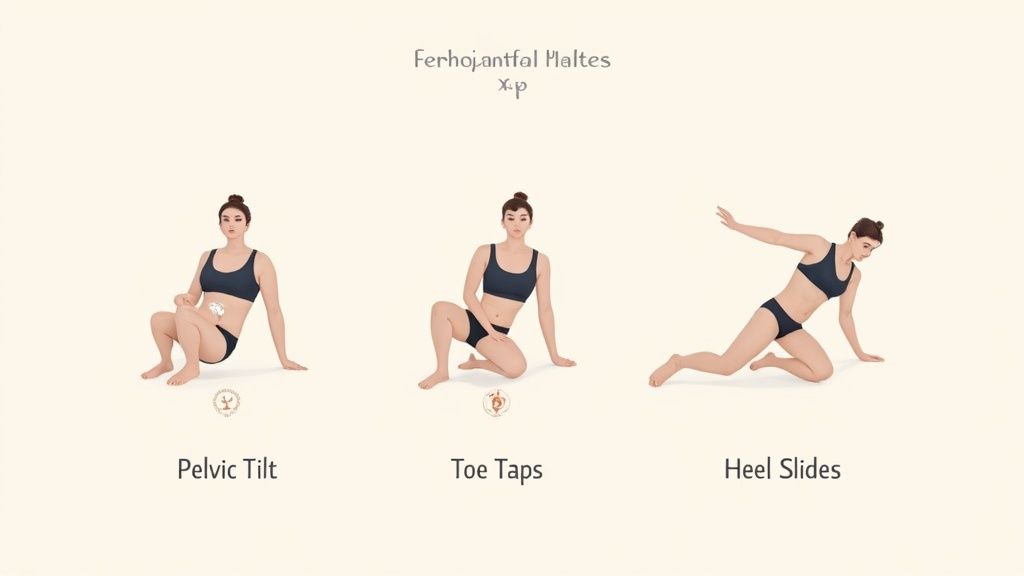
Exercise 1: Pelvic Tilts
Think of this as the ultimate mind-body reconnection for your deep core. It's a subtle movement, but it's incredibly powerful for mobilizing your lower back and teaching you how to start every movement from your center.
- Set Up: Lie on your back, knees bent and feet flat on the floor, about hip-width apart. Find your neutral spine, leaving that small, natural curve under your lower back. Let your arms rest long by your sides.
- The Movement: Inhale to prepare. As you exhale through pursed lips, gently draw your pubic bone up toward your navel, pressing your lower back firmly into the mat. You're tilting your pelvis backward.
- The Breath: Inhale while holding this gentle scoop. Then, exhale as you slowly and deliberately return to your neutral starting position.
- Reps: Aim for 8-10 slow, controlled repetitions.
Anatomy Cue: As you exhale and tilt, imagine you're zipping up a tight pair of high-waisted jeans. The feeling should be deep and low in your belly, originating from the transverse abdominis, not by pushing with your legs or glutes.
Exercise 2: Heel Slides
Heel slides are all about challenging your core to stay completely still while your legs are moving. This is a crucial skill for building functional strength that supports you in everyday activities, like simply walking across a room.
- Set Up: Start in the same neutral spine position as the pelvic tilt.
- The Movement: Inhale to prepare. On your exhale, engage your deep core and slowly slide one heel away from you along the floor until the leg is straight. The real work is in keeping your pelvis and torso absolutely motionless.
- The Breath: Inhale as you hold the extended leg. Exhale to slowly drag the heel back to where you started, keeping that deep core connection the entire time. Alternate legs with each rep.
- Reps: Perform 6-8 slides per leg.
Modifications for Heel Slides
If you feel your back arching or your hips rocking from side to side, that’s a sign your core isn't quite ready for the full range. No problem. Just modify.
- Beginner Mod: Don't straighten your leg all the way. Only slide your heel out as far as you can while keeping your pelvis perfectly still.
- WundaCore Progression: Place the WundaCore Resistance Ring between your inner thighs. Gently squeezing the ring throughout the movement will fire up your inner thighs (adductors) and pelvic floor, giving you an extra layer of stability.
Exercise 3: Toe Taps
Now we're upping the stability challenge. Toe taps require you to work from a "tabletop" position, which makes your TVA work harder to stop your lower back from arching.
- Set Up: Lie on your back. Engage your core and lift your legs one at a time to tabletop, with knees bent at a 90-degree angle directly over your hips. Your shins should be parallel to the floor. Do your best to maintain that neutral spine.
- The Movement: Inhale. As you exhale, slowly lower one leg, hinging from the hip, and gently tap your toes on the floor. Only go as low as you can without your back arching off the mat.
- The Breath: Inhale to lift the leg back to tabletop with control. Exhale to lower the opposite leg.
- Reps: Complete 8-10 taps on each side.
Critical Tip: If you feel even a hint of strain in your lower back, your deep core has checked out. Make the movement smaller or go back to Heel Slides to build more of that foundational strength first.
Exercise 4: Bent Knee Fall Outs
This exercise might look simple, but it’s deceptively challenging when you do it with control. It targets your deep hip rotators and pelvic stabilizers—both essential for core function and balance.
- Set Up: Lie on your back with your knees bent, feet flat, and spine in neutral.
- The Movement: Inhale. On the exhale, keep your pelvis perfectly still as you let one knee slowly fall out to the side, opening from the hip joint like a book.
- The Breath: Inhale to pause at the bottom. Exhale as you use your deep core and inner thigh muscles to draw the knee right back to the start.
- Reps: Alternate sides for 6-8 repetitions per leg.
The goal here is total isolation. If your opposite hip lifts off the floor as the knee falls out, you've gone too far. Just reduce the range of motion to maintain that perfect stability.
Exercise 5: The Bridge
The bridge is a fantastic move for strengthening your entire posterior chain—your glutes and hamstrings. These muscles are the unsung heroes of your core, providing essential support for your pelvis and lower back.
- Set Up: Lie on your back, knees bent, feet flat on the floor and hip-width apart. Your heels should be close enough that you can just graze them with your fingertips.
- The Movement: Inhale. On your exhale, press through your feet to lift your hips, creating a straight line from your shoulders to your knees. Give your glutes a good squeeze at the top.
- The Breath: Inhale to hold the position. Exhale to slowly roll your spine back down, one vertebra at a time, until you're back in neutral.
- Reps: Aim for 8-12 slow and controlled bridges.
While Pilates is our focus, other practices like yoga can beautifully complement your routine by strengthening your core and easing digestive issues. It's worth exploring yoga poses that reduce digestive discomfort and bloating as another tool in your wellness kit. Both disciplines share a focus on mindful movement and deep core engagement, which is exactly what we need during this transition.
Lifestyle Habits to Support Your Core Work
Targeted core exercise is a game-changer, but your results will be so much better when your lifestyle is on the same team. The hormonal shifts happening in your body are influenced by more than just movement. If you really want to tackle that stubborn belly fat, getting a handle on stress and nutrition are non-negotiable pieces of the puzzle.
One of the biggest drivers behind visceral fat is the stress hormone, cortisol. As estrogen dips during menopause, our bodies can become much more sensitive to cortisol's effects. Chronic stress keeps this hormone on overdrive, basically sending a memo to your body to store fat deep in your abdomen—exactly where you're trying to lose it.
This means your stress-management game has to be just as strong as your workout routine. You simply can't separate your physical and emotional states; they're completely connected.
Taming the Stress Hormone
Managing cortisol doesn't mean you need to blow up your life and move to a monastery. It’s all about weaving small, consistent habits into your day that help calm your nervous system.
- Mindful Breathing: Just five minutes of slow, deep belly breathing can bring cortisol levels down. This is different from a Pilates breath; you want to let your belly really expand on the inhale and soften on the exhale. This diaphragmatic breathing activates the vagus nerve, signaling your body to shift from "fight-or-flight" to "rest-and-digest" mode.
- Gentle Movement: Never underestimate the power of a brisk walk, especially if you can get out in nature. It helps burn off that anxious energy without adding more physical stress to your system.
- Prioritize Sleep: Not getting enough sleep is a huge stressor that sends cortisol through the roof. Aiming for 7-9 hours of quality sleep a night is one of the most powerful things you can do for hormone balance and fat loss.
Think of cortisol as the manager in charge of fat storage for your midsection. Every time you consciously relax—through breathwork, a walk, or just unplugging for a few minutes—you're telling that manager to go on a coffee break.
Nutrition That Supports Your Muscles
Just like endless crunches can backfire, a super restrictive diet often does more harm than good by jacking up your stress and slowing down your metabolism. Instead of focusing on what to cut out, let's focus on adding in the foods your body needs right now. The goal is to build and keep your lean muscle, because that's what keeps your metabolism fired up.
A smart eating strategy really boils down to a few key things:
- Protein Power: Make it a goal to include a source of lean protein with every single meal. Protein is absolutely essential for holding onto the muscle mass that we naturally start to lose with age. Think fish, chicken, tofu, beans, and Greek yogurt.
- Fiber First: Foods packed with fiber—vegetables, fruits, and whole grains—help you feel full and keep your blood sugar stable, which is a huge help with cravings. A healthy gut is also key for managing inflammation, and fiber is great for that.
- Anti-Inflammatory Choices: Visceral fat is linked to low-grade inflammation, so loading up on foods rich in omega-3s (like salmon and walnuts) and antioxidants (like berries and leafy greens) can help counteract that.
This approach works hand-in-hand with your workouts. For more ideas on movement that supports weight management, our guide on the best low-impact workout for weight loss has some great strategies. And if you're looking for a wider view on this journey, exploring effective tips on how to lose weight during menopause can offer even more support.
By bringing smart exercise, stress management, and supportive nutrition together, you create a powerful synergy that addresses menopausal belly fat from every possible angle.
Your Menopause Exercise Questions, Answered
Starting a new fitness plan always brings up questions, especially when you're targeting something as specific as menopausal belly fat. It's totally normal to want clear, anatomy-aware answers. Let's get into some of the most common things that might be on your mind so you can move forward with confidence.
How Soon Can I Expect to See Results?
This is the big question, right? You'll likely feel a difference pretty quickly—often within a few weeks, you'll notice a deeper connection to your core and better posture. But visible changes take a bit more time.
Remember, we're going after the deep visceral fat, not just the pinchable stuff under the skin. Reducing visceral fat is a slow-burn process that hinges on consistency—not just with these exercises, but with supportive nutrition and stress management, too.
Try focusing on these non-scale victories first:
- Feeling stronger and more stable during your daily movements.
- Noticing less of that nagging, day-to-day back pain.
- The way your clothes start to fit more comfortably around your waist.
The real goal here is a long-term shift in your body's internal support system. Be patient with yourself. Celebrating the feeling of building functional strength from the inside out is a huge win on its own.
Are These Exercises Safe with Back Pain or Diastasis Recti?
Because these movements are low-impact and focus on the deep core, they are generally much safer for anyone dealing with back pain or diastasis recti (that's abdominal separation) than traditional ab workouts like crunches.
The whole game is about avoiding excessive intra-abdominal pressure, which can make both of those conditions worse. Always think about keeping a neutral spine, and listen to what your body is telling you. If you see any "doming" or "coning"—that little ridge that can pop up along the linea alba—it's a sign to back off and modify the movement.
Of course, if you have a diagnosed condition, the best first step is always to chat with a physical therapist.
Can I Do These Exercises Every Day?
Even though these movements are gentle, your muscles still need time to repair and rebuild. Rest isn't lazy; it's a non-negotiable part of getting stronger. Muscle protein synthesis, the process of repairing and building muscle tissue, happens during rest, not during the workout itself.
Aim to do this specific core routine 3-4 times per week, and try to schedule it on non-consecutive days. This gives your body the downtime it needs. On your "off" days, focus on other kinds of movement. A balanced approach is what prevents overuse injuries and gives your overall metabolic health the boost it needs to manage menopausal changes.
Do I Need Cardio to Lose Menopause Belly Fat?
Yes, absolutely. The most effective approach is a one-two punch: targeted core work combined with consistent cardio. Think of it this way: the Pilates-based routine in this guide builds your muscular support system and improves your posture, which helps create a flatter, more toned abdominal appearance.
Cardio is what helps you burn calories and improve your overall cardiovascular health, which is essential for reducing total body fat—including that stubborn visceral fat. Aim for at least 150 minutes of moderate-intensity cardio each week. Things like brisk walking, swimming, or cycling are perfect complements to your strength work.
Ready to build a stronger core with a system truly designed for your body? The WundaCore collection gives you the tools and guidance to practice effective, anatomy-informed Pilates right from your home. Explore our patented equipment and streaming classes to start your journey today.