
Pilates Ring Exercises for Abs: Sculpt a Strong Core from the Inside Out
Using a Pilates ring for your ab work is one of the fastest ways to feel a deeper connection to your core. The ring’s resistance targets deep stabilizing muscles that standard mat exercises often glide over, helping you build a genuinely strong, stable midsection by engaging the correct anatomical structures.
How The Pilates Ring Unlocks Your Deep Core
The real secret of the Pilates ring—often called the magic circle—is its ability to provide constant, targeted resistance. Bodyweight exercises are great, but they rely primarily on gravity. The ring introduces an isometric challenge that forces your muscles to fire differently to maintain stability. It essentially "wakes up" sleepy, underused muscle fibers deep within your core musculature.
This consistent tactile feedback is the key to accessing the deeper layers of your abdominal wall. When you incorporate the ring into your ab routine, you’re not just hitting the superficial muscles; you're recruiting an entire system of stabilizers that support your spine and pelvis.
Targeting Your Entire Core
To truly understand what the ring does, it helps to remember what your core actually is from an anatomical standpoint. It’s so much more than the rectus abdominis or "six-pack." Think of it as a muscular corset that wraps around your entire torso, providing the foundation for almost every move you make.
Here are the main players the ring helps you connect with:
- Transverse Abdominis (TVA): This is your deepest core muscle, a wide, flat sheet of muscle that acts as your body's natural weight belt. Squeezing the ring, whether between your hands or inner thighs, immediately cues the TVA to contract. You’ll feel your navel draw in toward your spine, which is the primary action of this muscle, helping to stabilize your lumbar spine.
- Rectus Abdominis: These are the "six-pack" muscles at the front, responsible for trunk flexion. The ring adds a significant challenge to exercises like roll-ups, forcing this muscle to work with more control through every inch of its concentric (shortening) and eccentric (lengthening) phases.
- Obliques (Internal and External): Running along the sides of your torso, these are your powerhouse muscles for spinal rotation and lateral flexion. Using the ring in rotational movements adds direct resistance, helping you sculpt and define your waistline by challenging these muscles directly.
Before we go deeper, here's a quick breakdown of the core muscles the ring targets and what they do for you.
Anatomy of a Pilates Ring Ab Workout
| Core Muscle Group | Primary Function | How the Pilates Ring Engages It |
|---|---|---|
| Transverse Abdominis (TVA) | Deep core stabilization, spinal support | Squeezing the ring between hands or thighs activates the TVA's "corseting" effect. |
| Rectus Abdominis | Trunk flexion (bending forward) | Adds resistance to flexion exercises, requiring more controlled effort. |
| Obliques | Rotation and side-bending | Provides resistance during twisting movements to challenge and strengthen the sides. |
| Pelvic Floor | Supports organs, stabilizes pelvis | The ring's feedback helps you connect the pelvic floor lift with deep ab engagement. |
| Inner Thighs (Adductors) | Stabilize the pelvis and legs | Directly engaged when squeezing the ring between the knees or ankles. |
Understanding these anatomical connections is what turns a simple squeeze into a full-body, integrated movement. It's about working smarter, not just harder.
The Pilates method has always been rooted in a deep understanding of anatomy. Joseph Pilates developed it in the 1920s as a rehab system for injured athletes, focusing on core strength and balance. While props like the ring were added later, they perfectly align with the original principles of precise, controlled movement.
Beyond Crunches: The Isometric Advantage
Let’s be honest, traditional crunches can often lead to neck strain and rely more on momentum than muscle. The Pilates ring completely changes the game by encouraging isometric contractions—that’s when a muscle generates tension without changing length.
Imagine placing the ring between your ankles during a leg lift series. Your adductors (inner thighs) and the lower fibers of your transverse abdominis have to fire isometrically just to hold it in place, even before you start moving your legs.
This constant, low-level tension builds incredible endurance and control. It trains your body to keep your core stable throughout any movement, which translates directly to better posture, less back pain, and more power in everything else you do. By mastering this neuromuscular connection, you build a core that’s truly resilient.
Our guide on pilates exercises for core strength offers even more techniques to deepen this powerful connection.
Alright, you understand the why behind core anatomy. Now it's time to put that knowledge into action—this is where real, functional strength gets built. We're moving beyond theory to break down some of my favorite foundational Pilates ring exercises for your abs.
The goal isn't just to go through the motions. It’s about mastering that mind-muscle connection, making sure every single movement is precise, controlled, and recruits the deep core muscles you’re targeting.
Essentially, the ring creates a chain reaction. The external resistance you apply forces your deep internal stabilizers to fire up, building a stronger core from the inside out. It's a game-changer.
The Ring Hundred
The Hundred is a classic Pilates endurance exercise, and adding the ring just amplifies its core-carving power. This move intensely targets the rectus abdominis (your "six-pack" muscles) and the deep transverse abdominis, all while challenging your breath control and intercostal muscles.
- Get Set: Lie on your back with your knees bent in a tabletop position (hips and knees at 90 degrees). Place the Pilates ring between your inner thighs, just above the knees.
- The Movement: Inhale to prepare. As you exhale, perform a thoracic curl by lifting your head, neck, and shoulders off the mat, reaching your arms long by your sides.
- The Action: Start pumping your arms vigorously up and down as you take five short inhales, then five short exhales. All the while, you’re maintaining a gentle but constant squeeze on that ring.
That squeeze is everything! It activates your hip adductors, which co-contract with your lower abs and pelvic floor, deepening the engagement. Make sure your lumbar spine stays connected to the mat, not hyperextended.
Roll Up with The Ring
If there’s one move that tests your abdominal strength and spinal articulation, it’s the Roll Up. The ring is fantastic here because it gives you instant feedback on your form and muscular recruitment.
- Get Set: Lie supine with your legs straight out in front of you. Hold the ring between your hands with your arms extended toward the ceiling.
- The Movement: Inhale as you lift your head and shoulders. Then, exhale to continue peeling your spine off the mat, one vertebra at a time, reaching the ring toward your toes.
- The Action: It is absolutely critical that you use your abdominals to create flexion, not momentum from your hip flexors. Don't swing your arms or yank with your neck.
Pro Tip: At the top of the movement, give the ring a gentle squeeze. You'll feel your pectoralis major and serratus anterior fire up. This helps stabilize your scapulae and prevents you from collapsing into your lumbar spine.
Inhale at the top, and then exhale to slowly roll back down with just as much control. That slow, controlled descent is where you build incredible eccentric strength in your rectus abdominis.
Oblique Twists with Ring Resistance
This one hones in on your internal and external obliques—the muscles responsible for spinal rotation that cinch your waistline.
- Get Set: Sit tall with your knees bent and feet flat on the floor. Hold the ring out in front of your sternum with both hands.
- The Movement: Lean back just enough to feel your rectus abdominis engage, but keep your spine long and straight. Avoid lumbar flexion.
- The Action: Exhale as you rotate your torso to one side. The key is to keep your pelvis stable and facing forward. The rotation should originate from your thoracic spine, not from just swinging your arms. Inhale back to the center and exhale to the other side.
The ring acts as a great focal point, helping you maintain good upper-body posture. A little squeeze reminds you to keep your chest open and shoulders down, preventing tension from creeping into your trapezius muscles. Using a quality prop like The Original Wundacore Resistance Ring makes a huge difference, giving you consistent tension for maximum muscle activation.
Single Leg Stretch Variation
The Single Leg Stretch is a dynamic move that challenges both your coordination and abdominal endurance. Holding the ring between your hands adds an upper-body isometric challenge that locks your core in even further.
- Get Set: Lie on your back and perform a thoracic curl. Hold the ring between your palms with your arms extended straight up over your chest.
- The Movement: Bring one knee toward your chest while extending the other leg long, out at about a 45-degree angle.
- The Action: Exhale as you switch legs with a crisp, controlled motion. While your legs are moving, your upper body and the ring should remain perfectly still.
That stillness is everything. It’s achieved by deeply engaging your transverse abdominis to prevent any pelvic shifting. The ring’s feedback helps you notice if you’re rocking side-to-side, forcing your core to do all the stabilizing work.
Common Form Mistakes and How to Fix Them
In Pilates, precision is everything. It's the secret ingredient that transforms a simple movement into a powerhouse core exercise. The slightest error in your form can shift the workload away from your abdominal muscles and into structures you don't want to strain, like your lumbar spine or neck flexors.
Getting a handle on the biomechanics of these common mistakes is the first real step to correcting them and finally getting the deep core results you're after.
So many of these slip-ups come from a weak connection to the deep core—which is exactly what the Pilates ring is designed to fix. Let's walk through some of the biggest culprits so you can build a practice that's not only stronger but also much safer.
Arching The Lower Back
This is a big one. You know the feeling—as you move your legs, a gap opens up between your lower back and the mat. That lumbar hyperextension is a telltale sign that your deepest core muscle, the transverse abdominis (TVA), has disengaged. When that happens, your iliopsoas (hip flexors) takes over, pulling on your lumbar spine and causing strain.
The fix? Find your neutral pelvis or a slight posterior tilt. Before you even start the exercise, take an exhale and feel your TVA contract, gently drawing your navel toward your spine. Squeezing the Pilates ring between your inner thighs is a fantastic proprioceptive cue to fire up that deep TVA connection and keep it locked in.
The goal isn't to slam your back flat against the floor by tucking your tailbone. It's about engaging your abs so profoundly that they naturally stabilize your pelvis, keeping your spine safe and ensuring the work stays in your core.
Tensing The Neck and Shoulders
Ever finish a set of ab work and realize your neck feels like it did all the heavy lifting? That happens when your sternocleidomastoid (neck flexor muscles) tries to do the job your abdominals are supposed to be doing. Instead of initiating the curl from your upper abs, you lead with your chin, creating significant cervical tension.
To fix this, think about initiating the movement from your ribcage. Imagine your ribs gliding down toward your hips as you lift your head and shoulders. Soften your gaze toward your knees and maintain the natural curve of your cervical spine by keeping space between your chin and chest.
Using Momentum Instead of Muscle
Swinging your legs or using a jerky, rocking motion to "roll up" is a classic sign that you're letting momentum do the work for you. This doesn't just cheat your abs out of a good workout; it puts your joints at risk. Truly effective pilates ring exercises for abs are all about slow, methodical control.
The solution is simple: slow everything way down. Focus just as much on the eccentric phase (lowering) of the movement as you do on the concentric phase (lifting). The ring is an amazing feedback tool here. If you're using momentum, your pressure on the ring will be inconsistent. Concentrate on maintaining a smooth, steady squeeze to guarantee your muscles are in control.
This kind of deliberate control is especially vital for postpartum recovery. You can dive deeper into rebuilding that core stability in our guide to Pilates for diastasis recti.
How to Progress Your Ab Workout
Once you've gotten comfortable with the foundational Pilates ring exercises for your abs, the real journey begins. Your core muscles, just like any other muscle group, adapt to stress. To keep making progress and avoid a plateau, you need a strategy to continue building that deep, functional strength. This isn't about brute force; it’s about making intelligent tweaks to leverage, stability, and endurance to ask more of your muscles.
Progressing your ab workout really just means asking your core to stabilize your spine under more challenging conditions. By making small, intentional adjustments, you can fire up your abdominal wall—especially the deep transverse abdominis (TVA) and obliques—in a whole new way.
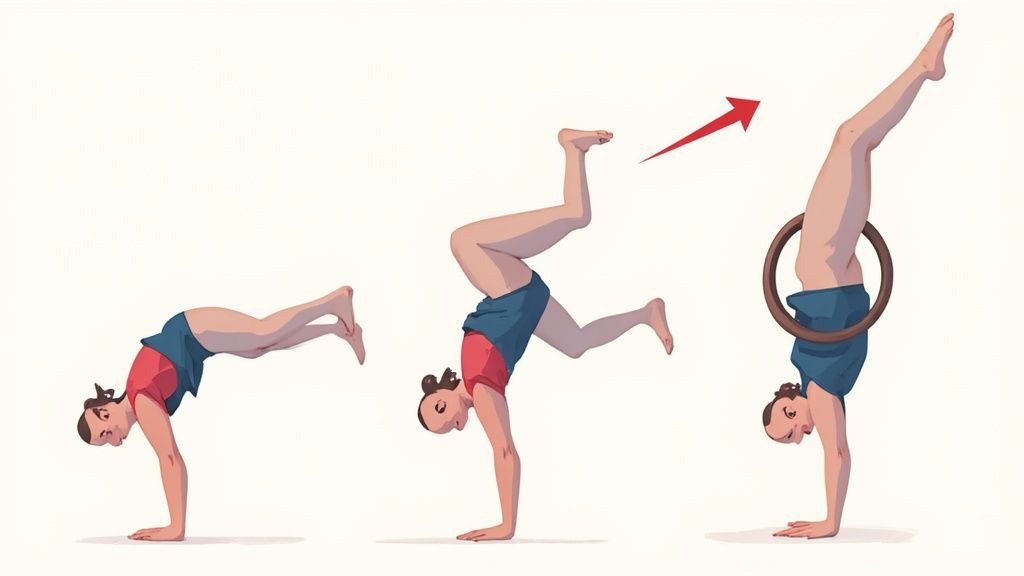
This process is all about honoring where your body is today while gently nudging it to get stronger for tomorrow.
Adjusting Your Leverage and Stability
One of the sneakiest—and most effective—ways to make an exercise harder is by changing your body's levers. Think of your arms and legs as levers originating from your trunk. The longer you make them, the more work your core has to do to control the load and maintain spinal stability. This biomechanical principle is at the heart of advancing your Pilates practice.
Take the Single Leg Stretch, for example. To level up, you simply lower the extended leg closer to the floor. That small change dramatically increases the torque on your lumbar spine, forcing your lower abs and TVA to work overtime to prevent pelvic tilting and back arching.
Here are a few simple ways to apply this concept:
- Lengthen Your Legs: Move from bent-knee (tabletop) positions to straight-leg variations.
- Reach Your Arms: Extend your arms overhead instead of keeping them by your sides to lengthen the lever of your upper body.
- Change Your Base: Progress from a supine position to seated or even standing exercises, which forces your core to work against gravity in a much more complex, multi-planar way.
Progression isn't always about learning a fancy new move. Sometimes, the most powerful advancement comes from perfecting a foundational exercise with longer levers and deeper, more focused neuromuscular control.
Of course, the flip side is just as important. Regressions are your friend! If you feel your form slipping—maybe your back starts to arch or your neck gets tense—just shorten your levers. Bring your legs back to tabletop or rest your head on the mat. Listening to your body is the absolute key to building strength safely and effectively.
From Beginner to Advanced Core Work
It can be helpful to see exactly how these small tweaks create such a big impact. A beginner variation is all about building that initial mind-muscle connection and finding stability. The advanced version takes that stability and challenges it with more load, complexity, and control.
Here’s a quick look at how some foundational exercises evolve as you get stronger.
Beginner vs. Advanced Exercise Progressions
| Exercise | Beginner Variation | Advanced Progression | Increased Anatomical Challenge |
|---|---|---|---|
| The Hundred | Knees in tabletop, head and shoulders on the mat, gentle ring squeeze. | Legs extended to 45 degrees, head and shoulders curled up, dynamic ring pulses. | Places greater endurance demand on the rectus abdominis and TVA to stabilize the extended legs. |
| Roll Up | Knees slightly bent, using the ring between the hands to assist the roll-up motion. | Legs straight, rolling down slowly with an added twist to engage the obliques. | Requires more eccentric (lengthening) control from the rectus abdominis and adds rotational work for the obliques. |
| Oblique Twists | Seated with feet on the floor, small range of rotation focusing on the ribcage. | Seated with legs lifted in tabletop, full-range rotation from the ribcage. | The unstable base forces the entire core, especially the TVA, to fire intensely to maintain balance during rotation. |
As you can see, the core movement often stays the same. The real magic happens when you challenge your body's stability by changing your relationship to gravity. It's a smarter, not harder, approach to building a truly strong and functional core.
Building Your Weekly Pilates Ring Ab Routine
Knowing the right moves is fantastic, but weaving them into a consistent practice is where you build neuromuscular adaptations. This is how you create lasting change. A structured weekly plan isn't about being rigid; it's about being smart—applying enough stimulus to your core muscles while giving them the time they need to recover and get stronger.
I've seen it time and time again: consistency beats intensity every single time. A great goal is to aim for 2-3 dedicated sessions per week on non-consecutive days. This gives your muscles enough stimulus to adapt and build strength without risking overtraining or letting your form degrade due to fatigue.
And a quick note: as you start challenging your core in new ways, you'll likely feel some muscle soreness. That's totally normal! Knowing a few natural remedies for muscle soreness can be a huge help in keeping you comfortable and on track with your routine.
Your Sample Weekly Workouts
To get you started, here are three sample routines designed to meet you where you are and grow with you. I've sequenced these Pilates ring exercises to maximize core engagement and build that deep, functional strength we're all after.
1. The 10-Minute Beginner Foundation
This is all about building that initial mind-muscle connection and mastering motor control. Think quality over quantity.
- Warm-up: Pelvic Tilts with the ring between your thighs (10 reps)
-
Main Set:
- The Hundred (legs in tabletop, head stays down) - 1 full set
- Roll Up (knees bent, focus on slow, controlled movement) - 8 reps
- Single Leg Stretch (ring between hands, pressing gently) - 10 reps per side
- Cooldown: A gentle spinal twist to release.
2. The 20-Minute Intermediate Definition
Ready for more? Here we layer in more complex movements and longer holds to increase the challenge on the musculature.
- Warm-up: Pelvic Tilts and Bridges with the ring (10 reps each)
-
Main Set:
- The Hundred (legs extended to 45 degrees) - 1 full set
- Roll Up with Ring (legs straight) - 10 reps
- Oblique Twists (feet lifted in tabletop) - 12 reps per side
- Double Leg Lower/Lift (ring between ankles) - 10 reps
- Cooldown: A nice, full-body stretch.
A friendly reminder: the goal is always precision, not speed. The resistance from the Pilates ring amplifies every single movement, which makes proper form completely non-negotiable if you want to target those deep core muscles effectively.
3. The 30-Minute Advanced Core Flow
This workout is for when you're ready for a dynamic, endurance-based challenge that links movements together seamlessly.
- Warm-up: Cat-Cow followed by Plank holds (30 seconds each)
-
Main Set:
- The Hundred (legs low, adding pulses with the ring) - 1 full set
- Teaser with Ring (full expression, if it feels right!) - 8 reps
- Criss-Cross with Ring (squeezing between the ankles) - 15 reps per side
- Side Bend with Ring (from a seated position) - 8 reps per side
- Cooldown: Extended stretching, really focusing on the hip flexors and obliques.
The reason these routines work so well is simple: the ring increases muscular recruitment. Research and experience show that using the ring can increase core engagement by up to 15-20% compared to doing the same moves without it.
For the best results, aim for 10-15 reps per set in your workouts. This rep range is perfect for building the endurance your core needs, as it's composed of mostly slow-twitch, postural muscle fibers. As fitness experts on AOL.com have noted, this kind of targeted resistance is key.
Common Questions Answered
Got a few lingering questions about getting the most out of your Pilates ring? Let's clear up some of the most common ones so you can feel confident building a stronger, more connected core.
Can I Use a Pilates Ring for Abs Every Day?
I get this question all the time! While your core is definitely built for endurance, hitting it with intense workouts every single day isn't the fastest route to a stronger midsection.
Your abdominal muscles, like the rectus abdominis and obliques, need time for micro-tear repair to get stronger. Overtraining can actually backfire, leading to fatigue and poor neuromuscular control, which defeats the whole purpose. A much smarter approach is to aim for 2-4 focused sessions per week on non-consecutive days. This gives your muscle fibers the perfect rhythm of stimulus and recovery to build real strength.
What’s the Real Difference Between a Cheap and a Quality Pilates Ring?
This one is huge. The main differences come down to durability, the consistency of the resistance, and ergonomics. A high-quality ring, usually made from sprung steel, gives you smooth, consistent resistance that helps you engage your muscles properly through their entire range of motion. Plus, they have padded, ergonomic handles that allow you to focus on your form instead of fidgeting with uncomfortable grips.
On the flip side, cheaper plastic rings tend to warp over time. This creates inconsistent tension that can lead to muscular imbalances or jerky movements. Their handles are often just hard plastic, which can be distracting and prevent you from properly activating the target muscles.
Think of it this way: A quality ring provides clear anatomical feedback, helping you feel that deep connection to your core. A cheap one just adds awkward, unhelpful pressure.
Will a Pilates Ring Give Me a Six-Pack?
These exercises are fantastic for strengthening and defining your entire core, including the "six-pack" muscle, the rectus abdominis. They build the deep, functional strength that contributes to a visibly toned and flat midsection.
But let's be real—visible abs also depend heavily on a low body fat percentage. The formula is a combination of consistent, targeted exercise (like what you're doing with the ring!) to create muscle hypertrophy, and a balanced diet to reduce the layer of subcutaneous fat that covers the muscle.
Ready to feel the difference a premium, studio-quality ring can make in your practice? The WundaCore Resistance Ring is engineered for perfect tension and comfort, helping you unlock your deepest core strength from home.