
The Basics of Pilates An Anatomy-Focused Beginner's Guide
The basics of Pilates are rooted in one powerful idea: mastering the art of controlled movement. It’s not just about what muscles you work, but about understanding how your body is designed to move, using anatomical principles to build deep, functional strength from the inside out.
Why Anatomy Is The Foundation of Pilates
Pilates is more than a workout; it's a method of conditioning your body and mind together, built on the science of human movement and biomechanics. Its founder, Joseph Pilates, called his method "Contrology," which he defined as the complete coordination of body, mind, and spirit. This idea connects directly to our modern understanding of anatomy and neuromuscular control.
A true Pilates practice begins with anatomical awareness. Instead of just copying an instructor's movements, you learn to feel which muscles are firing, how your spine is aligned, and where your pelvis is positioned in space. This internal, sensory focus is the secret sauce that makes the practice so effective for neuromuscular re-education.
The Shift From Exercise to Intelligent Movement
This is where the real magic happens. When you understand your body's mechanics, a simple leg lift is no longer a mindless motion. It becomes a targeted exercise to engage your deep core musculature, stabilize your lumbopelvic region, and improve femoral mobility in the hip socket—all without putting undue strain on your lumbar spine.
"Contrology develops the body uniformly, corrects wrong postures, restores physical vitality, invigorates the mind, and elevates the spirit." - Joseph Pilates
This is exactly why anatomy is so central to the basics of Pilates. Without it, you're just going through the motions. With it, you're re-educating your body to move with efficiency, grace, and power.
Key Anatomical Concepts in Pilates
To get you started, every Pilates session circles back to a few core anatomical ideas. These principles ensure you build functional strength that supports your skeletal system and improves daily movement patterns.
- Core Engagement: This means learning to activate the deep abdominal and back muscles (transverse abdominis, multifidus) that form your body's natural corset, providing intrinsic spinal support.
- Spinal Alignment: It's all about understanding the natural kyphotic and lordotic curves of your spine (cervical, thoracic, lumbar) and learning how to maintain them during movement to prevent injury and improve posture.
- Pelvic Stability: Think of your pelvis as the keystone of your skeleton. Keeping it stable by co-contracting the surrounding musculature creates a solid base for your limbs to move from, which is essential for protecting your lower back and sacroiliac joints.
Every Pilates movement, from the most basic to the most advanced, is guided by a set of foundational principles. These aren't just rules to follow; they are biomechanical concepts to feel and embody in your practice.
Here’s a quick rundown of the six principles that will guide you on your journey.
The Six Foundational Principles of Pilates
| Principle | Anatomical Focus |
|---|---|
| Centering | Activating the deep core muscles—the "powerhouse"—to stabilize the lumbopelvic region. |
| Concentration | Bringing full mental attention to each movement for precise neuromuscular control. |
| Control | Executing movement with deliberate muscular engagement, not momentum, to protect joints. |
| Precision | Focusing on correct form and skeletal alignment to maximize muscular benefit from each exercise. |
| Breath | Using diaphragmatic breathing to fuel movement and engage the deep core stabilizers. |
| Flow | Linking movements into a smooth sequence, challenging muscular endurance and coordination. |
As you begin your practice, you'll hear your instructor reference these ideas constantly. Over time, they become second nature, transforming your neuromuscular patterns both on and off the mat.
To truly appreciate how Pilates fits into a holistic approach to physical well-being, you might want to explore broader health and wellness resources. By focusing on these anatomical foundations from day one, you’re not just exercising—you're starting a practice that builds lasting strength and incredible body awareness.
Understanding the Powerhouse: Your Body's True Center
In Pilates, we talk a lot about moving from your center. Anatomically, this center is what we call the “Powerhouse.” But forget about chasing a six-pack; this isn't just about the superficial rectus abdominis.
The Powerhouse is a deep, intelligent system of muscles that acts as the command center for your entire body. Think of it as an internal cylinder or corset that wraps around your lumbo-pelvic region, supporting your spine, stabilizing your pelvis, and generating controlled, efficient movement. It’s the engine that drives every single exercise.
Learning to connect with and activate this deep core is your first and most important job in Pilates. When you get this right, everything else starts to click into place.
This focus on deep, functional strength is a huge reason Pilates has exploded in popularity. It's not just a trend; it's a fundamental shift in how people approach fitness. In fact, booking data from one major platform showed a massive 84% year-over-year increase in Pilates classes, making it their most booked workout globally for several years straight. People are craving mindful, anatomy-driven movement, and you can read more about these fitness trends and the rise of Pilates on Athletechnews.
The Muscles That Make Up Your Powerhouse
So, what exactly is this Powerhouse? It’s not one single muscle, but a team of four key muscular groups working together in perfect synergy to create intra-abdominal pressure and spinal stability.
- Transverse Abdominis (TVA): This is your deepest abdominal layer. Picture a wide, flat belt that wraps around your waist, from the ribs to the pelvis. When you engage it, its horizontal fibers cinch inward, creating hoop tension that supports your lumbar spine like nothing else.
- Pelvic Floor: These muscles form a supportive sling or muscular hammock at the base of your pelvic bowl. They not only support your internal organs but also work in coordination with your deep abdominals and diaphragm to manage core stability and pressure.
- Diaphragm: This is your primary breathing muscle, a dome-shaped sheet of muscle that forms the roof of your core. In Pilates, the breath is intertwined with movement. Proper diaphragmatic breathing coordinates the diaphragm with the TVA and pelvic floor, creating a strong, stable core canister.
- Multifidus: Don't let their small size fool you. These deep, powerful muscles run along your spine, connecting one vertebra to the next. Their primary job is segmental stabilization, providing fine-tuned stability for your back and protecting it from strain.
The goal here isn't to grip or clench for dear life. It's about finding a gentle, constant hum of co-contraction. Think of it like turning a dimmer switch up to a low, steady glow, not flipping a light switch on and off. That subtle neuromuscular control is the real magic of Pilates.
How to Find and "Turn On" Your Powerhouse
Feeling these deep muscles for the first time can be tricky, but a little anatomical guidance makes all the difference. This is one of the most fundamental skills you'll learn in the basics of Pilates.
Here’s a simple way to build that mind-body connection:
- Find Your Transverse Abdominis: Lie supine with your knees bent and feet flat on the floor. Place your fingertips on your anterior superior iliac spine (the bony points at the front of your hips), then slide them about one inch in and one inch down.
- Exhale and Engage: Take a relaxed breath in. As you exhale, imagine you're gently drawing your hip bones toward each other. Another great cue is to think about zipping up a pair of snug, high-waisted pants from the inside.
- Feel the Contraction: You should feel a subtle tension or firming up under your fingertips. It’s not a big, dramatic hardening—just a gentle tension. That’s your TVA activating.
Try to hold that light engagement while you continue to breathe. This simple activation is the foundation you’ll build every single Pilates exercise on. When you learn to initiate every movement from this deep, stable center, you protect your body, supercharge your results, and truly unlock the power of your practice.
Achieving Spinal Alignment and Pelvic Stability
Once you’ve started to connect with your Powerhouse, the next piece of the puzzle is creating a stable skeletal foundation to move from.
Think of your pelvis as the concrete foundation of a house and your spine as the frame built right on top. If that foundation is tilted or unstable, the entire vertebral column will be off-kilter. In Pilates, we get specific about this relationship between the pelvis and spine to build a strong, reliable base for all movement.
This awareness is exactly what protects your lumbar spine and sacroiliac joints from strain and lets you move your arms and legs with control and fluidity. It all begins with finding your "neutral."
Finding Your Neutral Spine
Let's clear something up: your spine isn’t meant to be perfectly straight. It has three beautiful, natural curves that act as shock absorbers. There’s a gentle inward curve at your low back (the lumbar lordosis), an outward curve at your mid-back (the thoracic kyphosis), and another inward curve at your neck (the cervical lordosis).
A neutral spine is the position where all these natural curves are present and balanced. It's the biomechanically optimal position where you place the least amount of stress on your intervertebral discs and facet joints.
This infographic gives you a great visual of how those deep core muscles—your abs, pelvic floor, and diaphragm—all work as a team to support this alignment.
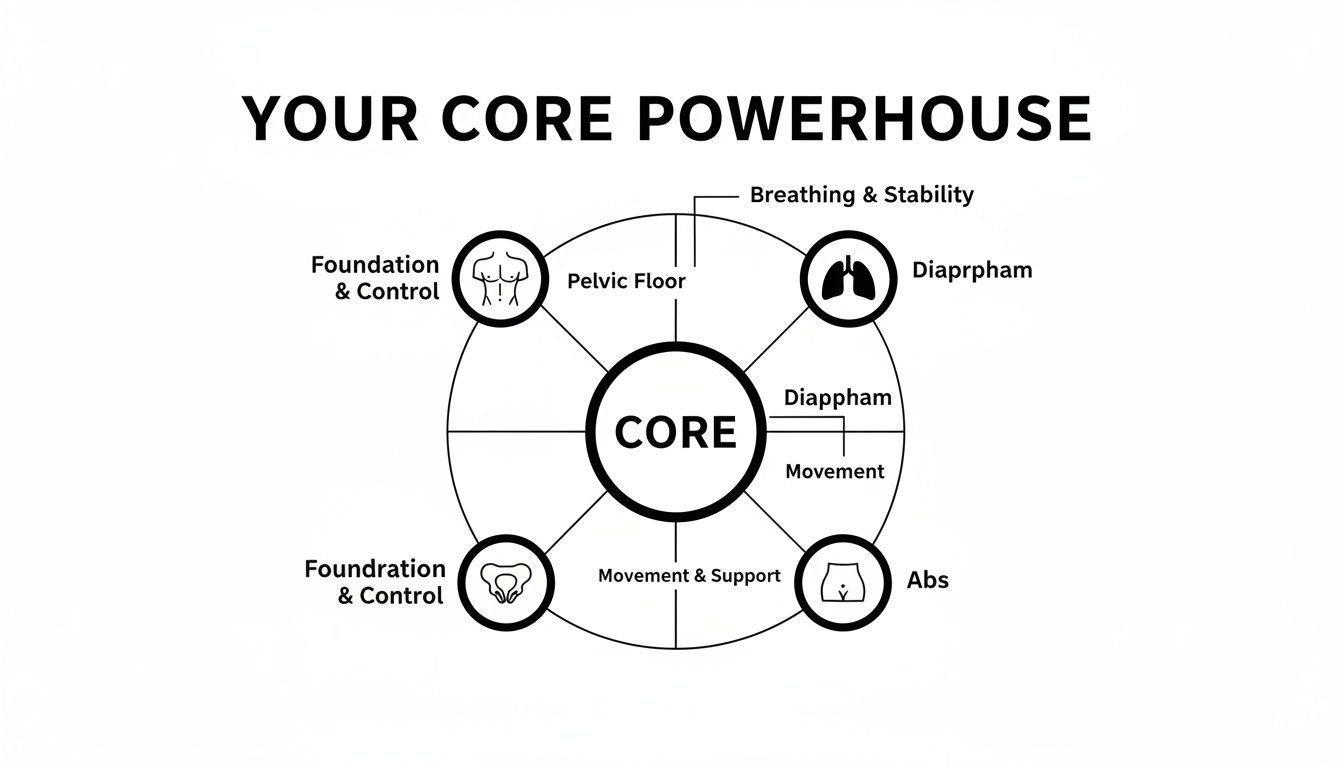
You can see the incredible synergy between the diaphragm at the top, the abdominals wrapping around the front and sides, and the pelvic floor creating the base. Together, they form that stable "canister" that holds your spine in its optimal position.
Self-Check for Neutral Alignment: Try this on the floor. Lie supine with your knees bent and feet flat. Place the heels of your hands on your pointy hip bones (ASIS) and let your fingertips rest on your pubic bone, creating a triangle shape. When you're in neutral, that triangle should be lying perfectly flat, parallel to the floor.
Imprinted Spine and the Pelvic Clock
While neutral is our home base, sometimes we intentionally shift our alignment for certain exercises, especially when developing core strength.
- Imprinted Spine: For this, you’ll gently press your lumbar spine toward the mat. This involves a slight posterior pelvic tilt, bringing your pubic bone a tiny bit higher than your hip bones. We often use this to give the low back extra support and ensure the abdominals are working, not the hip flexors.
- Pelvic Clock: This is a fantastic visualization to develop kinesthetic awareness. Imagine a clock face is lying flat on your lower abdomen. 12 o'clock is at your navel, and 6 o'clock is at your pubic bone. You gently rock your pelvis through an anterior and posterior tilt (12 to 6) and a lateral tilt (3 to 9) to find your center.
Mastering these subtle pelvic movements is a game-changer for your posture and overall control. If you want to dive deeper, you can learn more about how Pilates and posture are interconnected and how this work can start to unwind long-held imbalances.
By learning to stabilize your pelvis, you're creating a powerful anchor. This ensures that when you lift a leg or an arm, the movement is isolated at the hip or shoulder joint, and the work is coming from the right place—not from straining your back.
Anatomy-Based Cues for Foundational Pilates Exercises
Now that we've covered the core principles and how to find proper alignment, it's time to put it all into motion. Real progress in Pilates comes from understanding the why behind each movement, not just trying to copy shapes. Here, we'll look at a few foundational exercises through an anatomical lens, giving you the specific cues to build great habits from your very first session.
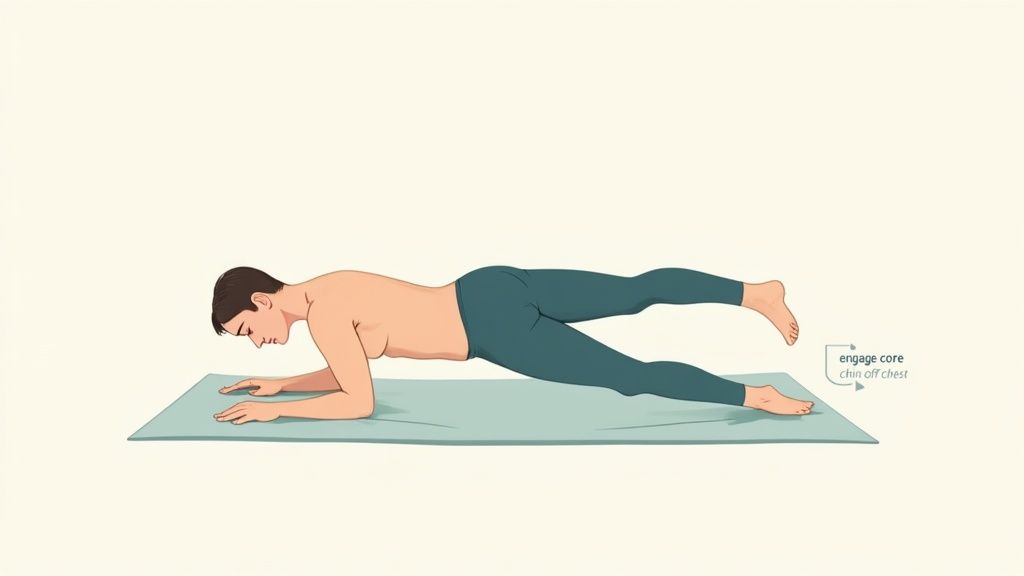
This approach turns a simple exercise into a powerful tool for re-patterning how you move. Instead of just going through the motions, you’ll learn to feel the right muscles firing, protect your joints, and build that deep, functional strength Pilates is known for.
The Hundred: An Exercise in Breath and Endurance
The Hundred is a classic Pilates warm-up designed to integrate breath with core engagement and build abdominal endurance. The goal is maintaining deep core stability while challenging the global "six-pack" muscles.
- Primary Muscles Targeted: Transverse abdominis (TVA) for stability, rectus abdominis and obliques for flexion and endurance.
- Anatomical Cue: As you perform the thoracic flexion (curling your head and shoulders off the mat), initiate the lift from your abdominals, not by straining your neck flexors. Keep the space between your chin and chest open to maintain a neutral cervical spine. The lift should come from the bottom tips of your scapulae.
- Common Mistake to Avoid: Watch out for abdominal "doming" or bulging. This indicates that intra-abdominal pressure is overpowering your TVA. To correct this, lower your head slightly, deepen the exhale, and focus on drawing your navel towards your spine to re-engage the TVA.
The Roll Up: A Lesson in Spinal Articulation
The Roll Up is the ultimate test of abdominal control and sequential spinal mobility. It teaches you to articulate your spine one vertebra at a time, moving through flexion and extension with precision.
Anatomical Deep Dive
- Initiation: The movement starts with a deep exhale to engage the TVA, which stabilizes your lumbar spine as you begin to lift your head and shoulders.
- Articulation: As you roll up, focus on creating a deep "C" curve (spinal flexion). Think about lifting each vertebra off the floor in sequence, from the cervical spine down through the thoracic and lumbar regions.
- Control on the Return: The eccentric (lowering) phase is just as important. Fight the urge to just flop back onto the mat. Instead, imagine you are carefully placing your spine down, one bone at a time, lengthening as you go to control the descent.
The real secret is to avoid using momentum from the hip flexors (iliopsoas). If you find your feet popping up, it's a dead giveaway that your hip flexors are overpowering your abdominals. Try bending your knees slightly to inhibit the hip flexors and give your core a better chance to do its job.
This focus on anatomy-driven, low-impact fitness has fueled huge growth in the Pilates world. One industry report valued the market at USD 176.35 billion, with projections showing it could hit over USD 420 billion by 2032. This isn't just a trend; it's a major shift toward mindful, sustainable ways to move. You can learn more about the growth of the Pilates market and its future trends online.
Single Leg Circles: For Hip Mobility and Pelvic Stability
This exercise isn't about the range of motion in your leg. It’s about disassociation: keeping your pelvis and torso perfectly still while the femur moves freely within the acetabulum (hip socket).
- Primary Muscles Targeted: Hip flexors/extensors (iliopsoas, glutes), adductors/abductors (inner/outer thighs), and deep core stabilizers (TVA, obliques, multifidus).
- Anatomical Cue: Picture your pelvis as a bowl full of water that you absolutely cannot spill. As your leg circles, your core's job is to prevent any rocking or tilting of the pelvis. This requires constant, isometric contractions from your obliques and TVA to maintain stability.
- Common Mistake to Avoid: A rocking pelvis. To prevent this, make your leg circles smaller. The goal is controlled femoral mobility without sacrificing lumbo-pelvic stability. As your core stabilizing muscles get stronger, you can gradually increase the range of motion.
To build that crucial stability, it's worth exploring these specific Pilates exercises for core strength that create a powerful and reliable foundation for all your movements.
How to Start Your Pilates Practice
You’ve got a handle on the principles and a feel for the foundational exercises, so what’s next? The best way to get started is to choose a path that fits your life, your budget, and how you like to learn. Really, it comes down to two main options: practicing at home or joining a studio.
Making this choice is a big first step. A home practice offers incredible convenience and is easy on the wallet, letting you sneak in a session whenever you find a spare moment. The flip side is that it demands a good bit of self-motivation to stay on track.
On the other hand, a studio gives you structure, accountability, and the amazing feedback of a trained instructor who can offer real-time corrections. That sense of community can also be a huge motivator to keep showing up.
Building Your Practice at Home
Starting at home is a fantastic and totally accessible way to begin. You can build a seriously strong foundation with just a mat and your own body, focusing on the exercises we've already covered.
To help you get started, here’s a simple 15-minute routine you can do anywhere:
- Warm-up (2 minutes): Start with some gentle Pelvic Clocks and Cat-Cow stretches to mobilize the spine in flexion and extension.
- The Hundred (1 minute): Go for the full 100 breaths, keeping your deep core (TVA) connected the whole time.
- The Roll Up (3 minutes): Complete 5-8 repetitions. Focus on that smooth, one-vertebra-at-a-time articulation.
- Single Leg Circles (3 minutes): Do 8 circles in each direction on each leg. The real work here is keeping your pelvis perfectly still to demonstrate stability.
- Cool-down (1 minute): Finish up with a gentle, full-body stretch to release any tension.
Enhancing Your Home Setup with Props
While you don't need them, a few simple props can give you that extra bit of feedback to help you find the right muscles. A small stability ball tucked behind your low back can guide you into a deeper core connection, while a resistance band can help you feel the work in your back and shoulders.
If you're wondering what to get, our guide to the most essential Pilates equipment for home use can help you choose the right tools for your space.
Choosing a Studio and Instructor
If you're craving expert guidance and that in-person energy, a studio is the way to go. The Pilates world is booming right now—about 77% of studios worldwide are reporting growth, and 40% are actively hiring more instructors to keep up with demand. That growth means you have more options than ever before. You can read more about these industry trends and studio statistics from recent reports.
When you start looking, you'll generally find two main types of classes:
- Mat Classes: These focus on bodyweight exercises done on a mat, sometimes with small props. They're amazing for building that deep, foundational strength from the ground up.
- Reformer Classes: These classes use a specialized machine with springs and pulleys to add resistance and support, offering a completely different kind of challenge and feedback.
What to Look For: The single most important factor is the instructor. A great teacher will prioritize anatomy, offer modifications for your body, and provide hands-on cues that help you connect with the work on a deeper level. Don't be afraid to try out a few different studios to find a teacher whose style really clicks with you.
Clearing Up Common Questions About Pilates
Even after getting the hang of the core principles, it's totally normal to have a few questions pop up. Let's walk through some of the most common ones I hear from beginners. My goal is to clear up any confusion so you can step onto your mat feeling confident and ready to move.
How Is Pilates Different From Yoga?
This is probably the number one question I get! While both are fantastic mind-body practices, their core mission is a little different. Think of yoga as an ancient spiritual practice designed to connect the mind, body, and spirit, often using flexibility and sustained postures to get there.
Pilates, on the other hand, originated as a system of physical rehabilitation. Its primary anatomical focus is on strengthening the deep stabilizing muscles of the core—your "Powerhouse." The goal is to build a strong, stable center to improve posture and movement efficiency. That constant, deep core engagement against spring resistance or gravity is a key differentiator.
Can I Do Pilates If I Have Back Pain?
For many people, Pilates is a game-changer for managing back pain. Why? Because it directly targets the exact muscles that support your spine, like the transverse abdominis and multifidus. By teaching you how to find and hold a neutral spine, you start to re-pattern the neuromuscular habits that often contribute to pain.
That said, it is absolutely essential to talk to your doctor or physical therapist first. Some conditions, like disc herniations or spinal stenosis, require specific, careful modifications. The safest way to practice is to work with a qualified instructor who understands your specific condition and can tailor the movements for you.
How Often Should a Beginner Practice Pilates to See Results?
When you're just starting, consistency beats intensity every time. Aiming for 2-3 sessions a week is the sweet spot for most beginners. This gives your nervous system and muscles enough time to recover and adapt, which is when true neuromuscular re-patterning happens and the mind-body connection gets stronger.
Don't forget what Joseph Pilates himself famously promised:
"In 10 sessions you'll feel the difference, in 20 you'll see the difference, and in 30 you'll have a whole new body."
Even a focused, 20-minute session can be incredibly effective when you prioritize the quality and anatomical precision of your movement over just counting reps.
Do I Need to Be Flexible to Start Pilates?
Not at all. This might be the biggest myth out there! You don't come to Pilates because you're already flexible; you come to Pilates to develop active flexibility in a safe, supportive way.
The exercises are designed to build both strength and mobility simultaneously. Instead of just holding static stretches, Pilates uses controlled, dynamic movements (eccentric contractions) to lengthen muscles while they are under tension, improving your functional range of motion without compromising joint stability.
Ready to build your own at-home practice with expert guidance and perfectly designed equipment? The WundaCore collection, created by celebrity trainer Amy Jordan, brings the anatomy-focused, studio-quality experience right to your living room. Explore our patented props and Wunda On Demand classes to start moving better and feeling stronger today. Learn more at WundaCore.