
Pilates and Posture: An Anatomical Guide to Realigning Your Spine
Absolutely. Pilates is one of the most effective methods to dramatically improve your posture, grounded in a deep understanding of human anatomy.
It works by systematically retraining the deep stabilizing muscles—your body’s intrinsic support system. By focusing on your core musculature, Pilates strengthens the very foundation of your skeletal alignment. This process helps you stand taller and move with greater efficiency and less pain by addressing the anatomical root of poor posture.
Your Anatomical Blueprint for a Stronger, Aligned Spine
Think of your spine as a series of articulated vertebrae, a complex and elegant structure. Now, imagine your core muscles as the sophisticated network of guy wires and foundational support that keeps this structure upright and stable. If that muscular foundation is weak or imbalanced, the entire vertebral column will start to lean, slump, and eventually develop serious structural compensations. That’s precisely what happens with poor posture—your skeleton collapses into biomechanically inefficient positions because the muscles designed to support it are not functioning optimally.
Pilates directly addresses the source of the problem by targeting what our founder, Joseph Pilates, called the "Powerhouse." This isn't just about the rectus abdominis (your "six-pack" muscles). It's a comprehensive network of deep muscles that envelop your torso like a natural corset, providing stability from the inside out.
This incredible anatomical center of gravity includes:
- The transversus abdominis (your deepest abdominal muscle that provides hoop tension around your midsection)
- The pelvic floor muscles (the supportive sling of musculature at the base of your pelvis)
- The diaphragm (your primary muscle of respiration, which acts as the "roof" of the core canister)
- The multifidus muscles (deep, powerful muscles that run along the spine, providing segmental stability to each vertebra)
When these muscles co-contract and work in synergy, they create a stable cylinder that supports and elongates your spine from within. Many traditional gym exercises focus on superficial "global mover" muscles, but Pilates is specifically designed to activate these deep, often-neglected local stabilizers. That is the anatomical secret that makes the connection between Pilates and posture so incredibly powerful.
Pilates isn't just about building brute strength; it's about creating an intelligent, responsive neuromuscular system for your entire body. It literally retrains your motor patterns to hold you in proper alignment without conscious effort.
Strengthening your Powerhouse provides your skeleton with the internal scaffolding it needs for a balanced, upright stance. Every controlled movement in Pilates reinforces this deep core stability, gradually correcting muscular imbalances and building true endurance in the very muscles responsible for maintaining your posture throughout the day.
And the work doesn't have to stop when you leave the mat. To complement your active efforts, understanding how to align your spine while sleeping is a game-changer for maintaining good posture around the clock. This creates a 24/7 approach to spinal health, ensuring your body stays supported even while you rest.
An Anatomical Guide to Perfect Posture
To truly understand why Pilates is so effective for posture, we must go deeper than the simple cue to "sit up straight." Lasting, genuine alignment does not originate from your shoulders—it emanates from a team of deep muscles known as the inner unit. This is your true anatomical core.
Think of these muscles as the internal scaffolding that supports your vertebral column from the inside out. When they are not firing correctly, the entire structure begins to sag, leading to common postural deviations.
Your Inner Unit: The Deep Core Support System
This inner unit is composed of four key muscles that create a supportive cylinder around your spine and pelvis. When they work in concert, a profound stabilization occurs.
- Transversus Abdominis: This is your body's innate corset. As the deepest abdominal layer, its horizontal fibers wrap around your entire midsection. Proper engagement creates hoop tension, instantly stabilizing your lumbar spine.
- Diaphragm: More than just a muscle for respiration, your diaphragm forms the "roof" of your core. Proper diaphragmatic breathing regulates intra-abdominal pressure, a critical component of spinal stability.
- Multifidus: These are small but powerful muscles running alongside your spine, connecting individual vertebrae. They provide crucial segmental control, preventing vertebral collapse and shear forces.
- Pelvic Floor: This muscular sling forms the "floor" of your core. It acts like a supportive hammock for your internal organs and provides a lifting force that helps decompress the entire spine.
When this team is strong and coordinated, it creates a rock-solid foundation. This allows your larger "mover" muscles (the outer unit) to perform their functions without compromising spinal alignment. Pilates is specifically designed to re-awaken and strengthen these deep, often-underused muscles. You can dive deeper into the specific muscle groups Pilates targets in our detailed guide.
How Modern Life Creates Muscular Imbalances
Our daily habits, particularly prolonged sitting, wage a silent war on our posture. Hunching over a desk or phone is a recipe for predictable muscular imbalance.
Your hip flexors (iliopsoas) become short and tight, pulling your pelvis into an anterior tilt. This exaggerates the natural curve of the lower back, creating lumbar lordosis (swayback). Concurrently, your shoulders protract (round forward) and your head juts forward, leading to thoracic kyphosis, the classic "hunchback" posture. This forward head posture places immense strain on the cervical spine.
These are not merely aesthetic concerns. They create significant mechanical stress on your muscles, ligaments, and intervertebral discs, often leading to chronic pain.
Simply pulling your shoulders back is an ineffective, temporary fix that fails to address the underlying muscular imbalance. Pilates gets to the anatomical root of the problem by strengthening the weak, lengthened muscles (like the gluteals and rhomboids) while simultaneously lengthening the tight, shortened muscles (like the pectorals and hip flexors).
This infographic shows how the Pilates "Powerhouse" concept is the key to unlocking better posture.
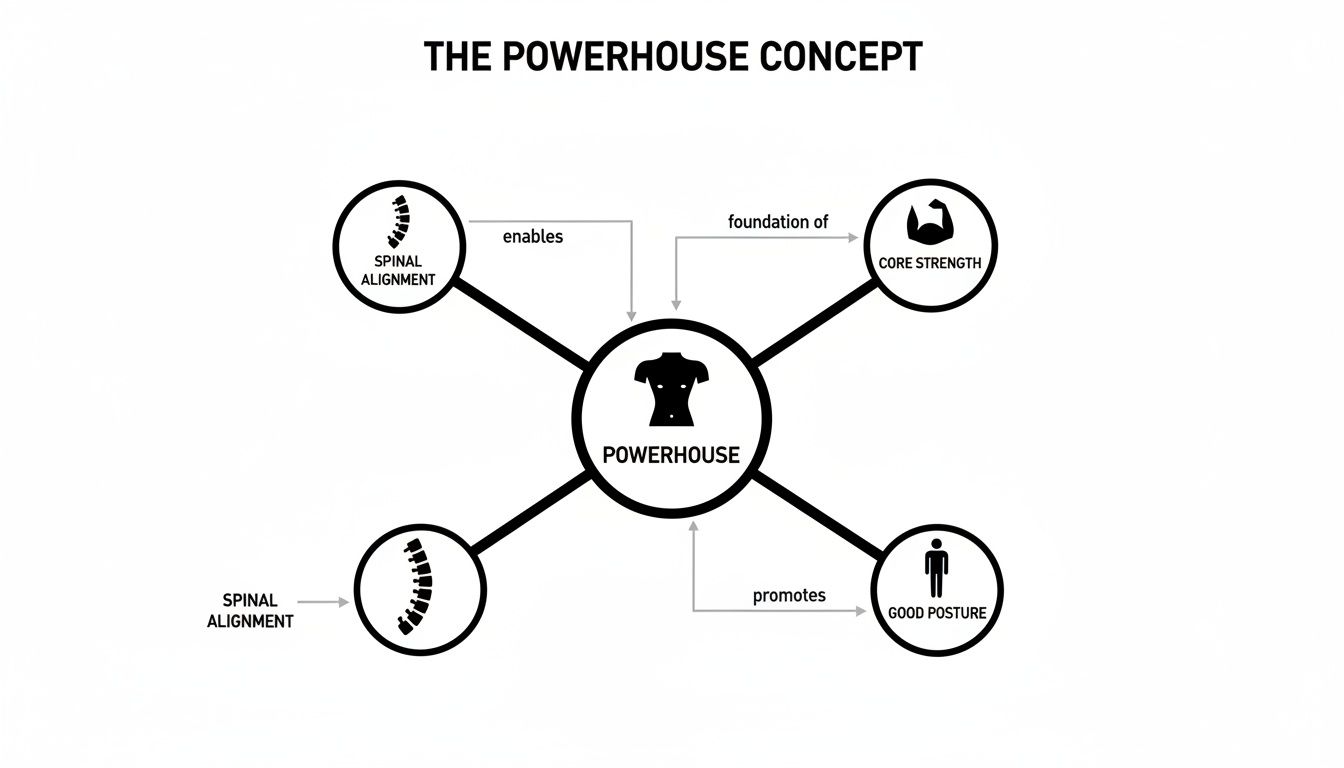
As you can see, a strong Powerhouse is the central pillar that supports both spinal alignment and effortless, good posture.
How Pilates Rewires Your Body for Better Posture
Knowing the anatomy of good posture is one thing. Training your body to maintain it subconsciously is another. This is where Pilates excels. It is more than just a workout; it is a method of re-educating the neuromuscular system, awakening deep connections between your brain and muscles that may have been dormant for years.
Pilates achieves this through its core principles, especially Concentration, Control, and Precision. Instead of performing mindless repetitions, every single movement demands your full attention and deliberate muscular control. This focused approach is what activates the deep stabilizing muscles—like the transversus abdominis and multifidus—that constitute your "Powerhouse." These are the precise muscles required for a supported, healthy spine.
The Power of Eccentric Contractions
One of the secret weapons in the Pilates anatomy playbook is the focus on eccentric muscle contractions. This occurs when a muscle lengthens while under tension—for example, the controlled lowering phase of a bicep curl.
It’s like installing a super-smooth brake pedal on your muscles. Eccentric training is what builds that long, lean strength and incredible control, preventing the kind of bulky muscle that can sometimes make posture worse by pulling your bones out of alignment.
This controlled lengthening is what creates that classic, elongated "Pilates body." You're building functional strength that supports your skeleton in an upright, spacious way, which is the perfect antidote to the muscle shortening and tightening that comes from sitting all day.
Forging a Mind-Body Connection for Automatic Alignment
Every precise, controlled movement in Pilates sends a clear signal from your brain to the specific muscles performing the work. Over time, this repetition builds stronger, faster, and more efficient neural pathways. It's akin to upgrading your body's communication system from a slow dial-up connection to a high-speed fiber-optic network.
This enhanced neuromuscular connection is what makes good posture feel natural and automatic. You’ll find yourself sitting taller and standing with more ease without constant self-correction. Using equipment like a professional Pilates Reformer can accelerate this process, as it provides tactile feedback that guides your body into optimal biomechanical form.
The global boom in Pilates is no accident; it's directly tied to these proven results. The market has been growing at a 10% compound annual rate, largely because the science backs it up. One key study showed that after just six months of regular practice, women saw significant improvements in their shoulder, head, and pelvic alignment. These are the exact corrections needed to prevent pain, especially when you consider that misalignment contributes to a staggering 80% of back pain cases worldwide. You can dive deeper into the scientific foundations of Pilates and posture on ideafit.com.
Essential WundaCore Exercises for Spinal Health
Theory is one thing, but real change in your posture happens when you put that knowledge into action. It's time to move from anatomy to application, using the WundaCore to fire up the key muscles that give you a healthy, aligned spine.
These foundational exercises are specifically designed to wake up your deep core, build true endurance, and create a stronger internal framework from the inside out. Each movement demands precision and control, directly targeting the postural muscles we've been talking about. Think of it less as a workout and more as re-educating your body for better alignment.
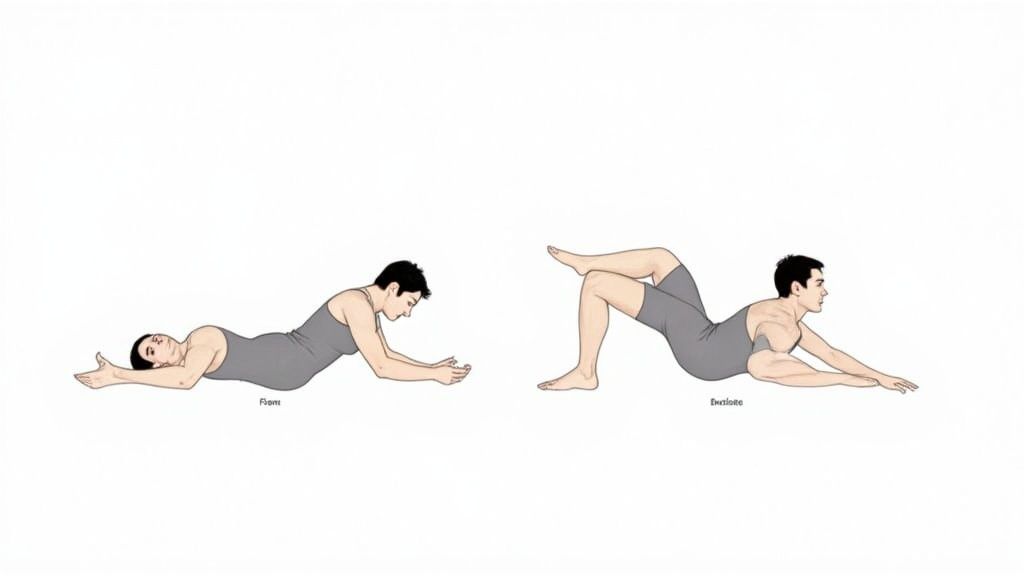
The Hundred For Core Endurance
A true Pilates classic, The Hundred is a powerhouse for building deep abdominal strength and stability. Adding the WundaCore provides resistance that challenges your core to work even harder to maintain a neutral spine.
- Step 1: Lie on your back, bringing your knees into a tabletop position with shins parallel to the floor. Place the WundaCore snugly between your inner thighs.
- Step 2: Take an inhale to get ready. On your exhale, curl your head, neck, and shoulders up off the mat. Give the WundaCore a firm squeeze to connect to your inner thighs and pelvic floor.
- Step 3: Reach your arms long by your sides, palms facing down. Start pumping your arms up and down in a small, sharp motion. Breathe in for 5 pumps and breathe out for 5 pumps to complete one full breath cycle.
- Anatomy Focus: This move instantly fires up the transversus abdominis—your body’s natural corset—which is essential for stabilizing your lower back. The squeeze on the WundaCore activates the adductors and deep pelvic floor muscles, creating a more profound core connection.
Bridging For Glute Activation
Poor posture often stems from weak gluteal muscles, which can cause the lumbar spine to hyperextend. Bridging is the perfect antidote, activating these powerful hip extensors to help realign the pelvis and support the spine.
- Step 1: Lie on your back with your knees bent and feet flat on the floor, about hip-width apart. Position the WundaCore between your inner thighs.
- Step 2: Inhale to prepare. As you exhale, press down through your feet to peel your spine off the floor, one vertebra at a time. Squeeze the WundaCore on the way up, aiming for a long, clean line from your shoulders to your knees.
- Step 3: Pause at the top. The focus here is on feeling the work in your glutes and hamstrings, not your lumbar extensors. Inhale as you slowly articulate your spine back down, placing one vertebra on the mat at a time.
- Anatomy Focus: Bridging primarily targets the gluteus maximus and hamstrings, the muscles responsible for hip extension. Using the WundaCore keeps the deep core stabilizers engaged, preventing lumbar hyperextension and ensuring the work remains in your posterior chain where it belongs.
Remember, the goal isn’t just to lift your hips as high as you can. The real magic comes from articulating your spine with control, creating space between each vertebra as you move.
By focusing on these foundational movements, you begin to build the muscular support system essential for improving your posture. For more ways to target these crucial muscles, you can explore our detailed guide to Pilates exercises for core strength to continue your journey.
The Science Behind Pilates and Postural Correction
When you finish a Pilates session and feel that incredible sensation of standing taller, it’s not just in your head. It’s a real, measurable physiological change happening in your body, backed by a growing body of scientific research. We’re moving beyond anecdotal success stories; clinical studies are now confirming exactly how Pilates creates lasting structural change.
This isn’t a quick fix or a temporary illusion. Pilates is all about systematically retraining your neuromuscular system—the intricate communication network between your brain and your muscles. Researchers are observing tangible benefits, not just for common postural complaints like rounded shoulders, but even for significant spinal conditions. The evidence is clear: Pilates is a powerful tool for postural correction.
What the Research Actually Means for You
When you read a study that mentions a "decreased thoracic kyphosis," it's easy to get lost in the jargon. But what that really means is a scientific way of saying it corrects a hunchback posture. In your daily life, that translates to less strain on your cervical and thoracic spine at your desk, the ability to take deeper breaths by freeing the diaphragm, and a more open, confident stance. It's the science behind feeling less compressed and more mobile.
Researchers have also found that Pilates can be incredibly effective for correcting spinal deformities. One extensive review, funded by the NIH, looked at multiple trials and confirmed that Pilates exercises significantly lower the Cobb angle—the key measurement used to track the curvature of the spine in scoliosis.
It's not just for adults, either. In one trial with preschoolers, just 10 weeks of Pilates led to noticeable improvements in rounded shoulders and thoracic kyphosis compared to the kids who didn't participate. These results show just how adaptable and effective the method is, even from a very young age. You can dive into the full research on Pilates and spinal deformities on the NIH's website.
Why Low-Impact Delivers High-Impact Results
A huge part of the anatomical magic is that Pilates is low-impact. This is the secret to its success for so many people. It allows you to strengthen the deep, stabilizing muscles that support your spine and core without placing undue stress on your joints. That accessibility is a game-changer, especially for anyone dealing with existing pain or structural issues.
Pilates works by strengthening your body from the inside out. Think of it as building a strong, supportive "inner corset" that holds your spine in its best possible alignment. This internal support system is what makes good posture feel effortless and natural.
This approach makes Pilates a practice you can stick with for the long haul. Instead of forcing your body into alignment with aggressive, high-impact movements, it gently guides you back to a state of natural balance. The focus on controlled, precise movements builds endurance in the exact muscle fibers responsible for holding you upright all day long, turning healthy patterns into second nature.
Building Lifelong Posture and Balance with Pilates
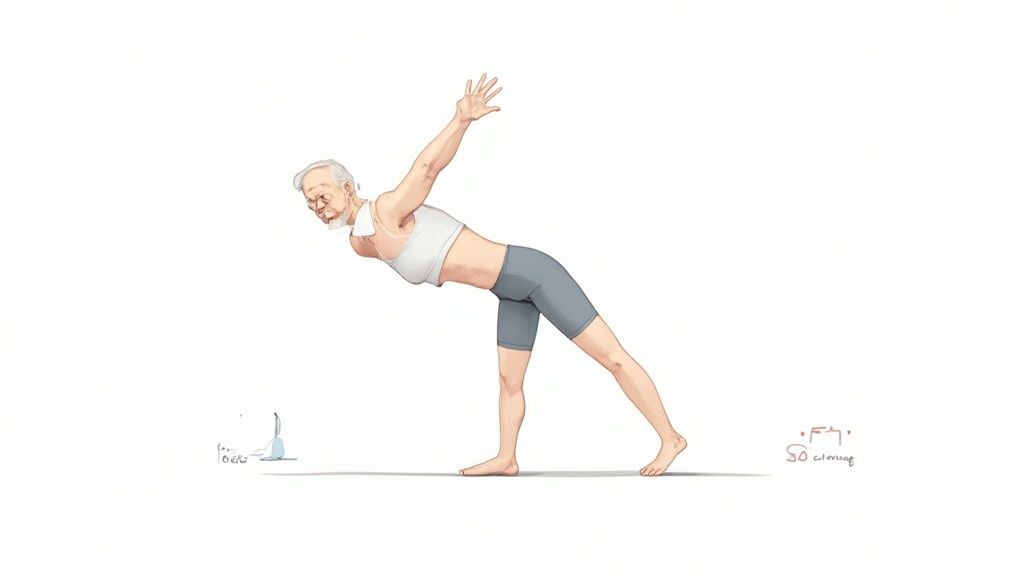
The work you do in Pilates today is more than just a fix for your current posture. Think of it as an investment in your future self—laying the foundation for a body that stays strong, resilient, and independent as you move through life.
How does it work? By fine-tuning a system you probably don't think much about: your neuromuscular system.
This system is in charge of your proprioception, which is your body’s incredible, built-in ability to know where it is in space without having to look. It's like an internal GPS. Pilates sharpens this sense, forging a stronger mind-body connection that is absolutely essential for maintaining balance and preventing falls, a key part of aging gracefully.
Enhancing Stability for Healthy Aging
Good posture isn't just about looking confident; it’s a cornerstone of long-term physical health. When your spine is aligned, you reduce the daily wear and tear on your joints, helping to fend off the chronic pain and degenerative issues that can really limit mobility down the road. By strengthening the deep stabilizing muscles that support your skeleton, Pilates creates a sustainable framework for movement.
A regular Pilates practice is like a retirement plan for your body. The stability, balance, and awareness you build today become the physical capital you rely on for decades to come, ensuring a high quality of life.
We're seeing more and more research confirm these long-term benefits, with measurable gains in stability for older adults. For instance, studies on adults over 60 found that Pilates created immediate postural shifts, including a 5-10% decrease in that all-too-common upper back rounding. Another trial showed that just five weeks of practice improved dynamic balance and posture, and incredibly, those benefits lasted for a full year. You can dig into the research on Pilates for older adults on PMC yourself.
This focus on balance and alignment also does wonders for your joint health. If you’re looking to take your mobility even further, you can explore our guide to Pilates exercises for flexibility. At its core, Pilates offers a sustainable path to keeping your body strong, balanced, and vibrant for life.
Common Questions About Pilates and Posture
Starting Pilates to fix your posture is a big step, and it's totally normal to have a few questions. Understanding the anatomical principles behind it is key to building confidence and seeing how these small, controlled movements can create huge, lasting change in your body.
Let's dive into some of the most common questions we hear.
How Long Until I See Posture Improvements?
This is the big one, right? While many people report feeling "taller" and more aware of their alignment after just a handful of sessions, real, visible change takes consistency. You're essentially retraining your entire neuromuscular system, teaching it a new normal.
You can expect to see and feel measurable improvements in your spinal alignment and core strength within 8 to 12 weeks, provided you're practicing two to three times per week. The secret is consistency—you’re teaching those deep postural muscles a brand new, healthier way to hold you up.
Is Pilates Safe for Posture with Back Pain?
Absolutely. In fact, Pilates is often recommended for managing back pain precisely because of its anatomical focus. It gets to the root of the issue by strengthening the deep support muscles of the spine without any high-impact stress. By targeting muscles like the transversus abdominis and multifidus, you're building an internal "corset" that stabilizes your lumbar spine.
That said, it is crucial to work with a qualified instructor who knows how to modify exercises for your specific needs. And as always, check in with your doctor before starting any new fitness program, especially if you're dealing with an injury.
Pilates can't lengthen your bones, but it absolutely can help you achieve your maximum potential height. By decompressing the spine and strengthening the muscles that hold you upright, it corrects the slouching habits that make you appear shorter.
Will Pilates Make Me Look Taller?
While Pilates can't actually make your bones grow longer, it can definitely make you appear taller. How? By undoing the postural habits, like slouching, that have been compressing your frame for years.
We focus on decompressing the spine by creating space between the vertebrae, activating your core musculature to support an upright torso, and opening the chest by strengthening the upper back extensors. The result is that you stand at your full, potential height. Many people find they not only look taller but move with a whole new level of confidence.
Ready to build a stronger, more aligned spine from home? The WundaCore collection gives you the tools and expert instruction to retrain your posture from the inside out. Explore our equipment and start your Wunda On Demand trial today at wundacore.com.