
What Muscles Does Pilates Work? An Expert Anatomical Guide
Pilates is a full-body workout, but not in the way most people think. It's famous for building incredible core strength, but that’s just the beginning. The real magic of Pilates is how it strengthens the muscles you can't see—the deep, internal stabilizers that form the foundation for every single movement you make.
From there, the work radiates outward, methodically targeting your entire muscular structure to create balanced, integrated strength.
The Complete Anatomy of a Pilates Workout
When people call Pilates an "ab workout," they're only seeing the tip of the iceberg. Think of your body as a skyscraper. Many workouts focus on the shiny exterior—the superficial muscles like the rectus abdominis or biceps. Pilates, on the other hand, starts by reinforcing the building's deep, internal framework.
In Pilates, we call this foundation the "Powerhouse." It’s the true anatomical center of your strength, and once it’s solid, every other movement becomes more efficient, powerful, and controlled. Every exercise, in its own way, becomes a full-body exercise.
A Full-Body Approach to Muscular Strength
So, which muscles does Pilates actually work? The short answer is... all of them. But it’s how it works them that makes all the difference. Instead of pursuing brute force or muscular hypertrophy, Pilates emphasizes control, stability, and endurance.
The entire method is built on strengthening your body from the inside out. This means we first activate the deep support system of the torso before recruiting the larger, superficial "mover" muscles. This creates a body that's not just strong, but also gracefully aligned, resilient, and far less prone to injury. You’re essentially re-educating your neuromuscular system to move more efficiently.
The goal of Pilates is to build a body that is uniformly developed. One that can handle daily tasks with energy and ease, and support you in your athletic goals without getting sidelined by injury. It’s all about creating functional strength you can actually use.
To give you a clearer picture, let's break down the primary and secondary muscle groups you'll engage in a typical Pilates practice.
Quick Guide to Muscles Targeted in Pilates
This table provides a snapshot of the key muscle groups we focus on in Pilates and the critical role they play in building a strong, integrated body.
| Muscle Group Category | Key Muscles Targeted | Primary Role in Pilates |
|---|---|---|
| The Deep Core | Transversus Abdominis, Pelvic Floor, Multifidus | Creating intra-abdominal pressure and stabilizing the lumbar spine. |
| Glutes and Hips | Gluteus Maximus, Medius, Minimus, Hip Adductors/Abductors | Stabilizing the pelvis and powering lower body movements. |
| Back and Shoulders | Erector Spinae, Latissimus Dorsi, Scapular Stabilizers | Supporting posture, articulating the spine, and enabling upper body control. |
| Legs | Quadriceps, Hamstrings, Calves | Building balanced strength and stability around the knee and ankle joints. |
While this list helps categorize the muscles, remember that Pilates is about integration. We're teaching all these different parts to work together as a single, coordinated system.
Key Muscle Groups Targeted
While the goal is always total-body integration, a well-rounded Pilates session will place a strong emphasis on a few key areas:
- The Deep Core: This is your body's "inner corset." It includes the transversus abdominis, pelvic floor muscles, multifidus, and diaphragm. These muscles co-contract to create a stable base for all movement. You can dive deeper into this in our guide to Pilates exercises for core strength.
- Glutes and Hips: Your gluteal muscles (gluteus maximus, medius, and minimus) and deep hip rotators are the powerhouse of your lower body. Strengthening them is crucial for pelvic stability, proper gait, and generating power.
- Back and Shoulders: Pilates works wonders for posture by strengthening the spinal extensors (like the erector spinae) and the muscles that control the scapula (rhomboids, serratus anterior, trapezius). A strong, supported back is a happy back.
- Lower Body: The quadriceps femoris, hamstrings, and gastrocnemius/soleus all get a serious workout, but the focus is always on creating balanced muscular tension around the joints, not just building bulk.
Ultimately, Pilates is less about isolating individual muscles and more about forging a powerful connection between your mind and body. It teaches you to move with intention, precision, and a new level of anatomical awareness.
Understanding the Powerhouse: Your Body's True Core
When a Pilates instructor talks about your core, they aren't just pointing to the six-pack muscles you might see in the mirror. We're talking about something much deeper, more functional, and absolutely central to the method: the Powerhouse. This isn't just a catchy term; it’s an anatomical concept that forms the true center of your strength. Mastering it is the key to unlocking movement that feels integrated and powerful.
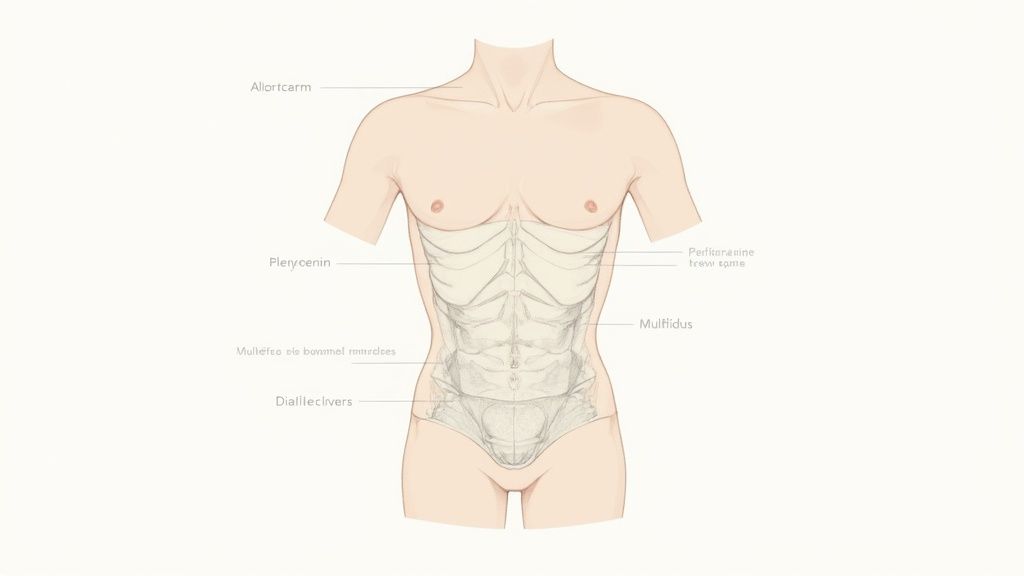
Imagine a supportive, muscular cylinder wrapping around your entire lumbopelvic region, starting just below your ribs and extending all the way down to the base of your pelvis. That’s your Powerhouse. It’s a dynamic, 360-degree support system that stabilizes your spine, protects your viscera, and acts as the anchor for every single move you make.
The Four Pillars of Your Inner Core
This muscular cylinder is actually made up of four distinct muscles working in perfect synergy. When one engages, the others respond, creating a stable, pressurized core that protects your back and makes every movement more efficient. Pilates trains you to consciously co-activate this system until it becomes second nature.
Here are the four key players:
- The Transversus Abdominis (TVA): Think of this as your body's natural corset. It’s the deepest of your abdominal muscles, with fibers running horizontally around your midsection. When you exhale and feel that sensation of drawing your navel toward your spine, you're activating your TVA.
- The Pelvic Floor: These are the hammock-like muscles (levator ani and coccygeus) at the very base of your pelvis. They support your organs and work in tandem with your deep abs and diaphragm to manage internal pressure. A strong, responsive pelvic floor is absolutely essential for stability.
- The Multifidus: These are tiny but mighty muscles running along your spine, connecting one vertebra to the next. They act like small tension wires, providing crucial segmental stability to your back. They are the unsung heroes of a healthy spine.
- The Diaphragm: Your primary muscle of respiration forms the "lid" of the Powerhouse cylinder. This is why proper diaphragmatic breathing in Pilates isn't just for relaxation; it's the engine that drives deep core engagement.
How the Powerhouse Creates Stability
Picture your spine as the mast of a ship. The Powerhouse muscles are the rigging that holds the mast upright and steady, even when the waters get choppy. When you perform a Pilates exercise—like The Hundred or a Roll-Up—you're not just working your superficial rectus abdominis. You're training these four deep muscles to co-contract, creating what's known as intra-abdominal pressure.
This controlled pressure acts like an internal airbag for your spine, keeping it stable and protected while your limbs are moving through space. This is precisely why Pilates is so effective at building a strong back and improving posture. You learn to generate strength from your center, which takes the strain off weaker areas like your neck, shoulders, and lower back.
"The Powerhouse is your body's command center. When you learn to initiate every movement from this stable base, you move with more power, precision, and control. This is the foundation of functional strength that supports you in everything you do."
From Novice to Expert: The Mind-Muscle Connection
Learning to consciously engage these deep muscles takes practice. It's all about building a strong mind-muscle connection that develops over time with consistent, precise movement. At first, your brain will likely try to recruit the larger, more dominant muscles to do the work. But as you practice, you'll learn to isolate and activate the right ones.
This learning curve is backed by science. One study showed that experienced Pilates practitioners have significantly higher muscle activation in key core muscles compared to novices. The experienced group's abdominal activity reached 50% or more of their maximum voluntary contraction during exercises, demonstrating an exceptional level of engagement and control. You can explore the full details of this core activation research to learn more.
This is why precise coaching cues are so important in Pilates. Instructions like "wrap your waistline" or "lift internally" aren't just pretty words; they're designed to help you find and awaken these deep, stabilizing muscles. The pelvic floor, for instance, plays a huge role in anchoring the Powerhouse. Understanding how to engage it can dramatically improve your entire practice. You can deepen your knowledge by reading our guide to Pilates for the pelvic floor.
Ultimately, building a strong Powerhouse is about more than just getting a flat stomach. It’s about re-educating your body to move from a place of deep, internal support, creating a foundation for a stronger, more resilient, and pain-free life.
From Your Center, Strength Radiates Out
While your Powerhouse is absolutely the command center, its influence doesn’t just stop at your torso. A true Pilates practice teaches this central stability to radiate outward, creating integrated, full-body strength. This is where the answer to "what muscles does Pilates work?" expands from your core to, well, everything. We’re talking about sculpting and strengthening from head to toe.
Think of your Powerhouse as the trunk of a mighty tree. For that tree to be truly strong, it needs deep roots anchoring it to the ground and sturdy branches reaching for the sky. It's the same with your body. Pilates uses your stable core to build powerful legs and a strong, aligned upper body.
Every single exercise is designed to challenge this lumbo-pelvic stability. We’re making sure that your arms and legs are moving from a solid, supported base, not just creating compensatory strain on vulnerable joints.
Sculpting a Powerful Lower Body
There's a reason Pilates is famous for creating long, defined legs without adding bulk. It’s all about balanced muscle development and deep control. We target everything from the large, powerful muscles of your hips down to the tiny stabilizers buzzing around your ankles.
Here’s a quick anatomical tour of the key lower body muscles we’re lighting up:
- The Gluteal Complex: Your glutes—the gluteus maximus, medius, and minimus—get a lot of attention. Exercises like Bridges and the Side-Lying Leg Series teach you to initiate hip extension and abduction from your seat. This not only builds a strong posterior chain but also stabilizes your pelvis and protects your lumbar spine.
- Hamstrings and Quadriceps: Pilates methodically works the muscles on both the back (hamstrings) and front (quadriceps) of your thighs. The goal isn't just strength, but harmony between these agonist-antagonist pairs. This improves knee stability and makes functional movements like walking, running, and climbing stairs feel more efficient.
- Adductors and Abductors: We can't forget the inner thigh muscles (adductors) and the outer hip muscles (abductors). They're crucial for maintaining pelvic stability in the frontal plane. By strengthening them together, we help prevent common issues like nagging knee pain and dial in your overall alignment.
Forging a Strong and Aligned Upper Body
Pilates builds upper body strength, but not in the way you might think. Instead of isolating muscles like biceps or triceps with heavy weights, we focus on integrating your arms and shoulders into your back and core. This creates a lean, functional strength that has a direct, visible impact on your posture.
We put a special focus on these key areas:
- Back Musculature: We’re constantly firing up the latissimus dorsi (the large "V" shaped muscle of your back) and the rhomboids and trapezius (the ones between and around your shoulder blades). This creates a strong "upper back corset" that promotes thoracic extension and melts away that all-too-common neck and shoulder tension.
- Shoulder Stabilizers: A huge amount of our work targets the smaller, intricate muscles that control your shoulder blade (scapula), including the serratus anterior. When you learn how to stabilize your scapula, you create a solid base for every arm movement. Suddenly, things feel more efficient and the risk of injury plummets.
- Arms and Chest: While they aren’t always the main event, muscles like the deltoids (shoulders), triceps brachii, and pectorals (chest) are consistently put to work. You'll feel them in everything from Push-Ups to any movement that involves the resistance of springs or bands.
This isn't just talk; this integrated approach delivers real, measurable results. One study found that a consistent Pilates program led to an 8.22% increase in handgrip strength and a massive 23.41% improvement in lower-limb strength. And the core? Abdominal strength jumped by 31%. You can read the full study on Pilates and muscle strength to see the data for yourself.
The Secret Sauce for Long, Lean Muscles: Eccentric Contraction
Ever wonder what the secret is behind that distinctive "Pilates body"? A big piece of the puzzle is our focus on eccentric muscle contractions. This is what happens when a muscle lengthens while it's still under tension.
Imagine slowly lowering a heavy box to the floor. Your bicep is lengthening, but it's working intensely to control the descent. That’s the "braking" part of a movement, and it’s pure eccentric work.
Pilates is packed with these controlled, eccentric movements. When you slowly roll down one vertebra at a time in a Roll-Up, your abdominal muscles are working eccentrically. When you lower your legs with control, your hip flexors and deep core are working eccentrically. This specific type of contraction is the key to building muscle fibers that are both strong and long, creating that beautiful definition without the bulk.
It’s this meticulous control that re-sculpts the body, creating muscular symmetry and correcting the imbalances that so often lead to chronic pain and poor posture.
An Anatomical Map of Classic Pilates Exercises
Now that we have a feel for the deep core and how Pilates builds strength from the inside out, let's connect those ideas to the exercises themselves. To really understand what muscles Pilates works, we need to look under the hood of the classic movements and see what's firing, what's stabilizing, and what's lengthening.
This anatomical peek will help you build a powerful mind-muscle connection, turning what looks like a simple movement into something incredibly effective. Think of it as creating a conversation between your brain and your neuromuscular system.
The image below gives you a great visual of how Pilates connects everything—your lower body, upper body, and back—all through your central Powerhouse.
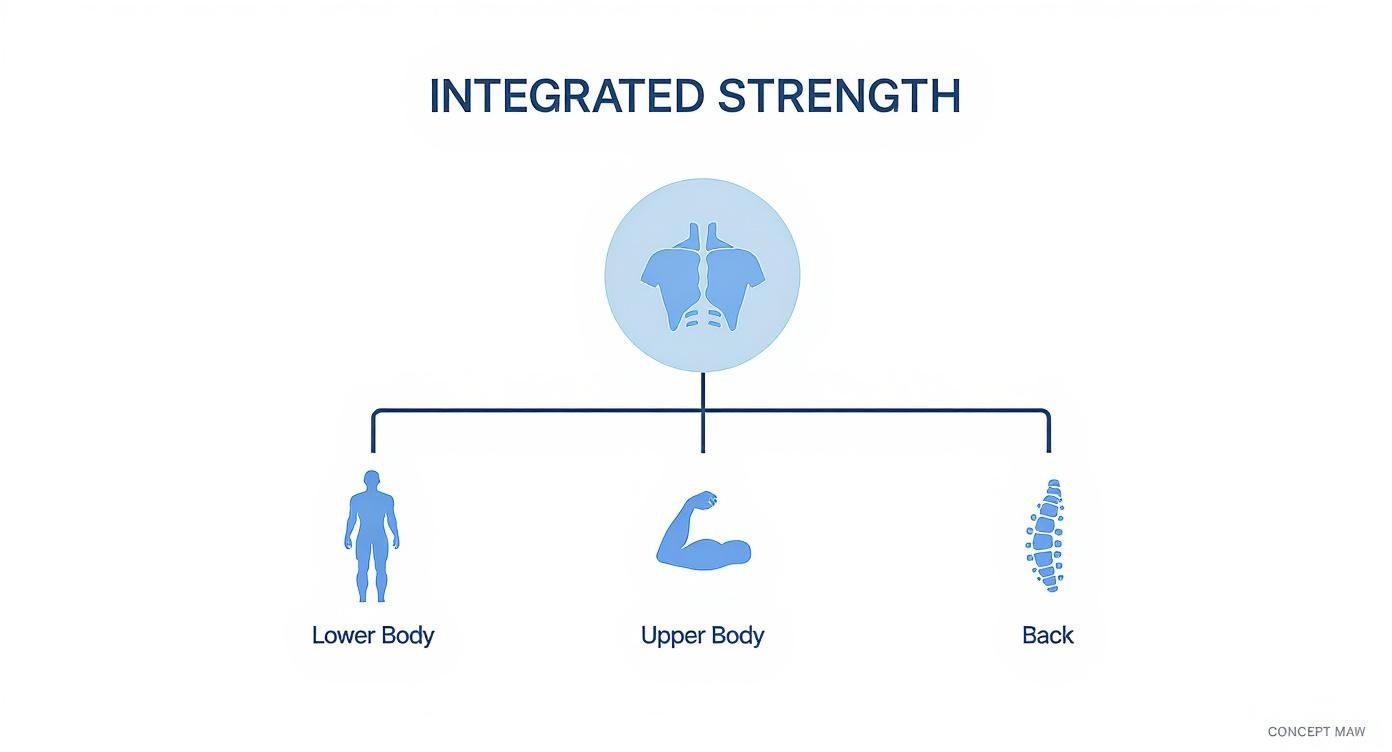
It shows that real strength isn't about isolating muscles. It’s a coordinated dance where every arm and leg movement gets its support and power from a stable, activated core.
To put this into practice, let's break down a few classic Pilates exercises and see which muscles are doing the heavy lifting. The table below gives a quick overview, but we'll dive deeper into some fan favorites.
Muscle Activation Guide for Key Pilates Exercises
| Pilates Exercise | Primary Muscles Worked | Secondary and Stabilizer Muscles |
|---|---|---|
| The Hundred | Rectus Abdominis, Obliques, Transversus Abdominis (TVA) | Hip Flexors, Quadriceps, Pelvic Floor, Deltoids, Triceps |
| The Roll Up | Rectus Abdominis, Obliques | TVA, Hip Adductors, Latissimus Dorsi, Pectorals |
| Single Leg Circles | Hip Flexors (Iliopsoas, Rectus Femoris), Quadriceps | Entire Powerhouse (TVA, Obliques, Multifidus), Gluteus Medius |
| Swan Dive | Erector Spinae, Gluteus Maximus | Hamstrings, Rhomboids, Middle Trapezius, TVA |
| Criss-Cross | Obliques, Rectus Abdominis | TVA, Pelvic Floor, Hip Flexors, Latissimus Dorsi |
| Leg Pull Front | Gluteus Maximus, Hamstrings, Deltoids, Triceps | TVA, Obliques, Erector Spinae, Quadriceps |
| Swimming | Gluteus Maximus, Hamstrings, Erector Spinae, Deltoids | TVA, Multifidus, Latissimus Dorsi, Rhomboids |
Understanding this map helps you move with more intention, getting so much more out of every single repetition.
The Hundred: An Exercise in Core Endurance
The Hundred is almost always the first exercise in a mat class, and for good reason. It's a fantastic dynamic warm-up that demands deep core endurance, breath control, and full-body attention right out of the gate.
While it might look like you're just pumping your arms and working your abs, the real effort is happening on a much deeper level.
- Primary Movers: The muscles creating the thoracic flexion ("ab curl") are your rectus abdominis and your internal and external obliques. They are working isometrically, meaning they’re holding a contraction to keep your head and shoulders lifted.
- Deep Stabilizers: The real star of the show here is the transversus abdominis (TVA). It must stay engaged to maintain the connection of the lumbar spine to the mat and prevent abdominal distension. Your pelvic floor is its essential partner, co-contracting to lock in that deep stability.
- Secondary Muscles: The vigorous arm pumps engage the anterior deltoids (fronts of the shoulders) and triceps. At the same time, your hip flexors and quadriceps are working hard to hold your legs steady in the air.
Actionable Cue: As you pump your arms, focus on maintaining that deep abdominal scoop. With every exhale, imagine your TVA is a corset cinching tighter around your waist. This simple thought keeps the work out of your neck and hip flexors and puts it right where it belongs: your Powerhouse.
The Roll Up: Articulating the Spine
The Roll Up is the ultimate test of abdominal control and your ability to articulate your spine segment by segment. It asks you to peel your back off the mat one vertebra at a time, which requires a profound level of core strength and spinal flexibility.
There's a reason this one is so challenging—it quickly reveals any weak spots in your abdominal wall and shines a spotlight on tightness in your hamstrings and erector spinae.
The goal of The Roll Up isn’t speed; it’s control. Each segment of your spine should lift and lower independently. This precision is what builds a strong, supple back and a deeply connected core.
Here’s who’s on the team for this movement:
- Primary Movers: The rectus abdominis and obliques are the engines, firing concentrically to create the spinal flexion.
- Eccentric Control: The real magic happens on the way back down. Your abdominal muscles have to work eccentrically (lengthening under tension) to control your descent. This is the secret sauce for building long, defined muscles.
- Stabilizers: Your TVA is critical for preventing momentum from taking over. Your hip adductors (inner thighs) squeeze together to aid pelvic stability, while your latissimus dorsi helps depress and anchor your shoulders, away from your ears.
Common Mistake: A lot of people use their hip flexors or a jerky movement to get up. To fix this, press your lumbar spine firmly into the mat as you start to roll, ensuring your abdominal muscles are the ones initiating the move.
Single Leg Circles: Hip Mobility and Pelvic Stability
At first glance, Single Leg Circles look pretty simple. But this exercise is a masterclass in dissociation—learning to move one part of your body (the femur in the hip socket) while keeping another part (your pelvis and torso) perfectly still.
This movement is fantastic for improving the range of motion in the hip joint and strengthening all the muscles that stabilize the pelvis.
- Primary Movers: The muscles moving the leg in the hip socket are your hip flexors (like the iliopsoas and rectus femoris) and the quadriceps.
- Key Stabilizers: This is where the real work is hiding. Your entire Powerhouse—TVA, obliques, multifidus, and pelvic floor—has to work overtime to stop your pelvis from rocking side to side. On the stationary leg, your gluteus medius is firing to prevent the hip from dropping.
Actionable Cue: Imagine your pelvis is a full bowl of water that you absolutely cannot spill. Keep it completely level as your leg circles. If you feel a wobble, make the circles smaller until you find that stability. Control is way more important than how big you can make the circle.
Swan Dive: Strengthening the Entire Posterior Chain
After all that forward bending, the Swan Dive offers some much-needed spinal extension. It strengthens the entire posterior chain—the network of muscles running all along the back of your body. It's a powerful antidote to the kyphotic (slumped-forward) posture many of us find ourselves in during the day.
- Primary Movers: The erector spinae muscles, which run right alongside your spine, are the primary lifters here. Your gluteus maximus engages powerfully to assist in hip extension and support your lower back.
- Secondary and Stabilizer Muscles: The hamstrings assist the glutes in lifting the legs. Your rhomboids and middle trapezius retract and depress your scapulae, which helps open up your chest. All the while, your TVA provides crucial anterior support, preventing you from hyperextending the lumbar spine.
This map makes it clear: every classic Pilates exercise is a full-body event. Understanding what muscles Pilates works is less about isolating parts and more about appreciating the symphony of coordination needed for precise, powerful movement.
How Mat and Reformer Pilates Target Muscles Differently
When you’re weighing Mat versus Reformer Pilates, the big question is often, “Which one is better for building muscle?” But honestly, that’s not really the right way to look at it. One isn't superior; they just challenge your muscles with different types of resistance.
Think of it this way: the Mat and the Reformer each create unique anatomical challenges. The real key is understanding how each one changes the conversation your muscles are having with your body.
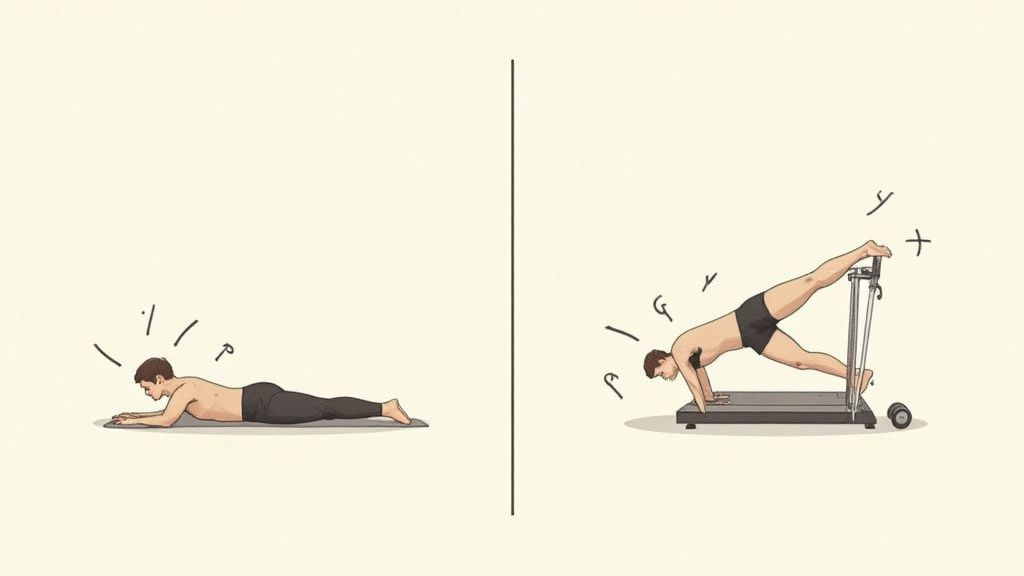
On the mat, it’s just you against gravity. Your own body weight becomes the resistance, forcing your deepest stabilizing muscles to fire up and control every single move. It’s an honest, unfiltered test of your Powerhouse strength. Your core has to provide all the support and opposition—there’s nowhere to hide.
Mat Pilates: The Gravity Challenge
In Mat Pilates, every exercise is a negotiation with gravity's constant downward pull. Your muscles have to work in what we call a closed-chain environment, and this kind of training is fantastic for developing deep, intrinsic strength and control from the inside out.
- Muscle Focus: Mat work is king when it comes to activating the entire core cylinder—your transversus abdominis, obliques, multifidus, and pelvic floor.
- Anatomical Demand: With no external support, your body must learn to create its own stability. This significantly enhances your proprioception and neuromuscular coordination.
The Reformer: A Dialogue with Resistance
The Reformer completely changes the game. With its system of springs, straps, and that gliding carriage, it introduces variable, external resistance. The springs can either assist your movement or add a significant challenge, letting you work your muscles in ways gravity alone just can’t.
This external feedback is amazing for improving proprioception—your body's awareness of where it is in space. It guides your form, making it so much easier to feel the right muscles engaging. That constant tension from the springs is also perfect for focusing on eccentric contractions, which is when a muscle lengthens under load. That’s the secret sauce for building long, defined muscle tone. It’s also why many people find that certain Pilates reformer exercises can target the glutes, hamstrings, and upper back with greater intensity.
The Reformer doesn't just add weight; it adds information. The springs provide constant feedback, teaching your muscles how to work with control through a full range of motion, which is crucial for building functional, integrated strength.
Comparing Muscle Activation
So, while both are incredibly effective, the equipment can definitely change the intensity and type of muscle work you’re doing. On the Reformer, the adjustable spring tension allows for progressive overload—a core principle for building strength. You can methodically increase the resistance to keep challenging your muscles as they get stronger.
Research using electromyography (which measures muscle activity) has found that apparatus-based Pilates can generate activation levels of 10-20% of maximum voluntary contraction in key core stabilizers. While that might not sound like a huge number, those levels are the sweet spot for building muscle endurance and refining postural control, rather than just building brute force.
Ultimately, the best approach often involves a little of both. Mat work builds that foundational core strength and control, and the Reformer gives you a way to deepen that work, add targeted resistance, and fine-tune your movement patterns. It's a perfect partnership.
Why Precise Movement Is the Key to Muscle Activation
Knowing which muscles Pilates works is only one piece of the puzzle. The real secret to unlocking that deep, connected strength isn't just what you do, but how you do it. This is where Pilates really sets itself apart from a traditional workout—it’s a practice of intention, where precision and control trump speed and reps every single time.
The entire method is built on six core principles: Centering, Concentration, Control, Precision, Breath, and Flow. These aren't just feel-good concepts; they're direct instructions for how your body should move and which muscles should fire. When you rush through an exercise, your bigger, more dominant muscles will always jump in to take over. But when you slow it all down, you give those smaller, deeper stabilizers a chance to wake up and get to work.
Translating Principles into Muscle Action
This focus on deliberate, controlled movement is what ensures you're actually targeting the right muscles instead of "cheating" with the ones that are already strong. You're not just going through the motions; you're actively re-educating your body's neuromuscular pathways.
Here's how that plays out in a real session:
-
Control over Speed: When you perform a Roll Down with slow, meticulous control, you're maximizing the eccentric contraction (the lengthening phase) of your rectus abdominis and obliques. That controlled lengthening is what builds those long, lean muscle fibers. If you just flop down, you miss the benefit entirely.
-
Precision over Power: Think about doing a Leg Circle. When you execute it with perfect precision, keeping your pelvis completely still, you force your deep core—especially the transversus abdominis and multifidus—to work overtime to stabilize you. A big, sloppy, uncontrolled circle just lets momentum do all the work, completely missing the point.
The essence of Pilates is moving from a stable center. Every breath, every cue, and every moment of concentration is designed to reinforce this connection, turning each exercise into a lesson in muscular intelligence.
This mindful approach builds an incredible mind-muscle connection, which means you get so much more out of every single movement. If you're interested in going deeper, these smarter, functional training principles that reduce injury risk really echo the Pilates emphasis on moving with intention.
Sorting Fact from Fiction: Your Pilates Muscle Questions Answered
Let's clear up some of the most common questions I hear about Pilates, muscle, and what you can realistically expect from your practice.
Does Pilates Build Bulky Muscles Like Weightlifting?
Not at all. Pilates is engineered to create long, lean, and highly functional muscles, not the kind of bulk you see from heavy lifting. The secret lies in its emphasis on eccentric contractions—that’s the part of a movement where you lengthen a muscle while it’s still under tension.
Think about the feeling of slowly controlling a spring as it closes on the Reformer. That’s an eccentric contraction in action. This type of work is fantastic for toning and defining muscles without dramatically increasing their cross-sectional area, a process known as hypertrophy. You're building deep, supportive strength that improves posture and joint health, resulting in a sculpted look, not a bodybuilder's physique.
Can I Build Muscle With Only Mat Pilates?
Absolutely. Don't underestimate the power of a mat. Mat Pilates is incredibly effective for building both muscle strength and endurance because it uses two potent forms of resistance: your own bodyweight and the relentless pull of gravity.
Every single movement requires your deep core stabilizers to fire up and control your limbs in space. While equipment like the Reformer certainly adds another layer of resistance and challenge, a consistent, precise mat practice is more than enough to forge a strong, toned body from the inside out.
How Often Should I Do Pilates to See Muscle Definition?
When it comes to seeing results, consistency is everything. For most people, a dedicated practice of two to three times per week hits the sweet spot. This frequency gives your body the perfect stimulus for muscle development while allowing enough time for repair and adaptation—which is when the real strengthening magic happens.
You'll probably start to feel stronger and more connected to your core within a few weeks. Those visible changes in muscle tone usually start to show up within a couple of months, especially when you pair your practice with balanced nutrition.
If you're curious about the science behind muscle recovery, understanding your creatine kinase (CK) levels can offer some interesting insights into how your body responds to exercise. This can help you fine-tune your schedule for optimal results.
Ready to feel the difference that precise, anatomy-informed movement can make? The WundaCore collection brings the studio experience home, giving you all the tools you need to build deep, functional strength. Explore our equipment and start your journey with Wunda On Demand today. Start your practice at WundaCore.