
Pilates for pelvic floor: An anatomical guide to strength and control
Pilates is an incredible tool for strengthening the pelvic floor, but it’s about so much more than just isolated contractions. It’s a practice that teaches you to build deep, functional strength from the inside out by coordinating controlled movements with your breath. When done correctly, Pilates creates a powerful, integrated support system for your entire core by focusing on the precise anatomical function of your deep stability muscles.
Connecting with Your Pelvic Floor Anatomy
Before you can truly strengthen your pelvic floor, you need to understand what it is and how it functions anatomically. Forget any vague advice you’ve heard before. Let’s get specific.
Imagine your pelvic floor not as a single muscle, but as a complex, multi-layered hammock of muscles. This muscular sling, known as the pelvic diaphragm, stretches from your pubic bone at the front to your coccyx (tailbone) at the back, and side-to-side between your ischial tuberosities (sitting bones). It’s composed of several muscles, primarily the levator ani group, which supports your pelvic organs (bladder, uterus, and rectum), maintains continence by controlling the sphincters, and plays a crucial role in sexual function and core stability.
But here’s the key anatomical takeaway: it doesn’t work alone. It operates in perfect synergy with a team of other deep core muscles. We call them the "Core Four."
The Core Four Connection
True core strength isn't just about your rectus abdominis (the "six-pack" muscles). It's about the coordinated effort of four essential muscle groups that form a dynamic muscular container, managing intra-abdominal pressure. When these four work in harmony, your core is stable, responsive, and strong.
This infographic shows how the Core Four works together as a single, integrated system.

This image really highlights that the pelvic floor is a central player in a much larger stability system, not some isolated muscle you can just squeeze and forget.
The biomechanical relationship between your breath and your pelvic floor is foundational to anatomy-informed Pilates.
- On your inhale: Your diaphragm (the primary muscle of respiration) contracts and descends, increasing intra-abdominal pressure. In response, your pelvic floor muscles lengthen and lower eccentrically to accommodate this pressure.
- On your exhale: Your diaphragm relaxes and lifts, and your pelvic floor and deep transverse abdominis muscles should gently recoil and contract concentrically, lifting upwards in response.
This rhythmic coordination is the secret to building real, functional pelvic floor strength.
To help you visualize this team, here’s a quick breakdown of the key players and their anatomical roles.
The Core Four Your Pelvic Floor's Support System
| Muscle Group | Anatomical Location | Primary Function in Core Stability |
|---|---|---|
| Pelvic Floor | The base of the pelvis, forming a "hammock" | Supports pelvic organs and works with the diaphragm for pressure regulation. |
| Diaphragm | Dome-shaped muscle at the base of the rib cage | The primary muscle of respiration; its movement directly influences the pelvic floor. |
| Transverse Abdominis (TVA) | The deepest abdominal layer, wrapping around the torso | Acts as a natural corset, stabilizing the spine and pelvis. |
| Multifidus | Small, deep muscles running along the spine | Provides segmental stability to each vertebra, crucial for spinal health. |
Understanding how these muscles work together is the first—and most important—step toward reconnecting with your body.
Why Your Pelvic Floor Might Weaken
So, what causes this beautifully designed system to lose its integrity? Life happens.
Many factors can compromise these muscles, including pregnancy, childbirth, aging, chronic coughing, or even high-impact exercise without proper core engagement. When this support system weakens, it can lead to issues like urinary incontinence, a condition that is far more common than most people think.
Globally, urinary incontinence affects an estimated 17% to 30% of women over 20, with that number rising to as high as 50% in women over 60. Childbirth significantly increases this risk, with about 75% of mothers reporting issues compared to just 37.5% of women who haven't given birth.
This strong connection between life events and pelvic health is precisely why a targeted, mindful approach like Pilates is so effective. For a deeper dive, you can find more details in our complete guide on how to strengthen your pelvic floor.
The good news? It’s absolutely possible to re-establish this deep muscular connection, improve function, and restore your confidence. By understanding the anatomy, you’ve already taken the most critical step forward.
Getting to the Core of Pelvic Floor Pilates
Doing pelvic floor work effectively isn't just about going through the motions—it’s about how you do them. It requires intention and a deep awareness of what’s happening inside your body. Pilates gives us the perfect framework for this, shifting the focus from mindless reps to mindful, controlled engagement.
Think of these principles as your pre-flight checklist for every single movement. Mastering them ensures that every exercise you do is actually building strength safely and effectively.
It all starts with your breath. Forget what you might have learned about holding your breath during a tough lift. In Pilates, the breath is synchronized with the movement, and your exhale is the secret sauce. As you breathe out, you’ll cue that gentle concentric contraction of the pelvic floor and your deep transverse abdominis. This isn't just a helpful tip; it's the engine that powers real activation.
Finding Your Neutral Starting Point
Before you even think about moving, you have to find your neutral pelvis and spine. This isn't about jamming your low back flat into the mat (a posterior tilt) or creating a huge arch (an anterior tilt). It’s about finding that natural, subtle lordotic curve in your lumbar spine that allows your core muscles—pelvic floor included—to function optimally.
Here’s a simple way to find it: lie on your back with your knees bent and feet flat. Picture your two anterior superior iliac spines (ASIS), the bony points at the front of your hips, and your pubic bone forming a small, flat triangle. When that triangle is parallel to the ceiling, you've found your neutral. This is the ideal starting point for most foundational pilates for pelvic floor exercises.
Key Takeaway: Think of a neutral pelvis as your "home base." It's the position where your skeleton is perfectly aligned, allowing the deep core muscles like the transverse abdominis and pelvic floor to fire up correctly, without other muscles trying to compensate and take over.
The Power of Concentration, Control, and Precision
Once you’ve found your alignment, it’s time to layer in the core tenets of Pilates: concentration, control, and precision. This means you’re moving slowly and with purpose, focusing all your mental energy on the exact muscles you want to work. It’s the real difference between just doing an exercise and creating a powerful, lasting neuromuscular connection.
For instance, when you do a bridge, don't just thrust your hips up. Concentrate on initiating the movement with a gentle pelvic floor lift first. Then, articulate your spine off the mat, peeling it up one vertebra at a time, from coccyx to thoracic spine.
This controlled approach is everything. It stops you from falling into bad habits like bearing down or letting your gluteus maximus do all the work, which can actually strain the pelvic floor. Instead, you train your entire core system to work together as a smart, cohesive unit. If you're ready to see how these principles apply to more movements, our guide on Pilates exercises for core strength is a great place to go next.
Your Foundational Pelvic Floor Pilates Routine
Alright, you've got the 'what' and the 'why,' so let's get into the 'how.' It’s time to put this knowledge into practice on the mat. This routine is all about creating that crucial connection between your brain and your deep core system. We're not looking for a big burn here; the goal is precision, awareness, and control.
Think of each movement as a quiet conversation with your body, teaching you to find and activate the right muscles without gripping or straining.
Pelvic Tilts for Initial Activation
I like to think of the pelvic tilt less as an "exercise" and more as an awakening for your deep core. It’s the perfect way to start feeling the synergy between your low abs, your lumbar spine, and your pelvic floor.
Start by lying on your back with your knees bent and feet flat on the floor, about hip-distance apart. Let your arms rest by your sides. First, find your neutral pelvis—that small, natural space under your lower back.
- On your inhale, let your belly soften and feel your pelvic floor relax and descend.
- On your exhale, gently draw your pubic bone up toward your navel, feeling your lumbar spine lightly imprint into the mat. As you do this, visualize gently lifting the pelvic floor—like you’re sipping a smoothie through a straw.
- Inhale again, and slowly return to your neutral start, releasing the contraction with complete control.
The key is making the movement small and initiating it from your deep abdominals. Don't push with your feet or clench your glutes; let the deep core do the work.
Heel Slides to Build Stability
Heel slides are a fantastic challenge. They ask you to keep your pelvis completely still while your leg moves, training your transverse abdominis and pelvic floor to do their main job: stabilize against limb movement.
Begin in the same neutral position you found for the pelvic tilt.
- Exhale: Engage your pelvic floor and deep abs. Slowly slide one heel away from you, straightening the leg along the floor.
- Inhale: Keep your pelvis perfectly still—no rocking side to side!—and slide the heel right back to where you started.
Focus on keeping the triangle of your hip bones and pubic bone level and quiet the entire time. If you feel your back arch or your hips start to wobble, you've lost that core connection. Just shorten how far you slide your heel out until you can maintain that rock-solid stability.
Bent Knee Fall Outs for Hip and Pelvic Control
This movement is brilliant for teaching your body to differentiate between hip movement (femoral rotation) and pelvic instability. It trains the deep core muscles, including your pelvic floor, to hold the fort while your femur moves in the hip socket.
Pro Tip: Imagine your pelvis is a full bowl of water. As one knee opens out to the side, your goal is to keep that bowl perfectly level so you don't spill a single drop.
Start in your neutral position with knees bent.
- Exhale and gently engage your core and pelvic floor.
- Inhale as you slowly allow one knee to fall open to the side. Go only as far as you can without letting the opposite hip lift or rock.
- Exhale and use those deep core muscles to draw the knee back to the center.
It’s all about control here, not range of motion. A small, controlled movement with a stable pelvis is far more effective than a large, floppy one. This subtle exercise is a powerhouse in any pilates for pelvic floor routine because it teaches your body what true, functional stability feels like from the inside out.
How to Progress to Advanced Pelvic Floor Exercises
Once you've mastered the foundational movements and really built that solid mind-muscle connection, it’s time to level up. Progressing your Pilates for pelvic floor work isn't about adding heavy weights or moving faster; it’s about asking your deep core system to maintain stability while the rest of your body is in motion.
This shift from static holds to dynamic, integrated strength is where true functional fitness is built. You're essentially teaching your pelvic floor, transverse abdominis, and multifidus muscles to fire reflexively and support you through more complex challenges.
This next phase is all about maintaining that deep, internal lift while your arms and legs move, which is exactly what your body does in daily life—like when you lift a toddler or carry in a heavy bag of groceries.
From Bridge to Leg Lifts
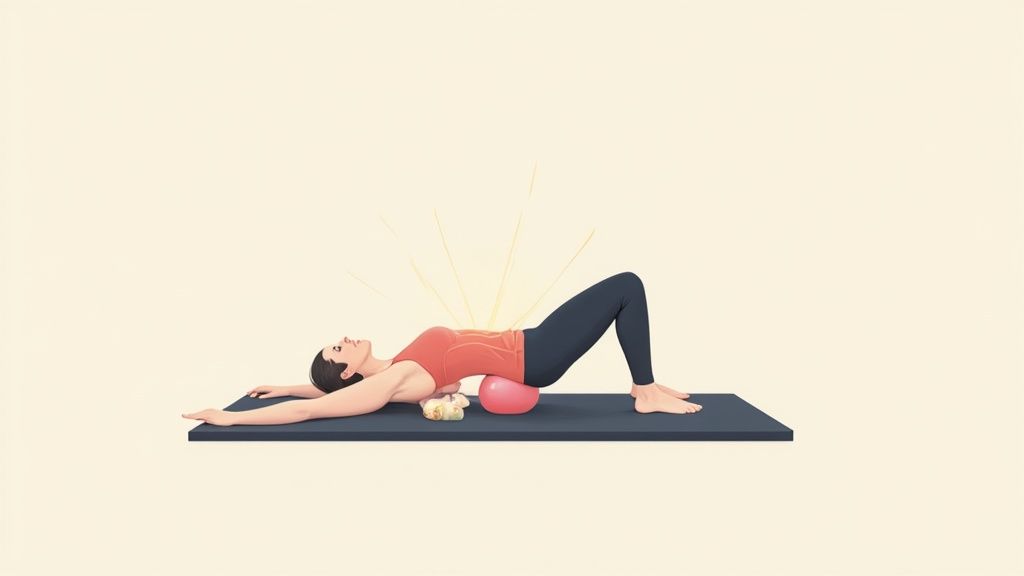
The basic Pilates Bridge is fantastic for waking up the glutes and the entire posterior chain. The progression I love adds a stability challenge that directly tests your pelvic floor's endurance.
First, perform a standard Bridge: exhale to engage your core and lift your hips. Once you're holding a steady, stable bridge, the real work begins.
- Maintain Hip Height: Without letting your pelvis drop or tilt, shift your weight onto one foot.
- Lift with Control: Exhale as you lift the opposite leg into a tabletop position (knee bent at 90 degrees).
- Lower with Precision: Inhale as you lower the foot back to the mat, making sure your hips stay perfectly level the entire time.
This progression forces the stabilizing muscles on your standing side—including the deep hip rotators and your pelvic floor—to work overtime to keep your pelvis from dropping. It's a game-changer.
This type of integrated work is incredibly effective. Research comparing Pilates to conventional pelvic floor muscle training found that Pilates was equally effective at improving pelvic floor strength over 12 weeks. The major advantage? Pilates delivered full-body benefits like improved flexibility, posture, and overall confidence. You can explore the full study about Pilates and pelvic floor outcomes on Physio-pedia.com.
Modifying The Hundred for Deep Core Work
The classic Hundred can be too intense when you're just starting out, often causing the rectus abdominis to bulge or the back to arch. But a modified version is an excellent progression for building deep core endurance without the strain.
Lie on your back with your knees in a tabletop position. Instead of lifting your head and shoulders, keep them resting comfortably on the mat for now.
Focus solely on the arm pumps and your breath. Inhale for five short, crisp pumps of your arms, and exhale for five pumps. Throughout all 100 breaths, your primary job is to maintain a stable pelvis and a gentle, consistent engagement of your pelvic floor and deep abdominals.
Incorporating Props to Deepen Your Connection
Simple props can give you invaluable feedback and add a new layer of challenge, helping you connect even more deeply with those target muscles. It’s like having an instructor’s hands guiding you.
- Soft Pilates Ball: Place a slightly deflated ball between your inner thighs during a Bridge. As you lift your hips, gently squeeze the ball. This activates your adductors (inner thigh muscles), which have a direct fascial connection to the pelvic floor and really intensifies the engagement.
- Resistance Bands: A light loop band around your thighs during Bent Knee Fall Outs provides gentle resistance. As you open one knee out to the side against the band, your deep core has to work harder to stabilize your pelvis. For more ideas, check out our guide on the best resistance bands for Pilates.
Making these small adjustments and adding props challenges your body in new ways. It helps transform your pelvic floor from a muscle you just "squeeze" into a responsive, integrated part of your core's support system.
To help you visualize how these exercises build on one another, I've put together a simple progression pathway.
Exercise Progression Pathway
This table shows how to safely move from a foundational exercise to a more advanced variation. Notice how each step adds a specific challenge to test your stability and control.
| Foundational Exercise | Intermediate Progression | Advanced Variation | Key Challenge Added |
|---|---|---|---|
| Pelvic Tilt | Basic Bridge | Bridge with Leg Lift | Unilateral stability |
| Bent Knee Fall Out | Fall Out with Band | Leg Slides (Heels on Mat) | Limb extension, core control |
| Tabletop Hold | Modified Hundred | Toe Taps | Dynamic lower limb movement |
Start where you feel confident and in control. The goal is always quality of movement over quantity or speed. As you get stronger, you'll naturally feel ready to take on the next challenge.
Fitting Pelvic Floor Work Into Your Real Life
Let’s be honest: the most advanced pelvic floor exercise in the world is useless if you only do it once a month. When it comes to building real, lasting strength, consistency beats intensity every single time.
The key isn't to find an extra hour in your day—it's about weaving these essential movements into the life you already have. This is how you turn an item on your to-do list into a sustainable, empowering habit. Short, focused sessions are incredibly effective for building strength and reinforcing that crucial mind-muscle connection.
Three Mini-Workouts for a Packed Schedule
To get you started, here are three simple "mini-workouts" I give my clients. Each one is designed to fit into a busy day and serves a specific purpose, showing you how to tailor your practice to what your body needs right now.
-
The 5-Minute Morning Activation: Before you even get out of bed, take five minutes to reconnect with your Core Four. Lie on your back with your knees bent and flow through 10-12 slow, controlled Pelvic Tilts, followed by 8-10 Heel Slides on each leg. It’s a gentle way to wake up your deep core stabilizers and set a foundation of support for the day ahead.
-
The 10-Minute Pre-Workout Prep: Getting ready for a run, a lifting session, or a bigger Pilates workout? Spend ten minutes priming your core. Start with Pelvic Tilts, move into a set of Bridges (12 reps), and finish with Bent Knee Fall Outs (8 per side). This sequence ensures your pelvic floor and deep abs are fired up and ready to stabilize you during more demanding movements.
-
The 15-Minute Comprehensive Strength Session: When you have a bit more time, you can create a more complete workout. Try combining foundational and progressive exercises: start with Pelvic Tilts, move to Bridges with alternating Leg Lifts (6 per side), and finish with Modified Hundreds and Toe Taps. This session builds both endurance and dynamic stability.
Don't just take my word for it—the power of consistency is backed by research. One 12-week community-based Pilates program showed significant benefits for women managing stress urinary incontinence. The twice-weekly classes improved symptoms, and the group setting boosted motivation, proving that regular practice creates real, lasting change. You can learn more about the findings on community-based Pilates programs from the National Institutes of Health.
Building Your Own Smart Routine
The logic behind these mini-workouts is simple, and you can absolutely use it to build your own. Just follow these principles based on how much time you have and what your body is asking for.
- Always Start with Activation: Begin with a gentle movement like Pelvic Tilts to establish that mind-body connection.
- Add a Stability Challenge: Next, include an exercise that challenges your core to stay still while a limb moves, like Heel Slides or Bent Knee Fall Outs.
- Finish with Endurance: Finally, layer in an exercise that requires sustained engagement, like the Bridge or Modified Hundreds.
By mixing and matching these elements, you can create an endless variety of short, powerful workouts. This approach makes it easy to stay consistent, turning your pelvic floor health from a chore into a simple, daily act of self-care.
When to Seek Professional Guidance for Pelvic Health
Pilates is an incredible tool for connecting with and strengthening your pelvic floor, but it’s one part of the bigger picture. Think of your Pilates practice as a powerful member of your wellness team. But sometimes, you need to call in a specialist.
Knowing when to self-guide your movement journey and when to seek a professional diagnosis is the key to working safely and effectively. You get the best results from your Pilates practice when you’re building on a healthy, functional foundation.
Signs It's Time to Consult a Professional
Listening to your body is always the most important principle. If you experience any of the following, it’s a clear signal to pause your routine and book an appointment with a pelvic floor physical therapist or your doctor. These specialists can give you a proper assessment and create a plan that’s truly personalized to your body’s needs.
- Pain During or After Exercise: You should feel your muscles working, not a sharp, shooting, or lingering pain in your pelvis, hips, or low back. Pain is your body’s way of telling you something isn’t right.
- Worsening Symptoms: If issues like incontinence or pelvic pressure get worse with exercise—not better—stop immediately. This could be a sign that you're accidentally bearing down instead of lifting and supporting from within.
- Inability to Feel a Contraction: If you honestly can't feel anything happening when you try to engage your pelvic floor, don't just keep guessing. A physical therapist can use biofeedback and internal cues to help you finally build that crucial mind-body connection.
- Symptoms of Prolapse: A feeling of heaviness, bulging, or a sensation that "something is falling out" of the vagina needs an immediate medical evaluation.
A pelvic floor physical therapist is a highly trained specialist who can diagnose and treat pelvic floor dysfunction. They can assess your muscle tone, strength, and coordination to see if your muscles are too tight (hypertonic), too weak (hypotonic), or uncoordinated—problems that general exercise alone can’t fix.
This guide is here to empower you. And honestly, the most empowering step you can take is knowing when to ask for expert help. Getting a proper diagnosis ensures your pilates for pelvic floor practice is built on a foundation of safety and a true understanding of your own anatomy.
Common Questions About Pilates and Pelvic Health
It's completely normal to have questions when you start a new practice, especially one that focuses on such a personal part of your body. Getting clear on a few common points can help you feel confident and ready to begin your Pilates journey the right way. Let's tackle some of the most frequent things people ask about using pilates for pelvic floor training.
How Long Until I See Results?
This is always the first question, and the honest-to-goodness answer is: it really depends. Real progress hinges on where you're starting from, how consistent you are, and your own body awareness.
Some people feel a much deeper connection and notice better control within just a few weeks of consistent practice—think 3-4 sessions a week. For others, particularly if you're postpartum or recovering from surgery, it might take a couple of months to see a real shift in symptoms like incontinence.
You're rebuilding a deep neuromuscular connection between your brain and your muscles. Patience and consistency are truly your best friends here.
Key Takeaway: Try to focus on the quality of each and every contraction instead of watching the clock or calendar. Small, mindful, and consistent efforts build lasting strength far better than a few intense, rushed sessions. A focused five minutes every single day will do more for you than one hurried hour once a week.
What Is the Difference Between Kegels and Pilates?
While both Kegels and Pilates work the pelvic floor, they approach it from different anatomical perspectives. A Kegel is an isolated contraction, focusing solely on the pelvic floor muscles. Pilates, on the other hand, integrates that pelvic floor contraction with the breath and the entire "Core Four" system, training it to work dynamically with the rest of the body.
Here's another way to think about it: Kegels build isolated strength in one muscle group. Pilates teaches that muscle group how to be a team player, coordinating with the diaphragm, transverse abdominis, and multifidus to support you through everything life throws at you—lifting groceries, chasing your kids, or even just laughing hard with a friend. It trains the muscle to be truly functional.
If you're dealing with persistent issues, it's so important to understand conditions like chronic pelvic pain and to get professional, one-on-one advice.
Ready to build a strong, responsive core with guidance you can trust? The WundaCore collection is designed to help you connect with your body on a deeper level. Our patented props and expert-led Wunda On Demand classes bring the anatomy-informed principles of studio Pilates right into your home, making it easier than ever to build functional strength. Explore the WundaCore system today.