
The Anatomical Guide to Resistance Band Exercises
Exercises with resistance bands are a fantastic way to build strength and stability, largely because they create constant tension throughout an entire movement. This unique quality engages not only primary movers like the gluteus maximus or deltoids but also the smaller stabilizer muscles—such as the rotator cuff group and deep core musculature—that are so vital for joint health and functional strength.
Why Resistance Bands Are More Than Just Rubber
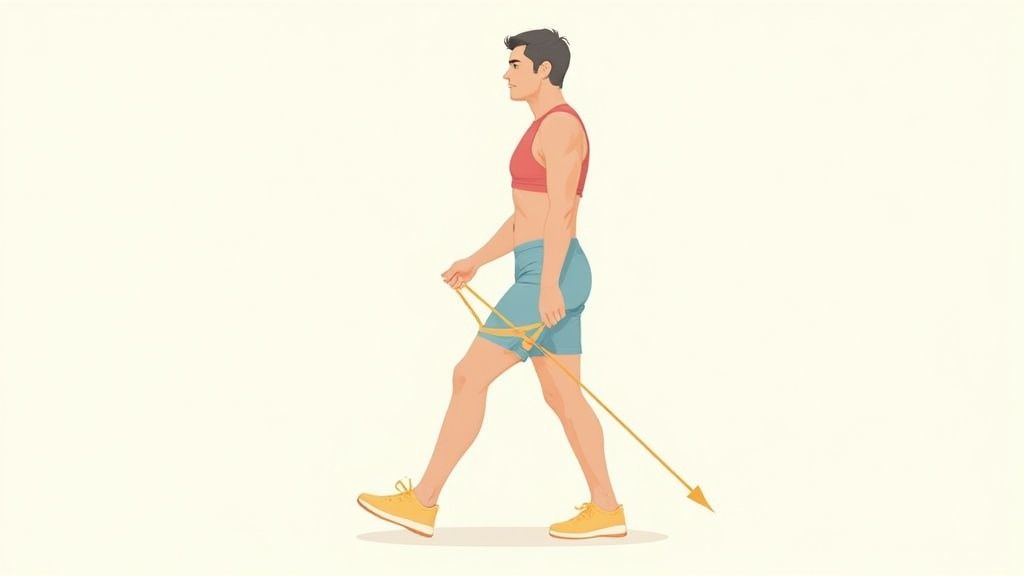
It’s easy to look at a resistance band and see a simple piece of rubber, but the way it interacts with your body’s biomechanics is surprisingly complex. Unlike a dumbbell or barbell, which relies on gravity and feels heaviest at one specific point in the lift, bands offer something called variable resistance.
What does that mean from an anatomical perspective? The tension increases the more you stretch the band. This forces your muscles to recruit more motor units through their complete range of motion, particularly at the peak of contraction where the muscle is in its shortest, strongest position.
This continuous tension is what makes band work so effective physiologically. Your muscles never get a moment of rest at the top or bottom of a rep, which leads to greater time under tension—a key physiological factor for triggering muscle hypertrophy (growth).
Awakening Stabilizer Muscles
The real magic of band work, especially for Pilates and functional movement, is its ability to activate the smaller, often-neglected stabilizer muscles. I'm talking about the deep core muscles like the transverse abdominis that support your lumbar spine, the rotator cuff muscles (supraspinatus, infraspinatus, teres minor, and subscapularis) that secure the humeral head in the shoulder socket, and the gluteus medius that prevents pelvic drop during gait.
Bands challenge your body in multiple planes of motion (sagittal, frontal, and transverse), forcing these stabilizers to fire constantly to maintain proper joint centration and control. This leads to profound anatomical benefits:
- Improved Joint Stability: Strengthening the muscles that envelop your joints—like those around the scapula and hip—creates a more stable and resilient structure.
- Enhanced Injury Resilience: Many common injuries stem from muscular imbalances where dominant muscles overpower weaker stabilizers. Bands are brilliant for correcting these imbalances by targeting the specific muscles responsible for joint integrity.
- Better Functional Strength: This training translates directly to real-world activities, from lifting groceries to improving balance, because it teaches your body to function as an integrated neuromuscular system.
The constant feedback from the band is incredible for improving your neuromuscular connection. You are forced to control the movement on both the concentric (muscle shortening) and eccentric (muscle lengthening) phases, essentially doubling the effectiveness of every repetition from a motor control standpoint.
At a glance, it's easy to see why both tools have their place in a well-rounded fitness routine.
Resistance Bands vs Free Weights: An Anatomical Comparison
| Feature | Resistance Bands | Free Weights |
|---|---|---|
| Type of Resistance | Variable (increases with stretch) | Constant (gravity-based) |
| Muscle Activation | Emphasizes stabilizer muscles and peak contraction | Primarily targets major muscle groups (prime movers) |
| Joint Impact | Low-impact; less shear force on joints | Can place higher compressive and shear forces on joints |
| Portability | Excellent; lightweight and compact | Limited; heavy and bulky |
| Versatility | High; allows for multi-planar movements | Moderate; primarily vertical movements |
Ultimately, the choice isn't about which is "better," but which is right for your specific anatomical goals, from building foundational stability to adding pure muscular strength.
A Cornerstone of Modern Fitness
It's really no surprise that physical therapists and professional athletes have been using bands for years, both for rehabilitation and for peak performance training. Their versatility and focus on controlled, anatomy-driven movement make them an indispensable tool. This isn't just a niche trend; the global resistance bands market hit approximately USD 1.66 billion in 2024 and is expected to keep climbing.
Choosing the right tool is always the first step. Our detailed guide on the best resistance bands for Pilates can help you select the perfect option to begin your journey toward building a stronger, more resilient body from the ground up.
Getting Your Head in the Game: Connecting Your Mind and Muscle
If you want to get real results from your band workouts, you have to do more than just go through the motions. The secret sauce is building a strong mind-muscle connection—the conscious, focused intention of contracting a specific muscle. This isn't a vague concept; it’s a neuromuscular process that enhances motor unit recruitment, which leads to cleaner form, faster results, and a much lower risk of injury.
Think of it this way: your brain sends electrical signals via motor neurons to your muscle fibers, telling them to contract. When you intentionally focus on a specific muscle, you're strengthening that neural pathway. The constant tension from a resistance band is the perfect tool for practicing this because you can feel the muscle fibers firing through the entire movement, from full extension to peak contraction.
Anatomy in Action, Not Just in a Book
Let's forget dry textbook diagrams and think about the functional role of your muscles. When you understand their real-world jobs, it's easier to feel them working during an exercise.
-
The Gluteus Medius: Located on the lateral aspect of your hip, this muscle is a stability powerhouse for the pelvis. Its primary job is hip abduction (moving your leg away from your midline) and preventing the opposite hip from dropping when you're on one leg. When you feel that deep burn during a banded clamshell, you're strengthening the exact muscle that provides stability to the entire kinetic chain, protecting your knees and lower back.
-
The Rhomboids (Major and Minor): Tucked between your scapulae (shoulder blades), their main function is scapular retraction—pulling your shoulder blades toward your spine. They're your first line of defense against kyphotic "desk slump" posture. In a banded row, consciously squeezing your scapulae together activates the rhomboids and builds a stronger, more upright thoracic spine.
-
The Transverse Abdominis (TVA): This is your body's innate weight belt, the deepest layer of your abdominal wall. Its fibers run horizontally around your midsection. When you brace your core during a plank with a band, you're firing up the TVA to create intra-abdominal pressure that stabilizes the lumbar spine and protects your lower back.
Knowing the anatomical why behind an exercise is as important as knowing how. Realizing that a banded bridge strengthens the gluteus maximus, the primary hip extensor that powers every step you take, turns a simple exercise into a purposeful movement.
Simple Ways to Build a Stronger Connection
Developing this internal awareness takes practice, but a few simple techniques can enhance the neuromuscular connection. The idea is to make every single repetition count, not just crank through a set number.
First, slow the tempo way down. Rushing through reps uses momentum, but moving slowly and with control forces the target muscle to stay engaged. Try a 3-second count during the concentric (shortening) phase and a 3-second count during the eccentric (lengthening) phase. This increased time under tension not only stimulates hypertrophy but also gives your brain a chance to process the sensory feedback from the contracting muscle.
Another trick I love is tactile cueing—lightly touching the muscle you're trying to work. If you're doing a seated row, placing a hand on the latissimus dorsi on the side of your back provides direct physical feedback to your brain. This simple cue can be a game-changer for activating muscles and ensuring proper biomechanics.
Your Go-To Resistance Band Exercise Library
Alright, we've covered the why and how. Now it's time to put it all into practice. This is where you'll find my favorite, most effective band exercises, broken down with a serious focus on anatomy and optimizing your form.
True strength comes from moving with intention. For every exercise here, I’ll explain exactly which muscles you should feel contracting and give you the same insider cues I use with my clients to make sure every rep counts.
Think of it less like a list and more like a lesson in applied anatomy. We're building a smarter, more connected body. Mastering that mind-muscle connection is a process, and this visual breaks it down beautifully.
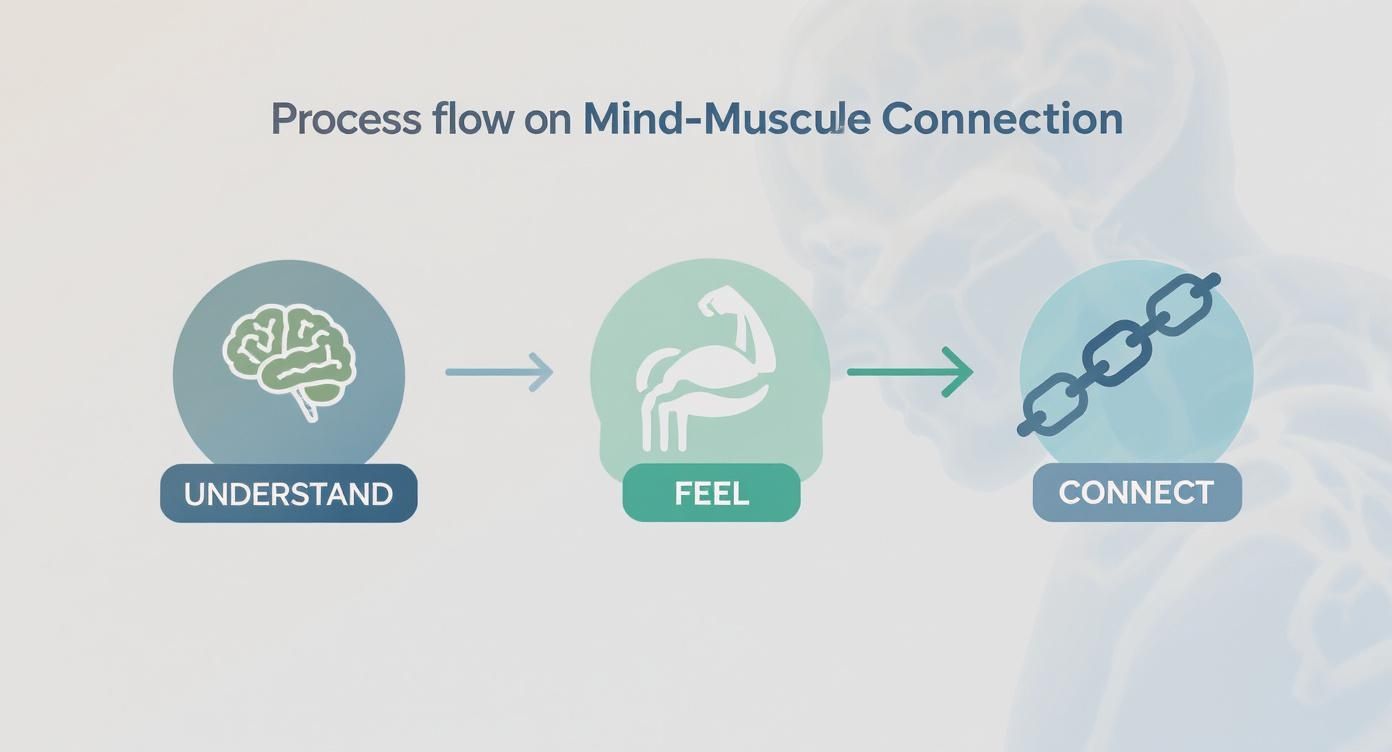
It really is that simple: first you understand the target muscle's function, then you learn to feel its contraction, and finally, you build a solid, reliable connection between your brain and your body.
Upper Body Exercises With Bands
Strengthening your upper body with bands isn't about brute force. It’s about controlled activation of the right muscles—especially the scapular stabilizers that combat poor posture.
Banded Face Pull
This is a non-negotiable for shoulder health and correcting forward-head posture. It’s brilliant for targeting the often-neglected muscles of the upper back and posterior shoulder.
- Primary Muscles Targeted: Posterior Deltoids, Rhomboids, Middle Trapezius, and the external rotators of the rotator cuff (Infraspinatus, Teres Minor).
- Execution Cue: Anchor your band at chest height. As you pull the band toward your face, think about pulling it apart simultaneously. Drive this movement by retracting your scapulae (squeezing shoulder blades together).
- Anatomy Tip: You want to initiate this pull from your upper back, not your biceps. If your arms are taking over, use a lighter band and concentrate on that initial scapular retraction before your arms even begin to bend.
Banded Overhead Press
This is a fantastic shoulder builder that demands significant core stability to prevent lumbar hyperextension (arching the back). The band's ascending resistance challenges the muscles most at the top of the movement.
- Primary Muscles Targeted: Deltoids (all three heads: anterior, lateral, posterior), Triceps Brachii, and your deep core stabilizers (Transverse Abdominis, Multifidus).
- Execution Cue: Stand on the band with one or both feet, holding the other end at shoulder height. Before you press, engage your core by drawing your navel towards your spine. Press straight up, aiming to get your bicep near your ear while maintaining a neutral spine.
- Anatomy Tip: The band is constantly trying to pull you into an anterior pelvic tilt. Your deep core muscles and glutes must co-contract to maintain a neutral pelvic position, making this a highly effective integrated core exercise.
Lower Body Exercises With Bands
Your lower body is your power center. These moves build functional strength from the ground up, targeting the entire hip complex and legs.
Banded Glute Bridge
The undisputed king of glute activation. Placing a mini-band just above your knees adds a frontal plane resistance that forces your gluteus medius (a key hip abductor and stabilizer) to engage.
- Primary Muscles Targeted: Gluteus Maximus (prime mover for hip extension), Gluteus Medius, and Hamstrings (as synergists).
- Execution Cue: Lie on your back with the band above your knees and feet flat. Actively drive your knees outward against the band to pre-activate the gluteus medius before initiating the hip lift. Squeeze your glutes to drive hip extension, creating a straight line from shoulders to knees.
- Anatomy Tip: You should feel this almost entirely in your glutes. If your lower back or hamstrings are cramping, perform a slight posterior pelvic tilt (tucking your tailbone) before you lift to ensure the gluteus maximus is the prime mover.
The real magic of using bands is the tactile feedback they provide. In a glute bridge, that band around your knees is a constant proprioceptive reminder to maintain hip abduction, helping you rewire neuromuscular patterns for better stability.
This popularity isn't just a trend. North America has become the dominant region in the global resistance bands market, accounting for a massive 40.2% of the total market share in 2024. This boom is driven by a strong fitness culture and people who value training tools that are both effective and accessible.
Core Exercises With Bands
A strong core is more than a six-pack. It’s a stable cylinder that transfers force between your upper and lower body, protecting your spine.
Banded Pallof Press
This is one of the best anti-rotation exercises, targeting your core musculature in the transverse plane in a way crunches can't. The band tries to rotate your torso, and your core's job is to resist that force.
- Primary Muscles Targeted: Obliques (internal and external), Transverse Abdominis.
- Execution Cue: Anchor a band at chest height and stand sideways to it. Clasp the band with both hands at your sternum. Slowly press your hands straight out, fighting the rotational pull from the band. Your goal is to keep your pelvis and torso completely still.
- Anatomy Tip: The primary work happens isometrically as your core muscles fire to prevent lumbar rotation. Exhaling sharply as you press out will help you engage your transverse abdominis more deeply.
While bands offer a huge variety of movements, if you're looking to build a well-rounded routine, you can explore other diverse resistance training exercises to complement your band work.
How to Build Workouts That Actually Work
Having a list of exercises is great, but knowing how to program them into a smart, effective workout? That’s where the real magic happens. A great workout is a thoughtful plan that respects your body's physiology, progressively overloads your muscles, and builds in recovery so you adapt and come back stronger.
Think of it like building a house—you wouldn't start without a blueprint. The same principle applies here. Let's move beyond just what exercises to do and get into the why behind the programming variables.
The Building Blocks of a Great Workout
Programming comes down to manipulating a few key variables. Once you understand these, you can tailor any workout to your specific physiological goals, whether that’s building muscular endurance or functional strength.
- Sets: A set is one round of an exercise. For most goals, 3-4 sets per exercise provides sufficient stimulus for adaptation without causing excessive fatigue.
- Reps (Repetitions): This dictates the primary metabolic effect. For muscular endurance, aim for a higher range of 12-20 reps. To promote strength and hypertrophy, use a heavier band and target 8-12 reps, bringing the muscle closer to mechanical failure.
- Tempo: This is the speed of each repetition and is crucial for muscle activation. I'm a big fan of a slow, controlled tempo—like a 3-second eccentric phase and a 3-second concentric phase. This maximizes the muscle's "time under tension," which is a key driver of hypertrophy and forces stabilizer muscles to engage.
- Rest: Rest periods are critical for ATP (energy) replenishment in your muscles. For endurance work, keep rest short (30-45 seconds) to challenge the muscle's metabolic capacity. For strength focus, allow more time (60-90 seconds) for neuromuscular recovery so you can maintain high force output on the next set.
The real art of programming is learning to listen to your body's biofeedback. If your form breaks down on the last few reps, that's a good sign! It means you've achieved sufficient motor unit fatigue. If an exercise feels too easy, it’s time to progress by using a heavier band or increasing reps.
Sample Resistance Band Workouts You Can Do Today
Theory is one thing, but let's put it into practice. Here are two of my favorite mini-workouts designed for efficiency and impact. They're perfect for those days when you're short on time but still want a quality session, especially if you’re working out at home with the best fitness equipment for small spaces.
15-Minute Core Ignition Routine
This quick routine targets your entire core musculature, from the deep stabilizers like the transverse abdominis to the obliques that control rotation.
- Banded Pallof Press: 3 sets of 12 reps per side (45 seconds rest)
- Banded Dead Bug: 3 sets of 10 reps per side (30 seconds rest)
- Plank with Banded Abduction: 3 sets of 15 reps per side (45 seconds rest)
30-Minute Full-Body Burner
In just 30 minutes, this workout hits all the major muscle groups, promoting balanced, full-body strength.
- Warm-up: 5 minutes of light cardio and dynamic stretching (e.g., arm circles, leg swings).
- Banded Squats: 3 sets of 15 reps
- Banded Bent-Over Rows: 3 sets of 12 reps
- Banded Glute Bridges: 3 sets of 20 reps
- Banded Overhead Press: 3 sets of 12 reps
- Cool-down: 5 minutes of static stretching, holding each stretch for at least 30 seconds.
Using Bands for Recovery and Rehabilitation
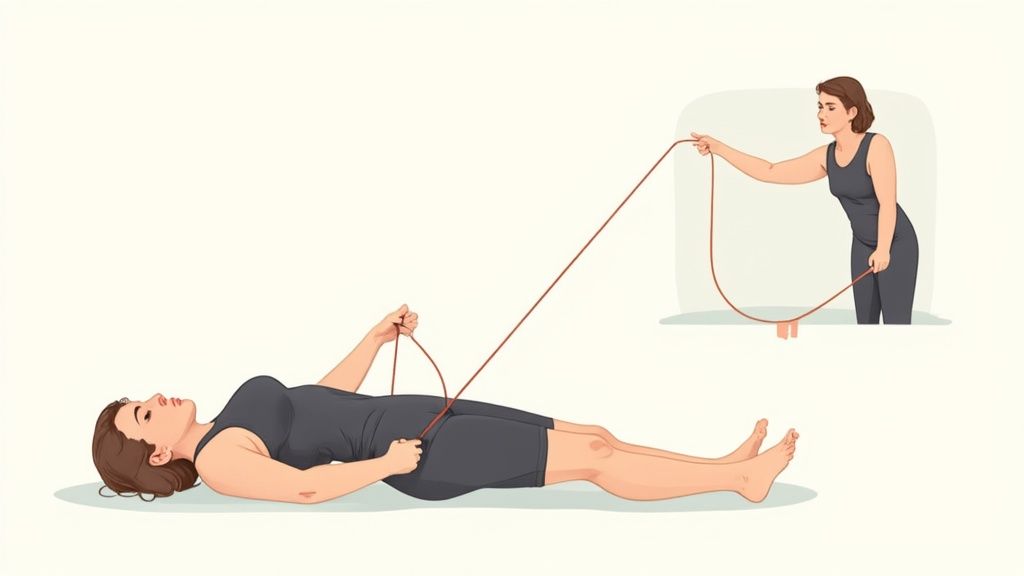
Resistance bands aren't just for building strength—they're one of the best tools we have for rebuilding it. Their gentle, adaptable resistance is why they're a staple in physical therapy. They’re perfect for promoting healing, correcting muscular imbalances, and preventing future injuries.
The magic of using bands for recovery is their ability to provide controlled tension without significant joint loading. This allows you to safely re-establish correct movement patterns and strengthen specific tissues with minimal stress on healing joints, ligaments, and tendons.
This approach is so effective that physical therapists use bands to retrain motor control post-injury. They’re a go-to tool because the resistance is easily gradable and the risk of re-injury is incredibly low.
Targeting Specific Anatomical Needs
In a therapeutic setting, exercises with resistance bands become incredibly precise. It’s not about how much you can lift; it’s about activating the exact muscle needed to restore proper joint arthrokinematics (how joints move).
Take someone recovering from a shoulder impingement. They might use a light band for external rotation exercises. The goal isn't building bulky deltoids, but gently strengthening the infraspinatus and teres minor—two critical rotator cuff muscles. Strengthening these helps depress and stabilize the head of the humerus in the shoulder socket, creating more subacromial space and reducing pain.
Similarly, persistent knee pain often traces back to weak hip stabilizers, specifically the gluteus medius. A physical therapist will prescribe exercises like clamshells or lateral band walks to isolate this muscle. Strengthening it improves pelvic stability in the frontal plane, preventing the knee from collapsing inward (valgus collapse) during gait or squats. You're fixing the biomechanical root cause, not just chasing the symptom.
The slow, controlled nature of these therapeutic band exercises is everything. It’s about re-educating your neuromuscular system—teaching your brain and muscles to fire in the correct sequence again. This mindful work builds a foundation of true, lasting resilience.
Principles for Effective Rehabilitation
When you’re using bands for recovery, the focus shifts entirely to precision, motor control, and listening to your body’s signals.
- Go Light: Always start with the lightest band. The goal is muscle activation and endurance, not maximal force production.
- Slow Down: Perform every repetition with a deliberate, slow tempo. This ensures the target muscle is working, not momentum.
- Focus on Form: Perfect biomechanics are non-negotiable. Even a tiny compensation from a synergistic muscle can defeat the purpose of the exercise.
These gentle, targeted movements are a huge part of many low impact strength training exercises. To get the most out of your recovery workouts and support your body's healing process, you might also consider looking into supplements specifically for muscle recovery.
Your Top Resistance Band Questions, Answered
As you start working with resistance bands, a few questions always seem to pop up. Understanding how bands interact with your anatomy is key to getting great results safely, so let's clear up some of the most common ones.
Can I Actually Build Muscle With Resistance Bands?
Absolutely. Muscle growth (hypertrophy) is a response to mechanical tension and metabolic stress. Bands are exceptional at creating both. To achieve progressive overload with bands, you can use a thicker band, increase the stretch, or decrease rest times.
The constant tension from bands is particularly effective at recruiting stabilizer muscles—like the gluteus medius for hip stability or the rotator cuff for shoulder integrity—that are sometimes under-stimulated by free weights. This comprehensive muscle activation leads to gains in both functional strength and muscle size (hypertrophy).
Which Band Should I Be Using?
This depends on the exercise and the target muscle group. Different bands are designed for different anatomical applications.
-
Large Loop Bands: These are ideal for large, compound movements where you want to load major muscle groups like the quadriceps, glutes, and latissimus dorsi. They're excellent for adding resistance to squats and deadlifts or for assisting with pull-ups.
-
Mini-Bands (Hip Circles): These are perfect for activation and isolation work, especially for the hip complex. Placing a mini-band above the knees during a glute bridge is one of the most effective ways to activate the external hip rotators (gluteus medius and minimus) and improve pelvic stability.
-
Tube Bands with Handles: These are great for mimicking traditional strength training movements. They excel at exercises like a chest press (targeting the pectorals) or a seated row (targeting the rhomboids and latissimus dorsi), offering a familiar motion with the unique challenge of ascending resistance.
My advice? Invest in a set with several resistance levels. This allows you to choose the appropriate load for different muscle groups and exercises.
Are Bands Better Than Dumbbells?
They aren't "better," but they are anatomically distinct tools. It’s like asking if a scalpel is better than a forceps; they serve different purposes.
Bands provide variable resistance, meaning the tension increases as you stretch it. This maximally challenges the muscle at its point of peak contraction. This is fantastic for activating stabilizer muscles and improving joint stability.
Dumbbells, on the other hand, provide constant resistance due to gravity. This is excellent for building maximal strength and power in prime movers. The best approach is often to combine both. This ensures you build a balanced, resilient body by strengthening the large prime movers with weights and the crucial stabilizing muscles with bands.
Ready to experience how anatomy-informed training can change your body? The WundaCore collection is designed from the ground up to help you connect with your muscles and build strength from the inside out. It's time to elevate your home workouts and discover a smarter way to move. Explore the complete WundaCore setup today.