
Best Fitness Equipment for Small Spaces
When you're trying to fit a workout into a small apartment or a crowded room, the right gear can make all the difference. The best equipment for tight spaces is almost always multifunctional. Think adjustable dumbbells that replace an entire rack, versatile resistance bands, or suspension trainers that use your own body weight. These pieces are the MVPs of compact living because they deliver a full-body workout without eating up every last square foot.
Designing Your Space-Saving Home Gym
Turning a forgotten corner into your personal fitness sanctuary is way more doable than you might think. The key is to stop thinking, "I don't have enough space," and start asking, "How can I get the most out of the space I do have?" It all begins with a simple, actionable plan to create a motivating home gym that doesn't add to the clutter. You don’t need a dedicated room—even a small 6x6 foot area can become an incredibly effective fitness hub.
The boom in home workouts, especially in cities where space is a luxury, has completely reshaped the fitness market. In 2025, the at-home fitness market is valued at a whopping $10.11 billion, and it's projected to more than double to $20.56 billion by 2034. This explosion shows just how many people are looking for smart, compact fitness solutions that actually work.
The Anatomy of a Compact Gym
A great small-space gym is built on three simple pillars: multifunctionality, a minimal footprint, and clever storage. When you look at a piece of equipment, don't just see it for its primary function. Instead, think about how many different muscle groups it engages and, just as importantly, how easily it tucks away when you're done.
- Multifunctional Gear: Go for equipment that can work your entire body. A good set of resistance bands, for example, can target your latissimus dorsi and rhomboids (back), pectorals (chest), biceps and triceps (arms), and your quadriceps and glutes (legs).
- Foldable Designs: Keep an eye out for anything that folds or collapses. This is your secret weapon for using vertical space for storage, which keeps your floor clear.
- True Footprint: Always measure a piece of equipment twice: once for when it's in use and again for when it's stored. Something might look tiny when folded up but could require a surprising amount of clearance when you're actually working out.
To really nail your layout, it helps to start with a solid foundation by understanding what is space planning. This strategic mindset ensures every inch of your workout zone is pulling its weight.
This simple flowchart breaks down the process into three manageable steps.
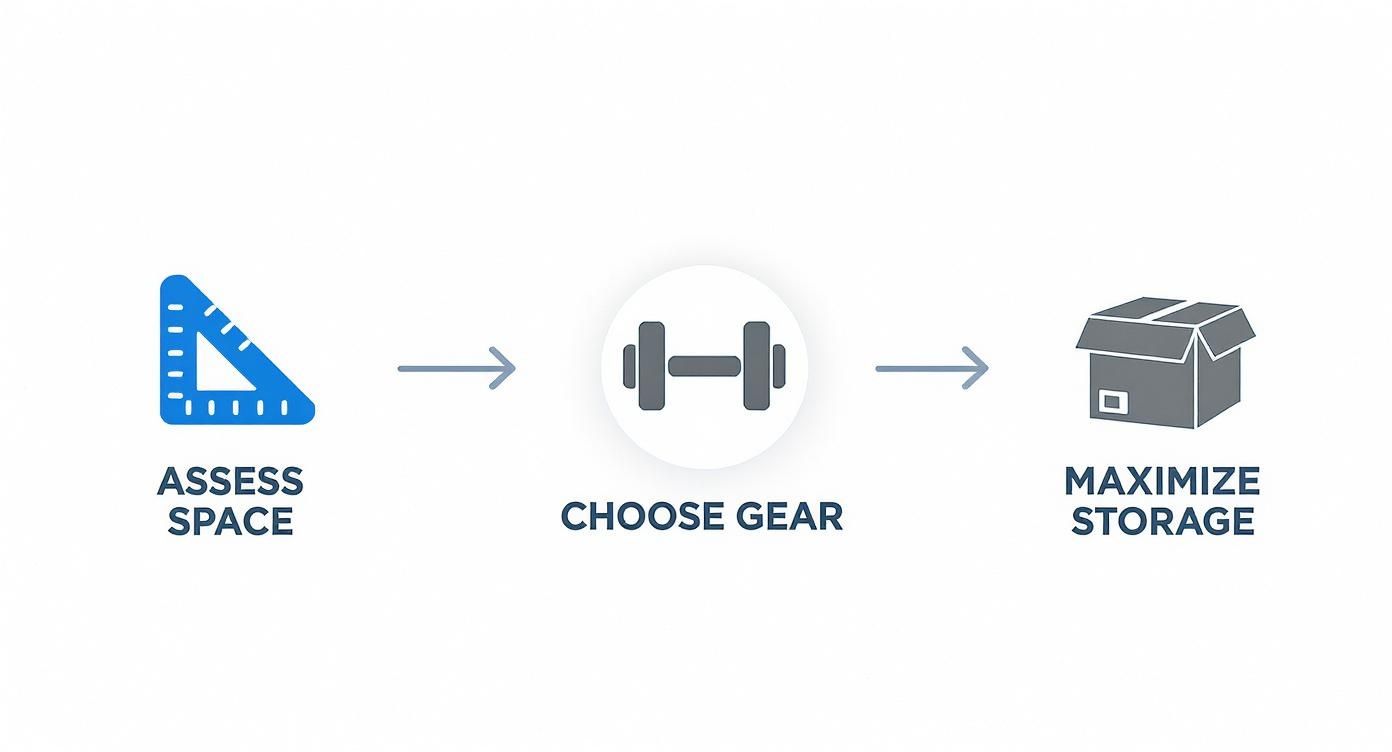
This three-step flow—assess your space, choose versatile gear, and plan your storage—is the blueprint for any successful compact gym. It’s that simple.
A high-quality mat is the unsung hero of any home gym. It’s not just for cushioning your spine and joints during floor exercises; it provides stability for core work and visually defines your workout zone, helping you get in the right mindset. You can dive deeper into why it's so essential in our guide to choosing an exercise and yoga mat.
The Essential Gear for Full-Body Strength
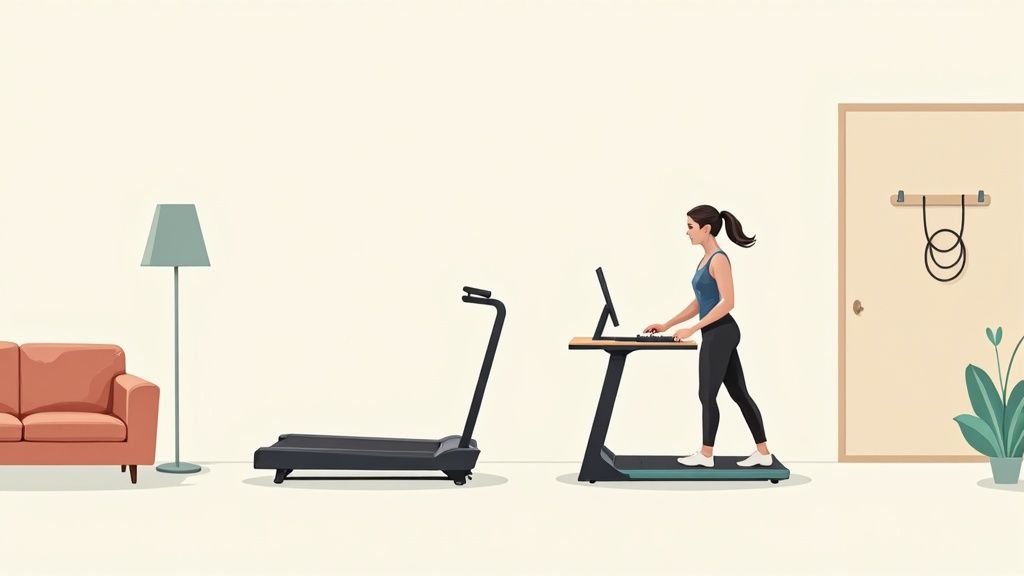
Let's be honest: building a solid strength routine in a small space isn't about collecting a dozen different gadgets. It’s about being selective. You want a few key pieces that act like a Swiss Army knife for your muscles, letting you hit your entire body without turning your living room into a cluttered gym.
The secret is choosing gear that supports progressive overload—that's the anatomical principle of gradually increasing resistance to stimulate muscle hypertrophy (growth). When you do this with smart, space-saving tools, you get real results without sacrificing your floor space.
The Power of Adjustable Weights
Think of adjustable dumbbells as an entire weight rack packed into the footprint of just one pair. A quick turn of a dial takes you from light weights for something like a shoulder raise to a heavy load for squats. It's this kind of adaptability that makes them some of the best fitness equipment for small spaces.
They’re especially great for sculpting your upper body. You can easily target:
- Biceps and Triceps: Move through curls and overhead extensions, adjusting the weight to challenge the biceps brachii and triceps brachii through their full range of motion.
- Shoulders and Chest: Handle shoulder presses to work the deltoids and floor presses to engage the pectoralis major with the exact resistance you need to actually build strength.
An adjustable kettlebell brings that same space-saving magic to more dynamic, full-body moves. With just one kettlebell, you can do swings, goblet squats, and rows that fire up your entire posterior chain—the glutes, hamstrings, and erector spinae—all at once.
The All-In-One Gym in a Bag
If you want the most bang for your buck with almost zero storage footprint, you can’t beat suspension trainers and resistance bands. These tools are genius because they use your own body weight and elastic tension for a workout that can be dialed up or down for any fitness level.
A suspension trainer, for example, lets you change the difficulty of an exercise just by shifting your body's angle. This instability forces deep core muscles like the transverse abdominis and multifidus to fire, building foundational strength with every rep.
Resistance bands are just as powerful. They're a super portable way to add tension to bodyweight moves or even mimic exercises you'd do on a cable machine. They’re also perfect for activating smaller stabilizer muscles, like the gluteus medius or rotator cuff, that free weights sometimes miss. For more ideas, you can check out our guide on adding similar tools like Pilates equipment at home.
The Foundational Role of a Quality Mat
A good mat might not build muscle on its own, but it’s the foundation for almost every other exercise you’ll do. It gives you the cushion and grip you need for floor-based movements like push-ups, planks, and glute bridges—all of which are non-negotiable for building core strength.
A strong core is the centerpiece of all functional movement. It protects your lumbar spine and keeps your posture in check by strengthening the entire cylinder of muscle around your midsection.
When you put these pieces together—adjustable weights, versatile bands, and a supportive mat—you’ve created a complete system for full-body strength that fits right into your life and your home. The growing demand for these kinds of smart home solutions is clear. The home gym equipment market is expected to hit $12.4 billion in 2025 and is projected to climb to $19.6 billion by 2035. You can see more on this trend over at Future Market Insights.
To help you decide, here’s a quick look at how these key pieces of equipment stack up for targeting different muscle groups.
Compact Strength Equipment Muscle Group Focus
| Equipment Type | Primary Muscle Groups | Storage Footprint | Key Benefit |
|---|---|---|---|
| Adjustable Dumbbells | Biceps, Triceps, Deltoids, Pectorals, Latissimus Dorsi, Quadriceps | Small (fits in a corner) | Replaces an entire weight rack, allowing for progressive overload. |
| Adjustable Kettlebell | Glutes, Hamstrings, Erector Spinae, Latissimus Dorsi, Deltoids | Very Small (single unit) | Excellent for dynamic, full-body power and cardio movements. |
| Suspension Trainer | Pectorals, Latissimus Dorsi, Transverse Abdominis, Biceps, Triceps | Minimal (hangs in a closet) | Uses bodyweight for a highly scalable, full-body workout. |
| Resistance Bands | Gluteus Medius, Rotator Cuff, Rhomboids, Core (stabilizers) | Tiny (fits in a drawer) | Portable and perfect for activation, rehab, and adding tension. |
| WundaCore | Deep Core (Transverse Abdominis, Multifidus), Glutes, Adductors, Erector Spinae | Minimal (slides under a sofa) | Targets core stability and foundational strength patterns. |
Choosing the right combination from this list will give you the power to build a truly effective, well-rounded strength routine that respects your limited space.
Finding Cardio Solutions That Actually Fit
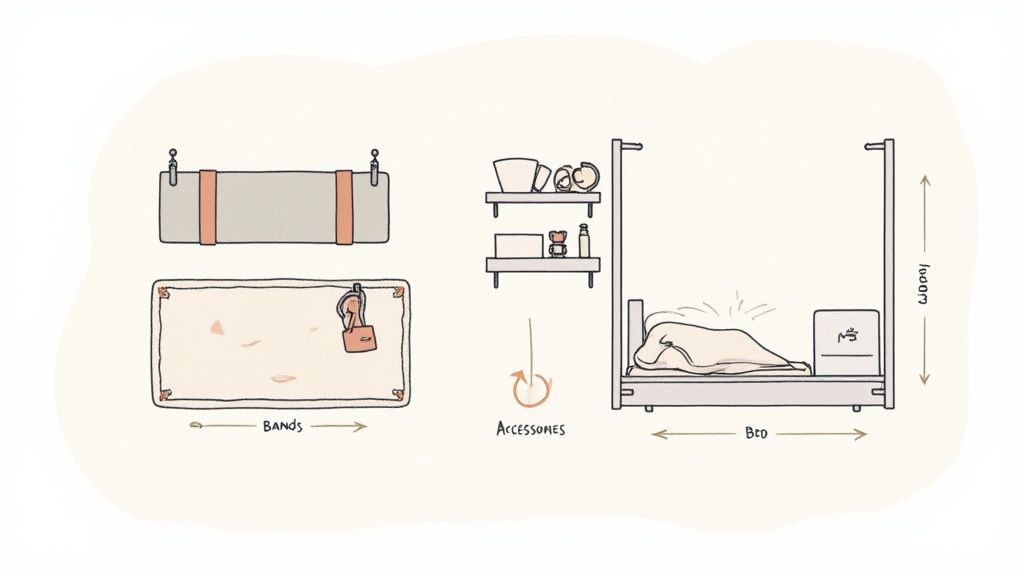
Getting your heart rate up shouldn't mean sacrificing half your living room to a clunky machine. Thankfully, modern cardio equipment has evolved. Today's options are engineered for tight quarters, delivering powerful workouts that strengthen your most important muscle—the heart—without dominating your home.
The goal is simple: elevate your heart rate, improve circulation, and boost your overall cardiovascular endurance. By integrating short bursts of cardio, you train your heart (the cardiac muscle) to pump blood more efficiently, which is the foundation for any fitness goal.
Under-Desk and Foldable Treadmills
The rise of the "walking pad," or under-desk treadmill, is a true game-changer for anyone working from home or living in a small apartment. These ultra-slim machines slide effortlessly under a sofa or bed, making them practically invisible when you're done. They are the perfect tool for weaving low-impact movement into your day.
From an anatomical perspective, walking engages the entire lower body. Consistent use strengthens:
- Glutes and Hamstrings: The posterior chain muscles that power hip extension with every stride.
- Quadriceps and Calves: The muscles at the front of your legs (quadriceps) and back of your lower leg (gastrocnemius and soleus) responsible for pushing off.
- Core Stabilizers: Your abdominal and lower back muscles, which engage to maintain pelvic stability and upright posture with every step.
This makes them one of the best pieces of fitness equipment for small spaces when you need to stay active but don't have a dedicated block of time for a workout.
Mini-Steppers and Jump Ropes
For those who want a bit more intensity in a tiny package, mini-steppers and jump ropes are unbeatable. A mini-stepper mimics climbing stairs, giving you a super-concentrated lower-body workout. The constant stepping motion specifically targets and builds endurance in your gluteus maximus and quadriceps, creating a powerful burn in a remarkably small footprint.
The classic jump rope, however, is a full-body conditioning powerhouse. It does more than just get your heart pounding; it’s a masterclass in coordination and muscular engagement.
Jumping rope activates your calves, quads, and glutes for explosive power, but it also engages your deltoids, rotator cuff, and core to control the rope’s rotation. This synchronization builds neuromuscular coordination—the communication between your central nervous system and your muscle fibers. It's an incredible tool for improving agility and cardiovascular health, all while fitting neatly inside a drawer.
Smart Layouts and Storage to Maximize Your Space
Owning the right compact fitness gear is a fantastic first step, but the real magic in creating a functional home gym lies in a smart layout. The goal is to carve out a zone that feels intentional and inviting, not like you're navigating an obstacle course just to get a workout in. With a bit of strategic thinking, you can design a space that flows, making it incredibly easy to start—and more importantly, stick with—your fitness routine.
It’s an approach more and more people are embracing. The global market for small fitness equipment is actually projected to hit $2,729.8 million by 2025, which is a huge indicator of how much we want to integrate wellness right into our living spaces. You can learn more about these market findings if you're curious, but the takeaway is clear: creating a dedicated fitness space at home is no longer a luxury, it's a priority.
Creating Functional Workout Zones
Even if you live in a studio apartment, you can absolutely create a dedicated workout zone. The trick is to think in terms of movement patterns and easy access to your gear. You want to arrange things so you can flow from one exercise to the next without a major furniture shuffle.
A simple but incredibly effective way to do this is with a "station" approach. Even in a tiny corner, you can designate specific spots for different activities.
- Floor Station: Your movement mat is the anchor here. Keep this area clear for core work, stretching, and any bodyweight exercises. All you really need is enough space to lie down and extend your arms and legs to avoid compromising your range of motion.
- Strength Station: This is where you'll place your adjustable dumbbells or kettlebell. If you've got a foldable bench, set it up so you have enough clearance on both sides for exercises like presses and rows, allowing for full muscle contraction.
- Cardio Station: If you’re a fan of jumping rope, make sure you have enough vertical clearance to avoid hitting the ceiling. For things like a mini-stepper or a walking pad, you can just tuck it against a wall when it's not in use.
This zoned setup does more than just organize your stuff; it helps create mental boundaries, signaling to your brain that when you step into this space, it’s time to focus on you.
Unlocking Vertical and Hidden Storage
When your floor space is at a premium, the only way to go is up. Vertical storage is your absolute best friend for keeping a small area tidy and functional. Wall-mounted racks or simple hooks are perfect for hanging resistance bands, jump ropes, and even your mat. This gets your equipment off the floor and turns it into a neat, organized display.
Smart storage isn't just about being tidy; it's about reducing friction. When your equipment is easy to access and put away, you remove one of the biggest barriers to starting a workout.
Hidden storage is just as crucial. Think about furniture that can pull double duty, like an ottoman bench that opens up to store your weights or a slim container that slides right under your bed with all your accessories. For spaces that need to be truly flexible, you can integrate furniture that disappears completely. Innovative Murphy cabinet and chest beds, for instance, can free up a huge amount of floor space for more dynamic workouts. By combining these vertical and hidden solutions, you can maintain a beautiful, uncluttered home that’s always ready for a great workout.
Your Blueprint for Compact Gym Workouts
Okay, you’ve mapped out your space and picked your gear. Now for the fun part: putting it all into motion. After all, even the smartest fitness equipment for small spaces is only as good as the work you put in with it.
I've put together three distinct routines to get you started. Think of these as your go-to blueprints for building a strong, balanced body, each one designed to be incredibly efficient and hit key muscle groups. Whether you're short on time or ready for a focused strength day, there’s a plan here for you.
Routine 1: Full-Body HIIT
This is your secret weapon for those crazy-busy days. In just 15 minutes, you can get a killer workout that torches calories and gets your heart pumping. All you need is a jump rope and some resistance bands. The goal here is to push your cardiovascular system hard while activating your major muscle groups.
- Jump Rope (3 minutes): Start here. A nice, steady pace will warm up your entire body, especially your gastrocnemius and soleus (calves), quadriceps, and core.
- Banded Squat to Press (10-12 reps): Stand on a resistance band, holding the ends at your shoulders. This compound movement targets the glutes, quads, and deltoids, engaging the lower and upper body simultaneously.
- Banded Rows (12-15 reps): Anchor your band to something solid. Pull it back, focusing on scapular retraction to activate your latissimus dorsi and rhomboids, the key muscles for posture.
- Mountain Climbers (45 seconds): Drop down to the floor for this classic. It's an amazing finisher that recruits your abdominals, hip flexors, and deltoids for stability.
The secret to making this work is to repeat the circuit as many times as you can in those 15 minutes. Rest only when you absolutely have to. This keeps your heart rate soaring and makes every second count.
Routine 2: The Strength Builder
When you have a bit more time—say, 30 minutes—this is your session. It’s a focused strength workout using adjustable dumbbells and a mat to build real, functional power. We're focusing on compound movements that recruit multiple joints and muscles for maximal efficiency.
- Goblet Squats (3 sets of 10 reps): Hold one dumbbell close to your chest and focus on sinking deep into your squat. This is a game-changer for building strength in your quadriceps, glutes, and core erector spinae.
- Dumbbell Bench Press (3 sets of 8 reps): You can do this on a foldable bench or right on your mat. It’s a classic for a reason, targeting your pectoralis major, anterior deltoids, and triceps.
- Dumbbell Rows (3 sets of 10 reps per side): This move isolates the big muscles of your upper back, hitting the latissimus dorsi and trapezius to build a strong, supportive frame.
- Plank (3 sets, hold for 45 seconds): Finish strong with the ultimate core stabilizer. This creates an isometric contraction in your abdominals and obliques, building deep strength.
Routine 3: Core and Tone
This 20-minute, low-impact workout is perfect for active recovery days or when you just want to tune in and focus on control. It’s all about strengthening those deep core muscles that provide spinal stability and a toned midsection. A simple resistance band is all you need to add a nice challenge.
You can find even more ideas in our guide on the best resistance bands for Pilates.
- Glute Bridges (15 reps): Pop a loop band around your thighs, just above the knees, for added resistance. This simple move isolates and activates your gluteus maximus and hamstrings.
- Banded Clamshells (15 reps per side): This is my favorite for targeting the gluteus medius, a key hip abductor muscle crucial for pelvic stability.
- Bird-Dog (10 reps per side): A true Pilates staple. This exercise is all about balance and control, engaging your erector spinae and abdominals to stabilize the spine during limb movement.
- Dead Bug (12 reps): Don’t let the name fool you. This is one of the best moves for strengthening the deep transverse abdominis while keeping your lumbar spine safely supported.
To help you put it all together, here’s a simple schedule you can follow to ensure you’re getting a well-rounded week of movement.
Sample Weekly Compact Workout Plan
This schedule is just a starting point! Feel free to move days around to fit your life, and always listen to your body. The key is consistency.
| Day | Workout Focus | Routine Example | Duration |
|---|---|---|---|
| Monday | Strength | Routine 2: The Strength Builder | 30 Minutes |
| Tuesday | Cardio & HIIT | Routine 1: Full-Body HIIT | 15 Minutes |
| Wednesday | Core & Active Recovery | Routine 3: Core and Tone | 20 Minutes |
| Thursday | Strength | Routine 2: The Strength Builder | 30 Minutes |
| Friday | Cardio & HIIT | Routine 1: Full-Body HIIT | 15 Minutes |
| Saturday | Active Recovery | Light activity like walking or stretching | 30 Minutes |
| Sunday | Rest | Full rest day | - |
Mixing these routines throughout the week will help you build muscle, improve your cardiovascular health, and enhance your core stability without ever leaving your home. Enjoy the process
Answering Your Small-Space Gym Questions
Starting to plan a home gym brings up a ton of questions, especially when you're working with limited real estate. It's totally normal. Let's walk through some of the most common hurdles people face and find solutions that will help you build a workout space that genuinely works for you.
What Is the Single Most Versatile Piece of Equipment?
If I had to pick just one thing, a solid set of adjustable dumbbells would be at the top of my list. They're an incredible investment. From an anatomical perspective, they’re the simplest way to achieve progressive overload—the key to building strength and muscle hypertrophy.
With just one pair, you can hit every major muscle group, from your pectorals and latissimus dorsi to your quadriceps. They take up almost no floor space and slide right under a bed or into a closet. If you're looking for something with zero impact that still fires up your entire system, a good suspension trainer is a very close second. It uses your own body weight for resistance, forcing your deep stabilizer muscles to kick in and improving your neuromuscular coordination with hundreds of possible exercises.
How Can I Protect Floors and Avoid Disturbing Neighbors?
This is a huge one, especially for apartment dwellers where sound and impact travel right through the building. The easiest and most effective fix is a set of high-density rubber or foam interlocking mats. These mats do two crucial things: they absorb the shock from high-impact moves, which is kinder to your joints (like your knees and ankles), and they seriously dampen the noise, keeping your downstairs neighbors happy.
When you're doing anything with impact, like jumps, or even just setting down weights, really focus on eccentric control—the lowering phase of a movement—to land softly. That little bit of muscular control makes a big difference. Another great option is to swap in resistance bands for some of your strength work—they provide constant muscle tension without any of the clanking of traditional weights.
Can I Get a Good Cardio Workout Without a Machine?
Absolutely. You don't need a bulky treadmill to get your heart pumping. High-Intensity Interval Training (HIIT) is one of the most efficient ways to boost your cardiovascular health, and you can do it in a tiny footprint. A simple jump rope gives you a phenomenal, full-body workout that gets your heart rate up while strengthening the bones and muscles in your lower body through plyometric action.
Bodyweight circuits are also fantastic. Stringing together exercises like burpees, high knees, and mountain climbers will have you breathing hard in no time, effectively conditioning your heart and lungs. For a lower-impact day, a mini-stepper or a foldable walking pad are both great for keeping your cardio fitness up without stressing your joints.
A lot of people think you need a big, expensive machine for effective cardio. The truth is, your body’s largest muscles are your engine, and you can fire them up powerfully with almost no equipment at all.
Is a Foldable Workout Bench a Necessary Investment?
A foldable bench is a game-changer if your routine revolves around dumbbell work. It provides critical support for your spine during essential exercises like chest presses, incline presses, and rows. That stability is what allows you to properly isolate the muscles you’re trying to work—like your pectoralis major or latissimus dorsi—and move with good form, which is key for preventing injury.
But is it necessary? If your workouts are more focused on bodyweight exercises, Pilates, or resistance bands, you can definitely get by without one. For anyone serious about lifting free weights in a small space, though, it unlocks a much wider range of exercises and makes your whole routine safer and more effective.
Ready to build a strong, stable core that supports every movement you make? The WundaCore collection is designed to bring anatomy-informed, studio-quality Pilates right into your small space. Discover our supportive mats, resistance tools, and on-demand classes to move better and feel stronger. Explore the collection at WundaCore.