
Your Guide to Pilates Equipment at Home
Picture this: a space in your own home, set up perfectly for your body's unique structure, ready to go the moment you are. That’s the real magic of creating your own home Pilates studio. Having the best pilates equipment at home isn't just about convenience; it's about committing to a deeper, more personal conversation between your brain and your muscular system.
Why a Home Pilates Studio Is Your Secret Weapon
Setting up your own practice space is all about two things: consistency and anatomical precision. When your equipment is right there, you eliminate the single biggest obstacle to your fitness goals—friction. No more commuting, no more trying to fit a class schedule into your already packed day. It’s just you and the tools you need to support your body's unique biomechanics. That consistency is what truly builds lasting change in your core strength and spinal alignment.
A dedicated home setup also gives you the quiet to turn your focus inward. Instead of getting distracted in a busy class, you can tune into the small signals your body is sending. You’ll learn to feel the deep, wrapping engagement of your transverse abdominis (your body's natural corset) or notice how a tiny pelvic tilt suddenly fires up your gluteal muscles. This kind of proprioceptive awareness is the bedrock of a safe, effective Pilates practice.
Building Your Anatomical Awareness
The right equipment doesn't just make exercises harder; it acts as your personal anatomy guide, giving you tactile feedback that's nearly impossible to get from bodyweight exercises alone. It helps you find and hold proper alignment and zero in on specific muscle groups with laser-like accuracy.
- Spinal Support: A good mat is more than padding. It protects your vertebrae during rolling movements, allowing your deep abdominal muscles to do the work without putting compressive strain on your spine.
- Targeted Resistance: Tools like resistance bands or a Pilates ring are incredible for isolating and activating the smaller, stabilizing muscles around your joints—think the rotator cuff in your shoulder or your deep hip rotators like the piriformis.
- Neuromuscular Connection: Equipment gives you something tangible to push or pull against. This resistance enhances the neural pathway between your brain's intention and the physical reality of a muscle contracting.
This focused, at-home approach is really taking off. The global market for Pilates equipment is expected to hit $377.67 million by 2025, largely because so many people are investing in creating their own practice spaces. You can learn more about the growth of the Pilates equipment market and see just how big this movement has become.
At its core, Pilates is an anatomical conversation. A home studio gives you the quiet space and consistent tools to truly listen to your body, respond to its needs, and guide it toward its strongest, most aligned state.
Decoding the Essential Home Pilates Tools
Stepping into the world of at-home Pilates equipment can feel a bit overwhelming, but let's reframe how we look at it. Think of each piece of equipment not as a complicated machine, but as a partner that helps you communicate more clearly with your own body. These tools provide feedback, offer support where your anatomy needs it, and add just the right amount of challenge to help you connect with your musculature on a much deeper level.
Every single piece of gear is designed with a specific anatomical purpose in mind. Take a high-quality mat, for example. It's so much more than just a comfy cushion—it's the literal foundation of your practice. When you're doing an exercise like the Hundred, that mat provides essential support for your spine, freeing up your deep core muscles—your transverse abdominis and obliques—to fire properly without unnecessary strain on your lumbar spine.
The mat is where most people begin their journey, and its explosion in popularity mirrors the massive shift toward wellness at home. The global market for yoga and Pilates mats was valued at a staggering $1,576.3 million in 2025 and is expected to hit $2,981.4 million by 2035. That’s a whole lot of people rolling out their mats! It just goes to show how fundamental this simple tool has become.
How Resistance Shapes and Strengthens
Now, let's talk resistance. Larger studio equipment like the Reformer uses springs to create eccentric muscle contractions. This is the physiological magic that happens when a muscle lengthens while still under tension—picture the control it takes to slowly lower a heavy weight instead of just letting it drop. This type of work is what builds long, resilient muscle fibers, targeting everything from your powerhouse core to the smaller muscles in your limbs.
But here’s the great news: you don't need a huge, expensive machine to get the benefits of resistance training. Smaller, more apartment-friendly tools can give you many of the same anatomical benefits.
- The Magic Circle: This simple ring is a master of tactile feedback. When you squeeze it between your inner thighs, you can’t help but feel your adductor muscles instantly switch on. Place it between your hands, and you’ll activate your pectoral muscles and the crucial stabilizers around your scapulae (shoulder blades).
- Resistance Bands: Bands are fantastic for zeroing in on specific muscle groups. Loop a band around your thighs during a bridge, and you'll immediately feel your gluteus medius—a key hip abductor—light up. They're also my go-to for external rotation exercises to build rotator cuff stability. For more ideas, check out our guide on finding the best resistance bands for Pilates.
This whole-body connection is what a great home Pilates practice is all about—linking core strength, better posture, and that all-important mind-body relationship.
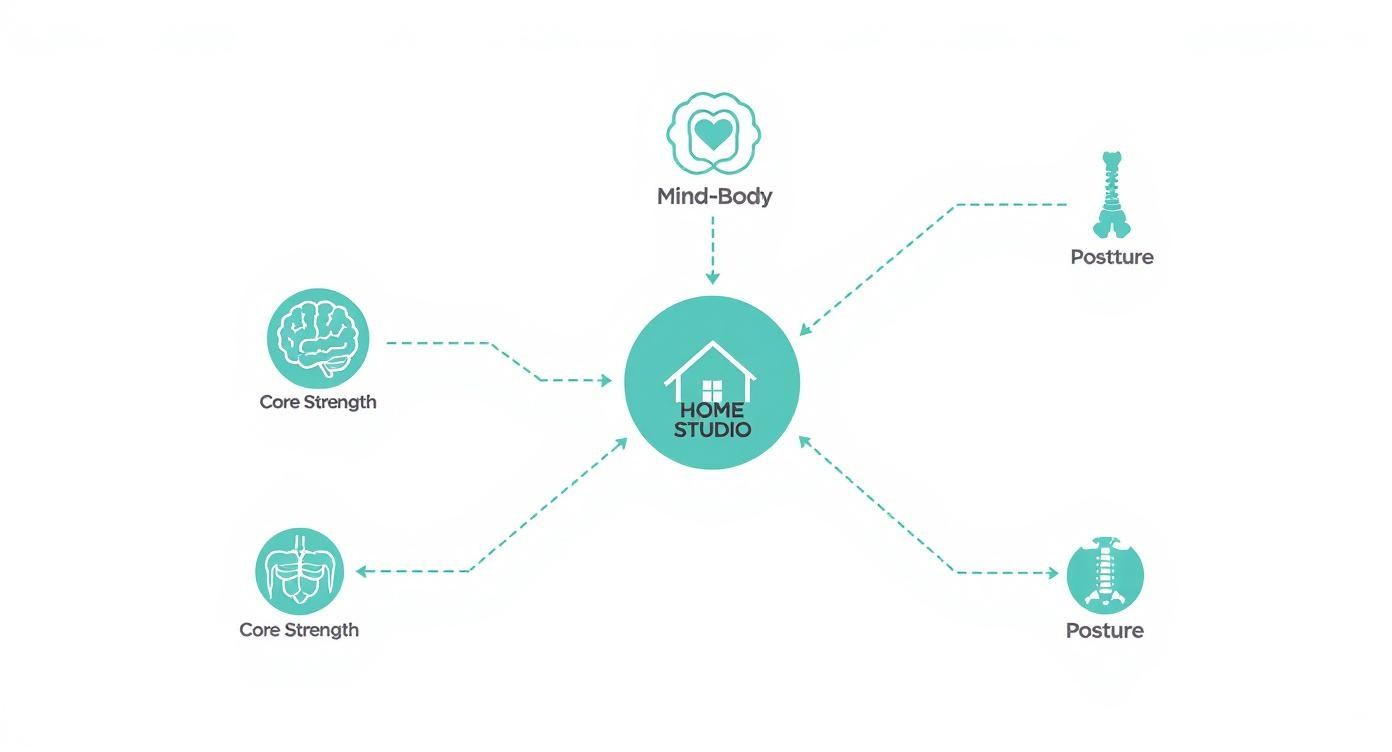
As you can see, it’s all connected. When you improve one area, you naturally lift the others, creating a powerful cycle of physical and mental progress.
To make it even clearer, here’s a quick breakdown of some essential pieces and what they do for your body.
Essential Pilates Equipment and Its Anatomical Focus
| Equipment | Primary Anatomical Focus | Ideal for Home Use |
|---|---|---|
| Pilates Mat | Core (Transverse Abdominis, Obliques), Spinal Articulation | Foundation: Provides essential cushioning for the vertebral column and a dedicated space for floor-based exercises. |
| Magic Circle | Inner/Outer Thighs (Adductors/Abductors), Pectorals, Latissimus Dorsi | Clarity: Excellent for giving tactile feedback to help you "find" and engage specific muscle groups. |
| Resistance Bands | Glutes (especially Gluteus Medius), Rotator Cuff, Hamstrings | Versatility: Perfect for targeted strengthening of smaller stabilizers, adding challenge, and assisting with stretches. |
| Foam Roller | Thoracic Spine Mobility, Iliotibial (IT) Band, Myofascial Release | Recovery & Mobility: Great for releasing adhesions in fascia and improving flexibility and spinal movement. |
| Small Stability Ball | Deep Core Stabilizers (Multifidus), Inner Thighs, Pelvic Floor | Precision: Adds an element of instability to challenge your deepest core muscles and refine pelvic alignment. |
Each of these tools offers a unique way to deepen your practice and understand your body's mechanics a little better.
Your Personal Anatomy Coach
Ultimately, every piece of equipment acts like your own personal anatomy coach. It guides your body into better alignment and helps you connect with muscles you might not have even known were there. It’s what turns an abstract cue like "engage your core" into a palpable muscular contraction you can actually replicate.
The 'why' behind each piece of gear is its unique ability to communicate with your anatomy. The right tools don't just add difficulty; they add clarity, teaching you how to move with more intelligence, precision, and power from the inside out.
This is the secret sauce that transforms a random set of exercises into a truly intelligent and effective practice. When you choose tools that support your body and match your goals, you create a home setup that is not only safe but will deliver incredible results.
How to Choose the Right Home Pilates Reformer
The reformer is the heart and soul of so many Pilates practices. When you decide to bring one into your home, you're not just buying a piece of equipment—you're choosing a partner for your body's journey. The right machine will support your spine, challenge your core musculature in a whole new way, and feel like it was made just for your skeletal structure.
With so many people discovering the power of at-home Pilates, the market for these incredible machines has exploded. It’s projected to be a $250 million industry by 2025, and that number is only expected to climb. If you want to dive deeper into the numbers, you can check out some fascinating insights on this growing fitness trend at Archive Market Research.
This growth is great news for you. It means more choices, from clever, space-saving models to full-blown studio-quality reformers. But beyond the price tag and footprint, the most critical features are the ones that protect and support your unique anatomy.
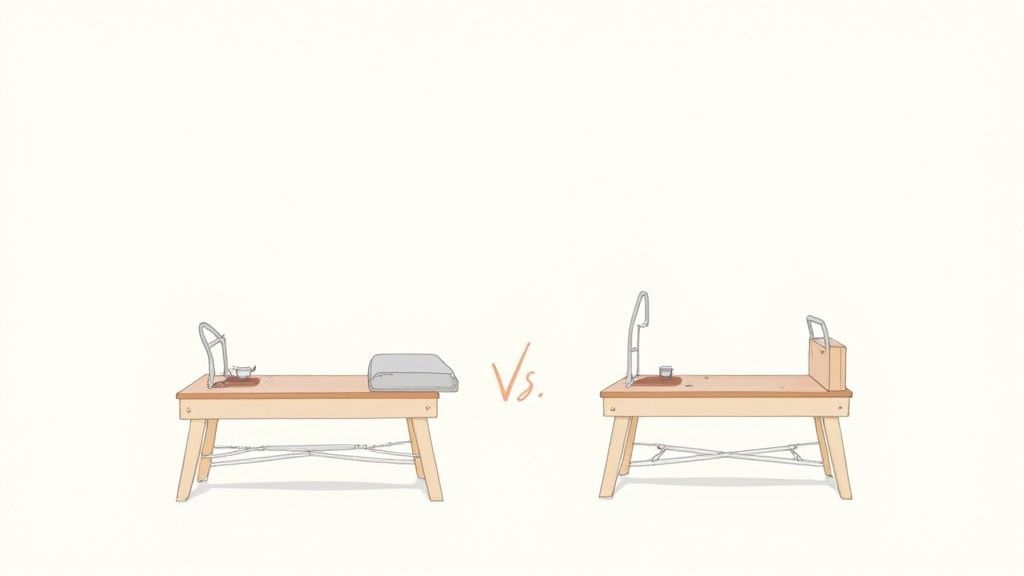
Prioritizing Spinal Alignment and Safety
When you’re looking at pilates equipment at home, especially a reformer, adjustability is everything. Your body isn't one-size-fits-all, and your reformer shouldn't be either. A machine that doesn't fit your limb length can encourage poor form and even lead to biomechanical strain. For me, two features are completely non-negotiable.
- Adjustable Footbar: This lets you find the perfect position for your femur and tibia length. Proper placement is the key to maintaining a neutral pelvis and spine, which prevents your lumbar erector spinae muscles from overworking.
- Adjustable Headrest: A headrest that can lie flat or prop up is essential for supporting the natural lordotic curve of your cervical spine. It’s a small detail that makes a huge difference, preventing neck strain and ensuring your alignment is optimal from your skull to your sacrum.
These adjustments mean the machine works for your anatomy, not against it. This frees you up to focus on what really matters: connecting with the correct muscles instead of fighting with your equipment.
The Powerhouse and Progressive Overload
The real magic of the reformer is its spring system. The springs offer a unique kind of resistance that challenges your muscles through their entire range of motion—something free weights just can't replicate. This is how we safely build strength in the powerhouse: that deep network of muscles in your abdominals, glutes, lower back, and pelvic floor that acts as your body's true center of stability.
A reformer's adjustable spring tension is the key to progressive overload. By changing the spring combination, you can consistently and safely challenge your muscles, encouraging them to adapt and grow stronger without putting undue compressive stress on your joints.
This system is beautifully nuanced. You can make tiny adjustments to the resistance, which makes it perfect for everyone from absolute beginners to seasoned pros. Sometimes, a lighter spring setting is actually more challenging for your deep core stabilizers, while heavier springs build serious muscular strength. It's this versatility that ensures your home reformer will grow with you. To see these ideas in action, take a look at our breakdown of essential Pilates reformer exercises.
Ultimately, choosing a reformer is an investment in your well-being. By focusing on features that support proper anatomical alignment—like an adjustable footbar, headrest, and customizable spring tension—you'll ensure your pilates equipment at home is a safe, effective tool for building strength from the inside out for years to come.
Designing Your Ideal Home Practice Space
Your workout space is more than just a room—it’s an environment that can either support or hinder your practice. How you set up your pilates equipment at home isn't about interior decorating; it's about engineering a safe, motivating zone where your body can move freely and your mind can connect with your anatomy.
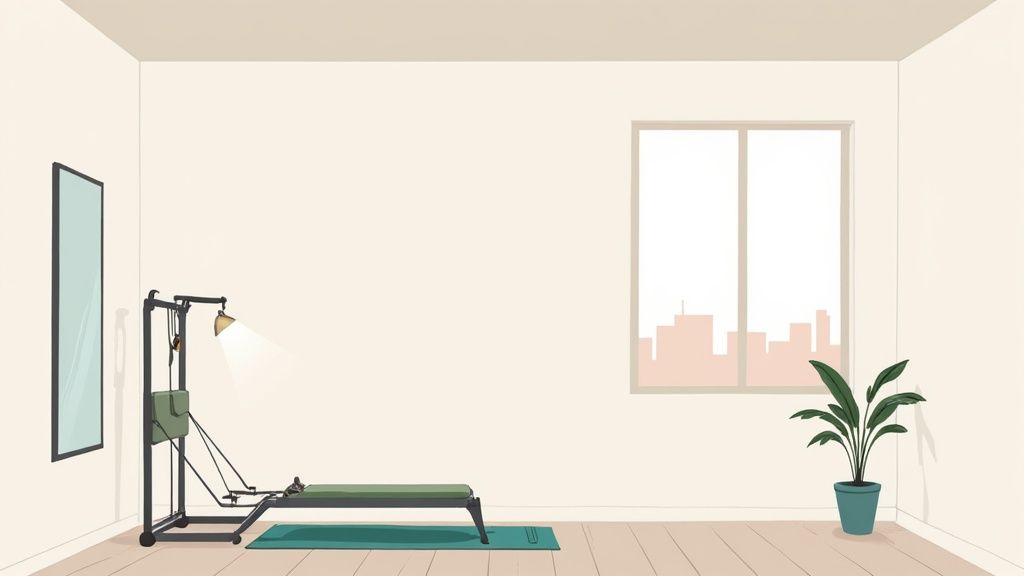
Let's start with the practicalities, because safety is the foundation of any good practice. Before you even think about unrolling a mat or setting up a reformer, check your floor. It needs to be level and stable. An uneven surface can throw off your skeletal alignment and put abnormal stress on your joints, which is the exact opposite of what Pilates is meant to do.
Engineering a Safe Anatomical Zone
Space is another non-negotiable. You absolutely need enough room to move through a full range of motion without your limbs hitting furniture. This is essential for getting those muscle-lengthening benefits from exercises like Leg Circles or the Swan. A good rule of thumb is to have at least two feet of clear space on all sides of your mat or reformer.
Before you start any session, run through these quick safety checks. It takes less than a minute.
- Grip Check: Make sure your mat isn’t going to slide around. A slippery surface can compromise your balance and knock your spine out of alignment during dynamic movements. We cover this in our guide to choosing the right exercise and yoga mat.
- Spring Inspection: If you're on a reformer, give your springs a quick once-over. Look for any signs of wear or overstretching to make sure you're getting consistent, reliable resistance.
- Strap Security: Check that all your straps and loops are fastened securely and aren't frayed. You want to be confident they can support you safely through every movement.
Enhancing the Mind-Body Connection
Once you’ve established physical safety, you can add elements that sharpen your mental focus and proprioception—your body’s internal GPS for limb and joint position. This is where the magic of the neuromuscular connection really happens.
A mirror is one of the most powerful tools you can have. It gives you instant visual feedback, so you can self-correct your form in real-time. Is your spine neutral? Are your scapulae depressed? Is your transverse abdominis truly engaged? A mirror tells all.
Simple things make a big difference, too. Think about calming, dimmable lighting and good ventilation. Your working muscles need oxygen, and a serene atmosphere helps you tune out the noise and listen to your body's physiological signals.
If you really want to create a space you love, understanding a few fundamental interior design concepts can be a game-changer. A well-designed space doesn't just look good—it makes your practice safer and a whole lot more enjoyable.
Bringing Expert Guidance into Your Home Studio
Having the right Pilates equipment at home is a fantastic start, but it's really only half the equation. To truly unlock the anatomical benefits and see real change in your body, you need expert instruction. This is where streaming classes come in, bridging the gap by bringing the structured programming and nuanced biomechanical cues of a certified instructor right into your living room.
Without that guidance, it’s all too easy to miss the tiny adjustments that make a huge difference. An instructor’s voice can be the reminder you need to draw your navel to your spine (activating the transverse abdominis!) or to keep your ribs soft instead of flaring them (preventing hyperextension of the thoracic spine). These cues are everything when it comes to mastering proper form, preventing injury, and ensuring you’re actually recruiting the muscles you intend to work.
Choosing Your Virtual Instructor
Let's be honest, not all online platforms are created equal. When you're picking a service, you want to find one that truly prioritizes anatomical understanding and offers a deep library of classes. This ensures you can always find workouts that match your equipment, whether you’re on a mat, a reformer, or just using smaller props.
Here’s what I tell my clients to look for in a quality streaming service:
- Certified Instructors: Look for teachers with comprehensive certifications who emphasize proper form and biomechanics, not just speed or intensity.
- Variety of Levels: A good platform will guide you through clear progressions. You should see foundational beginner classes all the way up to advanced sessions, allowing you to build strength safely and at your own pace.
- Diverse Equipment Use: Find a library with dedicated classes for the specific props you own. This is key to getting the most out of your investment.
Great instruction is all about translating anatomical concepts into sensations you can actually feel in your body. When an instructor cues you to "press through your heels to activate your glutes," they're giving you a direct roadmap to a deeper neuromuscular connection. Suddenly, a simple movement becomes a purposeful, muscle-shaping exercise.
Setting Up for Success
To get that studio-quality experience at home, your setup really matters. You need to be able to see the instructor clearly—and allow them to see you, if you’re in a live class—without compromising your own posture.
Try positioning your screen (whether it's a laptop, tablet, or TV) slightly above eye level. It should be far enough away that you can see it from your mat without craning your neck. This simple adjustment helps you maintain the natural alignment of your cervical spine, preventing strain while you follow along. By pairing your high-quality equipment with expert virtual guidance, you're creating a home studio that is powerful, safe, and incredibly effective.
Smart Equipment Bundles for Your Fitness Goals
Choosing the right Pilates equipment for your home shouldn't be a puzzle. Think of it less like shopping and more like curating a personalized toolkit for your body. The real goal is to find pieces that work together to help you meet your specific anatomical goals, whether you're trying to activate your deep core stabilizers or you're ready to build long, resilient muscle.
To make it simple, we've put together three WundaCore bundles. Each one is designed to support a different stage of your journey, creating a complete system where every tool makes the others even more effective.
The Core Foundation Bundle
This is where it all begins. If you're new to Pilates or feel like you've lost touch with your body’s powerhouse—that deep network of muscles including the transverse abdominis, pelvic floor, and diaphragm—this bundle is for you.
- WundaCore Movement Mat: This isn't just any mat. It provides essential cushioning for your spine and a stable, non-slip surface for all your foundational work.
- WundaCore Resistance Ring: An amazing tool for tactile feedback. When you squeeze it between your inner thighs, you can’t help but find and activate your adductors and pelvic floor. It’s an instant connection.
- Light Resistance Bands: Perfect for targeting smaller, crucial muscles like the gluteus medius, a key hip abductor that’s absolutely vital for pelvic stability.
These pieces work together to teach your body the language of deep core engagement from the ground up. You’re building a solid neuromuscular base for every single movement that follows.
The Lean Strength Builder Bundle
Are you ready to dial up the intensity and challenge your muscles in a new way? This bundle is all about building functional, integrated strength that you can feel in every movement.
It starts with everything in the Core Foundation Bundle, and then we add:
- Foam Roller: Fantastic for improving mobility in your thoracic spine (your upper/mid-back) and for myofascial release, which helps your muscles recover faster and function more efficiently.
- WundaCore Weights: These light weights are designed to add a thoughtful challenge to your mat exercises, helping you tone the musculature of your arms, shoulders, and back without causing hypertrophy (bulk).
This combination shifts the focus from just activating muscles to building real endurance and strength. The foam roller prepares your tissues for the work, and the added weights force your core to work even harder to maintain stability and control through movement.
The Advanced Studio Flow Bundle
For those who live and breathe Pilates and want to bring that dynamic, full-body studio experience home, this is the ultimate setup. It offers maximum versatility for the most advanced anatomical work.
This bundle takes everything from the previous two and adds the WundaCore Block. The block is a game-changer. It adds a whole new layer of challenge and support, helping you deepen stretches, find precise alignment in complex positions, and even add instability to activate your deepest stabilizers.
With this complete toolkit, you can tackle the most advanced repertoire with the anatomical precision and control of a true practitioner.
Common Questions About Home Pilates Setups
Diving into the world of at-home Pilates equipment always brings up a few practical questions. It’s completely normal! Getting these details sorted out first helps you move forward with confidence, knowing you’re creating a space that’s not just effective, but truly safe for your body's biomechanics.
Let’s get into some of the things my clients ask most often.
How Much Space Do I Really Need for a Pilates Reformer?
Think of it this way: a standard home reformer needs a footprint of about 8-9 feet long and 2-3 feet wide. But the most important number isn't the machine's dimensions—it's the space around it. You absolutely need at least 2 feet of clear space on all sides.
This isn't for aesthetics; it's a non-negotiable safety rule for your anatomy. It gives your limbs the room they need to move through their full range of motion without impacting a wall or furniture. If you're working with a cozier space, foldable reformers or models that can be stored vertically are fantastic options.
Can I Get a Real Workout with Just a Mat and Small Props?
Absolutely. There's a reason Mat Pilates is the foundation of the entire method—it’s deceptively challenging. It’s how you build deep core strength, learn to articulate your spine with control, and develop incredible proprioception.
The magic is that the right props can brilliantly mimic the resistance and feedback you get from the large apparatus. For instance, a resistance ring gives you that targeted adduction to activate your inner thighs and pelvic floor, while bands can challenge your glutes and shoulders in a way that feels surprisingly similar to spring-based work on a reformer.
Is It Safe to Use Home Pilates Equipment Without an Instructor?
Yes, it is, but with one major condition: you must make expert guidance your top priority. Safety in Pilates is all about proper anatomical form. It’s what protects your joints from strain and ensures you’re recruiting the correct muscles.
I always tell people to start their journey with high-quality online classes led by certified instructors who obsess over anatomical cues and proper alignment. And before every single session, do a quick safety check of your equipment. A quick look at your springs and straps is all it takes to make sure everything is in perfect working order.
At WundaCore, our mission is to empower your home practice with thoughtfully designed tools and world-class instruction. Explore our curated equipment bundles and start building a stronger, more connected body today. Find the setup that’s perfect for you at https://wundacore.com.