
How to Make Exercise a Habit That Actually Lasts
The secret to making exercise a habit isn't about intensity or grueling workouts. It’s about anatomy—specifically, the anatomy of your brain. Your brain is wired to create shortcuts for repeated behaviors, forming neural pathways that turn conscious effort into automatic action. To build a lasting exercise habit, you need to understand this internal wiring and start so small that it feels almost too easy. This tiny promise to yourself is the key to bypassing your brain's resistance and building real momentum.
Your First Move to a Lifelong Exercise Habit
If the thought of starting a big fitness routine feels paralyzing, you're not alone. The pressure to "go big or go home" is precisely why so many of us never even start. It’s a huge factor in why nearly one-third of adults worldwide, about 1.8 billion people, are physically inactive. That number is projected to hit 35% by 2030 if we don't find a better way.
The answer isn't more willpower. It's making the barrier to entry so ridiculously low that your brain doesn’t register it as a threat.
Start Small, Win Big
Let's toss out the "all or nothing" mindset for good. Your only goal in the beginning is to establish the simple act of showing up for yourself. That's it.
A five-minute Pilates session on your mat, maybe with a versatile tool like the WundaCore board, is infinitely more powerful than an ambitious plan you ditch after three days. This tiny commitment begins to strengthen the neural pathways associated with exercise, creating a new default behavior without triggering the fatigue and dread that comes with overdoing it.
This is how that small, consistent effort blossoms into a real habit over the first month.
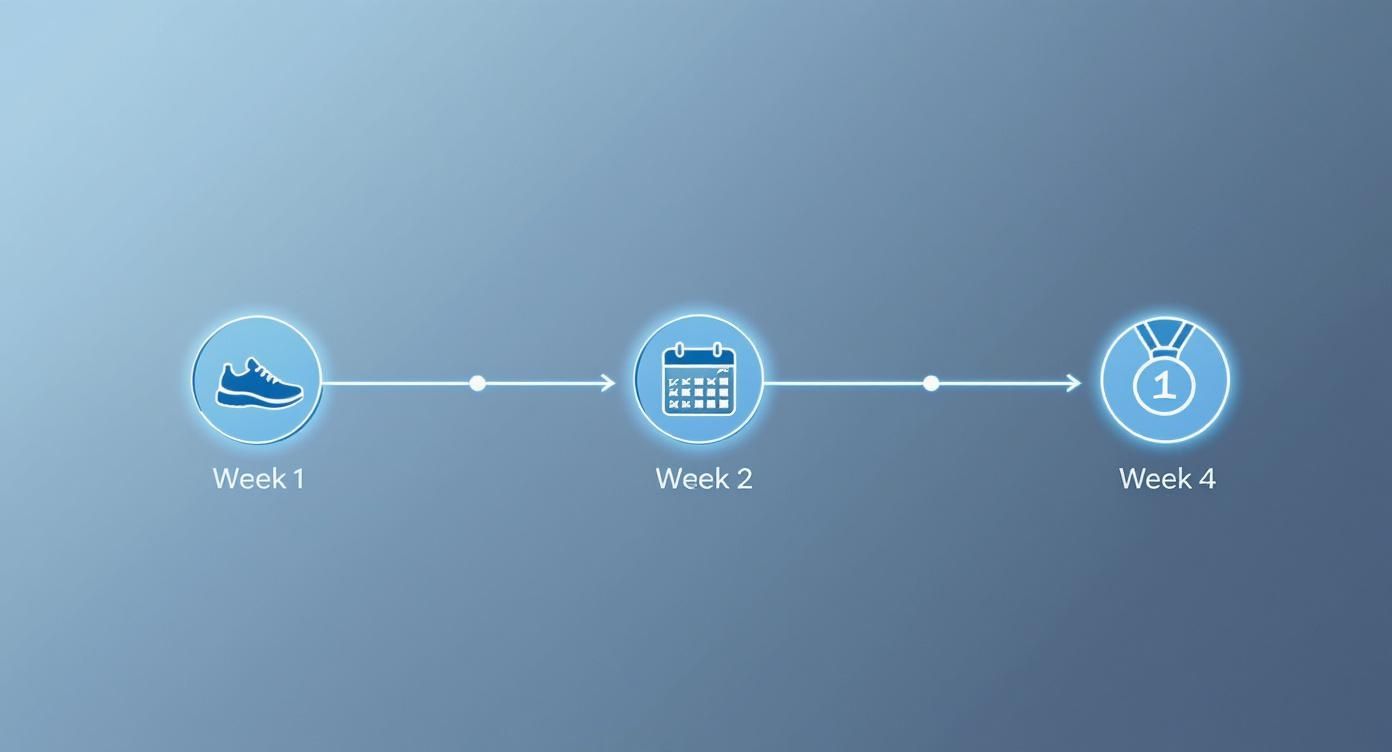
As you can see, the journey is simple: just start (Week 1), then weave it into your daily rhythm (Week 2), and before you know it, you're celebrating a solid routine (Week 4).
Your 30-Day Blueprint for Consistency
Instead of staring down a whole month, think in weekly phases. Breaking it down this way makes the process feel manageable, with a clear focus for each step. The idea is to build a foundation so strong that your daily movement becomes as automatic as brushing your teeth.
If you're brand new to this, exploring some simple low-impact exercises for beginners is a great place to find inspiration for your short daily sessions.
The most important workout is the one you do on the day you don't feel like it. Proving to yourself that you can show up for just five minutes is the victory that builds a lifelong habit.
Here’s a clear path for your first month. Notice how the focus is always on consistency, not intensity. This is how you build a habit that actually lasts.
Your First 30 Days to a Sustainable Exercise Habit
This weekly breakdown is your roadmap. It’s designed to gently build your exercise habit from the ground up, proving to yourself that you can stick with it.
| Week | Primary Goal | Actionable Task Example | Mindset Focus |
|---|---|---|---|
| Week 1 | Show Up Consistently | Perform a 5-minute Pilates routine daily. | "I am building a routine, not running a marathon." |
| Week 2 | Increase Duration Slightly | Extend your daily workout to 7-10 minutes. | "I am capable of a little more than I thought." |
| Week 3 | Introduce Variety | Try a new 10-minute workout or add a new move. | "Exploration keeps this fresh and engaging." |
| Week 4 | Solidify the Habit | Complete four 15-minute workouts this week. | "I am someone who exercises regularly." |
By the end of the month, you won't be forcing yourself to exercise anymore. You'll have built a true habit—and a new relationship with movement—one small, consistent step at a time.
Understanding the Anatomy of a Habit
If you really want to make exercise stick, you have to stop relying on willpower and start understanding the anatomy of your brain. You're building a new system for your brain to follow, one that runs on autopilot. Every single habit you have—from that first cup of coffee to mindlessly checking your phone—runs on a simple but incredibly powerful feedback system in your basal ganglia called the habit loop.
Getting to know this loop is like getting the blueprint for your own brain. It has three parts, and when you learn how to assemble them intentionally, you can build a structure that makes daily movement feel almost inevitable.
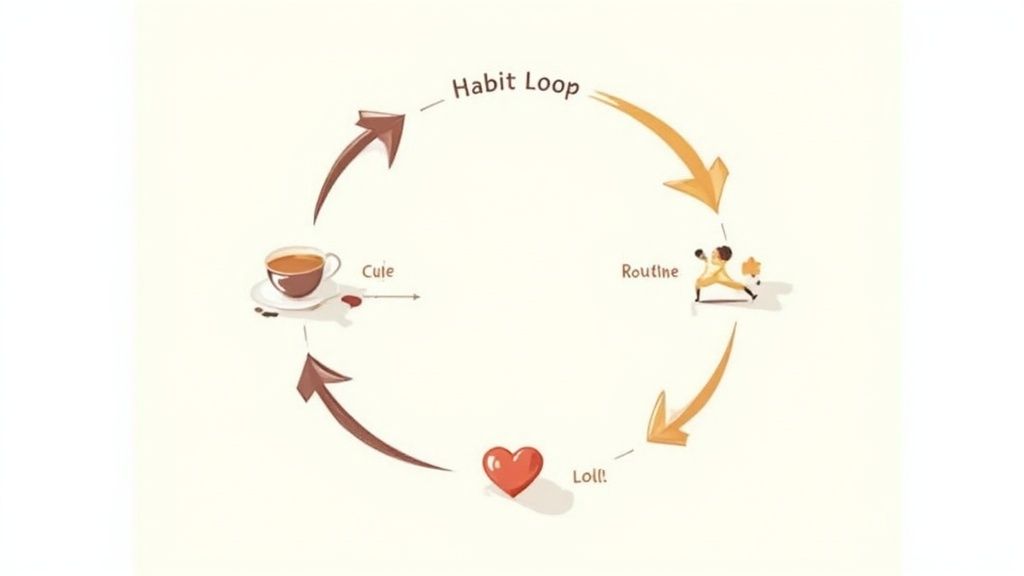
The Cue: The Trigger for Action
First up is the cue. This is the spark, the little nudge that tells your brain to switch into automatic mode and run a specific program. Cues are everywhere. They can be a time of day, a place, an emotion, or something you just did.
Your phone buzzes? Your brain's sensory cortex registers the vibration, signaling a cue to check it. The kitchen clock hits noon? A visual cue triggers thoughts of lunch. These triggers are so woven into our day we don’t even notice them, yet they dictate so much of what we do.
To build an exercise habit, your job is to design a cue that’s impossible to miss. A vague goal like "I'll work out later" is a recipe for failure. You need a specific, concrete trigger.
- Location-Based Cue: The classic example? Place your WundaCore board and mat right next to your bed. The very first thing your feet touch in the morning becomes the tactile signal to start your 5-minute routine.
- Action-Based Cue: This is my personal favorite. As soon as you finish brushing your teeth, you walk straight to your workout spot. One habit literally flows into the next.
This is where you take back control. By planting obvious cues in your environment, you remove the need for an internal debate. The trigger is there; your brain knows what to do next.
The Routine: The Behavior Itself
The routine is simply the action you perform—in our case, the workout. Now, here’s where most people go wrong: they make the routine way too hard. Your brain is wired to conserve energy, and the prefrontal cortex will fight back against anything that feels like a huge effort, especially when you’re just starting.
This is exactly why a 5-minute Pilates session is so powerful. The goal isn't to get a killer workout. The goal is to make the routine so ridiculously easy that skipping it feels like more effort than just doing it.
Your focus at the very beginning isn't on the intensity of the workout, but on the sheer consistency of the routine. You’re just greasing the wheels and strengthening the neural pathway. You can worry about performance later.
Once showing up becomes second nature, you can start adding a few minutes or increasing the difficulty. But for now, just doing it—no matter how short—is the win.
The Reward: The Reason It Sticks
Finally, we get to the reward. This is the secret sauce, the part of the loop that tells your brain, "Hey, that was good. Let's remember to do that again." The reward is what cements the behavior and creates a craving that pulls you through the loop next time.
When we experience something pleasurable, our brain's reward system releases a little hit of dopamine, which reinforces whatever action we just took. A reward can be tangible, like a treat, or internal, like a feeling of pride or the release of endorphins.
The key is that the reward needs to be immediate.
- A Relaxing Ritual: Follow up your workout with a cup of your favorite tea or just two minutes of quiet, mindful breathing. This calms the nervous system.
- Sensory Satisfaction: Hop in a hot shower and really notice how good it feels on your muscles.
- Track Your Wins: Nothing beats the satisfaction of putting a big, fat 'X' on a calendar. Visually tracking progress activates the same reward circuits in your brain.
By consciously choosing and enjoying a reward, you’re actively teaching your brain to look forward to the whole sequence. This is the force that turns a clunky, deliberate action into an effortless habit. It's the same powerful cycle behind all behaviors; in fact, understanding the psychological hooks of addiction shows just how universal these mechanisms are.
Master this three-part cycle—cue, routine, reward—and you’ll have the tools to build a new identity as someone who just is active.
How to Design Your Personal Exercise System
Now that you understand the mechanics behind the habit loop, it's time to become the architect of your own routine. A generic plan you find online will almost never stick because it wasn't designed for your life, your schedule, and your brain.
The real secret to making exercise a lasting habit is building a system that slots so perfectly into your day that it feels almost effortless. To do that, we’re going to focus on two powerful, evidence-backed techniques: habit stacking and temptation bundling. Think of them less as "tricks" and more as smart ways to work with your brain's existing wiring, not against it.
The Power of Habit Stacking
Habit stacking is brilliantly simple. You just anchor your new exercise habit to a behavior you already do automatically. Your brain has well-worn neural pathways for daily actions like brewing coffee or brushing your teeth. By linking your workout directly to one of those, you take motivation and memory completely out of the equation.
The formula looks like this: "After I [CURRENT, AUTOMATIC HABIT], I will [NEW EXERCISE HABIT]."
This works because your existing habit becomes a powerful, unavoidable cue. There's no decision to make; one action just flows right into the next. You're using the momentum you already have to get started.
The goal is to make the transition into your workout so seamless that it becomes the most logical next step. You're not trying to find time for exercise; you're letting your existing schedule create the time for you.
To put this into practice, think about a daily habit that is absolutely non-negotiable for you. The more ingrained it is, the better. Here are a few real-world examples to get your wheels turning.
- For the Remote Worker: "After I close my laptop for the day, I will immediately change into my workout clothes and start my 10-minute Pilates session."
- For the Busy Parent: "After I drop the kids off at school, I will come home and do my WundaCore workout before I even look at my phone."
- For the Morning Person: "After my first cup of coffee is finished, I will unroll my mat and begin my routine."
Notice the specificity. "After work" is too vague and easy to ignore. "After I shut down my computer" is a concrete, unmissable cue that triggers the next action.
Making Exercise Irresistible with Temptation Bundling
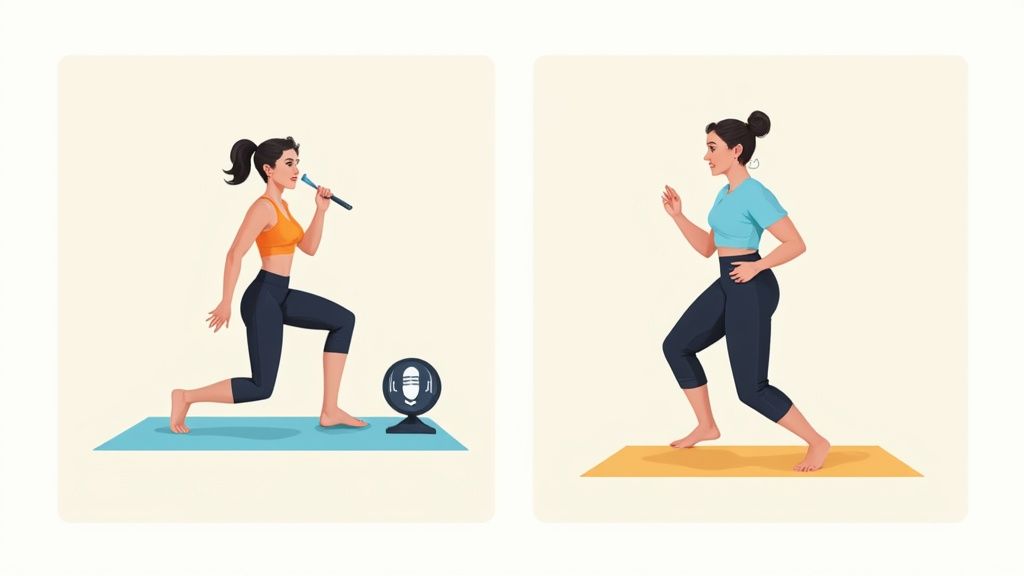
If habit stacking gets you started, temptation bundling is what makes you want to do it. This technique involves pairing something you want to do with the habit you need to do (in this case, exercise).
Think of something you truly look forward to—a guilty-pleasure podcast, a favorite TV show, or a special playlist. Now, make a rule for yourself: you can only enjoy that specific thing while you are exercising. This simple shift transforms your workout from a chore into a treat you actually crave.
Your brain starts to associate the dopamine hit from the enjoyable activity with the exercise itself. Soon enough, you're not just motivated to work out; you're motivated to get your daily dose of that feel-good activity.
Practical Temptation Bundling Ideas
This is where you can get creative and tailor a system that feels like a genuine reward. The more you truly enjoy the "bundle," the more effective this strategy will be.
- Listen to a specific podcast or audiobook only when you're on your mat. You'll find yourself eager to exercise just to find out what happens next.
- Watch your favorite "trashy" reality show on a tablet while you do your workout. No workout, no drama.
- Create a workout-only playlist filled with songs that make you want to move but that you don't listen to any other time.
- Save your best phone catch-ups with friends or family for a walk or a light stretching session.
This approach is incredibly effective for home workouts. As you design your personal space, you can even check out the best fitness equipment for small spaces to create an environment that makes these bundles even easier to implement.
By combining these two methods, you create a personalized, resilient system. Habit stacking provides the trigger, and temptation bundling provides the craving, making it far more likely that you’ll show up day after day.
Using Tech and Community for Real Motivation
Let's be honest, trying to build a new habit on willpower alone is a recipe for burnout. The secret isn't gritting your teeth and forcing it. It's about building a smart support system around you.
Relying on technology and connecting with other people gives you the external structure and social boost you need to make movement stick. Your brain loves feedback and connection. Tech gives you the data, and community provides the encouragement. Put them together, and you have a powerful combination that makes showing up feel less like a chore and more like something you actually want to do.
Harnessing the Power of Technology
It’s no surprise that wearable tech is everywhere. A survey of over 2,000 industry experts from the American College of Sports Medicine ranked it as the #1 fitness trend. Mobile exercise apps are right there with it, hitting a wild 850 million downloads in 2023.
And this stuff works. Just look at the data from platforms like Strava, which projects that 66% of runners and cyclists will hit personal bests in 2025 simply by using the app to track their progress. Tracking makes your effort tangible. It turns invisible work into real numbers—steps, heart rate, personal records—that your brain registers as a win.
Every time you close a ring on your watch or get a notification, it’s a tiny hit of dopamine that reinforces the habit loop. It’s immediate, satisfying feedback.
If you're ready to dive in, checking out a list of the best health tracking apps is a great place to start. The key is to find a tool that feels good to you and use it to celebrate your small wins, not just to track numbers.
Finding Your People for Accountability
As great as tech is, it can't give you a high-five. That's where human connection comes in. Knowing someone is in your corner—or even just expecting you to show up—can be the single biggest factor in long-term success.
This doesn't mean you have to join a super-intense, competitive gym. Your community can be found anywhere.
- Online Groups: You can find Facebook or Reddit groups for literally any fitness interest, from home Pilates pros to people who are just starting to run.
- Local Clubs: A neighborhood walking group or a local cycling club gives you a scheduled, real-world reason to get out the door.
- Digital Fitness Subscriptions: Many online platforms have community baked right in. When you subscribe to something like our Wunda On Demand classes, you’re instantly connected to a whole group of people working toward similar goals. It creates a real sense of shared purpose.
The best support system is one where you feel encouraged, not judged. The goal is to find a group that celebrates consistency over perfection.
Ultimately, having a support network transforms exercise from something you have to do alone into something you get to do together. It provides accountability when you're feeling lazy and gives you a place to celebrate your progress with people who really get it. This blend of smart tech and real community creates a foundation strong enough to keep you on track for good.
Overcoming Common Barriers and Plateaus
No matter how dialed-in your system is, life will eventually throw you a curveball. An unexpected project at work, a week of travel, or a sudden motivation dip can feel like a complete derailment. But here’s the thing: these aren’t failures. They are an inevitable, and frankly, normal part of building a real, lifelong habit.
The secret is having a playbook ready to go. Knowing how you'll handle these challenges before they pop up is what separates a temporary blip from quitting altogether. This is your guide for troubleshooting the most common roadblocks that stand between you and your commitment to movement.
When You Have Absolutely No Time
The "I don't have time" feeling is probably the number one habit-killer out there. On those truly hectic days, even a 15-minute workout can feel like an impossible luxury. The answer isn't to magically invent more time, but to shift your definition of what a "successful" workout looks like.
When you're squeezed for time, your goal changes from performance to preservation. You're just trying to keep the habit alive.
The most powerful habit-forming workout isn't the longest or the hardest. It's the one you do on the day you almost skipped. This micro-win reinforces your identity as someone who shows up, no matter what.
Instead of throwing in the towel, deploy your "minimum viable workout." This is a pre-planned, ultra-short routine you can do anywhere, anytime. It’s so brief, there's really no excuse to miss it.
Your 5-Minute Travel-Friendly Bodyweight Plan
Here's a simple, no-equipment routine you can do on a busy day at home or tucked away in a hotel room. Just perform each movement for 60 seconds.
- Bodyweight Squats: Activates the glutes, quadriceps, and hamstrings while engaging the core for stability. Focus on smooth, controlled movement.
- Plank: A full-body isometric hold that strengthens the entire core musculature, including the transverse abdominis, rectus abdominis, and obliques.
- Alternating Lunges: Targets major leg muscles unilaterally, improving balance and coordination while stretching the hip flexors.
- Push-up Negatives: This eccentric focus builds strength in the pectorals, deltoids, and triceps by controlling the lowering phase of the movement.
- Glute Bridges: Isolates the gluteus maximus and hamstrings, crucial for hip extension and counteracting the effects of prolonged sitting.
This isn't about torching calories. It’s about checking the box and sending a clear signal to your brain: "I am still a person who exercises."
Escaping the Motivation Slump
Let's be honest: motivation is a fickle friend. It’s flying high when you first start a new routine, but it naturally ebbs and flows. Relying on sheer willpower to fuel your habit is a losing game. So when your "why" feels miles away and the couch is calling your name, you need a system, not more grit.
One of the most effective tools I've seen is the Two-Day Rule. It’s beautifully simple: never miss your workout more than two days in a row.
Missing one day? That's just life happening. It's an anomaly. But missing two days in a row is the start of a brand new, undesirable habit of not exercising. That second day becomes a critical choice point. This rule gives you a clear, non-negotiable boundary that stops a small slip from turning into a total slide. It removes the guilt and gives you a simple directive: just get back to it.
Breaking Through a Fitness Plateau
At some point, you'll hit a plateau. It happens to everyone. Your progress stalls, the workouts feel a bit stale, and it seems like you’re putting in the effort without seeing any new changes. This isn't a bad sign! It's actually your body's signal that your neuromuscular system has adapted to the current challenge and is ready for something new.
Fighting a plateau isn't about just doing more of the same thing. It’s about introducing a strategic change, a concept known as progressive overload. You need to give your body a new stimulus to adapt to.
Here are a few ways to gently dial up the challenge without completely overhauling your routine:
- Increase Resistance: If you're using equipment like a WundaCore resistance ring, you can focus on more controlled, slower movements to increase the time your muscles are under tension. Every bit of control adds a new challenge.
- Change the Tempo: Try performing an exercise more slowly on the eccentric (or lowering) phase. For example, take three slow counts to lower into a squat and one count to come back up. This increases micro-tears in the muscle fibers, promoting growth.
- Reduce Rest Time: Shorten your rest periods between exercises by 10-15 seconds. This increases metabolic stress and cardiovascular demand, forcing your body to adapt.
- Try a New Move: Swap in one or two new exercises. This challenges your muscles and your motor control pathways in a new way, which can be incredibly motivating all on its own.
By anticipating these common roadblocks—no time, flagging motivation, and plateaus—you can prepare your response. With a plan in hand, these barriers become simple detours, not dead ends, on your path to making exercise an unbreakable habit.
Your Questions, Answered
Even with a solid plan, questions are going to pop up as you work on making exercise a real, lasting habit. That's completely normal. Getting clear, straightforward answers can be the one thing that keeps you going when you hit a bump in the road.
Let’s tackle some of the most common questions I hear.
How Long Does It Really Take to Form an Exercise Habit?
First, let's get this out of the way: forget the "21 days" myth. That number was an off-the-cuff observation from a plastic surgeon in the 1960s about how long it took his patients to get used to a new nose, not a scientific conclusion about habit change.
Modern research paints a much more realistic picture. One landmark study found it can take anywhere from 18 to 254 days for a new behavior to feel automatic. The average? About 66 days. That huge range demonstrates the principle of neuroplasticity—every individual's brain rewires at a different rate.
Instead of getting hung up on a magic number, focus on what you can actually control: consistency. The real win isn't hitting a specific day on the calendar; it's when the neural pathway for your workout becomes so strong that starting it feels as non-negotiable as brushing your teeth.
What Is the Best Time of Day to Exercise?
The best time of day to exercise is the time that aligns with your body's natural circadian rhythm. Period. There is no one-size-fits-all answer here, and what works beautifully for an early bird will be a total non-starter for a night owl whose cortisol levels peak later in the day.
Sure, some evidence suggests morning workouts might have a slight edge for habit formation—mostly because you get it done before the day’s chaos has a chance to intervene. But that’s only true if it genuinely fits your life.
The most effective time to build your exercise habit is during your personal "path of least resistance." This is the time slot with the fewest potential conflicts and where you know you'll have the mental and physical energy to show up.
Be honest with yourself and experiment. If you have to fight your own body clock and wrestle with your schedule every single day, the habit will never stick. Consistency is so much more important than the specific time on the clock.
I Missed a Few Days. Have I Ruined My Habit?
Absolutely not. Let's be crystal clear on this: missing a day, or even a few, does not erase the neural pathways you've started to build. This is one of the most important mindset shifts you can make. The "all-or-nothing" thinking is what truly ruins habits, not a brief interruption.
The single most important workout is the one you do after you've missed one. It proves you're resilient and committed.
A simple but powerful trick to avoid a downward spiral is the "two-day rule." It's exactly what it sounds like: never miss your planned exercise for more than two days in a row. A single missed day is just life happening. Two missed days, however, is the beginning of a new, less desirable habit of not exercising. Give yourself a little grace for the lapse, and get right back to it.
How Do I Stay Motivated When I Don’t See Results?
This is a big one. It's easy to feel fired up when you see quick physical changes, but physiological adaptations like hypertrophy (muscle growth) are often slow to appear. The key is to stop tying your success to outcomes you can't directly control, like the number on the scale.
Motivation is fickle. A solid system is reliable.
Your job is to shift your focus from lagging indicators (physical results like muscle definition) to leading indicators (the actions you control). Your primary goal should be celebrating the act of showing up.
- Track Your Wins: Keep a simple calendar and put a big 'X' on every day you complete your workout. Seeing that chain of X's build up is an incredibly powerful visual of your commitment. Your victory is the consistency itself.
- Redefine "Results": Look for the immediate physiological benefits. Did you feel less stressed after your 10-minute Pilates session (a sign of reduced cortisol)? Did you sleep better (improved sleep architecture)? Did you get a little burst of energy from endorphin release or a sense of accomplishment?
These are real, immediate results. When you focus on how exercise makes you feel right now, you create a positive feedback loop that doesn't depend on what you see in the mirror. You build the habit by rewarding the action, and the physical results will follow that strong foundation.
At WundaCore, we believe in building sustainable wellness through movement that feels good and fits your life. Our on-demand classes and expertly designed equipment are made to help you build consistency, find joy in the process, and create a habit that lasts. Discover a new way to move at https://wundacore.com.