
How to Stay Consistent with Exercise: An Anatomical Guide to a Lasting Habit
Let's be honest: staying consistent with exercise has almost nothing to do with willpower. It’s about building a better system. One that relies on small, repeatable actions instead of chasing huge, far-off goals.
The real secret is connecting your motivation directly to your own anatomy. This simple shift can transform your workouts from a chore into a tangible way to improve how your body feels and functions, day in and day out.
Your Blueprint for Unshakeable Exercise Consistency
So many of us fall off the fitness wagon because our goals are just too vague. "Get in shape" or "be healthier" sound great, but what do they actually mean? They don't give you a strong enough reason to show up when you're tired, unmotivated, or just plain busy.
The key to building a routine that actually sticks is to connect your effort to a real, anatomical benefit you can feel.
Instead of focusing on some abstract future outcome, pinpoint a physical improvement you want to feel right now. This immediately shifts your mindset from "enduring a workout" to "actively solving a problem."
Think about it this way: if you struggle with lower back pain after sitting all day, your goal isn't just to "strengthen your core." It's about learning to activate your transverse abdominis—your body’s own natural corset—to stabilize your lumbar spine and find immediate relief. Suddenly, each exercise has a specific, personal purpose.
Connect Your 'Why' to Your Anatomy
To put this into practice, you need to find your true "why" and link it directly to a part of your body. This is your intrinsic motivator, and trust me, it’s what will get you moving on low-energy days far more than any number on a scale.
What daily movements cause you discomfort? What do you wish felt easier?
- Sitting at a Desk: Do you feel your shoulders rounding forward, causing that familiar strain in your cervical and thoracic spine? Your goal becomes strengthening the rhomboids and serratus anterior to retract your scapulae, improving your posture.
- Carrying Groceries: Does a simple task like this feel way too taxing? The focus then becomes building functional strength in your gluteus medius and obliques to stabilize your pelvis and prevent spinal shearing forces.
- Playing with Kids: Do you get out of breath faster than you'd like? The aim is to improve your VO2 max—the maximum rate at which your heart, lungs, and muscles can effectively use oxygen during exercise.
This reframing makes the payoff immediate. You’re not just exercising anymore; you're actively upgrading your body's mechanics. For anyone just starting out or needing a gentler approach, understanding the principles of a low-impact workout routine is a perfect way to build these mind-body connections safely and effectively.
Before we dive into the daily and weekly strategies, let's summarize this foundational concept. This framework is your starting point for building a truly sustainable practice.
Your Consistency Kickstart Framework
| Principle | Actionable Strategy | Anatomical Benefit |
|---|---|---|
| Specificity | Shift your goal from a vague outcome ("get fit") to a physical feeling ("relieve back pain"). | Targets specific muscles (e.g., transverse abdominis) for immediate functional improvement. |
| Connection | Identify a daily-life challenge (e.g., neck strain from desk work). | Focuses on strengthening supporting musculature (e.g., rhomboids) to correct postural imbalances. |
| Immediacy | Choose exercises that provide a noticeable benefit right away. | Creates a positive feedback loop, reinforcing the habit by delivering tangible results. |
| Education | Learn the "what" and "why" behind a movement. | Builds proprioception (body awareness) and transforms exercise into neuromuscular re-education. |
This approach sets you up for long-term success by making each workout meaningful. You're not just going through the motions; you're actively engaging with your body to make it stronger and more resilient.
By framing your goals in tangible, anatomical terms, you create a powerful feedback loop. You perform an exercise, feel a direct benefit—like less spinal compression or better pelvic stability—and you're naturally motivated to do it again.
This method transforms exercise from an obligation into a skill. You're no longer just counting reps; you're learning how to communicate with your neuromuscular system, making targeted improvements that truly enhance your quality of life. This is the foundation for staying consistent with exercise, for good.
The Anatomy of Motivation and Habit Formation
Ever wonder why some exercise routines stick while others fizzle out after a few weeks? It's not about willpower. The secret is buried deep inside your brain and body, and understanding it is the first step toward building a practice that lasts. When you learn to work with your biology instead of fighting it, consistency becomes almost effortless.
Every time you repeat a movement, like a simple WundaCore routine, you're forging and strengthening neural pathways within a part of your brain called the basal ganglia. Think of it as your internal autopilot. With enough repetition, this area takes over motor control, shifting the conscious thought of "I should probably work out" into a background process that just happens—like reaching for your toothbrush in the morning.
The Dopamine Reward Loop
What really seals the deal is a powerful little neurotransmitter: dopamine. When you exercise, your brain releases this feel-good chemical, giving you a sense of pleasure and satisfaction. This isn't just a nice bonus; it's a critical part of the neurochemical feedback loop that builds habits.
Your brain logs that dopamine surge as a reward, creating a strong neurological link between the action (exercise) and the positive feeling. This makes you want to repeat the behavior to get that reward again. If you're curious about the science, learning how to increase dopamine naturally can give you even more insight into building that internal drive.
This diagram shows how these pieces fit together to create a solid foundation for consistency.
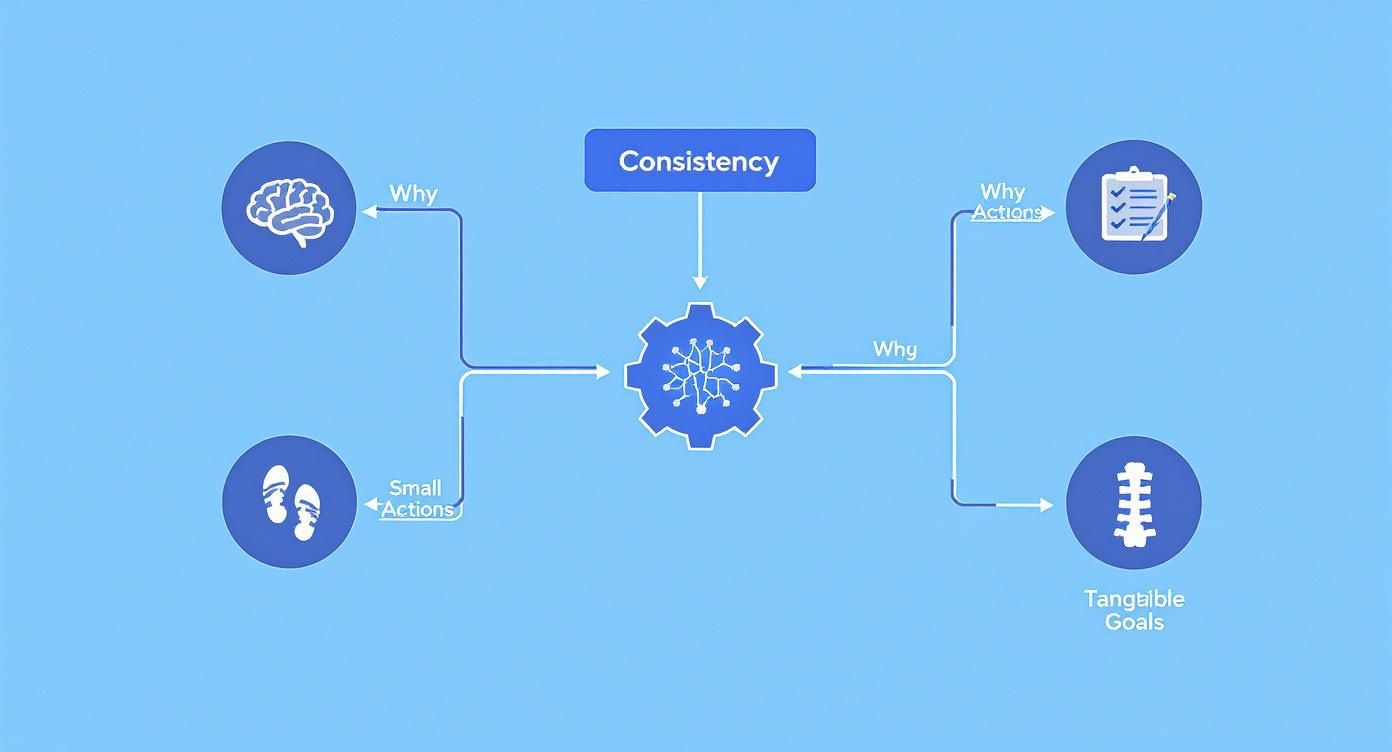
As you can see, a lasting habit is built on a clear "why," small and repeatable actions, and tangible goals you can actually feel in your body.
Engineering Your Motivation
The good news is you don't have to sit around waiting for motivation to strike. You can engineer it. The trick is to link your workouts to immediate rewards your brain can latch onto, rather than distant goals like weight loss that might take months to show up.
Try focusing on what you feel in the moment. Notice things like:
- Muscle Engagement: That satisfying feeling of your deep core muscles firing up during a plank, specifically the transverse abdominis and internal obliques.
- Improved Balance: The newfound stability in your ankles and hips as you hold a challenging pose, thanks to better proprioceptor feedback.
- Post-Workout Calm: The mental fog lifting and a sense of ease washing over you after a session as your parasympathetic nervous system activates.
These immediate sensations are powerful positive feedback, strengthening that dopamine loop and making your brain actively look forward to the next session.
Your body is in a constant conversation with your brain. By focusing on immediate physical feedback—like the satisfying burn of engaged muscles or the feeling of a more stable core—you give your brain a concrete reason to repeat the behavior.
This approach transforms exercise from a chore into a genuine conversation with your body. It’s how you build a habit that you not only stick with, but actually start to crave.
How Cortisol Can Sabotage Your Efforts
There's another hormone we need to talk about: cortisol, the stress hormone. If you're living a high-stress life, chronically elevated cortisol can quietly sabotage your best intentions. It leads to fatigue, slows muscle recovery by inhibiting protein synthesis, and can make the very idea of moving your body feel like climbing a mountain.
This is where mindful movement is a game-changer. Gentle, controlled exercises, like the ones we focus on in Pilates and WundaCore, are designed to regulate your autonomic nervous system. By connecting diaphragmatic breathing to precise movements, you can actively lower your cortisol levels. Your workout becomes a form of stress relief—a solution, not just another thing on your to-do list. When that shift happens, your body and mind will start asking for it.
Designing Your Personalized Exercise Plan
Let's be honest: that generic workout plan you downloaded from the internet probably isn't going to stick. Why? Because to truly build a consistent exercise habit, you need a plan that respects your actual life—your schedule, your energy levels, and what you genuinely find enjoyable. The best routine is one that bends and flows with you, not against you.
This means we have to let go of the “all or nothing” mindset. You absolutely do not need a full hour at the gym to see and feel progress. In fact, when you're focused on building a sustainable habit, shorter, more frequent sessions are often far more effective for neuromuscular adaptation.
Embrace the Power of Movement Snacking
This is where the idea of 'movement snacking' becomes a total game-changer. It's all about weaving short, 5-10 minute bursts of focused movement throughout your day. Instead of one intimidating hour-long session, you might do a 10-minute WundaCore routine in the morning, take a brisk walk at lunch, and do some gentle stretches before winding down for bed.
This approach works wonders for a few key anatomical reasons:
- It lowers the barrier to entry. A 10-minute commitment feels completely manageable, even on the most chaotic days.
- It keeps your metabolism humming. Moving more often helps maintain insulin sensitivity and keeps your metabolic rate elevated all day long.
- It builds the habit faster. More frequent repetitions help your brain's basal ganglia automate the behavior, making it feel second nature.
By snacking on movement, you accumulate serious health benefits without feeling like you've had to overhaul your entire schedule. It makes consistency feel almost effortless because it’s built right into the small pockets of your day.
Schedule and Stack Your Workouts
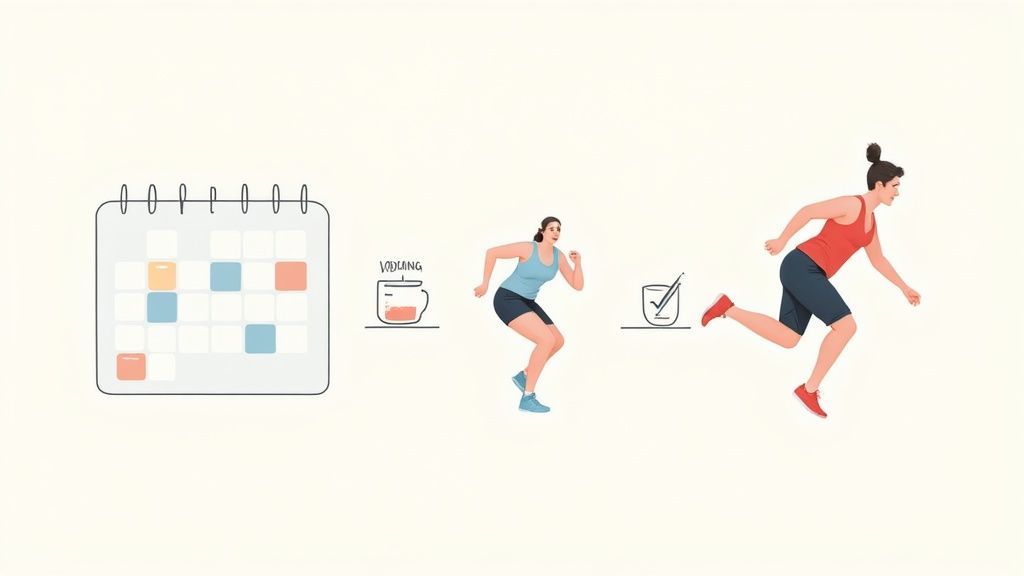
Treat your workouts like you would any other important, non-negotiable appointment. If it’s on your calendar, you're so much more likely to do it. This simple act sends a powerful message to your brain: this time is protected and important.
To make this even more effective, try a technique called habit stacking. It’s brilliant. You simply link your new exercise habit to an existing one you already do automatically.
For instance, maybe you want to start a quick core workout every morning. The stack could sound like this: “After I press start on the coffee maker, I will roll out my mat and do my 10-minute WundaCore session.” The coffee habit becomes the neurological trigger for your workout, removing the need for willpower or motivation to kick in.
A truly personal plan isn't just about which exercises you choose; it's about how seamlessly you weave them into the real rhythm of your life. By scheduling movement and stacking it with existing habits, you build a system that runs on autopilot, not willpower.
This focus on adaptability is happening all over the fitness world. In Europe, a remarkable 60% of fitness clubs now offer hybrid memberships, blending the convenience of at-home classes with the community of a physical space. It's all about making movement work for you.
Creating a Balanced Weekly Plan
A smart weekly plan balances different types of movement to support your whole body—think strength, cardio, and flexibility. This doesn't mean you need separate, long workouts for each. You can achieve this balance beautifully with movement snacks.
Here’s what a sample week could look like:
| Day | Anatomical Focus | Movement Snack Examples (5-15 mins each) |
|---|---|---|
| Mon & Thu | Muscular Strength | Morning: WundaCore routine for deep core. Lunch: Squats and lunges for glute and quad hypertrophy. |
| Tue & Fri | Cardiovascular | Morning: Brisk 15-minute walk to elevate heart rate. Afternoon: Dance break to 3 favorite songs. |
| Wed | Active Recovery | Lunch: Gentle stretching or foam rolling for myofascial release. Evening: A relaxing yoga flow to increase flexibility. |
| Sat & Sun | Flexibility/Play | A longer hike, a fun Wunda On Demand class, or active time with family to improve joint mobility. |
This kind of structure ensures you're challenging different muscle groups and energy systems without ever feeling overwhelmed or burnt out. And if you're just starting out or need options that are kind to your joints, exploring a variety of low-impact exercises for beginners is a fantastic way to build out your weekly plan with confidence.
Using Tech for Smarter Accountability
Technology can be a phenomenal partner on your fitness journey, almost like a smart, objective coach living right on your wrist. I'm not just talking about counting steps. This is about moving beyond basic metrics to really listen to your body’s subtle anatomical cues. When you start to understand the data, you can build a routine that works with your biology, not against it.
This is how you learn to stop guessing and start responding to what your body actually needs.

Tune Into Your Body’s Feedback
Modern wearables give us a stream of real-time physiological data that, not long ago, was only available to elite athletes. Think of metrics like heart rate variability (HRV), resting heart rate, and sleep scores as direct reports from your autonomic nervous system.
A lower-than-usual HRV score, for example, isn't just a random number. It’s a signal that your nervous system is in a "fight or flight" (sympathetic) state and hasn't fully recovered. On those days, pushing through a high-intensity workout could spike your cortisol levels and lead straight to burnout. Instead, that data empowers you to swap in a gentle WundaCore session focused on mindful movement and breathwork, which can help activate the "rest and digest" (parasympathetic) nervous system to support recovery.
By learning to interpret data like HRV and recovery scores, you're essentially having a conversation with your central nervous system. This anatomical insight helps you make smarter training decisions, preventing overtraining and keeping you consistent in the long run.
This shift transforms your entire approach. You move from a rigid schedule to an intuitive, responsive practice that honors your body's daily capacity—a cornerstone of how to stay consistent with exercise.
Use Data to Drive Motivation
Let’s be honest: seeing tangible progress is incredibly motivating. When you track your workouts, you create a powerful feedback loop. Seeing improvements—like a lower resting heart rate or the ability to hold a plank for longer—provides concrete evidence that your hard work is paying off, even before you see visible changes in the mirror.
It's no surprise that this approach has become so mainstream. Research from the American College of Sports Medicine consistently shows that wearable technology and mobile exercise apps are top fitness trends. With 59% of smartphone users having at least one fitness app, these tools are now central to how we personalize our routines and stay motivated. You can discover more about these fitness trends and their impact right from the source.
This data-driven progress taps directly into our brain's reward system, reinforcing the habit with every small win. Platforms like Wunda On Demand integrate this beautifully, allowing you to follow structured programs and see your progress accumulate over time.
Connect With a Digital Community
Accountability is a massive piece of the consistency puzzle, and technology makes it easier than ever to find your people. Many fitness apps and platforms have built-in community features where you can share your workouts, celebrate milestones, and cheer each other on.
This taps into our fundamental human need for connection. Knowing that others are on a similar journey makes your own efforts feel less isolated and much more meaningful.
Whether it's joining a challenge in the Wunda On Demand community or just sharing a post-workout selfie with a friend, that small act of connection can be the very thing that gets you to show up on days when you’d rather stay on the couch.
Overcoming Common Consistency Hurdles
Let’s be honest: even the most perfect exercise plan will eventually run into a real-world roadblock. A chaotic week at work, a sudden dip in motivation, or an unexpected ache can throw you completely off course. The secret to long-term consistency isn’t about avoiding these hurdles—it's about learning how to navigate them with realistic, compassionate strategies.
One of the biggest traps I see people fall into is the "all-or-nothing" mindset. You tell yourself that a workout only "counts" if it's a full hour, so when your schedule implodes, you do nothing at all. This is a fast track to inconsistency. The better approach is to shift your goal from perfection to participation, even if it’s just for 10 minutes.
Adapting to Life's Demands
When time feels like your biggest enemy, short, focused sessions become your superpower. A 10-minute core stabilization routine with your WundaCore equipment isn't a "lesser" workout; it’s a smart, targeted session that fires up your deep abdominal wall, supports your spine, and keeps the neuromuscular habit alive.
This is especially true if you’re working with limited square footage. Finding the best fitness equipment for small spaces means you can seamlessly integrate these micro-workouts into your day without needing a dedicated home gym. The goal is to always have a manageable option ready to go.
Navigating Plateaus and Injuries
Hitting a plateau where your progress stalls can be incredibly frustrating. This is usually your body’s way of signaling physiological adaptation. To continue making progress, you need to apply the anatomical principle of progressive overload—the practice of gradually increasing the demands on your musculoskeletal system.
You don't need to overhaul your entire routine. Small tweaks work wonders:
- Increase Resistance: Swap in a stronger resistance loop or focus on creating more controlled tension.
- Modify Tempo: Try slowing down the lowering (eccentric) phase of an exercise. This increases the time your muscles are under tension, a potent stimulus for strength gain.
- Adjust Leverage: Change your body position to make an exercise harder, like extending your legs further out during a core exercise, which increases the lever arm.
Of course, nothing sidelines consistency faster than an injury. Staying in the game requires a proactive mindset. Learning how to prevent sports injuries by focusing on proper form, warming up to increase blood flow and muscle elasticity, and truly listening to your body's nociceptive (pain) signals is non-negotiable for staying active long-term.
A setback is not a failure; it’s a signal to adapt. Whether it’s swapping a long workout for a short one or modifying an exercise to accommodate an ache, the consistent person is the one who learns to be flexible.
Working With Your Body's Hormones
For many of us, hormonal shifts introduce a unique set of challenges. Fluctuations in estrogen and progesterone during the menstrual cycle or the transition through menopause can affect everything from energy and mood to joint laxity. Instead of fighting your body, learn to work with its endocrine rhythms.
During lower-energy phases of your cycle, focus on restorative movements like gentle Pilates or deep stretching. When you feel a surge of strength, prioritize targeted resistance training. This is especially important during menopause, as we know resistance training is proven to support bone mineral density (combating osteoporosis) and help maintain a healthy metabolic rate.
By tuning into your body's signals, you can choose the right movement for the right day. This makes your practice feel supportive and sustainable, not like another battle you have to fight.
Answering Your Top Consistency Questions
Even with the best plan, questions always pop up. Making movement a real, lasting part of your life means learning to work with the nuances of your own body and mind. Let’s tackle some of the most common questions I hear, with clear, anatomy-focused answers to help you stay on track for good.
How Long Does It Really Take To Build An Exercise Habit?
I know you’ve heard the 21-day myth, but let’s set the record straight. Neuroscientific research shows it’s a deeply personal process, taking anywhere from 18 to 254 days. The timeline isn't what matters—it's the consistent repetition that actually rewires your brain's neural circuits.
Your real goal is to make movement automatic for your brain's basal ganglia, the part that handles motor control and habit formation. To get there, just focus on showing up for the first few months. Even 5-10 minutes counts. It’s this consistency, not the intensity, that builds the strong neural pathways for a habit that sticks.
The objective isn't a perfect workout; it's automaticity. You're training your brain to start moving without a big internal debate. Every small session strengthens that neuromuscular connection, making exercise feel as natural as brewing your morning coffee.
What Is The Best Type of Exercise To Stay Consistent?
Honestly? The best exercise is the one you actually do. It needs to be something you genuinely enjoy and can perform safely.
From an anatomical perspective, a balanced routine with strength, cardio, and mobility is the gold standard for long-term health. It supports everything from musculoskeletal integrity and cardiovascular function to joint range of motion.
But to build the habit, you have to start with something that lights you up. If you love to dance, do that. If you crave quiet, focused movement, try Pilates. That feeling of enjoyment creates a positive dopamine feedback loop in your brain, making you want to come back for more. That's the real secret to making it stick.
How Do I Stay Motivated When I Don't See Physical Results?
This is a big one. It's so easy to lose steam when you're waiting for the mirror to change. Visible physical results take time; processes like muscle hypertrophy (growth) and fat metabolism are gradual physiological adaptations.
The key is to shift your focus from how you look to how you feel and perform. Start tracking non-scale victories. These are the immediate, tangible signs that your body is adapting and getting stronger from the inside out.
Keep a simple log of your small wins. You'll be amazed at how motivating they are.
- Holding a plank for 10 seconds longer. That’s your transverse abdominis and obliques improving their endurance capacity.
- Feeling less lower back pain after a long day of sitting. This is a direct result of improved core stabilization and better postural muscle tone.
- Having more energy in the afternoon. That’s your cardiovascular and mitochondrial systems becoming more efficient at producing and using energy.
When you track these internal, anatomical shifts, you get concrete proof of your progress. And that is a far more powerful motivator than any number on a scale.
Ready to build a system that makes consistency feel effortless? The WundaCore collection and Wunda On Demand classes are designed with anatomy-informed principles to help you connect with your body, see real progress, and build a practice you love. Explore our equipment and start your journey.