
Low Impact Workout for Women: An Anatomy-Focused Guide
A low-impact workout is one of the most powerful tools a woman can have in her fitness arsenal. It’s a way to build serious strength, boost your cardiovascular health, and find new energy—all without putting unnecessary stress on your joints. These workouts, built on controlled and fluid movements like those in Pilates, swimming, or cycling, are a smart, sustainable way to stay strong through every phase of life.
Why Low Impact Workouts Just Work for a Woman's Anatomy
Let's clear something up: ‘low impact’ never means ‘low results.’ A well-designed low-impact workout is a strategic approach that works with the unique anatomy and physiology of the female body, not against it. It’s all about building functional strength and resilience in a way that honors your body's specific structural design.
From the monthly cycle to the major shifts of pregnancy and menopause, a woman’s body is constantly changing. Hormonal fluctuations can directly affect everything from the laxity of your ligaments and energy levels to how your core muscles function. Pounding, high-stress exercises can sometimes work against these anatomical realities, leading to injury or burnout.
This is where low-impact training really shines.
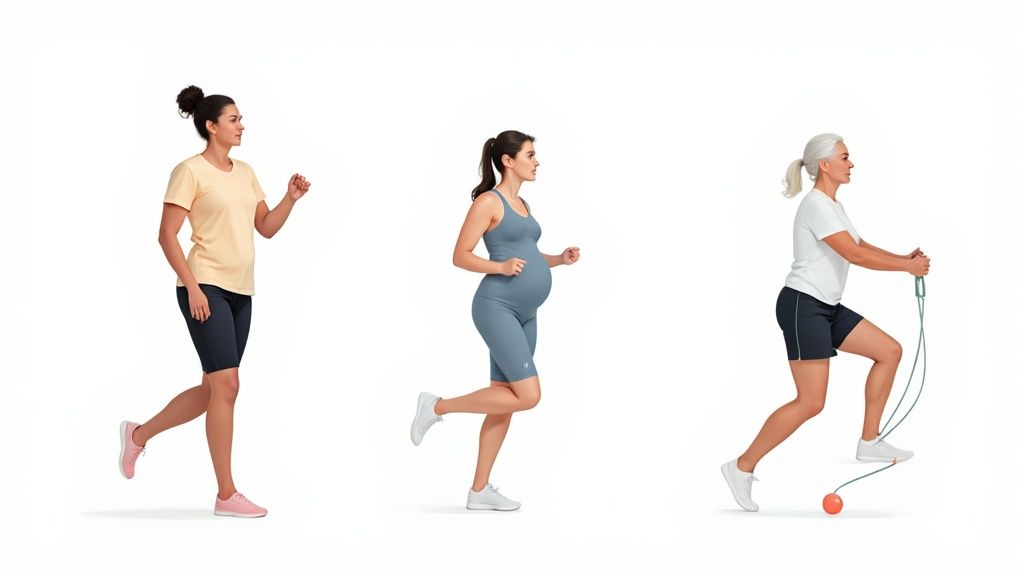
Working With Your Hormonal Blueprint
Interestingly, research suggests that women may get even greater protective health benefits from low-to-moderate intensity activities than men do. Studies show that consistent movement like walking or cycling gives women more substantial protection against conditions like type 2 diabetes and heart disease. This difference is thought to be linked to our unique physiological makeup.
The science really just confirms what many of us know intuitively: syncing your movement with your body's anatomical needs is essential.
A low impact workout isn’t about taking it easy; it’s about training smarter. It’s a way of respecting your body’s anatomy today so you can build a more resilient structure for tomorrow.
Supporting Your Anatomy at Every Life Stage
This adaptable approach is especially crucial during specific life stages where protecting your joints and maintaining core stability are top priorities.
During pregnancy, for example, your body's center of gravity shifts forward, and ligaments soften to prepare for childbirth. For expectant mothers, incorporating supportive activities like pelvic floor physical therapy during pregnancy is a game-changer for maintaining deep core strength and preparing the pelvic muscles for delivery—and it aligns perfectly with low-impact principles.
Likewise, during and after menopause, declining estrogen levels can reduce bone mineral density. This makes low-impact, weight-bearing exercises absolutely essential for stimulating osteoblasts (bone-building cells) without putting compressive stress on joints like the hips and spine.
Low-impact exercise isn’t just a single workout type; it’s a philosophy that meets you where you are. Here’s a quick look at how it supports women’s bodies.
Key Benefits of Low Impact Workouts for Women
| Life Stage | Anatomical Focus | Primary Benefit |
|---|---|---|
| Menstruation | Uterus, Abdominals | Reduces cramping and bloating through gentle, blood-circulating movement |
| Pregnancy | Pelvic Floor, Transverse Abdominis, Spine | Supports changing posture and prepares pelvic muscles for labor |
| Postpartum | Diastasis Recti, Gluteus Medius | Safely rebuilds deep core strength and pelvic stability |
| Perimenopause/Menopause | Bones (Femur, Spine) & Joints | Builds bone density and improves joint health |
| Post-Menopause | Proprioceptors & Bone Density | Enhances stability and protects against osteoporosis |
This table just scratches the surface, but it highlights how a low-impact approach can be strategically adapted to provide exactly what your body's structure needs, right when it needs it. It’s about creating a fitness habit that supports you for a lifetime.
Working with Your Body, Not Against It
To really get lasting results from any low-impact workout, we need to go beyond just copying movements. It's about understanding the "why" behind them from an anatomical perspective. When you learn to move with intention and an awareness of your own anatomy, you unlock a completely different level of strength. This is where we move from just "doing exercises" to building a smarter, more resilient body.
We're going to get into the foundational muscular systems that support literally everything you do. This isn't about chasing surface-level abs; it’s about waking up the deep, intelligent network of muscles that creates stability and power from the inside out.
The Core and Pelvic Floor Connection
So many people hear "core" and immediately picture the rectus abdominis (the six-pack muscle). But your true core is a muscular cylinder: the diaphragm is the lid, the pelvic floor is the base, and the deep transverse abdominis (TVA) is the corset that wraps all the way around you.
When these muscles learn to contract and relax in coordination, they create an unshakable foundation for every single movement, all while protecting your lumbar spine and improving your posture.
For women, the health of the pelvic floor is a non-negotiable part of the anatomical conversation. This group of muscles is like a supportive hammock for your bladder, uterus, and bowels. Major life events like pregnancy and childbirth, plus the natural hormonal shifts we all go through, can weaken this area. That's why targeted, low-impact exercises are so essential for maintaining its strength and function.
This connection is what makes the work so powerful. When you do a glute bridge, you're not just toning your glutes. You're learning to engage your TVA and gently lift your pelvic floor, strengthening that entire core system without a single crunch or any unnecessary strain on the spinal discs.
How Hormones Influence Your Joints
A woman’s body is in a constant dance with its hormones, and this has a direct effect on your musculoskeletal system. Throughout your monthly cycle, and especially during big transitions like pregnancy and menopause, shifting hormone levels change how your muscles respond and how stable your joints are.
For instance, when estrogen and relaxin levels fluctuate, your ligaments can become more pliable. While a little extra flexibility might sound nice, it also means your joints are less stable and more susceptible to injury if you aren't moving mindfully. High-impact, jarring movements can put way too much shear force on vulnerable joints like your hips, knees, and ankles.
This is exactly why a low impact workout for women is such a brilliant strategy. It lets you:
- Build strength safely: You can achieve muscular fatigue without overloading your joints.
- Move with stability: The focus is on controlled, precise motion, which teaches your stabilizing muscles how to properly support and protect your joints.
- Adapt to your body: It’s easy to modify movements based on how you’re feeling on any given day. You learn to listen to your body’s anatomical signals and honor them.
Intelligent Movement for Hips and Posture
Proper hip mechanics are another huge piece of the puzzle for women's fitness. Because of the anatomical design of the female pelvis, we often have a wider Q-angle (the angle from the anterior superior iliac spine down to the center of the kneecap). This can put a different kind of biomechanical stress on our knees and hips.
If we aren't moving with awareness, this can lead to frustrating muscle imbalances—think weak gluteus medius and chronically tight hip flexors (psoas and iliacus), a problem made so much worse by our modern, sedentary lifestyles. This combination is a classic recipe for poor posture and that nagging lower back ache.
Low-impact exercises hit this problem head-on by zeroing in on glute strength and hip mobility. Movements like side-lying leg lifts or clamshells are perfect for targeting these crucial stabilizing muscles, helping you create better alignment from the ground up. When you work with your anatomy this way, you’re not just exercising. You're re-educating your body's neuromuscular patterns to build a stronger, more balanced foundation for life.
Building Your Foundational Low Impact Routine
Alright, we've covered the ‘why’ behind smart, intentional movement. Now it’s time to put that knowledge into action. A solid routine is more than just a random list of exercises—it's your roadmap to preparing the body, challenging it safely, and building strength that actually shows up in your day-to-day life. Let's build your sustainable low impact workout for women, no matter where you're starting from.
A great workout never just starts. It begins with a dynamic warm-up designed to wake up your muscles and get your joints ready for what's next. This is all about active, flowing movements that increase synovial fluid in the joints and forge that all-important mind-muscle connection. Think of it as priming the engine before you go for a drive.
This diagram really brings home how we build strength from the inside out in a well-designed low-impact routine. We start with the core and radiate outward.
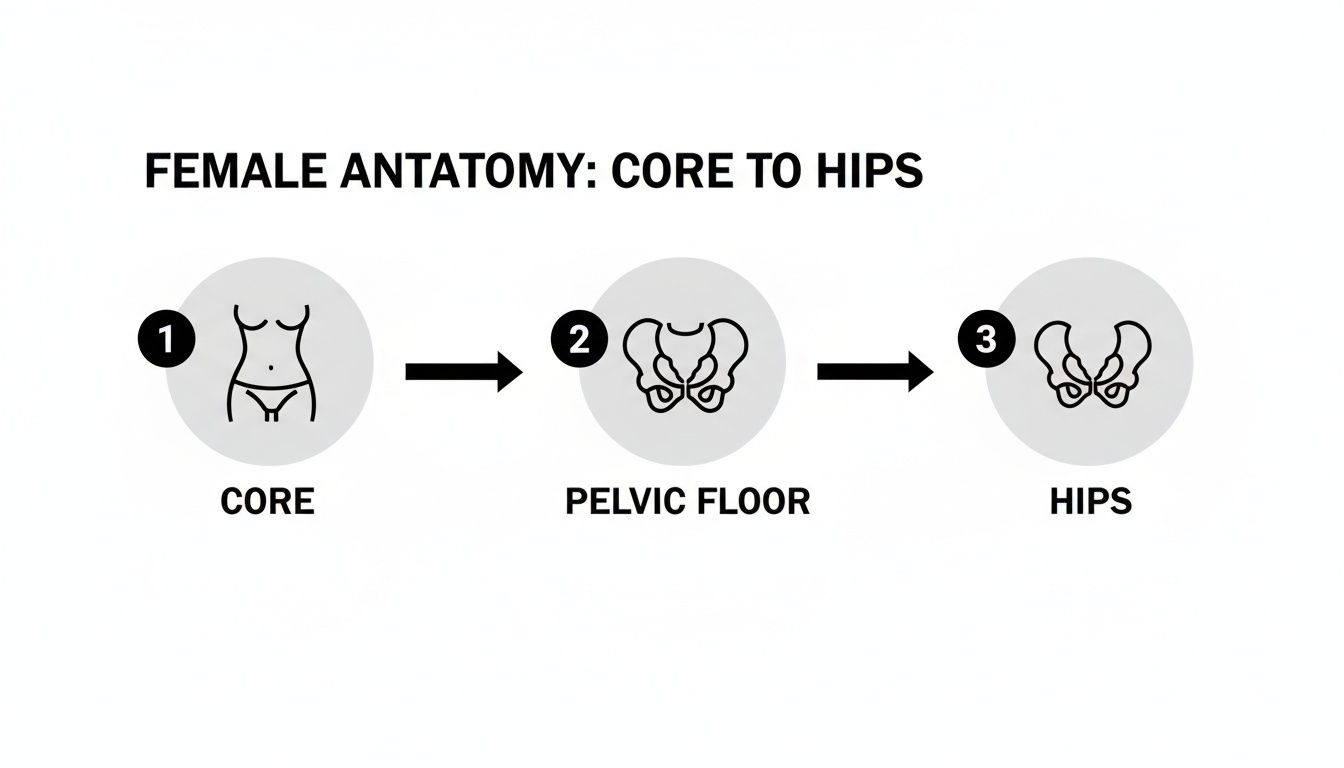
You can see how true, functional strength really starts from your center, giving your pelvic floor and hips the neuromuscular support they need to be powerful.
Your 20-Minute Beginner Circuit
Just starting out or getting back into the swing of things after a break? This 20-minute circuit is the perfect entry point. The name of the game here is mastering your form. Speed and reps can wait. Your only job is to feel the right muscles firing with every single movement.
Give each exercise your full attention for 45 seconds, then take a 15-second breather. Go through the whole circuit twice.
- Glute Bridge: Lie on your back and press through your heels to achieve hip extension. Squeeze your gluteus maximus at the top, making sure you’re using your deep core to prevent lumbar hyperextension. This is key for building posture-supporting strength.
- Bird-Dog: Start on all fours and extend the opposite arm and leg. The real work here is keeping your torso rock-solid and still. Your transverse abdominis should be working hard to prevent pelvic rotation, building incredible core stability.
- Modified Plank: You can do this from your knees or forearms. Don't just hold it—actively press the floor away and think about gently pulling your navel toward your spine. You’ll feel your entire core cylinder light up.
- Bodyweight Squat to a Chair: Stand in front of a chair and lower your hips back and down like you’re about to sit, just tapping the seat before you stand back up. This is a fantastic way to nail proper hip-hinge mechanics without putting compressive force on your knees.
- Wall Push-Up: Face a wall and perform a push-up. This builds strength in the pectorals and triceps while teaching your core to stay engaged, all without putting pressure on the wrist joints.
Looking for a few more foundational moves? Check out our guide on low-impact exercises for beginners to expand your toolkit.
The 30-Minute Intermediate Flow
Feeling ready to level up? This intermediate routine introduces more complex movements that will really test your stability. We’re shifting the focus from basic muscle activation to coordinated, full-body strength.
Progression isn't just about adding more reps. True advancement comes from challenging your stability, increasing your range of motion with control, and connecting movements in a fluid, intentional way.
This routine is designed to flow from one exercise to the next with very little rest, which helps keep your heart rate up. Perform each move for 50 seconds, with just 10 seconds to transition to the next. Aim for three full rounds.
- Single-Leg Glute Bridge: Taking one leg away dramatically increases the stability challenge for the glute and hamstring on your standing side.
- Plank with Shoulder Taps: From a full plank, slowly tap your opposite shoulder. You’ll have to fight the urge to rotate your hips, which deepens the anti-rotation work for your internal and external obliques.
- Reverse Lunge with Knee Drive: Step back into a lunge, then power up by driving that back knee toward your chest as you find your balance on the standing leg. This builds single-leg strength and dynamic stability.
- Side Plank with Hip Dip: From a side plank, lower your hip toward the floor and then lift it back up. This specifically targets muscles crucial for spinal stability, like the obliques and quadratus lumborum.
- Superman: Lying on your stomach, lift your arms and legs, engaging your entire posterior chain—from the erector spinae in your back down to your glutes and hamstrings.
The 40-Minute Advanced Challenge
This advanced routine is where we test your strength, endurance, and control. It’s built around dynamic transitions and demands a high level of core stabilization from start to finish. The goal is to move with both power and precision.
Work for 45 seconds, rest for 15, and get through four complete rounds.
- Curtsy Lunge to Lateral Lunge: This combo challenges your hip mobility and outer glutes (gluteus medius and minimus) in multiple planes of motion.
- Plank Jack (Low-Impact): From a plank, simply step one foot out to the side and bring it back, then switch sides. It’s a great way to get your heart rate up without any jumping.
- Bear Crawl Hold with Alternating Leg Lifts: Get into a tabletop position but with your knees hovering an inch off the floor. Now, lift one foot at a time. This places an intense demand on your entire core.
- Pistol Squat to a Box: Perform a single-leg squat down to a low box or step. Focus on a slow, controlled descent and powering back up.
- Walkouts to Push-Up: From a standing position, walk your hands out to a plank, do one solid push-up, and walk your hands back to your feet. It’s a fantastic full-body drill for strength and mobility.
Adapting Your Workouts Through Menopause
Your body is constantly evolving, and your fitness routine should, too. This becomes incredibly clear during perimenopause and menopause, when our bodies go through some pretty major physiological shifts. This isn't a time to push against the changes—it's about learning to work with them for better long-term health.
As estrogen levels naturally decline, a couple of key things happen: we can see a drop in bone mineral density and a decrease in muscle mass (a process called sarcopenia). This hormonal shift makes our bones more vulnerable and can slow down our metabolism. A smart low impact workout for women is one of the best ways to tackle these anatomical challenges head-on.
It’s the perfect opportunity to shift your focus away from high-impact, joint-jarring movements toward exercises that build serious strength and bone density, without all the unnecessary strain.
Protecting Bones and Building Muscle
Keeping your skeleton healthy becomes a huge priority during menopause, and the best way to do that is with weight-bearing, low-impact exercise. Now, this doesn't mean you have to start deadlifting heavy barbells (unless you want to!). It just means choosing movements where your bones have to support your body's weight, which sends a signal to them to stay strong and dense.
Some fantastic options that fit the bill include:
- Strength Training: Using your own body weight, resistance bands, or light weights is perfect. Think squats, lunges, and modified push-ups.
- Incline Walking: Hopping on a treadmill and adding an incline increases the axial load on your bones in a really safe, controlled way.
- Stair Climbing: Every single step is a weight-bearing movement that challenges your lower body and gets your heart rate up.
At the same time, we need to fight back against muscle loss. Strength training is your best friend here. It not only builds the muscle needed to support your metabolism but also creates a strong, supportive framework around your joints, which dramatically improves stability.
If you're also navigating weight changes during this time, understanding that connection between muscle and metabolism is a game-changer. We dive deeper into specific strategies in our guide on menopause belly fat exercises.
Enhancing Balance and Stability
Another big focus during and after menopause is balance. Changes in muscle mass, and sometimes even in our inner ear function (the vestibular system), can throw off our stability and increase the risk of falls. This is where low-impact workouts truly shine, as they're exceptional for improving your proprioception—your body's awareness of where it is in space.
Your workout should do more than just make you stronger; it should make you more confident in your movement. By improving balance, you're not just preventing falls—you're preserving your independence and quality of life.
Start incorporating specific movements designed to challenge your balance in a safe environment. Things like single-leg stands, slow and controlled lunges, or even exercises borrowed from Tai Chi and Pilates are fantastic for this.
Every time you safely challenge your stability, you're reinforcing the neural pathways between your brain and your muscles. This makes every movement you do more precise, more secure, and more confident. This isn't about slowing down at all. It's about getting smarter and more intentional with your movement to build a resilient, capable body for all the decades ahead.
Using Smart Tools Like WundaCore to Enhance Your Routine
Once you’ve gotten comfortable with the foundational movements, the right tools can be a game-changer. They help deepen muscle activation and push you past those frustrating plateaus. While bodyweight exercises are fantastic, adding smart resistance and support can seriously amplify your results from any low impact workout for women.
This is where equipment designed with your anatomy in mind really makes a difference. A tool like the WundaCore adds a layer of adjustable resistance that challenges your muscles in new ways without ever putting stress on your joints. It’s not just about making the workout harder; it’s about making it smarter.
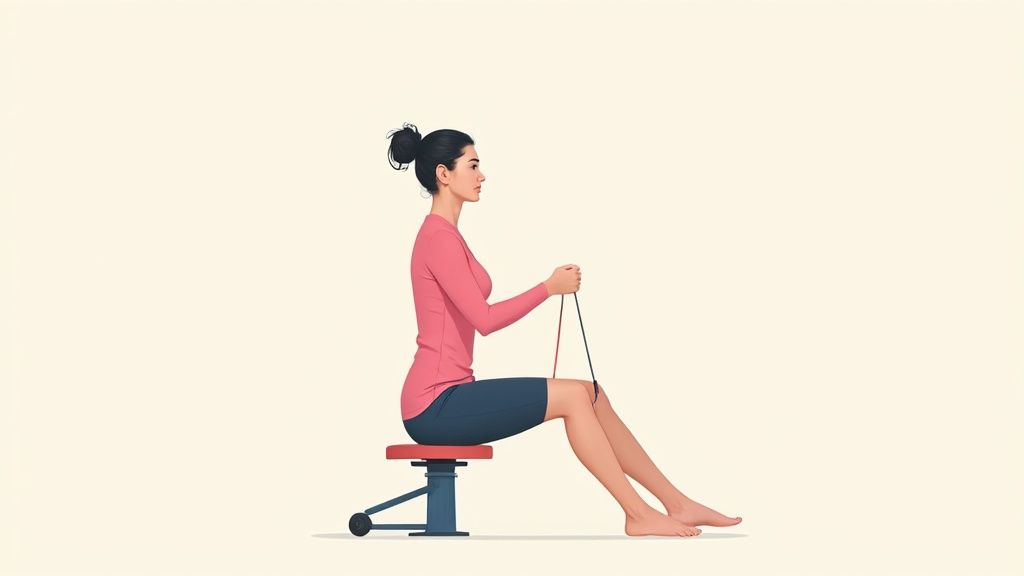
Unlocking Deeper Muscle Engagement
Think about a classic exercise like a glute bridge. Now, imagine doing it with the Original WundaCore Resistance Ring. You can place it between your thighs and actively squeeze against it as you lift. Suddenly, you’re not just working your glutes. That simple addition fires up your inner thigh muscles (adductors) and deep core stabilizers at the same time, creating a much more integrated and powerful movement.
This approach lets you:
- Target specific muscles with much greater precision for better toning.
- Get tactile feedback that helps you feel the connection and correct your form instantly.
- Increase the challenge without resorting to high-impact jumping or other jarring motions.
A smart tool isn’t meant to just exhaust you—it’s meant to educate your body. It provides the feedback you need to master proper form and activate muscles you might not have realized you had.
The Power of Expert Guidance
Beyond physical equipment, having access to expert coaching and motivation is what keeps you consistent. This is a huge trend right now—industry analysis shows low-impact exercise is a major favorite for 2025, largely because it puts no added stress on joints while improving mobility. Women, especially, are looking for these kinds of sustainable fitness solutions that fit their long-term health goals.
On-demand classes, for example, bring a seasoned instructor right into your living room. Instead of guessing your way through a routine, you get real-time cues on form, breathing, and which muscles to engage. It ensures every minute of your workout is actually productive. Plus, the variety keeps things fresh and helps you avoid the boredom that can so often derail a new fitness habit. For more on this, there's a great article about choosing the best home workout app for women that offers some valuable insights.
Your Low-Impact Fitness Questions, Answered
Starting any new fitness path brings up questions. That’s a good thing—it means you’re being thoughtful about how you move your body. Let's walk through some of the most common things people ask about starting a low-impact workout for women so you can get moving with total confidence.
I want to clear up any confusion and give you straightforward, real-world answers.
How Often Should I Do a Low-Impact Workout to See Results?
When you’re starting out, consistency beats intensity every time. To see and feel real changes in your strength, muscle tone, and heart health, a great goal is 3 to 5 low-impact workouts per week. This schedule gives your muscles enough time to recover and adapt, which is how they get stronger.
If you're brand new, you might start with three 20-minute routines. Someone with more experience could aim for four or five 40-minute sessions. The most important thing is to listen to your body. Make sure you schedule at least one or two complete rest days. That recovery time is when the magic happens—it’s essential for muscle repair and preventing burnout so you can stick with it for the long haul.
Can I Actually Lose Weight with Only Low-Impact Workouts?
Absolutely. There's a common misconception that you have to punish your body with high-impact exercise to lose weight, and it's just not true. Weight management comes down to creating a sustainable calorie deficit, and a well-designed low-impact workout is a powerful way to do that.
The trick is to choose activities that get your heart rate up and, just as importantly, build lean muscle. Things like:
- Walking on an incline
- Cycling with added resistance
- Swimming
- Structured Pilates routines, like our WundaCore classes
Muscle is metabolically active, meaning it burns more calories at rest than fat does. By building muscle through consistent, low-impact strength training, you’re gently boosting your metabolism around the clock. Pair that with nourishing food, and you have an incredibly effective and sustainable strategy for healthy weight management.
What Is the Difference Between Low-Impact and Low-Intensity?
This is probably one of the most crucial distinctions to understand in fitness. Getting this right helps you pick the perfect workout for your goals on any given day.
Low-impact is all about the movement—it’s kind to your joints because one foot is almost always on the ground. Think walking, cycling, or using an elliptical. Low-intensity, on the other hand, describes your effort level, which we usually measure by heart rate.
A workout can easily be low-impact but high-intensity. Picture a challenging WundaCore class that has you sweating and your muscles shaking, or power-walking up a steep hill. You're pushing your cardiovascular system and seriously challenging your muscles, all without a single jump. This combination is the secret to getting incredible results without beating up your joints.
Ready to feel the difference that anatomy-informed, low-impact training can make? WundaCore provides the tools and expert guidance to help you build real strength from the inside out. Explore our on-demand classes and smart equipment to start your journey today at https://wundacore.com.