
Osteoporosis and Pilates: Anatomy-Focused Guide to Boost Bone Health
Osteoporosis and Pilates join forces to create anatomically-informed movement routines that respect skeletal geometry. By zeroing in on spinal alignment, cortical-trabecular interfaces, and neuromuscular coordination, you stimulate mechanosensitive osteocytes, promote bone maintenance, and lower fall risk. In just a few weeks, an anatomy-focused Pilates practice can safely load bone tissue along primary stress lines, reinforce deep core stabilizers—like the transverse abdominis and multifidus—and sharpen proprioception via muscle spindles.
Pilates For Osteoporosis And Bone Strength
Bone tissue remodels in response to mechanical stress according to Wolff’s law. Anatomy-informed Pilates borrows this principle, directing controlled forces to cortical bone of the vertebral bodies and the trabecular network of the femoral neck.
By dialing in spinal alignment and precise muscle engagement, you off-load vulnerable sites and build skeletal resilience.
-
Safe Mechanical Loading
Controlled axial resistance—think heel presses on a WundaCore Resistance Ring—sends compressive force along the femoral shaft and up through trabecular arches, avoiding harmful shear at the femoral neck. -
Core Control Emphasis
Activating the transverse abdominis and multifidus creates an internal corset that relieves stress on the vertebral endplates and intervertebral discs. -
Balance Drills
Single-leg stands or dynamic reach exercises engage muscle spindles in the gluteus medius, tibialis anterior, and peroneals—sharpening proprioceptive feedback to prevent falls.
Pilates routines become a personalized roadmap when you factor in fracture history, spinal curvature angles, and hip joint biomechanics.
Here’s a quick overview of how Pilates supports bone density, balance, and injury prevention:
Pilates and Bone Health Summary
| Benefit | Description |
|---|---|
| Bone Density Maintenance | Controlled loading on cortical bone and trabecular interfaces stimulates osteoblast activity. |
| Balance Enhancement | Proprioceptive drills target muscle spindles in hip stabilizers and ankle supinators. |
| Injury Prevention | Core activation and alignment cues protect vertebral lamellae and reduce shear forces. |
Client Progress Snapshot
"After three vertebral fractures, Sarah regained confidence within eight weeks by progressing from basic mat work to light Loop resistances under expert guidance."
Many instructors use stories like Sarah’s to illustrate how microprogressions—adding a Loop or Ring—can reestablish neuromuscular trust in the body.
Equipment Tips
- The WundaCore Resistance Ring delivers consistent axial loading, feeding back through the periosteum to activate osteogenic cells.
- A Light Loop adds targeted hip abduction load across the gluteus medius insertion at the greater trochanter.
- The Movement Mat and Block introduce subtle instability and height cues for spinal segmental awareness.
Next, we’ll explore bone microarchitecture, review clinical studies on Pilates benefits, cover essential safety guidelines, and share anatomy-informed modifications using WundaCore props.
Understanding Bone Anatomy For Osteoporosis
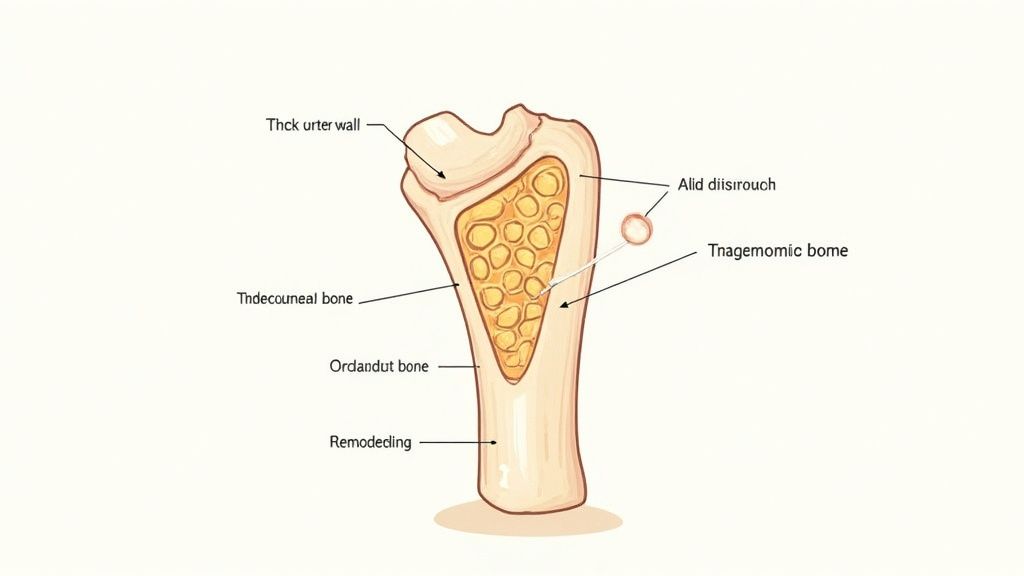
Bones are our body’s scaffolding: they support movement and withstand daily stresses. Imagine a house with solid exterior walls and hidden beams inside—that’s the balance between strength and lightness in your skeleton.
- Cortical Bone: The dense outer layer composed of osteons (Haversian systems) with concentric lamellae surrounding central canals. It provides rigid support like exterior walls.
- Trabecular Bone: A spongy network of trabeculae oriented along principal stress lines, akin to interior support beams, housing marrow and vascular channels.
- Periosteum & Endosteum: The periosteum is a fibrous surface layer rich in osteoprogenitor cells; the endosteum lines marrow cavities, both vital for bone remodeling.
- Bone Remodeling: Osteoclasts create Howship’s lacunae to resorb aged tissue; osteoblasts then secrete osteoid, mineralizing new lamellae guided by osteocytes in canaliculi.
Mechanical forces act like wind pressing on a frame, signaling weak spots to fortify. In Pilates, gentle axial loading around the spine targets vertebral bodies and hip joints precisely—areas at highest risk for vertebral compression and femoral neck fractures.
“Mechanical loading is the biological cue that keeps bones from becoming brittle.”
Spinal vertebrae feature a thin cortical shell with abundant trabecular cores—ideal for shock absorption but vulnerable under forward flexion. Femoral neck trabeculae form arches to distribute load; lacking sufficient gluteal and hip abductor support, they risk overload.
- Thoracic Vertebrae: Rich in trabecular content, experiencing compressive loads from rib cage and upper-body mass.
- Lumbar Vertebrae: Larger vertebral bodies with more cortical margin, tasked with bearing trunk weight.
- Femoral Neck: A narrow cortical bridge between head and shaft, relying on periosteal integrity and abductor forces.
How Muscle Forces Protect Bones
Muscles act like tension cables, redirecting compressive forces away from fragile bone regions. Engaging hip abductors (gluteus medius/minimus) offloads the femoral neck; activating the erector spinae and multifidus stabilizes the lumbar spine by bracing posterior vertebral arches.
- Hip Abduction Cues: Loop above the knees ensures gluteus medius activation along its iliac crest origin.
- Core Brace Analogy: Picture a suspension bridge with the transverse abdominis and internal obliques tightening like cables around your lumbar ring.
- Scapular Stability: Retract and depress the scapulae to lock the shoulder girdle, protecting cervical and upper thoracic segments under load.
Vulnerable Regions To Monitor
The thoracic and lumbar spine endure constant loading from posture and movement. Their high trabecular content means even slight density loss impairs shock absorption.
- Vertebrae: Maintain a neutral spine during flexion exercises to protect anterior vertebral bodies and endplates.
- Femoral Neck: Use controlled hip abduction and avoid excessive adduction or internal rotation to minimize shear.
Opt for modifications—like side-lying leg work rather than deep roll-downs—to safeguard these anatomically vulnerable areas.
Cortical bone makes up about 80% of skeleton mass, while trabecular bone accounts for the other 20% but remodels more rapidly.
Pilates Impact On Bone Strength And Fall Risk
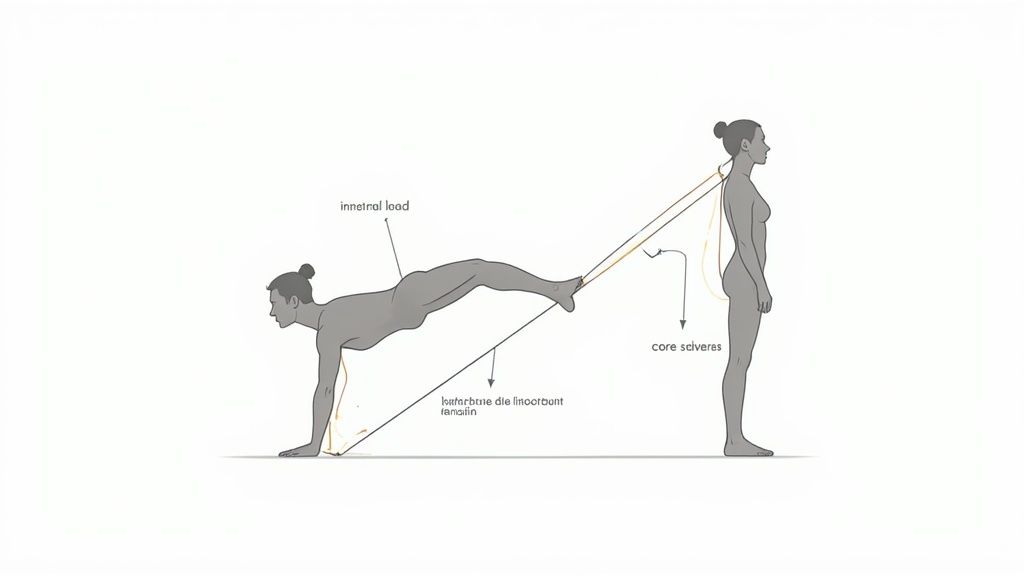
Precision in Pilates delivers targeted mechanical stimuli that activate osteoblasts via osteocyte mechanotransduction in Haversian systems and trabecular lacunae. Meanwhile, refined proprioception lowers fall risk by improving sensory feedback from joint capsules and muscle spindles.
Imagine your core as the suspension cables under a bridge. As you draw the transverse abdominis toward your spine, you stabilize each vertebral lamella—shielding them from shear and compression.
- Controlled Axial Loading: Using the WundaCore Resistance Ring under your heel slide sends a compressive vector through the subtrochanteric region up the femoral neck.
- Deep Core Engagement: Recruiting deep abdominal fibers, including the pyramidalis and quadratus lumborum, keeps your lumbar curve neutral.
- Dynamic Balance Drills: Single-leg stands on the Movement Mat refine vestibular and proprioceptive pathways in the ankle and hip joints.
Small variations—like heel presses through the Loop—target the gluteal medius insertion on the greater trochanter without overstressing the joint capsule.
Key Effects Explained
Systematic reviews show mind–body practices such as Pilates help maintain BMD and enhance balance, posture, and fall risk—even if they produce less dramatic density increases than progressive, high-intensity resistance training. Learn more about this finding
Mind–body practices deliver stability and postural benefits by optimizing muscle coordination around joints, even if BMD changes are modest.
Comparison of Pilates and High-Intensity Training for Bone Health
| Approach | BMD Improvement | Muscle Strength | Fall Risk Impact | Adverse Events |
|---|---|---|---|---|
| Pilates | Maintenance of existing BMD | Moderate gains in stabilizer muscles | Noticeable drop in slip-related falls | Low |
| High-Intensity Resistance (HiRIT) | 2–5% increase over 6–12 months | Significant increase in major muscle groups | Substantial fall risk reduction | Moderate muscle soreness |
Anatomy-Informed Modifications And Sample Routine
-
Hip Loading With Loop
Loop above your knees engages gluteus medius/minimus, transmitting load from iliac crest to greater trochanter through a stable pelvis. -
Slow Transitions
Use the Block under your ischial tuberosities during sit-to-stand to cue posterior pelvic tilt and protect lumbar facets. -
Proprioceptive Challenges
Single-leg stands with head turns amplify vestibular input, refining feedback channels in the inner ear and foot mechanoreceptors.
Clinical Evidence On Pilates Benefits
Research into Pilates and bone health has grown, mixing program lengths, session intensities, and prop use. That variety means we pair bone density data with real-world gains in strength and balance.
In randomized trials, participants attend 60-minute Pilates classes combining mat work with tools like the Resistance Ring and Loop. A meta-analysis of 591 participants across 11 trials noted a pooled effect size of 0.07 for BMD when Pilates is combined with yoga, with DXA scans showing minimal change over typical program durations. Discover more insights about BMD changes in this meta-analysis
Yet functional improvements often outpace density shifts. Studies report 10–15% gains in timed up-and-go tests and a 12% increase in leg-press strength after eight weeks of twice-weekly Pilates.
Study Design And Outcomes
Programs vary by frequency, exercise selection, and progression but commonly include:
- Bone Mineral Density (BMD) via DXA scans
- Timed functional tests (gait speed, balance)
- Self-reported pain and quality of life
- Dropout rates and adverse events
Well-designed Pilates routines often show adherence above 95% and minimal adverse events—highlighting the safety of anatomy-focused progressions.
“Consistency in session frequency and gradual progression is vital for seeing real-world gains,” notes a lead investigator.
Program Variables That Matter
- 12-week routines maintain cortical and trabecular bone mass
- 24–32-week programs can spark small BMD increases at the spine and hip
- Higher-load prop progressions outpace mat-only work for targeted bone stimulation
To maximize fall-risk reduction, blend axial-loading moves with dynamic balance drills:
- Resistance Ring heel presses for femoral neck loading
- Single-leg stands on the Movement Mat for ankle and hip proprioception
- Controlled roll-downs on the Block to protect lumbar vertebrae
Pair Pilates with progressive resistance training for amplified skeletal benefits: Learn more about resistance training benefits for women
Practical Takeaways
| Parameter | Effectiveness |
|---|---|
| 12-week mat program | BMD maintenance, moderate strength |
| 24-week mixed routine | Small BMD gains, better balance |
| Twice-weekly frequency | High adherence, low adverse events |
Safety Precautions And When To Consult
Pilates offers strength and balance, but with osteoporosis you need extra caution. Screen for risk factors that could compromise fragile bone integrity.
Watch for these red flags:
- Recent Vertebral Compression: Height loss or persistent back stiffness may indicate unstable wedge fractures.
- Severe Kyphosis: Exaggerated thoracic curve raises shear forces on anterior vertebral bodies.
- Advanced Joint Degeneration: Altered biomechanics at hips or shoulders shifts load onto osteoporotic bone.
- Neurologic Symptoms: Tingling, numbness, or burning suggest nerve root compression.
Early detection lets you adapt your practice before exacerbating injury. Note any sharp pain, radiating discomfort, or unusual fatigue during sessions.
Professional Screening Tips
- Posture Check: Observe neutral alignment in standing and seated positions.
- Pain Log: Track location, intensity, and triggers of discomfort.
- Movement Assessment: Test hip hinges and scapular control under load.
- Neurologic Screen: Monitor for changes in sensation or muscle strength.
If concerns arise, pause your routine and seek medical clearance. Imaging or specialist evaluation can confirm bone stability and safe progression.
“Persistent pain after low-impact loading or new neurologic symptoms warrant immediate medical evaluation.”
Exercise Modifications
- Replace full roll-ups with partial curl-ups on a Block to avoid end-range flexion.
- Emphasize hip hinge drills to reduce lumbar shear.
- Use the Loop for side bends, maintaining a neutral spine.
- Swap overhead reaches for arm circles to preserve shoulder capsule integrity.
Advance only after completing movements pain-free for two weeks. Explore more tools in our guide to low-impact exercise equipment for seniors.
Anatomy-Based Pilates Modifications And Routines
Every Pilates move can be mapped to your skeleton, safely loading fragile regions while building functional strength and improving balance. Below are three sequences using the Resistance Ring, Loop, Block, and Movement Mat to guide you from the mat to standing work.
Equipment At A Glance:
- Resistance Ring: Applies circumferential pressure and axial load to vertebral endplates.
- Loop: Facilitates controlled hip abduction forces on the femoral neck.
- Block: Cues pelvic tilt, steadies roll-downs, and shields lumbar vertebrae.
- Movement Mat: Introduces subtle ground instability for proprioceptive challenge.
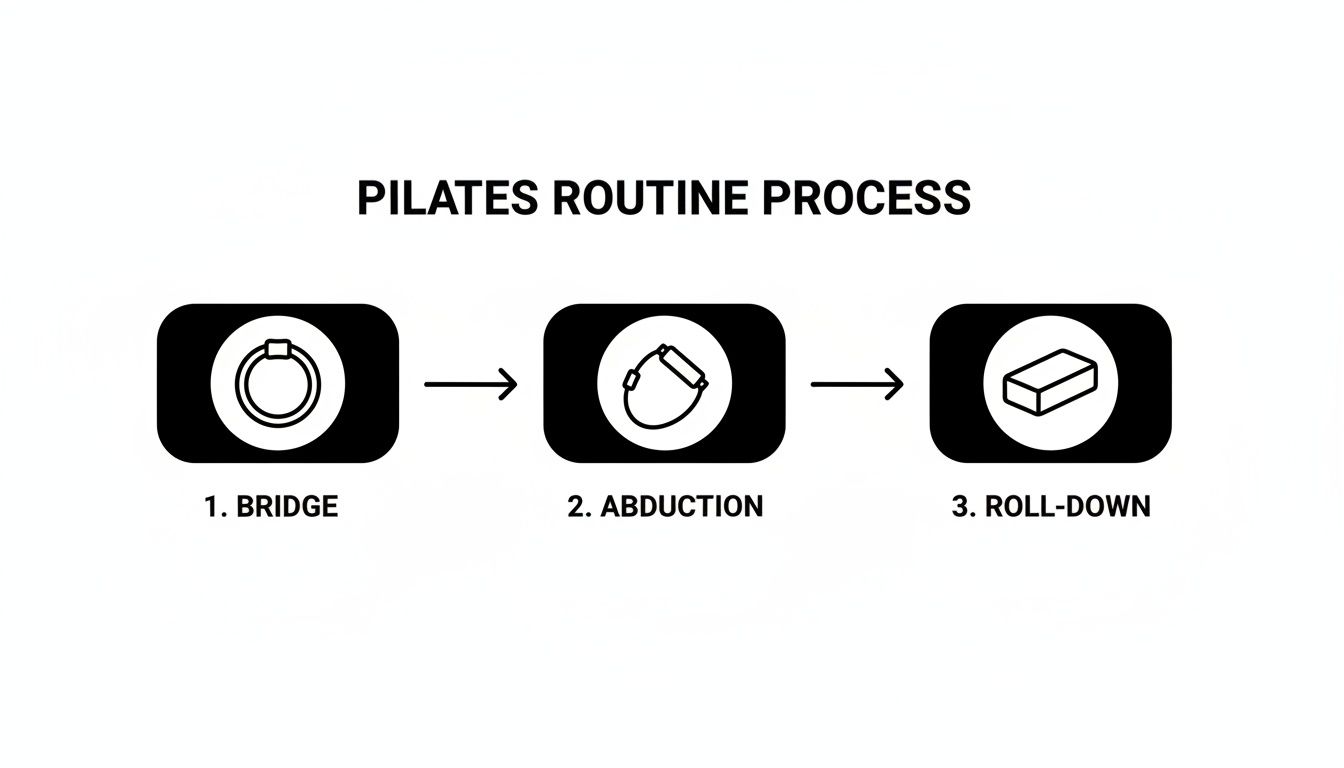
Bridge Sequence With Ring
Lie supine with knees bent, feet hip-width apart, Ring above ankles. Draw your navel toward spine, press through heels to lift into a neutral-curve Bridge.
- Hold 3–5 seconds, feeling rib expansion and pelvic stability.
- Lower slowly, articulating each vertebra.
- Repeat 8–12 reps, focusing on controlled motion and pelvic alignment.
Clinical trials showed faster gait speed, stronger hip extensors, and up to 34.7% localized BMD gains in targeted protocols. Read the full clinical study on bone density improvements.
Standing Hip Abduction Modifications
Stand with Loop above knees, feet hip-width. Press outward to engage gluteus medius at the greater trochanter, maintaining level iliac crests.
- Reps: 10–15 per side.
- Tip: Use a Block behind hips to monitor pelvic tilt.
- Pause at end range for enhanced proprioception.
Block Supported Roll Down Sequence
Sit on Movement Mat with Block under sacrum. Exhale to articulate spine forward, stopping at safe flexion.
- Roll only to a comfortable depth—avoid end-range flexion.
- Press into Block if pelvic control wanes.
- Return slowly, stacking vertebrae back to neutral.
For more age-specific routines, see our guide on Pilates for Women Over 50.
Common Questions About Osteoporosis And Pilates
Is Pilates Safe for People With Osteoporosis?
Absolutely—when modified anatomically. Avoid deep spinal flexion and high-impact moves. Proper alignment and muscle engagement protect the vertebral lamellae and cortical bone.
Modified Pilates honors spinal curves and hip mechanics while keeping vulnerable bones safe.
How Soon Can I Expect Fitness Improvements?
Notice posture and balance gains within 4–6 Weeks. By 8–12 Weeks, core strength and stability often show measurable improvement.
| Timeline | Expected Change |
|---|---|
| 4–6 Weeks | Improved posture and steadier balance |
| 8–12 Weeks | Noticeable boost in core strength and stability |
Can Pilates Increase Bone Density on Its Own?
Pilates excels at preserving existing BMD and optimizing movement patterns. For larger density gains, combine Pilates with progressive weight-bearing resistance.
When Should I Get Medical Clearance?
Consult your doctor if you’ve had:
- A recent fracture or vertebral compression
- Unexplained pain during flexion or rotation
- New neurologic symptoms (tingling, numbness)
Getting the green light ensures every session is both safe and effective.
Ready to take your Pilates practice up a notch? Shop WundaCore gear at WundaCore today for studio-quality, expert-led workouts you can do at home any time.