
Your Anatomy-First Guide to Postpartum Core Strengthening Exercises
Forget everything you think you know about "getting your abs back" after pregnancy. Postpartum core work isn't about endless crunches or jumping back into high-intensity workouts. It’s a much smarter, more intentional process of reconnecting with your body's deep anatomical structures from the inside out.
We’re talking about rebuilding the deep muscular system—the transverse abdominis, pelvic floor, diaphragm, and multifidus—that supports your spine and pelvis. This is the very foundation that was so beautifully stretched and adapted to grow your baby. This anatomy-first approach is the key to preventing nagging back pain, healing diastasis recti, and building true, functional strength for all the demands of motherhood.
Your Guide to Rebuilding Your Core After Birth
The journey back to a strong core after childbirth is deeply personal. It’s not about "bouncing back" but about mindfully and intelligently rebuilding your anatomical foundation. Pregnancy literally rearranges your core, stretching the linea alba (the connective tissue down the midline of your abdomen) and placing incredible demands on your pelvic floor and deep abdominal muscles. This is completely normal.
The challenge is that this process leaves your deep core muscles feeling disconnected. Think of your core as a dynamic canister: your diaphragm is the lid, your pelvic floor is the base, and your transverse abdominis and multifidus wrap around it all. After birth, this canister often isn't working as one cohesive unit, which can lead to everything from back pain and pelvic instability to that persistent "mummy tummy" feeling.
Why an Anatomy-First Approach Matters
An effective postpartum core program focuses on restoring the neuromuscular communication between all parts of that canister before adding heavy loads or intense exercises. Believe it or not, jumping right back into planks or sit-ups can actually make things worse, especially if you have a diastasis recti (abdominal separation), by creating excessive intra-abdominal pressure that the weakened linea alba cannot manage.
The goal isn't just to flatten your stomach; it's to restore the function of your entire core system. This means relearning how to breathe for stability, activating the right muscles in the right order, and building a foundation that supports every single move you make—from lifting your baby out of the crib to eventually returning to the fitness you love.
Understanding the why behind each movement is what makes this process so powerful. It turns your workout from a simple checklist into a mindful practice of healing. By putting anatomy first, you ensure every tiny pelvic tilt and every focused breath is a productive step toward a stronger, more resilient you.
Let's take a closer look at the key players in this recovery process.
Postpartum Core Recovery At a Glance
This table breaks down the main anatomical components we focus on in postpartum recovery. Understanding their roles is the first step in effectively retraining them to work together again.
| Anatomical Focus | What It Is | Why It Matters for Recovery |
|---|---|---|
| Diaphragm | The dome-shaped muscle at the base of your ribs that powers your breathing. | Proper diaphragmatic breathing helps regulate intra-abdominal pressure, gently engaging the deep core and pelvic floor. |
| Transverse Abdominis (TVA) | Your deepest abdominal muscle, which acts like a natural corset, wrapping around your midsection from your spine to your linea alba. | This is the primary muscle for stabilizing your spine and pelvis. Reconnecting with it is key to healing diastasis recti. |
| Pelvic Floor | A group of muscles (like the levator ani) that form a "hammock" at the base of your pelvis, supporting your organs. | Pregnancy and birth stretch and weaken these muscles. Restoring their strength and function is crucial for preventing incontinence and prolapse. |
| Multifidus | Small, deep muscles that run along your spine, providing segmental stability with every movement. | These often become inactive during pregnancy, contributing to postpartum back pain. Waking them up is essential for a stable back. |
By focusing on how these parts are designed to function as a team, you can build a truly resilient core that will support you for years to come.
This guide will walk you through that process, moving beyond generic advice to give you a clear, safe, and effective roadmap. To round out your recovery, you can also explore other gentle postpartum fitness exercises that will complement your core-specific work.
Getting to Know Your Postpartum Core
Before we jump into any exercises, let’s get acquainted with what’s actually happening inside your postpartum body. Pregnancy and birth are transformative, stretching and shifting your core muscles in profound ways. Rebuilding your strength isn’t about just crunching your rectus abdominis back into place; it's about re-learning how to make the entire system work together again.
Think of your core as a canister, a dynamic container built to manage pressure and provide stability for every single thing you do—from breathing to lifting your baby out of the crib.
This "core canister" concept is central to understanding how to heal and strengthen effectively. It's a team effort.
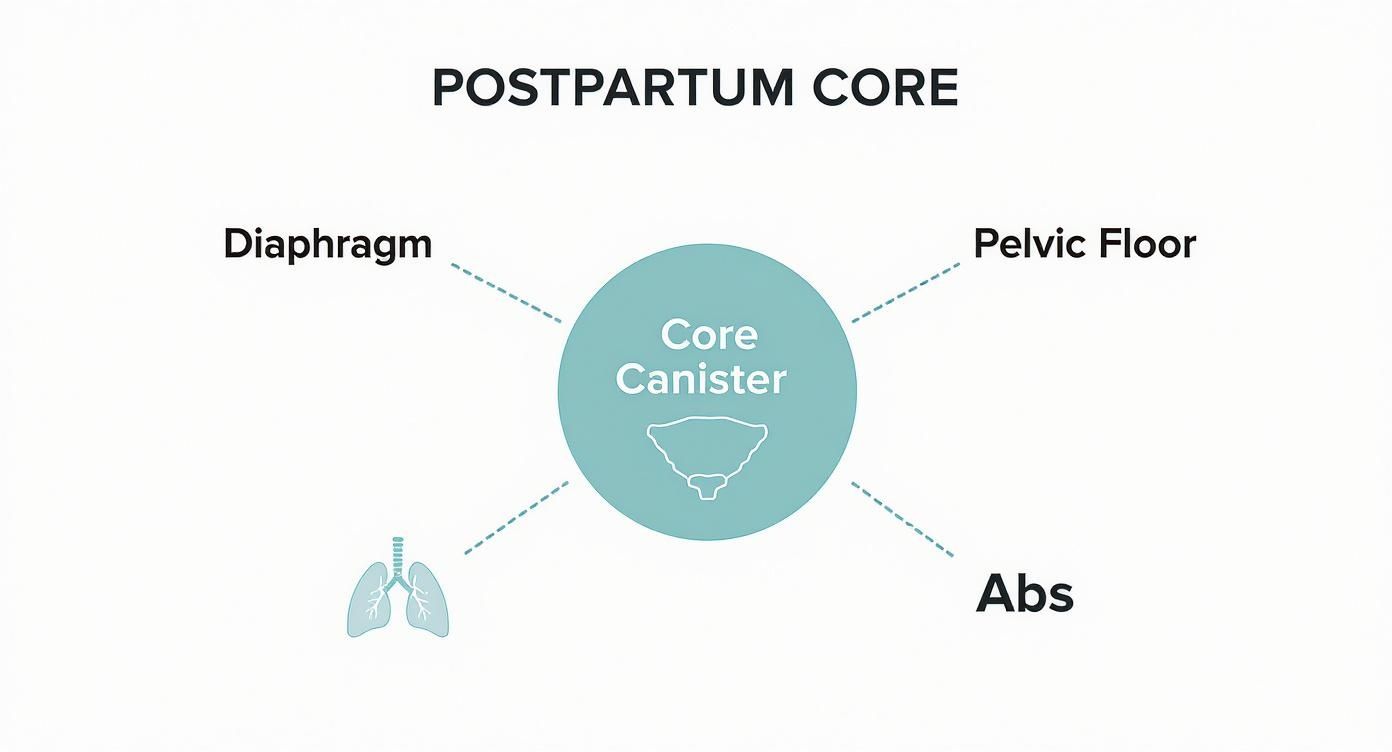
As you can see, true core function relies on the synergy between these key players, not just one isolated muscle group.
The Key Players in Your Core Canister
Your core is so much more than the "six-pack" muscles (the rectus abdominis). It's a deep, intelligent system of four critical muscle groups that need to communicate and work in perfect harmony.
- The Diaphragm: This is the lid of your canister. Sitting at the base of your ribcage, this dome-shaped muscle is your primary engine for breathing. Its downward contraction on an inhale initiates a pressure change that communicates directly with the pelvic floor.
- The Pelvic Floor: Think of this as the base or floor of the canister. This group of muscles, including the levator ani and coccygeus, forms a supportive sling at the bottom of your pelvis, holding up your organs and playing a massive role in continence and stability.
- The Transverse Abdominis (TVA): Meet your body’s natural corset. The TVA is the deepest layer of your abdominals, with fibers that run horizontally around your entire midsection to stabilize your spine and pelvis. It’s the true hero of deep core strength.
- The Multifidus: These are the small but mighty muscles that run along the vertebrae of your spine, providing segmental stability. They tend to get a little sleepy during pregnancy, which is a common culprit behind that nagging postpartum back pain.
Pregnancy puts this whole system under incredible strain, stretching the abdominal wall and often causing a disconnect in how these muscles talk to each other. Our first job is to get them talking again.
It All Starts With Your Breath
The single most powerful tool you have to reconnect this system is your breath. We call it “360 breathing” or diaphragmatic breathing, and it is the absolute foundation of every postpartum core exercise we do. It’s how you retrain the canister to work as a team.
Here’s the anatomical process: on an inhale, your diaphragm moves down, and your pelvic floor and TVA should gently relax and expand eccentrically. On an exhale, your diaphragm lifts, and your pelvic floor and TVA gently lift and engage concentrically. This coordinated rhythm is the secret to managing internal pressure correctly.
Think of it like this: your breath is the conductor of your core’s orchestra. When the conductor cues correctly, every musician plays in perfect harmony. Without that cue, you just get noise instead of beautiful music.
Mastering this breathwork is non-negotiable. It’s what turns a simple movement into a potent, healing exercise, ensuring you’re building strength from the inside out—exactly what your body needs right now.
How to Self-Check for Diastasis Recti
Diastasis Recti Abdominis (DRA)—the separation of the rectus abdominis muscles due to the stretching of the linea alba connective tissue—is incredibly common after pregnancy. Knowing if you have it helps you choose the right exercises.
Here’s a simple, safe way to check for a separation at home:
- Get into position. Lie on your back with your knees bent and feet flat on the floor, just like you’re setting up for a crunch.
- Place your fingers. Rest the fingertips of one hand on your midline right at your navel, pointing down toward your pelvis.
- Engage gently. Lift just your head and shoulders off the floor—enough to feel your ab muscles tense up, but not a full crunch.
- Feel for the gap. Gently press your fingers down and feel for the space between the two firm bands of your rectus abdominis muscles. How many fingers can you fit in the gap? That’s the width.
- Check three spots. To get the full picture, assess the gap at your belly button, about two inches above it, and two inches below it.
Make a mental note of both the width (how many fingers) and the depth (does it feel soft and deep, or more taut?). A deep, soft gap often points to weaker connective tissue. This isn't a formal diagnosis, but it gives you incredibly valuable information about your body.
The good news? The right kind of exercise makes a huge difference. Research has shown that an eight-week program of deep core stability exercises can lead to a significant decrease in abdominal separation. Understanding the muscles of your pelvic floor is a critical piece of this puzzle, and you can learn more about how to strengthen your pelvic floor in our detailed guide.
Foundational Exercises to Reconnect Your Core
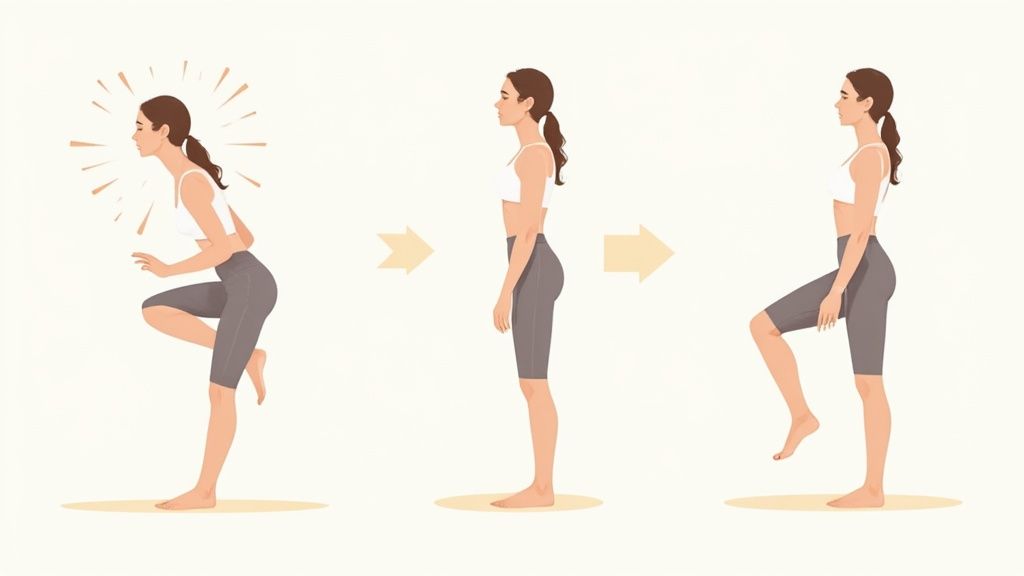
Alright, you've got the "why" behind your postpartum core anatomy. Now it's time to get on the mat and gently put that knowledge into practice. We're starting with a series of incredibly intentional movements designed to re-establish that crucial mind-muscle connection. Think of this phase as a quiet conversation with your core, not a shouting match.
The focus here isn’t about feeling the burn; it's about precision and awareness. We'll use the “360 breath” as the engine for every single move, ensuring you’re building deep, functional strength from the inside out. This is where the real magic happens.
Mastering Diaphragmatic Breathing
Before we do any tilting, lifting, or bridging, we must solidify your connection to your breath. Honestly, this is the single most important exercise in your entire recovery. It's how we retrain your diaphragm, transverse abdominis (TVA), and pelvic floor to start working together again as a team.
To start, lie on your back with your knees bent and feet flat on the floor. Place one hand on your chest and the other just below your ribcage on your belly.
- Inhale: Breathe slowly in through your nose. Feel your ribcage expand in every direction—front, sides, and back into the mat. Your diaphragm contracts and flattens, creating space in the thoracic cavity.
- Exhale: Breathe out slowly through your lips, like you’re gently blowing out a candle. You should feel your belly draw inward as your transverse abdominis softly engages and your pelvic floor gently lifts.
This is subtle, but it's so powerful. You're resetting your nervous system and teaching your core how to properly manage pressure, which is absolutely essential for healing diastasis recti. If you're looking for a deeper dive, our guide on Pilates for diastasis recti has even more targeted strategies.
Gentle Pelvic Tilts
Once you feel that breath connection clicking into place, you can add a little bit of movement. The pelvic tilt zeroes in on the lower part of your TVA and starts to reawaken the muscles that stabilize your lumbopelvic region.
Stay in the same position from your breathwork, but place your hands on your hip bones (anterior superior iliac spine) so you can feel the movement.
- Inhale to prepare. Let your back have its natural, slight curve away from the floor (a neutral lumbar spine).
- Exhale completely. As you do, use your deep belly muscles (TVA) to gently tilt your pelvis, pressing your lower back lightly into the floor in a posterior pelvic tilt.
- Inhale to release slowly back to your neutral starting position.
Keep the movement small and controlled. It should come from your deep core, not from squeezing your glutes or pushing with your feet.
Controlled Heel Slides
This exercise builds on the pelvic tilt by asking your core to stay stable while your leg moves—a fundamental skill you use all day, every day. Heel slides specifically train your TVA to fire correctly and prevent your pelvis from tilting or your lumbar spine from arching.
Start on your back, both knees bent.
- Exhale and Engage: Take a slow exhale to gently engage your core, just like you did in the pelvic tilt.
- Slide and Extend: Keeping your core engaged and your pelvis perfectly still, slowly slide one heel away from you until your leg is straight.
- Inhale and Return: Take an inhale as you slowly slide that heel back to the starting position.
Watch Out For This: The most common mistake I see is lumbar extension (the low back arching off the floor) as the leg extends. If you feel that happening, you've gone too far. Only slide your heel out as far as you can while keeping a stable, neutral spine. The quality of control is way more important than the range of motion.
The Foundational Glute Bridge
Strong glutes (gluteus maximus, medius, and minimus) are a new mom's best friend. They are key hip extensors and external rotators, giving critical support to your pelvis and lower back, taking a massive amount of strain off your recovering core.
Here's how to do it right:
- Lie on your back with your knees bent and feet hip-width apart. Your feet should be flat on the floor, relatively close to your butt.
- Exhale to engage your core, then initiate the movement by squeezing your glutes to lift your hips off the floor.
- Create a nice, straight line from your shoulders to your knees, avoiding hyperextension of the lumbar spine.
- Inhale as you slowly lower your hips back down to the floor with control.
This move is a multitasker: it strengthens your glutes and hamstrings while teaching your core to stay engaged during hip extension.
Bird-Dog Preparation
The full Bird-Dog exercise is incredible for building cross-body core stability, but it's often too much too soon. This prep phase teaches you to engage your TVA against gravity without overwhelming your system.
Start on all fours. Your hands should be directly under your shoulders and your knees right under your hips. Find a neutral spine—not arched, not rounded.
- Hand Lift: Inhale to prepare. Exhale to gently engage your core, then slowly lift one hand just an inch off the floor without shifting your body weight. Hold for a full breath cycle, then lower.
- Knee Lift: Once you've mastered the hand lift, try the same thing with your knees. Exhale, engage, and lift one knee just an inch off the floor. The goal is zero movement through your pelvis or spine. Imagine you have a cup of tea balanced on your sacrum.
These tiny movements are deceptively effective at training your deep core stabilizers, like the multifidus muscles that run along your spine. By starting here, with these foundational exercises, you're building a resilient, intelligent core that will support you through all the beautiful chaos of motherhood.
How to Progress Your Core Workouts Safely
Once you’ve mastered that initial gentle reconnection phase, your body is ready for the next chapter. This is where we start to layer on more challenge, asking your core to stay stable even when things get a little tougher. Progressing safely is all about building strength intelligently—not rushing into advanced movements that could cause a setback.
The key here is to listen intently to what your body is telling you. Think of each new exercise as an opportunity to check in with your core canister. Are you able to maintain that deep connection? Can you breathe through the movement without your upper body tensing up? This mindful approach is what builds true, lasting strength.
A Quick Word on Abdominal Coning or Doming
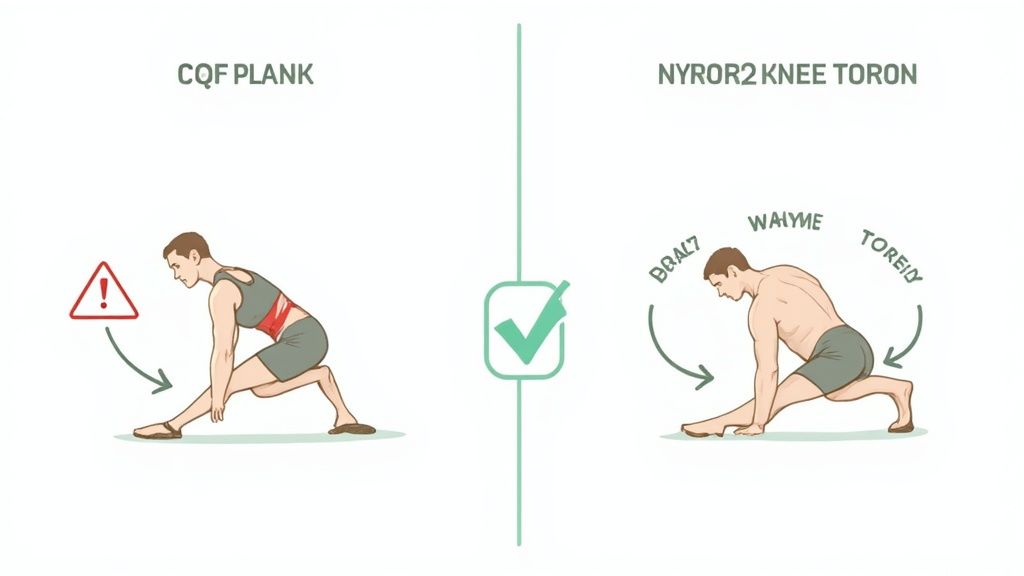
Before we jump into new exercises, we need to talk about a critical visual cue to watch for: abdominal coning or doming. It looks like a ridge or a little tent popping up along the midline of your belly during an exercise.
This is your body's way of saying that the intra-abdominal pressure is a bit too much for your linea alba (that connective tissue between your rectus abdominis muscles) to handle at the moment. It means your deep core isn't quite managing the load, so the pressure is pushing outward.
If you see this, it’s not a failure! It's just a signal to take a step back. Regress the movement to a less challenging version where you can keep your core flat and engaged. This is the absolute smartest way to progress without compromising your diastasis recti healing.
Level Up Your Core Work with These Exercises
When you can nail those foundational movements without any coning and with a solid breath connection, you're ready to add these progressions. Remember to start with low reps—perfect form is always the priority.
The Dead Bug
This is a gold-standard movement for postpartum recovery. It’s brilliant because it challenges your core to stabilize your pelvis and spine while your limbs are moving, which is exactly what you do in your day-to-day life.
- Start on your back with your knees bent at a 90-degree angle over your hips (we call this tabletop position) and your arms reaching toward the ceiling.
- Exhale to engage your deep core, making sure your low back stays comfortably connected to the floor.
- Slowly lower your opposite arm and leg toward the floor. Only go as far as you can without your back arching or that belly coning. This challenges your core to resist lumbar extension.
- Inhale and return to the start with control. Then repeat on the other side.
A great way to start is with just the leg movements. Keep both arms reaching for the ceiling and alternate lowering one leg at a time. This reduces the challenge while you build control.
Modified Side Plank From Knees
Side planks are incredible for the obliques and quadratus lumborum—key muscles for pelvic and spinal stability. Starting from your knees makes this move much more accessible for the postpartum body.
- Lie on your side with your knees bent and stacked. Prop yourself up on your forearm, making sure your elbow is right under your shoulder.
- Exhale and lift your hips off the floor, creating a straight line from your head to your knees.
- Really focus on keeping your hips stacked (don't let that top one roll back!) and feel the lift coming from your bottom oblique muscle.
- Hold for 15-30 seconds, breathing steadily. Lower with control and then switch sides.
Introducing Plank Progressions
The plank is a fantastic full-body exercise, but a full plank is often way too demanding for the early postpartum core. We need to build up to it gradually.
- Elevated Plank: Start with your hands on a high surface like a kitchen counter or the back of a sturdy sofa. The higher the incline, the less load on your core. Walk your feet back until your body forms one long line. Hold, focusing on deep core engagement and watching for any doming.
- Kneeling Plank: Next, you can move to the floor, but on your knees and forearms. Keep a straight line from your head down to your knees, squeezing your glutes and engaging your core to keep your hips from sagging.
When you're feeling strong and ready for the next level, you can explore our guide to powerful Pilates exercises for core strength that will continue to challenge you in a safe, effective way.
It’s encouraging to know that this careful, progressive work aligns with expert recommendations. Guidelines from The American College of Obstetricians and Gynecologists (ACOG) support integrating core strengthening into a postpartum fitness routine. Evidence shows that specific abdominal exercises can effectively reduce the severity of diastasis recti, with a gradual reintroduction being key. You can discover more insights about these postpartum rehabilitation timelines to see how this structured approach supports long-term recovery.
When to Start and When to See a Professional
Knowing how to do postpartum core work is one thing, but knowing when to start is a whole different ballgame. The desire to feel like yourself again is so real and completely understandable. But your body has just done something miraculous, and it needs time to heal. Pushing too hard, too soon can actually set you back.
The standard advice you'll hear is to wait for your six-week postpartum checkup. Please, do not skip this appointment. Whether you had a vaginal delivery or a C-section, this visit is your chance to get a crucial baseline on how your body is healing and the official green light from your doctor or midwife to ease back into exercise.
But here’s the thing: that six-week mark is just a general guideline. The most important skill you can learn right now is how to listen to your body's specific signals. While you might be cleared for gentle movement, your readiness for a structured core program really depends on how you're feeling day-to-day.
Red Flags That Signal It's Time to Pause
Before you jump into any workout, you need to check in with your body. Are there any signs that your core and pelvic floor aren't quite ready for the challenge? Seeing these isn't a failure—it's just your body's way of asking for a little more time or a different approach.
Keep an eye out for these red flags:
- Pain: You should never, ever feel sharp, pinching, or lingering pain in your pelvis, hips, back, or abdomen. Not during, and not after.
- Urinary or Fecal Incontinence: Any leaking at all—even a tiny bit when you sneeze, cough, or move—is a clear sign that your pelvic floor isn't managing the pressure just yet.
- Pelvic Heaviness or Pressure: If you feel a sense of bulging, dragging, or heaviness down there, it could be a symptom of pelvic organ prolapse.
- Abdominal Coning or Doming: We talked about this earlier. If you see that tell-tale ridge or tent pop up along your midline during an exercise, it means your deep core isn't quite able to manage the internal pressure.
If you're experiencing any of these, it's time to connect with a pelvic floor physical therapist. These specialists are the absolute experts in postpartum recovery. They can give you a proper assessment and create a plan that is truly customized for your body. Seeing a PT is one of the most powerful, proactive steps you can take in your healing.
Understanding Postpartum Exercise Engagement
Even with all the known benefits, we know that starting a postpartum fitness routine is challenging for so many new moms. A 2019 study revealed that the rate of physical exercise among postpartum women was a surprisingly low 19.5%.
The research also showed that education was a major factor—college-educated women were almost three times more likely to exercise. These numbers really highlight why accessible, clear guidance is so important for everyone. You can read the full research about these postpartum exercise patterns to learn more.
Common Questions About Postpartum Core Recovery
Diving into postpartum core work can feel like navigating a whole new world. It's totally normal to be bursting with questions, feeling both excited to move and a little unsure of where to start. We get it. Let's walk through some of the most common concerns we hear from new moms, so you can feel clear and confident.
How Do I Know I'm Doing a Kegel Correctly?
This is my favorite question, because a proper Kegel is so much more than just squeezing like you're trying to stop the flow of urine. In fact, that cue can sometimes do more harm than good!
A true Kegel is a subtle, upward lift.
Picture this: imagine you're using your vagina and anus to gently pick up a tiny blueberry and lift it straight up inside your pelvis. It's a soft, internal sensation—not a big, forceful clench of your glutes or a squeeze of your inner thighs. Your breath is your best friend here. Exhale as you initiate that gentle lift, and inhale as you fully let go and relax the muscles back down. That release is just as important as the contraction.
Are These Exercises Safe After a C-Section?
Yes, one hundred percent. The foundational work of reconnecting to your deep core with your breath isn't just safe after a C-section, it's incredibly healing. That said, your timeline and approach will look a little different.
Your scar needs time to heal, so your starting point will be even more gentle. The initial focus is purely on diaphragmatic breathing and the most subtle transverse abdominis (TVA) engagements. Once your doctor gives you the green light and your incision is well-healed, you can begin to think about gentle scar tissue mobilization. This means softly massaging around and eventually on your scar to prevent adhesions and improve how the tissue moves—a game-changer for restoring full abdominal function.
Always, always listen to your body. Back off immediately if you feel any pulling, pinching, or pain at your incision site.
It's a huge myth that C-section moms don't need to worry about their pelvic floor. Your pelvic floor muscles supported the weight of your growing baby for nine months and went through the pressures of birth. They absolutely need and deserve just as much love and attention as your abdominal wall.
How Long Does Healing Diastasis Recti Take?
Ah, the million-dollar question. The honest answer is that there's no magic timeline for healing diastasis recti. Every body, every pregnancy, and every birth is unique, and your recovery journey will be, too. It’s so important to release any pressure for a quick fix.
Several things influence your healing timeline:
- Your body's unique makeup: The natural elasticity of your connective tissue (your linea alba) plays a big part.
- Previous pregnancies: Your core has a memory, and it might respond differently after one or more pregnancies.
- Your daily movements: How you get out of bed, lift your baby, and carry the car seat all have a huge impact on your core pressure system.
- Consistency is key: Gentle, consistent practice is so much more effective than going hard once or twice a week.
Remember, the goal isn't just about "closing the gap." It's about restoring functional tension to the linea alba. That's what truly gives you core stability and strength. Focus on progress, not perfection. Slow and steady really does win this race.
Ready to build a strong, functional core with expert guidance? The WundaCore system provides the tools and on-demand classes you need to support your postpartum recovery from home. Explore our anatomy-informed workouts and see the difference mindful movement can make.