
A Guide to Virtual Pilates Classes From Home
Think of virtual Pilates as having a world-class instructor right in your living room, guiding you through an anatomy-focused workout on your own schedule. It’s the modern answer to in-person studios, giving you access to expert coaching through live-streamed classes or on-demand video libraries.
The Rise of At-Home Pilates Workouts
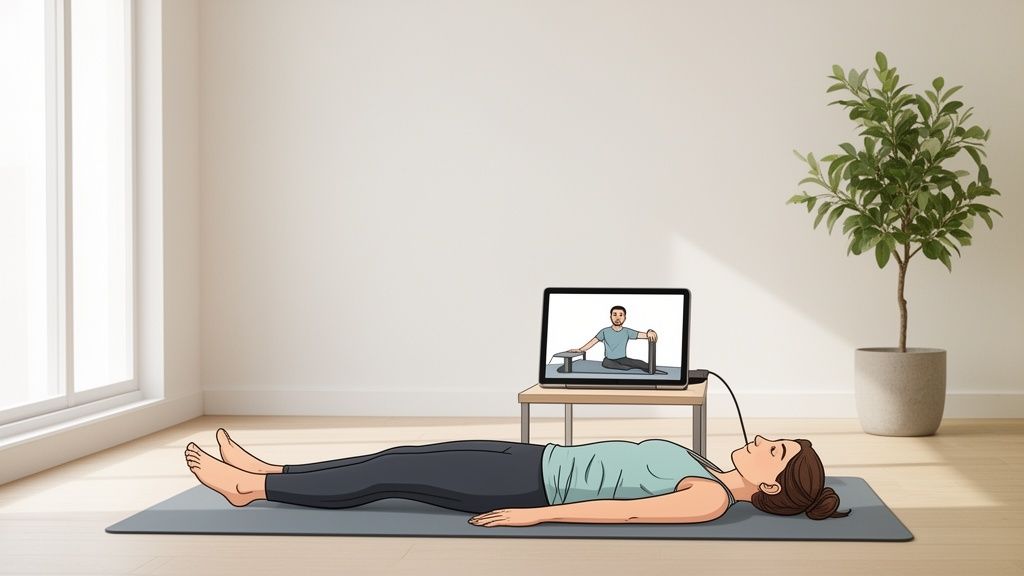
Let's be honest, Pilates is no longer confined to the four walls of a studio. What started as a niche method for building deep, intelligent strength has exploded into a global movement, and a lot of that is thanks to the sheer accessibility of virtual classes. This isn't just about convenience; it's a fundamental shift in how we connect with our own biomechanics.
The numbers don't lie. The global market for Pilates and Yoga studios, now hugely driven by digital offerings, was valued at a massive USD 160.03 billion in 2024. It’s projected to nearly double to USD 323.83 billion by 2032. This incredible growth shows just how many people are embracing streaming platforms to get studio-quality instruction from anywhere. You can dig deeper into the insights about this fitness market growth and its digital drivers.
Bringing Anatomy-Focused Fitness Home
At its very core, Pilates is an intelligent exercise system built on a deep respect for human anatomy. A great class isn't just a string of exercises; it's a guided tour of your musculoskeletal system. A skilled instructor uses precise verbal cues to help you innervate specific muscles—like the deep transversus abdominis or the multifidus along your spine—fine-tune your skeletal alignment, and build strength from the inside out.
Virtual platforms have gotten incredibly good at delivering this detailed, nuanced coaching right through your screen. This means you get all the benefits of an anatomy-driven workout—like improved posture and true lumbopelvic stability—without ever leaving home.
More Than Just a Workout
Moving your practice home offers some unique advantages for building a resilient, balanced body. It strips away distractions, encourages you to listen closely to your body's proprioceptive feedback, and makes it easier to weave mindful movement into your daily life. This approach empowers you to:
- Build True Core Strength: Finally learn how to activate the deep abdominal and pelvic floor muscles that support your spine and create real stability.
- Enhance Neuromuscular Awareness: Develop a stronger mind-body connection by focusing on the quality and precision of every single movement and muscle contraction.
- Improve Posture and Skeletal Alignment: Start correcting the muscular imbalances that come from modern life, like anterior pelvic tilt from sitting at a desk for hours on end.
Ultimately, virtual Pilates classes are a smart, effective way for anyone looking to build a strong, functional, and deeply connected body—entirely on their own terms.
What Makes a Great Virtual Pilates Class
Not all digital workouts are created equal, and that’s especially true when it comes to Pilates. A truly great virtual class is so much more than just a follow-along video; it’s basically an anatomy lesson in motion. It separates itself from a generic fitness routine by digging into the “why” behind every single movement, ensuring you’re building strength and proprioceptive awareness from the inside out.
A great class is always built on solid anatomical principles. Instead of just telling you to "do a crunch," a skilled instructor will guide you to feel the specific muscles that should be initiating the movement, such as the rectus abdominis flexing the trunk. This deep focus is what prevents injury and creates real, lasting neuromuscular change. It’s the difference between mindlessly going through the motions and intelligently sculpting your body.
The Power of Precise Cuing
In a virtual setting, the instructor can't offer hands-on adjustments. This is where the magic of precise verbal cuing comes in. Their words literally become their hands, guiding you to make tiny micro-adjustments that can completely transform an exercise. This is why a deep knowledge of anatomy isn't just a bonus—it's essential.
An exceptional instructor uses vivid language and anatomical analogies to help you connect mind to muscle. For instance, they might ask you to imagine your transversus abdominis as a natural corset, cinching inward to support your lumbar spine.
A great cue doesn't just tell you what to do; it tells you what to feel. This focus on internal sensation is how virtual Pilates delivers studio-quality results, teaching you to become your own best teacher.
This level of detailed coaching ensures you're activating the right muscles, not just letting stronger, more dominant ones like the hip flexors take over. It’s a subtle but powerful distinction that makes every minute of your workout count.
Core Principles of Movement
Great virtual Pilates classes are structured around foundational biomechanical concepts that apply to every exercise. Once you understand these ideas, you'll unlock the full potential of your practice.
- Deep Core Engagement: This is way more than the superficial "six-pack" muscles (rectus abdominis). It’s about activating the transverse abdominis—the deepest layer of your abs—to create a stable foundation for every move you make.
- Spinal Articulation: You’ll learn to move your spine with incredible control, one vertebra at a time. This not only increases mobility in the thoracic and lumbar spine but is crucial for exercises like the Roll Up, promoting a healthy, flexible back.
- Pelvic Stability: Your instructor will teach you to find and maintain a neutral pelvis. This simple act prevents your lumbar spine from arching (lordosis) or rounding (kyphosis), protecting it from strain and making sure the work stays right where it belongs: in your core and glutes.
This anatomy-first approach is what builds true, functional strength. It works to correct the muscular imbalances we all develop from daily life, improves your posture, and gives you a profound sense of control over your own body. When you find a class that lives and breathes these principles, you’ve found more than just a workout—you’ve found a path to moving better for the rest of your life.
Creating Your Ideal Home Practice Space
You absolutely don’t need a professional-grade studio to get a fantastic Pilates workout at home. The real secret is simply carving out a dedicated spot—even a small one—where you can move without bumping into the coffee table and focus without distractions. Think of it as your personal sanctuary for mindful movement.
The foundation of any good home practice starts with a high-quality mat. This isn't just about being comfortable; it's about protecting your body's bony landmarks. A well-cushioned mat provides crucial support for your spine during floor exercises like the Roll Up, allowing each vertebra to articulate safely. It also gives you a stable, non-slip surface for standing work, helping you build proper alignment from the ground up.
Essential Props for Deeper Work
While a mat is all you truly need, adding a few simple props can seriously amplify your results without cluttering up your living room. These tools are brilliant for providing tactile feedback and resistance, helping you fire up those deep, stabilizing muscles that can be so tricky to target.
- Resistance Ring: Often called the "Magic Circle," this prop is a game-changer for deepening your connection to the adductor muscles of the inner thighs and the pectoral muscles of the chest. When you squeeze the ring, you can feel that muscular engagement with so much more precision.
- Loop Bands: A simple loop band can completely transform your glute activation. Pop it around your thighs during exercises like bridges, and you’ll immediately feel the targeted resistance in your gluteus medius, making sure your glutes—not your lumbar spine—are doing the heavy lifting.
This is what we're talking about when we say "core." It's not just about abs; it's the entire system connecting your spine, pelvis, and deep abdominal muscles.
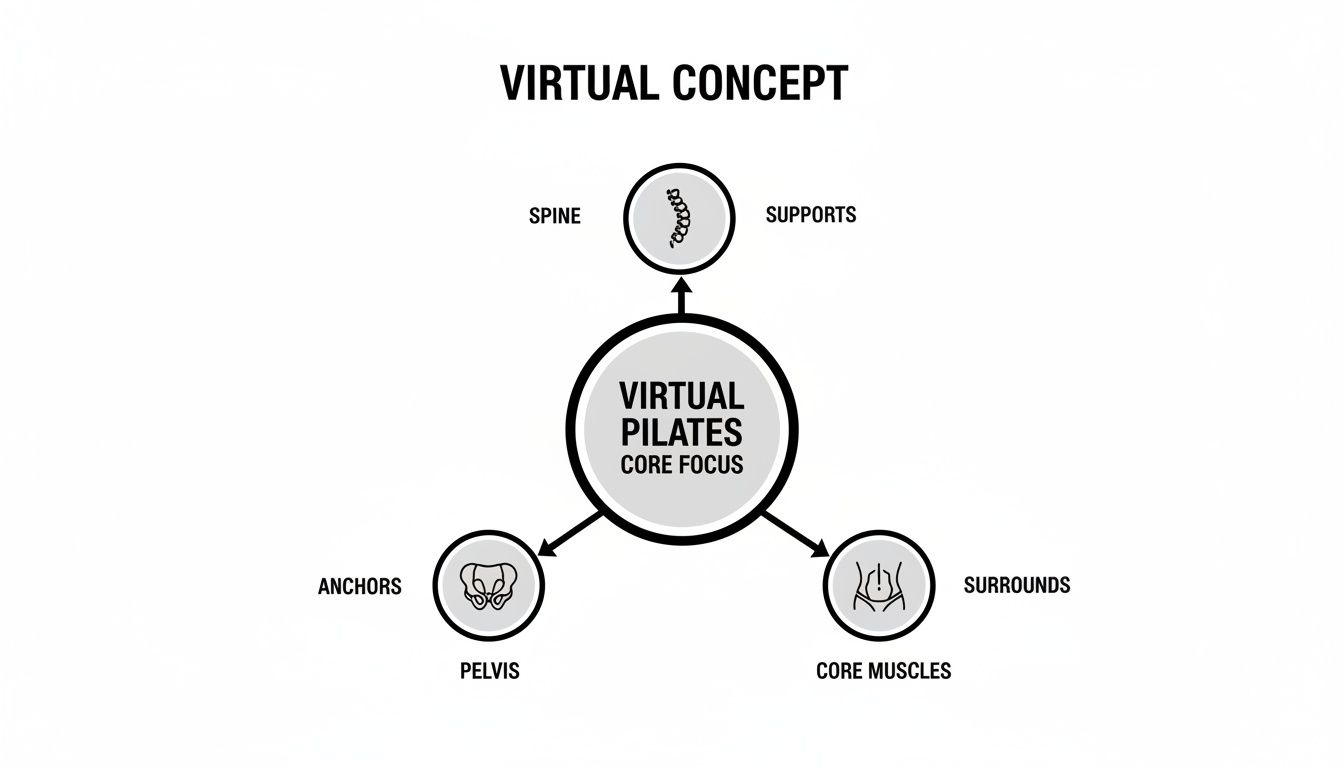
Props are designed to help you engage these key areas, building functional strength right from your center.
Optimizing Your Virtual Setup
To get the most out of every guided session, a little tech prep goes a long way. If you’re in a live class, your camera placement is everything. You want your instructor to be able to see your entire body, from head to toe, as you move on the mat so they can give you helpful feedback on your skeletal alignment.
Good lighting makes a huge difference, too. Try to avoid sitting with a bright window or lamp behind you, as it’ll turn you into a silhouette. It's much better to face a light source so your form is crystal clear.
Pro Tip: Do a quick test run before class. Open your camera app and check your angle and lighting. This way, you won’t have to scramble to make adjustments right as the workout is starting.
The whole home fitness movement has sent virtual Pilates soaring, with both equipment and digital classes driving major growth. In fact, the market for Pilates devices grew from $1,129.68 million in 2021 and is on track to hit $1,491.15 million by 2025. This demand for effective at-home solutions is exactly why tools like the WundaCore Resistance Ring and Movement Mat were created—for people seeking real, low-impact results from their own homes.
For more ideas on setting up your space, check out our complete guide to at-home Pilates equipment.
How to Choose the Right Virtual Pilates Program
With so many virtual Pilates classes out there, finding the right one can feel overwhelming. The secret isn't just to pick any program, but to find one that truly understands your body, meets your goals, and is built on solid anatomical principles. Making a thoughtful choice means you’re not just exercising—you're investing in real, sustainable strength.
Your first step is to look past the slick marketing and dig into the instructor’s credentials and teaching philosophy. A great teacher doesn't just show you the moves; they explain the why behind them. Their expertise in anatomy and biomechanics is what turns a simple exercise into a powerful, corrective movement.
Evaluate the Instructor’s Expertise and Style
In a virtual class, an instructor’s ability to communicate complex anatomical concepts clearly is everything. Without the benefit of hands-on adjustments, their verbal cues are your lifeline. Look for instructors who use descriptive language that helps you create that mind-body connection, ensuring you’re firing up the right muscles and protecting your joints from injury.
Before you commit, always take advantage of a trial class. As you move, ask yourself these questions:
- Are the Cues Clear? Does the instructor explain what a movement should feel like? Do they use anatomical analogies that make tricky concepts click?
- Are There Modifications? Do they offer options for different levels? A quality program should make a beginner feel completely supported while still challenging a seasoned practitioner.
- What’s the Pacing Like? Does the class feel rushed, or is there enough time to find your alignment and proper muscle engagement in each exercise?
Doing this little bit of homework upfront helps you find a teacher you connect with and whose knowledge you can trust. You can learn more by exploring our top picks for the best at-home Pilates program to suit different needs.
Match the Program to Your Personal Goals
Next, get clear on what you want to achieve. Are you just starting out and need to build a strong foundation and correct your posture? Or are you more experienced and looking for advanced, dynamic flows to deepen your practice? Your goals will point you toward the right program.
A program built on a deep understanding of anatomy will serve any goal. Whether you're focused on rehabilitation or peak performance, the principles of core stabilization, spinal articulation, and pelvic stability are the universal building blocks for a healthy, resilient body.
The great thing about the recent Pilates boom—driven in part by Gen Z—is the sheer variety of options now available. With 40% of global fitness centers now offering hybrid virtual and in-person sessions, the demand for high-quality, home-friendly workouts has exploded. This hybrid model makes it easier than ever to find virtual classes for everyone, from total newbies to seasoned pros. You can find more insights into these 2026 Pilates trends and their impact.
Getting the Most from Your At-Home Practice
Showing up for your virtual Pilates class is the first step, but truly being present is where the real magic happens. To get the results you're after, you have to treat your home practice with the same focus you'd bring to a studio session. That all starts with prepping your body for the work ahead.
A good warm-up isn't just a suggestion—it's non-negotiable for waking up your neuromuscular system and sidestepping injury. It increases blood flow to the muscles (perfusion), lubricates the joints with synovial fluid, and tells your nervous system it's time to move. To keep your body safe and get the most out of every class, understanding how to warm up before exercise is absolutely essential.
Stay Present and Listen to Your Body
Let's be honest, one of the biggest challenges at home is the constant pull of distractions. Without the energy of a live studio, it's easy for your mind to drift. The solution? Make your class time sacred. Silence your phone, close those extra browser tabs, and let everyone in your house know you're unavailable.
This creates the space you need to actually listen to your body. Pilates was never a "no pain, no gain" situation. Real, sustainable strength is built by respecting your body's limits and grabbing a modification whenever you need it. When an instructor suggests bending your knees in a hamstring stretch, it's not a sign of weakness—it's a smart adjustment to protect your lumbar spine and isolate the stretch in the hamstring muscle group.
Listening to your body is the ultimate form of anatomical respect. It’s how you build sustainable strength by working with your body, not against it, which is the very foundation of the Pilates method.
Master Your Tech for Better Feedback
In a virtual class, your instructor is your eyes and ears. For them to give you those game-changing form corrections, they need a clear view of your anatomy in motion. Take a minute before class to get your camera set up just right, making sure they can see your entire mat from head to toe.
- Full-Body View: Back that camera up! Your instructor needs to see your skeletal alignment from your crown all the way down to your feet.
- Good Lighting: Try to face a window or another light source. This keeps you from becoming a silhouette, so your instructor can catch the subtle details in your movement.
- Stable Connection: If you can, plug directly into your router or at least get closer to it. A smooth, lag-free stream means you won't miss a single anatomical cue.
Nailing these details—a mindful warm-up, a focused mind, and a clear camera view—will completely transform your practice. Precision, control, and consistency are what build real, functional strength, session after session.
Why Virtual Pilates Is More Than a Workout
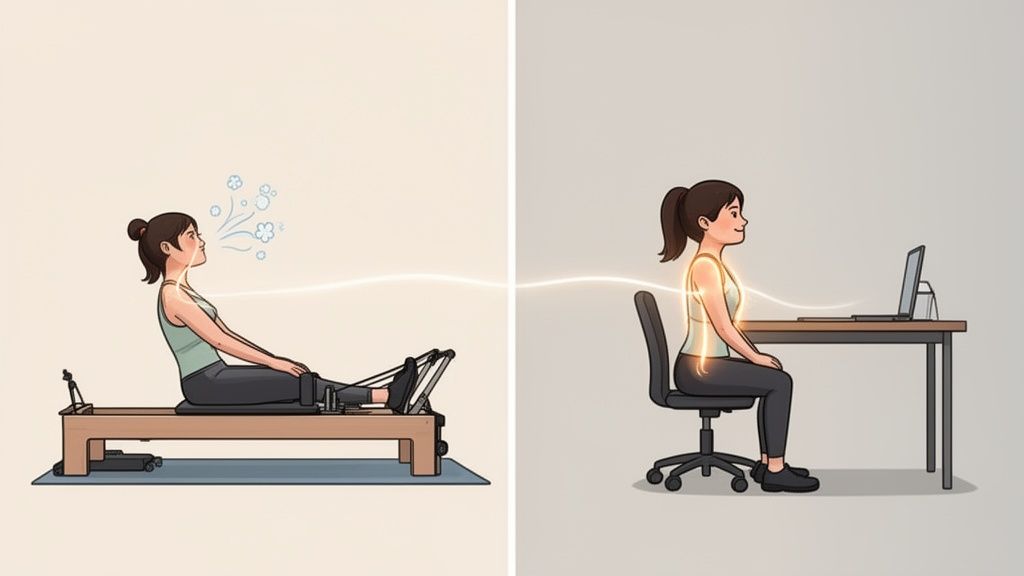
Let's get one thing straight: virtual Pilates is so much more than just another at-home workout. Think of it as a deep dive into self-care, a practice that quietly re-educates your neuromuscular patterns, long after you've rolled up your mat.
With its focus on anatomy and how your body is truly designed to move, you start to build an incredible proprioceptive awareness. Suddenly, simple, everyday actions transform into moments of mindful strength.
This practice doesn't stay on the mat. The core biomechanical principles you learn—like how to properly engage your deep abdominals or articulate your spine one vertebra at a time—show up everywhere. You’ll find yourself sitting taller at your desk without even thinking about it, or lifting a heavy box using your glutes and legs instead of your lumbar spine.
From Core Strength to Daily Life
The real magic of Pilates happens when you see its power in the real world. By consistently training those deep stabilizing muscles around your spine and pelvis, you’re not just building six-pack abs; you’re building a resilient foundation that supports you through everything life throws your way.
This intelligent strength becomes a natural, almost subconscious, part of your daily routine:
- Improved Posture: A strong, connected core gives your spine effortless support. That desk-induced thoracic kyphosis doesn't stand a chance.
- Greater Flexibility: When your joints and muscles have more mobility, movement just feels better. You feel less stiff and more fluid in everything you do.
- Mental Resilience: The intense focus required for each muscle contraction forges a powerful link between your mind and body. This concentration has a way of spilling over, helping you reduce stress and stay focused off the mat. Dive deeper into this in our guide to mind-body connection exercises.
Ultimately, virtual Pilates is an incredibly accessible and powerful tool for building a more connected, balanced life, no matter where you are.
Your Questions About Virtual Pilates, Answered
Jumping into your first virtual Pilates class can bring up a few questions, even after you know all the benefits. That's completely normal. Let's walk through some of the most common things people ask, so you can feel totally confident hitting the mat at home.
Can Beginners Really Learn Proper Form Virtually?
Absolutely. A well-designed virtual class isn't about just watching and copying; it's built around clear, precise verbal instruction. An experienced instructor will guide you through the anatomical principles of each exercise, so you learn why you're moving a certain way and how to engage the right muscles safely from day one.
Many platforms, including ours, offer foundational classes designed specifically for beginners to build confidence and nail down the technique. And in a live class, you can always position your camera for real-time feedback. The instructor can then guide you to adjust your pelvic alignment or deepen your transverse abdominis connection, just like they would in a studio.
How Much Space and Equipment Do I Actually Need?
Honestly, you need less than you think. To get started, all you really need is enough space to lay down a Pilates mat with room to extend your arms and legs without hitting a wall or the sofa. A quality mat is important—it’ll cushion your spine during all that delicious articulation work.
While you can get a fantastic workout with just your body and a mat, adding a few versatile props can really elevate the experience. Something like a resistance ring, for instance, adds resistance and tactile feedback, helping you activate deep stabilizing muscles and effectively mimic the feel of studio equipment without cluttering up your living room.
Consistency is far more important than intensity when it comes to seeing real anatomical change. The goal isn't exhaustion; it’s about progressively teaching your body to move with more intelligence and control.
How Often Should I Do Virtual Pilates to See Results?
If you're looking for those noticeable improvements in core strength, posture, and flexibility, a great goal is 2-3 classes per week. This schedule gives your muscles time to recover and adapt, which is exactly when the strengthening magic happens through muscle protein synthesis.
That’s the beauty of virtual Pilates—you can easily fit it into your real life. Even a focused 20-30 minute practice a few times a week will deliver far more benefits than one long, infrequent workout. It's all about building those neuromuscular patterns that create lasting change in how your brain communicates with your muscles.
Ready to build a stronger, more connected body from anywhere? The WundaCore collection, including our patented Resistance Ring and Movement Mat, brings an anatomy-focused studio experience right to your home. Explore our equipment and On Demand classes today.