
Ankle Band Workout: Build Strength and Stability with Targeted Exercises
An ankle band workout is one of the smartest ways to strengthen the tiny, often-neglected stabilizer muscles around your hips and ankles. All it takes is a simple resistance loop. By adding targeted tension, these exercises wake up critical muscles that most traditional training misses, leading to better stability, improved alignment, and a serious reduction in injury risk. It’s all about building true, functional strength from the ground up by focusing on the specific anatomy of your lower body.
Why Ankle Band Workouts Deliver Powerful Results
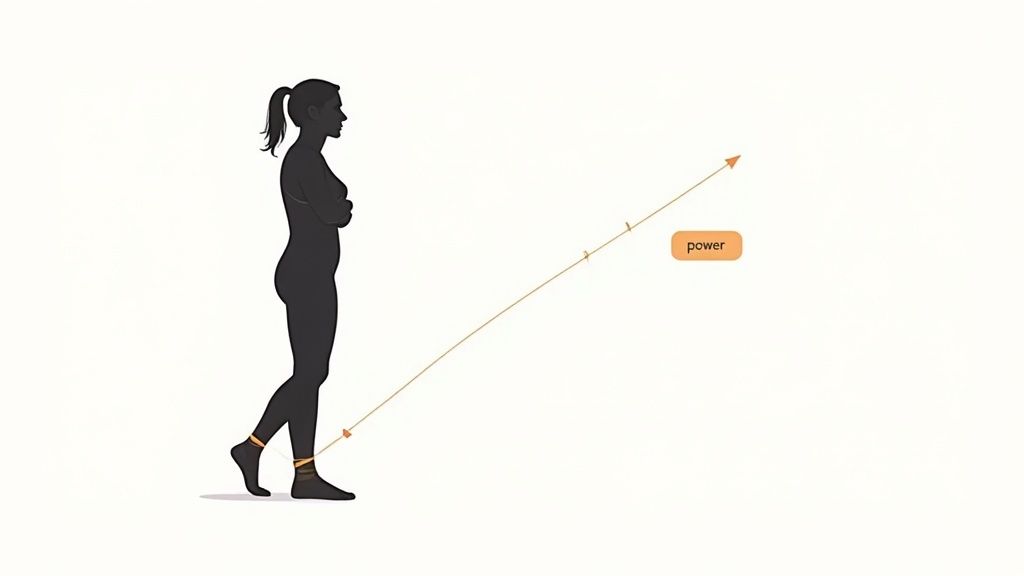
Let's get past just another list of exercises. To really get the most out of an ankle band workout, you need to understand the anatomy at play. These simple bands are brilliant at isolating and firing up the key stabilizer muscles that form the very foundation of your lower body’s strength and control.
The real magic is in the constant, multi-directional tension the band creates. This isn't just about making muscles bigger; it’s about waking up the smaller, supportive muscles that keep your joints properly aligned and make every movement more efficient. It's a direct line to improving the function of your kinetic chain.
Targeting Your Kinetic Chain Foundation
When you use an ankle band, you’re primarily activating the gluteus medius and gluteus minimus. These are the smaller hip muscles located on the side of your pelvis. Their primary anatomical functions are hip abduction (moving your leg away from your body's midline) and, crucially, stabilizing the pelvis during single-leg movements like walking or running.
When these muscles are weak—a common issue even in athletes—it can set off a chain reaction of instability down the kinetic chain. Think of them as the anchors for your pelvis. If they aren't firing correctly, other structures like your knee or lower back have to compensate, which is often where injuries begin.
Ankle band exercises are a form of neuromuscular training. They essentially teach your brain and muscles to communicate more effectively by improving proprioception and coordination. This stronger mind-muscle connection is a game-changer for preventing injuries and boosting performance.
Strengthening these deep hip muscles with an ankle band workout pays off in several huge ways:
- Improved Knee Stability: Strong hip abductors prevent the femur (thigh bone) from excessively adducting and internally rotating. This stops your knee from collapsing inward—a pattern called valgus collapse that’s a major contributor to knee pain and injuries like ACL tears.
- Enhanced Pelvic Alignment: A stable pelvis is the cornerstone of great posture and efficient movement, taking a ton of strain off your lumbar spine.
- Greater Overall Strength: When you build a solid foundation with stable hips, you can generate far more power in larger movements like squats, lunges, and running.
Progressive Resistance and Why It’s Catching On
This style of training is a perfect example of progressive overload, a core principle for getting stronger. As you improve, you simply level up to a band with more resistance. If that’s a new concept for you, our guide on what is progressive resistance training breaks down exactly how it works. This simple idea of gradually increasing the demand is what makes these workouts so effective for the long haul.
The explosive popularity of these bands points to a bigger shift toward accessible, smart home fitness. The global market for exercise bands was valued at up to USD 1.66 billion in 2024 and is only expected to grow. This trend shows that more and more people are recognizing the benefits of targeted, anatomy-focused training for both rehab and everyday fitness.
The Anatomy of Your Lower Body Powerhouse
To really get the most out of every single rep with an ankle band, it helps to know exactly what’s happening under the skin. Think of this as your quick-start guide to the muscles we're about to fire up, from the big power-producers in your hips to the tiny, crucial stabilizers that keep your ankles safe.
When you understand this mind-muscle connection, a simple leg lift becomes a targeted, powerful exercise. You’ll learn to feel the right muscles engaging, making every movement count toward building a stronger, more resilient lower body.
Beyond the Gluteus Maximus
When most people hear "glutes," they immediately think of the gluteus maximus—it's the biggest muscle in your body, after all. It’s a powerhouse for big movements like hip extension (squatting, sprinting). But ankle band work isn't just about the glute max; it's about giving some much-needed attention to its often-neglected neighbors.
The real stars of these workouts are the gluteus medius and gluteus minimus. Tucked away on the side of your hips, these muscles are responsible for abduction (lifting your leg away from your body) and, even more importantly, for keeping your pelvis stable when you're standing on one leg.
Every time you walk, climb stairs, or run, these smaller glute muscles are working hard to prevent your hip from dropping on the unsupported side (a phenomenon known as a Trendelenburg gait). Weakness here is incredibly common and can set off a chain reaction of alignment issues, often showing up as knee or low back pain.
Why Hip Stability Is a Game Changer
You'd be surprised how many people, even dedicated athletes, have weak hip stabilizers. When the glute medius isn't pulling its weight, other muscles like the Tensor Fasciae Latae (TFL) or quadratus lumborum (a low back muscle) have to jump in and compensate, leading to dysfunctional movement patterns and a much higher risk of injury.
Ankle band exercises zero in on this area, essentially waking these muscles up and forcing them to do their job properly. The payoff is huge for your entire body.
- Better Pelvic Control: Strong hip abductors create a solid base for your spine, which helps improve your posture and takes unnecessary strain off your lower back.
- Healthier Knees: They prevent that dreaded inward collapse of the knee (known as "knee valgus"), protecting the delicate ligaments and cartilage inside the joint from wear and tear.
- More Efficient Running: For runners, a stable pelvis translates to less wasted energy and a more powerful, efficient stride. It's why targeted strengthening like this is a core component in good marathon training guides.
Want a quick check? Stand on one leg in front of a mirror. Does your opposite hip immediately drop? Does your standing knee cave inward? If so, that's a tell-tale sign your gluteus medius could use some focused ankle band work.
Before we move on, let's break down exactly which muscles we're talking about and why they matter so much.
Key Muscles Targeted in Ankle Band Workouts
| Muscle Group | Primary Muscles | Key Function | Benefit of Strengthening |
|---|---|---|---|
| Hip Abductors | Gluteus Medius, Gluteus Minimus, Tensor Fasciae Latae (TFL) | Stabilize the pelvis, lift the leg out to the side (abduction). | Improves balance, reduces knee and lower back pain, enhances walking and running mechanics. |
| Hip Extensors | Gluteus Maximus, Hamstrings | Extend the hip (move the leg backward). | Increases power for sprinting, jumping, and climbing; improves posture by preventing pelvic tilt. |
| Ankle Stabilizers | Peroneus Longus and Brevis | Control side-to-side ankle movement (eversion), prevent ankle rolling. | Provides dynamic stability, reduces risk of ankle sprains, improves balance on uneven surfaces. |
| Foot Intrinsics | Various small muscles within the foot | Support the arch, aid in balance and shock absorption. | Enhances ground-feel and stability, contributes to a strong foundation for all movements. |
This table gives you a roadmap for what you should feel working during the exercises. It’s all about building a functionally strong lower body from the ground up.
Don't Forget Your Ankles and Feet
While a lot of the magic happens up at the hips, the band's position around your ankles also brings the supporting muscles of your lower legs and feet into the conversation. The constant tension forces you to control every part of the movement, right down to your toes.
The peroneal muscles (fibularis longus and brevis), running along the outside of your lower leg, get a fantastic workout here. Their primary job is eversion of the foot, which is the motion that counteracts an ankle roll. Think of them as your first line of defense against a nasty ankle sprain. Strengthening them gives you dynamic stability, helping your ankles adapt quickly and safely to uneven ground.
These exercises also fire up the tiny intrinsic muscles inside your feet, which are responsible for supporting your arches and absorbing shock. For a much deeper look at building this foundational strength, our guide on how to unlock your ankles for better movement is the perfect next step.
When you connect this anatomy to your workout, you stop just going through the motions. You start building a smarter, more connected lower body powerhouse, from your feet all the way up to your pelvis.
Your Essential Ankle Band Exercise Library
Alright, you've got the "why" behind building a powerful lower body. Now it’s time to put that knowledge into practice. This is where we move from theory to action with a library of foundational ankle band exercises, all designed to hit those crucial stabilizer muscles with absolute precision.
Each movement is broken down with specific, Pilates-inspired cues to help you nail your form. Instead of just going through the motions, you'll learn to feel the right muscles firing. This turns every single repetition into a more intentional, effective part of your workout. I’ll also give you clear starting points for reps and sets, whether you're building endurance or pure strength.
Foundational Ankle Band Exercises For Hip Strength
Let’s start with the bedrock of any solid glute activation routine. These first few exercises are specifically designed to isolate the gluteus medius and minimus—the key players for hip stability and pelvic control. Master these, and you'll build the foundation for more complex, powerful movements down the line.
1. Lateral Band Walks (Monster Walks)
This is a classic for a reason. It's phenomenal for teaching your hips to stay level while you move, directly targeting the gluteus medius. It’s a go-to for pre-run warmups and injury prevention.
- Setup: Pop the band around your ankles. Stand with your feet hip-width apart and sink into a mini-squat with a slight bend in your knees. Keep that chest up and core braced.
- Movement: Take a controlled step sideways with your right foot, leading with your heel. Your left foot follows, but only enough to return to that hip-width stance. The key is to resist the snap-back from the band.
- Pilates Cue: Imagine you're walking between two narrow panes of glass. Your hips shouldn't sway or bounce up and down; keep them perfectly level.
- Reps & Sets: Aim for 10-15 steps in each direction for 2-3 sets.
2. Standing Glute Kickbacks
This move hones in on the gluteus maximus, the powerhouse muscle that drives hip extension. The band adds that targeted resistance right where you need it most.
- Setup: With the band still around your ankles, stand tall. Shift your weight onto your left leg, keeping a soft bend in that knee. Brace your core to keep your back straight and protected.
- Movement: Squeeze your right glute and press your right leg straight back into hip extension. Keep the leg straight but not locked out. Move with control and, most importantly, avoid arching your lower back.
- Pilates Cue: Think of your leg as a pendulum swinging from the hip, powered only by your glute. The rest of your body should remain completely still and stable.
- Reps & Sets: Perform 12-15 reps on each leg for 2-3 sets.
This visual shows exactly how power flows from your hips, through your knees, and down to your ankles during functional movements.
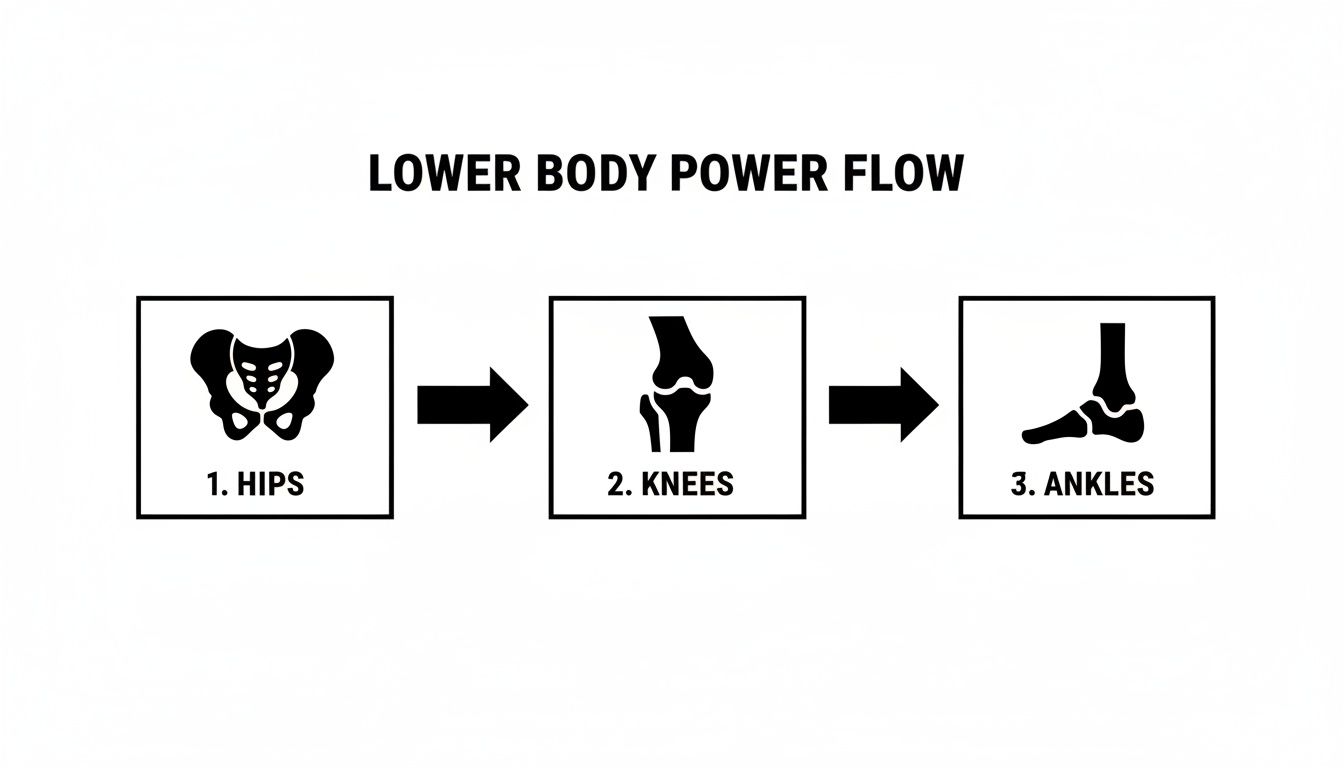
When you strengthen each link in this chain, you ensure that force is transferred efficiently. This reduces strain and plugs the energy leaks that can often lead to injury.
Floor-Based Exercises For Targeted Activation
Moving to the floor is a game-changer. It takes balance out of the equation and lets you focus purely on muscle contraction. These exercises are perfect for truly feeling that mind-muscle connection.
3. Clamshells
The clamshell is a physical therapy staple because it's one of the best ways to isolate and fire up the gluteus medius without letting other, bigger muscles take over.
- Setup: Lie on your side with your knees bent at about a 45-degree angle, heels lined up with your spine. The band goes just above your knees. Prop your head up with your bottom arm.
- Movement: Keeping your feet glued together, lift your top knee toward the ceiling, creating external rotation at the hip. Go as far as you can without rocking your hips back. Pause at the top, then slowly lower your knee back down.
- Pilates Cue: Imagine your pelvis is cemented to the floor. The only thing that moves is your top leg, rotating open from the hip joint.
- Reps & Sets: Go for 15-20 reps per side for 2-3 sets.
4. Glute Bridges with Abduction
This brilliant variation on the classic glute bridge adds a hip abduction component, firing up both the gluteus maximus (for the lift) and the gluteus medius (for the outward press). It’s a two-for-one.
- Setup: Lie on your back with your knees bent and feet flat on the floor, hip-width apart. The band should be just above your knees.
- Movement: Press through your heels to lift your hips into a bridge. At the top of the movement, press your knees out against the band, hold for a beat, bring them back to hip-width, and then lower your hips down with control.
- Pilates Cue: Maintain a constant, light tension on the band through the entire movement, even as you lift and lower. This is what keeps your glutes engaged from start to finish.
- Reps & Sets: Aim for 12-15 reps for 3 sets.
Pro Tip: The burn you feel, especially in exercises like lateral walks and clamshells, is a sign you’re waking up muscles that have been dormant. Embrace it! That feeling means you're building a stronger, more stable foundation. For more ideas, check out our guide to exercises with resistance bands for a full-body approach.
The Growing Role Of Ankle Bands In Fitness And Rehab
The effectiveness of these simple loops hasn't gone unnoticed. Ankle band training is now a staple in both high-performance athletic programs and clinical rehab settings.
Market data shows a clear trend: individuals are the main drivers of this growth, making up about 60% of resistance band use. This tells us that most people are buying them for their personal home workouts, not just for the gym.
Projections show the resistance band market is set to grow from around USD 1.8 billion to potentially USD 6.0 billion by the early 2030s. This highlights a sustained demand for portable, effective training tools that get real results.
How to Build Your Perfect Ankle Band Routine
Knowing the exercises is one thing, but weaving them into an effective, balanced workout is where the real magic happens. Let's move beyond individual movements and talk about smart programming. I’ll share three plug-and-play routines you can start today, each designed for a different goal and timeframe.
More importantly, I want you to understand the why behind the structure. My goal is to empower you to sequence exercises for the best results, understand how often to train, and apply progressive overload. Once you get these principles, you can build your own perfect routine and keep getting stronger.
Principles of Smart Workout Design
Before you jump into the samples, a few key concepts will help you customize your workouts and make them truly your own. We aren't just doing exercises; we're creating a specific adaptation in your body.
A well-structured ankle band workout should always start with activation exercises. Think of movements like Clamshells or Glute Bridges—their job is to "wake up" the target muscles, especially the gluteus medius and minimus. This ensures these key stabilizers are firing properly before you ask them to do heavier lifting. It's like priming the engine before you hit the gas.
From there, you can move into your strength-focused movements. These are the exercises that really challenge the muscles, like Lateral Walks or Standing Kickbacks. The sequence is critical here: doing the activation work first makes your strength work so much more effective because the right muscles are already engaged and ready to go.
Sample Ankle Band Routines For Any Schedule
Here are three sample routines I've designed for different goals. Feel free to use them as they are or as a starting point to create your own. Notice how they all follow that activation-then-strength principle we just talked about.
The 10-Minute Pre-Run Activation Circuit
This quick routine is my go-to for firing up the glutes and hips before a run, a leg day at the gym, or any activity that demands solid lower body stability. The goal here is purely activation, not exhaustion.
- Clamshells: 1 set of 20 reps per side.
- Glute Bridges: 1 set of 15 reps.
- Lateral Band Walks: 1 set of 15 steps in each direction.
- Standing Glute Kickbacks: 1 set of 12 reps per side.
Move through this circuit with almost no rest between exercises. You should feel the muscles waking up and a gentle warmth building in your hips.
The 20-Minute Hip Strength Focus
This workout is all about building muscular endurance and strength in your hip abductors and extensors. It's a fantastic standalone routine to sprinkle into your week two or three times.
For this 20-minute session, you’ll perform each exercise for multiple sets to really create that training stimulus.
- Warm-up: 2 minutes of light cardio (marching in place, leg swings).
- Glute Bridges with Abduction: 2 sets of 15 reps.
- Lateral Band Walks: 3 sets of 15 steps per direction.
- Standing Glute Kickbacks: 2 sets of 15 reps per leg.
- Cool-down: 2 minutes of stretching (figure-four stretch, hamstring stretch).
Try to rest for about 30-45 seconds between sets. This gives your muscles just enough time to recover for the next round without cooling down completely.
The 30-Minute Total Stability Workout
This is a more comprehensive session that integrates core stability and balance challenges, making it an incredibly functional ankle band workout. It’s designed to improve how your hips, core, and ankles work together as a single, coordinated system.
- Warm-up: 3 minutes of dynamic stretching.
- Clamshells: 2 sets of 20 reps per side.
- Single-Leg Balance: 2 sets of 30 seconds per leg (no band needed for this one).
- Glute Bridges with Abduction: 3 sets of 15 reps.
- Banded Squats (Band above knees): 3 sets of 12 reps, focusing on pushing the knees out.
- Standing Hip Abduction (Band at ankles): 2 sets of 15 reps per leg.
- Plank with Leg Lifts (Band at ankles): 2 sets of 10 lifts per leg.
- Cool-down: 3 minutes of full-body stretching.
To give you a clearer picture of how these routines fit together, here’s a quick comparison.
Sample Ankle Band Workout Programming
| Routine Focus | Duration | Sample Exercises | Best For |
|---|---|---|---|
| Glute Activation | 10 Minutes | Clamshells, Glute Bridges, Lateral Band Walks | A quick pre-run or pre-lift warm-up to wake up the hips. |
| Hip Strength | 20 Minutes | Glute Bridges with Abduction, Lateral Walks, Standing Kickbacks | Building muscular endurance and improving hip stability on its own. |
| Total Stability | 30 Minutes | Single-Leg Balance, Banded Squats, Floor Exercises | Full-body integration and developing better core control and balance. |
As you can see, you can get a great workout in, whether you have 10 minutes or 30. The key is to be intentional with the time you have.
The real secret to long-term results is progressive overload. This simply means gradually increasing the demand on your muscles. You can do this by using a heavier band, doing more reps or sets, or reducing your rest time. Without this gradual challenge, your body has no reason to adapt and get stronger.
By understanding these principles and using these templates, you can move beyond just following along. You can start building intelligent, purposeful routines that are perfectly suited to your body, your schedule, and your fitness goals.
Getting the Most from Every Repetition
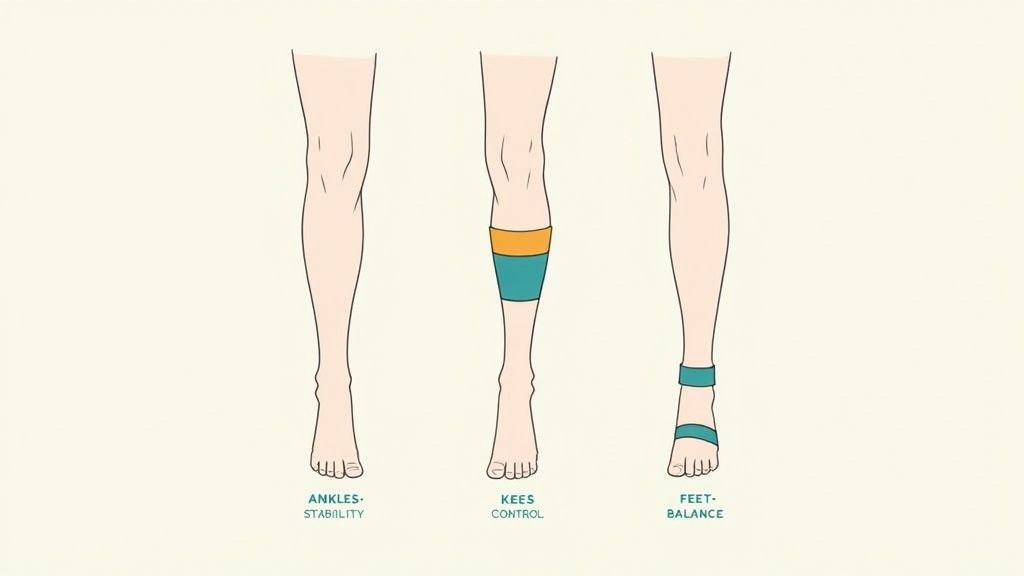
Knowing what muscles to work is just the start. The real transformation happens when we dial in the small details—the tiny shifts in technique that turn a simple exercise into a powerful, results-driven movement.
From choosing the right band to knowing exactly where to place it, these are the coaching points that make all the difference in your practice. Let's get into the specifics so you can feel the work exactly where you should.
Choosing the Right Ankle Band
Not all bands are created equal, and your choice between fabric or latex can seriously impact your workout experience.
- Latex Bands: These are the thin, stretchy loops you often see. They're fantastic for beginners because they offer a really wide range of lighter resistances. The big downside? They are notorious for rolling up, bunching, and even snapping mid-exercise, which is a huge distraction.
- Fabric Bands: A worthy investment. These bands are wider, thicker, and almost always have a non-slip grip woven right into the lining. They provide more substantial resistance and stay put, letting you focus on your movement, not on adjusting your gear.
Most brands use a color-coding system for resistance, but it's not standardized. One company's "heavy" might be another's "medium." My advice is to always start with a lighter resistance until you've mastered the form.
Strategic Band Placement for Targeted Results
Where you place the band completely changes the exercise. It's a subtle shift with a massive impact because it alters the lever arm, telling your body which muscles need to fire the most.
Placing the band around your ankles creates the longest lever arm from your hip joint. This position is the most challenging for your hip abductors (like that all-important gluteus medius). It’s my go-to for targeted hip strengthening in exercises like Lateral Walks or Standing Abductions.
Moving the band just above your knees shortens that lever arm. The exercise instantly feels a little easier on the hips. I often use this placement as a tactile cue during squats or bridges to remind clients to actively press their knees outward, which reinforces good alignment and really helps wake up the glutes.
Common Mistakes That Sabotage Your Workout
Even the best exercises fall flat with poor form. Here are the most common mistakes I see in the studio and how to fix them so you're building muscle, not just going through the motions.
Using Momentum, Not Muscle
Swinging your leg or rushing through reps uses momentum, which completely bypasses the muscle-building tension we’re trying to create.
- The Fix: Slow it all down. Focus on a controlled, deliberate tempo—I like to cue a two-second count for the concentric (working) phase and a two-second count for the eccentric (returning) phase. Pause for just a beat at the peak of the movement to really feel the target muscle squeeze.
Arching Your Lower Back
This happens all the time in exercises like Glute Kickbacks. It’s so easy to arch the lower back (lumbar extension) to try and get the leg higher, but this just puts stress on your spine and takes the work completely out of your glutes.
- The Fix: Brace your core. Imagine you're about to be punched lightly in the stomach. This simple cue helps lock your ribcage and pelvis together, ensuring the movement comes purely from hip extension, powered by your glutes.
Ankle bands are just one piece of a much larger puzzle. The market for related tools like wearable ankle weights—often used alongside bands in both fitness and rehab settings—was valued at roughly USD 1.2 billion in 2023. It's projected to nearly double by 2032, which shows a huge shift toward effective, at-home training aids.
To get the most out of your training and recovery, it's also worth exploring whether to use a sauna before or after your workout, as it can really enhance your results. By focusing on these technical details, you ensure every single repetition contributes directly to building a stronger, more stable foundation from the ground up.
Your Top Ankle Band Questions, Answered
As you start working with ankle bands, you're bound to have a few questions pop up. It happens to everyone! Below, I've answered some of the most common things people ask, breaking down the why behind the movements so you can train smarter and feel more confident.
How Often Should I Do An Ankle Band Workout?
This really comes down to your "why." What's your goal?
If you're looking to build serious strength in those key hip muscles—like the gluteus medius and minimus—think 2-3 times per week on non-consecutive days. That rest day in between is non-negotiable; it's when the magic happens. Your muscle fibers need that time to repair and get stronger.
But if you're just using a light band for neuromuscular activation to "wake up" your glutes before a run or a heavy lifting session, you can do that far more often. A quick 5-10 minute activation routine 4-5 times a week is perfect for this. The goal isn't fatigue, it's getting the right muscles to fire so they're ready for the main event.
Can Ankle Band Workouts Really Help with Knee Pain?
In many situations, absolutely. A surprising amount of knee pain isn't a knee problem at all—it's a hip problem in disguise.
When your gluteus medius (the primary muscle on the side of your hip) is weak, it struggles to control your femur (thigh bone). This can cause your knee to collapse inward, a pattern called knee valgus. This misalignment puts a ton of stress on the delicate structures inside your knee joint, like the meniscus and ligaments.
Ankle band exercises directly target and strengthen that weak glute medius. By teaching it to do its job properly, you stabilize the hip, which in turn keeps the knee tracking correctly. You're fixing the problem at the source. Of course, if your pain is sharp, sudden, or just won't go away, it's always best to check in with a physical therapist.
Think of your gluteus medius as the rudder for your leg. A strong rudder keeps the ship (your leg) on course, preventing the knee from drifting into painful territory. Ankle band work strengthens that rudder.
What Is the Difference Between a Band at My Ankles vs. Knees?
Where you place the band completely changes the exercise by playing with leverage. It’s a simple tweak with a big impact on biomechanics.
-
Band at the Ankles: This creates the longest lever arm from your hip joint, which is the axis of rotation for abduction exercises. Because the resistance is so far from the muscles doing the work, it creates the greatest torque, making exercises like lateral walks much more challenging for your hip abductors. This is your go-to placement for building maximum strength.
-
Band Above the Knees: Moving the band up shortens the lever arm, which reduces the torque on the hip joint and makes the movement feel a bit easier. This is a great starting point for beginners. It also works brilliantly as a tactile cue during squats or glute bridges, giving you something to physically push out against to keep your knees from caving in.
My Latex Band Keeps Rolling Up. What Should I Do?
Ugh, the rolling band—the most annoying workout distraction! The truth is, that's just what thin latex bands do. The best, simplest, and most effective solution is to make the switch to a fabric resistance band.
Fabric bands are a game-changer. They're wider, so they distribute pressure more evenly. More importantly, they have non-slip rubber grips woven right into the inside. This design keeps them flat against your legs, so they won't roll, bunch, or snap. It's a small investment that lets you focus 100% on your form instead of constantly fiddling with your equipment.
Ready to experience the difference that anatomy-informed Pilates can make? WundaCore brings the studio to you with expertly designed equipment and on-demand classes that build true, functional strength. Elevate your ankle band workout and unlock your body’s potential with our patented props and world-class instruction.