
What Is Progressive Resistance Training Explained
If you’ve ever tried to get stronger, you’ve used progressive resistance training—even if you didn’t know it by name. It’s the simple, powerful idea that to build strength, you have to consistently and systematically challenge your musculoskeletal system to do just a little bit more than it’s used to.
This isn’t about going from zero to hero overnight. It’s about making your workouts gradually harder over time, which is the secret sauce for real, lasting physiological change.
What Is Progressive Resistance Training
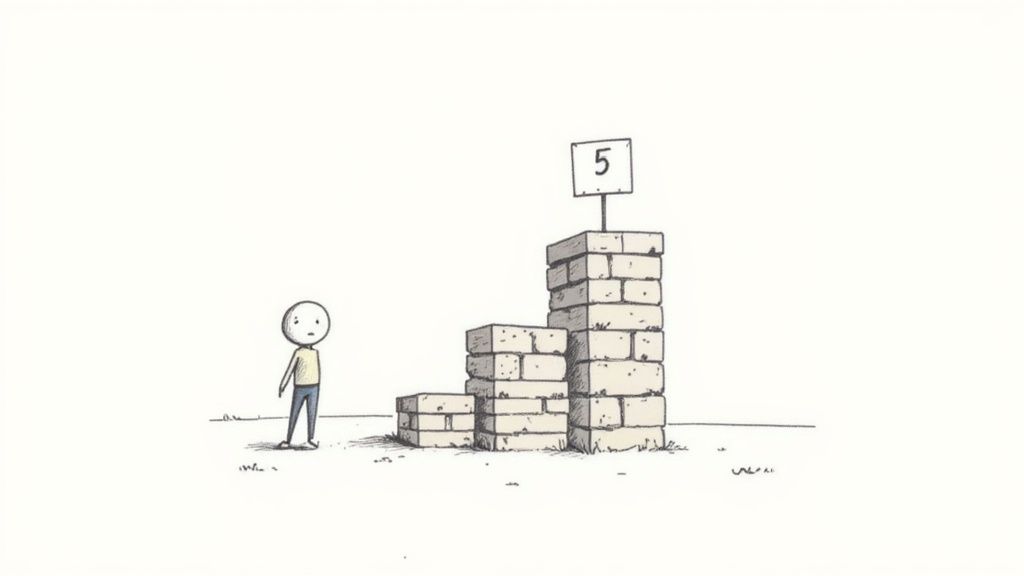
Think of it like learning a new skill. You don't start by playing a complex piece of music; you start with the scales. You master one, then move to the next. Progressive resistance training (PRT) applies that same step-by-step logic to your muscles, tendons, and bones. It’s a structured conversation where you gradually ask for more effort, and your body answers by fortifying its structures.
This entire method hinges on a core biological truth: muscular adaptation. When you challenge your muscles with resistance—whether it's from dumbbells, resistance bands, or your own body weight on a mat—you send a clear physiological signal that they need to remodel and strengthen. In response, your body repairs and rebuilds those muscle fibers to be more capable and resilient for the next time.
The Anatomical Blueprint for Strength
At its heart, PRT is a direct conversation with your musculoskeletal system—your bones, muscles, tendons, and ligaments. Every time you perform a squat, a push-up, or a Footwork series on the Pilates reformer, you're engaging this intricate network of tissues.
Here’s a quick peek at what’s happening under the hood:
- Muscle Fibers: The resistance creates tiny, microscopic tears in your muscle fibers (specifically, within the sarcomeres, the basic contractile units). Don’t worry, this is a good thing! This controlled stress, known as micro-trauma, is the trigger for muscle growth and repair, a process known as hypertrophy.
- Tendons and Ligaments: It’s not just about muscles. Your connective tissues, like the tendons that attach muscle to bone and the ligaments that connect bone to bone, also get the message. They adapt by synthesizing more collagen, becoming denser and stronger to better support more powerful muscle contractions and keep your joints stable under load.
- Bone Density: The mechanical load from resistance exercise signals osteoblasts (bone-building cells) to lay down more bone mineral. This increases bone mineral density, making your entire skeleton stronger and more robust over time.
The "progressive" part of the name is where the magic really happens. By methodically increasing the challenge, you ensure your body never gets too comfortable. You’re always giving its anatomical systems a new problem to solve.
Progressive resistance training isn’t just about mindlessly lifting heavy things. It's the intelligent and systematic application of stress that convinces your anatomy it needs to evolve. Each small, incremental increase is a new building block that strengthens your entire structure.
This constant cycle of stimulus, recovery, and adaptation is what drives real strength from the inside out. You're not trying to shock your system into submission; you're gently nudging it forward, one session at a time. It's the smartest way to sidestep plateaus and move toward your goals safely and effectively.
To really get this, we need to look at the specific variables you can tweak in your routine. It's not just about adding more weight. There are four key pillars you can adjust to keep the progress coming.
The Four Pillars of Progressive Resistance Training
This table breaks down the fundamental variables you can adjust in your training program to create a progressive stimulus for muscle adaptation.
| Pillar | Definition | Example of Progression |
|---|---|---|
| Intensity | The amount of resistance used, such as the weight, spring tension, or difficulty level of a bodyweight exercise. | Adding 5 pounds to your squat, moving from a light spring to a medium spring on the reformer, or progressing from a knee push-up to a full push-up. |
| Volume | The total amount of work performed, typically measured as sets x reps x weight. It’s the "how much" of your workout. | Increasing from 3 sets of 10 reps to 3 sets of 12 reps, or adding a fourth set to your primary exercises. |
| Frequency | How often you train a specific muscle group or perform a particular workout within a given period (usually a week). | Moving from a full-body routine 2 times per week to 3 times per week, or adding a dedicated glute-focused session to your schedule. |
| Density | The amount of work you do in a specific amount of time. Increasing density means doing the same work in less time. | Reducing your rest time between sets from 90 seconds to 60 seconds, or completing a circuit in 15 minutes instead of 18 minutes. |
By playing with these four pillars, you have an almost endless number of ways to keep your body guessing and adapting. This ensures you’re always making progress, even when you don’t have access to heavier weights or different equipment.
The Science of How Muscles Adapt and Grow
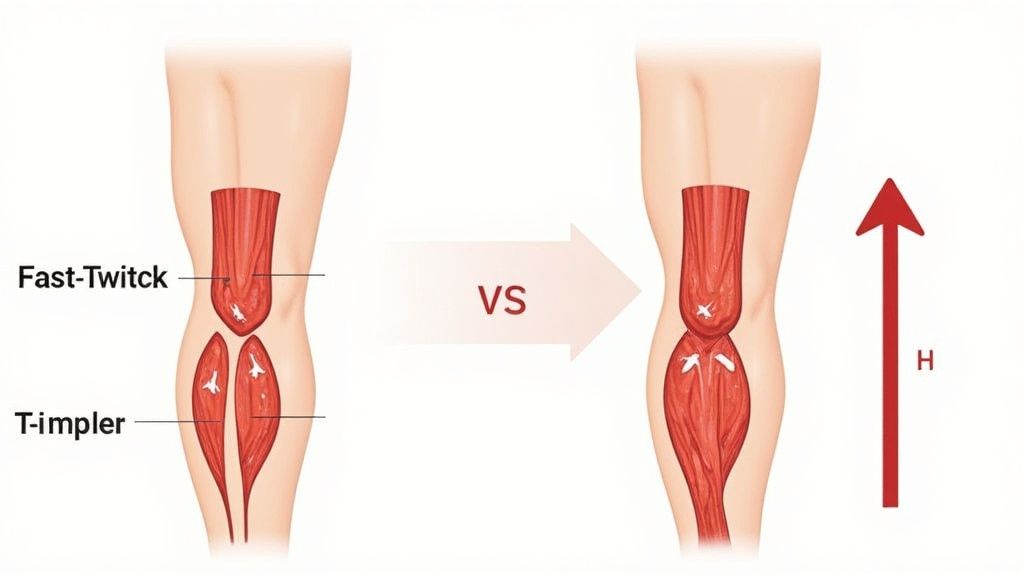
To really get what progressive resistance training is all about, we need to look past the movements themselves and zoom right into the cellular level of muscle tissue. Every single time you challenge your body with a tough exercise, you’re kicking off a pretty amazing chain reaction. It’s a direct conversation between your brain, your nervous system, and your muscle cells that turns all that hard work into real, measurable strength.
This conversation happens in two ways: through neuromuscular coordination and through physical changes in the muscle tissue. When you first start out, the quickest gains you’ll see are actually your nervous system getting smarter. This is called neural adaptation, and it’s where your brain gets way more efficient at sending electrical signals down motor neurons to your muscles, recruiting more muscle fibers to contract in unison.
Think of it like a new orchestra conductor. At first, the timing might be a little off, but soon they learn how to cue every section perfectly. In those first few weeks of training, you feel stronger not because your muscles have physically grown, but because your brain is simply better at activating the muscle mass you already have. This is the crucial first step that sets the stage for the physical changes to come.
The Cycle of Breakdown and Rebuilding
Once your nervous system is firing on all cylinders, the real work begins in the muscle tissue itself. The driver behind muscle growth is a process called hypertrophy, which simply means your individual muscle fibers are getting bigger in diameter. And it’s all triggered by that feeling of soreness you get after a good workout: microscopic damage.
When you challenge your muscles with resistance, you create tiny, controlled tears in the fibers. I know micro-trauma sounds a little scary, but it’s the essential signal your body needs to kickstart its repair process via satellite cells.
Your body’s response to this controlled stress is amazing. It doesn’t just patch up the damage—it overcompensates. It rebuilds the muscle fibers to be thicker, stronger, and more resilient than before, preparing them for the next time they face that same challenge.
This cycle of breakdown, repair, and reinforcement is the absolute heart of progressive resistance. Of course, to make the most of this process, achieving optimal nutrient absorption is just as important as the workout. Without the right building blocks from your diet, particularly protein, your body can't run its repair crew effectively.
Targeting the Right Muscle Fibers
It’s also important to know that not all muscle fibers are created equal. Your body has different types for different jobs, and progressive resistance training is especially good at targeting the ones that give you power and strength.
Let’s break down the two main players:
- Slow-Twitch (Type I) Fibers: These are your endurance athletes. They are rich in mitochondria and myoglobin, making them highly efficient at using oxygen to generate fuel for continuous, extended muscle contractions. They are recruited for sustained activities like holding a posture or going for a long run.
- Fast-Twitch (Type II) Fibers: These are your powerhouses. They contract with speed and force but also fatigue much faster as they primarily rely on anaerobic metabolism. They’re responsible for explosive movements like jumping, sprinting, or lifting heavy, and they have the most potential for growth (hypertrophy).
Progressive resistance training, particularly when you’re using challenging loads or performing powerful movements, specifically calls on these fast-twitch fibers. By consistently pushing them near their limit, you are directly stimulating the very fibers that lead to visible muscle growth and big jumps in strength. This targeted approach is exactly why this training method is so effective at changing your body's shape and how it moves.
Tracing the Historical Roots of Progression
The idea of progressive resistance training might feel like a modern fitness breakthrough, but its core principles are as old as strength itself. This isn’t some new trend cooked up in a lab; it's a fundamental concept that has been proven for thousands of years.
The story starts, as so many great ones do, in ancient Greece. The legendary wrestler Milo of Croton is often hailed as the original poster boy for progressive overload, and his method was beautifully simple.
He started by lifting a newborn calf and carrying it on his shoulders every day. As the calf grew, so did the weight he was lifting. This constant, gradual increase in demand forced his body to adapt, making him stronger and stronger until he was hoisting a full-grown ox. This story, dating all the way back to around 558 BCE, is one of the first and best examples of progressive resistance in action. You can find out more about these early training methods and their impact on modern science.
From Ancient Legend to Modern Science
For centuries, Milo's approach was basically how athletes and soldiers trained—by intuition. But it wasn't until World War II that this age-old wisdom was finally put under a scientific microscope.
Enter Dr. Thomas L. DeLorme, an American army physician tasked with a massive challenge: rehabilitating injured soldiers and getting them strong enough to return to duty. He needed a system—something repeatable, measurable, and effective. So, he developed protocols based on a percentage of a patient's one-repetition maximum (1-RM), which is the heaviest weight someone can lift for a single rep through a full range of motion.
This was a game-changer.
Dr. DeLorme’s work formalized the art of progression into a science. He demonstrated that structured, measurable increases in resistance were not only effective for elite athletes but also crucial for therapeutic rehabilitation, cementing PRT’s place in both physical therapy and exercise physiology.
His research was the missing piece of the puzzle. It gave us the clinical proof that gradually and systematically increasing resistance could predictably restore muscle function and build strength safely. What started as a legend about a man and a calf became a cornerstone of modern strength and conditioning, used by everyone from physical therapists helping someone learn to walk again to elite athletes chasing world records.
Applying Progression to Your Workouts
Alright, so you get the history and the science behind progressive resistance. But how do we take that knowledge off the page and onto the mat? This is where theory gets real, and where you start building tangible strength in every single workout.
Progression isn't just about grabbing a heavier weight or a thicker band. It's about being clever and intentional, manipulating different parts of your workout to keep your body guessing—and adapting. Think of it like having a whole toolkit of ways to make things challenging so you never hit a plateau.
More Than Just Adding Weight
The most obvious path forward is adding more load, but honestly, that’s just scratching the surface. Your body is incredibly smart and responds to all kinds of challenges. This gives you a ton of creative ways to make an exercise harder, especially if you’re working out at home or have limited equipment.
You can spark new muscle growth just by tweaking these variables:
- Repetitions (Reps): This is progression in its simplest form. If you did 8 reps of a squat last week, your goal this week is 9 or 10 with the same good form. You're increasing the total work your muscles have to do within a single set.
- Sets: Adding another round of an exercise is a straightforward way to crank up the volume. Bumping up from 3 sets to 4 might not sound like much, but it presents a significant new challenge for your muscles to overcome.
- Rest Periods: This one is sneaky but effective. If you normally rest for 90 seconds between sets, try cutting it to 75. Shortening your rest time increases the metabolic stress on your muscles by limiting the time for ATP (energy) replenishment, making the workout denser and tougher on your cardiovascular system, too.
This idea of gradually asking more from your body isn't new—it's a principle that has stood the test of time, from ancient Greek legends to modern exercise labs.
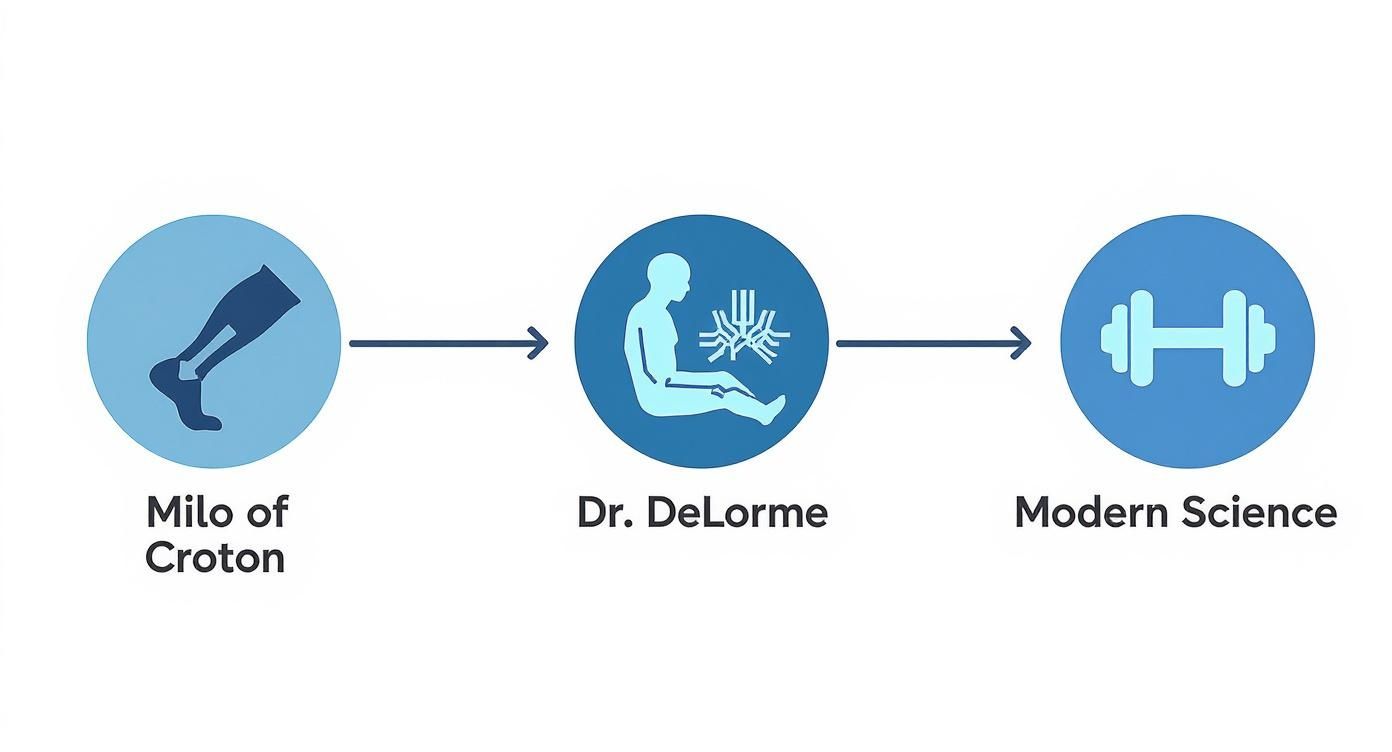
This journey shows that while our tools have evolved from carrying calves to using precision-engineered equipment, the core concept remains unchanged: your body will always adapt to the demands you place on it.
The Overlooked Forms of Progression
Some of the most powerful ways to progress have nothing to do with numbers. When you shift your focus to the quality of your movement, you can create a deeper, more effective muscular challenge that’s often more potent than just adding another plate.
Let's look at a few of these game-changers:
- Lifting Tempo: This is all about the speed of each rep. Try slowing down the lowering (eccentric) phase of a movement. For example, take 3-4 seconds to lower into a squat. This dramatically increases the time your muscles are under tension, which is a major catalyst for hypertrophy.
- Range of Motion (ROM): Simply moving deeper is a fantastic way to progress. Can you squat an inch lower, achieving greater hip flexion? Can you get a fuller stretch in your lunge, elongating the hip flexors? Pushing your range forces your muscles to work harder through a greater arc of motion and recruits more muscle fibers along the way.
- Improved Form: This is the ultimate progression. Perfecting your technique ensures that the target muscle (the agonist) is doing 100% of the work. No cheating, no momentum—just pure, focused effort that maximizes the stimulus where it counts.
Progression is really a conversation with your body. Some days, it’ll be ready for more weight. On others, the smarter choice is to slow down, perfect your form, and truly master the movement you’re in.
Comparing Progression Methods In Resistance Training
To make this crystal clear, let's break down the different variables you can play with. Each method has a time and a place, giving you a flexible toolkit for continuous improvement.
| Progression Method | How It Works | When to Use It |
|---|---|---|
| Increase Load | Add more weight or resistance. | When you can comfortably hit your target rep range with excellent form. |
| Increase Reps | Perform more repetitions with the same weight. | Great for building muscular endurance and mastering a specific load before increasing it. |
| Increase Sets | Add another round of the exercise. | A simple way to boost total workout volume and stimulate more growth. |
| Decrease Rest | Shorten rest periods between sets. | Increases metabolic stress and workout density; good for conditioning and fat loss phases. |
| Slow Tempo | Increase the time under tension by slowing down the rep. | Excellent for improving mind-muscle connection and overcoming strength plateaus. |
| Increase ROM | Move through a fuller range of motion. | When you've mastered the current range and want to challenge your muscles more deeply. |
By mixing and matching these methods, you ensure your body never gets too comfortable. You're always providing a fresh challenge, which is the secret ingredient for long-term results.
This approach is incredibly adaptable. For those who love equipment-free training, there are countless exercises with resistance bands that allow for seamless progression by simply adjusting your technique or the tension. To keep your training on track, it helps to follow a structured plan, and a practical guide to personal training programming can be a fantastic resource. When you embrace all these different ways to progress, you give yourself endless avenues to keep moving forward.
Your Progressive Resistance Training Blueprint
Now that we’ve covered the “what” and the “why,” it’s time to get practical. Let's translate all that theory into a clear, actionable plan you can start today. This is where the science of muscular adaptation meets real-world movement.
We’re going to build a solid foundation first, then layer on challenges in a smart, systematic way. This blueprint is designed to work whether you're using traditional weights, your own bodyweight, or even a Pilates reformer. It’s all about starting where you are and moving forward with purpose.
A Sample 4-Week Foundational Plan
This plan is all about mastering core compound movements. These are the big-bang-for-your-buck exercises that engage major muscle groups across multiple joints, building a base of strength and coordination that will serve you in everything you do.
Your goal for these first four weeks is simple: master the form. Perform this routine 2-3 times per week, making sure you have at least one day of rest in between to let your body recover and adapt.
Focus Exercises:
- Squats: The king of lower body exercises, hitting your quadriceps, glutes (maximus and medius), hamstrings, and core stabilizers.
- Rows: Your go-to for a strong back, targeting the latissimus dorsi, rhomboids, biceps, and posterior deltoids.
- Overhead Press: Builds strong, stable shoulders by working the deltoids, triceps, and upper fibers of the pectoralis major.
For each of these, your target is 3 sets of 8-12 repetitions. Once you can nail every rep of every set with beautiful form, you’ve earned the right to progress.
The real secret here isn't just doing the exercises—it's learning to listen to your body. True progression happens when you can confidently own the current challenge. That’s the signal that your muscles and nervous system are primed and ready for what’s next.
Visualizing Your Progression Path
Seeing how a single exercise can evolve is one of the best ways to understand what progressive resistance training is all about. It's not about jumping to the heaviest weight possible; it's a thoughtful journey from foundational stability to advanced strength.
Every step builds on the one before it, ensuring you’re developing real, how to build functional strength that supports you in the studio and in life.
Let’s use the squat, a fundamental human movement, as our example:
- Phase 1: Bodyweight Squat. This is ground zero. The entire focus is on mastering the movement pattern itself—initiating with hip flexion, keeping the spine neutral, and making sure your knees track over your second and third toes. The only resistance is your own body, and you progress by adding reps or slowing down the movement.
- Phase 2: Goblet Squat. Now we add an anterior load. By holding a single dumbbell or kettlebell at your chest, you not only increase the load on your legs but also fire up your core musculature (like the rectus abdominis and obliques) to prevent torso flexion.
- Phase 3: Barbell Back Squat. This is a classic strength-building progression. Placing a barbell across your upper back allows for a significant increase in load, demanding maximum effort from your entire posterior chain (glutes, hamstrings, spinal erectors) and all the little stabilizer muscles that support the movement.
This same logic—master the pattern, add a challenge, increase the load—applies to any exercise.
Progression Beyond Traditional Weights
Don't think this is just a "gym bro" thing. Progressive resistance is a universal principle, and it truly shines in disciplines like Pilates, where tiny adjustments can create massive challenges.
Let’s look at a classic Pilates reformer exercise: Footwork.
- Initial Stage: You might start your Footwork series on one medium-tension spring. This gives you enough feedback to engage your leg muscles (quadriceps, hamstrings, glutes) and core stabilizers without your form breaking down or your pelvis becoming unstable.
- Progression Stage: As you get stronger and your control sharpens, you could progress by adding one light spring. It might not sound like much, but that small increase in tension forces your quads, glutes, and hamstrings to work significantly harder through the entire range of motion, creating a much deeper level of muscular engagement and neuromuscular control.
Common Questions About Progressive Resistance Training
As you start putting these ideas into practice, a few questions always seem to pop up. Getting these sorted out can be the difference between feeling stuck and feeling totally confident in your plan. Let's walk through some of the most common ones I hear.
Progressive Resistance vs Progressive Overload
It's easy to get these two mixed up, and you’ll often hear people use them interchangeably. But they're not quite the same.
Think of it this way: progressive overload is the big, universal law of getting stronger. It’s the "what." It's the simple, non-negotiable physiological principle that you have to consistently ask more of your muscles to get them to adapt.
Progressive resistance training (PRT), on the other hand, is the "how." It's the actual road map—the specific, structured method you follow using resistance to make that overload happen. So, progressive overload is the destination, and PRT is the detailed plan you use to drive there.
How Quickly Should I Progress?
This is a big one, and the honest answer is: it’s completely unique to you. How fast you can add more challenge depends on everything from your training history and nutrition to how well you’re sleeping and recovering. Pushing too fast is a classic mistake that often leads to sloppy form and, eventually, injury. Patience really is your best friend here.
A fantastic, time-tested guideline is the "2-for-2 rule." If you can perform two more reps than your target on the very last set of an exercise, for two workouts in a row, it’s a solid sign you're ready to bump up the resistance. This little rule helps ensure your progress is earned, not forced.
Remember, slow and steady progress that you can sustain for months is infinitely better than big, reckless jumps that your body simply isn't ready for.
Can This Work Without Weights?
Absolutely. Progressive resistance is a principle, not a piece of equipment. In fact, your own bodyweight is one of the most versatile and powerful tools you have, and you can manipulate it in all sorts of clever ways.
Here’s how you can apply progression at home with just your body:
- Add more reps or tack on an extra set to your workout.
- Slow down your tempo, making each part of the movement more deliberate to increase time under tension.
- Shrink your rest periods between sets to make your workout denser and more challenging.
- Level up the exercise itself, like moving from a standard push-up on your knees (reducing the lever length) to a full push-up, or eventually a decline push-up (increasing the load on the chest and shoulders).
If you’re looking to build strength without putting a lot of stress on your joints, exploring low impact strength training exercises is a brilliant place to start applying these bodyweight principles safely.
Ready to put these principles into action with a system designed for intelligent, anatomy-informed progression? WundaCore brings the studio experience home with equipment and on-demand classes that help you build real strength from the inside out. Explore the WundaCore collection and start your journey today.