
Your Guide to At Home Pilates Equipment
The best at home Pilates equipment isn't just one thing. It can be as simple as a great mat or as specific as tools like resistance rings and loops. These pieces aren't just accessories; think of them as anatomical partners in your practice, designed to deepen your connection to your core musculature, refine your biomechanics, and help you get that studio-quality workout right at home.
Why the Right Equipment Transforms Your Home Practice
Starting a Pilates practice at home is about so much more than just buying some gear. It’s about understanding how the right tools can fundamentally change the conversation you're having with your body's muscular and skeletal systems.
Joseph Pilates originally called his method "Contrology"—the art of using your mind to control your muscles. The right equipment acts as a guide in this process, helping you find the neuromuscular precision that makes Pilates so incredibly effective. Think of it this way: sometimes a prop offers support, helping you isolate and activate a deep stabilizing muscle like the multifidus. Other times, it adds a challenge, creating resistance that builds true, functional strength by forcing specific muscle groups to work through their full range of motion.
Connecting Equipment to Your Anatomy
Every prop is designed with a specific anatomical purpose in mind. A Pilates ring, for example, isn't just for squeezing. Its resistance provides real-time, tactile feedback that helps you engage your adductor muscles (inner thighs) and pelvic floor—two key components of your deep core system. This focus on anatomy ensures you aren't just going through the motions, but are actually building a stronger, more intelligent body.
This appreciation for mindful, anatomy-focused exercise is catching on. The global demand for Pilates equipment is projected to hit USD 377.7 million by 2025, with North America leading the trend. You can explore more data on the Pilates equipment market growth to see just how big this shift is.
At its core, Pilates equipment is designed to teach you about your own body. It provides the feedback necessary to engage stabilizer muscles, correct imbalances, and execute movements with intention and control.
Ultimately, the goal here is to empower you to make smart choices. When you understand how each piece of at home Pilates equipment works with your muscular system, you can build a setup that truly serves your personal fitness goals, turning any space into your own personal sanctuary for mindful movement.
Understanding Your True Core Anatomy
Before you even think about buying your first piece of at-home Pilates equipment, let's get one thing straight. When most people say "core," they're picturing the rectus abdominis—the six-pack muscle. But in the world of Pilates, that's just the superficial tip of the iceberg. Your real core is a much deeper, smarter system of muscles that’s the true source of your stability, power, and posture.
Think of it as a muscular cylinder wrapping around your entire midsection, from the diaphragm down to the pelvic floor. This system is designed to fire up and stabilize your spine before you even move. Once you understand how it works, you’ll see exactly how each piece of equipment is designed to help you tap into that power.
The Four Pillars of Your Deep Core
Your deep core is really a team of four key muscles working together in a coordinated system. Each one has a specific job, and the right Pilates prop can help you feel and connect with them in a whole new way.
- Transverse Abdominis (TVA): This is your body’s built-in corset. It’s the deepest abdominal muscle, and its fibers wrap horizontally around your torso. When you engage it properly, it cinches your waist, stabilizes your lumbar spine, and supports your internal organs.
- Pelvic Floor: Imagine a muscular hammock or sling at the very base of your pelvis. That’s your pelvic floor. It supports your internal organs and works synergistically with your TVA and diaphragm to manage intra-abdominal pressure.
- Multifidus: These are tiny but mighty muscles running along both sides of your spine. They act like little guide wires, stabilizing each individual vertebra and protecting your back from shearing forces during twists or forward flexion.
- Diaphragm: This is your main breathing muscle, and it acts as the lid on top of your core cylinder. Proper diaphragmatic breathing is everything in Pilates because it’s what initiates the co-contraction of the entire deep core system.
The real magic of Pilates happens when these four muscle groups learn to fire in perfect sync. Equipment gives you the feedback you need—sometimes support, sometimes resistance—to wake up that deep neuromuscular connection and turn a simple movement into a powerful, precise exercise.
This is exactly how equipment helps you achieve the key benefits of Pilates—by targeting your true core.
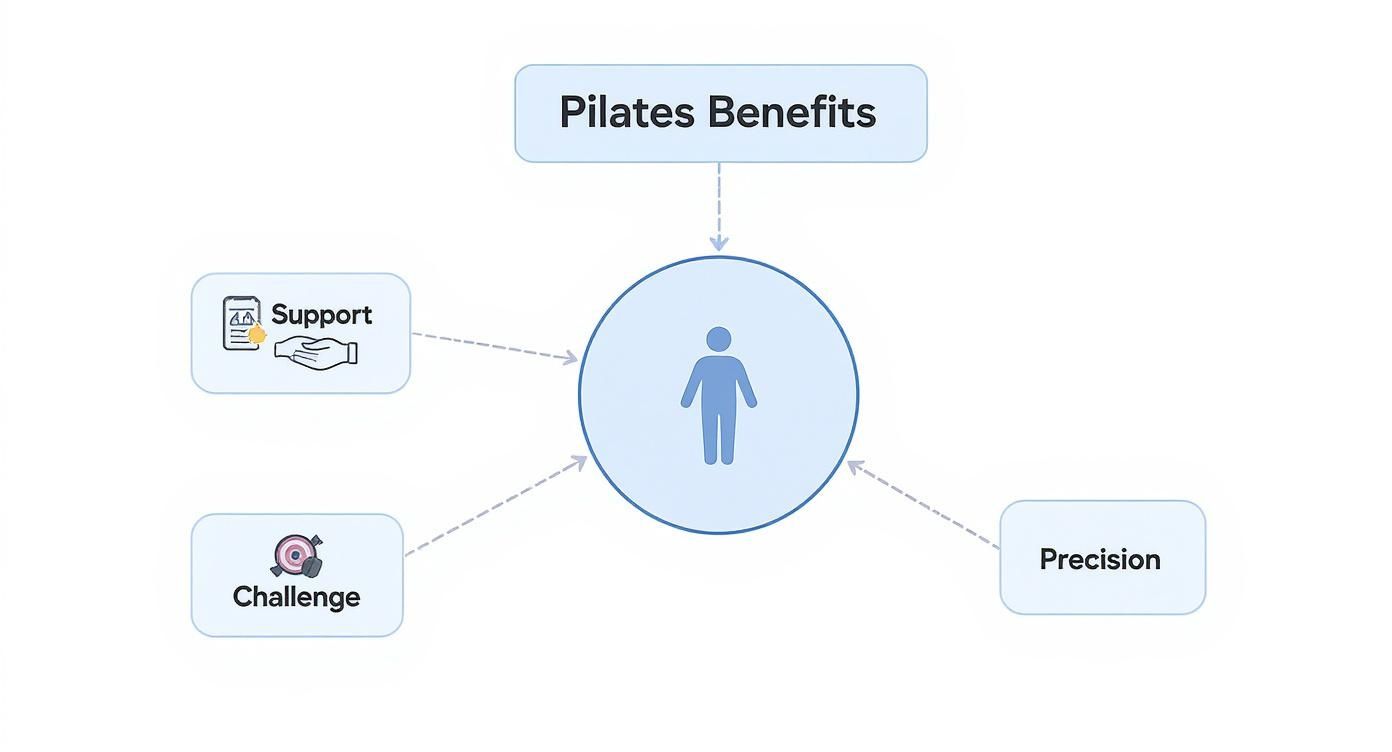
As the image shows, props are just tools to help you either support your form, challenge your strength, or refine your precision. It all leads back to a stronger, more anatomically aware body.
With this anatomy in mind, you can start to see that every piece of gear has a real purpose. It’s not just an accessory; it’s a tool designed to help you communicate with those deep muscles, building incredible strength from the inside out.
Your Guide to Essential and Optional Pilates Props
Putting together your perfect at home Pilates equipment setup is a journey, not a race. You don't need a studio's worth of gear to get started—you just need the right tools that speak to your body and your goals. Let's break down the must-haves from the nice-to-haves, so you can build a practice that grows right along with you.
Thinking about it this way ensures you invest in what truly matters. Each piece of equipment serves a very specific anatomical purpose, helping you connect with your muscles and movement on a much deeper level.
The Undeniable Essentials
To really practice Pilates, you need two things: a stable surface to protect your spine and a way to create feedback for your muscles. These items are the non-negotiable foundation of any home setup. They provide the support and resistance needed to activate the deep core muscles we're always talking about.
- A Quality Pilates Mat: This is your home base, your connection to the floor. It’s easily the most important piece you’ll buy. Forget that flimsy yoga mat—a proper Pilates mat has substantial cushioning to protect the spinous processes of your vertebrae, as well as your hips and joints, during rolling and articulated core work. Its dense foam creates a stable, non-slip surface, giving you the confidence to move with precision.
- The Pilates Ring (Magic Circle): Don't let its simplicity fool you; this ring is a master teacher for your body. Squeeze it between your inner thighs, and you’ll instantly feel your adductor muscles and pelvic floor engage. Press it between your hands, and you activate the pectoral muscles and serratus anterior, which are crucial for scapular stability. The ring gives you immediate, tactile feedback, showing you exactly where that muscular connection should come from.
Optional Props for Deeper Work
Once you've got the essentials down, a few optional props can add new layers of challenge and refinement to your workouts. They're designed to test your proprioception, add progressive resistance, or provide targeted myofascial release, letting you fine-tune your practice.
Think of optional props as your toolkit for progression. They introduce new variables that challenge your body's feedback system, forcing smaller stabilizing muscles to kick in and building a more resilient, intelligent body.
Adding these tools is a popular way to expand a home practice. It’s a global trend, too—the Pilates home equipment market in China is expected to rocket past USD 730 million in 2025, with online sales of small props jumping 78% year-over-year.
Here are some of the most effective optional tools to consider:
- Resistance Bands: These are brilliant for mimicking the spring tension of a Reformer right on your mat. They add progressive resistance, which means a muscle has to work harder through its entire range of motion. This is fantastic for challenging your glutes (maximus, medius, and minimus), outer hips (tensor fasciae latae), and the small stabilizing muscles of the rotator cuff. Check out our guide on choosing the best resistance bands for Pilates to find the right fit.
- Small Stability Ball: This little inflatable ball is a powerhouse for proprioceptive feedback. Tucked behind your lumbar spine, it gives you an undeniable cue to engage your transverse abdominis. You can also place it between your knees or ankles to fire up the adductors, adding a serious core challenge to almost any exercise.
- Foam Roller: Often seen as just a recovery tool, the foam roller is an incredible Pilates prop. When you lie on it lengthwise along your spine, its unstable surface immediately challenges your balance, forcing your deep core stabilizers (like the multifidus) to work overtime just to keep you steady. It's also an amazing tool for working on thoracic spinal articulation and opening up through the chest.
Choosing Your Foundational At-Home Pilates Equipment
To make it even clearer, let's compare these foundational pieces side-by-side. This will help you see exactly what each tool does and who it's best for as you start building your home studio.
| Equipment | Primary Anatomical Function | Ideal For | Category |
|---|---|---|---|
| Pilates Mat | Provides spinal cushioning and a stable, non-slip surface | Everyone, from absolute beginners to seasoned pros | Essential |
| Pilates Ring | Offers tactile feedback to activate adductors, pelvic floor, and core | Beginners needing connection cues; advanced users seeking deeper engagement | Essential |
| Resistance Bands | Mimics spring resistance to build strength in glutes and upper body | All levels looking to add progressive strength work to their mat practice | Optional |
| Small Ball | Adds instability to challenge core stabilizers; provides feedback | Users wanting to deepen TVA connection and add variety | Optional |
| Foam Roller | Challenges balance, activates deep stabilizers, aids in mobility | Intermediate to advanced users focused on stability and spinal health | Optional |
Ultimately, the best setup is the one that meets you where you are. Start with a great mat and a ring, and you have everything you need for a powerful, effective Pilates practice. From there, you can slowly add optional props that align with your personal goals.
How to Choose High-Quality and Safe Equipment
Investing in at-home Pilates equipment is really an investment in your own body, so it’s worth taking the time to choose pieces that are safe, durable, and actually effective. The market is exploding—it's projected to shoot past USD 11 billion by 2035—which means you have more options than ever. You can discover more about this growth in the Pilates gear market. But with all that choice, it’s crucial to know how to spot quality gear that supports your anatomy versus cheap knock-offs that can compromise your form and even lead to injury.
When you're looking, try to think less about brand names and more about the raw materials and design. Those are the things that will directly impact your body's alignment and whether you’re truly engaging the right muscles.
Decoding Your Pilates Mat
Your mat isn't just a mat; it's the foundation of your entire practice. It's the critical interface between your body and the floor, protecting your spine and creating a stable base for every precise movement you make.
-
Material Matters: Look for mats made from TPE (Thermoplastic Elastomer). It's a high-density, closed-cell foam that gives you fantastic cushioning and grip, but without that gnarly chemical smell you often get with cheaper PVC mats.
-
Optimal Thickness: A real Pilates mat should be at least 6-8mm thick. That density provides essential padding for your vertebrae during rolling exercises like the Roll Up, protecting the bony parts of your spine from bruising and discomfort. For more detailed advice, you can check out our guide on selecting the right exercise mat.
-
Texture for Grip: A slightly textured surface is key. It prevents your hands and feet from slipping during planks or leg circles, and that stability allows you to maintain proper biomechanical form and stay safe.
Evaluating Rings and Bands
When it comes to resistance tools like Pilates rings and bands, quality construction is everything. It directly translates to better muscle activation and safety. A poorly made band can snap, and a cheap ring can offer inconsistent tension, totally undermining your workout.
For Pilates rings, look for a spring steel core. It offers far more consistent and durable resistance than fiberglass, which tends to lose its tension over time. The handles are also a big deal. Make sure they are well-padded on both the inside and outside. These pads aren't just for comfort; they ensure you can maintain a secure grip, letting you focus on engaging your deep core and adductors instead of straining the muscles in your hands and forearms.
A well-designed prop shouldn't create tension in the wrong places. Quality equipment feels like a natural extension of your body, providing feedback that guides you into deeper, more accurate muscle engagement without causing strain in your joints, hands, or neck.
With resistance bands, prioritize materials that give you a smooth, consistent stretch. Fabric bands are usually a better bet—they’re more durable, less likely to snap than latex, and they won't roll up your legs during exercises like clamshells. It seems like a small detail, but it makes a huge difference in keeping your focus and form intact.
Creating Your Ideal Home Practice Space
Let’s be honest, transforming a part of your home into a dedicated Pilates space is less about having a huge room and more about carving out an environment that helps you focus. The right space, no matter how small, has a huge impact on your ability to move with intention and really connect with your body.
The goal here is simple: create a spot that invites mindful movement. A cluttered or cramped area just creates mental static, pulling your attention away from the deep core work and precision that Pilates is all about. Even the tiniest, most organized nook can become a powerful place for your practice.
The Minimalist Corner: A Smart Solution for Small Spaces
You absolutely do not need a dedicated home gym to build a powerful and effective practice. A "Minimalist Corner" is something you can create in just about any apartment or home, making Pilates accessible to everyone. The secret is maximizing what you can do in the space you have.
The single most important thing to consider is anatomical clearance. You need enough room to fully extend your arms and legs in every direction without bumping into furniture or a wall. This is non-negotiable for performing exercises like Roll Overs or Side Kicks through their complete range of motion, which is what builds balanced, functional strength across your joints.
Your practice space should let your body be the star of the show. All you really need is a flat, stable floor with enough room for your mat and at least two feet of clear space on all sides. This gives you the freedom to move without hesitation, which keeps both you and your home safe.
Designing a Space for Focus and Flow
Once you’ve marked out your territory, think about the little details that can enhance the mind-body connection. What helps you tune in and shut out the day-to-day noise?
- Flooring: A hard, level surface like wood or tile is perfect. If you’re working on carpet, you might want to place a firm yoga mat or an equipment mat under your Pilates mat. This creates a more stable foundation, which is so important for proprioceptive feedback and spinal support.
- Lighting: Soft, natural light is always the winner. If that’s not an option, try using dimmable lamps to create a calm atmosphere that helps you focus inward on what your muscles are doing, not on outside distractions.
- Organization: Keep your at home Pilates equipment tidy. Simple vertical storage like wall shelves or even a nice basket can make a world of difference. An organized space helps create an organized mind, making it that much easier to transition into your workout.
Even if you’re tight on room, a little thoughtful planning goes a long way. For more ideas on how to get the most out of a smaller footprint, check out our guide on finding the best fitness equipment for small spaces.
Putting Your Equipment into Practice
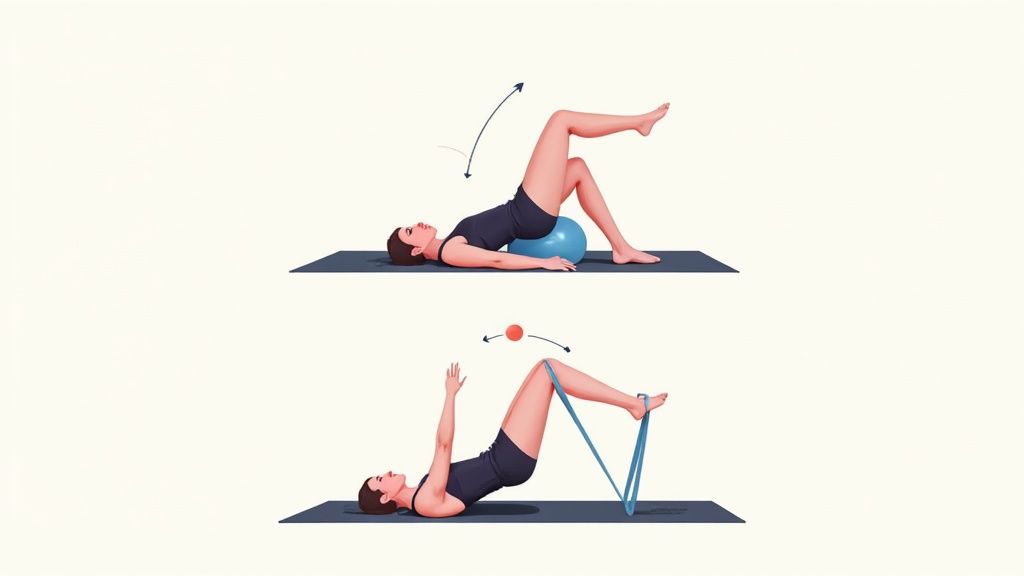
Alright, you’ve got the gear and you’ve carved out your space. Now comes the fun part: moving from theory to action. It’s one thing to understand why a prop is useful, but it’s a whole different ballgame to actually feel its effect on your body. The real magic happens when you use these tools to start a conversation with muscles you might not have spoken to in years.
Every prop you own is designed to do one of two things: provide proprioceptive feedback or add a challenge. Let's walk through a few mini-workouts that bring this idea to life, focusing on those deep neuromuscular connections that make Pilates so incredibly effective.
Deep Core Activation Flow
This quick sequence uses a small stability ball to help you connect with your deepest abdominal muscle—the transverse abdominis (TVA). Think of it as your body's built-in corset. When you get it to fire correctly, it provides amazing support for your entire spine.
- Pelvic Curls: Lie on your back, knees bent and feet flat on the floor. Pop the ball between your inner thighs. As you breathe out, give the ball a gentle squeeze—this wakes up your adductors and pelvic floor. Then, slowly articulate your spine off the mat, one vertebra at a time. That little ball gives you instant feedback, making sure the work is coming from your deep core and glutes, not your lumbar spine erectors.
- The Hundred Prep: Now, place the slightly deflated ball right under your sacrum (that flat, bony plate at the base of your spine). This tiny bit of lift makes it so much easier to keep your pelvis in a neutral position. As you bring your legs up to a tabletop position, you’ll feel your TVA immediately switch on to keep you stable. The ball is essentially teaching your nervous system where to find that deep core connection.
Glute and Outer Thigh Sculpting
For this one, your resistance band is your best friend. It provides a constant, nagging challenge through the entire movement, targeting the gluteus medius and minimus. These are the crucial stabilizer muscles for your hips and pelvis, and keeping them strong is key to preventing knee and lower back pain down the road.
Using a resistance band is like having a portable Reformer. It mimics the spring-based tension of studio machines, forcing your muscles to work harder during both the concentric (shortening) and eccentric (lengthening) phases of a movement. This builds balanced, functional strength.
- Clamshells: Lie on your side and loop a resistance band just above your knees, which should be bent at about a 45-degree angle. Keeping your feet glued together, lift your top knee against the band's tension. The trick here is to make the move happen from your deep glute muscles, initiating external hip rotation without rocking your pelvis backward. The band makes it nearly impossible to cheat.
- Side-Lying Leg Lifts: From that same position, straighten your top leg. Keeping your core tight, lift and lower the leg with control. The band adds a serious burn, targeting the glute medius to build the stability you need for walking, running, and just about everything else.
Common Questions About Home Pilates Equipment
Jumping into the world of at home Pilates equipment always brings up a few last-minute questions. Getting those answers sorted out is the best way to feel confident about investing in your practice so you can start moving. Let's tackle some of the most common ones I hear.
What Is the Absolute Minimum I Need to Start?
Honestly, the only thing you absolutely need is a good mat. A real Pilates mat—thicker than your average yoga mat—is non-negotiable for protecting the spinous processes of your vertebrae during all the rolling and articulating we do. That's it.
But if you're going to add just one more thing, make it a Pilates ring. It's the best tool for teaching you how to fire up those deep core and inner thigh (adductor) muscles. It gives you invaluable tactile feedback that's hard to find on your own.
While the mat is the true essential, the Pilates ring is what teaches you the feeling of deep muscular connection. It’s like a guide that helps turn anatomy lessons into something you can actually feel in your body.
Can I Get Studio Results Without a Reformer?
Absolutely. You can get incredible, body-changing results with mat Pilates and a few smart props. Mat work is the bedrock of the entire Pilates method. It’s where you learn to use your own body weight as resistance to build profound, functional strength from the inside out.
Props like resistance bands and rings do a great job of mimicking some of the spring tension you'd get from a Reformer, letting you challenge your muscles in new and interesting ways. The neuromuscular experience is definitely different, but a consistent, focused home practice will deliver huge improvements in core strength, flexibility, and muscle tone.
How Do I Know Which Resistance Band to Choose?
Always, always start with a light resistance band. This is especially true when you're targeting smaller stabilizer muscles around the shoulders (like the rotator cuff) or hips (like the gluteus medius).
A good rule of thumb: you should be able to complete 10-15 repetitions with perfect form. You want to feel the target muscle working, not straining your joints or using momentum to compensate. As you get stronger, you can move up to medium and heavy bands. My advice is to buy a pack with a few different resistance levels. That way, you’ll always have the right tool for the job, whether you're working your glutes or your rotator cuff.
Ready to build a stronger, more connected body from home? WundaCore provides the expertly designed, anatomy-focused equipment and streaming classes you need to create a studio-quality practice anywhere. Explore the complete WundaCore collection and start your journey today.