
Beginner Pilates Reformer Workout: Safe, Clear Steps for Your First Session
A beginner Pilates reformer workout isn't just a random set of exercises. It’s a carefully structured sequence of low-impact movements designed to build deep core strength, unlock flexibility, and sharpen your body awareness. The goal is to establish a powerful mind-body connection right from your very first session.
Why Anatomy Is Your Secret Weapon In Pilates
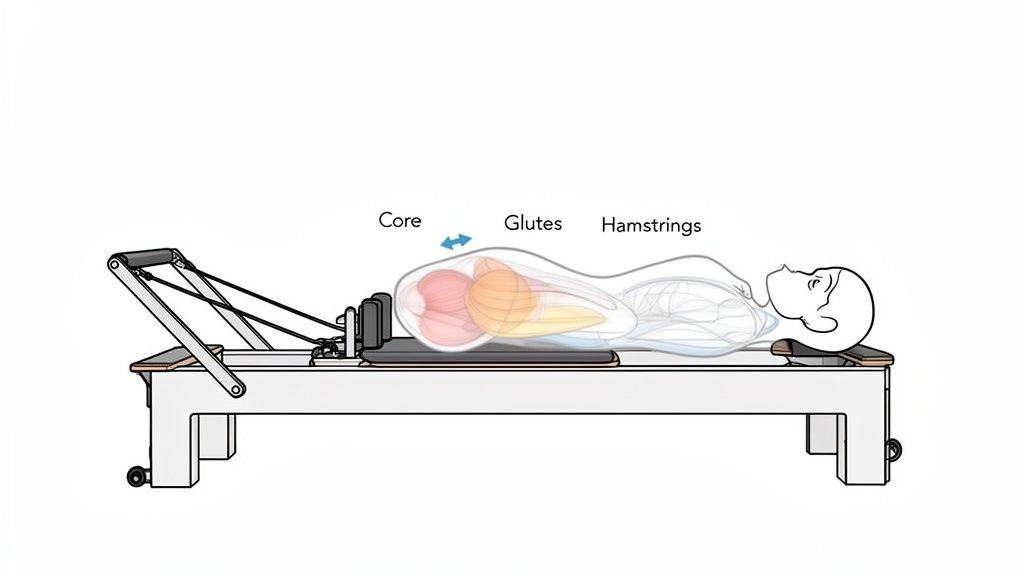
Stepping onto a Pilates reformer for the first time can feel like learning a new language. But what if you had a secret translator? That's exactly what a basic understanding of anatomy gives you. It elevates your movements from simply following instructions to a powerful, intentional practice.
Instead of just mindlessly pushing the carriage back and forth, you’ll start to understand why you're doing it. You'll feel the deep transversus abdominis engage to create a supportive corset for your spine, or notice how your gluteus maximus fires to extend the hip and stabilize your pelvis. This anatomical awareness is the key to unlocking the true, lasting benefits of Pilates.
The Power Of The Powerhouse
In the Pilates world, you'll hear the term "Powerhouse" a lot. This refers to the group of muscles that form a supportive cylinder around your entire trunk. This includes the abdominals (transversus abdominis, obliques, rectus abdominis), the muscles of your lower back (like the multifidus), the pelvic floor at the base, and the diaphragm at the top.
When an instructor cues you to "draw your navel to your spine," they're helping you activate this deep muscular system. Mastering this foundational engagement protects your lumbar spine and makes every other movement you do safer and far more effective.
Moving Beyond The Core
While the Powerhouse is central, Pilates is a full-body workout. Knowing which muscles you're targeting prevents you from compensating with the wrong ones—a classic beginner mistake that can lead to strain. During leg circles, for instance, the goal is to mobilize the hip joint (femur in the acetabulum) using your glutes and inner thighs, not by gripping your hip flexors (iliopsoas) or tensing your neck muscles (trapezius).
This focus on anatomy is what makes Pilates so incredibly effective. It's more than just exercise; it's a re-education in neuromuscular patterns that builds strength from the inside out, improving your posture, balance, and the way you carry yourself through everyday life.
Below is a quick look at the core principles, the muscles they activate, and why they're non-negotiable for your first workout.
Foundational Pilates Principles And Their Anatomical Focus
| Pilates Principle | Primary Anatomical Focus | Why It Matters For Beginners |
|---|---|---|
| Centering | The "Powerhouse" (abdominals, pelvic floor, diaphragm, deep back muscles) | Establishes a strong, stable base originating from the lumbo-pelvic region. |
| Concentration | Neuromuscular pathways (mind-muscle connection) | Ensures precise activation of target muscles and inhibits overactive, compensating ones. |
| Control | Deep stabilizers (e.g., multifidus, transversus abdominis) and prime movers | Prevents ballistic, uncontrolled movements, protecting joints and deepening muscle work. |
| Precision | Specific muscle groups for each phase of an exercise | Teaches proper biomechanics from the start, which is the key to seeing results. |
| Breath | Diaphragm, intercostal muscles, pelvic floor | Deepens core activation through intra-abdominal pressure and facilitates spinal mobility. |
| Flow | Full-body integration and muscle synergy | Connects exercises smoothly, training muscles to work together in efficient patterns. |
Getting a feel for these principles in your own body is what it's all about. It transforms the workout from something you do to something you embody. You can explore a deeper dive into what muscles Pilates works in our dedicated guide.
Understanding the "why" behind an exercise—its anatomical purpose—is what separates a beginner from an advanced practitioner. It’s not about how heavy the springs are; it’s about the precision and control you bring to the movement.
Setting Up Your Reformer For A Safe Workout
Before you even think about pushing off that footbar, let’s talk about the most important part of your workout: setting up your reformer. This isn’t just a quick check; it's about customizing the machine to fit your body's unique biomechanics. Taking a minute to do this right ensures you maintain proper spinal and joint alignment, which is crucial for targeting the correct muscles and preventing injury.
Think of this pre-workout ritual as the foundation for every single exercise that follows. When the machine is properly dialed in, you can move with confidence, knowing you’re fully supported. This is especially true when you're just starting out—building these good habits from day one makes all the difference.
Your Pre-Workout Checklist
Getting your reformer ready involves just a few key adjustments. Each one serves a very specific anatomical purpose, making sure the machine moves with you, not against you.
- Adjusting the Headrest: Your headrest is there to support the natural curve of your neck (your cervical spine). If it's too high, it forces your cervical spine into flexion. Too low, and it might hyperextend. The goal is simple: maintain a neutral cervical spine, keeping it in line with your thoracic and lumbar spine.
- Positioning the Carriage Stopper: This little piece dictates your starting position. For most exercises, you want to set it so that when the carriage is "home," your knees are bent at a 90-degree angle, with the knee joint stacked directly over the ankle joint. This alignment is crucial for protecting the knee from unnecessary shear forces, especially during an exercise like Footwork.
- Setting the Footbar Height: The footbar position will change depending on the exercise and your own hip and hamstring flexibility. For beginners doing Footwork, a higher position reduces the degree of hip flexion required, making it more accessible. As your hamstring length and hip mobility improve, a lower position will increase the challenge, requiring more core control to maintain a neutral pelvis.
Demystifying Spring Tension
The springs on a reformer provide resistance, and learning to choose the right amount is more of an art than a science. Here's a secret: more resistance isn't always better. In fact, for many exercises, lighter springs can be way more challenging because they force your deep stabilizing muscles to work harder to control the carriage.
The springs are there to teach, not just to challenge. Lighter springs reveal where you lack control, while heavier springs build strength. Your job as a beginner is to find the tension that allows for perfect form.
Start with the recommended spring load for each exercise, which is typically one or two full-resistance springs for foundational moves. Most importantly, pay attention to how your body feels. You should feel your target muscles working, not your joints straining. If you notice your lumbar spine arching or your shoulders elevating towards your ears, that's a clear signal from your body to lighten the load. Finding the best Pilates equipment for home use often comes down to how intuitive and user-friendly these adjustments feel.
Your Foundational Beginner Reformer Workout
Alright, it's time to put all that knowledge into practice and actually feel what intentional movement is like on the reformer.
This sequence is designed specifically for beginners. We're going to focus on foundational exercises that build deep core strength, improve hip articulation, and forge the neuromuscular connections you'll rely on in every single session from here on out. Remember to move slowly and with control—the goal is always precision over speed.
This quick visual breaks down the essential pre-workout adjustments to make sure the machine is set up perfectly for your body.
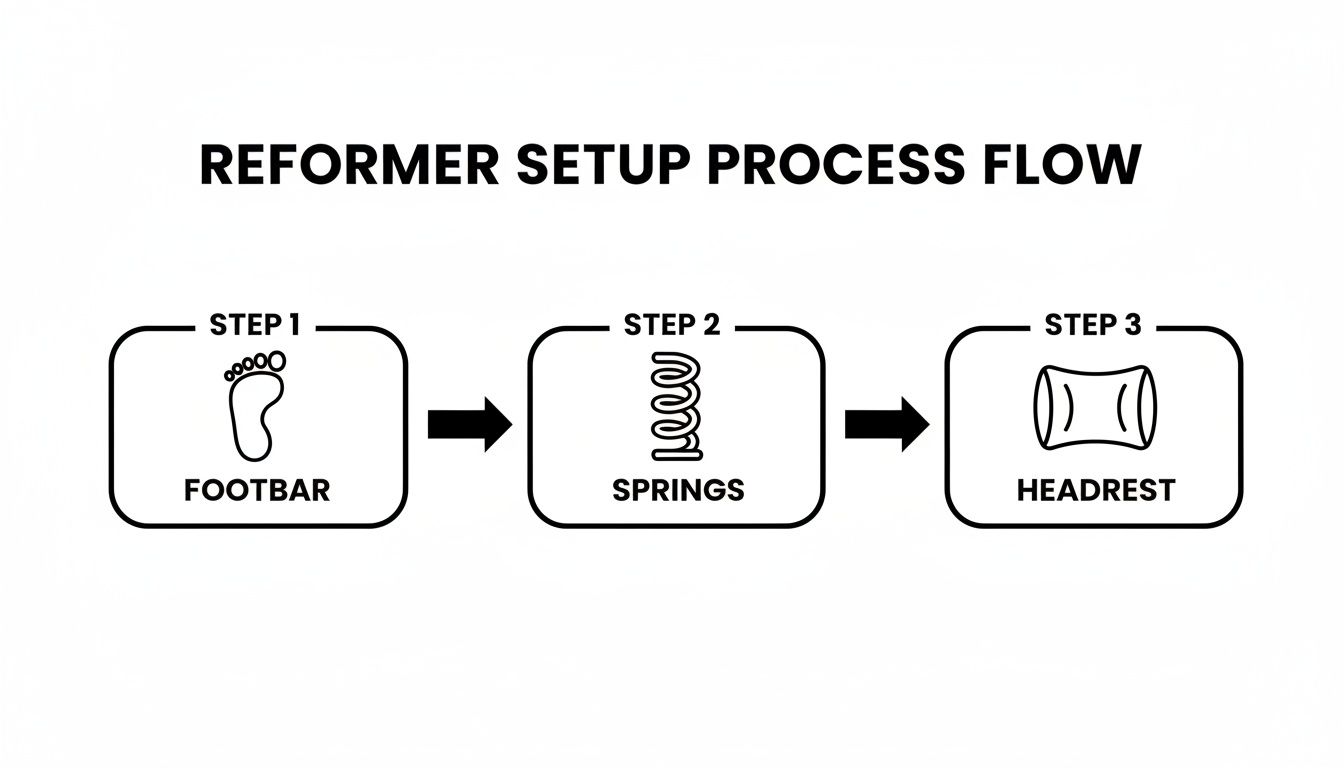
This highlights how important it is to customize the footbar, springs, and headrest before you even start. Getting this right ensures every movement is both safe and effective.
Exercise 1: Footwork Series
Footwork might look simple, but it’s a powerhouse for teaching proper lower body alignment and pelvic stability. It warms up the major muscles of the legs while demanding core engagement to prevent unwanted movement in the spine.
- Setup: Lie on your back with a neutral spine (a small space under your lower back). Place your heels on the footbar, hip-distance apart. Start with 2-3 medium springs.
- Anatomical Focus: As you press the carriage out (hip and knee extension), feel your hamstrings and gluteus maximus initiate the movement. Your quadriceps then engage to fully straighten the legs. Your deep abdominals, particularly the transversus abdominis, must remain contracted to keep your pelvis from tilting anteriorly or your lumbar spine from arching.
- Common Mistake: Allowing the lumbar spine to arch and peel off the mat during the push phase.
- Correction: Exhale on the push and imagine gently cinching a belt around your waist. This cue activates the transversus abdominis, which helps stabilize the pelvis and lumbar spine against the carriage.
Exercise 2: The Hundred
The Hundred is a classic Pilates exercise that builds abdominal endurance and teaches breath-movement coordination. It's a true test of your Powerhouse's ability to maintain spinal flexion against gravity.
- Setup: Lie on your back, knees in a tabletop position (hips and knees at 90 degrees). Lift your head and shoulders, flexing the upper thoracic spine. Gaze toward your abdomen. Extend arms long, palms down. Use 1 medium spring.
- Anatomical Focus: The primary workers are your rectus abdominis and obliques, which maintain thoracic flexion. As you pump your arms from the shoulder joint, your triceps and latissimus dorsi engage to create stability. The real challenge is using your transversus abdominis to prevent your lower back from arching and your abdomen from doming, especially with legs in tabletop.
- Breathing Cue: Inhale for five short pumps, exhale for five. This diaphragmatic breathing helps maintain intra-abdominal pressure, supporting the core from within.
The goal of The Hundred isn't to strain your neck. It's about maintaining a stable, scooped core while your limbs move. Think of your torso, from ribs to hips, as a solid, unmoving unit.
Exercise 3: Leg Circles
This exercise feels incredible and is fantastic for improving the mobility of the femur within the hip socket while strengthening the stabilizing muscles around the pelvis. It demands precise control from your core.
- Setup: Lie on your back, place one foot in a strap, and extend the leg towards the ceiling. The other foot can rest on the footbar. Use 1 light-to-medium spring.
- Anatomical Focus: As you circle the leg, the movement should be initiated from your gluteal muscles and deep external hip rotators. Your adductors (inner thighs) and abductors (outer thighs/gluteus medius) work to control the leg's movement across the body's midline and out to the side. Most importantly, your obliques and transversus abdominis must work isometrically to keep the pelvis completely stable on the carriage. Any rocking indicates the core has disengaged.
Exercise 4: Stomach Massage Series: Round Back
Don't let the name fool you—this is a deep abdominal workout. It teaches you to articulate your spine while challenging your core to work from a flexed (rounded) position.
- Setup: Sit on the carriage facing the footbar. Place your heels on the bar. Round your spine into a "C" curve by flexing your lumbar and thoracic spine and scooping your abdominals deeply. Use 2-3 medium springs.
- Anatomical Focus: You are actively working your rectus abdominis and obliques to maintain the C-curve against the pull of the springs. As you press out with your legs, your quadriceps engage, but the real test is using your deep abdominals to control the eccentric return of the carriage, preventing the springs from pulling you in abruptly.
- Common Mistake: Losing the spinal flexion and straightening the back as the legs extend.
- Correction: Keep your gaze towards your navel and imagine deepening the scoop of your abdominals as the carriage moves away. This focus helps maintain the engagement of the rectus abdominis and protects the lumbar spine from extending.
Mastering Your Breath And Mind-Muscle Connection
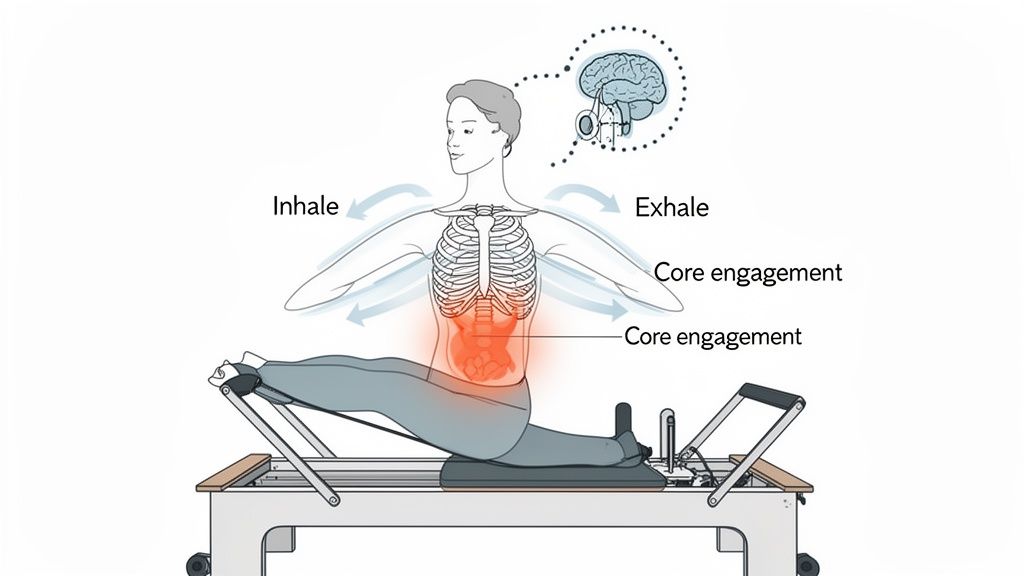
When you're new to the reformer, it's easy to focus only on the big movements. But how you breathe is just as critical as how you move—if not more. Most of us go through our day with shallow chest breathing that only uses the top of our lungs. In Pilates, we retrain that pattern with lateral breathing, your secret weapon for maintaining deep core stability.
Here’s how to think about it: as you inhale, imagine your rib cage expanding out to the sides and back, like an accordion. This engages the intercostal muscles between your ribs. This technique allows you to fill your lungs completely without letting your belly puff out, which would release the tension in your deep abdominal wall. It's this breath that keeps your Powerhouse engaged and your spine supported.
Syncing Breath With Movement
Once you've got the feel for lateral breathing, the next step is to sync it up with your movements. The golden rule is simple but powerful: exhale on the effort (concentric contraction), inhale on the return (eccentric contraction).
- During Footwork: As you press the carriage away (the effort), give a forceful exhale through pursed lips. Use that breath to deepen the contraction of your transversus abdominis and glutes. As you control the carriage back home, take a slow, deliberate inhale, feeling the ribs expand laterally.
- During The Hundred: This is the famous exception! Here, the breath is quick and percussive—five sharp inhales through the nose, five sharp exhales through the mouth—to create and sustain intra-abdominal pressure and endurance.
A powerful exhale helps you recruit your deepest core muscle, the transversus abdominis. Think of it as a natural corset that cinches your waist and stabilizes your entire lumbo-pelvic region from the inside out. You can dive deeper into the nuances by exploring different breathing techniques for Pilates and see what resonates with your body.
Awakening Your Mind-Muscle Connection
This conscious breathing leads directly to what we call the mind-muscle connection—the act of intentionally feeling the specific muscles you're meant to be working. It's the difference between just pushing the carriage away and truly feeling your glutes initiating that hip extension. This intentional focus on neuromuscular pathways is what makes every Pilates movement so effective.
The mind-muscle connection is your internal GPS for movement. Without it, you’re just going through the motions. With it, every repetition has a clear purpose and destination.
The data backs this up. In North America, 45% of new Pilates students are beginners between 35-55 years old who see an average 18% improvement in muscle tone in just 10 weeks of reformer work. A staggering 92% of beginners report feeling stronger after completing a program, and that's largely because this method prioritizes form and neuromuscular connection over simply fatiguing muscles.
So, What Comes After Your First Workout?
You did it. You finished your first reformer workout, and that's a huge accomplishment! The real magic, though, happens next. It's about turning that one session into a consistent practice that builds lasting strength and mobility.
Progressing safely isn’t about immediately jumping to heavier springs or trying the most complicated moves you’ve seen online. Real, sustainable progress is made through small, intentional adjustments that challenge your body without ever sacrificing the precise biomechanics you’ve just started to learn.
It all comes down to consistency. To make Pilates a real part of your life and keep showing up for yourself, it helps to understand the art of building healthy habits that actually stick. It’s this commitment that gives your neuromuscular system the time it needs to adapt and build true functional strength.
Tune In and Listen to Your Body
Your body is constantly giving you feedback, and learning to interpret these signals is the most important skill you can develop in Pilates.
Feeling a deep, warm sensation in your glutes or a gentle burn in your abdominals? That's your "aha!" moment—a sign your nervous system is successfully connecting with the target muscles. But sharp pain in a joint, like your lower back or knee, is a stop sign. It's your body's way of saying, "Hey, this alignment is causing strain, let's modify."
This awareness is what keeps you safe and ensures you're building balanced strength, not reinforcing faulty movement patterns. For example, if you feel your hip flexors (iliopsoas) taking over during an ab exercise, it's a signal that your deep abdominals have fatigued. That's your cue to modify the movement, not to force it with poor form.
Smart Ways to Level Up Your Practice
Adding more springs is often the least important way to progress, especially when you're starting out. Here are a few much more effective ways to safely increase the challenge:
- Master the Return. Instead of letting the springs pull you back in, focus on slowing down the return of the carriage. This is called an eccentric contraction—where the muscle lengthens under tension—and it's an incredibly powerful way to build deep strength and control. In Footwork, for instance, try taking twice as long to bring the carriage home (eccentric phase) as you did to press it out (concentric phase).
- Expand Your Range of Motion (Without Wiggling!). In an exercise like Leg Circles, see if you can make the circle a tiny bit larger while keeping your pelvis absolutely immobile. This challenges your deep core stabilizers, like your obliques and transversus abdominis, to work harder isometrically to prevent any pelvic tilt or rotation.
True advancement in Pilates isn't measured by the color of the spring you're using. It's measured by the depth of your connection to the movement and the precision with which you execute it.
Ultimately, your next workout is all about building on the foundation you just laid. Pay attention to what felt solid and what felt wobbly. This feedback is your personal roadmap, guiding you toward a practice that feels both sustainable and incredibly rewarding.
Got Questions? We've Got Answers
Starting something new always brings up a few questions. When it comes to your first beginner Pilates reformer workout, it's totally normal to wonder what's what. Getting the "why" behind the movements not only builds your confidence but helps you connect with your body on a deeper level. Let's tackle some of the most common questions I hear from new clients.
How Often Should I Be Doing This As a Beginner?
I always tell my new clients to aim for 2-3 sessions a week. That’s the sweet spot. It gives your neuromuscular system the perfect rhythm of work and recovery.
Think of it this way: during workouts, you create micro-tears in your muscles. The rest days are when your body repairs and builds stronger, leaner muscle tissue. It also gives your brain time to consolidate motor learning, building the muscle memory you need to automatically fire up deep stabilizers like your transversus abdominis.
Is It Normal to Feel Shaky During the Exercises?
Absolutely! In fact, shaking is usually a fantastic sign. It means you're activating deep, intrinsic stabilizer muscles that may have been underused in other forms of exercise.
These trembles occur as your nervous system learns to recruit these muscle fibers efficiently to control the unstable surface of the moving carriage. As long as there's no pain, it just means you've found your neuromuscular edge—and that's where true strength is built. If the shaking feels overwhelming, simply reduce your range of motion or lighten the springs until you regain control.
Shaking isn't weakness; it's your deep core waking up and getting stronger. Every little tremble is a sign of progress, so embrace it!
Can I Do Reformer Workouts If I Have Back Pain?
For many people with non-acute back pain, Pilates can be a game-changer. That's because it focuses on strengthening the deep core musculature—the transversus abdominis, multifidus, pelvic floor—which forms a natural supportive corset for your lumbar spine.
The reformer provides a supportive, low-impact surface to safely strengthen these muscles and teach proper movement patterns like maintaining a neutral spine. That said, you absolutely must get clearance from your doctor or physical therapist first. And the golden rule is to always listen to your body—stop immediately if you feel any sharp or radiating pain.
Ready to build a strong, intelligent, and sustainable Pilates practice from home? The WundaCore collection, designed by celebrity trainer Amy Jordan, provides the tools and expert guidance you need. Explore our patented props and start your journey with Wunda On Demand today. Learn more at https://wundacore.com.