
Breathing techniques for pilates: Unlock Core Stability and Movement
Let's be honest, in most workouts, the instruction to "just breathe" feels like a total afterthought. But in Pilates, breathing isn't a suggestion—it's the engine. It’s the foundational principle that powers every single movement you make.
From a purely anatomical standpoint, the breath is the non-negotiable link between your nervous system and your musculoskeletal system, turning simple exercises into deeply effective, core-strengthening work.
The Hidden Engine Behind Every Pilates Movement
We're not just talking about getting oxygen into your lungs. Proper Pilates breathing is a sophisticated method for creating and managing intra-abdominal pressure. Think of it as a dynamic, natural corset that stabilizes your spine from the inside out. This technique specifically targets and awakens the deep core musculature—like the transverse abdominis and multifidus—which often lie dormant in our day-to-day lives.
From Contrology to Modern Practice
This intense focus on the breath comes straight from our founder, Joseph Pilates. He built his entire method, which he originally called "Contrology," around six core principles, and breathing was right at the center.
While interned during World War I, Pilates trained others using these precise, breath-controlled movements. He famously credited his breathing and oxygenation techniques for building lung capacity and immunity, noting that none of his trainees fell victim to the devastating 1918 influenza epidemic.
Why Lateral Breathing is Different
The specific technique we focus on is lateral breathing, also known as intercostal breathing. Anatomically, this is different from how you're likely breathing right now. Most of us are either "chest breathers" (using accessory muscles in the neck and shoulders) or "belly breathers" (allowing the abdominal wall to fully distend), both of which can create unwanted tension or completely disengage the core.
Let's quickly compare the three primary breathing styles to see why the Pilates approach is so unique from a biomechanical perspective.
Three Primary Breathing Styles Compared
| Breathing Style | Primary Muscles Used | Effect on Core | Best For |
|---|---|---|---|
| Chest Breathing | Scalenes, Sternocleidomastoid, Upper Trapezius | Disengaged, can create cervical tension | Inefficient, often a stress response |
| Diaphragmatic (Belly) | Diaphragm, Relaxed Abdominals | Abdominal wall fully relaxes & distends | Relaxation, activating the parasympathetic nervous system |
| Lateral (Pilates) | Diaphragm, Intercostals, Transverse Abdominis | Stays engaged and stabilized | Core-based exercise, supporting the spine |
As you can see, lateral breathing is the only style that allows for deep diaphragmatic action while keeping the abdominal wall actively engaged. This is the anatomical key to maintaining spinal stability during dynamic movements.
This technique ensures your core stays braced and active, providing the stability needed for precise, controlled movements. It also has a profound effect on your alignment. After all, a supported core is essential for great posture.
By focusing on the breath, you turn your attention inward, creating a powerful mind-body connection. It stops you from just 'going through the motions' and forces you to be present and controlled.
Beyond the physical benefits, mastering your breath is a powerful wellness tool, offering further strategies for inner calm and stress relief. This intense focus is what makes the practice so effective, turning each session into a moving meditation that strengthens you from the inside out.
The Anatomy of a Powerful Pilates Breath
To really get a handle on Pilates breathing, you need to understand the biomechanics happening inside your body. It's not about just following commands; it’s about feeling a deep, anatomical connection. Forget the dry textbook diagrams—this is about understanding the why behind every cue so you can visualize and activate the right muscles at the right time.
Think of your respiratory system and core as a finely tuned team of muscles. When one part contracts correctly, it signals the others to co-contract, creating a wave of stability and power that starts deep within your torso.
Your Primary Breathing Muscle: The Diaphragm
The main character in our anatomical story is your diaphragm. It’s not just passive tissue; it’s a powerful, dome-shaped muscle that sits at the base of the ribcage, separating the thoracic cavity (housing the heart and lungs) from the abdominal cavity. When you inhale correctly, this dome contracts, flattens, and descends, creating a vacuum that pulls air deep into the lower lobes of your lungs.
This downward movement is everything. It gently massages your visceral organs and maximizes your lung capacity. Most importantly, it creates space without forcing your belly to bulge out, which would disengage your deep abdominal muscles. On an average day, most of us only use about 30% of our diaphragm's full range of motion, falling back on shallow chest breathing instead.
The Ribcage and Your Intercostal Muscles
This is where Pilates breathing really sets itself apart. While your diaphragm moves down, your intercostal muscles—the small muscles nestled in the spaces between each rib—get to work. They are the stars of what we call lateral breathing.
On an inhale, the external intercostals contract to lift and expand your ribcage outward (laterally) and backward (posteriorly), like an accordion opening. This is that "lateral" expansion you always hear about in class. It allows your lungs to fill completely while keeping your deep abdominal muscles engaged and stable, something you just can't do with simple belly breathing where the abs relax and distend.
This concept map shows how the lungs are the central hub, connecting the mind, body, and spine through controlled breath.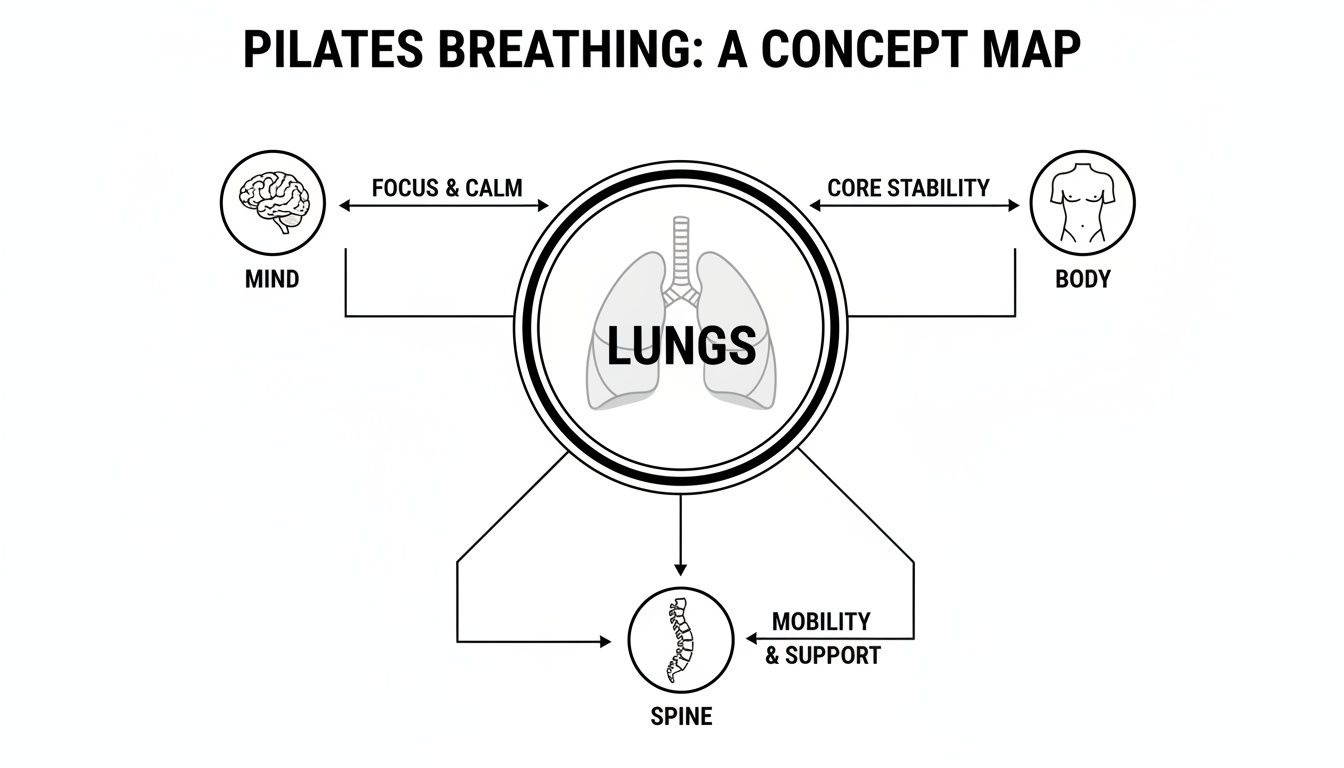
This visual really drives home that Pilates breathing isn't just a physical act. It's an integrative practice that sharpens mental focus and builds spinal support from the inside out.
The Deep Core Canister Connection
Now, let's connect that breath to your core's "inner unit," which we often visualize as a canister. This system includes four key muscle groups that must work in perfect synergy to stabilize the spine.
- The Diaphragm (The Lid): As we just covered, this muscle forms the top of your core canister, initiating the pressure changes with each breath.
- The Transverse Abdominis (The Walls): This is your deepest abdominal muscle, with fibers running horizontally like a natural corset that wraps around your entire midsection. On a forced exhale, the TVA contracts and cinches inward, increasing intra-abdominal pressure and providing crucial lumbo-pelvic stability.
- The Multifidus (The Back Support): These small but mighty muscles run along the spine from vertebra to vertebra, providing segmental stability. They co-contract with the TVA.
- The Pelvic Floor (The Base): This group of muscles forms the sling-like foundation of your core. It works in synergy with the diaphragm, gently lifting on the exhale and relaxing on the inhale.
When you exhale through pursed lips in Pilates, you create gentle back pressure that encourages the transverse abdominis and pelvic floor to engage automatically. This builds a strong, stable cylinder from within.
This coordinated effort, or co-contraction, is what protects your spine and generates true, deep core strength. Interestingly, these same anatomical principles are used in other wellness practices. If you want to explore the broader applications of conscious breath control, you can learn about other effective breathing techniques for anxiety attacks that also rely on this deep mind-body connection.
The Pelvic Floor's Essential Role
The pelvic floor is often the missing piece of the puzzle for many people. It's the literal foundation of your core, and its connection to the diaphragm is profound and neurological. On a proper inhale, as the diaphragm descends and increases intra-abdominal pressure, the pelvic floor should eccentrically load, meaning it gently lengthens and relaxes to accommodate the pressure change.
Then, on the exhale, as the diaphragm rises back up, the pelvic floor should subtly lift and concentrically contract right along with the TVA. This teamwork is fundamental for stability, especially during exercises that challenge your lower body and core. Understanding this relationship is so vital that we have specific guidance on how to strengthen your pelvic floor to support your entire Pilates practice.
By visualizing these anatomical players—the descending diaphragm, the expanding ribs, the cinching TVA, and the responsive pelvic floor—you move beyond simply following instructions. You begin to embody the principles, transforming your breath from an automatic function into your most powerful tool for control and precision.
Learning to Feel Your Lateral Breath
Knowing the anatomy behind a powerful Pilates breath is one thing, but actually feeling it in your own body? That’s where the magic really happens.
Most of us go through our day with tense shoulders and shallow breathing, so retraining this fundamental neuromuscular pattern takes some patience and awareness. This is your chance to connect the theory to your actual practice, turning abstract concepts into physical cues you can feel and control.
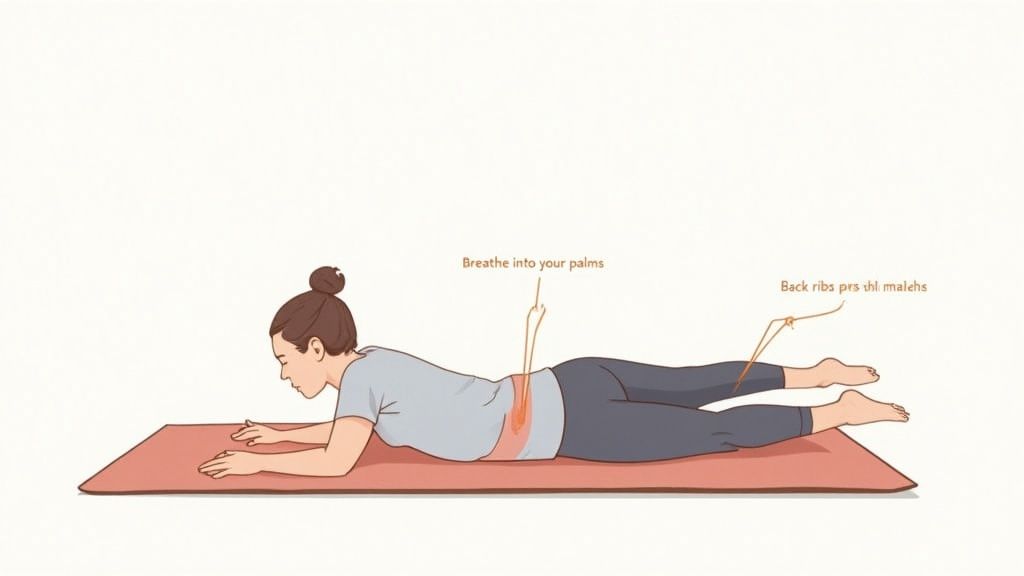
Finding Your Breath on the Mat
The easiest way to feel lateral breathing for the first time is to take gravity out of the equation. Lying supine gives you a stable, supportive surface so you can tune everything else out and focus completely on the sensation of your breath.
Find a comfortable spot on your back. Bend your knees (hook-lying position) and place your feet flat on the floor, about hip-width apart. Let your spine rest in neutral, maintaining that small, natural lordotic curve in your lumbar spine. Now, place your hands on the sides of your ribcage—fingertips wrapping slightly toward the front, thumbs toward the back.
Take a slow, smooth inhale through your nose. Instead of letting your belly pop up (which indicates abdominal disengagement) or your chest lift (which indicates use of accessory breathing muscles), direct the air into the lateral and posterior aspects of your ribcage. Your main cue here is to breathe into your palms, feeling your ribs expand out to the sides and press down into the floor beneath you.
Refining the Inhale and Exhale
The quality of your breath cycle is everything. A smooth, controlled breath ensures your deep core muscles stay switched on and supportive through every single Pilates movement.
-
The Inhale: Focus on a smooth inhalation through your nose for a count of three or four. Breathing through your nose warms and filters the air, encouraging deeper diaphragmatic action. Feel those external intercostal muscles working to widen your ribcage like an accordion.
-
The Exhale: Breathe out through gently pursed lips, like you’re slowly blowing through a straw. This pursed-lip technique creates a bit of back-pressure (positive end-expiratory pressure, or PEEP) that helps you find and engage your transverse abdominis and internal intercostals, which assist in forced exhalation. As you exhale, feel your ribs knitting back together as your deep abs gently cinch your waist.
This focus on thoracic breathing is the bedrock of movement control, a principle Joseph Pilates himself wrote about in his 1945 book, Return to Life Through Contrology. He argued this specific method cleanses the bloodstream by expelling up to 99% of stale air from the lungs. That's a huge difference from the 10-20% we typically expel with shallow breathing. As this concept evolved over the years, it also integrated the pelvic floor, which has been shown to significantly boost pelvic stability for so many practitioners. If you're curious about the history, you can learn more about the importance of breathing in Pilates from the perspective of early practitioners.
Progressing to New Positions
Once you've got the hang of lateral breathing on your back, it's time to see how gravity changes the game. Moving into different positions challenges your core and breathing muscles in new ways, helping you build a more resilient and adaptable breath pattern.
Start by coming to a comfortable seated position, either cross-legged or on a chair with your feet flat on the floor. Place your hands on your ribs again and repeat the exercise. You might notice it feels a bit tougher to get that sideways expansion without the floor to press into. This is good! It forces your deep postural muscles, like the multifidus and erector spinae, to work harder to maintain an erect spine while you breathe.
Next, try it on all fours (quadruped), with your hands under your shoulders and your knees under your hips. In this position, you can really send your breath into your posterior ribcage. As you inhale, feel your back expand and lift toward the ceiling, creating width across your scapulae. It’s a fantastic way to mobilize the thoracic spine and release tension in the upper back.
Pro Tip: For a game-changing sensory experience, try wrapping a resistance band snugly around your lower ribs. As you inhale, your goal is to push the band outward in all directions—to the sides and into your back. This proprioceptive feedback gives you clear, undeniable information that often makes the lateral breathing technique finally click.
By practicing these simple, sensory-focused exercises, you’ll develop a deep, intuitive feel for one of the most important breathing techniques for Pilates. This foundation turns your breath into a powerful tool for stability, control, and focus—not just in your workouts, but in your daily life, too.
Syncing Breath With Foundational Pilates Exercises
Alright, now that you can actually feel your lateral breath, it's time to put it to work. We're moving beyond just practicing the breath in isolation and weaving it into some classic Pilates movements. This is where the biomechanics become dynamic. You’ll quickly discover that the breath doesn't just go along for the ride—it drives the exercise, making every single move safer, deeper, and way more effective.
The universal principle here is simple but incredibly powerful from an anatomical standpoint: exhale on the effort (concentric phase) and inhale on the release (eccentric phase). Think about it: when you flex, twist, or lift against gravity, you exhale to deepen the co-contraction of the transverse abdominis and pelvic floor. When you lengthen, extend, or return to your starting position, you inhale to create space and prepare for the next muscular engagement. This rhythm isn't random; it's smart biomechanics at its best.
The Hundred: Percussive Breathing
The Hundred is probably the most iconic Pilates exercise out there, and its unique breathing pattern is what makes it so potent. It uses what we call percussive breathing—a series of short, sharp, rhythmic breaths.
The pattern is typically five quick inhales through the nose, followed by five quick exhales through the mouth. You do all this while holding an abdominal curl (thoracic flexion) and pumping your arms. This rapid air exchange does a few amazing things:
- It builds a ton of internal heat and increases circulation.
- It forces your transverse abdominis to stay isometrically contracted to stabilize your torso against the rapid pressure changes.
- It seriously improves your respiratory stamina and efficiency, a huge goal for Joseph Pilates.
Think of it as high-intensity interval training for your diaphragm and intercostals. Those quick, forceful exhales act like mini crunches for your deep core, reinforcing lumbo-pelvic stability with every single count.
The Roll Up: Coordinating Breath and Spinal Articulation
The Roll Up is the perfect showcase for how breath can guide your spine through flexion and extension. When you master the breath, this notoriously tricky exercise becomes a much smoother and more controlled articulation of the vertebral column.
As you start to roll up from the mat, you initiate a deep, forceful exhale. This move instinctively engages your transverse abdominis and pelvic floor, creating a supportive "cinch" around your middle that helps you peel your spine off the floor, one vertebra at a time, avoiding the use of the hip flexors (like the psoas) as the primary movers. Exhaling during this intense flexion protects your lower back by preventing abdominal doming.
Once you reach forward over your legs for the stretch, you inhale to find axial length in your spine. Then, you initiate the roll down with another long, controlled exhale, using your abdominals as brakes to eccentrically lower your spine back down.
This deliberate pairing of breath with movement turns the Roll Up from a jerky, momentum-based struggle into a controlled display of abdominal strength and spinal mobility.
Cat-Cow: Simple Breath for Spinal Health
Cat-Cow is a beautiful, foundational movement that perfectly illustrates the connection between breath and spinal movement. It’s a simple exercise, but it's the breath that makes it so restorative for mobilizing the spine.
- Inhale for Cow: As you drop your belly and lift your chest and tailbone (spinal extension), take a full inhale. This breath helps expand your chest and lengthen the rectus abdominis, encouraging a healthy extension through the thoracic and cervical spine.
- Exhale for Cat: As you round your spine, tuck your tailbone, and press the floor away (spinal flexion), you let out a complete exhale. This helps you pull your navel up and in toward your spine, deepening the abdominal contraction and maximizing the stretch through the erector spinae muscles.
The breath acts as a pacer here, making sure you move through your full range of motion without rushing. This deliberate sequence is one of the safest and most effective ways to get your thoracic spine (your mid-back) moving.
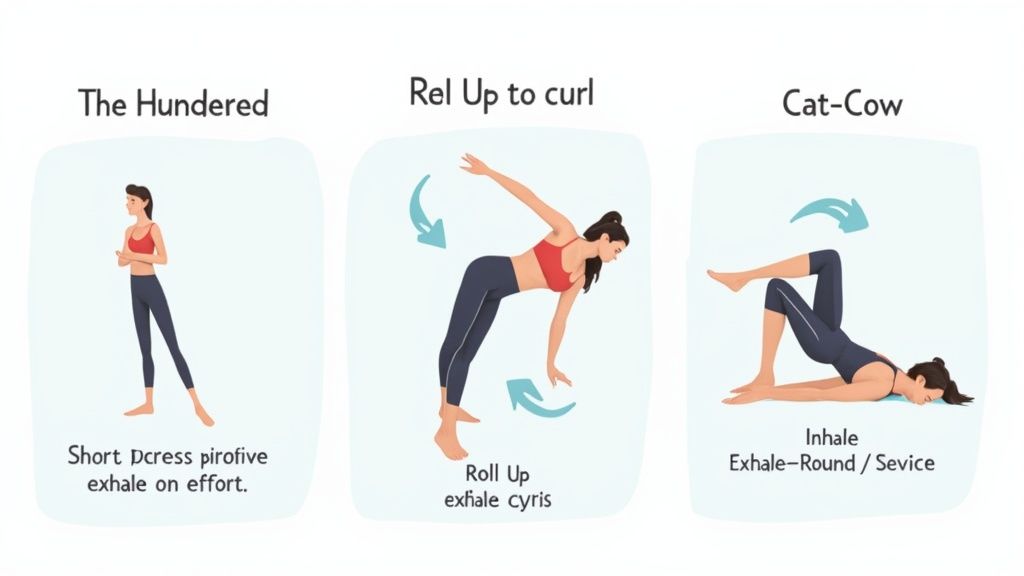
To help you put this all together, here’s a quick reference guide for how the breath works in these key movements.
Breath Patterns for Foundational Pilates Exercises
| Exercise | Inhale Action | Exhale Action | Primary Anatomical Goal of Breath |
|---|---|---|---|
| The Hundred | 5 short, sharp inhales through the nose | 5 short, sharp exhales through the mouth | Build heat, stamina, and maintain deep core stabilization |
| The Roll Up | While stretching forward (axial extension) and preparing to roll down | During spinal flexion (rolling up) and controlled spinal extension (rolling down) | Support the spine and deepen core engagement during flexion |
| Cat-Cow | During spinal extension (Cow Pose) | During spinal flexion (Cat Pose) | Guide and deepen the spinal articulation for mobility |
Remembering these patterns will help you get so much more out of every rep. If you’re ready to apply these same principles to other movements, you can explore more fantastic Pilates exercises for core strength that rely on this powerful breath-to-movement connection.
Common Breathing Mistakes and How to Fix Them
Even with the best of intentions, it’s all too easy to revert to suboptimal breathing patterns during a Pilates session. Correcting your breath is about rewiring neuromuscular habits for better stability, control, and power. Nailing down these common mistakes is the key to making your practice safer and more effective.
The biggest culprit is shallow chest breathing. This is when you use your accessory breathing muscles—the scalenes in your neck and the upper trapezius in your shoulders—to lift your chest for an inhale. Instead of your ribcage expanding laterally, your shoulders elevate toward your ears. This creates significant tension in the cervical spine and robs your deep core of its stabilizing role.
Another major one is breath-holding. When an exercise becomes challenging, our first instinct is often to hold our breath and brace. This is called the Valsalva maneuver, and it dramatically increases intra-abdominal and blood pressure. For anyone with cardiovascular conditions like hypertension, this can be risky, making a smooth, continuous breath non-negotiable for safety.
Pinpointing and Correcting Bad Habits
The first step is always proprioceptive awareness. You can't fix what you can't feel.
A quick mirror check is a great place to start. Stand sideways and watch your reflection as you inhale. Do your shoulders lift? If they do, you're likely defaulting to chest breathing.
To fix this, return to the foundational supine position on the mat:
- Lie on your back, knees bent, feet flat.
- Place your hands on the sides of your lower ribs.
- As you breathe in through your nose, actively keep your shoulders and neck relaxed, feeling them press gently into the mat.
- Focus all your attention on sending that breath into the lateral and posterior aspects of your ribcage, feeling that 360-degree expansion.
If breath-holding is your default, the solution is to decrease the load of the exercise. Reduce the range of motion or the spring tension until you can maintain a steady, even breath. Think of your breath as your physiological monitor—if you lose it, you've lost the core stability the exercise is designed to build.
The goal isn't just to move through an exercise, but to breathe through it. A steady, rhythmic breath indicates that your deep core system is online and supporting you, rather than using superficial muscle tension to get the job done.
Modifying Your Breath for Life's Stages
A truly smart Pilates practice adapts with you, and your breath is ground zero for that adaptability. Your breathing strategy needs to shift during different life stages or with certain health conditions. This isn't about doing less; it's about breathing with more intelligence.
Pregnancy Considerations
During pregnancy, managing intra-abdominal pressure is crucial. A hard, forceful exhale or holding your breath can put excessive strain on the pelvic floor and the linea alba (the connective tissue along the midline of the abdomen that can separate, causing diastasis recti).
The go-to modification here is often called the "blow before you go" technique.
- Initiate with Breath: Start your exhale just before you begin the concentric (effort) phase of the movement.
- Gentle Exhale: Instead of a sharp, pursed-lip breath, use a softer, audible "haaa" sound. This helps engage the transverse abdominis without generating excessive downward pressure.
- Monitor Doming: Always keep an eye on your abdomen. If you see any "coning" or "doming" along the midline, it’s a sign that the intra-abdominal pressure is too high for the linea alba to manage.
Menopause and Breath Control
For many women, menopause can bring on feelings of anxiety and a heightened sympathetic nervous system ("fight or flight") response. This is where your breath becomes a powerful tool for nervous system regulation. Controlled, diaphragmatic breathing has been proven to activate the vagus nerve and stimulate the parasympathetic ("rest and digest") response.
By weaving mindful, deep lateral breaths throughout your Pilates practice, you can actively manage stress, improve sleep, and create a sense of calm. The focus shifts from forceful engagement to smooth, calming rhythms. This turns your Pilates session from just a workout into a truly restorative practice for both your body and mind.
Your Top Questions About Pilates Breathing, Answered
Once you start trying to put all this breathing theory into practice, the real questions pop up. It’s one thing to read about lateral breathing, and a whole other thing to actually do it during a challenging series. Here are the most common questions I hear from clients, broken down with simple, anatomical answers to help you get it right on the mat.
Is It Okay to Breathe Through My Mouth?
The classic cue is to inhale through your nose and exhale through pursed lips, and for good reason. Inhaling through the nose (nasal breathing) is a built-in filtration system—it warms, filters, and humidifies the air, and it has been shown to encourage deeper diaphragmatic action.
But let's be realistic. If you're congested or just find nasal breathing difficult, mouth breathing is acceptable. The most important rule is to keep the breath flowing continuously. Don't hold it. The quality and control of your breath and the engagement of the correct musculature matter far more than the entry point of the air.
Why Do I Feel Dizzy or Lightheaded Sometimes?
This is incredibly common, especially when you first start focusing on such specific, deep breathing. That dizzy feeling is usually just a sign that you're either breathing a little too forcefully (altering your CO2-O2 balance) or simply providing your body with more oxygen than it's accustomed to.
If it happens, just pause. Stop the exercise for a moment and go back to your normal, easy breathing pattern until the sensation passes. As your body adapts and your respiratory muscles get stronger and more efficient with practice, this feeling almost always goes away.
How Does Pilates Breathing Affect My Pelvic Floor?
This is a fantastic question, and the answer is at the very heart of deep core biomechanics. Your diaphragm and your pelvic floor are designed to work together in a synergistic, piston-like rhythm.
- When you inhale: Your diaphragm contracts and descends. This increases intra-abdominal pressure, which naturally encourages your pelvic floor muscles to eccentrically load (gently lengthen and relax) to accommodate the pressure.
- When you exhale: Your diaphragm relaxes and lifts back up. This provides a subtle, automatic cue for your pelvic floor to concentrically contract (lift and engage), right along with your deep abdominal muscles (the transverse abdominis).
Mastering this rhythm is a game-changer for managing internal pressure, supporting your pelvic organs, and building true core stability from the inside out.
Think of your breath as the remote control for your pelvic floor. A proper, full Pilates exhale is one of the most effective ways to consciously connect with and strengthen these deep stabilizing muscles without clenching or straining.
What if I Can’t Feel My Ribs Expanding Sideways?
Don't worry, you're not alone! This is probably the biggest hurdle for new practitioners. Most of us have spent a lifetime breathing "vertically"—lifting our chest and shoulders up and down. Developing the proprioception to breathe "horizontally" into the sides and back of your ribcage takes time.
Your best friend here is tactile feedback. Grab a resistance band or even a long scarf and wrap it snugly around the base of your rib cage. Now, as you inhale, your only job is to feel that band stretch. Focus on expanding not just laterally, but posteriorly as well. This simple prop gives your nervous system the physical cue it needs to finally make that mind-body connection.
Ready to feel this in your own body with expertly guided workouts? The WundaCore collection, along with our patented props and Wunda On Demand classes, is designed to help you build that deep strength from the inside out. Explore our equipment and start your journey to a stronger, more connected practice today.