
Best Workout Equipment for Bad Knees: best workout equipment for bad knees
The very best workout equipment for bad knees has one thing in common: it’s all low-impact. Think recumbent bikes, ellipticals, and smart Pilates-based tools that build strength without pounding on your joints.
This kind of equipment is designed to reduce stressful forces while building up the very muscles that act as a natural brace for your knees. Ultimately, the right gear helps you stay active while protecting your joint's delicate structure.
Why Your Knees Hurt and How the Right Exercise Can Help
Before you can pick the right equipment, you have to understand the 'why' behind the pain. The knee is a complex hinge joint, but its main job is pretty simple: bend, straighten, and bear your weight. For it to work correctly, a whole team of interconnected parts needs to be in perfect harmony.
Think of your cartilage as the smooth, slick cushion between your thigh bone (femur) and shin bone (tibia). It’s a natural shock absorber that lets the bones glide over each other without any friction. But when that cushion starts to wear down from an old injury or a condition like osteoarthritis, the bones can begin to rub together. That’s where you get the pain, stiffness, and inflammation.
The Knee's Natural Support System
Now, ligaments like your ACL and MCL are like strong ropes that strap the bones together, keeping everything stable and preventing weird twists. But the real unsung heroes of knee health? The muscles that surround the joint.
Imagine the muscles in your legs—your quadriceps (front of the thigh), hamstrings (back of the thigh), and glutes (your backside)—as a living, dynamic brace. When these muscles are strong and switched on, they absorb the bulk of the impact from walking, climbing stairs, or just about any other movement. This muscular brace takes an immense amount of pressure off the knee joint itself.
When your support muscles are weak, your knee joint is forced to take on forces it was never designed to handle alone. This is often the root cause of chronic pain and further joint degradation.
Weak glutes and quads can throw your alignment out of whack, causing your knee to track improperly. This is a bit like driving a car with poorly aligned tires—eventually, the tread wears out unevenly, and you’re headed for trouble. That same uneven stress on your cartilage accelerates its wear and tear.
Turning Movement into Medicine
High-impact activities like running or jumping can feel like a jackhammer on sensitive knees. That repetitive pounding sends shockwaves right through the joint, irritating any damaged cartilage and inflaming the surrounding tissues.
This is exactly where the right kind of exercise becomes your most powerful tool.
Low-impact, controlled movement does the complete opposite. It’s all about strengthening that muscular brace without the damaging impact. Here’s how it works:
- It builds your natural brace: Targeted exercises fire up your quads, hamstrings, and glutes, creating a robust support system that stabilizes the knee and soaks up shock.
- It lubricates the joint: Gentle movement gets the synovial fluid circulating. Think of it as the joint's natural WD-40, helping to reduce stiffness and improve your range of motion.
- It reduces inflammation: Consistent, low-impact activity can help dial down chronic inflammation, which is a primary source of pain in conditions like arthritis.
Understanding this relationship between your muscles and joints empowers you to make smarter choices. Your goal isn't just to find any piece of equipment; it's to find the tools that help you build this protective muscular brace safely. This is your first step toward transforming exercise from something you fear into a real solution for long-term joint health.
The Top Low-Impact Cardio Machines For Joint Health
When your goal is to get your heart pumping without punishing your knees, the right cardio machine can be a total game-changer. The secret is finding equipment that guides you through a smooth, controlled motion, letting you build cardiovascular endurance while truly protecting your joints. It's about looking past a simple features list and really understanding how each machine works with your body.
The best options are designed to minimize impact from the get-go, taking the load off your body and guiding your limbs through a safe, predictable path. We'll compare three of the most effective choices: recumbent bikes, ellipticals, and rowing machines. Each one brings something different to the table, depending on your fitness level and what your body needs.
Recumbent Bikes: Your Seated Solution for Knee Protection
A recumbent bike is almost always the first recommendation for anyone dealing with significant knee pain, and for very good reason. The design is a world away from a typical upright bike. You’re in a reclined, seated position with the pedals out in front of you, which is a massive biomechanical win for sensitive knees.
By sitting back, the machine supports your entire body weight. This immediately removes the compressive load that activities like walking or even standing can put on your knee joints. The pedaling motion is a clean, circular pattern that strengthens your quadriceps and hamstrings—the crucial support system for your knees—without any stressful downward force.
The reclined posture of a recumbent bike helps reduce shear forces on the patella (kneecap) and provides a highly controlled environment to build leg strength, making it an ideal starting point for many rehabilitation and fitness journeys.
This controlled movement is exactly what you need to strengthen the muscles that act as a natural brace for the joint. As the diagram below shows, a healthy knee is all about teamwork between strong muscles and resilient cartilage.
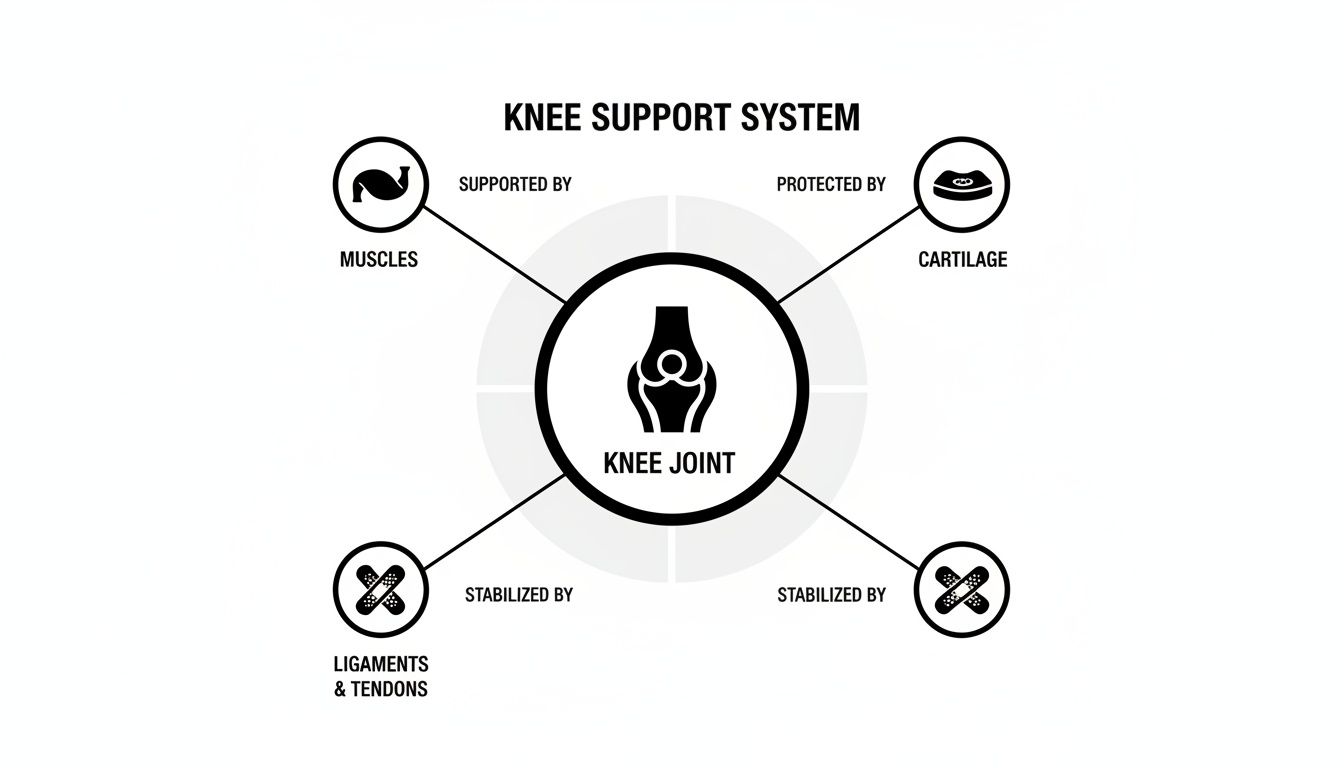
Recumbent bikes let you focus on strengthening the muscular side of that partnership in the safest way possible.
Ellipticals: Gliding Motion Without the Ground Impact
If you miss the feeling of running or walking but can't handle the impact, the elliptical trainer is your best friend. This machine guides your feet through an oval-shaped path, but the magic is that your feet never leave the pedals. This completely eliminates the jarring shock of each footstep.
This continuous gliding motion delivers a fantastic cardio workout that engages your quads, hamstrings, glutes, and even your upper body if you use the moving handlebars. It’s important to remember, though, that while ellipticals are zero-impact, they are still a weight-bearing exercise. You're standing the whole time, which is great for bone density but does mean your knees are supporting your body weight.
For many people, this is the perfect middle ground. You get a more intense, full-body workout than a recumbent bike while still being incredibly gentle on your joints compared to a treadmill.
Rowing Machines: Full-Body Power, With Proper Form
Rowing machines offer a powerful, low-impact workout that targets over 85% of your body's muscles, hitting everything from your back to your glutes and hamstrings. While it's a phenomenal tool for both cardio and strength, it requires a little extra attention to form to keep it knee-friendly.
The rowing stroke involves a deep knee bend during the "catch" phase. When you do it right, the power comes from pushing through your heels and driving with your legs and glutes—which is fantastic for building up those key knee-support muscles. The movement is smooth and fluid with zero impact.
The catch? Bad form—like pushing through your toes or letting your knees collapse inward—can put stress on the joint. Because of this, rowers are often a better fit for those with milder knee issues or for people who have already built a solid strength foundation and can hold proper technique. Once you master it, it’s one of the most effective and joint-safe workouts out there.
Comparing Low-Impact Cardio Machines for Knee Safety
To make the choice clearer, let’s break down how these popular machines stack up side-by-side, specifically for those of us keeping our knees in mind.
| Equipment Type | Impact Level | Key Benefit for Knees | Muscles Worked | Best For |
|---|---|---|---|---|
| Recumbent Bike | Zero Impact | Non-weight bearing; fully supports the body to remove all joint compression. | Quads, Hamstrings, Glutes | Significant knee pain, post-rehab, beginners, or building foundational leg strength safely. |
| Elliptical Trainer | Zero Impact | Feet never leave the pedals, eliminating jarring foot strikes; weight-bearing for bone density. | Full Body (Legs, Glutes, Core, Arms) | Moderate knee pain, those who want a running-like workout without impact, full-body conditioning. |
| Rowing Machine | Zero Impact | No-impact, fluid motion that strengthens the entire posterior chain (glutes, hamstrings) to support knees. | Full Body (85% of muscles) | Mild knee pain, those with good form, or anyone seeking a high-intensity, full-body strength and cardio workout. |
Ultimately, the "best" machine is the one that lets you move consistently and without pain. These options are also fantastic for older adults looking for comprehensive fitness; you can learn more about low-impact exercise equipment for seniors in our related guide.
The demand for equipment that meets these specific needs is growing fast. The global home fitness equipment market, valued at USD 13.57 billion in 2026, is projected to hit USD 22.99 billion by 2034. This surge is all about people like you seeking out smart, personalized solutions that fit their bodies and their homes.
Building Functional Strength Without Straining Your Knees
While low-impact cardio is fantastic for your heart and keeping joints lubricated, it’s only half the story. To create truly resilient knees, you need functional strength. Think of it this way: cardio keeps your engine running smoothly, but strength training builds the very frame that supports that engine.
The problem is, for anyone with cranky knees, traditional strength training—like heavy squats or lunges—can feel like piling weight onto an already overloaded system. It often does more harm than good.
This is where a smarter, more anatomy-focused approach changes everything. The goal isn’t to load the knee joint directly. Instead, we want to build a powerful muscular “scaffolding” around it. The real work happens when we strengthen the muscles that control the knee from a distance: your glutes, your hips, and your deep core.
When these powerhouse muscles are strong and switched on, they do the heavy lifting. They guide your leg through a stable path and absorb impact before it ever has a chance to rattle the sensitive cartilage in your knee.
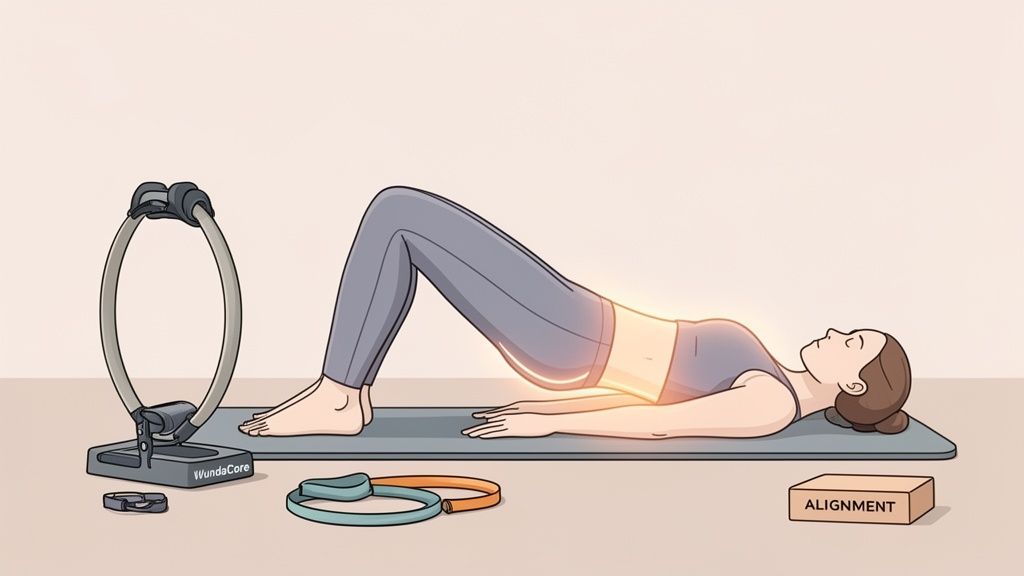
Shifting the Focus from Loading to Activating
Instead of grabbing heavy weights, Pilates-inspired equipment like resistance rings and loops lets you activate and strengthen these crucial support muscles through their full range of motion. It’s an inside-out approach to strength, creating deep stability that you’ll feel in everyday movements like walking, climbing stairs, or getting up from a chair.
This is the entire principle behind the WundaCore system. It’s not designed to just build bigger muscles, but to build smarter, more supportive muscles.
A strong core and activated glutes act as a natural brace for your entire lower body. By training these muscles, you are effectively offloading stress from the knee joint and correcting the movement patterns that may have contributed to your pain in the first place.
This method literally re-educates your body to move more efficiently, making sure the right muscles are firing at the right time. Take a simple bridge exercise with a resistance loop around your thighs. It doesn't just work your glutes; it teaches your body to stabilize your pelvis and stops your knees from caving inward—a common and incredibly damaging movement pattern.
The Role of Precision and Alignment
Building this kind of functional strength is all about precision. It’s not just what you do, but how you do it.
This is where cushioned mats and alignment blocks become so important. They aren’t just accessories; they are tools for ensuring every movement is therapeutic and effective.
Here’s how they directly help your knees:
- Cushioned Mats: A quality movement mat gives you a supportive, non-slip surface that protects your joints from hard floors. Even more importantly, it provides the stability you need to focus on precise muscle engagement without worrying about slipping or feeling uncomfortable.
- Alignment Blocks: Blocks are amazing for maintaining proper form. For example, placing a block between your knees during certain exercises can help fire up your inner thigh muscles and prevent your knees from collapsing, reinforcing correct alignment from the hip down.
These simple tools help you sidestep common form mistakes that put unnecessary strain on the knee. They guide your body into a position where the target muscles—the glutes, core, and hips—are forced to do the work, leaving the knee joint to move freely and without pressure. It’s a foundational strategy for anyone looking for the best workout equipment for bad knees because it addresses the root cause of the instability.
Remember, the goal is to build a body that supports itself from the inside out. For a healthier body and faster metabolism, it’s also a great idea to build more muscle with strength training. By focusing on the anatomy of movement and strengthening the entire support chain, you create stability that lasts.
You can learn more about how to get started by exploring some top choices for resistance training equipment for home. This way, you can ensure every exercise you do is a step toward less pain and more freedom.
How to Choose the Right Equipment for Your Body and Home
Picking the right workout equipment when you have bad knees is about so much more than fancy brands or whatever machine is currently trending. It’s a deeply personal choice, one that has to work for your unique body and the space you actually have at home. When you get this right, every movement feels supportive and healing—not stressful or damaging.
Think of it this way: your body is the blueprint. The perfect piece of equipment should feel like a natural extension of how you move, never forcing your joints into painful, awkward angles. This synergy is non-negotiable for protecting the delicate structures in and around your knee, from the kneecap itself to the ligaments holding everything together.
Aligning Equipment with Your Anatomy
The single most important factor here is adjustability. If a machine can't be dialed in to fit your specific body dimensions, it’s a recipe for trouble. Even a slightly off alignment can put weird, uneven stress on the knee joint, leading to irritation or even a new injury.
Before you even think about buying, ask yourself these crucial questions:
- Can I fully adjust the seat height and position? When you pedal or press, your leg should have a slight, comfortable bend at its furthest point. It should never lock out completely or feel crammed and overly bent.
- Does the machine’s movement path feel natural for my body? It should guide your legs smoothly, without making your knees twist awkwardly or cave inward.
- Is the frame solid and stable? A wobbly machine makes all those little stabilizing muscles around your joints work overtime to compensate, which is a fast track to strain and bad form.
It's like getting a suit tailored versus grabbing one off the rack. The generic one might sort of fit, but the custom-fit one supports you in all the right places. Your knees deserve that same level of personalized support.
Assessing Your Home Environment
Okay, once you’ve thought about your body, it's time to get real about your space. The most incredible, feature-packed machine is completely useless if it just becomes an expensive clothes hanger in a room you never go into. Practicality is everything.
Pull out a tape measure and figure out exactly what you're working with, making sure to account for the machine’s full range of motion. An elliptical, for instance, needs a lot more clearance front-to-back than a simple stationary bike does. As you plan your home gym, it’s also a good idea to think about organization. Exploring smart home gym equipment storage ideas can help keep your workout zone tidy and inviting, making you that much more likely to actually use it.
If you’re tight on space, don't worry. We put together a guide on the best fitness equipment for small spaces that’s full of great, compact options that are still fantastic for joint safety.
The Power of Guided Instruction
Finally, remember that even the best piece of equipment is only as good as the form you use on it. This is where guided workouts become an absolute game-changer. They're like having a virtual personal trainer right there with you, ensuring every single move is safe, effective, and purposeful.
Guided instruction, like the classes on Wunda On Demand, transforms a piece of equipment from a simple tool into a comprehensive training system. Expert coaches teach you proper form, muscle activation, and how to listen to your body, maximizing your investment while protecting your joints.
This expert oversight is especially critical when you're working with sensitive knees. A great instructor will remind you to engage your glutes or keep your knees tracking right over your ankles. These are the small, subtle cues that make the difference between a workout that strengthens you and one that sets you back. It’s how you build a truly resilient body, from the inside out.
Your Weekly Knee-Friendly Home Workout Plan
So you've invested in some great knee-friendly equipment. That's a huge first step. But the gear itself isn't the magic bullet—the real transformation happens when you build a smart, consistent routine around it. A good plan is what turns that equipment into real, lasting results. Let's map out what that looks like.
The key is finding a rhythm that mixes up different types of movement. This is how you avoid overuse injuries while building both heart health and functional strength. Think of it as a one-two punch for resilient knees: one day, you’re doing gentle, steady cardio, and the next, you're waking up those deep support muscles that protect the joint.
This strategy keeps you from hammering the same muscles and movement patterns every single day. It gives your body the time it needs to recover, adapt, and get stronger.
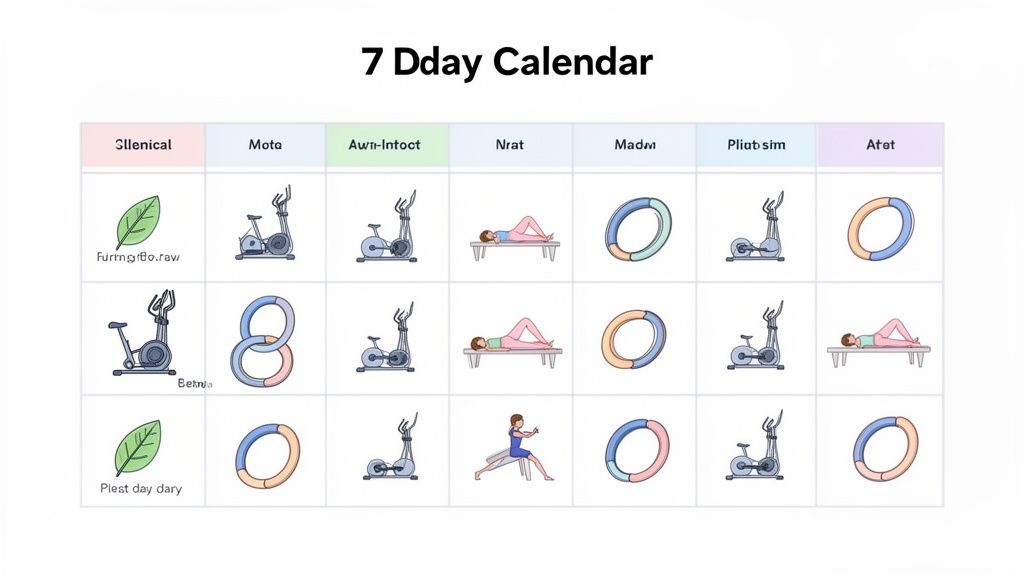
A Sample Week of Knee-Friendly Workouts
Here’s a blueprint for a balanced week. The most important rule? Always listen to your body. A "rest day" doesn't mean gluing yourself to the couch; it means active recovery, like a gentle walk or some light stretching.
-
Monday (Low-Impact Cardio): 20-30 minutes on your elliptical or recumbent bike. Keep the resistance light and focus on a smooth, steady rhythm. The goal is just to get your heart rate up without feeling any joint strain.
-
Tuesday (Functional Strength): A 25-minute Wunda On Demand class that hones in on your glutes and core. Use a resistance loop for exercises like bridges and clamshells to really fire up those crucial hip stabilizers.
-
Wednesday (Active Recovery): 15 minutes of gentle stretching. Give your hamstrings, quads, and calves some love. Back off immediately from any stretch that causes sharp pain in your knee.
-
Thursday (Low-Impact Cardio): Another 20-30 minutes on your cardio machine. Maybe try bumping up the resistance just a tiny bit from Monday, but drop it back down if you feel even a hint of discomfort.
-
Friday (Functional Strength): A 30-minute WundaCore session that targets total-body stability. This is where you’ll incorporate movements that challenge your balance and core, which in turn helps support better knee alignment.
-
Saturday (Active Fun): Get outside for a walk or do something active that you genuinely enjoy. Movement shouldn't always feel like a chore.
-
Sunday (Rest): Full rest or some very light, feel-good stretching. This is when your muscles get to repair and rebuild.
Smart Progression Is Your Best Friend
If there’s one principle to live by, it's smart progression. Seriously, start with shorter workouts and lower intensity than you think you need. Your first goal isn't to break a sweat; it's simply to move without pain. Once you can sail through a week's schedule comfortably, then you can start to gently dial up the challenge.
The rule of thumb for safe progression is simple: change only one thing at a time. Either add five minutes to your cardio session or bump up the resistance by one level—but never both in the same week. This measured approach is your best defense against flare-ups.
This gradual method is how you build a habit that sticks. You’re teaching your body to adapt, slowly strengthening the muscles and connective tissues around your knees. It’s a sustainable approach that reflects a major shift in the fitness world, where more and more people are looking for joint-friendly solutions to stay active. In fact, the market for cardiovascular training equipment is projected to lead this trend through 2032. You can find more insights on this move toward health-conscious fitness equipment on datainsightsmarket.com.
High-Risk Movements to Avoid
Knowing what not to do is just as important as knowing what to do. Certain exercises can put way too much stress on the knee joint, setting you back.
Make sure to steer clear of these common culprits:
- Deep Squats and Lunges: These can put a ton of pressure on your kneecap (the patellofemoral joint).
- High-Impact Jumping: Think jump squats or box jumps. The jarring force is just not worth the risk for sensitive cartilage.
- Exercises with Twisting or Pivoting: Quick, rotational movements can easily strain the ligaments that keep your knee stable.
By sticking to controlled, low-impact movements and sidestepping these high-risk exercises, you’ll build a safe and effective routine that makes your knees stronger, not sorer.
Your Top Questions About Exercising with Bad Knees, Answered
Working out with knee pain can feel confusing, and it's natural to have a lot of questions. Let's clear up some of the most common concerns so you can move forward with confidence and start feeling better in your body.
Should I Exercise If My Knees Are Hurting?
This is the big one, and the answer comes down to knowing the difference between "good" soreness and "bad" pain. Feeling a little fatigue in your thigh or glute muscles after a workout? That’s productive—it’s a sign you’re getting stronger. But sharp, stabbing, or grinding pain deep inside the knee joint itself? That's your body's stop sign.
The golden rule is pretty simple: if it hurts the joint, don’t do it. That said, avoiding all movement isn't the answer. Gentle, pain-free motion is actually one of the best things for your knees. It gets synovial fluid—your joint’s natural lubricant—flowing and boosts blood circulation, which helps dial down stiffness and inflammation.
Before you jump into any new routine, it’s always smart to get a proper diagnosis from a doctor or physical therapist. Issues like arthritis, a meniscal tear, or patellofemoral pain syndrome all need slightly different approaches. The goal is always to work with your body, using controlled movement as a powerful tool for healing, not as a source of more damage.
What Are the Safest Stretches for Tight Knees?
When the big muscles supporting your knee—your quads, hamstrings, and calves—get overly tight, they pull on the joint and throw everything out of alignment. Stretching these muscles is a fantastic way to relieve that pressure and get your mobility back.
The focus should always be on lengthening the muscles around the knee, not on forcing the joint itself into a deep, uncomfortable bend.
Here are a few gentle, effective stretches to get you started:
- Standing Quad Stretch: Grab a wall or chair for balance. Gently bring your heel toward your glute until you feel a light stretch in the front of your thigh. Keep your back straight and only go as far as feels good.
- Lying Hamstring Stretch: Lie on your back with both knees bent. Take a towel or strap and loop it around the bottom of one foot. Gently straighten that leg toward the ceiling, keeping a soft bend in the knee to avoid any strain. You should feel this in the back of your thigh.
- Calf Stretch: Stand facing a wall with your hands on it for support. Step one foot back, keeping that leg straight with your heel planted on the floor. You’ll feel a nice, gentle pull in your calf muscle.
Steer clear of any stretches that involve deep, loaded knee bends (like holding a deep squat) or any aggressive twisting movements.
Gentle, consistent stretching helps restore the natural balance of tension around the knee. Think of it as loosening overly tight guide wires on a tent pole; it allows the structure to stand straight and stable without being pulled out of alignment.
How Do I Ensure My Form Is Correct at Home?
Good form is everything. It’s your best defense against injury and the key to actually getting results. When you don't have a trainer watching your every move, it’s easy for little mistakes to sneak in. The good news is, you can become your own best form-checker with a few simple tricks.
Here are three practical ways to nail your form on your own:
- Start with Low or No Resistance: Before you add any weight or tension, just master the movement itself. This lets you focus purely on your alignment and feeling the right muscles turn on without struggling against a load.
- Use a Mirror: This is your best friend for at-home workouts. Set one up so you can see yourself from the side or front. The main thing you’re looking for is knee alignment—you want to see your knee tracking right over your second toe, never collapsing inward.
- Leverage Guided Instruction: This is where a platform like Wunda On Demand becomes a game-changer. Following an expert instructor is like having a physical therapist right in your living room. They give you constant verbal cues—like "engage your glutes" or "keep your hips level"—that build correct muscle memory until good form feels totally natural.
What Else Can I Do to Protect My Knees Besides Exercise?
A smart workout plan is crucial, but what you do the other 23 hours of the day matters just as much for long-term joint health. Think of it as a holistic approach where everything works together.
Beyond your workout, make these habits part of your routine:
- Wear Supportive Footwear: Your shoes are your first line of defense. Good ones absorb shock before it ever gets a chance to travel up to your knees.
- Maintain a Healthy Weight: This is one of the most powerful things you can do. Every extra pound of body weight adds about four pounds of pressure on your knees every time you take a step.
- Incorporate Anti-Inflammatory Foods: Foods rich in omega-3s (like salmon and walnuts) and antioxidants (like berries and leafy greens) can help your body manage underlying inflammation naturally.
- Prioritize Recovery: Rest days aren’t lazy—they’re essential. This is when your muscles repair and rebuild, creating that strong support system your joints need to thrive.
When you combine smart, knee-friendly exercise with these supportive daily habits, you create a powerful system for protecting your knees for years to come.
Ready to build a stronger, more resilient body from the inside out? The WundaCore system is designed to strengthen the deep muscles that support and protect your knees, all through safe, anatomy-focused movements. Explore our equipment and join the Wunda On Demand platform to start your journey toward pain-free fitness today at https://wundacore.com.