
Your Ultimate Guide to Resistance Training Equipment for Home
What if you could build a stronger, more resilient body without ever stepping foot in a gym? That's the power of resistance training, and this guide is your key to unlocking it right at home. We'll go beyond just picking up weights and explore how to create a personal workout space that’s not just convenient, but incredibly effective at targeting your anatomy.
Why Resistance Training at Home Is a Game-Changer
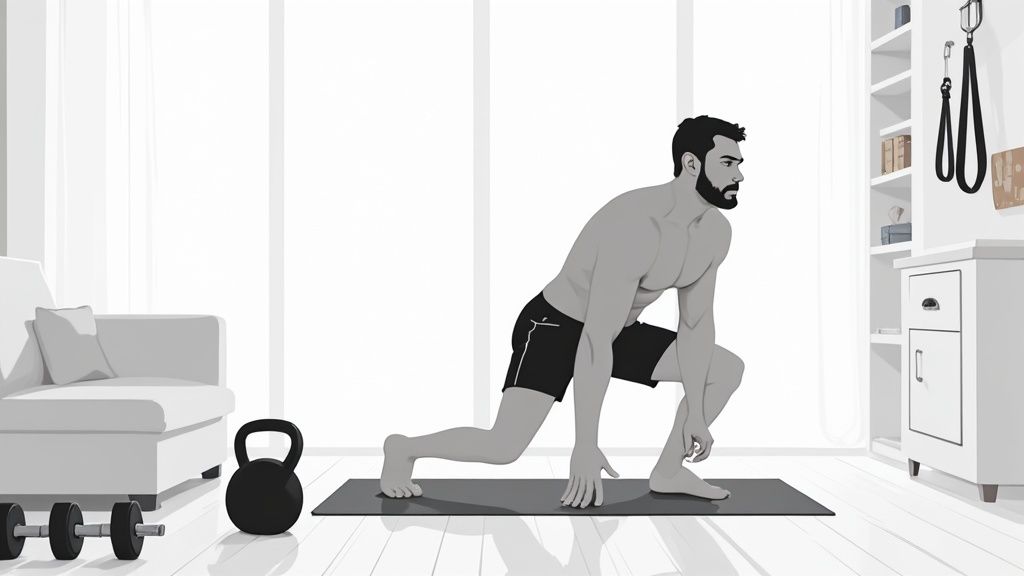
At its core, resistance training is simply using an opposing force to make your muscles contract. This action creates tiny, microscopic tears in your muscle fibers, a process known as microtrauma. Don't worry, this is a good thing! When your body repairs these fibers through a process called muscle protein synthesis, they grow back stronger and denser.
Think of it like a sculptor chipping away at marble; the stress reveals a more powerful form underneath. This is how you build lean muscle, which acts as your body's metabolic engine, burning more calories even when you're just relaxing on the couch.
The Real Secret to Getting Stronger: Progressive Overload
So, how do you keep seeing results? The magic lies in a principle called progressive overload. In simple terms, you have to consistently increase the challenge you place on your muscles to keep them growing. If you do the same thing over and over, your body adapts and you hit a plateau.
You can introduce this challenge in a few different ways:
- Go Heavier: Gradually pick up heavier dumbbells or move to a stronger resistance band.
- Do More: Add a few more reps to your set or complete an extra set in your routine.
- Slow It Down: Perform movements at a slower, more controlled pace to increase the time your muscles are under tension, maximizing the engagement of muscle fibers.
By mixing these methods into your workouts, you ensure your body is always adapting and getting stronger. If you want to dive deeper into this concept, you can learn more about what progressive resistance training is and how to apply it to your routine.
Resistance training does more than just build muscle. The mechanical stress it places on your bones actually signals cells called osteoblasts to increase bone mineral density. This makes them stronger and more resilient, which is crucial for long-term health.
The Rise of the Home Gym
This focus on accessible, effective workouts has fueled a massive shift toward home fitness. More people are discovering the incredible benefits of having their own resistance training equipment for home, creating personalized spaces that fit their busy lives.
The numbers don't lie. The global market for strength training equipment is projected to hit a staggering USD 17.81 billion by 2030, with home gym demand growing at a remarkable 6.84% compound annual growth rate. This boom is all about getting real results without the hassle of a gym membership.
Quick Guide to Home Resistance Training Equipment
To help you get started, here’s a quick rundown of the most popular types of equipment, what they’re good for, and who they’re best suited for. Think of this as your cheat sheet for building your ideal home workout space.
| Equipment Type | Primary Muscle Groups Targeted | Best For (Beginner/Intermediate/Advanced) |
|---|---|---|
| Resistance Bands | Full Body (glutes, legs, arms, back, core) | Beginner / Intermediate |
| Dumbbells | Full Body (isolated movements for all major groups) | All Levels |
| Kettlebells | Full Body (legs, glutes, core, back, shoulders) | Intermediate / Advanced |
| Bodyweight/Props | Full Body (core, legs, chest, back) | All Levels |
| Pilates Rings | Inner/Outer Thighs, Arms, Chest, Core | All Levels |
Choosing the right tool often comes down to your personal goals and the space you have available. The great thing is, you don't need a lot to get started. Even a single set of bands or dumbbells can open up a world of effective exercises.
How Resistance Bands Sculpt and Strengthen
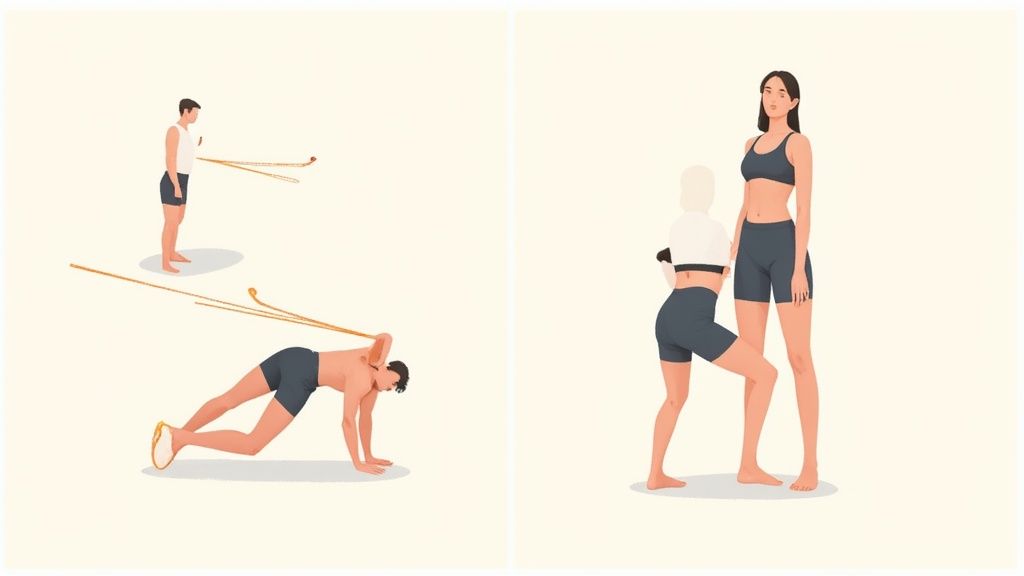
Resistance bands might look simple, but they're one of the smartest tools in your home fitness arsenal. Unlike a dumbbell, which feels heaviest at one point and lighter at another due to gravity, a band keeps the tension consistent through the entire movement.
This constant, challenging tension is what makes them so effective. As you stretch a band, the resistance gets progressively harder, forcing your muscles to work more at the peak of the exercise—right where they're strongest. This continuous engagement is a game-changer for building deep, functional strength.
The Science of Stabilizer Muscles
The real magic of bands happens beneath the surface. That variable tension constantly challenges your balance, forcing your smaller, often-overlooked stabilizer muscles to wake up and get to work.
Think of these stabilizers as the support crew for your big muscle groups. A bicep curl with a dumbbell mostly hits the bicep. But doing the same move with a band recruits muscles in your rotator cuff (like the supraspinatus and infraspinatus) and core just to keep your arm and body steady. It's about building an integrated, resilient body that moves better and is less prone to injury.
The constant tension from a resistance band eliminates "rest points" during an exercise. This increases the total time your muscles are under load, a key factor in stimulating muscle growth and endurance.
This is exactly why bands are such incredible resistance training equipment for home. They deliver a surprisingly complex, full-body challenge in a simple, portable package.
Long Bands for Major Muscle Groups
Long loop bands are the masters of compound movements. They let you target multiple large muscle groups at once for a workout that's both efficient and powerful.
- For the Lower Body: Loop a band under your feet and over your shoulders for a squat. You're not just working your quads and glutes; the band's upward pull forces your entire core, including the deep transverse abdominis and obliques, to fire up to keep you upright.
- For the Upper Body: In a bent-over row, the band creates a horizontal pull that hones in on the big muscles in your back, like the latissimus dorsi and rhomboids. All the while, the erector spinae muscles along your spine are working overtime to keep your torso stable.
By integrating these big muscle groups, you build practical, real-world strength that shows up when you're lifting groceries or carrying your kids.
Mini-Loops for Targeted Activation
While long bands build overall power, mini-loops are specialists. These small but mighty tools are perfect for zeroing in on smaller muscles that are crucial for stability and injury prevention.
Their most popular use is around the thighs or ankles to target the hips. When you place a mini-loop just above your knees during a glute bridge, it specifically lights up the gluteus medius. This muscle is vital for pelvic stabilization when you walk or run.
Strengthening it helps prevent common issues like runner's knee and lower back pain. That kind of targeted work is tough to achieve with free weights alone, making mini-loops an essential part of a well-rounded routine.
Whether you're new to fitness or have been training for years, knowing how to use bands opens up a world of possibilities. You can explore all kinds of new movements in our guide to effective exercises with resistance bands and see just how versatile they are. The different thicknesses and styles make it easy to progress, ensuring your muscles are always adapting, growing, and getting stronger.
Mastering Dumbbells and Kettlebells for Raw Power
When you’re ready to move beyond bands and bodyweight, free weights are the undisputed champions for building serious strength. Dumbbells and kettlebells are staples in any effective home gym, and for good reason—they challenge your body in completely different ways, forging muscle and power with every single lift.
And the numbers don't lie. Free weights are crushing it, holding a massive 43.55% of the market share in 2024. This isn’t a fleeting trend; it’s proof that these classic tools deliver real, lasting results for everyone from beginners to seasoned athletes. If you're curious about the data, you can read the full research on the strength training equipment market and see for yourself.
Dumbbells and the Power of Unilateral Training
The simple genius of a dumbbell is its perfect balance, which unlocks the power of unilateral training—working one side of your body at a time. This is a game-changer for building a symmetrical, resilient physique.
Think about lifting a barbell. Your dominant side almost always takes over, compensating for the weaker one. Over time, this sneaky habit can create or worsen muscle imbalances. Dumbbells stop that from happening. Each side is forced to do its own work.
- Fixing Imbalances: When you do a single-arm dumbbell press, all the little stabilizer muscles in your weaker shoulder have to fire up and get to work, helping it finally catch up.
- Building Symmetrical Arms: Curls with two dumbbells mean your left and right biceps brachii have to work independently, leading to much more even growth.
- Supercharging Your Core: Even a simple one-arm row becomes a core blast. Your obliques and deep transverse abdominis have to work overtime to keep you from twisting, turning a back exercise into a sneaky core workout.
This focused work lets you build a more balanced body from the ground up, hitting everything from your deltoids (shoulders) to your triceps with incredible precision.
The Kettlebell and Its Anatomical Advantage
If dumbbells are the masters of isolation, the kettlebell is the master of integration. Its unique shape—basically a cannonball with a handle—creates an off-balance center of mass. This simple design twist completely changes how your body has to handle the load.
The weight hangs below your hand, constantly pulling you off-balance. Your entire body has to fire up as a single, connected unit just to control it. This is where the magic happens, especially with dynamic movements that build explosive power.
A dumbbell moves in a predictable line. A kettlebell in motion creates a force that’s always shifting and pulling. This forces way more muscles to get involved at once, teaching your body how to generate and absorb power—a true cornerstone of functional fitness.
Anatomy of the Kettlebell Swing
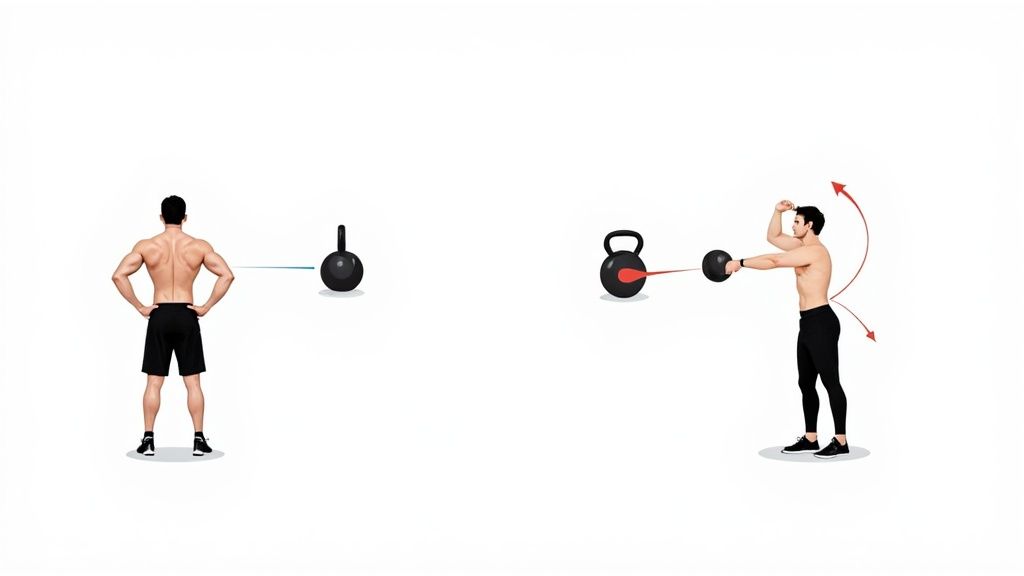
The kettlebell swing is probably the most famous kettlebell exercise out there, and it's earned its reputation. It’s an absolute powerhouse for building an incredibly strong posterior chain—all those important muscles running down the back of your body.
Let’s break down what’s really going on in a proper swing:
- The Hinge: It all starts with a deep hip hinge, not a squat. Think of it like loading a spring. You’re stretching your gluteus maximus and hamstrings, getting them ready to explode forward. Your lower back muscles (erector spinae) are firing to keep your spine perfectly straight.
- The Explosion: All the power comes from your hips. Your glutes and hamstrings contract with explosive force, driving the kettlebell up and forward. Your arms are just along for the ride, guiding the bell.
- The Plank: At the very top of the swing, your entire body locks into a rigid plank for a split second. Your quadriceps, glutes, and abs (rectus abdominis) are all braced, creating a moment of peak tension.
This one fluid movement builds explosive power, jacks up your heart rate, and strengthens the muscles that give you great posture. It’s what makes the kettlebell such an incredible tool for building real-world, functional strength.
Your Own Body: The Ultimate Resistance Tool
The single most effective and accessible piece of equipment you'll ever own is your own body. It’s a beautifully complex and adaptable machine that costs you nothing and is ready to go anytime, anywhere. This is the heart of calisthenics, or bodyweight training—the art of using your own mass against gravity to build true, functional strength and control.
Think of it this way: your body is a system of levers and joints. By simply changing your body's position—maybe bringing your hands closer for a push-up to target the triceps, or putting your feet on a chair to engage the upper pectorals—you change the biomechanics of the movement. This tweaks the load on your muscles, creating a challenge without ever picking up a weight. It’s progressive overload in its purest, most intuitive form.
A Quick Tour of Your Body's Teamwork
Bodyweight movements are incredible because they force your muscles to work together as a team. A classic push-up isn't just a chest exercise; it's a full-body conversation. As you lower down, your pectoralis major (chest) and anterior deltoids (front shoulders) are under tension, while your triceps brachii act as the brakes. Pushing back up demands a coordinated effort from all three, all while your core fires up to keep you as stable as a plank.
It’s the same story with a bodyweight squat. As you descend, your quadriceps and gluteus maximus are in control. To stand back up, they have to work in perfect concert, with your hamstrings and calves jumping in to assist. It’s a beautiful symphony of lower-body strength.
Bringing in Simple Props to Level Up
While your body alone is a powerhouse, adding a few simple props can completely change the game. They open up a whole new world of exercises and dial up the intensity by introducing elements like instability.
Two of my absolute favorites for any home setup are gymnastic rings and a stability ball. They take foundational movements and turn them into a serious test of strength, stability, and coordination.
The real magic of props like rings or a stability ball is controlled instability. This simple concept forces your nervous system to wake up and recruit more muscle fibers—especially those deep, tiny stabilizers—to keep you balanced. That's where you build next-level, integrated strength.
Gymnastic Rings for Unbeatable Upper Body Strength
For building a seriously strong upper body, nothing beats gymnastic rings. Because they’re suspended and can move freely, they force you to create all the stability. You'll feel muscles you never even knew existed.
Even a simple ring push-up becomes a full-body challenge. Your hands, wrists, shoulders, and core are constantly making tiny adjustments to keep the rings steady. This lights up key stabilizer muscles that often get missed:
- Rotator Cuff: These small but mighty muscles around your shoulder joint work overtime to keep everything locked in and secure.
- Serratus Anterior: This muscle wraps around your ribcage and keeps your shoulder blades flush against your back—it's absolutely vital for shoulder health.
- Latissimus Dorsi: Your big back muscles (lats) get in on the action, helping control the rings and adding power to your push.
This constant battle for stability builds a kind of deep, connected strength that you just can't get from a fixed machine.
The Stability Ball for a Rock-Solid Core
A stability ball is another fantastic piece of resistance training equipment for home, specifically for challenging your core in a 360-degree way. By creating an wobbly, unstable surface, it makes your deep core muscles fire on all cylinders to keep you from toppling over.
Take a plank with your forearms on the ball. It's worlds away from a plank on the floor. As the ball tries to roll, your entire core has to work as a single, coordinated unit. Your rectus abdominis (the "six-pack" muscles) braces the front, your obliques fight against any twisting, and your deep transverse abdominis—your body’s built-in corset—cinches everything in tight to protect your spine. This is how you build a truly functional core that supports every single thing you do.
How to Choose the Right Equipment for Your Goals
Now that you have a feel for how different tools work your body, you get to be your own personal consultant and build the perfect home gym. The secret is matching the equipment directly to your fitness ambitions. Let your goals dictate the gear, not the other way around.
Think of it like choosing the right knife in the kitchen. You wouldn't try to chop vegetables with a butter knife, right? In the same way, the best equipment for building visible muscle is very different from the gear that’s designed to improve your functional, everyday strength.
Building Visible Muscle and Strength
If your main goal is hypertrophy—the technical term for growing muscle size—then you need to focus on progressive overload with heavier resistance. This is where free weights really shine.
- Adjustable Dumbbells: These are fantastic for maximizing muscle growth, especially if you're tight on space. They let you gradually increase the weight for exercises like chest presses (pectoralis major) and bicep curls (biceps brachii), directly challenging your muscles to get stronger and bigger.
- Kettlebells: For building a powerful, dense posterior chain (your glutes, hamstrings, and erector spinae), it’s hard to beat a good set of kettlebells. The explosive nature of swings and cleans fires up a huge number of muscle fibers, leading to some serious gains in both strength and size.
Enhancing Functional, Everyday Fitness
Maybe your goal isn't about muscle size, but more about functional strength—the ability to move through your day with ease and without nagging pain. This style of training focuses on movements that mimic real-life activities, which means a big emphasis on stability, coordination, and core strength.
A combination of versatile tools often works best here. Resistance bands are perfect for waking up those small stabilizer muscles, while gymnastic rings build incredible core control and upper-body strength. This duo prepares your body for the dynamic, unpredictable movements of life, from hoisting heavy groceries to playing with your kids.
This simple decision tree can help you pick the right bodyweight tools based on whether you're focused on building a stronger core or developing more upper-body strength.
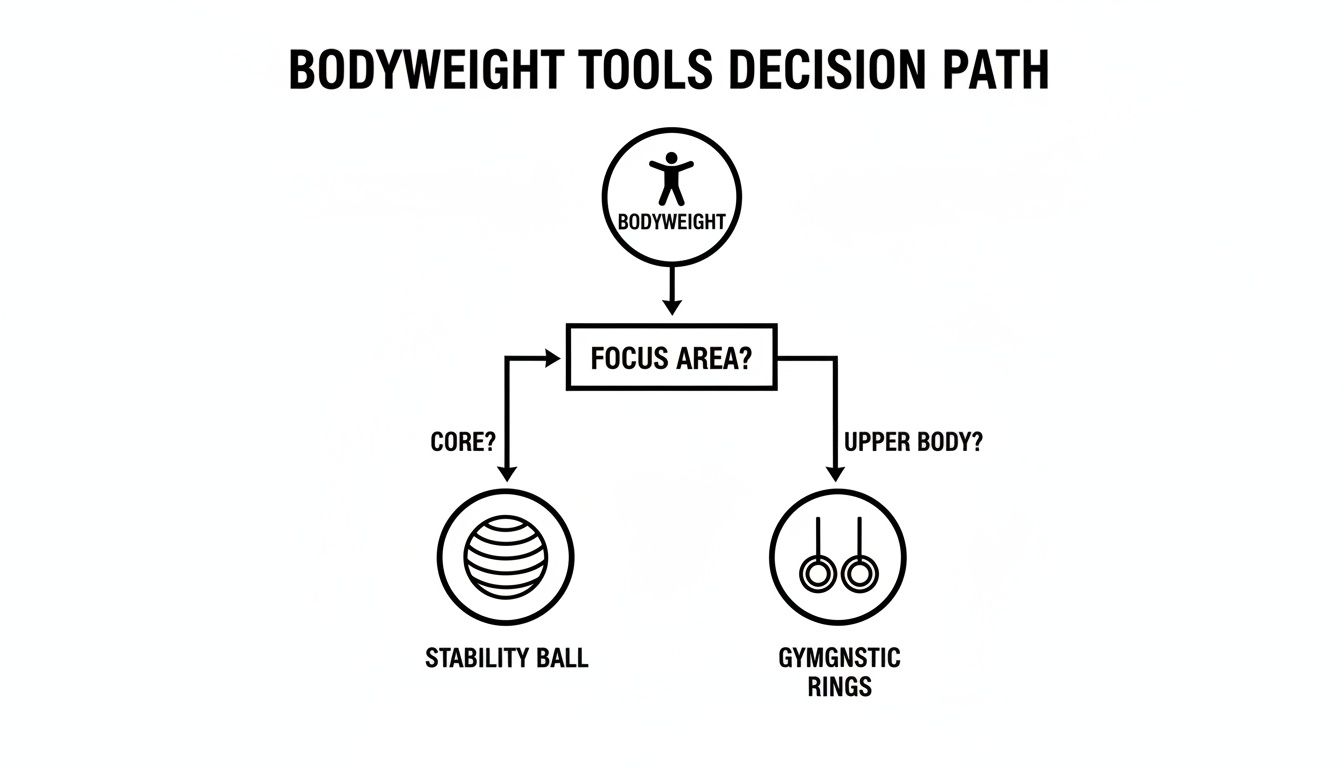
As you can see, you can simplify your choice by targeting either core stability with a stability ball or focusing on upper-body strength with gymnastic rings.
Starting on a Budget or with Limited Space
You don’t need a huge budget or a dedicated room to create an effective home gym. The global market for home exercise equipment, which hit USD 3.6 billion in 2024, is filled with affordable, space-saving options. When you pair that with a U.S. connected fitness market valued at USD 1.17 billion, it’s clear there are tools out there for every budget.
A powerful starter kit can be as simple as a set of versatile resistance loops and a stability ball. This combination allows you to perform dozens of exercises targeting every major muscle group without taking up much room.
For those working with minimal square footage, it’s all about choosing multi-functional gear. You can find some excellent ideas in our complete guide to the best fitness equipment for small spaces.
To help you see how these options stack up, here’s a quick comparison based on the factors that matter most for a home setup.
Equipment Comparison by Goal Space and Budget
| Equipment Type | Average Cost | Space Needed | Best for Muscle Growth | Best for Functional Fitness |
|---|---|---|---|---|
| Resistance Bands/Loops | $15 - $60 | Minimal | Good | Excellent |
| Gymnastic Rings | $30 - $80 | Moderate (ceiling height) | Good | Excellent |
| Adjustable Dumbbells | $150 - $500+ | Minimal | Excellent | Good |
| Kettlebells | $30 - $150 (per bell) | Small | Excellent | Excellent |
| Stability Ball | $20 - $40 | Moderate | Fair | Excellent |
This table makes it easy to see the trade-offs at a glance, helping you find the perfect fit for your specific situation.
No matter your goals, proper nutrition is the non-negotiable foundation for your success. To fuel your body effectively and support muscle recovery, understanding what are macronutrients and micronutrients is fundamental. When you align your equipment and your nutrition with your goals, you create a powerful formula for real results.
Your Questions About Home Resistance Training Answered
Diving into the world of home fitness can feel a little overwhelming. You've got the gear, but a lot of questions pop up. Where do I even start? How do I know if I'm pushing hard enough? Getting clear, straightforward answers is the key to building a practice that's both safe and truly effective.
Think of this as your go-to guide. We're going to cut through the noise and give you the actionable advice you need to train with confidence and get the results you're after.
How Much Weight Should I Start With?
Choosing your starting weight isn't about hitting a specific number; it's about listening to how your body responds. The golden rule is to find a weight or resistance level that lets you complete 8-12 repetitions with good, clean form. The last two reps should feel genuinely challenging, but not impossible.
Your muscles—whether it's your biceps brachii during a curl or your quadriceps in a squat—should feel tired by the end of the set. If you can breeze through 15 reps, the resistance is too light. If you can't manage 6-8 reps without your form falling apart, it's too heavy. This principle holds true for everything from dumbbells and kettlebells to resistance bands.
How Often Should I Do Resistance Training?
For most of us, aiming for 2-4 resistance training sessions per week is the sweet spot for building strength and muscle. This gives your body enough stimulus for muscle protein synthesis—that's the magic process where your body repairs and rebuilds muscle fibers stronger than before—while also allowing for crucial recovery time.
Overtraining can be just as counterproductive as undertraining. Your muscles don't grow during the workout; they grow during the rest periods in between. Giving muscle groups at least 48 hours to recover is crucial for progress.
This means you could set up your week with full-body workouts every other day, or you might split your routines to focus on different muscle groups on different days. It’s all about what works for your schedule and your body.
Is It Okay to Be Sore After Every Workout?
Feeling some muscle soreness, what we call Delayed Onset Muscle Soreness (DOMS), is completely normal. It’s especially common when you’re new to an exercise or you've upped the intensity. Think of it as the sign of microscopic damage to muscle fibers, which is a natural and necessary part of the adaptation process.
However, you shouldn’t feel debilitatingly sore after every single workout. As your body adapts to the new demands, the severity of DOMS should lessen. A consistent, moderate soreness tells you you’ve had a good challenge, but extreme pain that limits your movement could be a red flag for pushing too hard or using improper form. Learning to listen to your body is the most important skill you can develop.
Ready to bring the precision and effectiveness of a studio workout into your own home? WundaCore provides the expertly designed equipment and anatomy-informed streaming classes you need to build real, functional strength from the inside out.
Explore the WundaCore collection and start your journey today.