
Build Your Ultimate Home Pilates Kit: An Anatomical Guide
Thinking about bringing Pilates into your home? A home Pilates kit is your personal collection of equipment designed to engage your deep core musculature, improve spinal alignment, and master muscle control, all without leaving your house. It begins with a supportive mat and adds versatile tools like resistance bands and rings to help you connect with your body's anatomy on a deeper level.
Creating Your At-Home Pilates Sanctuary
Picture a quiet corner of your home transformed into a personal movement studio—a space dedicated to building a stronger, more anatomically aware body. That's the power of a well-chosen home Pilates kit. It’s more than just equipment; it's your key to mastering the core principles of Pilates (control, precision, and breath) by understanding how each movement affects your musculoskeletal system.
And you're not alone in this shift. The global Pilates equipment market is set to hit around $276.48 million, with a huge chunk of that coming from home-use gear. This trend highlights a growing desire for accessible wellness that fits into modern life by focusing on functional, intelligent movement.
The Anatomical Foundation of Pilates
At its core, Pilates is a conversation with your body’s deep muscular system. The practice is designed to meticulously target the stabilizing muscles that form your "powerhouse." This includes the transversus abdominis, the deepest abdominal muscle that acts like a natural corset, wrapping around your midsection to support your spine and internal organs. It also involves the multifidus muscles running along the spine and the crucial muscles of the pelvic floor.
A proper home Pilates kit provides the tools to awaken and strengthen these crucial, often-underused muscles. An exercise like "The Hundred" isn't just about the superficial rectus abdominis (the "six-pack"). Its true purpose is to train that deep core layer to fire isometrically, stabilizing your entire trunk against the movement of your limbs.
From Equipment to Empowerment
Each piece in your home kit has a specific anatomical purpose. Understanding this connection is the first step toward a practice that's truly effective, moving beyond simple imitation to intelligent execution.
This table breaks down the essentials and their direct anatomical focus.
Essential Pilates Kit Components and Anatomical Focus
| Equipment | Primary Muscle Groups Targeted | Main Benefit |
|---|---|---|
| The Mat | Full Body (especially core and spinal erectors) | Provides cushioning and a stable surface for exercises that require spinal articulation, like roll-ups and roll-downs, protecting each vertebra. |
| Resistance Ring | Adductors (Inner Thighs), Pelvic Floor, Pectorals | Offers tactile feedback to help you consciously engage hard-to-feel muscles and deepen your connection to your powerhouse. |
| Resistance Bands | Rotator Cuff, Gluteus Medius/Minimus, Rhomboids | Creates dynamic tension to strengthen smaller stabilizing muscles, like those around the shoulder and hip joints, improving joint stability. |
Let's dig a little deeper into how these pieces interact with your body.
How Each Piece Works With Your Body
-
The Mat: Think of your mat as the foundation for all movement. It provides the cushion needed to protect the spinous processes of your vertebrae as you articulate your spine. To get the right support, it helps to understand the differences between an exercise and yoga mat.
-
The Resistance Ring: This tool, often called a Magic Circle, is brilliant for providing proprioceptive feedback. It helps you feel and engage muscles you might not otherwise notice, like your adductors (inner thighs) and the levator ani group of the pelvic floor.
-
Resistance Bands: Bands are fantastic for creating dynamic tension that strengthens smaller, vital stabilizing muscles. Think about the rotator cuff in your shoulder—keeping the supraspinatus, infraspinatus, teres minor, and subscapularis strong is essential for healthy glenohumeral joint function, and bands are perfect for that.
By learning how each tool interacts with your anatomy, you move beyond just following instructions. You begin to understand the why behind each movement, leading to deeper muscle activation, better form, and more significant results.
This mindset transforms your workout into a mindful practice of building functional strength from the inside out. With the right home Pilates kit, you're empowering yourself to improve posture, increase mobility, and forge a powerful connection with your body’s amazing design.
The Foundational Equipment for Every Kit
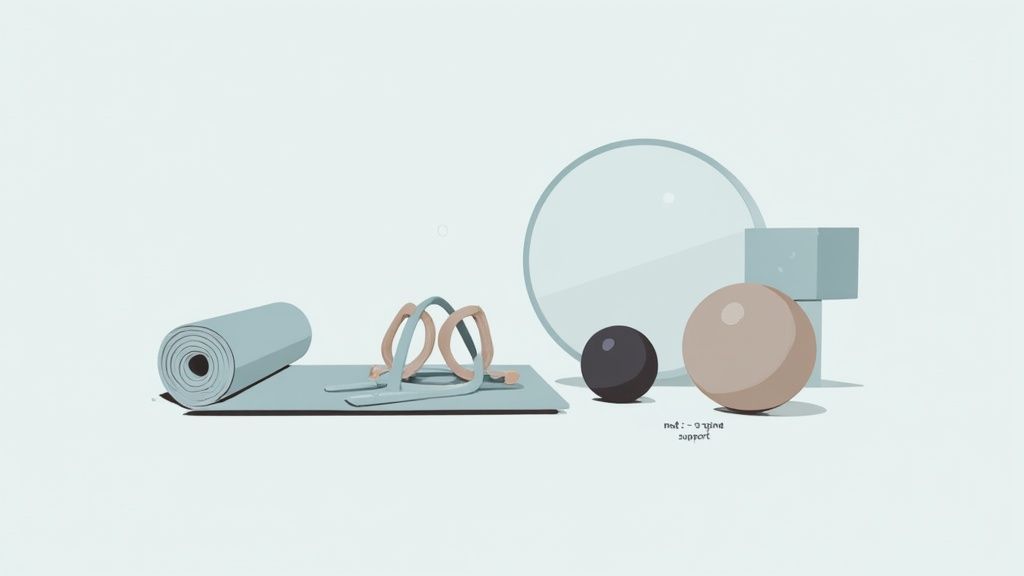
Assembling a home Pilates kit is an exercise in anatomical intention. A great setup is built on a few core tools that work together to support and challenge your body, targeting specific muscle groups and movement patterns.
Think of these pieces as your non-negotiables. Each one has a job, helping you connect more deeply with your own biomechanics and awaken key muscle groups. Let’s break down the cornerstones of every effective home Pilates kit from an anatomical perspective.
The Pilates Mat: Your Anatomical Stage
First things first: the Pilates mat is more than padding. It’s your stage, and its most important anatomical job is protecting your spine. During exercises that involve sequential spinal articulation—like a classic Roll Up—a thick mat provides essential cushioning for each individual vertebra.
This allows your spine, from the sacrum to the cervical vertebrae, to press down and peel off the floor with control. This is critical for building core strength safely, as it lets you engage your deep abdominals to control the movement, rather than bracing your spine against a hard surface.
Resistance Bands: The Tools for Dynamic Tension
Resistance bands are masters of creating controlled, dynamic tension. Unlike free weights, which rely on gravity, bands provide consistent resistance through the entire range of motion. This is a game-changer for activating the smaller, stabilizing muscles that are critical for joint health.
Take the rotator cuff, the group of four muscles stabilizing the shoulder joint. Using a band for external rotation exercises strengthens the infraspinatus and teres minor, promoting healthy shoulder mechanics and better posture. Or, loop a band around your thighs for a glute bridge. You'll immediately feel your gluteus medius (a key hip stabilizer and abductor) engage, creating stability across the entire pelvic girdle.
If you want to dive deeper, you can explore the best resistance bands for Pilates. For an extra challenge, adding tools like medium resistance cables can further enhance concentric and eccentric muscle contractions.
The goal of these foundational tools isn't just to make exercises harder. It's to provide tactile feedback and controlled resistance that helps you recruit the correct muscles with precision, leading to a more intelligent and effective workout.
This focus on precise muscle activation is what makes these simple tools—and the Pilates method itself—so incredibly effective.
The Pilates Ring: A Circle of Muscular Awareness
The Pilates ring, or Magic Circle, is an incredible tool for providing immediate, tactile feedback. Its main anatomical purpose is to help you connect with muscles that are notoriously difficult to isolate, particularly your adductors (inner thighs) and pelvic floor.
When you squeeze the ring between your thighs, you create an isometric contraction that activates the entire adductor group of muscles. This creates a co-contraction that makes it easier to engage your pelvic floor and deep core muscles, like the transversus abdominis.
This feedback loop is what makes the ring so essential. It guides you to find and hold contractions in the muscles that form the foundation of your "powerhouse," ensuring your movements originate from a place of deep, central stability—not just from your limbs.
Expanding Your Practice with Advanced Tools
Once you’ve built a solid foundation, your body will crave new neuromuscular challenges. This is the perfect time to introduce advanced tools to your home Pilates kit. These pieces do more than add difficulty; they introduce new variables like instability and increased load, deepening the communication between your nervous system and your muscles.
By strategically adding new equipment, you can target muscles in completely different ways, pushing past plateaus and unlocking new levels of strength and motor control.
Integrating Light Dumbbells for Sculpting and Stability
Light dumbbells are a fantastic way to apply the principle of progressive overload to your mat routine. The moment you add weight, you demand more from your deep core stabilizers to maintain proper form and spinal alignment.
Take "The Hundred." Performing it while holding one- or two-pound weights immediately intensifies the work. This challenges your transversus abdominis to maintain intra-abdominal pressure and keep your torso stable, but it also recruits the entire shoulder girdle—deltoids, serratus anterior, and rotator cuff muscles—to support the arm movements.
Similarly, holding light weights during a "Spine Twist" forces your internal and external obliques to work harder to manage the rotation against the added load. You end up sculpting your arms and shoulders while demanding a much deeper level of core engagement.
The Foam Roller for Balance and Proprioception
In a Pilates context, a foam roller becomes an instrument of instability, designed to seriously challenge your balance and heighten your proprioception—your body's awareness of its position in space.
When you lie on a foam roller, your deep stabilizing muscles must work overtime. Your entire core, from your pelvic floor up to the deep spinal stabilizers (the multifidus and rotatores), is constantly making micro-adjustments to keep you centered.
This unstable surface forces you to rely on true core strength rather than momentum. It removes your ability to "cheat" and demands that your powerhouse muscles do the work, leading to a much deeper and more effective neuromuscular connection.
This heightened challenge doesn't just build raw strength; it refines your motor control, creating a more intelligent and responsive body.
Portable Reformers and the Power of Spring Resistance
For those ready for the ultimate upgrade, a portable reformer brings the unique benefits of spring-based resistance into your home. The magic of the reformer lies in its springs, which challenge your muscles in a way weights cannot replicate.
Unlike gravity, springs provide continuous tension through both phases of movement. This facilitates both concentric (muscle shortening) and eccentric (muscle lengthening) contractions, which is the key to building the long, lean muscle tone Pilates is known for.
Here’s a quick anatomical breakdown:
- Concentric Contraction: The "push" or "pull" phase. When you press the carriage out with your feet (footwork), the springs provide resistance, forcing your glutes and quadriceps to fire to initiate the movement.
- Eccentric Contraction: The controlled "return" phase. As you slowly bring the carriage back, your muscles must work against the pull of the springs, lengthening under tension. This phase is crucial for building functional strength, muscular control, and preventing injury.
This constant, controlled resistance is incredibly effective. For a deeper dive, our guide to Pilates reformer exercises offers great insights. This two-way muscle work ensures every part of every rep is productive, leading to balanced strength and muscular endurance without bulk.
Customizing Your Kit for Your Body and Goals
An effective home Pilates kit is never one-size-fits-all. It should be a personalized toolkit, assembled to match your unique anatomy and specific aspirations. Your body’s structure, posture, and goals should dictate your equipment choices.
Instead of buying a pre-packaged box, think of yourself as a sculptor selecting the perfect tools to create your masterpiece—a stronger, more aligned body. The point is to choose pieces that directly address your needs, whether that’s rehabilitating the pelvic floor postpartum, combating the postural effects of a desk job, or building pure strength.
This thoughtful approach is the new standard. Home Pilates kits are a go-to for effective, low-impact workouts, with a clear trend toward lightweight, intelligent products. Lightweight home Pilates equipment now holds the majority of the market share, showing a preference for gear that’s easy to store and use.
The Postpartum Recovery Kit
For new mothers, the postpartum period is a time for gentle, targeted reconnection with the core and pelvic floor. The goal is safely re-engaging deep stabilizing muscles without placing undue stress on a healing body, particularly the linea alba if diastasis recti is present. An anatomy-focused kit for this phase is about support and mindful activation.
The hero of a postpartum kit is a stability ball. It’s brilliant for supporting the lumbar spine and pelvis during gentle core exercises. Using the ball for support during pelvic tilts or heel slides allows you to safely re-engage the transversus abdominis and pelvic floor muscles.
- Key Piece: A large, soft stability ball.
- Anatomical Focus: Re-engaging the transversus abdominis and pelvic floor muscles safely.
- How it Works: The ball provides proprioceptive feedback and support, allowing you to activate deep muscles without creating intra-abdominal pressure that could strain the abdominal wall.
By focusing on these foundational muscles first, you rebuild your core from the inside out. This creates a stable base that is essential for returning to more challenging exercises safely and effectively.
To support your journey, remember that your Pilates practice is powerfully complemented by nutrition. Consider exploring macro-friendly meal prep for your fitness goals to give your body the fuel it needs to recover and strengthen.
This image shows tools you might graduate to as your strength improves.
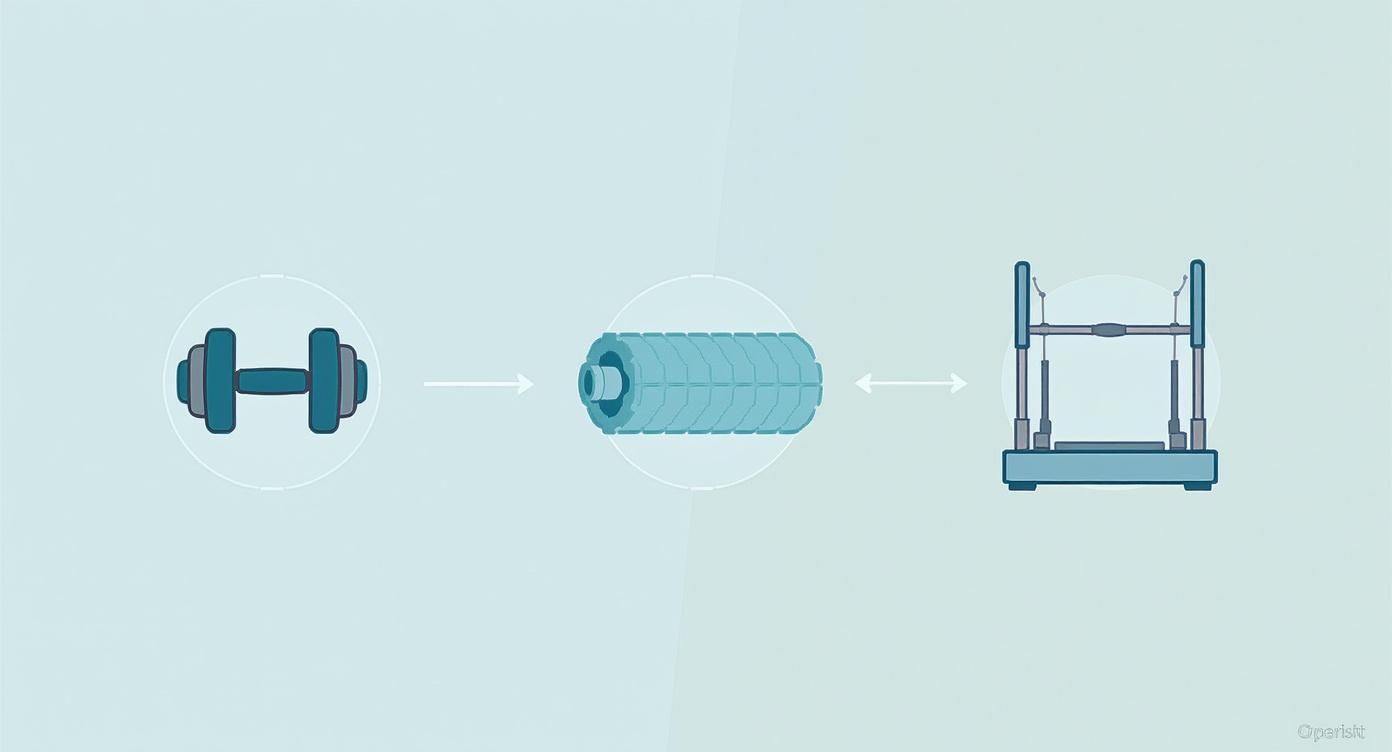
As you progress, incorporating tools like dumbbells, rollers, and even reformers can add new layers of challenge to your practice.
The Desk Worker’s Posture Kit
If you spend hours at a keyboard, your home Pilates kit should counteract the effects of a sedentary lifestyle. The primary anatomical goals are to promote thoracic spine extension and strengthen the upper back musculature that combats kyphosis (rounding of the upper back).
A foam roller is your secret weapon. Lying on it lengthwise allows you to open your chest and gently extend your thoracic spine, releasing tension in your pectoral muscles and encouraging better posture.
The Pilates ring is your other best friend. Squeezing it between your hands in front of your chest strengthens the rhomboids and middle trapezius—the key muscles between your shoulder blades (scapulae) that are responsible for scapular retraction, creating an upright posture.
- Key Pieces: Foam roller and Pilates ring.
- Anatomical Focus: Improving thoracic spine mobility and strengthening upper back muscles like the rhomboids and serratus anterior.
- How it Works: The roller releases myofascial tension in the chest and spine, while the ring provides targeted resistance to build strength in the muscles that hold your shoulders in a healthy, neutral position.
The Pure Strength Building Kit
For those whose primary goal is building strength and muscle definition, your kit needs to provide progressive resistance to stimulate hypertrophy.
Heavier resistance bands are a must. They add significant load to exercises like leg circles or bicep curls, challenging your muscles to adapt and grow stronger. Light dumbbells, from two to five pounds, can be integrated into mat work to intensify the demands on your core and sculpt the muscles of the arms and shoulders, such as the deltoids and triceps.
By adding this external load, you force your muscles to work harder through their full range of motion. This leads to increased strength and visible muscle tone without creating bulk, staying true to the Pilates principle of developing long, lean muscles.
Home Pilates Kit Recommendations by Fitness Goal
To make it clearer, let's match your specific fitness objectives and anatomical needs with the right equipment.
| User Goal | Anatomical Focus | Recommended Kit Components |
|---|---|---|
| Postpartum Recovery | Transversus Abdominis & Pelvic Floor | Stability Ball, Light Resistance Bands |
| Posture Correction | Thoracic Spine & Scapular Stabilizers | Foam Roller, Pilates Ring |
| Strength Building | Full Body Major Muscle Groups | Heavy Resistance Bands, Light Dumbbells, Pilates Ball |
| Flexibility & Mobility | Spine, Hips (psoas, hamstrings), Shoulders | Foam Roller, Stretch Straps, Pilates Ring |
| Balance & Proprioception | Core & Lower Body Stabilizers (gluteus medius) | Stability Ball, Wobble Board, Small Pilates Ball |
This table is a starting point. The beauty of a home Pilates kit is its adaptability—mix and match as your body and goals evolve.
Putting Your Pilates Kit into Action
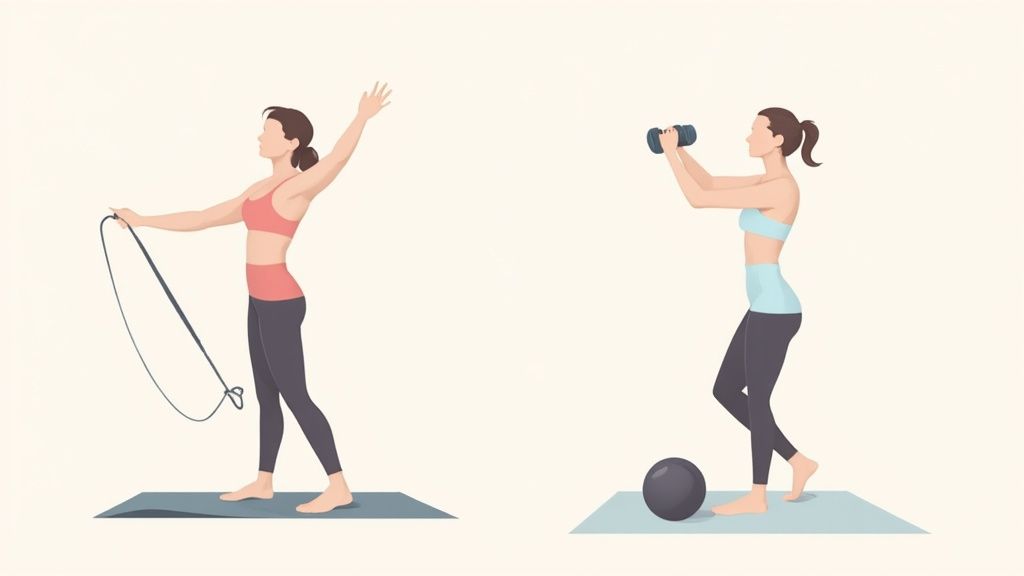
You've assembled your perfect home Pilates kit. Now it's time to move with purpose. This is where your mat becomes a personal studio and your props feel like extensions of your body, helping you tune into your anatomy with every exercise.
The rise of home workouts has walked hand-in-hand with the growth of the Pilates and yoga studio market. While studio classes are amazing, the convenience of practicing at home has created a huge demand for quality home kits. You can discover more insights about the growing Pilates market and how it’s shaping home fitness.
Let's bring your practice to life with two routines designed to build strength from the inside out, focusing on the anatomical why behind each movement.
Core Foundation Flow for Beginners
This flow is about developing proprioception and building that crucial neuromuscular connection. Forget speed; precision is the goal.
1. Pelvic Tilts (with Pilates Ball)
- How to do it: Lie on your back, knees bent, with feet flat. Place a small, soft Pilates ball under your sacrum (the flat, bony part at the base of your spine).
- Why it works: This move isolates and awakens your deep lower abdominals. As you gently rock your pelvis (creating posterior and anterior tilts), you’re training your transversus abdominis to initiate the movement without your lumbar erectors or hip flexors taking over. The ball provides feedback and support.
2. Leg Circles (with Resistance Band)
- How to do it: Still on your back, loop a light resistance band around the arch of one foot. Extend that leg toward the ceiling, holding the band and keeping your pelvis stable on the mat.
- Why it works: As you draw small, controlled circles, the band adds resistance that challenges the stabilizing muscles of the hip, especially the gluteus medius. This muscle is vital for pelvic stability and preventing low back pain. You’re building strength and improving hip joint mobility simultaneously.
This foundational work is about building awareness. You are teaching your body to recruit its deep stabilizing system first, creating a solid platform for all other movements, both in Pilates and in everyday life.
Intermediate Full-Body Sculpt
Ready to increase the challenge? This routine uses props to layer on intensity, targeting multiple muscle groups and demanding greater core control.
1. Plank to Pike (with Stability Ball)
- How to do it: Assume a high plank with your shins on a stability ball. Keeping your legs straight, engage your deep abdominals to lift your hips high into a pike position, rolling the ball toward your hands.
- Why it works: This is a major core challenge, firing up the rectus abdominis and deep transversus abdominis. The instability of the ball forces your entire shoulder girdle, including the serratus anterior (which keeps your shoulder blades stable), to work overtime.
2. Chest Press (with Pilates Ring)
- How to do it: Lie on your back, knees bent. Hold the Pilates ring between your palms with arms reaching toward the ceiling.
- Why it works: Squeezing the ring creates an isometric contraction that activates the pectoralis major (chest) and anterior deltoids. The key is to maintain this contraction while keeping your core engaged to prevent your ribcage from flaring. It’s an effective way to build upper body strength while reinforcing deep core stabilization.
By focusing on the "why" behind each exercise, your workout becomes an intentional practice. You are building a smarter, stronger, and more connected body from day one.
Common Questions About Home Pilates
Starting a Pilates practice at home always brings up a few questions. As you assemble your home Pilates kit, it's normal to wonder how to get the most out of your time. Let's dig into some common questions with practical, anatomy-focused answers.
Understanding how each movement connects to your muscles and posture is what creates real, lasting change. This is about building a more intelligent body from the inside out.
Can I Get Reformer-Level Results Without the Machine?
Absolutely. While the reformer is an incredible tool, you can target the exact same deep, stabilizing muscles with a well-chosen home Pilates kit. The secret is using props to mimic the reformer’s unique blend of resistance and support.
The magic of the reformer is its moving carriage and spring tension. A Pilates ball under your low back during ab work acts like that carriage, giving you support for a deeper engagement of your transversus abdominis while maintaining a neutral spine.
Resistance bands are your best friend for recreating spring tension. When you use a band for leg work, it forces your glutes and hamstrings to work through both concentric (shortening) and eccentric (lengthening) contractions—exactly what a reformer spring does. The Pilates ring provides targeted resistance that awakens your adductors and pelvic floor, uncannily similar to using the reformer's footbar.
The real power of Pilates was never in the machine itself. It’s in the principles: controlled movement, precise muscle engagement, and impeccable form. You can master all of these with or without a big piece of equipment, as long as you use your home kit with intention.
How Often Should I Practice to See Physical Changes?
When it comes to seeing real anatomical changes—like improved posture, a stronger core, and more muscle tone—consistency beats intensity. Aim for three to four focused sessions a week, each lasting 30 to 45 minutes. This gives your body the perfect rhythm of work and recovery, allowing muscle tissue to adapt and get stronger.
Here’s a realistic timeline of what you can expect:
- First Few Weeks (1-4): The first changes are neuromuscular. You’ll feel a stronger mind-body connection and become more aware of your posture. Your deep core muscles are "waking up."
- First Couple of Months (1-2): You’ll start to see changes. You may notice more definition in your abdominals, back, and glutes. Standing upright will feel more natural as the muscles supporting your spine (erector spinae, multifidus) grow stronger.
- Three Months and Beyond: These changes become ingrained. Movements will feel smoother, your stamina will improve, and you’ll have built a solid foundation of functional strength.
Remember, the quality and precision of each movement will get you results far faster than rushing through more frequent, less focused workouts.
What Is the Best Starter Kit for Lower Back Pain?
A home Pilates kit can be a game-changer for lower back pain, but you must choose your tools wisely. Always check with a doctor or physical therapist before starting a new program. The goal is to strengthen the muscles that form your body’s natural "corset" without putting strain on your lumbar spine.
For you, the non-negotiable pieces are:
- A High-Quality, Thick Pilates Mat: The extra cushioning is crucial for protecting your spine and joints.
- A Soft Stability Ball: This is brilliant for supporting the lumbar spine during core exercises. It helps you strengthen the transversus abdominis without allowing your back to arch or strain.
- Light Resistance Bands: These are perfect for activating the glutes and hamstrings. These muscles are key supporters of the lower back, and bands let you strengthen them without loading the spine. Strong glutes create a stable pelvis, which takes stress off the low back.
Begin with foundational moves, focusing entirely on maintaining a neutral spine and moving with slow control. Your focus should be on meticulously rebuilding the deep muscular support system that keeps your back safe and strong.
Ready to build a practice that feels like it was made for you? WundaCore brings the anatomy-informed coaching of a world-class studio right into your home. With our patented props and expert-led Wunda On Demand classes, you’ll learn to move with precision, build deep strength, and create a sustainable wellness routine that fits your life.
Explore the complete WundaCore system and start your journey today at https://wundacore.com.