
How to Activate Transverse Abdominis for True Core Strength
To activate your transverse abdominis, it's all about a slow, controlled exhale. Imagine gently drawing your navel in and up towards your spine—like you're zipping up a snug pair of high-waisted pants. This isn't a forceful suck-in or a rigid brace; it’s a subtle, deep muscular connection. Mastering this feeling is the absolute first step toward building true, functional core stability.
Understanding Your Body's Natural Corset
When most people hear the word "core," they immediately picture the rectus abdominis—the sought-after "six-pack" muscles right at the surface. But the real powerhouse, the true foundation of your core strength, lies much deeper. I'm talking about a crucial muscle called the transverse abdominis (TrA).
Learning how to properly activate your transverse abdominis starts with understanding its specific anatomy and function.
Think of the TrA as your body's own built-in corset or weightlifting belt. It’s the deepest of the four abdominal muscle layers, lying beneath the external obliques, internal obliques, and rectus abdominis. Its muscle fibers run horizontally, wrapping around your entire midsection from front to back. Anatomically, it originates from the inner surfaces of the lower six ribs, the thoracolumbar fascia (a diamond-shaped sheet of connective tissue in your lower back), and the iliac crest (the top of your hip bone). It then inserts into the linea alba, a tendinous seam running down the midline of your abdomen. This unique structure creates a powerful stabilizing cylinder around your spine and internal organs.
The Role of Your Deepest Abdominal Muscle
Unlike the muscles that flex your trunk forward (like the rectus abdominis), the TrA's primary job is all about stabilization. Its horizontal fibers are perfectly designed to create circumferential tension, cinching your waistline and increasing intra-abdominal pressure. This action is what supports and protects your lumbar spine from strain, especially during dynamic movements.
A properly functioning TrA is absolutely essential for:
- Spinal Stability: It works in concert with the multifidus (small muscles along the spine), diaphragm, and pelvic floor to form a dynamic "abdominal canister." This system acts as a natural back brace, taking the load off your vertebral discs.
- Improved Posture: By controlling the pressure within the abdomen, the TrA helps maintain the optimal relationship between your rib cage and pelvis, preventing excessive arching or slouching.
- A Foundation for All Movement: It provides a solid, stable base from which your arms and legs can move with power and efficiency. This applies to everything from lifting groceries and running to practicing Pilates.
The secret to a strong, resilient core isn't just about building visible abs; it's about awakening the deep, stabilizing muscles that support every single movement you make. Engaging the TrA is a quiet, internal process you have to feel, not force.
Connecting Breath to Your Core
The most intuitive pathway to finding and feeling your TrA is through your breath, thanks to its direct anatomical relationship with the diaphragm. The TrA and the diaphragm are intrinsically linked. When you inhale, your diaphragm contracts and moves downward, and your TrA and pelvic floor lengthen to make space. As you exhale, your diaphragm relaxes upward, and the TrA naturally recoils and engages to assist in pushing air out. This synergy is fundamental to deep core work.
Tapping into the transformative power of breath control is the cornerstone of effective core engagement, creating stability from the inside out.
Understanding this connection is vital before you even attempt specific exercises. The goal isn't to "suck in" your stomach, which just creates tension in the upper abs and neck. Instead, we're aiming for a gentle, deep tightening in your lower abdomen. This mindful approach is a key principle in so many movement practices, especially when you consider what muscles Pilates works to build integrated, full-body strength. Before you can move well, you must first learn to stabilize well.
How to Find and Feel Your Transverse Abdominis
Finding your transverse abdominis (TrA) for the first time is usually a pretty quiet "aha!" moment. It's not a big, powerful contraction like you'd get from a crunch. Instead, it’s a subtle, deep tension that you learn to feel over time. And the most reliable way to make that initial mind-body connection is to start with your breath.
A focused, complete exhale is the most natural trigger for a TrA contraction. This isn't about sucking in your stomach or aggressively bracing for impact. Think of it more as a gentle, deep sensation of your midsection drawing inward and upward, almost like you're zipping up a snug pair of high-waisted jeans from the inside out.
Using Tactile Cues to Confirm Activation
The easiest way to check if you’ve found the right muscle is to give yourself some physical feedback. Lie on your back with your knees bent and feet flat on the floor. Get into a neutral, comfortable position. This takes gravity out of the equation and lets you focus entirely on the sensation without any distractions.
Now, let's try the two-finger feedback method:
- First, find the bony points at the very front of your hips (these are your anterior superior iliac spine, or ASIS).
- From there, move your fingertips about one inch inward (medially) and one inch down (inferiorly).
- Gently press into the soft tissue of your lower abdomen.
Once your fingers are in place, take a relaxed breath in. As you exhale fully, concentrate on that feeling of gently drawing your belly button toward your spine. You should feel a subtle tension or firmness develop right under your fingertips. That's it! That's your TrA engaging. It’s a tightening, not a bulging.
This diagram helps break down the location, function, and activation of your body's natural corset.
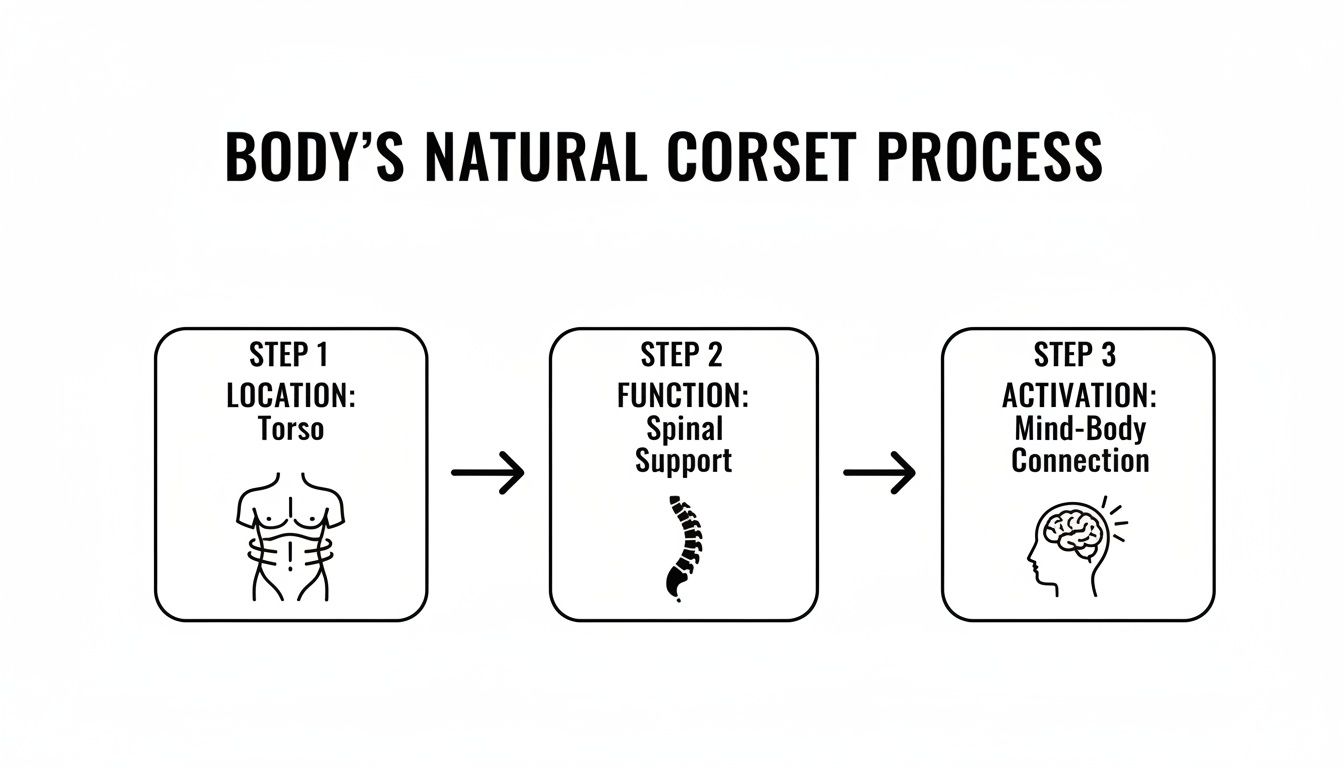
As you can see, the TrA's unique position allows it to support the spine—a process that all starts with this kind of mindful activation.
Distinguishing Engagement From Bracing
A really common mistake is to brace your entire abdomen like you’re about to get punched. That action mainly fires up the more superficial "six-pack" muscles (rectus abdominis) and obliques, which will often cause your abs to push outward against your fingers. Activating the TrA is the complete opposite—it's a hollowing or drawing-in sensation.
The goal is to feel a deep, gentle tension without holding your breath or seeing your stomach push up. If you're struggling, try a small, gentle cough. That reflexive action is your TrA firing instinctively to stabilize your spine.
Focusing on the quality of your exhale is everything here. For a deeper dive, exploring different breathing techniques for Pilates can make a huge difference in strengthening this connection.
Interestingly, research backs up this "less is more" approach. Studies show that learning how to activate the TrA with low-load, control-focused movements is often more effective than just grinding through harder ab exercises. Electromyography (EMG) studies found that even tough plank variations struggle to elicit TrA activation above 60% of its max potential. That peak level was actually recorded during a simple abdominal hollowing task, which tells us that precision and control are far better for targeting this deep muscle than sheer force.
This whole section is about building that initial link. Be patient, focus on that subtle feeling under your fingertips, and let your exhale be your guide. Nailing this foundational skill is the key to unlocking true, deep core stability.
Foundational Exercises to Build Your TrA Connection
Once you've gotten the hang of finding and feeling your transverse abdominis (TrA), it's time to gently challenge that connection with movement. We're moving beyond simple activation and starting to build real strength and endurance in this deep core stabilizer. We'll begin in stable positions, like lying on your back, to really isolate the TrA and stop those bigger, bossier muscles from taking over.
The goal here is quality over quantity. Slow, precise movements will do far more for you than rushing through a bunch of reps. Think of these as motor control drills designed to refine your mind-body connection, not old-school ab crunches.
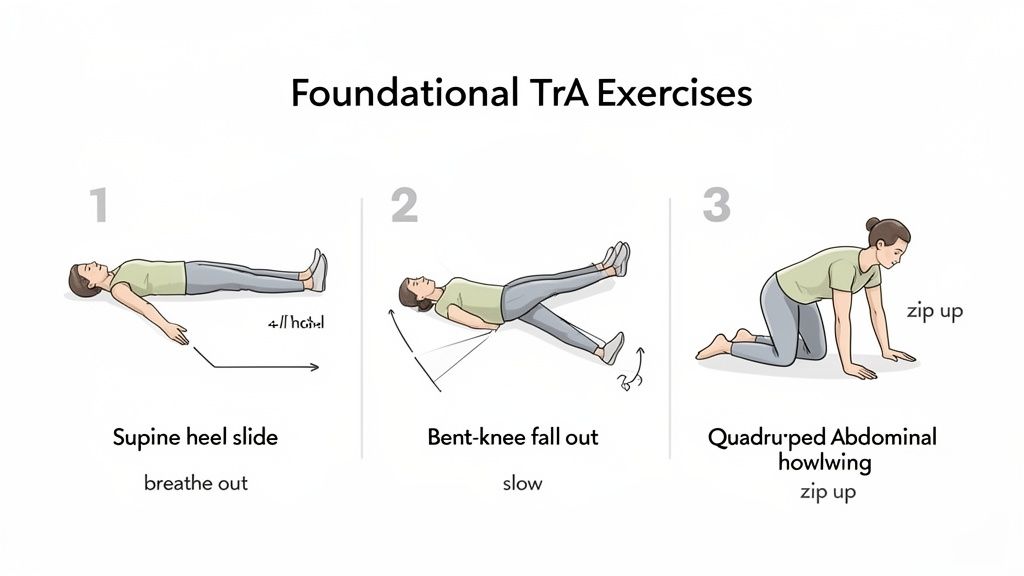
Supine Heel Slides
This is one of the very best first movements to try. It teaches your core to hold steady while your limbs are moving—a fundamental skill for literally everything you do.
- Starting Position: Lie on your back, knees bent and feet flat on the floor. Find your neutral pelvis.
- Activation: Take a breath in to prepare. As you exhale, gently draw your navel toward your spine to engage that deep TrA corset.
- The Movement: Keeping that core connection solid, slowly slide one heel away from you along the floor until your leg is straight.
- The Return: Inhale as you smoothly slide the heel back to where you started. The real work is keeping your pelvis perfectly still—no rocking side to side.
The key is to prevent your lumbar spine from arching up off the floor as your leg extends. If you feel that arch, you’ve lost the TrA connection and your hip flexors have taken over. Just reset and try again, maybe not sliding the leg out quite as far.
Bent Knee Fall Outs
This one looks deceptively simple, but the precision it demands makes it incredibly effective for teaching your TrA to control rotation and pelvic stability.
- Setup: Start in the same position as the heel slide—on your back with your knees bent.
- Engage: Exhale to find that deep abdominal wrap, gently zipping up from your pubic bone toward your navel.
- Action: While keeping your core engaged and the opposite hip completely still, slowly let one knee fall open to the side. Only go as far as you can without letting your pelvis rock along with it.
- Return: Inhale and use your deep core muscles—not your leg—to draw the knee back to the center.
Your whole focus should be on keeping the opposite side of your pelvis anchored to the mat. I often tell clients to imagine a full glass of water resting on that hip bone; don't spill a drop! This intense focus on stability is a core tenet of so many Pilates exercises for core strength.
This kind of focused practice pays off faster than you might think. Clinical research shows that activating the TrA is a skill that improves measurably in just a few weeks. One study found that a 4-week core program, training just twice per week, led to significant improvements in how strongly and quickly the TrA fired. This backs up what we see in the studio every day: slow, controlled practice builds the essential neural pathways for lasting stability.
Progressing Your TrA Activation for Functional Strength
So you've mastered the basic activation cues and can feel that deep corset muscle engaging. That's a huge win. But the real magic happens when your transverse abdominis (TrA) starts firing on its own, stabilizing your spine without you even having to think about it.
Now, we bridge the gap from conscious, isolated exercises to integrated, real-world strength. The goal is to make that deep core support second nature.
The way we do this is by adding gentle challenges—think light loads or a bit of controlled instability. We’re graduating from static holds on the floor to more dynamic movements that actually mimic the demands of daily life. This progression essentially forces your TrA to work harder to keep your spine stable and prevent unwanted movement, like your lower back arching or your pelvis rocking side-to-side.
Building Stability With Dynamic Movement
The Dead Bug is the perfect place to start this progression. It's a fantastic exercise because it challenges your core to stay rock-solid while your arms and legs are moving—a fundamental pattern for coordinated activities like walking, running, or reaching for something on a high shelf.
- Get into Position: Lie on your back with your knees bent at a 90-degree angle directly over your hips and your arms reaching for the ceiling. This is your "tabletop" position.
- Activate Your Core: Take a full exhale to engage your TrA. You should feel that deep cinching sensation as your lower back gently presses toward the floor.
- The Movement: Keeping that core connection locked in, slowly lower your opposite arm and leg toward the floor. Here's the key: only go as far as you can without your rib cage flaring up or your back arching off the mat.
- The Return: Inhale as you bring your arm and leg back to the start with total control. Then, switch sides.
The goal here is a completely quiet torso. If you feel your back start to arch, you've gone a little too far. Just dial back the range of motion until you can maintain that perfect stability.
Challenging Your Core in a Quadruped Position
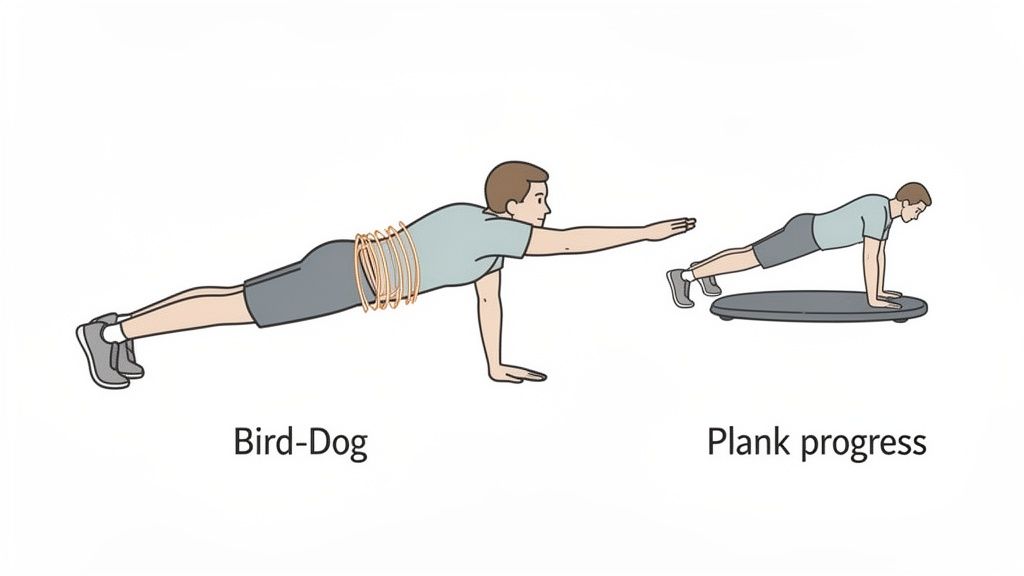
Moving onto your hands and knees completely changes the game. Suddenly, your core has to fight gravity in a whole new orientation. The Bird-Dog is my go-to exercise for this next phase.
- The Setup: Start on all fours. Make sure your hands are stacked directly under your shoulders and your knees are right under your hips.
- Engage: Exhale to find that deep abdominal lift, pulling your navel in and up to prevent your belly from sagging toward the floor.
- The Action: Extend one arm straight forward and the opposite leg straight back, focusing on keeping your hips and shoulders perfectly square to the floor. I tell my clients to imagine they have a tray of drinks balanced on their lower back—don't spill them!
- Hold and Return: Hold that extended position for a full breath, then return to the starting position with deliberate control.
This movement is brilliant because it trains the TrA to cooperate with the small stabilizing muscles along your spine (like the multifidus) to resist rotational forces. While our main focus here is the TrA, it’s always good to remember it's part of a bigger team. For a wider view, you can explore some great exercises for overall core stability.
Think of this progression as teaching your core to "multi-task." You're asking it to hold a stable center while your limbs create controlled chaos around it. This is the very definition of functional strength.
Finally, we have the classic Plank. It's a staple for a reason, but only if you do it right. Instead of just gritting your teeth and holding on for dear life, I want you to focus on using a powerful exhale to activate your TrA. This small shift transforms the plank from a passive hold into an active stability drill, teaching your core to support your entire body as one solid, integrated unit.
Now, let's look at how these pieces fit together in a clear progression.
Progressing Your TrA Exercises
This table lays out a path from those foundational activation exercises to more challenging, integrated movements. It also shows how you can incorporate props like the WundaCore Resistance Ring or Resistance Band to add another layer of feedback and challenge.
| Movement Level | Example Exercise | Focus | WundaCore Prop Integration |
|---|---|---|---|
| Foundational | Heel Slides, Bent Knee Fall Outs | Isolating the TrA without involving the spine or limbs in complex movement. Pure activation. | Place the Resistance Ring between inner thighs for alignment feedback. |
| Beginner Dynamic | Dead Bug | Maintaining a stable pelvis and rib cage while limbs move. Anti-extension. | Use the Resistance Band around feet to add a controlled challenge. |
| Intermediate Dynamic | Bird-Dog | Resisting rotational forces and maintaining a neutral spine against gravity. Anti-rotation. | A Resistance Ring between hand and opposite knee can increase engagement. |
| Advanced Integrated | Plank Variations (e.g., with leg lifts) | Integrating the TrA to stabilize the entire body under load. Full-body stability. | Place a Resistance Ring above the ankles during leg lifts for added glute work. |
Starting with the basics and mindfully working your way up this table is the safest and most effective way to build a truly strong and functional core.
Common TrA Activation Mistakes and How to Fix Them
Learning to properly activate your transverse abdominis (TrA) is a skill, and like any new skill, it takes patience and awareness. It’s incredibly common to get it wrong at first, but think of every mistake as a chance to get to know your body better. This is your personal troubleshooting guide for the most frequent pitfalls I see with clients.
One of the biggest hurdles is the tendency to use the wrong muscles. Instead of that subtle, deep engagement we're looking for, many people instinctively jump to the forceful movements they know from traditional ab workouts. Just recognizing these common errors is the first big step toward making your efforts truly effective.
Sucking In vs. True Engagement
The most frequent mistake, hands down, is simply sucking in your stomach. When you suck in, you're pulling everything up and in, which often lifts your rib cage and makes you hold your breath. This creates a ton of tension in your upper abs and diaphragm, but it completely misses the deep, stabilizing action of the TrA.
How to Fix It: Forget everything else and focus entirely on your exhale. As you breathe out slowly and completely, think about gently drawing your navel back toward your spine without letting your ribs pop up. Use your two fingers inside your hip bones for feedback; a real TrA engagement feels like a subtle tensioning or firming under your skin, not a dramatic, hollowed-out feeling.
Abdominal Doming or Bracing
Another common issue I see is "doming," where a little ridge pops up right down the midline of your abdomen along the linea alba. This is a dead giveaway that your rectus abdominis (the superficial "six-pack" muscle) has overpowered the deeper TrA. This almost always happens when an exercise is just a bit too challenging for your current level of deep core control.
How to Fix It: The moment you see doming, dial back the difficulty. If it happens during a Dead Bug, for instance, don't lower your arm and leg as far. Reset your connection on the exhale and make it your top priority to keep a flat, tensioned lower belly, even if that means a smaller range of motion for now.
The goal is to feel a gentle wrapping sensation around your entire midsection, almost like a corset tightening. If you feel any bulging or pushing outward, your superficial abs have crashed the party. Slow down, reset, and reconnect with your breath.
The Importance of Consistent Practice
These deep motor patterns can be especially tricky to relearn as we get older. Research shows that our natural ability to fire up the TrA can decline with age. One study, in fact, found that age alone explained nearly 20% of the variance in TrA activation capacity. This suggests that many adults over 40 may need a bit more focused coaching to find that connection.
You can learn more about the research on TrA activation and age if you're curious about the science. This really just highlights why mindful, consistent practice is so crucial for maintaining spinal health and balance through midlife and beyond.
Your Questions on TrA Activation, Answered
As you start exploring how to connect with your transverse abdominis, it's totally normal for questions to come up. This kind of deep, subtle work feels worlds away from traditional ab exercises, and that can be a little confusing at first.
Let's clear up some of the most common questions I hear from clients, so you can practice with more confidence and get the results you're looking for.
How Often Should I Practice These Exercises?
When it comes to training your TrA, consistency trumps intensity every single time. We're not trying to exhaust the muscle; we're trying to re-establish a clear line of communication between your brain and your deep core.
Think short and sweet. Aim for 5-10 minutes of focused practice every day. You could run through a few Heel Slides and Bent Knee Fall Outs before you even get out of bed, or maybe during a commercial break. The goal is to make this activation a regular, almost unconscious, part of your routine. You're teaching your body to make it an automatic habit.
Why Don’t I Feel a “Burn” Like I Do With Crunches?
This is a fantastic question because it gets right to the heart of what makes TrA training so different. You're not feeling that familiar muscle burn because we aren't working the muscle to metabolic fatigue like you would with endless crunches. The TrA is a deep stabilizer, and it's mostly made of slow-twitch muscle fibers designed for endurance, not for generating explosive power.
Activating your TrA is all about improving your neuromuscular coordination—it's like gently waking up a sleepy muscle and reminding it how to do its job. The feedback you're looking for is a subtle tension and a feeling of deep support, not the fiery burn of superficial muscle exhaustion.
Imagine you're learning to play a delicate instrument rather than lifting the heaviest weight you can find. It's all about precision, control, and sensation. It's a completely different kind of work for a completely different purpose.
Can I Overdo It When Training My Deep Core?
While it’s tough to "overdo" TrA activation in the same way you might strain a bicep, it's absolutely possible to create too much tension or recruit the wrong muscles. If you catch yourself holding your breath, bracing your upper abs, or feeling any strain in your neck or low back, that’s your cue to stop and reset.
This work isn't about creating a rigid, unyielding brace around your middle. A truly healthy core is both strong and pliable. We're aiming to build a responsive stabilizer that engages just enough to support the task at hand, whether you're lifting your child or holding a plank.
Always listen to your body. If the work stops feeling deep and subtle and starts feeling forceful and strained, take a break.
Ready to build a truly functional core with guidance and perfectly designed tools? The WundaCore collection, including our patented Resistance Ring and on-demand classes, provides the feedback and programming you need to activate your deep core safely and effectively. Start building strength from the inside out and explore our kits at wundacore.com.