
Is Pilates Strength Training? A Guide to Building Real Muscle
So, is Pilates actually strength training? The short answer is a resounding yes.
It’s a powerful method that uses controlled movement against resistance—whether from your own bodyweight or specialized spring-based equipment—to build deep, functional strength from the inside out. While many people associate Pilates with flexibility or "toning," its core principles are scientifically designed to spark muscle adaptation and build power.
Rethinking Strength The Pilates Method
When you hear "strength training," you probably picture someone lifting a heavy barbell. Pilates completely reframes that idea. Instead of focusing on maximal load, it prioritizes maximum control and precise activation of the muscular system through every single movement.
Rather than isolating superficial muscle groups (like the biceps or quadriceps), Pilates challenges your body as an integrated kinetic chain. This is what builds functional strength—the kind that improves motor control and efficiency in your everyday life.
This approach is built on a few key anatomical ideas that drive real muscle development:
- Controlled Resistance: Pilates uses springs or your bodyweight to create consistent tension throughout an entire range of motion, engaging both agonist and antagonist muscles simultaneously. This forces your muscles to work harder, without relying on momentum.
- Time Under Tension: The slow, deliberate pace is intentional. It keeps muscles under load for longer periods, which is a primary trigger for stimulating both Type I (slow-twitch) and Type II (fast-twitch) muscle fibers for growth and endurance.
- Full-Body Integration: Every movement originates from the deep core musculature. This creates a stable pelvic and spinal foundation (lumbopelvic stability) that allows the appendicular skeleton (arms and legs) to move with more power and precision.
Pilates vs Traditional Strength Training At a Glance
To see how these two methods stack up, let's break down their core differences and intended physiological outcomes. This table offers a quick snapshot of where each discipline shines.
| Attribute | Pilates | Traditional Strength Training |
|---|---|---|
| Primary Goal | Functional strength, core stability, motor control, and muscular endurance. | Muscular hypertrophy (size), maximal strength, and power output. |
| Resistance Type | Bodyweight, spring tension (variable and progressive resistance). | Free weights, machines, bands (consistent, quantifiable loads). |
| Movement Focus | Integrated, full-body movements emphasizing core connection and precision. | Often isolates specific muscle groups (e.g., bicep curls, leg extensions). |
| Contraction Type | Balances concentric and eccentric contractions with a focus on control. | Primarily focused on the concentric (lifting) phase, though eccentric is key. |
| Progression | Increases challenge through spring tension, complexity of movement, and stability demands. | Increases load (weight), volume (reps/sets), or intensity. |
| Typical Outcome | Lean muscle definition, improved posture, enhanced body awareness, and injury resilience. | Significant increase in muscle mass, raw strength, and power. |
While their approaches differ, both are valid and highly effective paths to building a stronger body. The best choice often depends on your specific anatomical and performance goals.
The Science Behind the Strength
Pilates isn't just a workout; it's a scientifically-backed method. Research consistently shows measurable improvements in muscle strength.
For example, studies have revealed that just 12 weeks of Pilates can lead to quantifiable increases in abdominal, upper-body, and lower-body strength. Other research has shown that older adults gain significant long-term improvements in balance and strength from consistent practice, proving its effectiveness across all ages.
Pilates builds strength not by overpowering the muscles, but by teaching them how to work smarter and more efficiently together. It's about creating a resilient, intelligent body.
Beyond the unique benefits of Pilates, understanding general strategies to get stronger faster can help you maximize your results. When you combine the deep control of Pilates with broader strength knowledge, you create a truly well-rounded and powerful fitness routine.
The Anatomical Blueprint for Pilates Muscle Growth
To really get to the heart of whether Pilates is strength training, we need to examine how muscles actually work at a physiological level. Pilates doesn't just scratch the surface; it sparks deep changes that build resilient, functional strength from the inside out. The entire method is built on precise muscle contractions and sustained, focused effort.
This quick map breaks down how Pilates pulls it all together—using your own bodyweight, adding external resistance, and demanding intense neuromuscular focus to build strength.
As you can see, all these pieces work in sync. This isn't about just becoming more flexible; it's a proven system for developing controlled, usable power.
Eccentric Contractions: The Secret to Long, Strong Muscles
Think about a bicep curl. Lifting the weight is a concentric contraction—your biceps brachii shortens as it contracts. But what about lowering the weight slowly and carefully? That’s the eccentric contraction, where the muscle lengthens under tension.
Pilates is obsessed with this eccentric phase. By using spring resistance or body weight to control the "return" part of an exercise, you're creating micro-tears in the muscle fibers. This process, known as delayed onset muscle soreness (DOMS), is the exact signal your body needs to repair and rebuild them stronger and more resilient. It’s this focus on the controlled lengthening of muscles that helps build long, lean, and incredibly durable muscle tissue.
Eccentric training is well-known for being especially effective for muscle conditioning and preventing injuries. Pilates weaves this principle into nearly every single exercise, making it a powerhouse for developing resilient strength.
This controlled lengthening is precisely why people who do Pilates often develop a physique that's both strong and sleek, not bulky. If you're looking to build muscle from multiple angles, exploring the best methods for building muscle can add even more context to what makes the Pilates approach so effective.
Time Under Tension: Making Every Second Count
In many workouts, momentum can be the enemy of real progress. Pilates is designed to eliminate it completely. That slow, deliberate pace isn't just for show; it's a strategic move to maximize time under tension (TUT). By keeping muscles actively engaged for the entire movement, both concentrically and eccentrically, you force more muscle fibers to be recruited.
Here’s an anatomical breakdown: a quick, sloppy rep might only engage the largest muscle fibers for a split second. A slow, controlled Pilates rep keeps both slow-twitch (endurance) and fast-twitch (power) fibers fired up for an extended period. This sustained effort exhausts the muscle fibers more thoroughly, sending a loud and clear hypertrophic signal to your body: adapt by getting stronger. This is a core reason why Pilates is absolutely legitimate strength training. You can get a better sense of this by diving into what muscles Pilates works and seeing how it engages the whole body.
Building Your Powerhouse: The Core Connection
Finally, you can't talk about the anatomy of Pilates without talking about the "powerhouse." This isn't just about your rectus abdominis (the six-pack). It's a whole network of deep, stabilizing muscles that wrap around your lumbopelvic region like a supportive corset.
These key players include:
- The Transverse Abdominis: Your deepest abdominal muscle, which acts like a natural weight belt to stabilize your spine.
- The Multifidus: A series of small but mighty muscles running along the vertebral column, providing crucial segmental stability.
- The Diaphragm: Your primary breathing muscle, which is totally integrated into generating intra-abdominal pressure for core control.
- The Pelvic Floor: The muscular sling at the base of your pelvis that supports your organs and provides foundational stability.
Every single Pilates exercise starts by engaging this powerhouse. When you strengthen these deep, stabilizing muscles first, you build an incredibly solid foundation. This is what allows for more powerful, efficient, and safer movement in everything else you do—from lifting heavy at the gym to just carrying your kids. It’s the anatomical blueprint for strength that’s built to last.
Comparing Muscle Hypertrophy: Pilates vs. Weightlifting
Let’s tackle one of the most common questions: “Will Pilates make me bulky?”
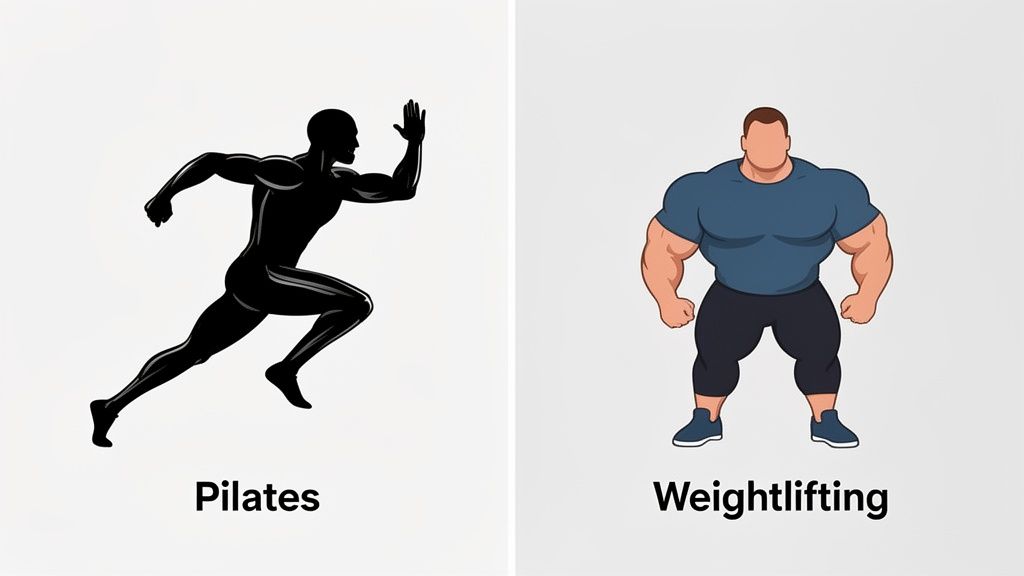
The short answer is a definitive no. The reason lies in how Pilates and traditional weightlifting approach muscle growth, a process known as hypertrophy. Understanding this difference is key to seeing why Pilates builds such incredible strength, but with a physical result that’s distinct from heavy lifting.
It’s less about building sheer size and more about creating dense, powerful, and incredibly functional muscle.
Two Paths to Muscle Growth
When you challenge your muscles, they adapt by getting bigger and stronger. But not all growth is created equal from a physiological standpoint. There are two main types of hypertrophy, and each training style favors one over the other.
- Myofibrillar Hypertrophy: This is an increase in the density and number of the muscle's actual contractile proteins (myofibrils). Think of it as upgrading your muscle’s “engine” to be more powerful without making it dramatically larger. This is the primary type of growth stimulated by Pilates.
- Sarcoplasmic Hypertrophy: This involves an increase in the volume of the fluid (sarcoplasm) that surrounds the muscle fibers. While this makes the muscle appear bigger, it doesn't contribute as much to its raw, force-producing power. This is what we typically see in bodybuilding-style training.
Pilates is a master at creating myofibrillar hypertrophy. The result is lean, defined muscle that’s shockingly strong for its size—picture the powerful yet streamlined physique of a sprinter compared to the sheer mass of a bodybuilder.
Progression, the Pilates Way
In weightlifting, the path to progression is pretty straightforward: add more weight to the bar. Simple.
In Pilates, the approach is more nuanced, focusing on enhancing neuromuscular efficiency. We challenge muscles from multiple anatomical planes to build a strength that’s completely integrated.
Instead of just lifting heavier, we advance by:
- Increasing Spring Resistance: On equipment like the Reformer, adding or changing springs directly increases the mechanical load your muscles have to manage.
- Demanding More Stability: Exercises are tweaked to challenge your balance and core control, forcing smaller stabilizing muscles like the gluteus medius or deep spinal rotators to fire up and work harder.
- Using Advanced Tools: Incorporating props like the WundaCore Resistance Ring can seriously intensify the work, replicating reformer-style resistance and deepening muscle engagement.
This focus on control and stability is what builds strength that actually shows up in your daily life, long after you’ve left the studio. We dive deeper into this concept in our guide to progressive resistance training.
Why People Are Choosing Pilates for Strength
The fitness world is really catching on. The explosion in Pilates' popularity isn't just a fleeting trend; it’s a reflection of a real shift toward building functional, sustainable strength that lasts.
In a global analysis, ClassPass reported that Pilates was the most-booked workout worldwide, beating out every other form of exercise. This isn’t a small thing. It shows just how many people are now turning to Pilates as their primary way to build a strong, resilient body.
Ultimately, both Pilates and weightlifting are fantastic forms of strength training. They just take different anatomical routes to get you stronger, offering two distinct—and equally valuable—approaches to building a powerful body.
How to Integrate Pilates Into Your Strength Routine
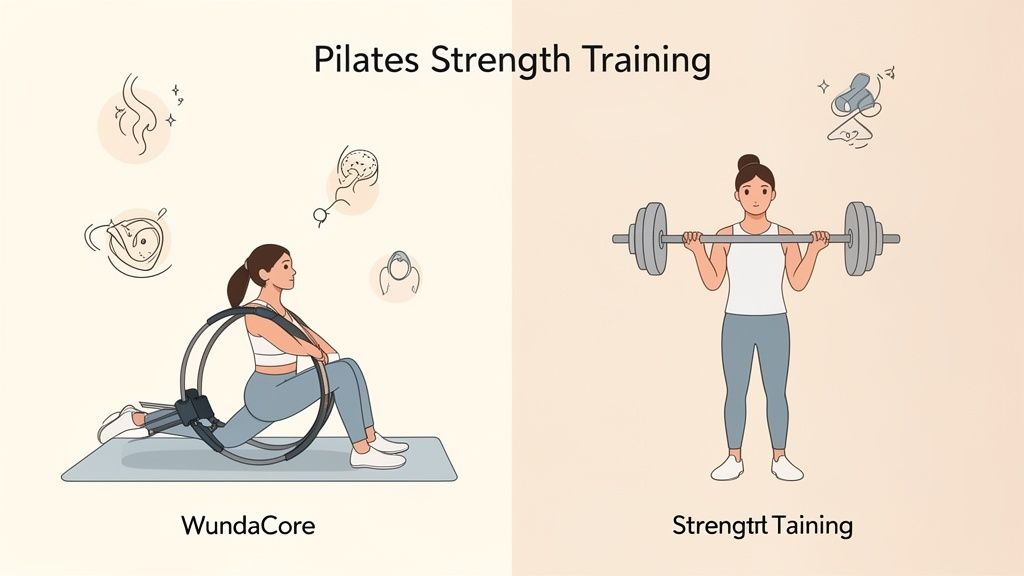
Alright, now that we’ve broken down the anatomical basis of Pilates strength, let's talk about putting it into action. This isn't an "either/or" situation. Think of Pilates as a powerful complement—something that shores up weak links in your kinetic chain, enhances performance, and builds a more resilient body from the inside out.
Weaving Pilates into what you already do is probably simpler than you think. Whether you're a dedicated weightlifter or a long-distance runner, Pilates targets the deep stabilizing muscles that often get missed, making you stronger and more efficient at everything else.
For the Weightlifter Building a Stronger Foundation
If you love lifting heavy, Pilates is your secret weapon for active recovery and prehab. Pushing heavy weight builds incredible strength, but it can also lead to muscle imbalances and a core that's strong on the surface (rectus abdominis) but weak underneath (transverse abdominis). Pilates goes straight to the source of these issues.
- Active Recovery Days: Instead of sitting on the couch, try a 30-minute Mat Pilates session. It boosts blood flow, restores mobility in the joints, and encourages fascial release without frying your central nervous system.
- Fixing Muscle Imbalances: Many Pilates exercises work unilaterally (one side of the body at a time). This quickly exposes—and corrects—the strength gaps between your left and right sides that can lead to injury under a heavy barbell.
- Bulletproofing Your Core: Moves like The Hundred or Leg Circles build the deep abdominal wall and multifidus strength you need to stabilize your spine during heavy squats and deadlifts. This protects your intervertebral discs and actually helps you lift more.
For the Runner Chasing Endurance and Power
Running is all about repetitive motion in the sagittal plane. If your core isn't stable, or your gluteus medius is weak, energy leaks out with every single stride, often leading to pelvic drop. This leads to early fatigue and the nagging overuse injuries that plague so many runners. Pilates builds the exact kind of lumbopelvic stability a runner needs to hold their form, even when exhaustion sets in.
Pilates doesn’t just build muscle; it builds control. For a runner, that neuromuscular control is the difference between an efficient stride that conserves energy and a sloppy one that wastes it.
Here’s how to slot it into your week:
- Pre-Run Activation (10-15 mins): Before you head out, do a few exercises like Bird-Dog or Single-Leg Bridges. This "wakes up" your glutes and deep core muscles through targeted neuromuscular activation, so they're ready to fire properly.
- Cross-Training Days (30-45 mins): Swap one of your shorter runs for a full Pilates session. You’ll build functional strength without the pounding on your joints, with a big focus on hip stability and posture. This improves your running economy—how efficiently you use oxygen—so you can run stronger, for longer.
Bringing the Studio Home with WundaCore
You don’t need a room full of expensive equipment to get the benefits of resistance-based Pilates. Tools like the WundaCore Resistance Ring are designed to mimic the spring-based tension of a Reformer right on your living room floor.
Adding it to your mat routine seriously ups the ante, firing up your adductors (inner thighs), glutes, and core in a whole new way. If you want more ideas, you can learn more about the best resistance bands for Pilates and find the right tools for your specific goals.
Tracking Strength Gains Beyond the Scale
When you commit to a new routine, you want to see results. I get it. But with Pilates, your biggest wins won't always show up on the bathroom scale. The real progress is measured in how your body moves, feels, and performs in your day-to-day life.
Instead of getting fixated on a number, start paying attention to the clues your body is giving you. These are the true markers of functional strength, reflecting that deep-down neuromuscular coordination and endurance you're building. This is how you know your powerhouse is getting stronger and your body is working smarter, not just harder.
Performance Indicators You Can Feel
Think about how you move when you're not actively working out. That’s where the benefits of Pilates truly shine. Start tracking these real-world metrics to see just how far you've come.
- Improved Posture: Are you standing and sitting taller without constantly having to correct yourself? That's your stronger core musculature, particularly the deep erector spinae and transverse abdominis, providing effortless support for your spine.
- Better Balance: Give yourself a quick test. Can you hold a single-leg stance for 10-15 seconds longer than you could last month? Enhanced balance is a clear sign your tiny stabilizer muscles in the hips and ankles are firing on all cylinders.
- Increased Endurance: How do you feel during other activities? Maybe you have more gas in the tank on your runs or feel less wiped out after a long day. That’s your muscular endurance and improved core stability at work.
The most profound strength gains from Pilates aren't just about lifting more; they're about living with more ease, control, and power in your own body. It’s strength you carry with you everywhere.
A Look at Real-World Progression
So, how do you actually see this improvement during your workouts? Progression in Pilates is subtle but incredibly powerful. It’s less about adding another plate to the bar and more about demanding greater precision and control from your own body.
Let’s look at a sample progression for a foundational exercise, The Hundred. This table shows how you can build serious strength over several weeks by advancing the same core movement, continuously challenging your muscles in new ways.
Sample Pilates Exercise Progression for Strength
This table illustrates how to progress a foundational Pilates exercise over time to continuously challenge muscles and build strength.
| Week Range | Exercise Variation (The Hundred) | Strength Focus | Metric for Success |
|---|---|---|---|
| Weeks 1-4 | Knees bent in tabletop, head down | Deep core connection and breath control | Complete 100 pumps without any neck strain. |
| Weeks 5-8 | Knees bent in tabletop, head and shoulders lifted | Abdominal endurance and upper body stability | Hold your curl without losing form for the full exercise. |
| Weeks 9-12 | Legs extended at a 45-degree angle | Full core engagement and increased load | Maintain a stable pelvis and low back connection. |
| Weeks 13+ | Legs lowered to a more challenging angle | Maximal core strength and control | Execute with precision and perfectly controlled breathing. |
This gradual increase in difficulty ensures you're consistently building strength, proving that progress can be measured in millimeters of control, not just kilograms on a bar. This is how you know your Pilates practice is delivering real, functional strength.
Got Questions About Pilates for Strength? Let's Clear Them Up.
As you start to think about adding Pilates to your routine, a few questions always pop up. Getting straight answers is the best way to figure out how this powerful method fits into your life and your goals.
Is Pilates a Standalone Strength Program?
For the vast majority of people looking for functional strength, incredible core stability, and better balance, the answer is a resounding yes. A consistent Pilates practice, say 3-4 times per week, is a complete system for building strength. It methodically loads your muscles with controlled, intelligent resistance.
Now, if your specific goal is to build the maximum muscle mass seen in bodybuilding (sarcoplasmic hypertrophy), you'll want to supplement with traditional heavy lifting. Pilates builds a lean, powerful, and integrated physique, but bodybuilding requires a different kind of stimulus.
How Fast Will I See Muscle Definition with Pilates?
You'll feel the neuromuscular changes long before you see them. Most people notice a huge difference in their core connection, posture, and body awareness within just a few weeks of consistent practice. It's a feeling of being more "plugged in."
As for visible muscle tone and definition, that typically starts to become noticeable after about 8-12 weeks. Just remember, everyone's body is different, and your results will depend on how often you practice, the intensity of your workouts, and your nutrition.
Pilates creates strength from the inside out. You'll feel the change in your stability and control long before you see every new line of muscle definition—trust the process.
Can Men Actually Build Muscle with Pilates?
Absolutely. Let's not forget, Pilates was created by a man, Joseph Pilates, to help rehabilitate and strengthen soldiers. The method is incredibly good at building the deep, stabilizing muscles that are often missed in typical gym workouts that focus on superficial "mirror muscles."
This focus on the body's foundational support system creates a balanced, functionally strong physique. It offers a unique muscular challenge that makes it a fantastic tool for men who want integrated, powerful strength without the bulk.
Is Pilates Good for Building Strength During Menopause?
It's an exceptional choice. During menopause, hormonal shifts can accelerate muscle loss and decrease bone density. Pilates is a game-changer because it's low-impact, which is much kinder to joints that might be feeling more sensitive.
More importantly, its focus on resistance training is exactly what's needed to fight age-related muscle loss (sarcopenia) and help preserve bone density (osteogenesis). This makes it a safe, smart, and highly effective way to build and maintain strength through menopause and beyond.
Ready to build deep, functional strength from home? The WundaCore collection, designed by celebrity trainer Amy Jordan, brings the anatomy-informed studio experience to you. With tools like the patented Resistance Ring and hundreds of on-demand classes, you can build a resilient, powerful body on your own schedule. Explore the complete system at https://wundacore.com.