
Pilates for Seniors: A Guide to Strength, Balance, and Anatomy
Pilates is a fantastic choice for older adults because it gets right to the heart of what matters for staying mobile and independent: core strength, posture, and mindful control. It’s a safe, incredibly effective way to keep moving well, especially when you’re practicing from the comfort of home. What makes it so different is its anatomy-driven approach, which is uniquely supportive of the aging body.
Why Pilates Is a Perfect Fit for Senior Fitness
As we get older, maintaining muscular strength and proprioceptive balance can feel like a full-time job. It’s completely understandable that conditions like osteoarthritis, joint stiffness, or even a fear of falling can make the thought of a new fitness routine a little intimidating.
Pilates meets you right where you are. It’s designed to address these exact concerns with controlled, gentle movements that build strength from the inside out, targeting the deep postural muscles. This isn't about high-impact, sweaty cardio; it’s all about precision, neuromuscular control, and connecting with your own body's mechanics.
Instead of putting compressive stress on your joints, Pilates movements are designed to stimulate synovial fluid production while strengthening the deep stabilizing muscles that act as your body's internal support system. Think of it as reinforcing your musculoskeletal frame from within—a frame that naturally improves your spinal alignment, can ease chronic back pain, and helps you move with more confidence and biomechanical efficiency.
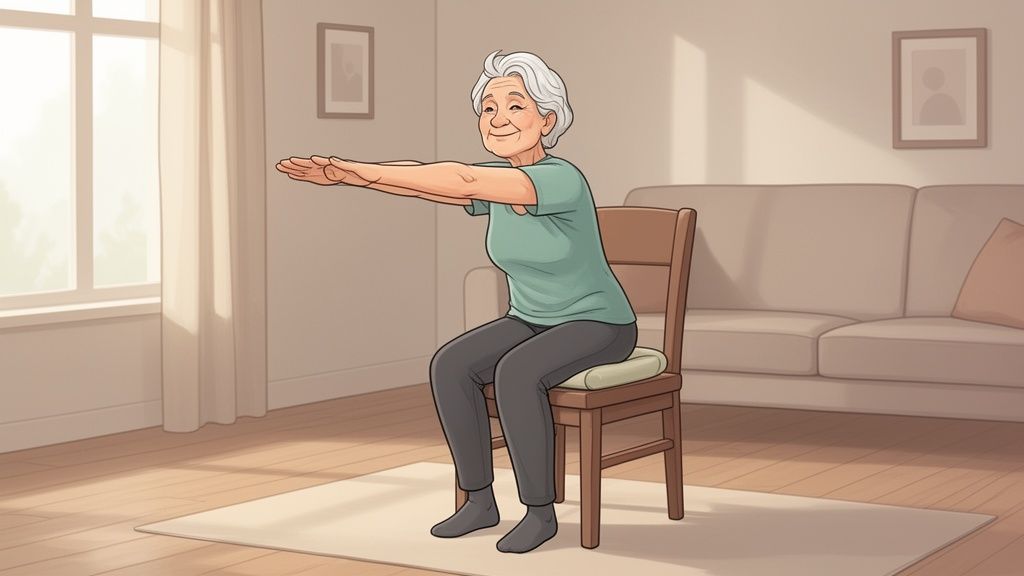
The Growing Appeal of Low-Impact Fitness
It's no surprise that Pilates has seen a huge surge in popularity, especially among older adults looking for workouts that are both effective and kind to their bodies. Industry numbers show that mat Pilates bookings have shot up by as much as 114%, and the demand for online classes has climbed right alongside it.
This shift really points to a bigger trend toward home-based fitness that offers convenience without compromising on joint-friendly movement. For anyone looking to build a routine that will stick, Pilates is a powerful cornerstone. It also pairs beautifully with other activities; you can explore a variety of year-round fitness exercises for seniors to create a well-rounded and sustainable plan.
Pilates meets you where you are. Its principles are not about achieving a perfect pose but about understanding your own body's anatomy and mechanics to move more efficiently and safely every single day.
Foundational Principles for Senior Wellness
The real magic of Pilates lies in its core principles, which happen to align perfectly with the physiological goals most important to older adults. Each one of these ideas translates directly into a real-world benefit that supports an active, independent life.
Let’s break down how these foundational concepts connect to senior health in a tangible, anatomical way.
How Pilates Principles Support Senior Wellness
| Pilates Principle | Anatomical Focus for Seniors | Real-World Benefit |
|---|---|---|
| Centering | Activating the deep core musculature (transverse abdominis, pelvic floor, diaphragm, multifidus) that wraps the lumbar spine like a natural corset. | A stronger, more stable core protects the intervertebral discs from strain, improves thoracic and lumbar posture, and provides a solid base for better balance, reducing fall risk. |
| Concentration | Creating a strong mind-body (neuromuscular) connection by focusing on proprioceptive feedback from muscles and joints during every movement. | This heightened somatic awareness helps correct poor postural habits, enables more mindful movement, and improves reaction time to prevent a stumble. |
| Control | Emphasizing slow, deliberate, eccentric and concentric muscle contractions rather than momentum. Every exercise has a clear biomechanical path. | Building muscle strength and endurance without jarring or stressing sensitive articular cartilage, making it ideal for managing conditions like arthritis. |
By focusing on these principles, you're not just "doing exercises." You're re-educating your neuromuscular system to move in a smarter, safer, and more efficient way that will serve you well beyond the mat.
Your Anatomical Blueprint: How Pilates Rebuilds the Body
Pilates isn't just a set of gentle exercises; it's a smart system designed to re-educate your body on how to move with biomechanical efficiency. For seniors, this focus on the body's fundamental mechanics is exactly what makes the practice so effective. It gets right to the heart of what supports mobility, protects against injury, and keeps you living a vibrant, active life.
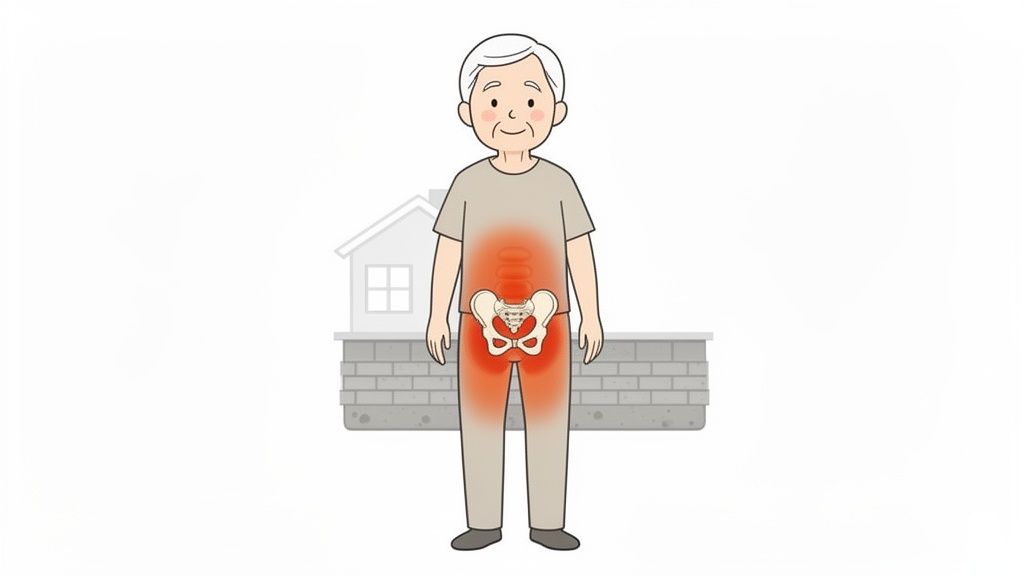
Think of your body like a house. Over decades, the foundation might settle a bit, the frame could weaken, and the hinges on the doors might start to get creaky. Pilates acts as the master anatomical blueprint to reinforce this entire structure from the inside out, starting with the most critical area of all: the core.
Building a Stronger Foundation
When we talk about the "core" in Pilates, we're going much deeper than just the rectus abdominis (the six-pack muscles). We're targeting the deep, stabilizing muscles that form a natural corset for your torso. This includes the transverse abdominis, which wraps around your midsection like a cummerbund, the multifidus muscles running along the spine, and the pelvic floor, which creates a supportive sling at the base of your pelvis.
These muscles are the true foundation of your strength. When they're strong and engaged, they create intra-abdominal pressure that stabilizes your spine, taking a huge amount of load off your lumbar vertebrae and creating a solid base for every single move you make. It's this internal support system that is so crucial for preventing the kind of nagging back pain that can put a damper on daily activities. You can dive deeper into what muscles Pilates works to build this foundational strength in our detailed guide.
This focus on deep muscle work delivers real, tangible results. Clinical trials have shown that older adults who practice Pilates just two or three times a week for 8–12 weeks see measurable improvements in both strength and flexibility. For instance, some studies have noted that lower back pain can decrease by a remarkable 30–50% after about eight weeks of consistent practice. It's a powerful demonstration of how quickly reinforcing your body's anatomical blueprint can bring real-world relief.
Lubricating Joints and Easing Stiffness
As we age, the hyaline cartilage that cushions our joints can begin to wear down, which often leads to the stiffness and discomfort of conditions like osteoarthritis. High-impact exercises can sometimes exacerbate this by jarring already sensitive joints. Pilates, however, takes a completely different, much kinder approach.
Its controlled, fluid movements gently guide your joints through their full range of motion. This gentle action stimulates the production of synovial fluid, the body's natural lubricant that nourishes cartilage and helps the articular surfaces glide smoothly against each other.
Think of your joints as rusty door hinges. If you try to force them open quickly, you might cause more damage. Pilates is like applying a few drops of oil and slowly, gently working the hinge back and forth until it moves freely, without a squeak.
This gentle lubrication is precisely why Pilates is so effective for managing the symptoms of arthritis. It helps reduce stiffness and improve mobility without creating inflammation or strain.
Maintaining a Supple Spine
A flexible spine is key to everything we do, from bending down to tie our shoes to reaching for something on a high shelf. With age, the spine can become rigid, limiting our movement and increasing the risk of injury. Pilates tackles this head-on with exercises focused on spinal articulation.
Movements like the Cat-Cow are designed to encourage each vertebra to move independently, one by one. This controlled segmentation helps maintain the health of the intervertebral discs and strengthens all the small, supportive muscles along the spinal column, such as the multifidus and erector spinae.
- Flexion (Rounding Forward): Gently stretches the erector spinae muscles all along your back.
- Extension (Arching Back): Strengthens the muscles that help you stand up tall against gravity.
- Rotation (Twisting): Improves mobility in the thoracic spine for everyday actions like turning and reaching.
By practicing these movements, you are essentially training your spine to stay resilient and adaptable. This isn't just about avoiding pain; it's about preserving the functional freedom to move through your day with confidence and ease. Pilates systematically rebuilds your body’s support systems, ensuring your anatomical blueprint remains strong for years to come.
How Pilates Improves Balance and Prevents Falls
For older adults, one of the biggest concerns is the risk of falling. A fall can instantly impact your independence and really shake your confidence. Pilates takes this on directly by systematically rebuilding your body's balance systems from the inside out. This isn't just about practicing standing on one leg; it's about re-educating the deep, neuromuscular wiring that keeps you upright and steady on your feet.
I like to think of balance as a three-legged stool. To stay stable, all three "legs"—the visual, vestibular, and somatosensory systems—need to be in constant communication with your brain. If even one leg gets a little wobbly, the whole stool becomes unstable.
This diagram shows the three key systems your body relies on to stay balanced.
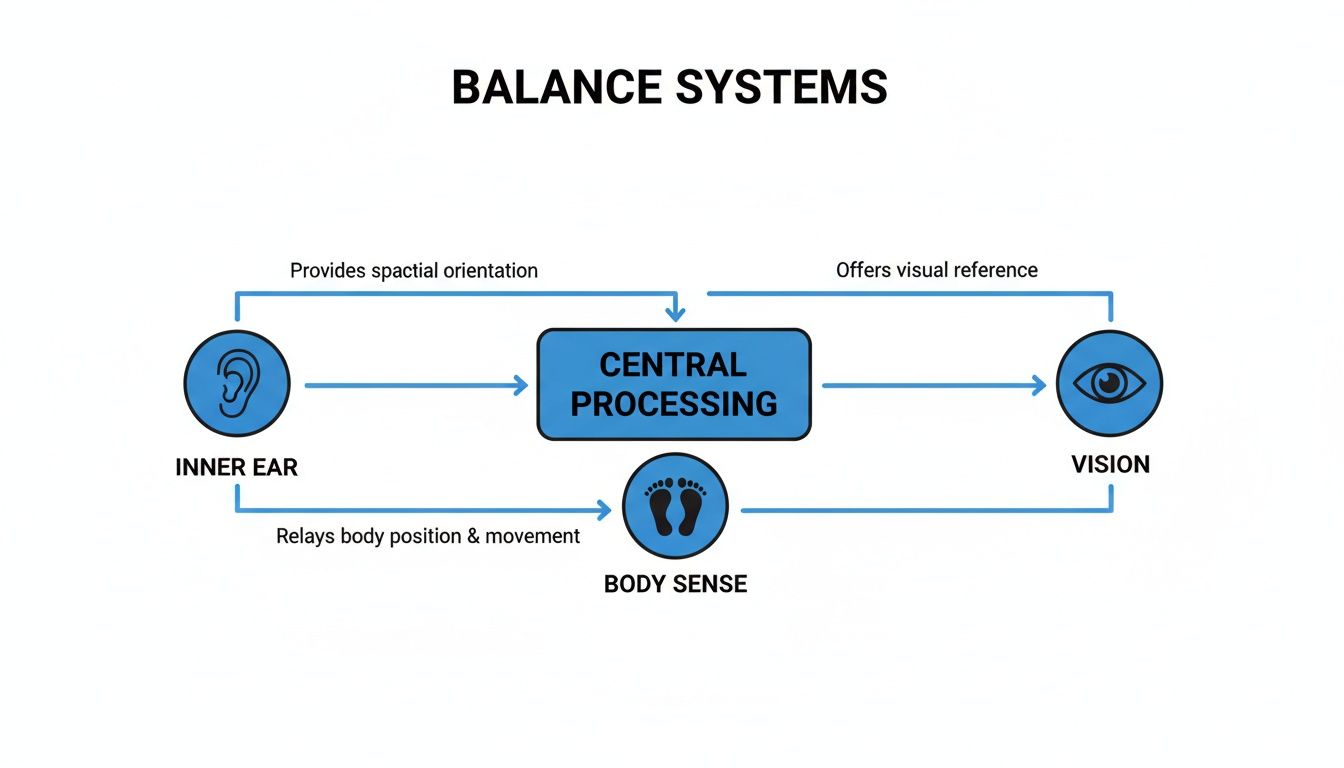
As you can see, your inner ear (vestibular system), your vision, and your body's own sense of where it is in space (somatosensory system) all feed critical signals to your brain. Your brain then coordinates the muscular response that keeps you from tipping over.
Waking Up Your Body’s Internal GPS
The first system Pilates targets is proprioception—your body's own internal GPS, a key component of the somatosensory system. It’s that amazing sense that lets you touch your nose with your eyes closed or walk up a flight of stairs without staring at your feet. This system relies on millions of tiny mechanoreceptors in your muscles and joints that are constantly sending feedback to your brain.
As we get older, this system can become less sensitive. Pilates movements, especially those that challenge your stability, are designed to "wake up" these receptors and sharpen their signals.
Take a simple standing leg lift, for example. The proprioceptors in the muscles and ligaments of your standing foot and ankle have to fire like crazy, making tiny, rapid adjustments to keep you from toppling over. This kind of practice fine-tunes your internal GPS, making it much more responsive when you encounter something unexpected, like an uneven sidewalk. Improving this ankle stability is so important, and you can build on it with a targeted ankle band workout to supplement your Pilates routine.
Anchoring Your Center of Gravity
The second key piece of the puzzle is your core strength. As we've covered, Pilates is brilliant at building deep core stability by firing up muscles like the transverse abdominis and pelvic floor. These muscles act like a strong, stable anchor right at your center of gravity.
Think about trying to balance a tall, wobbly pole versus a short, solid one. A strong core effectively stabilizes your lumbopelvic region, turning you into that short, solid pole—much, much harder to knock off balance. Every single Pilates exercise reinforces this central anchor, ensuring that when you move your limbs, you're moving from a foundation of rock-solid stability.
A strong core gives your limbs a stable base to move from. When your center is solid, your brain has to do less work to manage your arms and legs, freeing up resources to focus on balance and coordination.
The Proof Is in the Practice
This anatomical approach gets real, life-changing results. Studies have shown that structured Pilates programs lead to clinically significant improvements in balance for seniors. One 12-week study found that participants saw notable gains in their gait speed, dynamic balance, and lower-body strength compared to those who didn't do Pilates. The research confirms what we see in the studio every day: Pilates is a highly effective, low-impact way to prevent falls.
Simple Exercises to Start Building Balance
You don't need complicated moves to start improving your stability. Here are a few safe and effective Pilates-inspired exercises you can try at home. Just be sure to have a sturdy chair or a wall nearby for support.
- Heel-Toe Walking: Walk in a straight line, placing the heel of one foot directly in front of the toes of the other. This challenges your proprioceptive and vestibular systems in a controlled, gentle way.
- Single-Leg Stance: Stand tall and lift one foot just an inch off the floor. Hold for 10-15 seconds, focusing on engaging your core and activating the gluteus medius of the standing leg. Don't let your hip pop out to the side!
- Standing Leg Circles: Holding onto a chair for support, lift one leg slightly and draw small, controlled circles from the hip joint. This little movement is fantastic for challenging the stabilizing muscles in your hip and ankle.
By consistently practicing these simple, mindful movements, you're retraining your body's fundamental systems for balance. You’re building a stronger, more confident foundation for every single step you take.
Adapting Pilates for Common Health Conditions
One of the best things about Pilates is how beautifully it can be tailored to your body's unique anatomy. It isn't a rigid, one-size-fits-all workout. Instead, it’s a system of movement that we can intelligently modify to support exactly what you need, especially if you're navigating common age-related health conditions.
This isn't about gritting your teeth and pushing through pain—far from it. It's about working smarter. We use targeted movements to help lubricate joints, build a protective layer of muscle around them, and maintain mobility, all without causing a flare-up. When we approach it with an awareness of our own anatomy, Pilates becomes a powerful tool for therapy and strength, not strain.
Pilates for Osteoporosis: Bone-Safe Movements
When you're working with osteoporosis, the anatomical goal is simple: increase bone mineral density through safe, targeted loading without putting the spine at risk. The secret lies in applying gentle, controlled resistance.
Think of your bones a bit like muscles—they get stronger when they have a job to do, a principle known as Wolff's Law. Weight-bearing exercises send a mechanical signal to your osteoblasts (bone-building cells) to lay down more minerals in the bone matrix, which is what increases its density. In Pilates, we can create this effect just by using your own body weight or the light resistance of a band.
The single most important anatomical consideration for osteoporosis is to avoid loaded spinal flexion—that means no sharp, forward rounding of the spine while bearing weight. That C-curve shape can put excessive pressure on the anterior part of the vertebrae and increase the risk of a compression fracture.
- Focus On: Exercises that strengthen the spinal extensors (the muscles along your back), as these are the ones that hold you upright. Standing work, gentle bridging, and anything that encourages you to lengthen into a tall, neutral spine are fantastic choices.
- Modify or Avoid: Forward-rounding movements like the classic Roll Up. Your new mantra is to keep the spine long and elongated instead.
Soothing Arthritis with Gentle Motion
If you're dealing with arthritis, our focus shifts from building bone density to maintaining joint mobility and calming inflammation. An arthritic joint often has worn-down articular cartilage, which is what leads to that familiar stiffness and pain. For these joints, gentle movement is like medicine.
It encourages your body to produce more synovial fluid, which is the natural lubricant that nourishes the cartilage and helps your joint surfaces glide past each other smoothly. The controlled exercises in Pilates are perfect for guiding your joints through a healthy range of motion without the jarring impact you’d get from other types of workouts.
The principle here is simple: motion is lotion. For joints affected by arthritis, gentle, controlled movement is the key to managing stiffness and staying functional. Pilates gives us the perfect framework for this kind of mindful motion.
Instead of stopping all movement, which only leads to more stiffness, we find ways to move that feel good. This might mean making the range of motion smaller or using props to give you some extra support. For example, if kneeling is painful on your patella, we can do many of the same exercises while sitting in a chair or lying comfortably on your back.
Easing Lower Back Pain with Core Support
Lower back pain is incredibly common, and it often comes down to muscle imbalances or poor lumbopelvic alignment. So many seniors are navigating chronic pain, and Pilates offers a gentle but incredibly effective way to find relief. To see just how widespread this issue is, you can explore some recent chronic pain statistics.
Pilates gets to the root of the problem by strengthening the deep core muscles—like the transverse abdominis and multifidus—that act like a natural corset for your lumbar spine. When these muscles are strong and switched on, they take the pressure off your vertebrae and intervertebral discs. But for this to work, proper alignment is everything.
A simple trick that makes a world of difference for many floor exercises is to place a small cushion or a folded towel under your sacrum. This tiny bit of lift helps tilt your pelvis into a more neutral position, immediately relieving strain on the low back and making it easier for your deep core muscles to fire up correctly.
This small anatomical adjustment can turn an exercise that feels pinchy or uncomfortable into one that feels supportive and strengthening. It’s a perfect example of how Pilates teaches you to work with your body, not against it.
To make this even clearer, here’s a quick guide on how to approach these common conditions in your practice.
Pilates Modifications for Senior Health Conditions
This table breaks down the key anatomical focus for each condition, giving you a clear picture of what movements are most beneficial and which ones you'll want to adjust.
| Health Condition | Recommended Anatomical Focus and Exercises | Exercises to Modify or Avoid |
|---|---|---|
| Osteoporosis | Focus on spinal extension and neutral spine alignment. Prioritize weight-bearing exercises like standing leg lifts, gentle bridging, and quadruped (all-fours) exercises to strengthen back extensors and build bone density safely. | Avoid deep spinal flexion (forward rounding), such as in the Roll Up or Spine Stretch Forward. Also, avoid heavy twisting motions that can put pressure on the vertebrae. |
| Arthritis | Emphasize gentle, controlled range of motion to lubricate joints. Focus on exercises like pelvic clocks, gentle leg circles, and seated arm work. Use props for support and reduce the range of motion to stay pain-free. | Modify or avoid exercises that place direct pressure on inflamed joints, such as kneeling or deep lunges. High-impact or jarring movements should be avoided entirely. Listen to your body and never push through pain. |
| Lower Back Pain | Strengthen the deep core muscles (transverse abdominis and multifidus) to create a natural "corset" for the spine. Focus on neutral spine exercises like dead bugs, heel slides, and modified planks. Use props like a cushion under the hips. | Avoid exercises that cause the lower back to arch excessively (hyperlordosis) or flatten forcefully against the floor. Uncontrolled movements or those that put a heavy load on the lumbar spine (like double leg lifts without proper support) should be modified. |
By keeping these anatomical principles in mind, you can turn your Pilates practice into a personalized and therapeutic tool that supports your health journey safely and effectively for years to come.
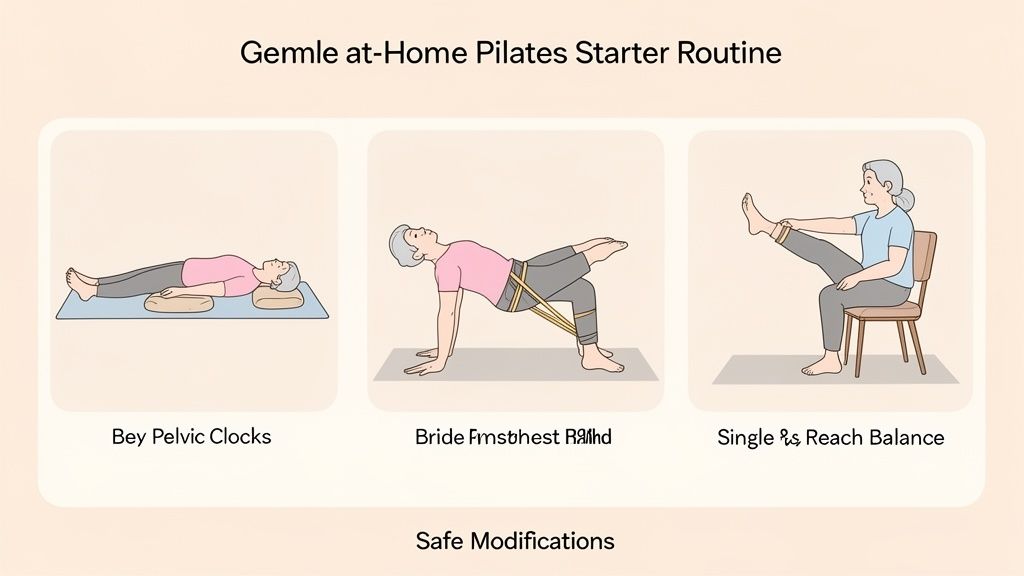
Your Gentle At-Home Pilates Starter Routine
Starting something new can feel like a big step, but the beauty of Pilates is how intuitive and effective its core movements are. I've designed this simple starter routine so you can do it right at home, focusing entirely on mindful movement and getting the biomechanics just right.
Each exercise has a clear anatomical purpose, helping you build strength and confidence from the very first session. The goal here isn't intensity; it's intention. By connecting your mind to your muscles, you're creating stronger neuromuscular pathways. Think of it as a conversation with your anatomy, where you learn to wake up dormant muscles and release chronic tension. This is precisely what makes Pilates so powerful for older adults.
Part 1: The Gentle Warm-Up
Before we jump into the main work, we need to gently wake the body up. This warm-up is all about increasing blood flow and preparing your spine and joints for movement, making sure you start your practice from a place of safety and awareness.
-
Deep Diaphragmatic Breathing: Lie on your back with your knees bent, feet flat on the floor. Place your hands on your lower ribcage. Take a deep breath in through your nose and feel your ribs expand laterally into your hands. Exhale slowly through your mouth, feeling your ribs gently narrow as your transverse abdominis engages.
- The Goal: This activates your main breathing muscle, the diaphragm, which helps calm the nervous system and co-contracts with the deep core muscles, preparing them for stabilization.
-
Pelvic Clocks: Staying on your back, imagine a clock face lying flat on your pelvis. The 12 is at your belly button, and the 6 is at your pubic bone. Gently tilt your pelvis to press your lumbar spine toward the floor (a posterior tilt to 6 o'clock), then gently arch it away (an anterior tilt to 12 o'clock). Rock slowly and smoothly between these two points.
- The Goal: We're releasing tension in the lumbar spine (low back) and gently mobilizing the sacroiliac (SI) joints, which can often feel stiff. This helps you find a neutral pelvic position.
Part 2: The Foundational Exercises
This set of movements targets the key muscles that support your posture, balance, and everyday activities. Focus on slow, controlled execution for every single rep. Remember, quality over quantity is everything in Pilates.
-
Bridging (Glute Bridge): Lying on your back with your knees bent, exhale and press firmly through your heels to lift your hips off the mat by engaging your glutes. You want to create a long, straight line from your shoulders to your knees without arching your low back. Inhale at the top, then exhale to slowly lower back down, articulating the spine one vertebra at a time.
- The Goal: This wakes up and strengthens the gluteus maximus and hamstrings. These powerful hip extensors are absolutely essential for supporting the lower back and propelling you forward when you walk.
-
Heel Slides: On your back with both knees bent, exhale as you slowly slide one heel away from you along the floor until the leg is straight. Inhale to slide it back to the start. The challenge is to keep your pelvis perfectly still—no rocking side to side!
- The Goal: This challenges your deep core corset, the transverse abdominis, to maintain lumbopelvic stability while your leg moves. It’s the same core control you need for walking and climbing stairs.
Pro-Tip: Want to boost your hip stabilizer strength during the Bridge? Place a light resistance band around your thighs, just above your knees. As you lift your hips, gently press your thighs outward against the band. This simple trick helps fire up the gluteus medius, a muscle that is so critical for single-leg balance.
Part 3: The Calming Cool-Down
The cool-down is just as important as the exercises. It lets your body process the work you’ve done and helps your nervous system shift back into a parasympathetic state of rest and recovery.
-
Single Knee to Chest Stretch: Gently hug one knee in toward your chest, keeping your other leg bent with the foot on the floor. Hold for 20-30 seconds, breathing deeply into your back.
- The Goal: A simple release for the gluteus maximus and lower back muscles on one side, easing any tension left over from your workout.
-
Gentle Spinal Twist: Lying on your back, open your arms out to the sides like a "T." Let both knees fall gently to one side, but try to keep both shoulders on the floor. Hold for a few deep breaths, then repeat on the other side.
- The Goal: We’re improving thoracic (mid-back) rotation here and giving the oblique muscles along the sides of your torso a lovely, gentle stretch.
This simple routine is a fantastic place to begin. As you feel stronger, you might consider adding a few tools to your practice. To learn more about how props can support your fitness journey, check out our guide on low-impact exercise equipment for seniors.
Remember, starting slowly and intentionally is the smartest way to build lasting strength and confidence.
Common Questions About Pilates for Seniors
Stepping into any new fitness routine is bound to bring up a few questions. That's a good thing! It means you're thinking about how to move safely and get the most out of your time. Let's walk through some of the most common queries we hear from seniors starting their Pilates journey.
Our goal here is to clear up any confusion and show you just how powerful and accessible Pilates can be, especially when you're practicing right from the comfort of your own home.
How Often Should I Practice Pilates?
When you're just starting out, think consistency over intensity. A great rhythm to aim for is two to three times per week on non-consecutive days. This gives your body, especially your muscles and nervous system, a day in between to rest, recover, and undergo protein synthesis for muscle repair.
Think of it like learning a new motor skill. That rest day gives your anatomy time to absorb the lessons of the previous session—like how to properly engage your transverse abdominis or maintain a neutral spine. Soon, what feels like a conscious effort starts to become an unconscious, ingrained motor pattern. As you get stronger and more confident, you might find yourself wanting to practice more often.
Do I Need Any Special Equipment to Start?
Honestly, you need very little to begin a safe and effective mat Pilates practice. The single most important piece of gear is a good, non-slip mat that gives your spine and joints enough cushion to feel supported.
So many foundational Pilates exercises are built around using your own body weight for resistance. This is one of the most brilliant parts of the method. Learning to control your own body against the pull of gravity is an incredibly effective way to build real, functional strength.
The most powerful tool in Pilates is, and always will be, your own body. It’s about creating a strong neuromuscular connection. Equipment can add variety and challenge down the road, but the real work starts with just you, your mat, and your breath.
As you progress, you might want to introduce simple props like a resistance band or a small ball to add a new dimension to your workouts, but they are absolutely not a requirement on day one.
Is Pilates Safe If I Have Arthritis or Osteoporosis?
Yes, not only is it safe, but it’s often highly recommended for both conditions—as long as it’s approached with anatomical awareness. The magic word here is modification, which is a core principle of the entire Pilates method.
-
For Arthritis: The gentle, controlled movements are fantastic for lubricating synovial joints without any harsh impact. We focus on improving your range of motion and easing stiffness by encouraging the production of synovial fluid, which is your body's own natural joint oil.
-
For Osteoporosis: The focus shifts to smart, bone-strengthening exercises that follow the principles of safe loading. We choose movements that safely add weight-bearing load to the skeleton, like standing leg work, while carefully avoiding positions of loaded spinal flexion to keep the vertebrae protected.
The most important rule is to always listen to your body. And if you can, work with a qualified instructor who understands the specific anatomical needs that come with these conditions.
Can I Do Pilates If I Have Limited Mobility?
Absolutely. One of the most beautiful things about Pilates is how incredibly adaptable it is. A huge number of exercises can be done while seated in a sturdy chair, which makes the practice accessible even if getting on and off the floor is a challenge right now.
Chair Pilates isn't a watered-down version of the "real" thing. It's a smart modification that uses the exact same anatomical principles—core stability, spinal alignment, and controlled movement—from a supported position. You can still strengthen your postural muscles, improve flexibility in your spine and hips, and deepen that all-important mind-body connection. It ensures that just about everyone can experience the benefits of Pilates, no matter their starting point.
Ready to build strength from the inside out with an anatomy-focused approach? The WundaCore collection, including our supportive Movement Mat and patented Resistance Ring, provides the perfect tools to bring a studio-quality experience right into your home. Explore our expertly designed equipment and start your journey to better movement today at https://wundacore.com.