
Pilates Home Equipment: An Anatomical Guide to a Stronger Core
Having the right Pilates home equipment can completely transform your practice, turning a corner of your living room into a private anatomy lab. It’s about more than just convenience; it’s about using intelligent tools to build the deep, integrated strength Pilates is famous for. This guide isn't just a list of props—we're going to dive into how each piece of equipment connects directly to your musculoskeletal system for a smarter, more effective workout.
The Rise of the Anatomy-Focused Home Pilates Studio
Doing Pilates at home has moved beyond a fleeting trend into a sustainable method for consistent, low-impact training. This shift toward creating personal fitness spaces is driven by our need for convenience without sacrificing quality. The focus is no longer just on movement, but on anatomically precise movement.
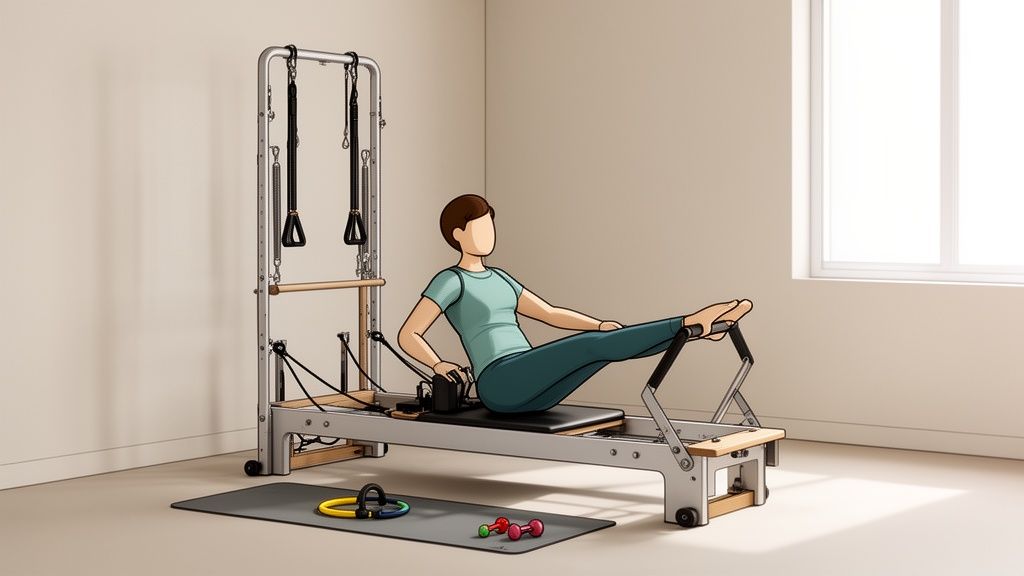
This evolution is reflected in market data. The North American market for at-home Pilates gear surpassed $2.7 billion in 2025 and is projected to grow at an annual rate of 21.60% through 2033. This growth is led by busy professionals, parents, and women navigating menopause who are discovering the power of anatomy-informed training. With the US holding a significant 65.20% of this market, it's clear that tools like Pilates rings and mats are becoming home staples because of their direct anatomical benefits and ease of storage. You can explore more data on this fitness market shift at HTF Market Insights.
A Deeper Connection to Your Musculoskeletal System
The best modern Pilates equipment is engineered with a deep understanding of human biomechanics. These tools are instruments that provide direct, tactile feedback, helping you isolate and activate specific muscles with precision. For example, a resistance ring isn't just a circle you squeeze; it's a proprioceptive tool that helps you finally feel the co-contraction of your deep core adductors and pelvic floor.
This focus on anatomical awareness is a game-changer for several key reasons:
- It builds true neuromuscular control: You learn to recruit the correct muscle fibers for each movement, which translates directly to improved posture, joint stability, and efficient daily movement patterns.
- It sharpens your proprioception: The equipment provides sensory feedback that teaches you what correct joint alignment and muscle engagement feel like internally.
- It helps replicate studio-quality results: Understanding how props mimic the resistance and support of larger machines allows you to achieve a reformer-inspired session, targeting muscles from various angles, right at home.
The goal isn’t just to perform an exercise. It’s to understand the anatomical purpose behind it. Anatomy-focused training empowers you to move with intention, turning every session into a lesson in your own body's mechanics.
By investing in equipment that supports this kind of intentional practice, you're setting yourself up for a much more rewarding journey. It's about building strength from the deep stabilizers outward, creating a resilient body that moves with efficiency and power.
Understanding Your Core Anatomy for Better Pilates
To get the most out of your Pilates home equipment, you must first understand the structures it’s designed to target. Many people hear "core" and think only of the rectus abdominis—the "six-pack" muscle. But in Pilates, the core is a deep, three-dimensional system of muscles that provides dynamic stability to the entire lumbo-pelvic region.
We focus on the body’s true powerhouse: an inner unit of deep muscles that function synergistically, like a natural corset, stabilizing the spine and pelvis from within. This isn't about superficial aesthetics; it's about building intelligent, functional strength. Activating this system is the key to moving with precision and mitigating injury risk.
Your Body's Natural Corset
Imagine your torso as a strong, flexible cylinder. This is your deep core, composed of several key muscles that must co-contract to create true stability. When you use Pilates props, you're essentially learning how to recruit this team effectively.
Here are the primary players:
- Transverse Abdominis (TVA): This is your deepest abdominal muscle. Its fibers run horizontally, wrapping around your waist like a corset. When it contracts, it creates intra-abdominal pressure that stabilizes the lumbar spine.
- Pelvic Floor: These muscles form the base of the core cylinder, acting as a supportive sling for your pelvic organs. A functional pelvic floor is crucial for controlling intra-abdominal pressure and stabilizing the pelvis.
- Multifidus: These are small but vital muscles that run along the spine, connecting individual vertebrae. They provide segmental stability, protecting the spine during movement.
- Diaphragm: Located at the top of the cylinder, your primary respiratory muscle. Proper diaphragmatic breathing initiates the co-contraction of the entire core system. The breath is the trigger.
Activating this "corset" isn't about bracing or sucking in your stomach. It’s a subtle, deep contraction that stabilizes the trunk, creating a solid base from which all other movements can safely and powerfully originate.
Connecting Anatomy to Your Equipment
Once you understand this system, your equipment gains a new purpose. A Pilates ring isn't just for squeezing; it becomes a tool for providing adductor resistance that facilitates a co-contraction of the pelvic floor and TVA. A resistance loop suddenly becomes a way to challenge the stability provided by your multifidus while the appendicular skeleton (arms and legs) is in motion.
You can dive deeper into how different props target these muscles in our guide on what muscles Pilates works.
Every piece of your Pilates home setup is an extension of this anatomical awareness, designed to help you connect with these deep, often-underused muscles. For more insight into building this foundational strength, exploring these effective exercises for core stability is a great next step.
When you focus on this inner unit, every exercise becomes a lesson in biomechanics, building a truly resilient and powerful body.
Choosing Your Essential Pilates Home Equipment
When establishing a home Pilates practice, it’s about choosing tools that enhance your anatomical awareness, not just cluttering your space. Think of each piece of equipment as a biofeedback device—a translator between your brain and your muscles.
A few well-chosen props provide the tactile feedback needed to truly understand the work. They act as an external cue, instantly informing you whether you’re activating the target muscles—like that deep "corset" system—or compensating with others. This biofeedback accelerates motor learning, making your movements more precise and effective from the start.
This map breaks down the core musculature. It’s a 360-degree support system, and your equipment is designed to help you activate all of it.
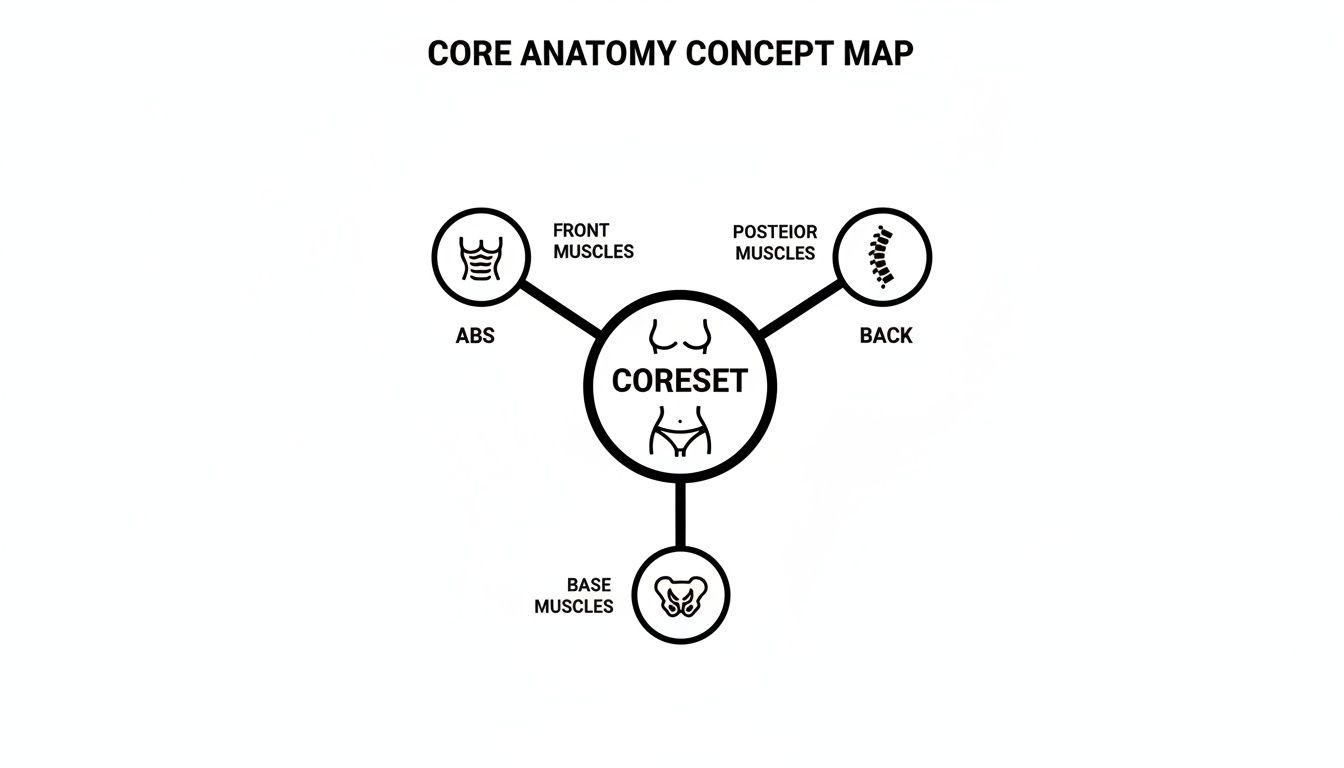
As you can see, a stable center requires the anterior, posterior, and base muscles of your torso to work in concert. Let's examine how specific props help you forge that connection.
Here’s a quick-reference guide linking each prop to its primary anatomical benefits.
Your Pilates Prop Anatomy Guide
| Equipment | Primary Muscle Groups Targeted | Anatomical Benefit | Best For |
|---|---|---|---|
| Pilates Ring | Inner Thighs (Adductors), Pelvic Floor, Transverse Abdominis (TVA) | Creates a kinetic chain reaction to co-contract the deep core "corset" system. | Developing deep core awareness and lumbo-pelvic stability. |
| Resistance Loops | Outer Glutes (Gluteus Medius & Minimus), Hips | Activates hip abductors and external rotators to stabilize the pelvis and femur. | Strengthening hip stabilizers to improve knee and sacroiliac joint alignment. |
| Pilates Mat | Spinal Extensors, Abdominals | Provides safe cushioning for spinal articulation and maintaining neutral spine alignment. | Everyone. The non-negotiable foundation for safe, effective floor-based exercise. |
| Yoga/Pilates Block | Adductors, Obliques, Core Stabilizers | Serves as a proprioceptive tool to ensure proper joint tracking and posture. | Modifying exercises for optimal biomechanical alignment and accessibility. |
This table is a starting point. The real understanding comes from experiencing these neuromuscular connections on the mat.
The Pilates Ring: An Anatomical Feedback Tool
The Pilates ring, or "magic circle," is a prime example of a prop that teaches anatomy. Placing it between your adductors (inner thigh muscles) and applying pressure does more than work your legs. It provides immediate, tangible biofeedback.
This adductor contraction travels up the kinetic chain, cueing an isometric contraction in the pelvic floor and deep transverse abdominis. It's a neuromuscular chain reaction. Suddenly, you can feel that deep, corset-like stabilization of your pelvis. The goal isn't merely to squeeze the ring; it's to use the ring to find and activate your deep core stabilizers.
Resistance Loops: Activating Your Outer Glutes
While the ring facilitates inward connection, resistance loops are brilliant for activating the lateral hip musculature. These muscles, particularly the gluteus medius and minimus, are critical for pelvic stability and preventing low back pain.
Place a loop around your thighs during a bridge or clamshell. The elastic resistance forces your hip abductors—often neurologically inhibited or "sleepy"—to work isometrically to prevent your knees from adducting (collapsing inward). For a deeper dive, we have a guide on picking the best resistance bands for Pilates. This targeted work builds the kind of strength that supports proper gait and joint mechanics.
Think of your equipment as an anatomy teacher. It doesn't just add challenge; it reveals neuromuscular imbalances, highlights areas of weakness, and teaches you how to create balanced, integrated strength.
It’s no surprise that demand for such intelligent, portable props is rising. The global Pilates equipment market is set to grow by $218.52 million between 2026 and 2030, largely driven by users seeking effective tools for home practice. According to Technavio's industry analysis, affordable, versatile gear like rings and bands are at the forefront.
Mats and Blocks: The Foundation of Support
Finally, don't overlook the basics: a great mat and a simple block. A supportive mat is essential. It cushions the vertebral bodies during articulation exercises like roll-ups, allowing each segment of the spine to move safely and independently.
A block is your best friend for alignment. Place it between your knees to maintain femoral alignment or under your pelvis to support a neutral spine. These simple tools position your body for optimal biomechanics, making every other prop you use more effective.
Creating Your Ideal At-Home Pilates Space
The environment where you practice is as critical as the pilates home equipment you use. Creating a dedicated space for movement isn't just about organization; it's a psychological cue to transition your focus inward. A clear, intentional space can elevate your practice into a mindful ritual. You don’t need a large home gym—a well-considered corner can become your personal studio.
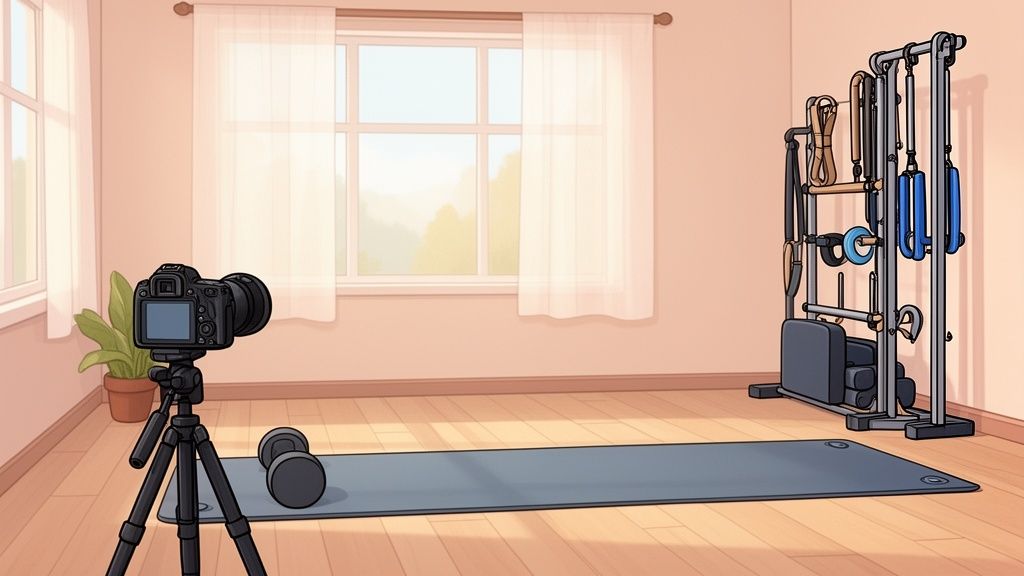
The goal is to design a space that is both inviting and biomechanically functional. This simple act of creating a "movement zone" signals to your brain that it’s time to focus on proprioception and connect with your body.
Designing Your Movement Zone
First, consider the physical space required for full range of motion. Lay your mat down and ensure you have at least a foot of clearance on all sides.
This is more important than it sounds. Many Pilates exercises involve large movements of the limbs in multiple planes of motion. Feeling spatially restricted can compromise your form and neuromuscular patterning. Give your body the space it needs to move freely.
Once you have your spot, consider the surface. A hard, level floor like wood or tile is ideal, as it provides the stability needed for proper skeletal alignment. If you're on carpet, a firm, high-density mat becomes even more crucial to prevent joint instability. We delve into this in our guide to choosing your Pilates mat thickness.
Designate your space as a "no-clutter zone." An organized area reduces cognitive load, making it easier to begin your practice. Simple solutions like a basket for your ring and loop or wall hooks can keep your equipment accessible and tidy.
Optimizing for Virtual Classes
If you follow online classes, your setup needs a few anatomical considerations. To get the most from your instructor’s cues, ensure you can see and hear them clearly.
- Camera and Screen Placement: Position your device so you can view the instructor while maintaining a neutral cervical spine (neck alignment), whether you're supine, prone, or standing. A stool or low table can help achieve this.
- Lighting: Natural light is excellent, but for evening sessions, place a lamp to the side. Avoid backlighting (a bright light source behind you), as it can obscure your form from an instructor in a live virtual class, preventing them from giving you alignment corrections.
- Clear Audio: You need to hear every anatomical cue distinctly. Headphones are a fantastic tool for this, helping to isolate instructions from ambient noise so you can focus entirely on the movement.
Investing time to create this intentional space is an investment in your practice. A functional and motivating environment fosters the consistency needed to build real, lasting neuromuscular changes.
Progressing Your Practice with Pilates Equipment
Beginning your Pilates journey on the mat is the perfect foundation. It’s where you develop initial neuromuscular connections to your deep core and master principles of breath and control. Once you’ve built that baseline awareness, intelligently incorporating pilates home equipment is how you deepen the work and achieve tangible progress.
This isn't about arbitrarily making exercises harder. It's a mindful progression that introduces new proprioceptive challenges and recruits a wider range of muscle fibers. Each piece of equipment offers different feedback or resistance, helping you build strength in a safe, biomechanically sound way.
From Support to Resistance
The journey of progression follows a logical anatomical path. You begin with tools for support and alignment, advance to equipment that provides tactile feedback, and finally, integrate props that build significant strength and stability. This layered approach ensures you master each stage of motor control before advancing, which is crucial for injury prevention.
A typical progression might look like this:
- Mastering the Mat: Your non-negotiable starting point. Here, you learn core engagement and proper form using only bodyweight, focusing on pure motor control.
- Introducing the Block: Next, you use a block for support and alignment. It acts as a physical cue to maintain proper joint positioning, making complex movements more accessible and biomechanically sound.
- Adding the Ring for Feedback: The Pilates ring is an exceptional tool for teaching anatomy. Squeezing it between your adductors provides immediate sensory feedback, helping you feel the co-contraction of your deep adductors and pelvic floor—a connection that is difficult to find without external cues.
- Building Strength with the Loop: Finally, you introduce a resistance loop. This tool adds a dynamic challenge, forcing your stabilizing muscles—especially the gluteus medius and minimus—to work harder to maintain skeletal alignment against external tension.
The Anatomy of Mindful Progression
This step-by-step process enhances your motor intelligence. For example, you might start using a block between your knees during a bridge to maintain neutral femoral alignment. Your brain learns the proprioceptive feeling of parallel thighs.
Next, you might swap the block for a Pilates ring. Now, you're not just maintaining alignment; you're actively engaging your adductors and deep core to create stability. You can physically feel the kinetic chain reaction from your inner thighs up to your pelvic floor. This deepens the mind-body connection.
The goal is to build strength upon a foundation of correct biomechanics. Gradually increasing the challenge with props ensures your deep stabilizing muscles adapt and strengthen, preventing larger, more dominant muscles from compensating and causing imbalances.
Finally, you might place a resistance loop around your thighs in that same bridge. The loop creates an adduction force, compelling your gluteal muscles to fire constantly to maintain abduction. You’ve layered a strength challenge on top of the stability you’ve already established. This mindful progression builds deep, integrated strength that supports your entire musculoskeletal system.
Caring For Your Equipment and Your Body
Consider your Pilates home equipment an investment in your physical well-being. Like any valuable tool, it requires maintenance to perform optimally. A little care ensures your props remain hygienic, safe, and ready to support your practice for years to come.
A simple wipe-down post-session is often all that’s needed. Sweat and oils can degrade materials over time, so making this a consistent habit is key. A helpful guide on using exercise equipment wipes can show you the best practices for keeping everything in top condition.
Listening To Your Body: An Anatomical Approach
As you care for your equipment, you must also listen to your body’s feedback. This is perhaps the most critical safety principle in Pilates: differentiating between the sensation of muscle fatigue and the signal of pain.
Muscle fatigue is a positive indicator of physiological adaptation and strength-building. Pain, conversely, is your body’s protective alarm system, signaling that you should stop and reassess your alignment or load.
Pain often indicates that you are moving out of proper alignment or placing undue stress on a joint. Heeding this signal is not a sign of weakness; it is the hallmark of intelligent training. It prevents injury, allowing you to build strength consistently.
This is where your props become invaluable training partners. If an exercise feels too strenuous or you feel a strain, your equipment can help you modify the movement to maintain proper biomechanics.
- Use a block for support: Placing a block under your sacrum during abdominal exercises can help maintain a neutral pelvis and prevent strain on the lumbar spine.
- Modify with a ring: If you feel unstable in a movement, a gentle squeeze on a Pilates ring can provide the proprioceptive feedback needed to engage your deep core stabilizers and find your center.
This is the essence of intelligent movement—working with your body’s anatomy, not against it. When you prioritize mindful movement and safety, you achieve superior results and build a strong, resilient body that will serve you for life.
Answering Your Pilates Home Equipment Questions
As you plan your at-home practice, questions about your pilates home equipment are natural. Making informed choices is the first step toward building a sustainable and effective routine. Let's address some common questions to help you start with anatomical confidence.
What Is the Most Essential Piece for a Beginner?
First and foremost, a high-quality, supportive mat is non-negotiable. It is the foundation that provides the necessary cushioning and stability for safe spinal articulation and movement.
After the mat, a Pilates ring is an excellent second investment. It provides invaluable tactile feedback, helping you physically feel and activate deep muscles like the adductors, pelvic floor, and transverse abdominis. This dramatically accelerates the process of building a strong mind-body connection.
This sensory feedback acts like an instructor's guiding hands. It's not just about adding resistance; it's about making deep, invisible muscles tangible to your brain, ensuring you're initiating movement from the correct place.
Can I Get Reformer-Level Results at Home?
While nothing can perfectly replicate the unique spring-based resistance of a studio reformer, you can absolutely achieve remarkable, studio-quality results at home. Modern equipment like resistance rings and loops are specifically designed to mimic reformer-style challenges by loading the muscles through various planes of motion.
When you combine this equipment with high-quality, anatomy-informed instruction, you can build deep functional strength, improve flexibility, and enhance muscle tone from your living room. The key to success lies in consistency and an unwavering focus on precise form.
How Do I Ensure Correct Form Without an Instructor?
This is a critical concern for any home practitioner. The key is to create your own feedback loops to monitor your alignment and muscle engagement.
First, choose an on-demand platform that emphasizes clear, anatomy-based verbal cueing—not just "lift your leg," but explaining which muscles should initiate the movement and how the rest of the body should be stabilized. Second, use your equipment as a guide. A Pilates ring provides instant sensory information when you're engaging the correct muscles.
Finally, consider using a mirror or filming yourself to compare your alignment with the instructor's. It is always better to prioritize the quality of each movement over the quantity of repetitions. This is how you build a safe, strong, and highly effective home practice.
Ready to build your own studio-quality practice? WundaCore provides the expertly designed equipment and on-demand classes you need to build deep, functional strength from home. Explore our collection at https://wundacore.com.