
How Pilates Mat Thickness Impacts Your Spinal Health and Performance
Choosing the right pilates mat thickness is more than a preference—it's a foundational choice for your anatomical well-being and workout efficacy. A mat's primary function is to provide a supportive interface between your body and the floor, protecting your spine and joints and allowing you to focus on form, not discomfort.
Why Mat Thickness Is an Anatomical Necessity
Your Pilates mat should be viewed as essential biomechanical equipment, much like a runner's specialized footwear. Shoes are engineered to absorb impact and support the arches of the foot; a Pilates mat is designed to create a stable, protective surface that works in harmony with your body's structure.
This is especially critical for the many signature Pilates movements where your spine articulates directly against the floor. The goal is always precision and control, which is anatomically impossible to achieve if your nervous system is registering pain signals from bony prominences pressing into a hard surface.
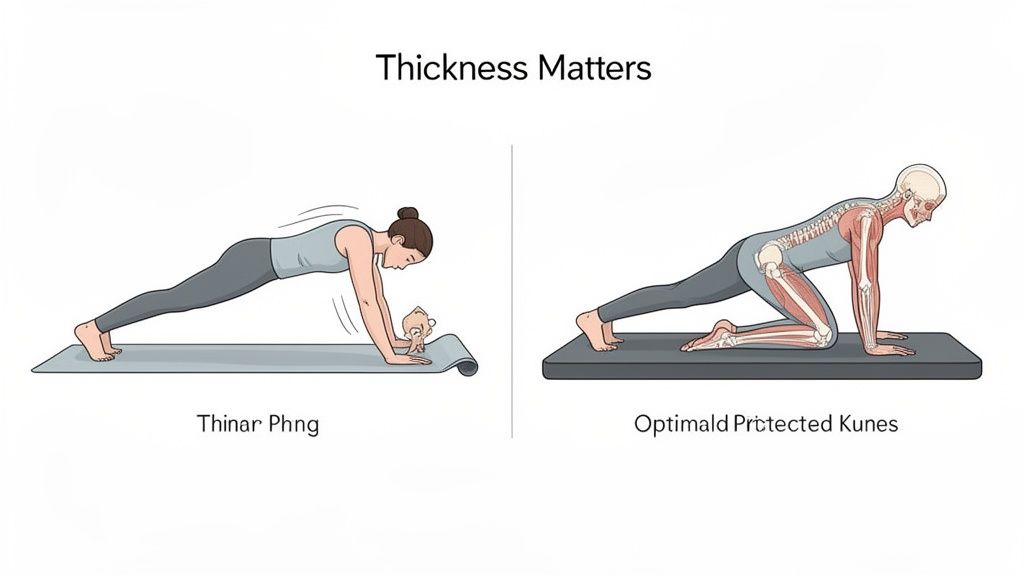
Supporting Your Vertebral Column Through Every Roll
Consider an exercise like 'rolling like a ball.' The biomechanical goal is to sequentially articulate through the thoracic and lumbar spine. On an inadequately cushioned mat, the spinous processes—the bony protrusions of your vertebrae—can painfully impact the floor. This not only causes discomfort but inhibits the very neuromuscular control you are trying to develop.
A mat with sufficient cushioning acts as a shock absorber for the vertebral column, transforming a potentially jarring exercise into a fluid, core-strengthening movement that massages the posterior chain muscles. It facilitates the smooth, sequential articulation that is fundamental to spinal health.
Protecting Your Joints and Bony Landmarks
Pilates engages the entire musculoskeletal system, placing specific demands on various joints and pressure points:
- Wrists (Radiocarpal joint): During plank or push-up variations, the wrists bear significant axial load. A supportive mat helps distribute this pressure across the carpal bones, preventing excessive extension and impingement.
- Knees (Patella): In any side-lying series or quadruped position, a thicker mat provides essential cushioning, preventing direct, painful pressure on the patella and tibial tuberosity.
- Hips and Tailbone (Ischial Tuberosities & Coccyx): Seated exercises like the 'teaser' require a stable base that protects the ischial tuberosities (sitting bones) and the coccyx from bruising and discomfort.
The Pilates equipment world is set to hit $345.51 million by 2025, and mats alone make up a $69.10 million piece of that. It's no surprise that thicker mats (over 6mm) are a huge part of this market—they absorb up to 25% more impact and can slash spinal pressure by 35% compared to thin 3mm mats. If you're curious, you can explore more market insights about Pilates equipment and see the data for yourself.
Ultimately, selecting the correct pilates mat thickness is about more than comfort. It is about creating an anatomically intelligent environment for your practice. It provides the biomechanical support necessary to engage your core with precision and build true, integrated strength.
Understanding Mat Thickness vs Density for Joint Support
When choosing a Pilates mat, it's a common misconception to equate thickness with anatomical support. While thickness provides cushion, the mat's density—the firmness of that cushion—is what delivers true biomechanical stability for your joints.
Imagine the difference between a thick, fluffy down comforter and a high-quality therapeutic mattress. You'd sink through the comforter, receiving no spinal alignment. The mattress, however, offers firm yet yielding support. A Pilates mat must function like the latter, providing both comfort and structural integrity.
A thick, low-density mat can be counterproductive to your joint health. In a plank, for example, your wrists would sink into the overly soft surface. This can force the wrist into hyperextension, compromising joint alignment and creating a cascade of instability throughout the entire kinetic chain, from your shoulders down to your core.
The Biomechanics of a Supportive Surface
A high-density mat provides a stable, reliable foundation for movement. This firmness is essential for the precise neuromuscular engagement that Pilates requires. It allows for efficient force transmission—the energy you generate from your core is not lost in a spongy surface but is instead translated directly into controlled, powerful movement.
This stability is what truly protects your key anatomical structures:
- Spine: During rolling exercises like the Roll Up, a dense mat compresses just enough to cushion each vertebra without creating an unstable surface that could compromise spinal alignment.
- Wrists: For any weight-bearing postures, a firm surface maintains a neutral wrist position, preventing the dangerous hyperextension that leads to strain.
- Knees: In side-lying work, proper density distributes pressure evenly across the joint capsule and surrounding tissues, rather than allowing collapse into a single painful pressure point.
If you want to dig a little deeper into how different layers impact body support, the principles behind choosing a memory foam mattress topper are surprisingly similar. It all comes down to that balance of cushion and support.
Why Density is a Biomechanical Priority in Pilates
The specific demands of Pilates—controlled spinal articulation, balance, and core-driven movement—make density a more critical factor than in many other fitness modalities. While many mats offer cushion, not all provide the unyielding base required for this level of precision.
A dense, supportive foundation is non-negotiable for maintaining proper alignment. The WundaCore Movement Mat is specifically engineered with high-density foam to provide this essential stability, protecting your joints and allowing you to execute movements with precision and control.
This is a primary reason why a generic thick exercise mat often fails to provide the same benefits or protection. The subtle differences in material science have a significant impact on your body's safety and your ability to progress your practice.
If you're curious about the specifics, we break it all down in our detailed guide on the differences between a Pilates mat vs a yoga mat. Ultimately, the right dense mat ensures your focus remains on your muscular engagement, not on unstable wrists or a poorly supported spine.
Choosing the Right Thickness for Your Body and Goals
Selecting the ideal Pilates mat thickness is not a one-size-fits-all decision. It's a personalized choice based on your unique anatomy, experience level, and practice environment. Your mat should be a tool tailored to your body's specific biomechanical needs.
Your own sensory feedback is the best guide. If you have joint sensitivity, bony prominences, or a history of lower back pain, your cushioning needs will differ from those of a seasoned practitioner with excellent core stability. The surface you practice on is also a factor; a hard tile floor requires more shock absorption than a carpeted one to protect your joints.
Your Pilates Mat Thickness Recommendation Guide
To simplify your choice, this guide breaks down common mat thicknesses based on user profile, anatomical benefits, and ideal workout surfaces.
| Mat Thickness | Best For (User Profile) | Anatomical Benefits | Ideal Workout Surface |
|---|---|---|---|
| Thin (Under 6mm) | Experienced practitioners seeking greater proprioceptive feedback from the floor for balance challenges. | Minimal cushioning; best for those without joint sensitivity. Allows for precise sensory input to the feet and hands. | Soft surfaces like carpet or specialized gym flooring. |
| Medium (6-10mm) | Most home practitioners; provides a versatile balance for both mat-based and standing exercises. | Offers a good balance of comfort for bony landmarks (spine, hips, patella) without compromising stability. | Works well on most surfaces, from hardwood to low-pile carpet. |
| Thick (10mm+) | Beginners, individuals with joint sensitivity (e.g., arthritis), or those with chronic back pain or low bone density. | Excellent cushioning to protect the vertebral column during rolling exercises and provide comfort for knees and wrists. | Hard surfaces like tile, concrete, or hardwood floors. |
Ultimately, listening to your body's signals is the first step. If an exercise feels jarring or painful on a bony landmark, your mat may be anatomically inadequate for your needs.
Matching Thickness to Your Body
Pilates mats generally fall into three thickness categories, each serving a distinct anatomical purpose.
-
Thin mats (under 6mm) are favored by advanced practitioners who desire direct proprioceptive feedback from the floor for balance work. For most individuals, this thin layer offers insufficient protection for the spinous processes, iliac crests, or patellae on hard surfaces.
-
Medium mats (6-10mm) represent the optimal balance for most home practices. They provide enough cushion to protect bony prominences without being so thick that they create instability during standing exercises.
-
Thick mats (10mm+) are essential for anyone with joint sensitivity, back pain, or for beginners developing core control. This extra cushioning is crucial for protecting the spine during dynamic rolling movements and for offloading pressure from the wrists and knees in weight-bearing positions.
This decision tree can help you visualize the process of choosing the right mat based on your body's feedback.
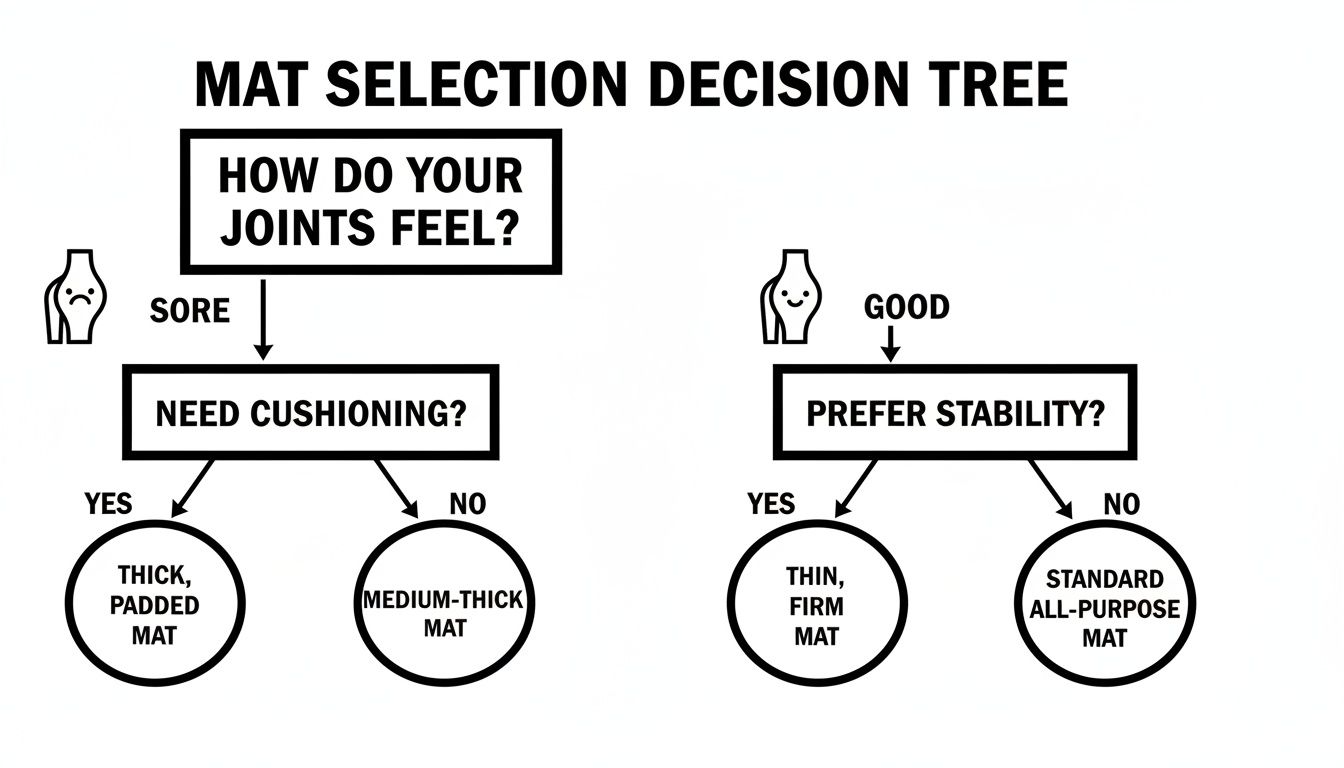
It really comes down to this: your body's feedback is your most valuable diagnostic tool.
How It Impacts Your Workout
Your mat's thickness directly influences your workout's effectiveness and your body's response. Some fitness equipment analyses have shown that people using mats thicker than 8mm report feeling up to 40% less fatigue during their workouts. The anatomical reason? Proper cushioning minimizes pain signals and micro-adjustments, allowing the nervous system to focus purely on muscular execution and form.
For anyone with sensitive joints or chronic back pain, a thicker, high-density mat isn't a luxury—it's a necessity. It absorbs the pressure that would otherwise go straight to your vertebrae, hips, and knees, making your workout safer and way more enjoyable.
As your practice and biomechanics evolve, your needs might change. A beginner who starts on a thick, forgiving mat might eventually want something a bit thinner for more stability. Even so, a high-quality, dense mat is a fantastic long-term investment. It provides a stable base for props and ensures you can tackle advanced moves without putting your joints at risk.
If you want to dive deeper, we have a whole article on why a thick Pilates mat is often the best choice.
How Mat Material Affects Stability and Durability
While thickness and density create the biomechanical foundation, the mat's material composition determines its grip (coefficient of friction), responsiveness, and lifespan. This is analogous to the rubber compound of a tire, which dictates its connection to the road.
Your mat's material directly impacts your stability and neuromuscular control. It governs the interaction between your hands, feet, and the surface, which is critical for maintaining proper alignment and preventing slips that could lead to injury.
Common Mat Materials and Their Anatomical Impact
Each material offers a unique set of properties that affect how your body interacts with the mat.
- PVC (Polyvinyl Chloride): Often found in budget-friendly mats, PVC is durable and easy to clean. Its primary drawback is a low coefficient of friction, especially when moist, which can lead to hands slipping in planks, compromising shoulder and wrist alignment.
- TPE (Thermoplastic Elastomer): A more eco-conscious option, TPE provides a good balance of lightweight cushioning and reliable grip. It has a more responsive feel, giving you better proprioceptive feedback from the floor than PVC.
- Natural Rubber: This material is the gold standard for grip. The open-cell structure provides exceptional traction, effectively anchoring your hands and feet. This superior grip is essential for preventing micro-slips that can strain joints and disrupt form.
If you want to go even deeper on this topic, our guide on the differences between an exercise and yoga mat explores how different materials are suited for different types of movement.
The Advantage of Multi-Layer Engineering
The most advanced mats today utilize a multi-layer construction, combining materials to optimize performance from an anatomical perspective. This is where thoughtful engineering creates a superior biomechanical tool.
For instance, a mat can be engineered with a high-traction natural rubber base for unwavering stability, fused with a cushioned, moisture-wicking top layer. This top layer protects the skin and joints while the base ensures the entire system remains anchored.
This layered approach creates a superior workout surface. Innovative mats like the WundaCore Movement Mat are specifically engineered to offer both the non-slip stability required for dynamic, reformer-inspired movements and the joint protection needed for floor-based exercises.
This construction eliminates the compromise between grip and cushioning. You receive a durable, supportive foundation that protects your joints while providing the stability needed to execute movements with anatomical precision.
The WundaCore Mat: An Anatomically Engineered Solution
Understanding the interplay of thickness, density, and material makes it clear: not all mats are created equal. We engineered the WundaCore Movement Mat to be an anatomical solution, bridging the gap between professional studio equipment and an effective home practice. It is not merely a surface, but a piece of performance gear designed to support your body's musculoskeletal structure.
The specific pilates mat thickness was deliberately chosen to provide robust joint protection without inducing the instability of an overly soft surface. This design directly addresses the anatomical demands of a rigorous Pilates practice, protecting the delicate spinous processes of the vertebrae during rolling exercises and cushioning the wrists and knees in weight-bearing positions.
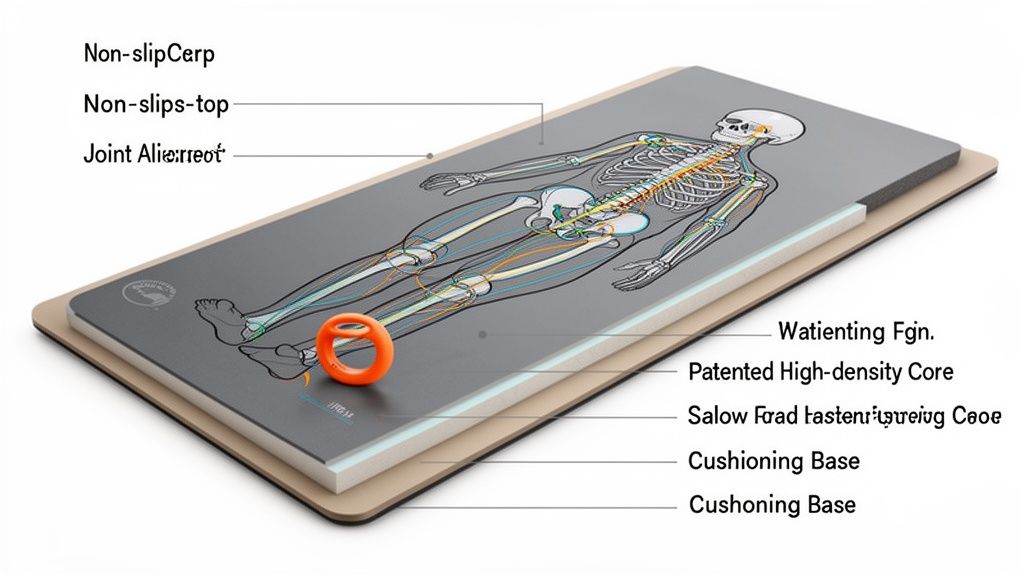
Designed for the WundaCore Ecosystem
The Movement Mat is the biomechanical foundation of the entire WundaCore ecosystem. Its patented high-density construction provides the unwavering stability necessary to effectively use props like the Resistance Ring. You can generate force against it with confidence, knowing the mat will not deform or shift, ensuring your energy is channeled directly into your core musculature.
This stability is paramount for getting the most from our Wunda On Demand classes, where precise, reformer-inspired movements require a solid, non-slip base. The mat's engineering ensures that every ounce of effort translates into building true, functional strength.
The WundaCore Movement Mat solves the single biggest problem that derails home fitness routines: pain and discomfort. By providing an anatomically supportive surface, it makes your workout effective and joint-friendly, which encourages the consistency you need to see lasting results.
A Modern Solution for Home Practice
There's a reason the market for high-quality mats is growing so quickly. The yoga and Pilates mat industry is currently valued at $4.073 billion and is projected to hit $6.945 billion by 2035. People are demanding better performance from their gear. Mats between 8-12mm now make up 45% of high-end sales because the data shows they improve stability by 30% during balance poses and cut slip risks by 52% on hard floors. You can read the full research about these market trends here.
The WundaCore mat fits perfectly into this modern demand for truly superior equipment. Its thoughtful design provides the anatomical support needed to help you move better, feel stronger, and build a consistent practice from the comfort of your own home.
Your Pilates Mat Thickness Questions Answered
Even with a thorough understanding of thickness, density, and materials, specific anatomical questions often arise. Let's address the most common ones.
Can I Just Use a Yoga Mat for Pilates?
While physically possible, it is not anatomically advisable. Yoga mats are intentionally thin, typically 3-5mm, to enhance proprioception (the sense of your body's position in space) for standing balance postures.
Pilates, however, involves extensive floor work with dynamic spinal articulation. A true Pilates mat—typically 6mm or thicker—provides the necessary cushioning to protect the spinous processes, sacrum, and coccyx. Using a thin yoga mat for Pilates often leads to discomfort and bruising on these bony landmarks, distracting you from proper form.
How Do I Know If My Mat Is Too Thin?
Your body's sensory feedback system will provide clear signals. If you are performing an exercise like 'rolling like a ball' and can feel each vertebra making sharp contact with the floor, your mat is too thin.
Other anatomical indicators include:
- Achy Wrists: Pain in the carpal region during planks suggests insufficient shock absorption and potential wrist hyperextension.
- Knee Pain: A sharp, localized pressure on the patella during quadruped or side-lying exercises indicates inadequate cushioning.
- Hip Bruises: Tenderness over the greater trochanter or iliac crest after a side-lying leg series is a sign of excessive pressure.
An appropriate Pilates mat should feel like a supportive extension of the floor, not a source of pain. If you are constantly distracted by pressure points, it is a clear sign you need a mat designed with your anatomy in mind.
Does a Thicker Mat Make Balance Exercises Harder?
This is an excellent question that highlights the crucial distinction between thickness and density. A thick but low-density, "squishy" mat will absolutely compromise your balance. It's like trying to stand on one leg on a soft mattress—your ankle and foot muscles have to work overtime to counteract the unstable surface.
This is where high-density Pilates mats excel. A well-engineered mat is thick enough to cushion your joints but firm enough to provide a stable foundation. It offers the best of both worlds: anatomical protection without sacrificing the proprioceptive feedback needed for balance and stability.
How Do I Care for My Mat to Preserve Its Support?
Proper maintenance is key to preserving your mat's structural integrity and supportive qualities. After each session, wipe it down with a damp cloth and a gentle, mat-safe cleaner.
Avoid harsh chemicals or abrasive sponges, as they can degrade the material and compromise its density and grip. Always allow the mat to air dry completely before rolling it up—with the top side facing out to prevent the edges from curling. Storing it away from direct sunlight will prevent the material from breaking down and losing its supportive properties.
And if you're thinking about overall support, you might also be interested in other ways of protecting your spine during daily activities.
We engineered the WundaCore Movement Mat to provide that ideal balance of anatomical support and stability, taking all the guesswork out of finding the right foundation for your home practice. Discover the difference at https://wundacore.com.