
Your Guide to the Perfect Thick Pilates Mat
A thick Pilates mat is so much more than a cushy accessory. Think of it as a crucial piece of equipment, specifically designed to protect your joints and spine during your floor-based practice. Anatomically, it serves as an interface between your body and a hard surface, providing the foundational support that makes deeper, safer, and more effective movement possible, especially for vulnerable skeletal structures.
Why Your Joints Will Thank You for a Thick Pilates Mat
Imagine going for a run. Would you choose high-performance sneakers or a pair of flimsy flip-flops? The sneakers, of course. They absorb impact, support the arches of your feet, and protect the complex joints of your ankles, knees, and hips. A thick Pilates mat serves the exact same anatomical function for your body on the floor. It provides the structural support you need for a safe, focused workout.
Without that cushioning, you're asking your skeletal system to absorb all the pressure from a hard surface. This becomes especially critical during core Pilates movements. When you perform a roll-down, for instance, each vertebra of your spine—from the cervical down to the lumbar—articulates and presses into the mat. On a thin surface, this can feel jarring and create painful pressure points on the spinous processes. A properly cushioned mat, however, cradles the spine, absorbing that force so your deep core muscles can control the movement instead of tensing up in defense.
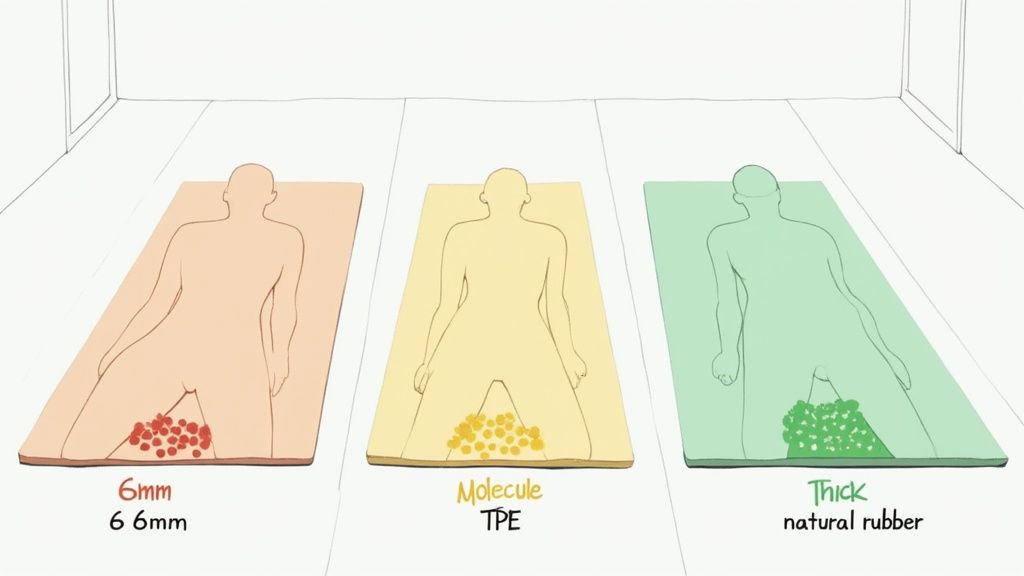
Protecting Key Anatomical Pressure Points
The benefits go well beyond just the spine. Several parts of your body are particularly vulnerable on a hard floor, which can compromise your biomechanics and even lead to injury.
A thick mat provides critical cushioning for:
- Knees: During positions like all-fours or kneeling sidekicks, your kneecap (patella) and the tibial tuberosity bear significant weight. A thick mat disperses this pressure, preventing pain and helping you maintain proper hip and pelvic alignment.
- Hips: In any side-lying series, the bony prominence of your hip (the greater trochanter of the femur) can dig into the floor. Proper padding eliminates this sharp pressure, allowing you to focus on activating your gluteus medius and obliques.
- Tailbone: For exercises that start from a seated position, like the roll-up or teaser, a cushioned surface protects your coccyx and sacrum from bruising and discomfort.
The Science of Support and Stability
There’s a reason thick Pilates mats, typically ranging from 6mm to 12mm, are a staple. Research suggests that mats over 8mm can reduce joint stress by up to 30% compared to standard 4mm yoga mats. This huge reduction in impact force is why the market for high-quality mats is projected to hit $6.95 billion by 2035.
A well-cushioned mat transforms your practice from an exercise in pain tolerance to a true exploration of biomechanics. It gives you the confidence to hold positions longer, move with greater neuromuscular control, and connect more deeply with your core musculature.
While the right mat provides essential physical support during your workout, it’s also smart to look at the bigger picture. For those seeking holistic solutions, exploring methods for managing arthritis and joint pain can offer fantastic complementary relief.
Ultimately, by removing the physiological fear of pain, a thick mat empowers you to build a stronger, more resilient body from the inside out.
How Mat Thickness and Material Impact Your Body
Picking out a thick Pilates mat isn't just about choosing your favorite color. It's a decision that directly affects your body's safety, your stability in every movement, and your neuromuscular performance. The two factors that matter most are the mat's thickness and the material it’s made from. These two elements work together to either support your practice or compromise your anatomical alignment.
Think of it this way: the mat's thickness is your shock absorber for the skeletal system, while the material is the interface for your nervous system. One gives you the cushion to soften the impact on bones and joints, and the other provides the sensory feedback and grip to keep you in control. Let's break down how to find the right combination for your body's specific needs.
Decoding Mat Thickness for Anatomical Support
The thickness of your Pilates mat, measured in millimeters (mm), dictates the level of cushioning your body receives. This goes way beyond comfort—it's about protecting your skeletal structure during floor work when your spine, hips, and knees are in direct contact with the ground.
-
6-8mm The Balanced Foundation: For many people, this range is the sweet spot. It offers enough padding to protect your vertebrae during a roll-up but is still firm enough that your nervous system receives clear feedback from the floor for standing work or planks. From an anatomical perspective, this thickness prevents jarring on your spinous processes without creating a "sinking" feeling, which can destabilize the ankle joint (talocrural joint).
-
8-10mm Superior Spinal Cushioning: If you have sensitive joints or a prominent spinal column, this thickness is a game-changer. A 10mm mat gives you exceptional shock absorption, cradling the bony parts of your vertebrae during exercises like The Hundred or rolling like a ball. This extra buffer reduces pressure, allowing for more fluid articulation of the spine.
-
10-15mm Maximum Joint Protection: This ultra-thick range is ideal if you're dealing with arthritis, have significant joint sensitivity, or are focusing on therapeutic movements. A 12mm or 15mm mat delivers the highest level of pressure relief for your patella in all-fours positions or for your greater trochanter during a side-lying series. The trade-off? You'll have less stability for balance-focused exercises, as the proprioceptors in your feet have to work harder to find a solid ground-feel.
A thicker mat acts as a buffer zone between your body and the hard floor. This zone helps dissipate forces that would otherwise go straight into your joints, making your practice safer and more sustainable over time.
This diagram shows how a mat provides that crucial support for the key pressure points in your body: the spine, knees, and hips.
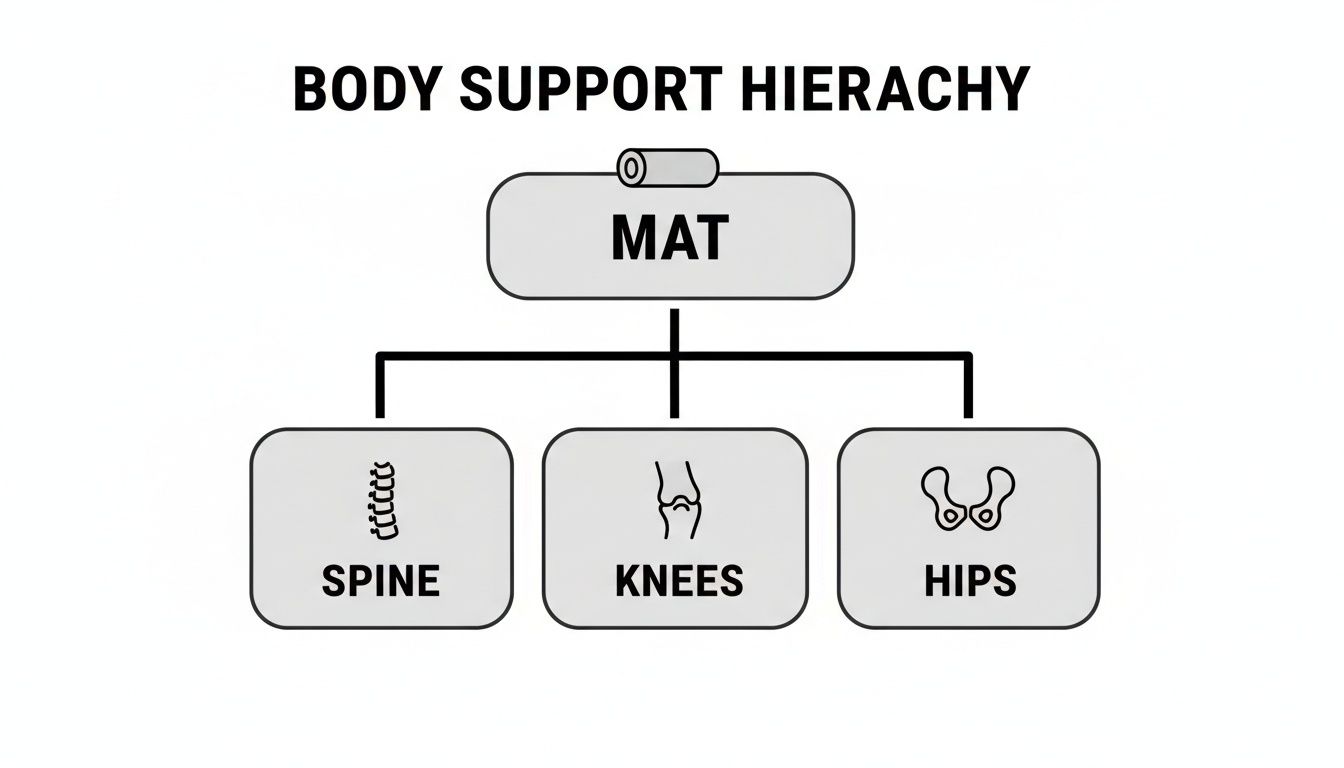
As you can see, the mat is your first line of defense, distributing pressure evenly to protect these vulnerable areas throughout your workout.
Matching Material Properties to Your Body's Needs
While thickness provides the cushion, the material determines the mat's density, grip, and how responsive it feels to your body. The right material can boost your stability and joint support, but the wrong one can feel squishy or slick, compromising your form and anatomical alignment. If you want to go deeper, you can explore the key differences between an exercise and yoga mat in our detailed guide.
Choosing the right material is just as important as choosing the right thickness. Let's look at the most common options and see how they stack up from an anatomical perspective.
Pilates Mat Material and Thickness Comparison
| Material | Typical Thickness Range | Primary Anatomical Benefit | Best For |
|---|---|---|---|
| NBR | 10mm - 15mm | Maximum cushioning and pressure absorption for sensitive joints. Conforms to the body to distribute weight evenly across bony landmarks. | People with arthritis, osteoporosis, or significant joint sensitivity needing superior comfort. |
| TPE | 6mm - 10mm | Balanced support and proprioceptive feedback. Dense enough to protect joints but responsive enough for good ground-feel. | Most practitioners, from beginners to intermediates, seeking a versatile all-around mat. |
| Natural Rubber | 4mm - 6mm | Excellent grip and firm feedback. Provides a stable base that helps engage small stabilizing muscles (e.g., in the feet and ankles). | Experienced practitioners who prioritize stability and grip for dynamic or advanced movements. |
Ultimately, the best mat is one that meets your body's specific anatomical needs. Whether you need maximum cushion from NBR or the grippy stability of natural rubber, understanding these materials helps you make an informed choice for your body.
Who Truly Needs Extra Cushioning for Joint Protection
While anyone can appreciate a comfortable surface, for some people, a thick Pilates mat is a game-changer. It's not a luxury; it's an essential piece of equipment that makes movement safer, more effective, and far more enjoyable by directly addressing their anatomical needs.
For these individuals, the right mat is the difference between a workout that strengthens and one that aggravates a sensitive area.
Think of it this way: a standard mat is like a basic sidewalk, and a thick, high-density mat is like a professional running track. Both get you where you’re going, but the track is specifically engineered to absorb impact and protect your joints. For certain body types and conditions, that engineered support is non-negotiable.
Beginners Building Neuromuscular Connections
When you’re just starting out in Pilates, your brain is working hard to build new neuromuscular pathways to learn proper form and activate the correct muscles. The last thing you need is the distraction of your vertebrae pressing into the floor or your knees aching in a quadruped position. Pain signals override the learning process.
A thick mat removes that barrier. It provides a forgiving surface that lets you focus on the quality of the movement itself, building confidence instead of developing pain-avoidance patterns. This is especially true for foundational exercises where your spine is in significant contact with the floor.
Crucial Exercises for Beginners:
- The Hundred: A thick mat cradles the lumbar spine, making it easier to hold a neutral or imprinted pelvis without strain.
- Roll-Up: The extra padding protects each vertebra as you articulate through spinal flexion and extension, preventing jarring impacts.
- Leg Circles: Good cushioning supports the sacrum and pelvis, allowing you to isolate the movement at the hip joint (femoroacetabular joint).
Individuals with Sensitive Joints or Arthritis
If you're dealing with arthritis or general joint sensitivity, you know that pressure is the enemy. A thin, hard mat can easily turn a beneficial workout into a painful one by creating compressive forces on inflamed joints, leading to flare-ups.
A thick, high-density foam mat acts as a powerful shock absorber. It minimizes the compressive forces on sensitive areas like the knees, hips, wrists, and spine by dispersing your body weight more evenly. This reduces pressure points on articular cartilage and allows you to move with less pain.
The right mat offers a therapeutic surface that respects your body’s limits while still empowering you to build supporting musculature. It’s a tool that gives you the freedom to move.
It’s especially vital during exercises that put direct weight on the joints. In a plank, it offers much-needed padding for the carpal bones of the wrist. During a side-lying series, it protects the greater trochanter of your hip, so you can focus on muscle engagement instead of bone-on-floor pressure.
Older Adults Focusing on Mobility
As we age, maintaining an active lifestyle is key, but joint health and bone density become paramount. A thick Pilates mat provides a secure and comfortable foundation for the mobility work, balance exercises, and strength training that maintains joint range of motion and muscular support.
The stability of a dense, thick mat gives older adults the confidence to move between positions without fearing a slip or a painful impact on a hard floor. It offers essential protection for the spine, hips, and knees—areas that can be more susceptible to osteoarthritic changes.
This is a big reason why the global Pilates and yoga studios market is projected to hit $520.61 billion by 2035. Studios are recognizing that providing high-quality, thick mats is crucial for mitigating injury risks, especially as more people of all ages embrace the practice. You can read the full research about the Pilates and yoga studio market growth on prnewswire.co.uk.
People with Prominent Bony Landmarks
Every body is different. Some of us just have a more prominent spine, pronounced iliac crests (hip bones), or bonier knees. For these body types, floor work on a thin mat isn't just uncomfortable—it can be downright painful.
This happens when a small, bony area bears a disproportionate amount of weight against a hard surface. It leads to bruising, soreness, and can even cause you to unconsciously alter your alignment to avoid the pain, defeating the purpose of the exercise.
A thick Pilates mat solves this by creating a buffer that conforms to your body's unique topography. Instead of your bones digging into the floor, they sink gently into the mat's supportive foam. The pressure gets distributed across a wider surface area, eliminating those sharp points of contact. This allows you to relax into the exercise and finally execute it with correct biomechanics, turning movements like Rolling Like a Ball from a painful chore into an effective spinal massage and core challenge.
How a Thick Mat Changes Your Pilates Practice
It’s easy to think a thick mat is just about cushioning your joints, but its impact is far more profound. The right mat is an active tool that completely changes the quality and effectiveness of your workout from a biomechanical standpoint. It's not just about comfort; it's about building a stable foundation so your body can perform with optimal alignment and muscle recruitment.
Think of it like this: practicing on a flimsy mat is like trying to do push-ups on a wobbly raft. Your nervous system is so busy firing stabilizer muscles to prevent a fall that you can't focus on the primary movers. A thick, supportive mat is like solid ground—it gives your body the confidence to engage the right muscles and get real results.
From Discomfort to Deeper Muscle Fatigue
Let's be honest. When you’re holding a plank, a teaser, or any challenging side-lying pose, what often makes you give up first? It's usually not muscular failure—it’s the sharp ache in your wrists, your coccyx digging into the floor, or a bruised feeling in your hip bone. Pain signals a threat, and your body wisely backs off.
A thick mat removes those pain signals from the equation. When you aren't fighting discomfort, you can finally push your muscles to their true point of fatigue. This is where physiological change happens. You start holding positions until you feel genuine muscle fatigue, which is exactly what builds strength and endurance.
This need for better support is a huge reason why the global Pilates market is set to hit an incredible $420.98 billion by 2032. It's not just a trend; it's a shift toward quality equipment. Good mats can cut impact forces by 35% during core work like roll-ups. Even more telling, their growing use in U.S. studios tracks with a 22% decrease in lower back complaints since 2020. You can get more details on the Pilates market's growth at futuredatastats.com.
Tuning Into Your Body's Feedback
A supportive mat also sharpens your proprioceptive feedback. Proprioception is your body's internal sense of its position and movement in space, managed by nerve receptors in your muscles and joints. A firm, thick mat gives your nervous system clear, reliable signals.
Imagine trying to balance on a squishy, memory-foam mattress. Your body is constantly making tiny, frantic adjustments just to stay upright because the proprioceptors aren't getting a solid read on the surface. Now, picture standing on a firm, supportive floor. You can instantly feel your weight shift and make small, precise muscular corrections.
A high-quality thick mat gives your body that clear, reliable information. It helps you feel if your pelvis is level, if your spine is in neutral, and if your transverse abdominis is truly engaged. This leads to cleaner, more effective movement.
This feedback loop is what helps you master the core principles of Pilates. You can connect your mind to your muscles more effectively, ensuring you’re working from your powerhouse instead of compensating with other muscle groups. The right WundaCore Movement Mat becomes a partner in refining your technique.
No More Slips or Micro-Strains
When you're flowing through dynamic movements like leg circles or rollovers, stability is everything. A thin, cheap mat will slip on the floor or bunch up underneath you. When that happens, your stabilizer muscles have to make constant, tiny corrections just to keep you from falling.
These micro-adjustments might not seem like a big deal, but they add up to muscular strain and fatigue. They break your focus, disrupt the flow of the exercise, and pull tension away from the muscles you're actually trying to work. A stable, thick mat with a good grip stays put. This gives you a secure surface to move on with confidence and fluidity, allowing for proper muscle isolation.
This stability does something powerful for your mindset, too. When you trust your mat, you can commit fully to every movement. You can focus on your breath and your form, knowing your foundation is solid. That mental freedom is what elevates a good practice into a great one.
Alright, you've got the anatomical reasons why a thicker Pilates mat can be a game-changer for your joints. Now comes the fun part: picking the right one for you. This isn't a one-size-fits-all situation. The perfect mat is a deeply personal choice that depends on your body, where you practice, and what you’re trying to achieve.
Let’s walk through how to find your perfect match, step-by-step.
Start With Your Own Body
Forget what works for your friend or instructor for a second. Your body's unique anatomy is the most important piece of this puzzle. A mat needs to support your specific needs, so let's get honest about what those are.
-
Got sensitive joints? Do your knees ache when you're on all fours? Does your lumbar spine complain during a Roll Up? If you're dealing with sensitive joints from arthritis, old injuries, or just your body's structure, a thicker mat is non-negotiable. Look for something 10mm or more to give you that crucial shock absorption.
-
How much do you compress the mat? Your body weight plays a big role in how much a mat compresses under load. A heavier person will need a denser—and often thicker—mat to get the same joint protection as a lighter person on something thinner. High-density NBR or TPE foam is your friend here; it’s designed to resist "bottoming out" under bony landmarks.
-
Are you bony in certain spots? If you have a prominent spinous process or iliac crests that seem to dig into the floor during a side-lying series, you know the feeling. A good thick Pilates mat will have enough cushion to mold around your body, distributing the pressure across a wider surface area to eliminate those painful hot spots.
Consider Your Workout Space
Where you do Pilates drastically changes how a mat feels. The floor underneath you is either helping your mat or making it work a lot harder from a biomechanical standpoint.
Think of it this way: a hardwood or tile floor has zero give. It offers absolutely no shock absorption, which means your mat is doing 100% of the cushioning work for your joints. For these hard surfaces, a thicker, denser mat is a must.
But if you practice on a plush carpet, that carpet is already providing some cushion. You might find a slightly thinner mat, say 8mm, feels more stable for balance and is still perfectly comfortable for your body.
Think About Your Practice Style
How you move matters. Not all Pilates is the same, and your mat should be a partner in your specific style.
-
For Dynamic, Flowing Pilates: If you love quick transitions and standing exercises, you need a smart balance of cushion and stability. A super-thick, squishy mat can destabilize your ankle and knee joints. An 8-10mm high-density TPE mat usually hits that sweet spot, giving you support without sacrificing your proprioceptive connection to the floor.
-
For Slow, Restorative Sessions: When your focus is on deep stretches, mindful holds, and releasing fascial tension, comfort is king. A 12-15mm mat will feel like a luxurious, supportive cloud, letting your body release into each position without any distracting pressure points.
Your mat should feel like an extension of your intention. For strength, it provides a stable base; for restoration, it offers a comforting cradle. Choosing correctly ensures your equipment supports your anatomical goals.
Match the Material to Your Needs
We’ve talked about how thickness gives you cushion, but the material is what dictates the mat’s feel, grip, and how long it will last.
The grip and texture are crucial for holding your form and preventing slips, which can lead to muscle strain. There’s nothing worse than your hands sliding in a plank, throwing your entire shoulder girdle out of alignment. For a deeper look at this, check out our article on the key differences between a Pilates mat vs yoga mat.
Finally, think long-term. A high-quality mat that’s durable and easy to clean is an investment in your health and the consistency of your practice. When you carefully weigh all these factors, you’ll find a thick Pilates mat that feels like it was made just for your body.
Common Questions About Thick Pilates Mats
Jumping into the world of Pilates equipment can feel like a lot, especially when you're trying to find the perfect foundation for your practice. A thick Pilates mat is a real investment in your joint health and overall performance, so it's only natural to have a few questions. Let's get them answered so you can choose and care for your mat with total confidence.
We'll cover everything from finding that sweet spot between cushion and stability to keeping your mat in top shape for years to come. These are the details that ensure your equipment truly supports your body where it counts.
Is a Pilates Mat Ever Too Thick?
Yes, absolutely. While cushion is fantastic for protecting your joints, there’s a point where too much of it can compromise your biomechanics. The whole purpose of a thick mat is to absorb pressure on bony landmarks like your spine, hips, and knees—without creating an unstable surface.
When a mat gets overly thick, usually past 15mm, it can start to feel unstable. This makes it difficult for the small stabilizing muscles in your feet and ankles to get good proprioceptive feedback, which you need for balance. For most people, the sweet spot is between 8mm and 12mm. That range gives you the perfect blend of joint-saving cushion for floor work and a solid, stable surface for standing exercises that require balance and neuromuscular control.
Think of it like this: you want to feel supported by the mat, not swallowed by it. The mat should absorb the hardness of the floor, not your ability to connect with it.
How Do I Properly Clean My Mat?
Good question! Keeping your mat clean isn't just about hygiene; it’s about preserving its material and grip for the long haul. The best way to clean it really comes down to what it's made of, since some materials are more porous than others.
- For Closed-Cell Mats (TPE, PVC): These are non-absorbent, which makes cleanup a breeze. Just wipe your mat down with a simple mix of water and a single drop of mild dish soap, or use a 50/50 solution of water and white vinegar.
- For Open-Cell Mats (Natural Rubber): These mats need a gentler touch because they can be damaged by harsh soaps or oils. Stick to plain water or a cleaner made specifically for natural rubber to avoid breaking down the material.
No matter what your mat is made of, always let it air dry completely before you roll it up. Trapping any dampness can lead to bacteria and will degrade the mat's integrity over time.
Can I Use My Thick Pilates Mat for Yoga?
You can, but it's not ideal from an anatomical standpoint. Pilates and yoga have different movement goals, which call for different types of mat support. A thick Pilates mat is engineered for cushioning, specifically to protect your spine and joints during controlled, floor-based movements where your body is in constant contact with the surface.
Yoga, on the other hand, is full of dynamic standing poses and balances. The generous padding of a thick mat can interfere with your ability to ground down through your feet, making poses like Tree Pose or Warrior III much more challenging. It dulls the proprioceptive feedback your feet need to make micro-adjustments for balance. Yoga mats are thinner for a reason—to give you a stronger, more stable connection to the floor. Using a Pilates mat for yoga can feel like trying to balance on a wobble board, undermining the very stability you’re trying to build.
Ready to feel the difference a truly supportive surface can make? The WundaCore Movement Mat was designed with your anatomy in mind, providing the perfect balance of cushion and stability to elevate your home practice.