
Pilates Mat vs Yoga Mat An Anatomical Guide to Your Practice
When you’re starting a movement practice, it’s easy to think of a mat as just a mat—a simple rectangle to mark your territory on the floor. But from an instructor's perspective, your mat is the single most important piece of equipment you'll own. It’s your foundation.
The real difference between a Pilates mat and a yoga mat comes down to their anatomical purpose. A Pilates mat is designed to be thick and dense, providing crucial cushioning for your spine and bony prominences during the rolling and floor-based exercises that are central to the practice. On the other hand, a yoga mat is thin and grippy, built to enhance proprioception and provide a stable connection to the ground for standing poses that challenge your balance and joint stability.
Why Your Mat Is Your Most Important Foundation
Choosing between these two isn’t just about preference; it’s a decision rooted in biomechanics. Each discipline asks different things of your body, placing unique demands on your skeletal structure, joints, and musculature. The right mat acts as your first line of defense against injury and your best tool for achieving proper alignment and form.
Anatomical Support Is the Core Differentiator
Pilates, which has its roots in rehabilitation, is all about core strength, precision, and spinal articulation. Think about foundational exercises like the Roll Up or the Hundred—they’re performed lying down and involve dynamic movements where your vertebrae press sequentially into the floor. This is where the mat’s design becomes critical from an anatomical standpoint.
A true Pilates mat is built with substantial thickness—often a half-inch or more—specifically to protect the bony parts of your spine, like the spinous processes of your vertebrae and your sacrum, from the compressive forces of a hard floor. Without that dense cushioning, you’re not just risking discomfort and bruising; you’re compromising your ability to safely articulate your spine.
Yoga, in contrast, is heavily focused on stability and proprioception—your body’s innate sense of its position in space, which is managed by nerve receptors in your muscles and joints. Poses like Warrior II or Tree Pose demand a firm, unwavering connection to the ground to engage all the tiny stabilizing muscles in your feet and ankles (like the peroneals and tibialis posterior). A thick, squishy mat would feel like standing on a marshmallow, completely undermining your balance and potentially straining ligaments in the ankle or knee.
That’s why yoga mats are intentionally thin and sticky. They allow your feet's mechanoreceptors to really feel the floor beneath you. This sensory feedback is essential for maintaining proper skeletal alignment and firing up the right muscle groups. Picking the wrong mat isn't just a comfort issue; it directly impacts your neuromuscular control and the safety of your practice. As you get more serious, you'll want to learn more about creating the perfect setup for effective Pilates at home.
Comparing the Core Anatomical Functions
The structural differences between these mats are a direct response to the kind of biomechanical forces they need to support. Getting this right is the first step toward a practice that protects your body and helps you get the most out of every session.
| Feature | Pilates Mat | Yoga Mat |
|---|---|---|
| Primary Function | Spinal protection and cushioning for floor-based, rolling movements. | Stability and ground-feedback for standing and balancing poses. |
| Anatomical Focus | Protects spinous processes, sacrum, and iliac crests from direct impact. | Supports ankle joint stability and enhances proprioception via mechanoreceptors in the feet. |
| Movement Type | Facilitates fluid, dynamic transitions and controlled spinal articulation. | Provides a stable, non-slip base for holding static poses and ensuring joint integrity. |
Anatomical Cushioning: Thickness and Density Explained
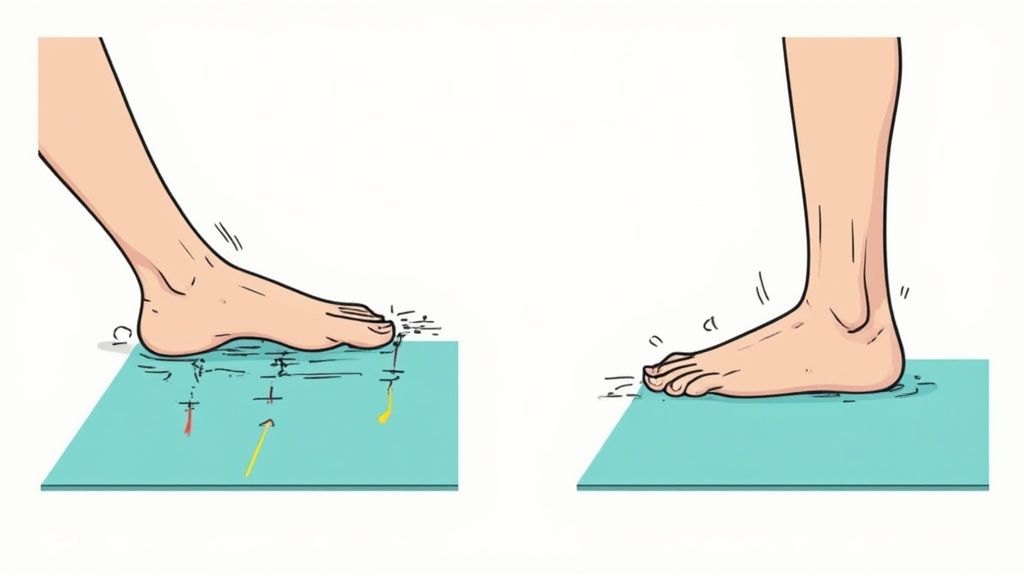
When you’re looking at a Pilates mat versus a yoga mat, the thickness and density aren't just minor details—they're fundamental to the anatomical integrity of each practice. The amount of cushioning you have directly impacts how your joints are protected, which muscles you activate, and your overall performance. A mat isn’t just a mat; its construction is a direct response to the unique forces your body experiences in each discipline.
In Pilates, your mat is your protective shield, especially for your skeletal system. Think about the classical repertoire: exercises like the Roll Up, Rolling Like a Ball, and the Hundred all involve articulating your spine against the floor. This repeated rolling and pressing puts a lot of pressure on your spinous processes—those bony bumps you can feel down your back.
The Purpose of High-Density Foam in Pilates
A proper Pilates mat is thick, usually at least a half-inch (around 12-15mm), and made of high-density foam. This isn't by accident. This robust construction creates an essential buffer between your skeleton and the hard floor beneath you. The dense foam is engineered to absorb and distribute your body weight, which helps prevent bruising and discomfort on bony prominences like your vertebrae, tailbone, and the iliac crest of your hips.
Just imagine trying to do a controlled Roll Down on a thin, flimsy mat. Every single vertebra would make hard contact with the floor, creating painful pressure points. That kind of discomfort doesn't just hurt; it completely disrupts the fluid, precise movement that Pilates is all about. Anatomically, it can cause you to tense your erector spinae muscles, compromising the very spinal articulation the exercise aims to improve.
The core idea here is anatomical support. A Pilates mat's density keeps it from "bottoming out"—compressing so much that it offers no real protection. This firm, yet forgiving, surface is what allows for safe spinal articulation, which is absolutely critical for building deep core strength and improving neuromuscular control of the spine.
It's no surprise that the market for proper gear is growing. The global Pilates and yoga studios market was valued at nearly USD 162 billion in 2024 and is projected to climb past USD 555 billion by 2035. This boom is fueled by a deeper understanding of how the right equipment, especially mats, supports the specific demands of each practice. You can find more details about these global studio market trends on researchnester.com.
Proprioception and the Yoga Mat
On the flip side, a standard yoga mat is much thinner, typically ranging from 1/8 to 1/4 inch (about 3-6mm). This isn't a design flaw; it’s a crucial feature for enhancing proprioception. Proprioception is your body's innate ability to sense its position, motion, and balance in space, thanks to feedback from sensory receptors in your muscles, tendons, and joints.
During standing poses like Warrior III or Tree Pose, your stability comes from the ground up. The thousands of mechanoreceptors in your feet are constantly sending signals to your brain about tiny shifts in weight and balance. A thin, firm yoga mat lets those signals travel clearly, helping you make the micro-adjustments in your ankles and feet needed to hold your pose. This direct connection to the floor is key for activating the small stabilizing muscles in your feet and lower legs, which are essential for maintaining joint congruency.
How Cushioning Changes Your Balance and Alignment
Too much cushioning creates a wobbly, unstable surface—like trying to do a balancing pose on a soft mattress. This instability makes your larger muscles (like the quadriceps and hamstrings) overcompensate, which can throw off your skeletal alignment and increase the risk of straining ligaments in your ankles or knees. The thinness of a yoga mat ensures you can truly ground down through the tripod of your feet, spread your toes, and create a solid, unwavering foundation.
Let's break down the functional difference:
- Pilates Mat: Designed to absorb impact and protect the bony parts of your axial skeleton during dynamic, floor-based movements involving the spine. It prioritizes cushioning over proprioceptive feedback.
- Yoga Mat: Built to provide a stable, non-slip surface that enhances proprioceptive feedback for better balance and joint alignment. It prioritizes proprioceptive feedback over cushioning.
Ultimately, the choice between a Pilates mat vs. a yoga mat comes down to their intended anatomical roles. One is built to protect your spine during controlled, rolling movements, while the other is designed to connect you firmly to the earth for stability and sensory feedback.
The Biomechanics of Grip and Surface Texture
The surface of your mat is so much more than just a place to stand. Think of it as an active partner in your workout, one that dictates how your body creates force, maintains joint stability, and moves safely. The differences in grip between a Pilates mat and a yoga mat aren't accidental; they're rooted in the biomechanics of each discipline, designed to either anchor you down or allow for smooth articulation.
A yoga mat is famous for its "sticky" feel. This high-grip surface creates a lot of friction, and it’s there for a very important reason: biomechanical safety. When you’re holding a pose like Downward-Facing Dog, your hands and feet are pushing both down and away from each other. That tacky texture provides the opposing force needed to prevent you from sliding out.
Yoga Grip and Keeping Your Joints Stable
This friction is absolutely critical for your joint health. If your mat didn't have enough grip, your muscles would have to work overtime just to counteract the slipping forces. That kind of overcompensation puts a ton of eccentric load on smaller, more vulnerable joints.
Here’s a look at how that grip protects you in a yoga practice:
- Wrists: In poses like Plank or Crow, a grippy mat lets you press down firmly, which stabilizes the radiocarpal joint. This seriously reduces the risk of hyperextension or strain on the wrist ligaments.
- Shoulders: When your hands are secure, the force of a pose travels correctly up your arm and into your shoulder girdle. This helps you engage the larger muscles of your back (like the latissimus dorsi and serratus anterior) instead of stressing your rotator cuff tendons.
- Ankles and Knees: During standing poses, a non-slip surface is everything. It keeps your feet from sliding, which is essential for maintaining proper alignment between the femur and tibia at the knee joint and avoiding ligamentous sprains.
This becomes even more important in a heated class, where sweat can reduce friction. That’s why materials like natural rubber are so popular—they keep their traction even when damp.
A yoga mat’s ‘stickiness’ is a biomechanical tool, plain and simple. It provides the static friction you need to hold poses securely. This lets you focus on your alignment and your breath, not on the fear of slipping and compromising your joint integrity.
Pilates Flow and Controlled Gliding
On the flip side, a Pilates mat usually has a smoother, less tacky surface. This isn't a flaw; it's a feature that supports the very heart of Pilates—control, precision, and flow. So many Pilates exercises are built around seamless, gliding movements where your body is constantly in motion across the mat.
Think about doing Leg Circles or Scissors. These movements demand that your limbs glide smoothly without getting stuck. A sticky yoga mat would just get in the way, creating friction that interrupts the flow and forces you into jerky, compensatory movements. That completely defeats the purpose of the exercise, which is to build control from the core.
The smoother texture of a Pilates mat has just enough grip to stop you from sliding around uncontrollably, but not so much that it gets in the way of intentional movement. This allows for:
- Fluid Transitions: You can move from one exercise to the next with that classic Pilates grace and control.
- Unhindered Articulation: For exercises that involve rolling or sliding, like the Teaser or Corkscrew, your clothes and skin won't catch on the mat, allowing for smooth vertebral sequencing.
- Precise Muscle Engagement: A smoother surface actually makes your core work harder. Your deep stabilizing muscles (like the transverse abdominis) have to control the movement from start to finish instead of relying on the mat's friction to hold you in place.
Trying to do a flowing Pilates sequence on a high-grip yoga mat can feel like you’re fighting against your own foundation. And trying to hold a Warrior pose on a slick Pilates mat? That’s just asking for joint instability. The surface of your mat is engineered for the specific biomechanical demands of each practice.
A Comparative Breakdown of Mat Construction
The way a Pilates mat is built versus a yoga mat goes way beyond what you see on the surface. It’s an intentional design process where every single choice—from the type of foam used to the final dimensions—is made to support very specific needs of your body in motion.
Getting a handle on these foundational differences is the key to picking a mat that not only feels good but actively enhances your practice and protects your body's structures.
The materials chosen for a mat directly impact how it performs. High-density foam, for example, is the absolute cornerstone of a great Pilates mat. Its cellular structure is engineered to handle repeated pressure from your spine without flattening out, giving you a stable, shock-absorbing surface that cushions your vertebrae during dynamic rolling exercises.
In contrast, the materials you'll find in yoga mats, like natural rubber or TPE, are all about resilience and grip. They offer the responsive feedback your mechanoreceptors need to hold poses securely.
Materials Under the Microscope
The big debate in mat materials often comes down to PVC, TPE, and natural rubber, and each one has its pros and cons. In the United States, where an estimated 36 million people practiced yoga in 2020, what a mat is made of has become a huge deal for consumers.
While PVC still commands a 39.2% share of the market because it's durable and affordable, there's a serious shift happening. Eco-conscious alternatives like TPE and natural rubber are gaining ground, especially among the 45% of practitioners who invest in premium mats each year.
A closer look shows how these materials serve different functions for your body:
- High-Density Foam (Pilates): This material is all about protecting your spine. Its dense cellular structure keeps it from "bottoming out," making sure your spinous processes, sacrum, and iliac crests stay cushioned. This is a non-negotiable for preventing bruises and discomfort during floor work.
- Natural Rubber (Yoga): Famous for its incredible "sticky" grip, natural rubber creates the friction you need to hold demanding poses like Downward-Facing Dog without your hands or feet slipping. That stability is vital for protecting your wrist and shoulder joints from unnecessary strain.
- TPE (Thermoplastic Elastomers): TPE is the versatile middle ground, often used in both types of mats. It gives you more cushioning than rubber but a better grip than standard foam, making it a solid choice for hybrid-style mats.
Dimensions and Body Alignment
Another make-or-break difference is the size. Pilates mats are typically longer and wider than yoga mats, and that’s not for a feeling of luxury—it's a functional, anatomical necessity.
So many Pilates exercises are done lying on your back (supine) or stomach (prone), which means you need a surface that supports your entire axial skeleton. On a standard yoga mat, it’s common for your head or feet to hang off the edge, which can compromise your spinal alignment and just be plain uncomfortable.
The extra width on a Pilates mat gives you the room you need for exercises with lateral movements, like a side-lying leg series that targets the gluteus medius. This means you can move freely without constantly shifting to stay on the mat, letting you focus on your form and muscular control. If you want to dive deeper into how different mats work for different workouts, check out our guide on choosing between an exercise and yoga mat.
The extra real estate on a Pilates mat is an intentional design choice that supports full-body articulation and fluid transitions. It allows you to execute movements with the proper range of motion without the anatomical constraint of a smaller surface.
This visual helps break down the relationship between a mat's texture and the type of movement it's designed for.
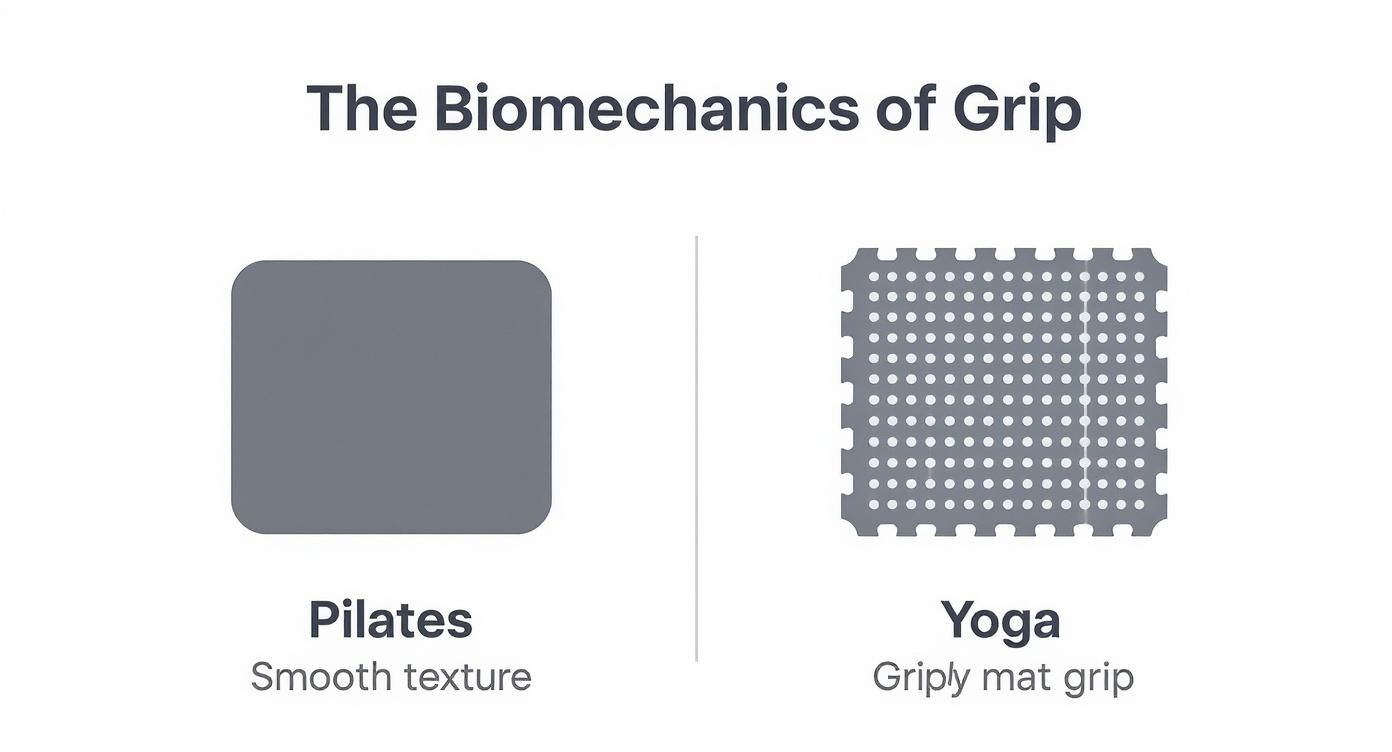
As you can see, the smooth surface of a Pilates mat is built to encourage flowing, gliding movements, while the grippy texture of a yoga mat is all about creating the friction needed for static holds.
To make it even clearer, let's lay out the key differences side-by-side.
Pilates Mat vs Yoga Mat Feature Comparison
This table breaks down the core distinctions between the two mats, explaining why they are designed so differently from an anatomical perspective.
| Feature | Pilates Mat | Yoga Mat | Anatomical Rationale |
|---|---|---|---|
| Thickness | Thicker (8-15mm) | Thinner (3-6mm) | Pilates: Cushions spine and bony prominences during rolling and supine exercises. Yoga: Enhances proprioception for balance. |
| Density | High-density foam | Varies (often medium) | Pilates: Provides stability and shock absorption without "bottoming out" to protect the spine. Yoga: Firm enough for sensory feedback. |
| Grip | Smooth, low-tack surface | Grippy, "sticky" texture | Pilates: Allows for smooth, gliding transitions. Yoga: Prevents hands/feet from slipping to protect joints in static holds. |
| Dimensions | Longer and wider | Standard length/width | Pilates: Supports full body length for supine/prone work and lateral movements, maintaining spinal alignment. |
| Cushioning | High | Low to moderate | Pilates: Prioritizes spinal protection. Yoga: Allows for better ground-feel and stability in standing balance poses. |
| Portability | Bulkier, heavier | Lighter, more compact | Yoga: Designed for easy transport to and from studios. |
This comparison highlights that the choice isn't about which mat is "better" overall, but which one is built to support the specific biomechanical demands of your practice.
Portability: A Practical Consideration
Finally, let's talk about the practical side of things. Portability is a direct result of a mat's construction.
The thick, dense foam that makes a Pilates mat so anatomically protective also makes it heavier and bulkier. Let's be honest, it's not always the most convenient thing to lug to and from a studio.
Yoga mats, being thinner and lighter, are a breeze to roll up tightly and carry around. It’s a classic trade-off: a Pilates mat prioritizes anatomical protection over portability, while a yoga mat is designed for convenience and practicing on the go. The right choice for you really comes down to where and how you plan to move.
How to Select the Right Mat for Your Body and Practice
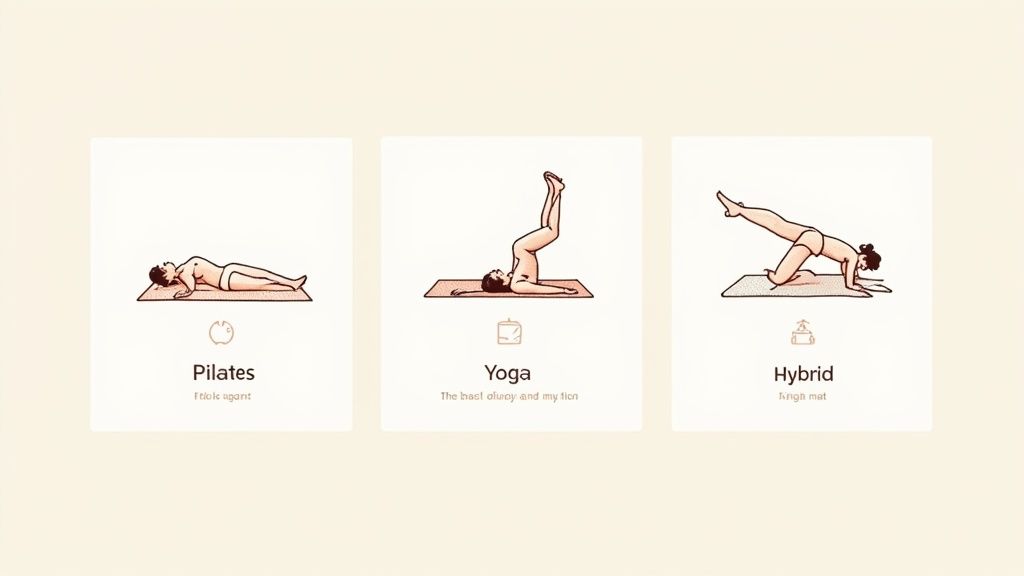
Choosing the right mat is a real investment in your body and your practice. It’s not about which mat is "better" but about finding the right tool for your specific anatomy, your workout style, and your personal goals. Think of this as a practical guide to help you find the mat that will truly support your body's structure.
The first step is to be honest about your primary movement practice. Your mat should be specialized for what you do most often to give you the right biomechanical support where it counts.
For the Classical Pilates Devotee
If your practice is built on classical Pilates, a thick, high-density foam mat is non-negotiable from a safety standpoint. The Pilates repertoire is full of exercises like the Roll Over, Jackknife, and Teaser that demand precise spinal articulation and serious core control. Your spine is in constant contact with the floor, acting as a pivot point for powerful, controlled movements.
A mat that’s at least a half-inch thick is essential to create that protective barrier. This cushioning stops your spinous processes and sacrum from painfully pressing into the floor, which can lead to bruising and throw off your alignment. Just as important, the high density of a proper Pilates mat gives you a firm, stable surface for feedback—you won't "bottom out" in the middle of a movement.
For anyone committed to a consistent Pilates practice, skimping on thickness and density is a direct compromise on spinal safety. The right mat lets you focus on your form and breath, not on the discomfort of your bones hitting the floor.
For the Dedicated Yogi
On the flip side, if your main practice is yoga—especially a dynamic style like Vinyasa or a hot yoga class—your anatomical focus shifts from cushioning to stability. A thin, non-slip rubber mat is your best friend here. You need an unwavering grip to hold poses like Warrior II or Downward-Facing Dog without sliding.
Too much cushion creates an unstable foundation, making it tough to engage the small stabilizing muscles in your feet and ankles. A thin yoga mat, usually around 3-5mm thick, improves your proprioception, letting you feel the ground and make those tiny neuromuscular adjustments needed for balance. The "sticky" surface is a key safety feature, preventing slips that could lead to strains in your wrists, shoulders, or ankles.
Navigating Hybrid Workouts Like Yogalates
The fitness world is full of hybrid workouts that blend the core-centric principles of Pilates with the flowing sequences of yoga. If your routine falls into this camp, you're caught between needing spinal cushioning and demanding joint-stabilizing grip. So, what's the solution?
For these blended practices, look for a "hybrid" or "crossover" mat. These are designed to bridge the gap, typically offering:
- Moderate Thickness: Usually around 6-8mm, giving you more cushion than a standard yoga mat but less bulk than a full Pilates mat.
- Balanced Texture: A surface that offers decent grip for standing poses without being so sticky that it gets in the way of fluid Pilates transitions.
- High-Quality Density: Made from dense TPE or rubber to provide support without feeling overly squishy and unstable.
This middle-ground approach gives you enough padding for light rolling and floor work while still providing enough stability for standing sequences. It's a compromise, but it's an effective one if you truly split your time between both disciplines.
The growing interest in both practices is reflected in market trends. As of 2025, the global market for yoga and Pilates mats is valued at approximately USD 1.58 billion, with yoga mats holding a 68.4% share. This market is expected to nearly double by 2035, a testament to the global focus on wellness.
Considering Your Body and Environment
Finally, it’s time to personalize your choice based on your unique anatomy and where you practice.
- Injury History: If you have a sensitive spine, back pain, or bony prominences like sharp iliac crests (hip bones) or a prominent tailbone, always lean toward a thicker, more cushioned Pilates-style mat, even for gentler workouts.
- Workout Environment: Are you practicing on a hard tile floor or a soft carpet? A hard floor demands more cushioning to protect your joints from impact, making a thicker mat the smarter choice.
- Personal Preference: Ultimately, comfort matters. If the proprioceptive feedback of a thin mat is just too jarring for your joints, a slightly thicker hybrid option might be the thing that encourages you to practice more consistently.
Beyond the mat, the right clothing can also make a huge difference in your practice. For example, finding the best leggings for Pilates can complement your mat choice and allow for a full, unrestricted range of motion. Making an informed decision empowers you to invest in a tool that truly supports your long-term well-being.
Common Questions About Pilates and Yoga Mats
People often ask me about the real differences between Pilates and yoga mats. It’s a great question, because getting the answer right is key to making sure every movement you make is anatomically supported. The right mat isn't just about comfort—it's about preventing injury and making your practice more effective.
Can I Use a Yoga Mat for Pilates?
I get this one a lot. While you technically can for some static exercises, I really don't recommend it for a dedicated Pilates practice. A standard yoga mat is usually just 3-6mm thick, which simply isn't enough padding for the dynamic, rolling movements at the heart of Pilates.
Think about exercises like the Roll Up or Rolling Like a Ball. You're articulating your spine, one vertebra at a time, against the floor. Without the substantial cushioning of a proper Pilates mat, your spinous processes, sacrum, and even your tailbone can take a beating, leading to discomfort or bruising. On top of that, the high-grip, sticky surface of a yoga mat can actually work against you, snagging your clothes and hindering the smooth vertebral sequencing Pilates demands. For true spinal safety and fluid movement, a Pilates mat is the only way to go.
What if I Practice Both Yoga and Pilates?
If you're committed to both disciplines, the best-case scenario is to own one of each. They’re specialized tools designed for very different biomechanical jobs. But if you have to choose just one, let your primary practice—and your body's needs—be your guide.
- If you have a sensitive spine or do a lot of classical Pilates, a thick Pilates mat is a non-negotiable for protection. Just know that its plushness will make balancing poses in yoga feel a bit wobbly, challenging your proprioception.
- If you’re mostly a yogi who dabbles in Pilates, you can probably stick with a yoga mat. You’ll just need to modify or skip the intense rolling exercises to protect your spine.
- For a balanced approach, there are "hybrid" mats, typically around 6-8mm thick. They're a solid compromise, offering more cushion than a yoga mat and better stability than a full-blown Pilates mat. They're great for mixed-modality workouts.
The bottom line? Choose the mat that best supports what you do most often and protects your most vulnerable anatomical structures. A hybrid mat is versatile, but nothing beats a specialized mat for performance and safety in its intended discipline.
Is Thickness the Only Factor for Spinal Support?
Absolutely not. Density is just as important—if not more so. A thick mat made from low-density, spongy foam might feel cushy at first, but it will compress completely under your body weight. We call this "bottoming out," and it offers a false sense of security while providing almost no real protection. Your spinous processes might as well be on the hard floor.
Real anatomical support comes from high-density foam. This is the good stuff. It provides firm, reliable cushioning that distributes your weight evenly and supports the controlled articulation of your spine without collapsing. When you're shopping for a Pilates mat, always look for high-density construction. It’s what truly protects your skeleton.
How Does Mat Choice Affect Other Joints?
Your mat’s design has a huge impact on your wrists, knees, and ankles. In yoga, that thin, grippy mat is vital. It helps stabilize your wrists in weight-bearing poses like Plank or Downward-Facing Dog, preventing strain on the carpal bones and ligaments. That firm surface also lets the small intrinsic muscles in your feet grip and engage, which is crucial for balance and protecting your ankle ligaments.
In Pilates, a thicker mat gives your knees and hips essential cushioning, especially during a side-lying series or any exercises on all fours, reducing pressure on the patella and greater trochanter. No matter which mat you choose, keeping it clean is key for long-term use and hygiene. You can find some great tips in your guide to a non-toxic yoga mat cleaner. Ultimately, the right mat is a critical piece of equipment for preventing joint injury and building a practice that feels good for years to come.
Ready to build a stronger foundation for your home practice? The WundaCore Movement Mat is expertly designed with high-density foam to provide the anatomical support and cushioning your spine needs for reformer-inspired workouts. Elevate your movement and protect your body by exploring our collection at https://wundacore.com.