
Pilates Mat Exercises for Beginners: An Anatomy-Focused Guide
Dipping your toes into Pilates can feel like a big step, but starting with pilates mat exercises for beginners is the absolute best way to build a strong, intelligent core. The beauty of mat work is its simplicity. It’s just you and your body weight, working together to build functional strength from the inside out by focusing on the specific muscles that stabilize and move you.
Why Mat Pilates Is The Best Place To Start
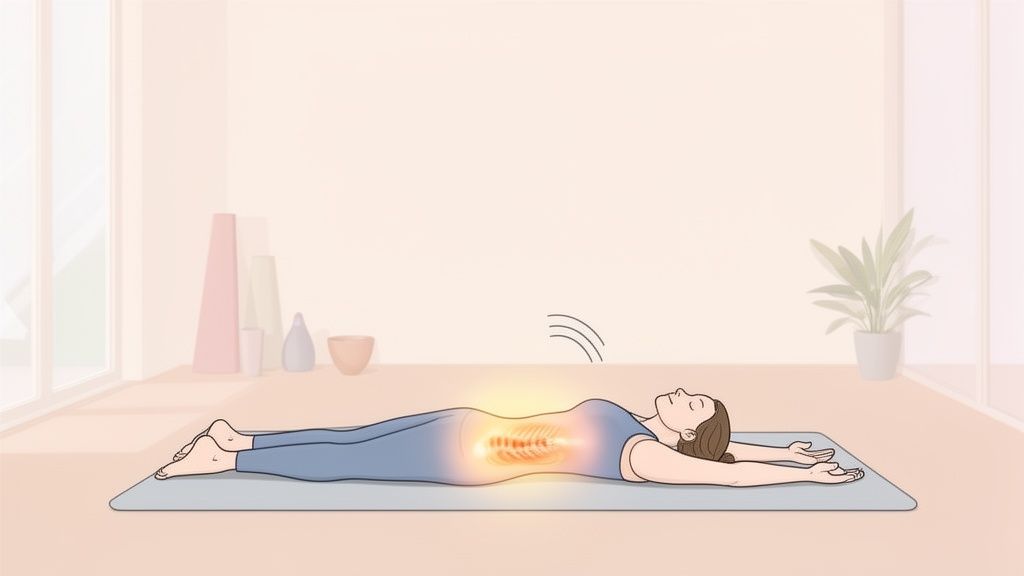
Think of mat Pilates as learning the alphabet of movement. It strips away all the reformers and towers, focusing purely on the neuromuscular conversation between your brain and your muscles. This is where the real magic happens.
Instead of relying on the feedback from springs and pulleys, you learn to create resistance from within. It’s a powerful skill that teaches you to consciously fire up those deep, stabilizing muscles to guide every single movement. This builds a unique kind of strength—one that protects your joints, dramatically improves your posture by strengthening your spinal erectors, and makes you feel more capable in everything you do.
Connecting to Your Deep Core Anatomy
The heart of mat Pilates is activating your "powerhouse." This isn't about getting a six-pack; it's about waking up the entire network of deep muscles that wraps around your torso like a supportive corset, from your diaphragm down to your pelvic floor.
To really understand what's happening, it helps to know the key players you're about to meet.
Anatomy 101: The Core Muscles You Will Activate
| Core Muscle Group | Anatomical Name | What It Does | Why It Matters For Beginners |
|---|---|---|---|
| Deepest Abdominals | Transverse Abdominis (TVA) | Wraps around your waist like a corset to stabilize the spine and pelvis. | This is your body’s natural weight belt. Activating it protects your lumbar spine in every exercise. |
| Spinal Stabilizers | Multifidus | A series of small muscles that run along your spine, supporting each vertebra. | Think of these as tiny guardians for your spine, crucial for inter-segmental stability and preventing strain. |
| Core Foundation | Pelvic Floor | A muscular sling at the base of your pelvis that supports organs and stabilizes the core. | This is the "floor" of your powerhouse. A strong pelvic floor is key for intra-abdominal pressure and control. |
Learning to activate these muscles is what turns an exercise from just "going through the motions" into a deeply effective movement. You'll finally understand what instructors mean by "draw your navel to your spine," translating a cue into a real, physical sensation of TVA engagement.
Building Strength with Bodyweight
There's a reason so many experts recommend mat Pilates as the ideal starting point. It’s all about building that foundational stability. Joseph Pilates' original method was built on precisely 34 mat exercises, each designed to blend breath and control to sculpt a powerful core and a deep mind-body connection.
Pilates isn't just a workout; it's a system for better movement. By focusing on core stability and spinal alignment, you build strength that carries over into your daily life, giving you better posture and more efficient, pain-free motion.
This approach makes it an incredibly joint-friendly practice. You're not pounding on your joints with high-impact moves or loading them with heavy weights. Instead, you're building resilience and strength in a sustainable way. It's a practice designed to build you up for the long haul.
And if you’re wondering about the specific surface you need, we have a whole guide breaking down the differences between a Pilates mat vs a yoga mat.
Understanding Your Anatomy for Better Pilates Form
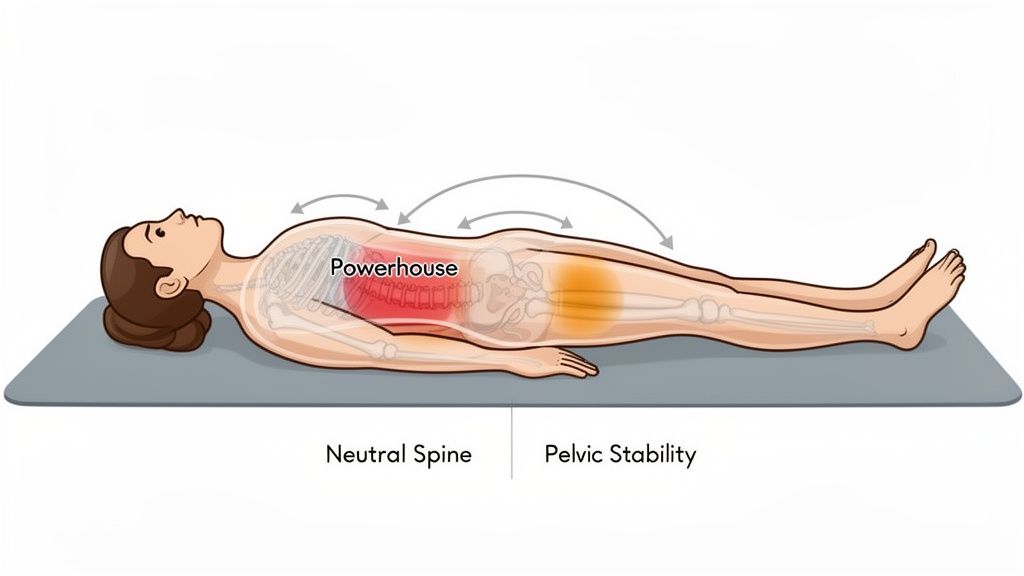
Before you jump into your first exercise, let's talk about what’s happening beneath the surface. This is what unlocks the real power of Pilates. Don't worry, this isn't a complex anatomy lesson. It's about building a mental map of your "powerhouse"—the network of deep core muscles that forms the true center of your strength.
I often describe this powerhouse as a muscular cylinder that includes your deep abdominals (transverse abdominis), your back extensors (erector spinae), the base of your pelvis (pelvic floor), and your diaphragm. This cylinder is responsible for stabilizing your entire torso and powering every single move you make, both on the mat and in your everyday life. When you truly connect with this powerhouse, even the most basic pilates mat exercises for beginners become incredibly effective.
Finding Your Neutral Spine
One of the very first things we focus on is finding a neutral spine. This simply means honoring the natural, gentle curves of your back—a slight inward curve in your lower back (lumbar spine) and a slight outward curve at your upper back (thoracic spine). It’s the strongest and safest position for your spine to be in.
Here’s a quick way to find it for yourself:
- Lie on your back with your knees bent and feet flat on the mat, about hip-width apart.
- Gently rock your pelvis forward and back. You'll feel your lower back arching away from the mat and then pressing flat against it. This movement is called an anterior and posterior pelvic tilt.
- Now, settle right into the middle point between those two extremes. You should have a tiny space under your lower back, just big enough to slide your fingertips through. That’s it.
This is your starting line for most exercises. It ensures you’re activating the right muscles from the get-go without putting any strain on your intervertebral discs.
A neutral spine isn't rigid; it's a position of readiness. Learning to maintain it while your limbs are moving is a core skill in Pilates that builds incredible stability and protects you from injury.
What Pelvic Stability Really Means
Once you’ve found that neutral spine, the next challenge is keeping it there. This is what we call pelvic stability. I like to have clients imagine their pelvis is a bowl of water. As you start moving your legs for an exercise, your goal is to keep that bowl perfectly still so you don't spill a single drop.
This stability comes from activating your deep core muscles, especially the transverse abdominis, which wraps around your torso like a natural corset. The cue you'll often hear, "draw your navel to your spine," is designed to wake up this exact muscle. It’s a subtle hollowing feeling, not a hard crunch. Your breath is your best friend here; check out our guide to breathing techniques for Pilates to learn more about this crucial connection.
Proper Shoulder Placement
Finally, let's bring our awareness up to the shoulders. So many of us carry tension in our necks and shoulders without even knowing it, often by over-recruiting the upper trapezius muscles. In Pilates, you’ll constantly hear me and other instructors cue you to "slide your shoulder blades down your back."
This simple action creates space between your ears and your shoulders by engaging the muscles in your upper back, specifically the serratus anterior and lower trapezius. It's so important because it prevents you from straining your neck and helps you maintain good posture through every movement, ensuring the work stays in your core, right where it belongs.
7 Foundational Pilates Mat Exercises For Beginners
Alright, you’ve got the theory down—you understand what a neutral spine feels like and why pelvic stability is so important. Now it’s time to actually move. This is where we connect the dots between knowing and doing.
Here are seven foundational mat exercises that every beginner should master. I’m going to break down more than just the how; I want you to understand the why behind each movement, focusing on the setup, your breathing, and exactly what muscles you should feel firing up. Think of this as your roadmap to building true, deep strength.
The Hundred
The Hundred is a classic for a reason. It’s the ultimate Pilates warm-up, designed to get your heart rate up, your blood pumping, and—most importantly—to sync your breath with your core engagement. It's an incredible exercise for building deep abdominal endurance.
- Anatomy Focus: The real star here is your transverse abdominis (TVA), which acts like your body's built-in corset. You'll also feel your rectus abdominis and obliques working hard to maintain thoracic flexion and stabilize the pelvis.
- Setup: Lie on your back and bring your knees into a tabletop position, making sure your shins are parallel to the floor. Gently curl your head, neck, and shoulders off the mat and look towards your navel. Reach your arms long by your sides with your palms facing down.
- Movement: Start pumping your arms up and down with energy, but keep the movement small and controlled, originating from the shoulder joint. You’ll inhale for a count of five pumps and exhale for a count of five pumps. The goal is ten full breath cycles, which gets you to the magic 100 pumps.
- Modification: If your neck starts talking to you (a sign of sternocleidomastoid overuse), place one hand behind your head for a little support or just keep your head resting on the mat. To make the core work a bit gentler, you can also keep your feet on the floor with your knees bent.
The secret to The Hundred isn’t about flailing your arms around. The real work is in keeping your torso completely still while your arms are moving. This is how you teach those deep core muscles to switch on and protect your spine.
The Roll Up
The Roll Up is a true test of abdominal strength and spinal articulation. It’s a powerful move that challenges you to move with precision, peeling your spine off the mat one single vertebra at a time. It’s as much about flexibility as it is about control.
- Anatomy Focus: This one is a major workout for the rectus abdominis (your "six-pack" muscles) and the obliques. Even more importantly, it promotes segmental mobility of the entire spine, from the cervical to the lumbar vertebrae.
- Setup: Lie flat on your back with your legs straight and squeezed together, feet flexed. Reach your arms up towards the ceiling.
- Movement: Take an inhale to get ready. On your exhale, start peeling your spine off the mat, bone by bone, reaching forward towards your toes into a C-curve. Inhale at the top, and then exhale to slowly roll back down with that same deliberate control.
- Common Mistake: The biggest pitfall is using momentum to fling yourself up, which often involves the hip flexors (psoas) taking over. If you find yourself getting stuck, try bending your knees slightly. A WundaCore Block placed under your lower back can also give you the support you need to build up the necessary strength.
Single Leg Circles
This exercise is all about disassociation—teaching your leg to move freely in the hip socket while your pelvis and core remain rock solid. Mastering this stillness is a game-changer for just about every other Pilates exercise you'll ever do.
- Anatomy Focus: While your femur is doing the circling, the real effort is coming from your deep core stabilizers (TVA and obliques) and your glutes. They're working isometrically to stop your pelvis from rocking from side to side.
- Setup: Lie on your back, find your neutral spine, and extend one leg up to the ceiling. Keep the other leg bent with your foot flat on the mat for stability.
- Movement: Inhale as you draw a circle with your extended leg, crossing it over the midline of your body. Exhale as you circle it out to the side and bring it back to the starting point. Aim for 5-8 circles in each direction before you switch legs.
Bridge
The Bridge is a must-do for strengthening your entire posterior chain—all those crucial muscles running along the back of your body. A strong posterior chain is non-negotiable for good posture and a stable pelvis.
- Anatomy Focus: This is a powerhouse for your gluteus maximus and hamstrings. Your spinal erectors and deep core muscles also get involved to keep your torso stable and prevent hyperextension of the lumbar spine.
- Setup: Lie on your back with your knees bent and feet flat on the mat, about hip-width apart. Your arms should be long by your sides.
- Movement: On an exhale, press firmly through your feet to peel your spine off the floor, lifting your hips up high. Inhale when you reach the top, imagining a long, straight line from your shoulders to your knees. Exhale again to slowly roll all the way back down.
To go deeper on how these movements build a strong center, check out our guide on other Pilates exercises for core strength.
Your First 20-Minute Beginner Pilates Mat Routine
Alright, you’ve learned the foundational movements. Now it’s time to weave them together into a practice that flows. Think of this 20-minute routine as your personal starter class, designed to wake up your powerhouse and build confidence right on your mat.
The goal here isn't just to do the exercises, but to move seamlessly from one to the next. This is where you start to feel the magic of Pilates—it becomes less like a checklist and more like a fluid conversation with your body.
The Anatomy-Focused Flow
I've sequenced this routine to gently prepare your body, challenge your stability, and then cool everything down. As you move, keep those anatomical cues we talked about in mind. Stay connected to that neutral spine and keep your powerhouse engaged.
This flow chart gives you a great visual of how the exercises connect. We start with the deep, energizing breath of The Hundred, move into the delicious spinal articulation of the Roll Up, and finish by firing up the entire back of your body with the Bridge.
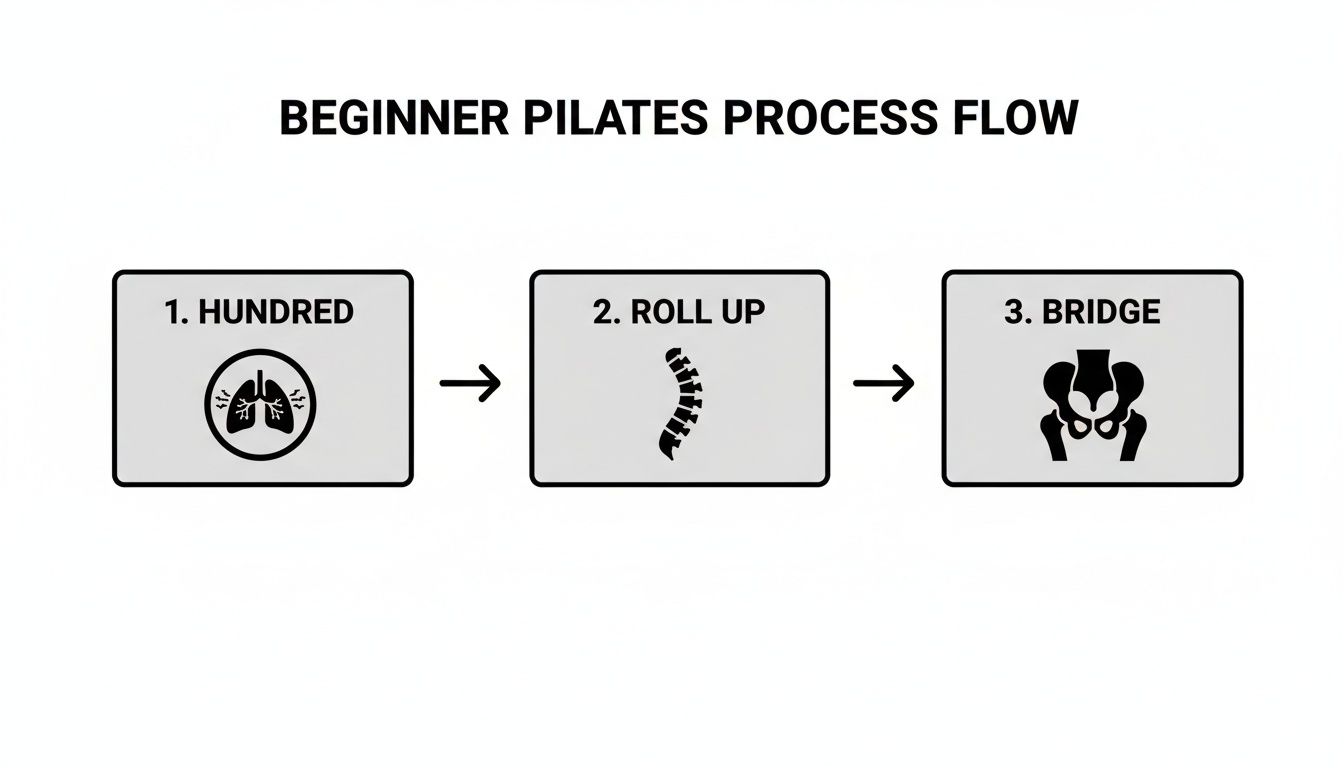
This progression from core endurance to spinal mobility and finally to glute strength creates a wonderfully balanced, full-body workout in a short amount of time.
Sample 20-Minute Beginner Mat Flow
Here’s a simple table you can follow. It breaks down the sequence, reps, and the main thing you should be feeling in your body for each movement.
| Phase | Exercise | Duration / Reps | Anatomy Focus And Key Cue |
|---|---|---|---|
| Warm-Up | Pelvic Tilts | 10 reps | Gently awaken the deep core and mobilize the lumbar spine. Focus on imprinting your lower back into the mat and then returning to neutral. |
| Warm-Up | The Hundred | 10 breath cycles | Keep your transverse abdominis pulled in tight to stabilize your torso while your arms pump with energy. |
| Core Work | The Roll Up | 6–8 reps | Articulate one vertebra at a time. Feel your rectus abdominis control every inch of the movement. |
| Core Work | Single Leg Circles | 5 reps each way, per leg | Use your obliques to lock your pelvis in place. It should be completely still as your leg moves in the hip socket. |
| Posterior Chain | Bridge | 8–10 reps | Squeeze your glutes and hamstrings to lift your hips high, creating a straight line from your shoulders to your knees. |
| Cool-Down | Seated Spine Twist | 3 reps each side | Grow tall through your spine first, then rotate from your thoracic spine. Keep your pelvis grounded and stable. |
| Cool-Down | Knees-to-Chest Hug | Hold for 30 seconds | Gently release your lower back and glutes. Take a few deep, restorative breaths to finish your practice with intention. |
Think of this routine as your launchpad. The goal isn't perfection; it's consistent, mindful practice. The most important thing is to pay attention to what you feel in your body—that awareness is the true foundation of Pilates.
There’s a reason Pilates has exploded in popularity. The global market is projected to hit a staggering $269.3 billion by 2028, all driven by the demand for accessible, low-impact workouts that deliver real results.
An ACE study even confirmed that beginner mat exercises bring the heart rate to about 54% of its max. That’s an intensity similar to a brisk walk—perfect for building strength without feeling totally exhausted. You can learn more about the best practices for starting Pilates and why it continues to be so effective.
How To Progress Your At-Home Pilates Practice
So, you’ve been practicing the foundational exercises and are starting to feel confident. What’s next? It might be tempting to just crank out more reps, but in Pilates, true progress isn't about doing more—it's about doing it better. The real magic happens when you deepen your control, precision, and connection to those deep stabilizing muscles that do all the hard work.
Advancing your practice means getting intentional. You start challenging your stability in new and subtle ways. Instead of just going through the motions, can you keep your pelvis perfectly still during Single Leg Circles? Can you articulate your spine bone by bone, even more slowly, during the Roll Up? This shift in focus is what builds that next-level, integrated strength.
Introducing Resistance To Mimic The Reformer
This is where a few simple props can completely change the game. Tools like a resistance ring or a loop are fantastic because they're designed to mimic the spring tension you'd find on a Pilates reformer, right in your living room. Adding this resistance forces your stabilizing muscles to fire up and work harder, taking your mat workout to a whole new level.
For example, try placing a WundaCore Resistance Ring between your inner thighs during a Bridge. You'll instantly feel your adductors and deep pelvic floor muscles engage in a way they just don't without it. Or, try squeezing a Loop between your hands during The Hundred. Suddenly, your serratus anterior and rhomboids have to work so much harder, demanding more stability from your entire core.
Progression in Pilates isn't about speed or quantity; it's about the quality of your control. Adding external resistance challenges your anatomy to maintain perfect form under a greater load, building strength that is both deep and functional.
This intelligent, anatomy-first approach is a huge reason Pilates has become so popular. In fact, it's emerged as the fastest-growing fitness modality in the U.S. Participation has surged from 9.2 million people in 2019 to 12.9 million by 2024—that’s a 40% increase! This remarkable growth outpaces both yoga and kettlebells. You can dive deeper into the stats behind Pilates' rapid rise on WomensHealthMag.com.
By thoughtfully incorporating props, you can build a more advanced, studio-quality workout right at home. It’s all about honoring your body's individual pace while continuing to refine that crucial mind-body connection that makes Pilates so effective.
Your Questions, Answered
Jumping into any new movement practice brings up a lot of questions, and that’s a good thing. When you're just starting out with Pilates mat exercises for beginners, a few questions tend to come up over and over. Getting some clarity here will give you the confidence to move safely and get the most out of your time on the mat.
How Often Should I Do Mat Pilates As A Beginner?
When you're building a new foundation, consistency always beats intensity. Hands down.
My advice is to aim for 2-3 sessions per week, making sure to take a day off in between. This gives those deep core stabilizing muscles—like the tiny multifidus muscles that run along your spine—the time they need to recover, adapt, and actually get stronger. This process of muscle repair is essential for building real strength.
You don’t need an hour-long session to see results. A focused 20-30 minutes is perfect. The goal isn't to push to exhaustion; it's to teach your body new, more efficient ways of moving. Always listen to what your body is telling you and prioritize quality over quantity.
Is It Normal To Not Feel The Burn In My Abs Right Away?
Absolutely. In fact, if you don't feel a big "burn" at first, it's often a sign that you're doing it exactly right.
Pilates is designed to target the deep, intrinsic core muscles first. We’re talking about your transverse abdominis (TVA), which wraps around your midsection like a natural corset. Instead of a fiery burn, you're more likely to feel a subtle sensation of deep support or a gentle, internal warmth. That's the feeling of your true core firing up.
This is the mind-body connection in action. As you keep practicing and improve your neuromuscular efficiency, your awareness of this deep engagement will grow, and the visible toning everyone talks about will follow.
This focus on deep muscle activation is what makes Pilates so effective. You're not just working the superficial "six-pack" muscles (rectus abdominis); you're building your body's support system from the inside out, creating a stable foundation for every other movement you make.
What If I Have Back Pain? Is Mat Pilates Safe?
For so many people, Pilates becomes the key to managing back pain. The reason is simple: it strengthens the very core muscles that are meant to support and protect your spine. The trick is to approach it with awareness and impeccable form.
The number one rule is to maintain a neutral spine unless an exercise specifically asks you to do otherwise. And never, ever push through sharp pain. If you have a known spinal condition, it's always smart to have a chat with your doctor or physical therapist before you begin.
Remember, almost every exercise can be modified. For instance, if you feel any strain in your low back, placing a supportive tool like the WundaCore Block under your pelvis can help you keep proper alignment without any strain. It makes the work both safer and more effective.
Ready to progress with confidence and precision? The WundaCore collection is designed to bring the anatomy-focused, studio-quality experience right to your home. Explore our patented props and expert-led Wunda On Demand classes to deepen your practice and build strength that truly supports you. Find your flow at https://wundacore.com.