
Sculpt and Strengthen: An Anatomical Guide to Pilates Ring Exercises for Thighs
If you've been doing endless squats and lunges without seeing the definition you want, it's time to shift your focus from sheer volume to anatomical precision. This is where the Pilates ring becomes an invaluable tool. This deceptively simple piece of equipment delivers the consistent, targeted tension your thigh muscles require, helping you sculpt and strengthen with low-impact, highly effective movements.
It’s less about brute force and more about activating the right muscles with intention.
Why the Pilates Ring Is Your Secret for Toned Thighs
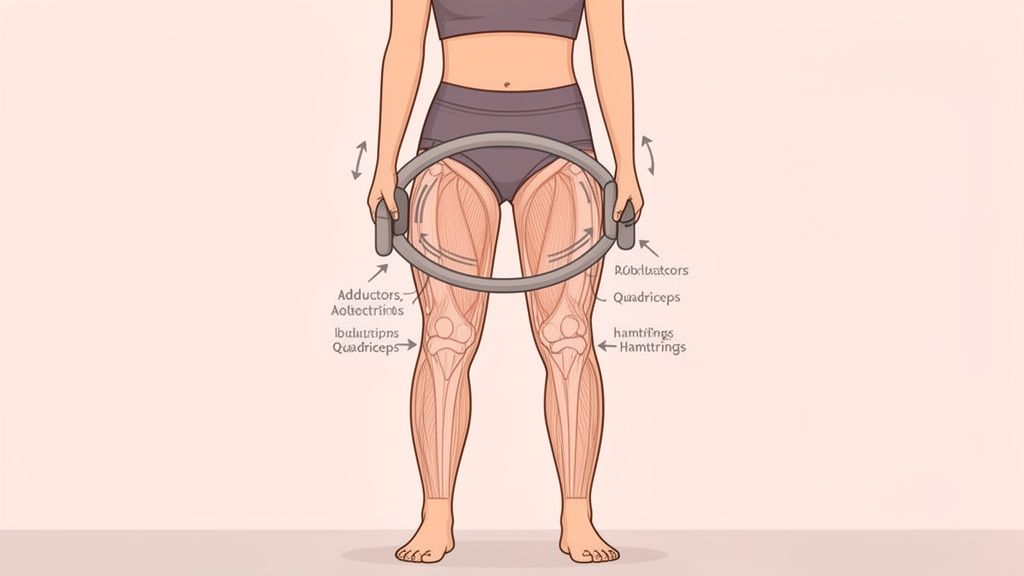
The real magic of the Pilates ring is its ability to create controlled, measurable resistance from any angle. Think about it: when you do a bodyweight squat, you're primarily working against the vertical force of gravity. The ring, however, creates a constant force that your muscles must actively contract against.
You're working concentrically as you squeeze the ring, and you're working eccentrically as you control its release. This dual-phase engagement is precisely what builds long, lean, strong muscle fibers without adding bulk.
This constant tension keeps your muscles engaged through their entire range of motion, which is key for building both strength and visible definition. Because it's so versatile, you can position the ring to isolate smaller, often-neglected stabilizer muscles with incredible accuracy.
The Anatomy of a Toned Thigh
To understand why the ring works so effectively, it's essential to know the muscular anatomy you're targeting. Your thigh is a complex system of muscles responsible for movement at both the hip and knee joints. A balanced workout engages all of them.
- Adductors (Inner Thighs): A group of five muscles (including the adductor longus, brevis, and magnus) originating from the pelvis and inserting along the femur. Their primary function is adduction—bringing the leg toward the body's midline. Squeezing the ring between your thighs is a direct line to firing up this entire group.
- Abductors (Outer Thighs & Hips): Located on the lateral side of the hip, this group includes the gluteus medius, gluteus minimus, and tensor fasciae latae (TFL). These crucial muscles move the leg away from the midline (abduction) and are vital for pelvic stability during single-leg movements like walking.
- Quadriceps Femoris (Front of Thighs): A large group of four muscles (rectus femoris, vastus lateralis, vastus medialis, and vastus intermedius) that collectively act to extend the knee.
- Hamstrings (Back of Thighs): A group of three muscles (biceps femoris, semitendinosus, and semimembranosus) responsible for flexing the knee and extending the hip.
By working through a series of specific pilates ring exercises for thighs, you create a truly balanced neuromuscular workout. This isn't just about aesthetics—it builds functional strength that supports proper biomechanics in every step you take.
We know these targeted movements work. Research into mat Pilates, which uses the same principles of controlled resistance, consistently shows significant changes in thigh circumference.
One study, for example, found that participants trimmed their average thigh measurement by over 3 cm after following a dedicated program. This really drives home how anatomy-focused movements deliver tangible results. If you're building out your home practice, exploring different types of Pilates equipment for home use can take your training even further.
To get the most out of every single squeeze and press with your Pilates ring, you need to understand the anatomy you’re working. This is about more than just going through the motions; it's about building a powerful neuromuscular connection.
When you move with intention and consciously recruit the correct muscle fibers, you make every repetition count. It’s the difference between just finishing a set and truly sculpting your thighs. This focus ensures you feel the work exactly where you should, preventing synergistic muscles from taking over.
Your Inner Thighs: The Adductors
Let's start with the inner thighs. This area is home to the adductor muscle group, a family of five different muscles. Their main job is exactly what it sounds like: adduction, the biomechanical action of pulling your femur inward toward the center of your body.
Think about standing on a slippery floor—your adductors engage isometrically to keep your legs from sliding apart. When you place that Pilates ring between your knees and squeeze, you are creating an isotonic contraction that directly targets this muscle group. That targeted resistance is precisely why the ring is such a game-changer for toning the inner thighs.
Your Outer Thighs and Hips: The Abductors
On the flip side, we have the abductor muscles, which include the gluteus medius and minimus on the outside of your hips. Their primary role is abduction, or moving your femur away from your body's midline. These muscles are the unsung heroes of your pelvic stability.
They work constantly to prevent the opposite side of your pelvis from dropping when you are standing on one leg (a phenomenon known as Trendelenburg gait). Weak abductors are a common culprit behind hip and knee pain. When you press outward on the ring in an exercise like a clamshell, you directly challenge and strengthen these crucial stabilizers.
A strong mind-muscle connection isn’t just some fitness buzzword. It's a real neurological process. By focusing your thoughts on a specific muscle, you can actually recruit more motor units, leading to a much more effective contraction and, ultimately, better results.
To help you visualize what's happening under the skin, here’s a quick cheat sheet.
Your Thigh Muscle Anatomy Cheat Sheet
| Muscle Group | Location | Primary Function | Pilates Ring Action |
|---|---|---|---|
| Adductors | Inner Thigh | Pulls femur toward midline | Squeezing the ring inward |
| Abductors | Outer Hips/Buttocks | Moves femur away from midline | Pressing the ring outward |
| Quadriceps | Front of Thigh | Extends the knee joint | Isometrically contracts to stabilize |
| Hamstrings | Back of Thigh | Flexes the knee joint | Co-contracts to stabilize |
This table is a great reference to keep in mind as you move through your routine, helping you connect the physical action with the anatomical function.
The Major Movers: Quadriceps and Hamstrings
While the Pilates ring is brilliant for isolating the adductors and abductors, it also calls on the larger muscles that power most of your leg movements.
- Quadriceps: This group of four muscles on the front of your thigh is what you use to straighten your knee. They are the prime movers for extending the leg from a bent position, like standing up from a chair.
- Hamstrings: Found on the back of your thigh, these three muscles act as antagonists to the quadriceps. They work to bend your knee and extend your hip, essential for the propulsive phase of walking and running.
Many ring exercises force you to hold an isometric contraction in your quads and hamstrings while you perform dynamic movements with your adductors or abductors. This creates integrated, functional strength throughout the entire leg. For a deeper dive into this, check out our guide on what muscles Pilates works.
Master Your Inner Thigh Workout
Alright, you've got the anatomy down. Now it's time to put that knowledge to work and really connect with those inner thigh muscles, or adductors as we call them. This is where the Pilates ring becomes your best friend. It provides targeted resistance that helps you sculpt and strengthen this area with a precision you just can't get otherwise.
We’re going to do more than just list exercises. I’ll walk you through the setup, the movement, and the anatomical why behind each one. The goal here isn't just to go through the motions; it's to build a powerful neuromuscular connection. That's the secret to getting better, faster results.
Think of it as a direct line from your brain to your thighs—every squeeze starts with intention.
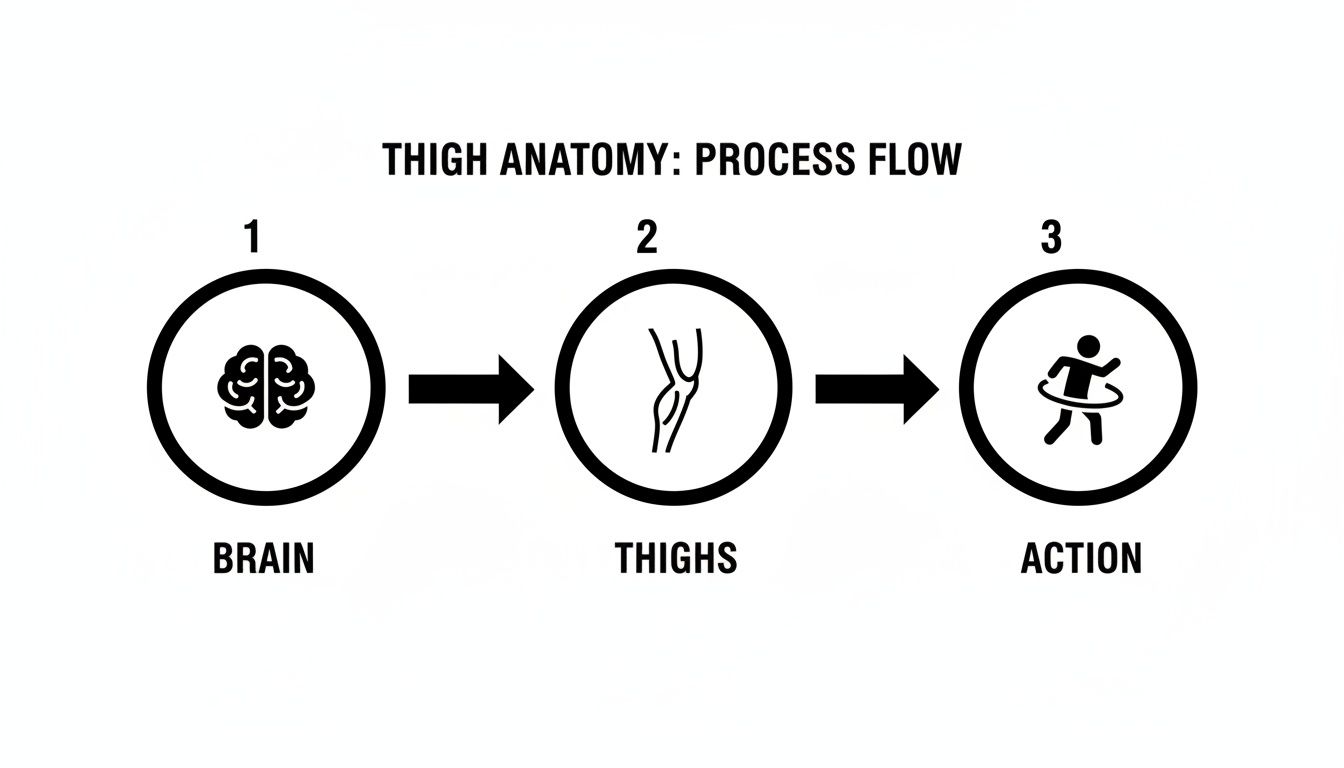
This simple diagram shows it all. Effective movement begins with focus, travels through your nervous system, and ends in a targeted, powerful muscle contraction.
Side-Lying Adductor Press
This is a classic for a reason—it isolates the adductors of the top leg with laser focus. It's a fantastic move for building that foundational inner thigh strength and getting a feel for the muscle you're working.
The Setup
Lie on your side, making sure your hips and shoulders are stacked perfectly in the frontal plane. Straighten your bottom leg out. Now, take the Pilates ring and place its bottom pad just above your bottom ankle. Bend your top leg and place that foot flat on the floor in front of you for stability. The ring's top pad should rest snugly against your top inner ankle (medial malleolus).
The Movement
Take a deep breath in to prepare. As you exhale, gently press down with your top leg, adducting your hip to squeeze the ring. Feel that engagement deep in your inner thigh, close to the pelvis. Hold that concentric contraction for a count of two. Inhale as you slowly release the tension over a count of three, performing an eccentric contraction to resist the ring's rebound.
Why It Works
This move hits the adductors directly by making them perform their primary function: hip adduction. The slow, controlled eccentric release is where the magic happens. It builds strength through the lengthening phase of muscle contraction, which is key for creating tone and preventing injury.
Inner Thigh Squeeze in Bridge
I love this variation because it's a compound movement. You take the classic glute bridge (hip extension) and layer in a powerful isometric adductor squeeze, working your glutes, hamstrings, and inner thighs all at once.
The Setup
Lie on your back with your knees bent and your feet flat on the floor, about hip-distance apart. Place the Pilates ring between your inner thighs, just above your knees. Rest your arms long by your sides, palms pressing into the mat to stabilize your torso.
The Movement
Inhale to get ready. On your exhale, articulate your spine off the floor, engaging your glutes and hamstrings to lift your hips until you form a straight line from your shoulders to your knees. Once at the top, give the ring a firm isometric squeeze with your inner thighs and hold it for three solid seconds. Inhale as you release the squeeze just a little, then exhale as you slowly lower your hips back down.
Why It Works
By adding that squeeze at the apex of the bridge, you're forcing your adductors to co-contract with your primary hip extensors (glutes and hamstrings). This integration builds true functional strength, teaching these muscle groups to work synergistically to stabilize your pelvis and femur.
A 12-week randomized trial showed that Pilates delivers significant gains in lower-limb strength. Participants saw impressive improvements in the 30-second chair sit-to-stand test, a key measure of functional thigh strength. It’s a great reminder of how consistent Pilates practice, boosted by ring resistance, builds the power we need for everyday life. You can learn more about the study's findings on Pilates and strength.
Common Mistakes and How to Fix Them
Even the best Pilates ring exercises for thighs won't work if your form is off. Here are common biomechanical compensations and how to correct them.
-
Mistake: Using momentum instead of muscle. It’s tempting to rush through reps or "bounce" the ring, but that completely negates the benefit of controlled concentric and eccentric contractions.
- The Fix: Slow it down. A count of two on the concentric squeeze and three on the eccentric release forces your muscle fibers to do all the work. Quality over quantity, always.
-
Mistake: Pelvic instability. When you're lying on your side, it's easy to let that top hip roll backward or forward. This breaks your alignment and shifts the load away from the target muscles.
- The Fix: Engage your deep core muscles (transverse abdominis) to lock your pelvis in a neutral position. Imagine your hips are stacked like two dinner plates, and don't let them tilt.
Build Balance with Outer Thigh Exercises
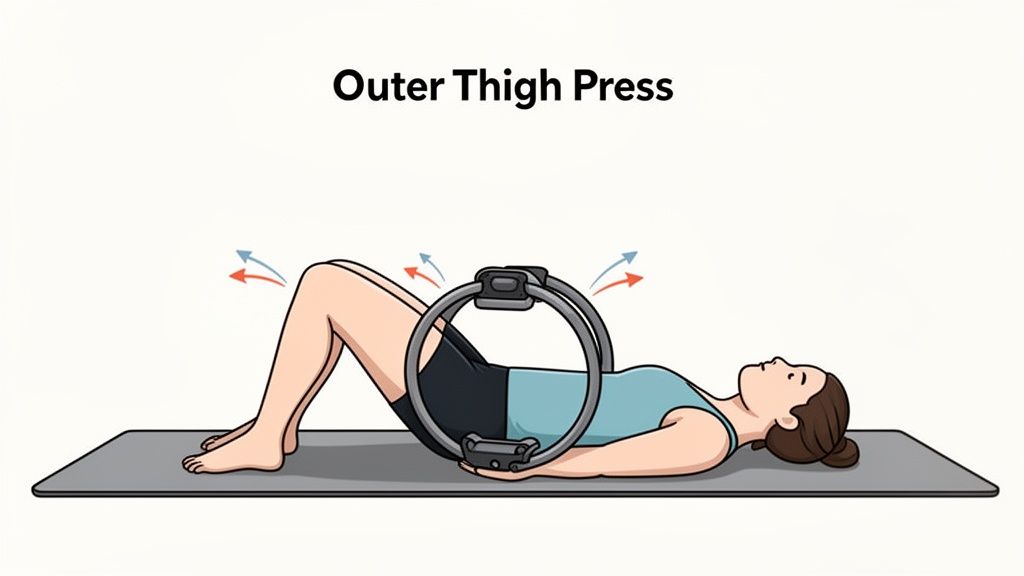
Now that we’ve activated the adductors, it's time to focus on the outside of the legs. Creating truly strong, sculpted legs is about muscular balance, which means giving your outer thighs and hips—your abductor muscles—the attention they deserve.
These muscles, especially the gluteus medius, are the unsung heroes of your stability. Strengthening them isn't just about aesthetics; it's about building a solid foundation that stabilizes your pelvis, protects your knees from valgus collapse (caving inward), and sharpens your balance.
Outer Thigh Press in Clamshell
The clamshell is a physical therapy favorite for good reason, and adding the Pilates ring amplifies its effectiveness. This move isolates the gluteus medius, a critical muscle for hip stability that prevents the pelvis from dropping when you walk or run.
The Setup
Lie on your side, stacking your hips and shoulders in one long line. Your knees should be bent at about a 45-degree angle in front of you, with your feet stacked. Place the Pilates ring on the outside of your thighs, just an inch or two above your knees.
The Movement
Keeping your feet perfectly together, exhale and initiate the movement from your deep hip rotators to press your top knee up into the ring (hip abduction and external rotation). Hold that press for a solid two-count, feeling that deep contraction in your outer hip and glute. Then, inhale and slowly lower your knee with control, fighting the ring's resistance on a slow three-count.
Why It Works
The ring provides constant, focused resistance, forcing your abductors to engage through their entire range of motion. The slow, controlled return (eccentric phase) is crucial—it builds the fine-tuned muscular control needed to stabilize the hip joint during dynamic activities.
Standing Abductor Lift
Let's take this work upright. Standing challenges your proprioception and makes all those little stabilizing muscles work overtime. This is a brilliant functional exercise that directly translates to the single-leg stability you need for daily life.
The Setup
Stand tall with your feet together, placing a hand lightly on a chair or wall for balance. Slip the Pilates ring around your outer ankles. Engage your core to keep your pelvis level and your spine elongated.
The Movement
First, ground down firmly through your standing foot, creating a stable base. As you exhale, lift your other leg straight out to the side (hip abduction), pressing into the ring's tension. Only go as high as you can without leaning your torso or hiking up your hip. The goal is pure, isolated movement at the hip joint. Hold for a moment at the peak, then inhale as you slowly control the leg back to the start.
Why It Works
This exercise is a two-for-one deal. You're creating a concentric contraction in the abductors of the moving leg, while the abductors of your standing leg are firing isometrically to prevent your pelvis from dropping. This dual action is incredibly effective for building the kind of integrated strength that improves gait and balance.
You can't build a truly strong, resilient body by only focusing on the big muscles. Muscular imbalances, particularly between the adductors and abductors, are one of the biggest culprits behind strain and injury. By targeting the outer thighs, you're creating the symmetry and support system your entire lower body needs to function optimally.
Common Form Pitfalls to Avoid
To get the full neuromuscular benefits from these pilates ring exercises for thighs, precision is everything. Here are common compensations to watch out for.
-
Mistake: Rocking the Hips. During the clamshell, it’s tempting to roll the top hip back to get the knee higher. This shifts the work out of your gluteus medius and into your lower back (quadratus lumborum).
- The Fix: Brace your core and imagine you're lying with your back flat against a wall. Your pelvis should not move at all during the exercise.
-
Mistake: Leaning the Torso. In the standing lift, leaning the torso away from the lifting leg is a classic compensation for weak abductors.
- The Fix: Shorten your range of motion. A smaller, controlled lift with a perfectly upright torso is infinitely more effective than a big, sloppy kick. Focus on isolating the movement to the hip joint itself.
If you want to dive deeper into how these muscles support pelvic stability, you can explore more detailed exercises for the gluteus medius in our comprehensive guide.
Your Go-To Pilates Ring Thigh Routines
Alright, let's put these moves together. The real magic happens when you combine these targeted exercises into smart, balanced flows. A structured routine is your best bet for working your inner and outer thighs in harmony, which is crucial for building balanced strength and avoiding those pesky muscular imbalances.
Before you jump in, a quick but important reminder: always warm up! To get the most out of every single squeeze and press—and to keep your body safe—your muscles need to be warm and ready to work. If you need some ideas, here's some great guidance on how to warm up before exercise for peak performance.
15-Minute Thigh Toning Flow
This little routine is perfect when you're just starting out or simply short on time. We're going to focus on super-controlled movements to build that powerful mind-muscle connection.
Give yourself about 30 seconds of rest between each exercise.
- Inner Thigh Squeeze in Bridge: 1 set of 15 reps
- Side-Lying Adductor Press: 1 set of 12 reps per side
- Outer Thigh Press in Clamshell: 1 set of 15 reps per side
- Standing Abductor Lift: 1 set of 12 reps per side
You'll notice we start on the floor. This is intentional. We activate the glutes and adductors from a stable supine position first, then move into more isolated side-lying work before finishing with a standing balance challenge. It’s a smart progression that safely prepares your body for more complex movements.
25-Minute Sculpt and Strengthen Circuit
Ready to kick things up a notch? This circuit is designed to challenge your muscular endurance. By moving a bit more quickly between exercises, you'll keep your heart rate up and your muscles firing.
Complete the full circuit, take a 60-second rest, and then hit it again for a total of two rounds.
- Inner Thigh Squeeze in Bridge: 15 reps
- Outer Thigh Press in Clamshell: 15 reps per side
- Side-Lying Adductor Press: 15 reps per side
- Standing Abductor Lift: 15 reps per side
This circuit-style approach taps into the same principles that make Pilates so effective for building real, functional strength. In fact, research shows that consistent Pilates practice can significantly boost lower limb muscle activation and joint flexion speeds—exactly what you need for everyday power and agility. The controlled resistance of the ring is your secret weapon for firing up those adductors and quads.
Your Top Thigh Workout Questions, Answered
As you start working with the Pilates ring, it's totally normal for questions to pop up. Getting good, anatomy-smart answers is what makes the difference between just going through the motions and seeing real change. Here are a few of the most common questions I get from clients, all broken down for you.
How Often Do I Need to Do These to See a Difference?
Think consistency, not intensity. For that toned, strong feeling you're after, I recommend aiming for 3 to 4 sessions a week on non-consecutive days. This rhythm gives your inner and outer thigh muscles (your adductors and abductors) the recovery time they need for muscle protein synthesis and repair.
Most people start to feel a change in neuromuscular control and muscle activation within just two or three weeks. As for visible hypertrophy and definition? Give it about six to eight weeks of consistent work, and you'll really start to notice it.
Can I Use the Ring if I Have Knee Pain?
For many people, the answer is a big yes. Because these exercises are low-impact, they're fantastic for strengthening the muscles that support the knee joint—specifically the quadriceps, hamstrings, and hip abductors. Strengthening this network can significantly improve patellar tracking and reduce pain.
The golden rule is always to listen to your body.
- Placement is everything: Make sure the ring is always above your knees on the femur, never pressing directly on the patella or the joint line itself.
- Stay in the pain-free zone: If you feel any sharp or pinching pain, that's your cue to stop. Pain is a signal to modify or regress the exercise.
- Form over everything: Proper biomechanical alignment is what keeps the work in your thigh muscles and prevents undue stress on your knee ligaments and cartilage.
If you have ongoing pain or a specific condition, consulting with a physical therapist is always your best move.
A high-quality ring makes a real difference. It provides a consistent, reliable resistance that won't give out on you, keeping your workouts effective long-term. Plus, they usually have better, more comfortable padded handles, which helps you maintain proper form and truly isolate the muscles you're targeting.
At WundaCore, we're all about building real, lasting strength through movement that's grounded in anatomy. Our equipment is designed to bring that intelligent, studio-quality experience into your home. Ready to move with purpose? Explore our collection at https://wundacore.com.