
Exercises for gluteus medius: 8 essential moves to boost strength
While the gluteus maximus often steals the spotlight in lower-body training, a deeper, more functionally critical muscle dictates your stability, prevents chronic knee and back pain, and sculpts the shape of your hips: the gluteus medius. Located on the outer surface of the pelvis, this fan-shaped muscle originates from the ilium (the large pelvic bone) and inserts onto the greater trochanter of the femur (the bony prominence on the side of your hip). Its primary anatomical functions are hip abduction (lifting your leg out to the side) and pelvic stabilization in the frontal plane. Every time you walk, run, climb stairs, or even stand on one leg, your gluteus medius fires to keep your pelvis level and your lower body aligned.
When this muscle is weak or inactive, a condition often called "gluteal amnesia," the body compensates, leading to a cascade of biomechanical issues. This can manifest as IT band syndrome, runner's knee, sacroiliac (SI) joint pain, and persistent lower back aches. Strengthening this specific muscle is not just about aesthetics; it's a fundamental component of building a resilient, functional, and pain-free body.
This comprehensive guide moves beyond basic movements to provide a definitive list of the most effective exercises for gluteus medius development. You will learn not just what to do, but how to do it correctly, with a strong focus on anatomical precision. We will cover:
- Detailed, step-by-step instructions for bodyweight, resistance band, and prop-assisted exercises.
- Common form mistakes to avoid and how to correct them for maximal muscle activation.
- Actionable regressions and progressions to meet you at any fitness level, from absolute beginner to advanced practitioner.
- Sample mini-workouts tailored for different goals and equipment, including the WundaCore platform.
By focusing on this hidden powerhouse, you'll build foundational strength that enhances every movement you make, ensuring your foundation is stable, powerful, and balanced from the inside out.
1. Clamshells
The Clamshell is a quintessential isolation exercise for targeting the gluteus medius. Performed lying on your side, this movement involves rotating your top thigh externally, lifting the knee towards the ceiling while keeping your feet together, mimicking the opening and closing of a clamshell. Its popularity stems from its accessibility and effectiveness, making it a staple in physical therapy, rehabilitation, and Pilates for specifically strengthening the hip abductors.
Because it isolates external rotation at the hip joint, the Clamshell is one of the best introductory exercises for gluteus medius, teaching you to feel the muscle contract without engaging larger, more dominant muscles like the gluteus maximus or the tensor fasciae latae (TFL).
How to Perform the Clamshell Correctly
Proper form is crucial to ensure you're activating the gluteus medius and not compensating with other muscles.
- Starting Position: Lie on your side with your hips and shoulders stacked vertically. Bend your knees to approximately a 45-degree angle, keeping your heels in line with your glutes. Prop your head up on your bottom arm or a pillow.
- Engage Your Core: Gently draw your navel toward your spine to stabilize your pelvis. This prevents your hips from rocking back and forth during the movement.
- The Movement: Keeping your feet touching, slowly lift your top knee toward the ceiling without letting your pelvis roll backward. The movement should be initiated from your glutes, not your lower back.
- Peak Contraction: Lift as high as you can while maintaining a stable pelvis. Pause at the top for a moment to feel the gluteus medius contract.
- Controlled Return: Slowly lower your knee back to the starting position with control. This eccentric (lowering) phase is just as important as the lift.
Anatomy Insight: The primary movers in the Clamshell are the posterior fibers of the gluteus medius, which are responsible for external rotation and abduction of the hip. The gluteus minimus, located deep to the medius, also assists. Stabilizing the pelvis with your core ensures these fibers are isolated and prevents the tensor fasciae latae (TFL) at the front of the hip from taking over.
Common Mistakes and Progressions
- Rocking the Hips: The most common mistake is allowing the hips to roll backward to gain more height. This shifts the work to the lower back and TFL. Keep your hips stacked and still.
- Moving Too Fast: Performing the exercise quickly relies on momentum. Slow, controlled movements maximize muscle engagement.
- Regression: If you feel strain, reduce the range of motion. Only lift your knee as high as you can without any hip movement.
- Progression: Add a resistance band around your thighs, just above the knees, to increase the challenge. For an advanced variation, perform a Glute Bridge with Clamshell, holding a bridge position while opening and closing the top leg.
2. Side-Lying Hip Abduction
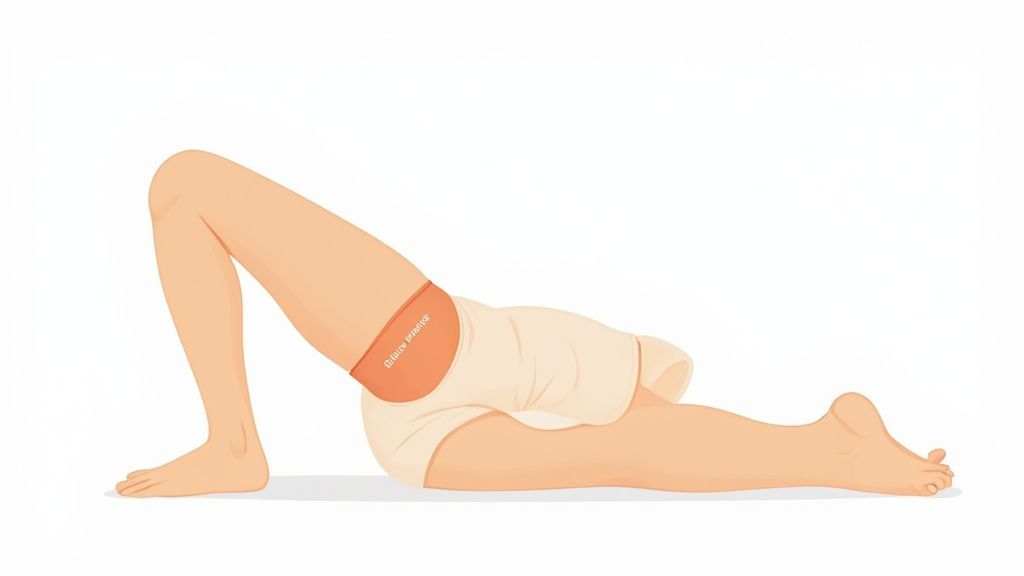
The Side-Lying Hip Abduction, often called a side leg lift, is a foundational exercise that directly isolates the gluteus medius. Performed by lying on your side and lifting the top leg straight up towards the ceiling, this movement is a pure expression of hip abduction. Its direct, uncomplicated nature makes it a highly effective tool for building strength and stability in the lateral hip muscles.
This exercise is fundamental in both clinical and fitness settings because it strengthens the primary role of the gluteus medius: stabilizing the pelvis in the frontal plane. As one of the most direct exercises for gluteus medius, it helps improve balance, gait, and stability during single-leg activities like running or climbing stairs.
How to Perform the Side-Lying Hip Abduction Correctly
Proper execution is key to isolating the gluteus medius and preventing compensation from other muscle groups like the TFL or quadratus lumborum (lower back).
- Starting Position: Lie on your side with your legs extended straight and stacked one on top of the other. Your body should form a straight line from your head to your heels. Rest your head on your bottom arm.
- Engage Your Core: Brace your core by gently pulling your navel in. This will keep your torso and pelvis stable throughout the entire movement.
- The Movement: Keeping your top leg straight and your foot in a neutral position (not turned up), lift the leg toward the ceiling. The movement should be slow and controlled, originating from your hip.
- Peak Contraction: Lift your leg only as high as you can without tilting your pelvis or torso. Pause at the top and focus on squeezing the side of your hip.
- Controlled Return: Slowly lower your leg back down to the starting position with control. Do not let gravity do the work. The lowering phase is crucial for building strength.
Anatomy Insight: This exercise primarily targets the gluteus medius and minimus, the key hip abductors. Keeping your leg parallel to the floor (not rotating the hip) and leading with the heel ensures these muscles are the prime movers. If the toes turn up, the tensor fasciae latae (TFL) and hip flexors can dominate the movement.
Common Mistakes and Progressions
- Rocking the Torso: A common error is using momentum or leaning the torso backward to lift the leg higher. Keep your upper body completely still.
- Leading with the Foot: Allowing your toes to point toward the ceiling rotates the hip externally, engaging the hip flexors and TFL more than the gluteus medius. Keep your foot parallel to the floor.
- Regression: If the full range is too difficult, simply reduce how high you lift your leg. You can also perform the exercise with a slight bend in the knees.
- Progression: To increase the intensity, add a resistance band around your ankles or wear an ankle weight on your top leg. You can also perform this exercise from a Side Plank position for an advanced core and glute challenge.
3. Bulgarian Split Squats
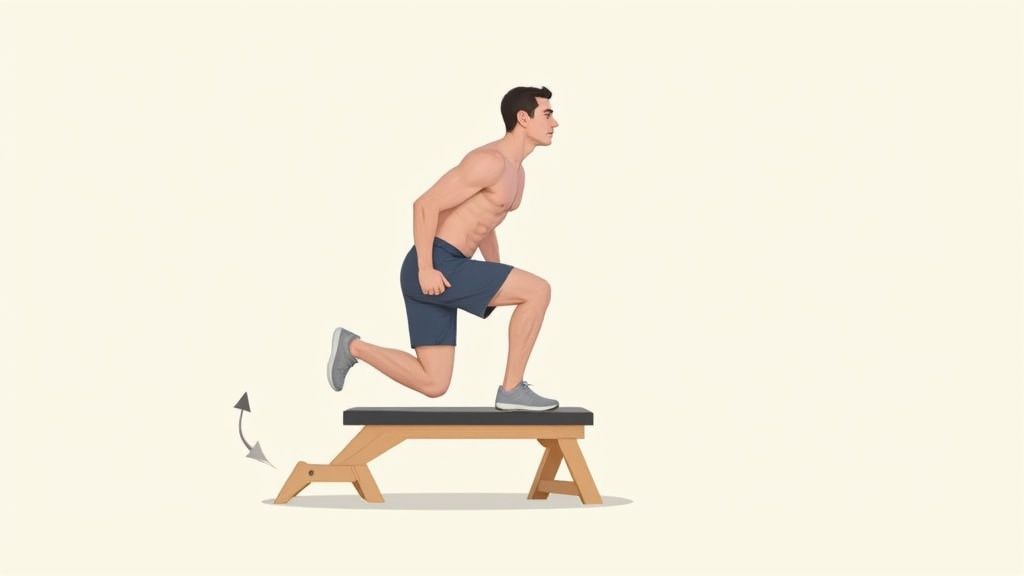
The Bulgarian Split Squat is a powerful unilateral exercise that challenges balance, stability, and lower body strength. It involves elevating your rear foot on a bench while performing a single-leg squat with your front leg. This split stance creates an unstable environment, forcing the gluteus medius of the front, working leg to fire intensely to maintain pelvic stability and prevent your hip from dropping outwards.
While it is a compound movement that also heavily recruits the gluteus maximus and quadriceps, its unique demand on single-leg stability makes it one of the most effective exercises for gluteus medius in a functional, standing position. It builds strength that translates directly into activities like running, climbing stairs, and lunging.
How to Perform the Bulgarian Split Squat Correctly
Executing this move with proper form is key to targeting the glutes and protecting your knees.
- Starting Position: Stand a few feet in front of a bench or sturdy chair. Place the top of your back foot onto the bench. Your front foot should be far enough forward so that your knee can track over your ankle as you lower down.
- Engage Your Core: Keep your torso upright and your chest proud. Brace your core to maintain a neutral spine and prevent your lower back from arching.
- The Movement: Lower your hips straight down toward the floor, bending your front knee. Descend until your front thigh is parallel to the ground or your back knee nearly touches the floor.
- Peak Contraction: Drive through the heel of your front foot to return to the starting position. Focus on squeezing the glute of your front leg to power the movement upward.
- Controlled Return: The entire movement should be smooth and controlled, avoiding any bouncing or jerky motions. Complete all reps on one side before switching to the other.
Anatomy Insight: The gluteus medius on the stance leg works isometrically to stabilize the pelvis in the frontal plane, preventing it from dropping on the unsupported side (a phenomenon known as the Trendelenburg sign). This stabilization role is crucial for hip health and efficient movement patterns. It counteracts the adduction torque at the hip, keeping your femur aligned with your foot and preventing knee valgus (caving inward).
Common Mistakes and Progressions
- Leaning Too Far Forward: An excessive forward lean can shift the emphasis to the quads and put stress on the lower back. Keep your chest up and torso relatively vertical.
- Front Knee Caving Inward: This is a classic sign of glute medius weakness. Actively push your front knee outward so it tracks in line with your foot.
- Regression: Start with bodyweight only and reduce the depth of your squat. You can also perform the exercise with your back foot on a lower surface.
- Progression: Once you master the form, add weight by holding dumbbells at your sides. This is often safer and easier to manage than a barbell. You can find more details on how to safely add resistance in our guide to progressive resistance training.
4. Hip Thrusts / Glute Bridges
The Hip Thrust (or its bodyweight counterpart, the Glute Bridge) is a powerhouse compound movement primarily celebrated for its ability to build the gluteus maximus. However, its role in strengthening the gluteus medius is crucial and often underestimated. By thrusting the hips upward against gravity, you create a powerful gluteal contraction where the gluteus medius works overtime to stabilize the pelvis and prevent the knees from caving inward or outward.
This dual-action of strengthening the prime mover (gluteus maximus) while engaging a key stabilizer makes Hip Thrusts one of the most efficient exercises for gluteus medius. Popularized by biomechanics expert Bret Contreras, this exercise is a staple for developing comprehensive glute strength and function.
How to Perform the Hip Thrust Correctly
Proper execution is key to maximizing glute activation and protecting your lower back. The Glute Bridge is performed on the floor, while the Hip Thrust uses a bench for a greater range of motion.
- Starting Position: Sit on the floor with your upper back against the edge of a sturdy bench. Place your feet flat on the floor, hip-width apart, with your knees bent. Your feet should be positioned so that your shins are vertical at the top of the movement.
- Engage Your Core: Brace your core and tuck your chin slightly toward your chest. This helps maintain a neutral spine and prevents hyperextension of the lower back.
- The Movement: Drive through your heels to lift your hips toward the ceiling until your body forms a straight line from your shoulders to your knees. Squeeze your glutes powerfully at the top.
- Peak Contraction: Pause for one to two seconds at the top, focusing on the contraction in your entire glute complex. Ensure your pelvis is posteriorly tilted (tucked under) to maximize glute engagement.
- Controlled Return: Slowly lower your hips back down toward the floor with control, without letting them rest completely before starting the next repetition.
Anatomy Insight: While the gluteus maximus is the primary driver of hip extension in this exercise, the gluteus medius and minimus act as dynamic stabilizers. They contract isometrically to maintain hip abduction and prevent adduction (knees collapsing inward), a critical function for knee and pelvic stability during movement. Adding a resistance band around the knees enhances this effect by forcing a conscious abduction effort.
Common Mistakes and Progressions
- Arching the Lower Back: Overextending the lumbar spine at the top of the lift is a common error. This shifts stress to the lower back instead of the glutes. Keep your core tight and ribcage down.
- Pushing Through Toes: Driving through your toes rather than your heels can engage the quadriceps more than the glutes. Keep your weight firmly in your heels.
- Regression: Start with the basic Glute Bridge on the floor to master the form. You can also perform a Banded Glute Bridge, placing a mini-band around your thighs and actively pressing your knees outward to increase gluteus medius activation.
- Progression: The most common progression is adding weight, such as a barbell or dumbbell, across your hips. For a unilateral challenge that heavily targets the gluteus medius, perform a Single-Leg Hip Thrust. You can explore various types of resistance training equipment for home to add a progressive challenge.
5. Lateral Band Walks
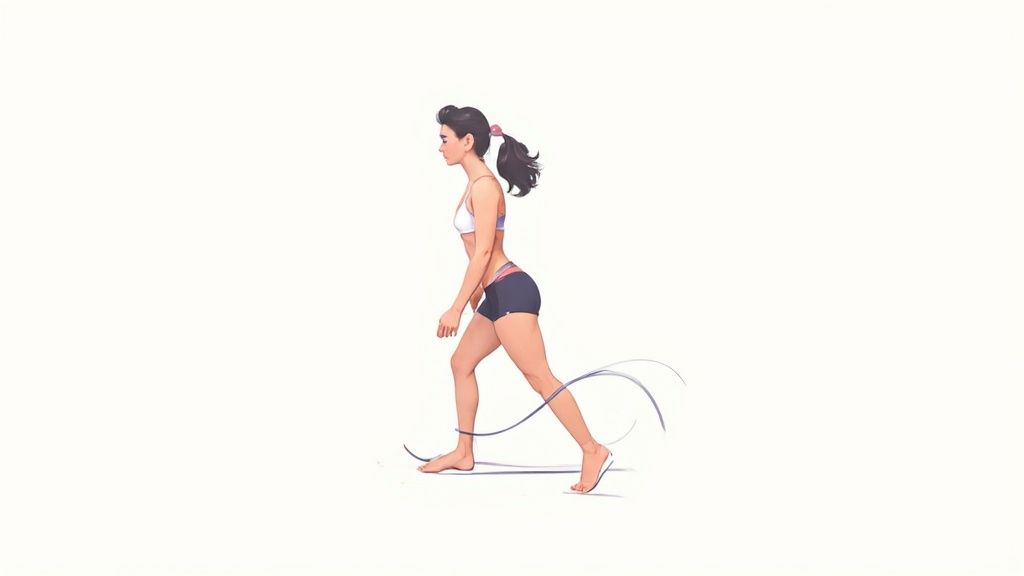
Lateral Band Walks, often called "monster walks," are a dynamic and functional exercise excellent for firing up the gluteus medius. This movement involves stepping sideways against the resistance of a band placed around your legs, forcing your hip abductors to work continuously to maintain tension and control your gait. It's a foundational exercise in strength and conditioning, physical therapy, and athletic training for its ability to improve hip stability, prevent injuries, and enhance athletic performance.
By requiring constant hip abduction under load, Lateral Band Walks are one of the most effective exercises for gluteus medius for building both strength and endurance in the muscle, which is crucial for pelvic stability during walking, running, and single-leg movements.
How to Perform Lateral Band Walks Correctly
Executing this move with precision ensures the gluteus medius is the primary worker, not the quadriceps or lower back.
- Starting Position: Place a resistance band around your thighs just above the knees, or for a greater challenge, around your ankles. Stand with your feet hip-width apart, creating initial tension on the band.
- Athletic Stance: Hinge slightly at your hips and bend your knees, adopting a "ready" or athletic stance. Keep your chest up and your core engaged.
- The Movement: Keeping your toes pointing forward, take a controlled step sideways with one foot, about 12-18 inches. Land softly on your mid-foot and maintain tension on the band.
- Follow Through: Bring your trailing leg in slowly, but only enough to return to a hip-width stance. Do not let your feet touch, as this releases the tension on the glutes.
- Repeat: Continue stepping in one direction for 10-15 reps before switching to lead with the other leg for the same number of reps.
Anatomy Insight: This is a dual-action exercise from an anatomical standpoint. The gluteus medius of the stepping leg works concentrically to abduct the hip against the band's resistance. Simultaneously, the gluteus medius of the stationary (stance) leg must fire isometrically to stabilize the pelvis and prevent it from dropping. This dual workload makes it a highly efficient exercise for neuromuscular control.
Common Mistakes and Progressions
- Letting Knees Cave In: A common error is allowing the knees to collapse inward (valgus), which negates the purpose of the exercise. Actively press your knees out against the band.
- Leaning the Torso: Avoid swaying your upper body from side to side. Keep your torso level and still by bracing your core.
- Regression: Use a lighter resistance band or reduce the size of your steps. Focus on maintaining perfect form with less resistance.
- Progression: Place the band around your ankles or feet to increase the lever length and challenge. You can also increase the band's resistance or the number of steps. For more ways to advance your routine, you can explore other exercises using resistance bands on WundaCore. For expanding your repertoire beyond Lateral Band Walks, explore more resistance band exercises for beginners to further strengthen your gluteus medius and surrounding muscles.
6. Single-Leg Deadlifts
The Single-Leg Deadlift (SLDL) is a powerful, functional exercise that challenges the gluteus medius in its crucial role as a pelvic stabilizer. This dynamic hip-hinge movement, performed on one leg, builds unilateral strength in the entire posterior chain (glutes, hamstrings, back) while demanding exceptional balance and coordination. Its value lies in its direct translation to real-world activities like running, climbing stairs, and lifting objects from the floor.
While often praised as a hamstring and gluteus maximus developer, the SLDL is one of the most effective exercises for gluteus medius because it forces the muscle to work isometrically to keep your hips level and prevent them from dropping to one side. This stabilization is key to preventing injuries and improving athletic performance.
How to Perform the Single-Leg Deadlift Correctly
Mastering the form without weight is essential before adding external resistance. Focus on the hip hinge, not on bending at the waist.
- Starting Position: Stand on your right leg with a soft, slight bend in the knee. Your left leg should be slightly behind you, resting on your toes for balance. Keep your spine neutral and your core engaged.
- Engage Your Core: Brace your abdomen as if preparing for a punch. This helps maintain a flat back and protects your lumbar spine throughout the movement.
- The Movement: Hinge forward at your hips, lowering your torso toward the floor while simultaneously extending your left leg straight behind you. Imagine your body forming a "T" shape at the bottom of the movement.
- Peak Contraction: Lower until your torso and back leg are nearly parallel to the floor, or as far as you can while maintaining a neutral spine. You should feel a stretch in your right hamstring and a strong contraction in your right glute.
- Controlled Return: Drive through your standing heel and squeeze your right glute to return to the starting position with control. Avoid using your lower back to pull yourself up.
Anatomy Insight: The gluteus medius on the standing leg works intensely to prevent hip drop (adduction) and internal rotation on the unsupported side. This isometric stabilization is vital for maintaining pelvic alignment during single-leg movements. It creates a stable base at the hip, allowing the gluteus maximus and hamstrings to function effectively as the primary movers for hip extension.
Common Mistakes and Progressions
- Rounding the Back: The most common error is rounding the lumbar spine instead of hinging at the hips. This places stress on the lower back. Keep your chest up and spine long.
- Opening the Hips: Many people allow the hip of the elevated leg to rotate open toward the ceiling. Keep your hips square and pointing directly at the floor throughout the entire repetition.
- Regression: If balance is an issue, perform the movement next to a wall for support. You can also perform a "kickstand" SLDL, keeping the toes of the back foot lightly on the floor.
- Progression: Once you have mastered the bodyweight version, hold a dumbbell or kettlebell in the hand opposite your standing leg (contralateral load) to increase the stability demand on the gluteus medius.
7. Cable Machine Side Raises (Hip Abduction Machine/Cable)
Cable Machine Side Raises, also known as Cable Hip Abduction, introduce external resistance to directly challenge the gluteus medius. Using a cable machine with an ankle cuff, this exercise provides consistent tension throughout the entire range of motion, something that is difficult to achieve with bodyweight or banded exercises alone. This constant tension is highly effective for stimulating muscle growth (hypertrophy) and building strength.
By allowing for precise, incremental weight increases, this movement is one of the most effective exercises for gluteus medius when it comes to progressive overload. It systematically strengthens the muscle responsible for stabilizing the pelvis and abducting the leg, translating to improved stability in compound movements like squats, lunges, and running.
How to Perform Cable Machine Side Raises Correctly
Proper setup and execution are key to maximizing glute activation while protecting your lower back.
- Starting Position: Attach an ankle cuff to the lowest setting on a cable machine pulley. Secure the cuff around the ankle of your outer leg (the one farther from the machine). Stand perpendicular to the machine, holding onto the frame for support with your inside arm. Take a small step away to create initial tension on the cable.
- Engage Your Core: Brace your core and keep your torso upright and stable. Maintain a slight bend in your supporting knee to avoid locking the joint.
- The Movement: Keeping your working leg straight but not locked, slowly lift it out to the side in a smooth arc. Focus on initiating the movement from your glute, not by leaning your torso away from the machine.
- Peak Contraction: Lift your leg as far as you can without any side-bending in your torso. Pause at the peak of the movement, squeezing your glute medius hard.
- Controlled Return: Slowly and deliberately return your leg to the starting position, resisting the pull of the cable. The eccentric (lowering) phase is crucial for building strength and control.
Anatomy Insight: This exercise primarily targets the gluteus medius and gluteus minimus, the key hip abductors. The constant tension from the cable ensures these muscles are working throughout both the concentric (lifting) and eccentric (lowering) phases of the movement. This leads to greater muscle fiber recruitment compared to exercises where tension drops off at the beginning or end of the range of motion.
Common Mistakes and Progressions
- Leaning the Torso: A very common mistake is to bend the torso sideways to gain momentum and lift the leg higher. This disengages the glutes and strains the obliques and lower back. Keep your torso rigid and upright.
- Swinging the Leg: Using momentum by swinging the leg reduces muscle activation. The movement should be deliberate and controlled in both directions.
- Regression: Reduce the weight to the lowest setting or perform standing bodyweight leg raises to master the form first.
- Progression: The primary method of progression is to gradually increase the weight on the cable stack. You can also increase the challenge by pausing for 2-3 seconds at the peak contraction of each repetition.
8. Monster Walks (Lateral Walks with Band)
Monster Walks, also known as Lateral Band Walks, are a dynamic and functional exercise that strengthens the gluteus medius through controlled movement. By placing a resistance band around the legs, you create constant tension that forces the hip abductors to work continuously to stabilize the pelvis and control each step. This movement is a staple in athletic training and physical therapy for its ability to improve hip stability, neuromuscular control, and dynamic balance.
As a compound, multi-joint movement, Monster Walks are one of the most effective functional exercises for gluteus medius, training the muscle to fire while you are upright and moving. This directly translates to better stability during activities like walking, running, and climbing stairs, helping to prevent common injuries associated with weak hip stabilizers.
How to Perform Monster Walks Correctly
Proper technique is essential to maintain tension on the glutes and prevent other muscles from taking over.
- Starting Position: Place a resistance band around your thighs, just above the knees. Stand with your feet hip-width apart, creating slight tension in the band. Lower into a quarter-squat position with your chest up, shoulders back, and core engaged.
- Engage Your Core: Brace your abdominal muscles to keep your torso stable and upright. This prevents your upper body from swaying side to side.
- The Movement: Take a slow, controlled step sideways with your right foot, leading with the heel. Push off your left foot to move, but do not drag it. The movement should be deliberate, not a bounce.
- Maintain Tension: Step just wide enough to feel a strong contraction in your glute medius, but not so wide that you lose your balance or form. Keep the tension on the band constant; never let your feet come completely together.
- Controlled Return: Slowly bring your left foot in, resetting to the initial hip-width stance before taking the next step. Complete 8-12 steps in one direction, then repeat in the opposite direction.
Anatomy Insight: The gluteus medius of the standing leg works isometrically to stabilize the pelvis, preventing the hip from dropping (a Trendelenburg sign). The gluteus medius of the moving leg works concentrically (as it steps out) and eccentrically (as the other leg follows) to abduct the hip against the band's resistance. This continuous tension under movement is excellent for building muscular endurance.
Common Mistakes and Progressions
- Letting Knees Cave In: A very common mistake is allowing the knees to collapse inward (valgus collapse), which negates the work of the gluteus medius. Actively push your knees out against the band.
- Leaning the Torso: Avoid swaying your upper body from side to side to create momentum. Keep your torso still and generate the movement from your hips.
- Regression: Use a lighter resistance band or reduce the depth of your squat. You can also place the band around your ankles for less challenge compared to around the forefoot.
- Progression: Increase the challenge by using a heavier band or placing the band around your ankles or the balls of your feet. This longer lever arm significantly increases the demand on the glute stabilizers. You can also move forward and backward in a zig-zag pattern.
Gluteus Medius: 8-Exercise Comparison
| Exercise | Implementation complexity 🔄 | Resources required ⚡ | Expected outcomes ⭐📊 | Ideal use cases 💡 | Key advantages |
|---|---|---|---|---|---|
| Clamshells | Low — simple side‑lying pattern, easy to learn | Minimal — bodyweight or light band | ⭐ Good glute med activation; 📊 limited strength gains | Rehab, beginners, activation drills | Accessible, low impact, easily progressed with bands |
| Side‑Lying Hip Abduction | Low — strict form needed to avoid rolling | Minimal — bodyweight, ankle weights or band | ⭐ Direct isolation of gluteus medius; 📊 improves hip stability | Targeted isolation, rehab, hip stability work | Pure glute med focus; scalable resistance |
| Bulgarian Split Squats | Medium–High — balance and coordination required | Bench/platform + dumbbells or barbell | ⭐⭐ Strong unilateral strength and hypertrophy; 📊 improves balance | Strength training, correcting imbalances, athletic programs | High load potential, addresses side‑to‑side asymmetry |
| Hip Thrusts / Glute Bridges | Medium — setup and cueing important | Bench or floor + barbell/dumbbells/bands | ⭐⭐⭐ High glute hypertrophy and power; 📊 glute med as stabilizer | Hypertrophy, strength, athletic power development | Allows heavy loading, strong transfer to hip extension power |
| Lateral Band Walks | Low — simple but need constant tension | Resistance band | ⭐ Excellent glute med activation; 📊 low maximal strength gains | Warm‑ups, activation, prehab | Portable, low impact, ideal activation exercise |
| Single‑Leg Deadlifts | High — steep learning curve; hinge + balance | Optional dumbbell/kettlebell | ⭐⭐ Improves unilateral posterior strength, balance, proprioception | Functional training, athletic carryover, balance work | Functional, builds posterior chain and stability |
| Cable Machine Side Raises | Low–Medium — straightforward setup, controlled motion | Cable machine + ankle attachment | ⭐⭐ Targeted glute med hypertrophy with constant tension | Gym‑based hypertrophy, rehab with precise loading | Constant tension, easy progressive overload, precise targeting |
| Monster Walks (Lateral Band) | Low — like band walks with multi‑directional options | Resistance band | ⭐ Excellent activation across directions; 📊 limited hypertrophy | Pre‑workout activation, athletic warm‑ups, injury prevention | Directional variety, highly portable, scalable by band tension |
Integrating Glute Medius Training Into Your Routine
You have now journeyed through a comprehensive exploration of the gluteus medius, from its critical anatomical role as a pelvic stabilizer to a diverse collection of exercises designed to activate and strengthen it. We have covered fundamental bodyweight movements like Clamshells and Side-Lying Hip Abductions, progressed to functional strength builders such as Bulgarian Split Squats and Single-Leg Deadlifts, and explored targeted resistance work with Lateral Band Walks. The key takeaway is not just what exercises to do, but how and why you are doing them.
A truly effective approach to gluteus medius training is rooted in mindful execution and anatomical awareness. It's about feeling the specific muscle fibers engage, maintaining impeccable form to prevent compensation from larger muscles like the gluteus maximus or tensor fasciae latae (TFL), and understanding that consistency is far more valuable than intensity. Weakness in this muscle is a silent contributor to a host of kinetic chain issues, manifesting as knee pain, lower back discomfort, or an unstable gait. By mastering these exercises, you are proactively building a more resilient, functional, and pain-free body from the ground up.
Key Takeaways for Lasting Strength
To ensure this knowledge translates into tangible results, let's distill the most crucial principles covered in this guide:
- Form Over Everything: The gluteus medius is easily overpowered by neighboring muscles. Prioritize perfect, controlled form on every single repetition. If you feel your lower back arching during a Glute Bridge or your TFL taking over in a Clamshell, regress the movement until you can isolate the target muscle.
- Consistency is Your Superpower: Strengthening the gluteus medius is not a one-and-done effort. Aim to incorporate 2-3 of your chosen exercises for gluteus medius into your routine multiple times per week. They serve as an excellent activation series before a run or a leg day, or as a standalone "mini-workout" on recovery days.
- Progressive Overload is Essential: To see change, you must challenge the muscle. This doesn't always mean adding more weight. You can progress by increasing reps, adding a pause at the peak of the contraction, slowing down the eccentric (lowering) phase, or introducing resistance with tools like the WundaCore Loop.
- Listen to Your Body's Feedback: Pay close attention to what you feel. A deep, focused burn in the upper-outer glute area is a sign of successful activation. Sharp pain, discomfort in your joints, or strain in your lower back are signals to stop, reassess your form, and potentially choose a different exercise.
Building Your Action Plan
Now, it is time to put this information into practice. Start by selecting two or three exercises from this list that feel most accessible to you. For a beginner, this might be Bodyweight Clamshells and Glute Bridges. An intermediate practitioner might choose Lateral Band Walks and Single-Leg Deadlifts. Commit to performing them 3-4 times per week, focusing intently on the mind-muscle connection.
As you build a strong foundation in this specific muscle, remember it's one part of a larger system. To develop a truly powerful and balanced posterior chain, it is beneficial to explore other effective glute exercises that target the gluteus maximus and minimus as well. This holistic approach ensures you are not just preventing injury but also unlocking new levels of athletic potential and everyday functional strength. Ultimately, a strong gluteus medius is your foundation for moving with confidence, power, and stability through every aspect of life.
Ready to elevate your core and glute training with precision-engineered tools? The WundaCore resistance ring is designed to provide targeted feedback and amplify activation in every movement, helping you perfect your form and achieve studio-quality results at home. Explore the WundaCore to see how intelligent design can transform your workout.