
Your Essential Pilates Starter Kit for Building Core Strength
A Pilates starter kit is your personal toolkit for building strength from the inside out. It's the collection of essential props you need to practice with correct anatomical alignment and truly feel the work in your body. Most kits will include a mat, a resistance ring, and loops—all designed to support your body's biomechanics and wake up deep postural muscles like the transverse abdominis and pelvic floor. A thoughtfully assembled kit can completely shift your practice from just doing the exercises to deeply connecting with them.
What a Pilates Starter Kit Does for Your Body
Think of your body as a sophisticated orchestra. Without a conductor, the musicians might play the right notes, but the timing and harmony are all off. In Pilates, your equipment acts as that conductor, guiding your muscles to fire in perfect sequence. A Pilates starter kit isn't just a random collection of props; it's a feedback system designed to awaken your body’s deep structural muscles.
Each piece has a distinct anatomical purpose. A resistance ring, for instance, gives you something tangible to press against, helping you feel the engagement of your inner thighs (adductors), which are absolutely essential for pelvic stability. A simple loop can help activate your gluteal muscles, ensuring they’re firing correctly to support your lumbar spine. This focus on precise muscle engagement is what makes Pilates so powerful.
You can dive deeper into these foundational ideas in our guide to the basics of Pilates.
Connecting Props to Movement
The real magic of a starter kit is its ability to teach you how to move correctly. The props provide tactile cues that make abstract anatomical instructions suddenly click.
When an instructor says, "Engage your transverse abdominis," a prop can provide the gentle resistance you need to actually feel that deep core muscle wrap around your midsection like a corset. This connection is everything. It’s vital for preventing injury and building the kind of functional strength that supports your spine and pelvis in everything you do, long after you’ve rolled up your mat.
A well-chosen Pilates kit does more than just add variety; it provides the biofeedback necessary to translate anatomical knowledge into precise, effective movement. It makes every single exercise safer and more powerful.
You can see this approach gaining momentum everywhere. The Pilates equipment market, which is built around these core starter kit items, is projected to grow by USD 218.52 million between 2026 and 2030.
For beginners, these kits are a total game-changer. They equip you for anatomy-informed classes and can reduce injury risk by up to 30% simply by promoting proper form from day one. You can get more insights on Pilates equipment market growth from Technavio. This growth isn’t just a trend; it reflects a real shift toward understanding that having the right tools is key to building strength progressively and safely.
Essential Pilates Starter Kit Components at a Glance
To get started, it helps to know what each piece of the puzzle does. Here’s a quick look at the fundamental items you'll find in a Pilates starter kit and how they support your body's structure.
| Component | Primary Anatomical Function | Best For Beginners |
|---|---|---|
| Pilates Mat | Provides cushioning for the vertebral column and joints, creates a stable surface for spinal articulation. | Yes |
| Resistance Ring | Activates inner/outer thighs (adductors/abductors) and deep core muscles (transverse abdominis) for pelvic stability. | Yes |
| Resistance Loops | Targets smaller muscle groups, especially gluteal muscles (gluteus medius) and hip rotators for functional strength. | Yes |
| Foam Blocks | Supports proper alignment of the cervical spine (neck), thoracic spine (upper back), and pelvis. | Yes |
This basic setup gives you everything you need to start building a strong, mindful, and effective Pilates practice right from your own home.
Understanding the Anatomy of Your Equipment
Every piece in your Pilates starter kit is so much more than an accessory. Think of each one as a tool designed to help you connect more deeply with your own musculoskeletal system. To really get the most out of your practice, you need to understand not just what the equipment does, but how it helps you recruit specific muscle groups and guide your biomechanical alignment.
This is what turns a series of abstract exercises into focused, effective movements that build strength from the inside out.
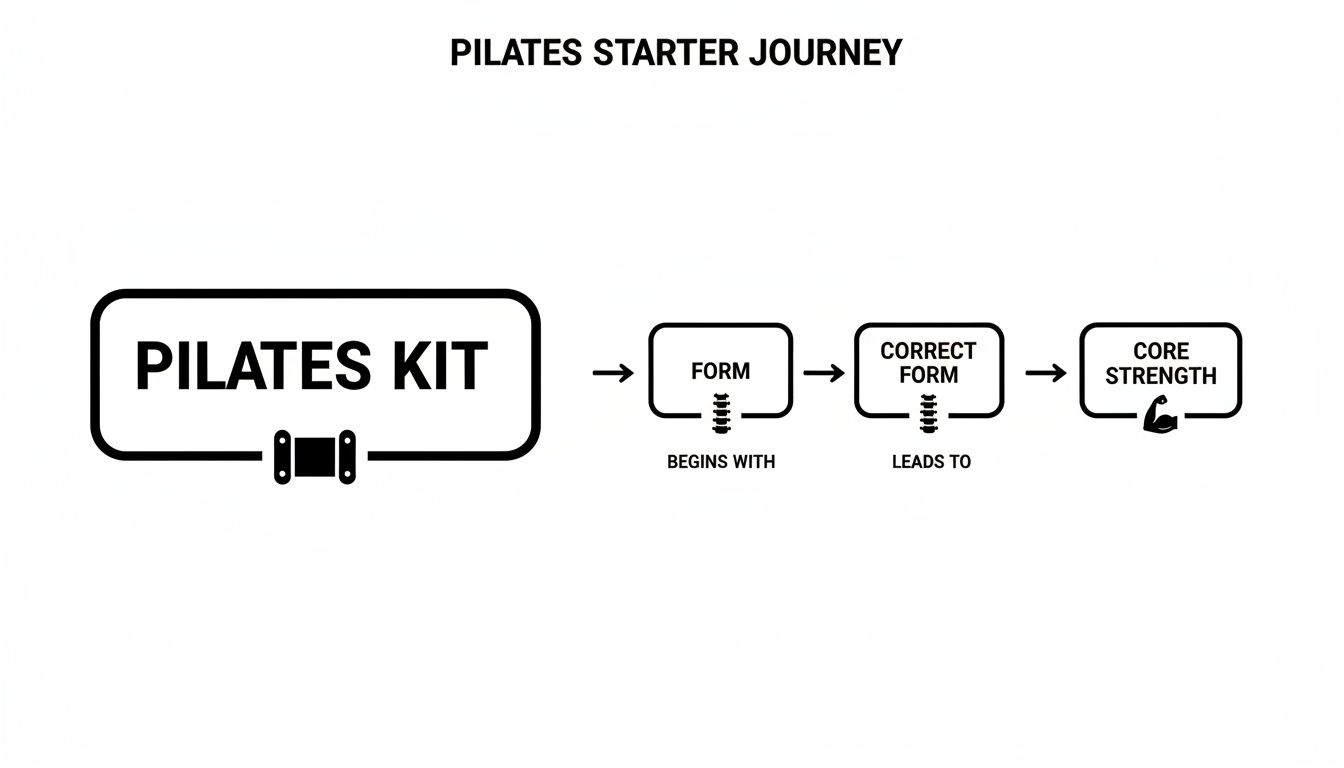
As you can see, it's a simple journey. The equipment provides the feedback you need to find correct alignment, and that alignment is the non-negotiable first step to truly engaging your core.
The Resistance Ring: Your Internal Feedback System
The Pilates ring, often called the "magic circle," is a masterclass in giving your body real-time feedback. When you place it between your inner thighs and squeeze, you create a tangible connection to those adductor muscles—key players in pelvic stability that often don't get enough attention.
It’s like a conversational tool for your neuromuscular system. The ring’s resistance gives your muscles something to "talk" to, making it easier to feel the deep core engagement we’re always striving for. It helps you wake up the transverse abdominis, your body’s own natural corset wrapping around your midsection to support your lumbar spine.
The Resistance Loop: Awakening Your Stabilizers
Small but mighty, the resistance loop is your secret weapon for waking up the smaller stabilizer muscles, especially around your hip girdle. When you slip a loop around your thighs for exercises like a bridge or side-lying leg lifts, it adds just enough opposition to force your gluteal muscles to fire properly.
Why is this anatomically significant? Many people have underactive glutes, leading to an unstable pelvis and compensatory strain on the lumbar spine. A simple loop helps you:
- Activate the gluteus medius, a crucial hip abductor that stabilizes your pelvis during single-leg movements like walking or climbing stairs.
- Improve hip joint stability, which in turn protects your knee joints and lumbar spine from absorbing excess force.
- Enhance neuromuscular control, teaching your brain and muscles to coordinate more efficiently for better movement patterns.
This little prop is fundamental for building the kind of foundational strength that supports every other move you make.
The Mat: Your Foundation for Alignment
Your Pilates mat is far more than just a cushion. It’s your stable, non-slip surface that makes proper spinal articulation and proprioception (body awareness) possible. An overly thick, squishy yoga mat can actually get in the way, hindering your connection to the floor and throwing off your biomechanics.
A proper Pilates mat gives you just enough support to protect your vertebral column without making you lose your feel for the ground beneath you. For a deeper dive, our guide on choosing the right Pilates mat thickness will help you find that perfect balance between comfort and control.
Think of the right mat as your personal movement laboratory. It provides the firm, supportive ground you need to safely explore how your spine moves and learn to position your body with precision.
The Block: Your Alignment Assistant
Finally, the humble foam block is an incredibly versatile tool for modifying exercises to fit your body's unique structure. Its main job is to bring the floor closer to you, making sure you can maintain proper skeletal alignment without straining your joints.
For instance, placing a block under your head when you're on your back helps keep your cervical spine in a neutral, happy position. It can also go under your sacrum to support your lower back or between your knees to maintain hip alignment. It’s an essential part of any Pilates starter kit because it makes the practice accessible and safe for every body type and flexibility level.
Choosing the Right Kit for Your Body and Goals
Picking out a Pilates starter kit isn’t like grabbing a generic set of weights off the shelf. It’s an investment in your unique anatomy and what you want to achieve. There’s truly no one-size-fits-all answer here. Your personal biomechanics, where you are in your fitness journey, and your ultimate goals are what really matter in deciding which tools will serve you best.
Think of it this way: a surgeon doesn’t use the same scalpel for every procedure. In the same way, your Pilates props should be hand-picked to support your specific needs—whether you're just starting out and building that foundational core strength or you need extra support for your joints. Understanding this from the get-go empowers you to build a kit that actually works with your body, not against it.
For the Beginner Building Foundational Strength
If you're brand new to Pilates, your number one goal is building that crucial mind-body connection. Your anatomical focus is on awakening the deep core muscles—the transverse abdominis, multifidus, and pelvic floor—that form your body's natural corset, stabilizing the lumbar-pelvic region.
A foundational kit is your best friend here. It should include:
- A Supportive Mat: This is non-negotiable. It protects your spine as you learn to articulate through each vertebra in exercises like the roll-up.
- A Resistance Ring: This circle provides tactile feedback. Squeezing it between your inner thighs helps you feel your adductors and pelvic floor co-contract, which is key to stabilizing your entire core.
- Light Resistance Loops: These are fantastic for activating the gluteus medius, a key hip stabilizer that’s often weak. Awakening this muscle helps prevent compensatory strain on the lower back.
This simple setup gives you the feedback you need to nail down correct form right from your very first workout, making sure you build strength on a solid, safe foundation.
For Those Needing Low-Impact Joint Support
One of the most beautiful things about Pilates is how effective it is for anyone needing a low-impact workout. This is especially true for women navigating menopause or anyone managing joint sensitivity. Here, the anatomical focus shifts to strengthening the muscles around the joints for support and helping to build bone density without stressful impact.
For women in menopause, for example, a consistent low-impact Pilates practice can help boost bone density by 1-2% annually. These kinds of kits are all about promoting consistency over intensity, which is why we see adherence rates above 70% in guided programs.
A low-impact kit is all about support and stability. It's designed to help you build strength safely, letting you focus on controlled movements that nourish your joints instead of punishing them.
A kit designed for joint support will often add a foam block to the essentials. This block is an alignment superhero—it basically brings the floor closer to you. You can place it under your head to keep your cervical spine in a neutral position or slide it under your sacrum to support your lower back and pelvis. This little adjustment reduces strain and allows for much deeper, safer muscle engagement.
If you're curious about other tools, you can explore more in our complete guide to Pilates equipment for home use. Each prop becomes an ally in your journey toward strong, resilient, and pain-free movement.
Setting Up Your Space for Your First Workout
So, you’ve unboxed your Pilates starter kit and you're ready to go. The first step is turning a corner of your home into your own personal Pilates studio. Don't worry, you don’t need a dedicated room! You just need to create a simple, thoughtful space where you can move without restriction and, more importantly, focus your mind on your body's internal sensations.
Getting this right is easier than you think. The main goal is to carve out a little distraction-free zone. Find a spot where you can lay your mat down flat with enough clearance for full range of motion in your limbs. This gives you room for movements like arm circles or leg extensions without compromising your form.
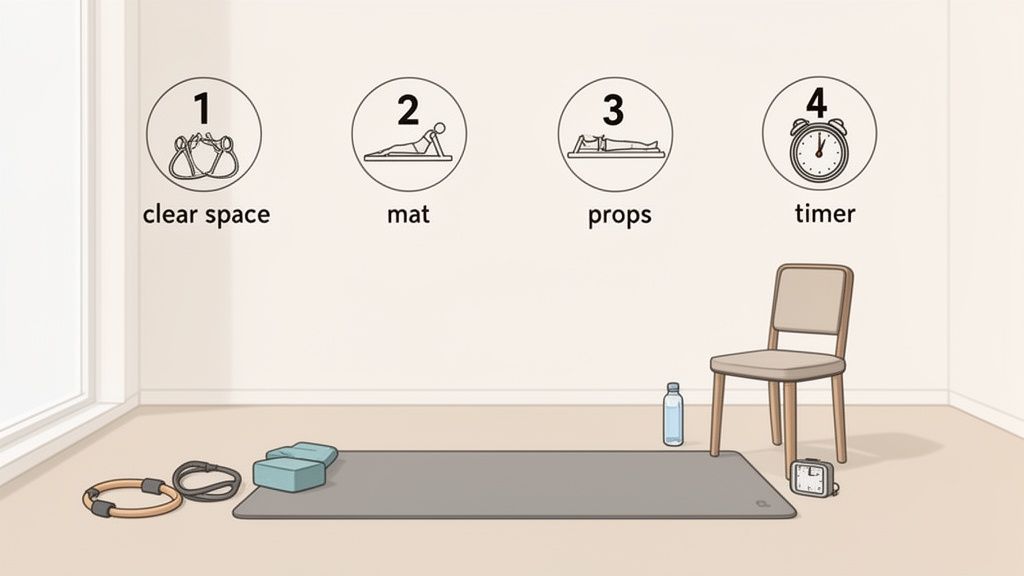
If space is tight, getting creative with some small apartment organization ideas to maximize your workout space can be a game-changer. Sometimes, just sliding a coffee table out of the way is all it takes to create an open, inviting environment for your practice.
Your First 20-Minute Routine
Once your space is ready, it's time to get on the mat. This routine is designed to be your first introduction to foundational Pilates movements, helping you build that all-important neuromuscular connection.
Here’s a simple sequence to get you started:
- Pelvic Curls (5-8 reps): Lie on your back with your knees bent. As you exhale, focus on engaging your deep abdominals to sequentially lift your spine off the mat—vertebra by vertebra. This teaches controlled spinal articulation.
- Leg Circles (5 reps each direction, each leg): With one leg extended, use your deep core muscles to keep your pelvis completely still as you circle the leg from the hip socket. The goal isn’t a high kick; it’s a stable torso and pelvis.
- The Hundred Prep (3-5 sets of 10 breaths): Lie on your back with your knees in a tabletop position. Lift your head and shoulders, maintaining space between your chin and chest. Pulse your arms vigorously while you breathe, feeling your deepest abdominal layer—the transverse abdominis—cinching in to support your lumbar spine.
This first workout isn't about pushing yourself to the limit. Think of it as a guided tour of your own anatomy. The real focus is on feeling how your core engages to support every single movement. That's the heart of Pilates.
This is exactly why a pilates starter kit is so effective. It removes the guesswork and gives you the tools you need to start right. It's a fact that beginners can face up to a 50% dropout rate when they don't have the right guidance and gear.
And for women in menopause, these kits provide core-focused exercises that have been shown to boost pelvic floor strength by 20% in just 12 weeks. Starting with this simple setup and routine lays the foundation for a practice that’s not just effective, but safe and sustainable for the long haul.
Why Expert Guidance Unlocks Your Kit's Potential
Getting a great Pilates starter kit is a fantastic first move, but the props themselves are only half of the story. Think of it like this: your new Pilates ring and loops are beautifully crafted instruments. They have the potential to create powerful change in your body, but it’s the conductor—the expert instruction—that brings it all together into a symphony of controlled movement. This is where professional guidance makes all the difference.
Expert instruction turns a series of random exercises into a purposeful, anatomy-informed practice. It's the difference between just going through the motions and truly understanding the biomechanical why behind every single movement you make.
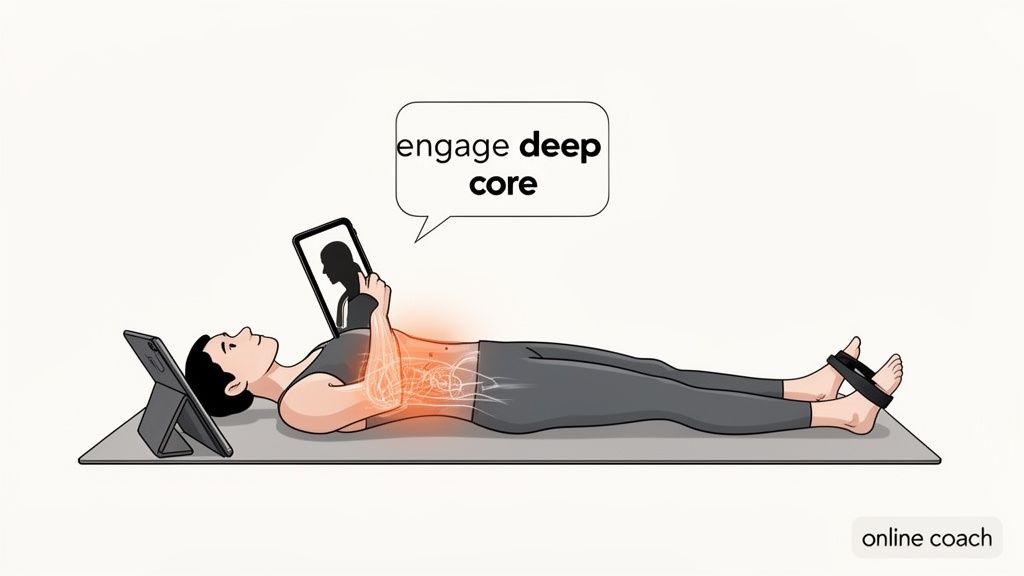
Without it, you might press into your resistance ring and feel a burn in your legs. But are you actually recruiting the deep adductor muscles to stabilize your pelvis, or are you letting your larger quadriceps muscles take over? That's the kind of neuromuscular precision that guidance provides.
Bridging the Gap Between Home and Studio
This is exactly why pairing your physical kit with a high-quality, on-demand platform like WundaCore creates a complete ecosystem for success. It closes the gap between practicing at home by yourself and getting the kind of personalized, form-focused feedback you’d expect from an in-person studio class.
Anatomy-informed coaching teaches you to connect with your body on a much deeper level. You’ll learn how to feel your transverse abdominis—your body’s natural corset—cinch in to support your spine. You'll discover how to fire up your gluteus medius to create stable, pain-free hips. This focus on precision is what keeps you safe and gets you real results.
Quality instruction ensures that every movement is building strength, not reinforcing poor movement patterns. It transforms your kit from a simple collection of props into a powerful system for creating real, sustainable change in your body.
Safe Progression and Mindful Movement
Expert guidance also provides a roadmap for progressing safely. A skilled instructor knows exactly how to use a prop to either support a movement for a beginner or add layers of challenge for a more advanced practitioner. This intelligent layering prevents you from hitting frustrating plateaus and seriously reduces the risk of injury.
This partnership between your props and a solid program teaches you how to listen to your body and move with intention. To get the most out of your workouts and stay on track, you might even consider using a workout planner app to log your sessions and progress.
An effective program will always guide you through a logical progression:
- Foundation: First, you’ll learn to establish a stable core and master your basic skeletal alignment.
- Activation: Next, you’ll use your props to awaken and strengthen specific muscle groups that might be underactive or "sleepy."
- Integration: Finally, you’ll learn to integrate these principles into more complex, full-body movements that flow with neuromuscular efficiency.
Ultimately, this guided approach is what truly unlocks the full potential of your Pilates starter kit, making sure every session is safe, effective, and moves you one step closer to your goals.
Answering Your Pilates Starter Kit Questions
As you get ready to dive into your practice, it's totally normal for a few questions to pop up. Let's tackle some of the most common ones we hear, giving you clear, anatomy-focused answers so you can use your Pilates starter kit to build strength the right way.
Can't I Just Use My Own Bodyweight?
Bodyweight Pilates is a fantastic way to get started, but a well-designed starter kit acts as a biofeedback tool, accelerating your progress. Think of the props as your personal anatomy teachers, guiding you to activate muscles that are tricky to find with bodyweight alone.
Take the resistance ring, for instance. When you squeeze it, you get immediate tactile feedback to fire up your deep adductor muscles (your inner thighs), which are crucial for stabilizing your pelvis. The loops are amazing for waking up sleepy gluteal muscles that are supposed to be supporting your lower back. This kind of feedback teaches you to engage deep stabilizing muscles that are often missed, helping you build a stronger, more intelligent foundation right from your very first session.
How Often Should I Use My Kit to See Results?
In Pilates, consistency always beats intensity. We're not trying to exhaust the body; we're building deep neuromuscular patterns and fine-tuning the conversation between your brain and your muscles. For most beginners, two or three focused sessions of 20-30 minutes a week is the sweet spot.
This gives your body's tissues enough time to adapt and get stronger without causing burnout. The most important thing is to listen to your body. Focus on the quality of each movement and feeling the correct muscle recruitment, rather than just cranking out reps. As your strength and proprioception improve, you can slowly increase the frequency or duration of your sessions.
The real magic in Pilates happens over time. Each session reinforces that mind-body connection, making correct form start to feel like second nature.
Is a Pilates Starter Kit Good for Back Pain?
Pilates is often recommended for back pain because it’s so effective at strengthening the deep core muscles that support the spine. We’re talking about muscles like the transverse abdominis and multifidus, which act as a natural corset for your torso, stabilizing the lumbar vertebrae.
A Pilates starter kit can be incredibly helpful here.
- A supportive mat gives you the cushioning you need to protect your vertebral column as you move.
- A foam block can be a game-changer. Placing it under your sacrum or head helps you maintain a neutral, pain-free alignment, taking unnecessary strain off your lower back and cervical spine.
But—and this is a big but—it is absolutely essential to talk to your doctor or a physical therapist before starting any new fitness routine if you have a pre-existing condition. Once you get the green light, look for beginner classes that are anatomy-informed and prioritize slow, controlled movements. This ensures you’re strengthening your body safely and effectively.
Ready to build a stronger, more connected body with the right tools and expert guidance? The WundaCore kits provide everything you need to start your anatomy-informed Pilates practice at home. Explore the WundaCore collection today.