
A Guide to Your Best Small Pilates Ball Workout
Don't let its size fool you. That small, squishy Pilates ball is one of the most powerful tools for building a truly strong and functional core. It’s a low-impact, high-reward way to wake up the deep stabilizing muscles that often get missed in other workouts, directly targeting the intricate network of your inner anatomical structure.
This simple prop adds just enough instability and targeted resistance to completely change the game, shifting the focus from superficial muscles to deep spinal support.
The Secret to Unlocking Your Deep Core
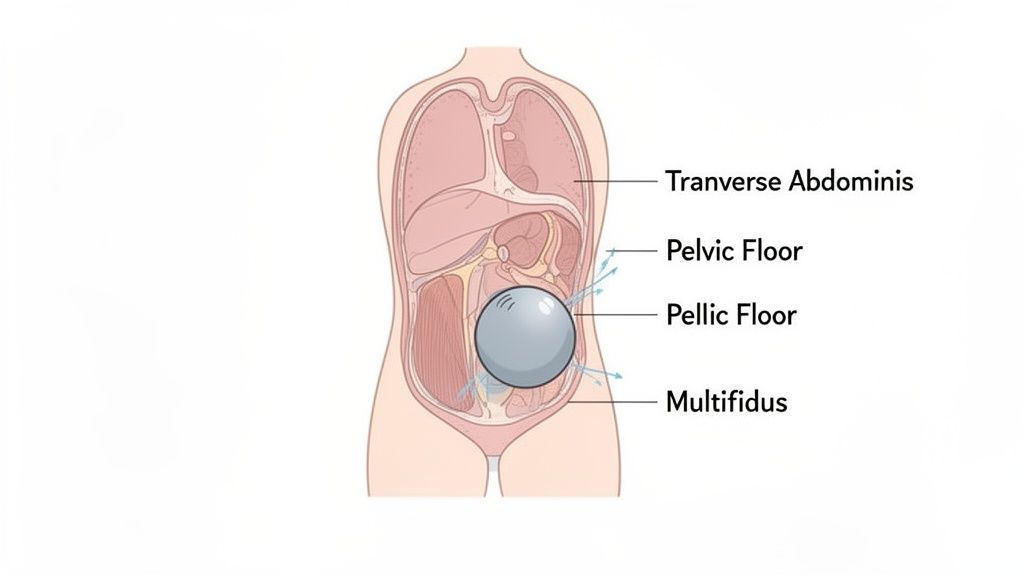
To really get the most out of your small ball, you need to understand the anatomy at work beneath the surface. True core strength isn’t about a six-pack (the rectus abdominis); it’s about firing up the intricate muscular system that supports your spine and keeps your pelvis stable. This is where the small ball works its magic.
Its power comes from a simple concept: proprioceptive feedback and instability. When you place the ball under your sacrum or squeeze it between your adductors (inner thighs), your body has to make constant neuromuscular micro-adjustments to stay balanced. This process forces those deep, internal stabilizers to switch on and work in concert, often for the first time.
Meet Your Inner Core Team
Think of your deep core as a muscular cylinder wrapping around your midsection, providing dynamic support from the inside out. The small Pilates ball is perfectly designed to help you connect with this crucial anatomical system.
Let’s take a look at the key players you're about to activate.
Anatomy Your Small Pilates Ball Will Target
This table breaks down the deep core muscles you'll be activating and why their function is so vital for building real-world strength.
| Core Muscle | Its Primary Anatomical Function | How the Ball Enhances Activation |
|---|---|---|
| Transverse Abdominis (TVA) | Your deepest abdominal muscle; its horizontal fibers wrap around your torso to stabilize the lumbar spine and pelvis. | Squeezing the ball provides direct physical feedback, helping you feel the TVA contract and create intra-abdominal pressure. |
| Pelvic Floor | A muscular sling at the base of your pelvis that supports organs and co-contracts with the TVA to stabilize the hips. | Placing the ball between your inner thighs encourages a natural lift and engagement of the pelvic floor via the adductor connection. |
| Multifidus | Small, deep muscles running along the spine that provide critical vertebra-by-vertebra stability and proprioceptive feedback. | The ball's instability prompts these muscles to fire reflexively to protect and stabilize your spine during movement. |
This is why understanding a little anatomy makes your workout so much more effective. You're no longer just going through the motions.
The real magic here is the mind-muscle connection. Having that prop against your body gives your brain instant proprioceptive feedback, making it easier to find and engage muscles you might not even know you have.
Why This Approach Actually Works
This focus on deep muscle engagement is why props are so popular in the Pilates and yoga world, a market valued at USD 161.98 billion in 2024. It’s not just a trend. Movement science shows that using tools like the small ball can boost muscle engagement in stability exercises by 20-30% compared to just doing them on a mat. That's a huge advantage for building real strength. You can dive deeper into this market growth on polarismarketresearch.com.
When you understand this anatomy, you shift your workout from a simple routine to a purposeful practice. You start building a functionally strong core that supports better posture, helps reduce back pain, and makes every other movement feel stronger and more connected.
Fundamental Exercises for Core Stability
Alright, you understand the "why" behind using a small Pilates ball. Now it's time to put that anatomical knowledge into practice. These next few movements are your foundation for building a truly strong, stable core from the inside out. We’re going to zero in on precise form, sync up your breath, and really feel the right muscles turn on.
Think of each exercise as a conversation with your body. The ball is a tool to help you listen more closely, giving you immediate feedback to fine-tune your alignment and muscular engagement. Let's get started.
Pelvic Curl with Adductor Squeeze
The Pelvic Curl is a Pilates classic for spinal articulation and gluteal strength. Adding the small ball between your knees transforms the exercise by recruiting the adductor muscles of your inner thighs. This engagement creates a direct fascial connection to your pelvic floor and deep core.
Find a spot on your mat. Lie on your back with your knees bent, feet flat on the floor, and about hip-distance apart. Now, place the slightly deflated ball right between your inner thighs.
Take an inhale to prepare. As you exhale, gently squeeze the ball. This action helps activate your deep abdominals, the transverse abdominis, which should draw in toward your spine. Continue exhaling as you peel your spine off the mat, one vertebra at a time, until you're resting on your shoulder blades.
Anatomy Cue: Focus on sequential articulation of the spine: coccyx, then sacrum, then the lumbar vertebrae. This is a controlled roll powered by your gluteus maximus and hamstrings, while your TVA and obliques keep your pelvis stable and prevent your ribs from flaring.
Inhale and hold your bridge at the top. On your next exhale, slowly reverse the movement, lowering your spine back down with the same deliberate control. The goal is fluid motion. Aim for 8-12 repetitions, focusing on the quality of the adductor squeeze and the control of your spine.
Abdominal Prep with Lumbar Support
This is how you perform abdominal flexion the smart way. Placing the small ball in your lumbar curve provides crucial proprioceptive feedback, helps maintain a neutral spine, and prevents your iliopsoas (hip flexors) from taking over. This simple tweak lets you truly isolate and strengthen the rectus abdominis and obliques.
Sit up tall with your knees bent and tuck the ball behind you, right in the curve of your lower back. Gently lean back into it until you feel supported.
Place your hands behind your head to support the weight of your skull, keeping your elbows wide. Inhale deeply, allowing for lateral expansion of your rib cage. As you exhale, engage your core by pulling your navel toward your spine, and curl your upper body forward and up, flexing the thoracic spine. Your eyes should be looking just over your knees.
- Modification for Beginners: Keep the movement small. You're looking for deep abdominal contraction, not maximal height.
- Progression for Advanced Users: As you curl up, float one leg to a tabletop position (femur perpendicular to the floor). Alternate legs with each rep to challenge pelvic stability.
The ball supports your lumbar spine, reducing strain and making it one of the best ways to learn proper form. Building a truly integrated core means understanding how all these muscles work together. For a deeper dive, our guide on Pilates exercises for core strength offers even more insights.
Perform 10-15 repetitions with slow, deliberate control. A strong, stable core is non-negotiable for athletes of all kinds. To see how this kind of foundational strength benefits other sports, you might find these proven workouts & tips for track and field interesting.
Creating Your At-Home Pilates Routine
Let's be real: seeing anatomical and functional results from any workout boils down to consistency. But that doesn't mean you need an hour every day to build a strong core. The secret is having a few go-to routines you can pull out, no matter how wild your schedule gets.
This is about making your practice fit into your life. The boom in at-home Pilates is no accident. The global Pilates equipment market hit a value of US$116.8 million in 2022 and is on track to reach US$281.6 million by 2034. Since the pandemic, home fitness has exploded, with the home segment capturing a massive 45% of revenue. Props like the small ball are perfect because they fit seamlessly into our busy lives. You can dive deeper into the growth of the Pilates equipment market if you're curious.
The 10-Minute Core Wake-Up
For those mornings when you’re scrambling for time, this quick flow is exactly what you need. It's the perfect way to fire up your deep core stabilizers, mobilize your spine, and set a positive tone for your day. Gentle, but anatomically profound.
- Pelvic Curl with Adductor Squeeze: Move through 8 reps with a slow, controlled tempo. Focus on articulating each vertebra, feeling the work in your glutes and hamstrings, supported by your TVA.
- Abdominal Prep with Lumbar Support: Aim for 10-12 reps, using your exhale to deepen the contraction of your rectus abdominis and obliques. Keep your neck long by relaxing the sternocleidomastoid muscles.
- Spinal Mobility Sequence: Finish by placing the ball under your thoracic spine for 5 gentle extensions. This feels amazing and helps mobilize the upper back, undoing postural slouching.
This little sequence is a perfect example of how you can shift the ball to target different muscles in just a few minutes.
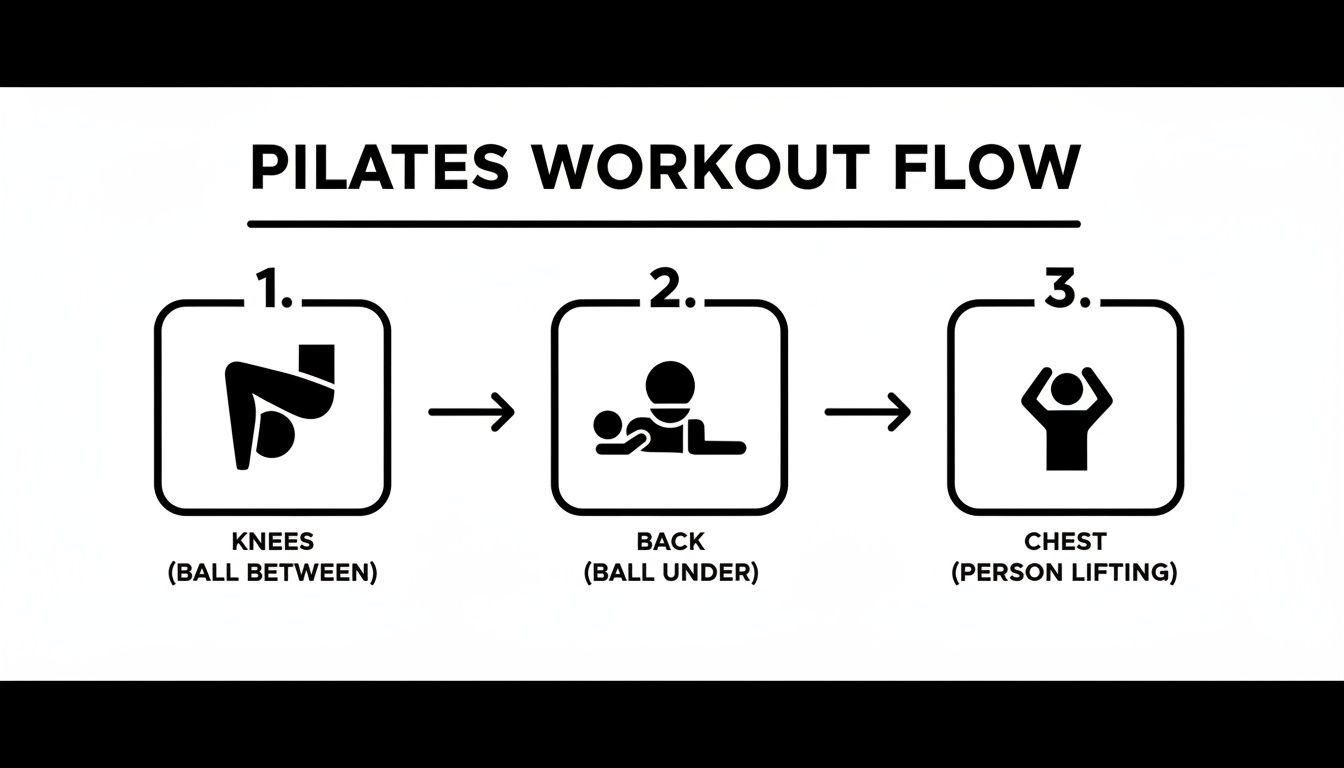
As you can see, the ball can move from between the knees (for adductor and pelvic floor connection) to under the back (for support and mobility), creating a well-rounded mini-workout.
Sample Workout Templates for Your Schedule
Find a routine that fits your day, each designed with a different fitness goal and anatomical focus in mind.
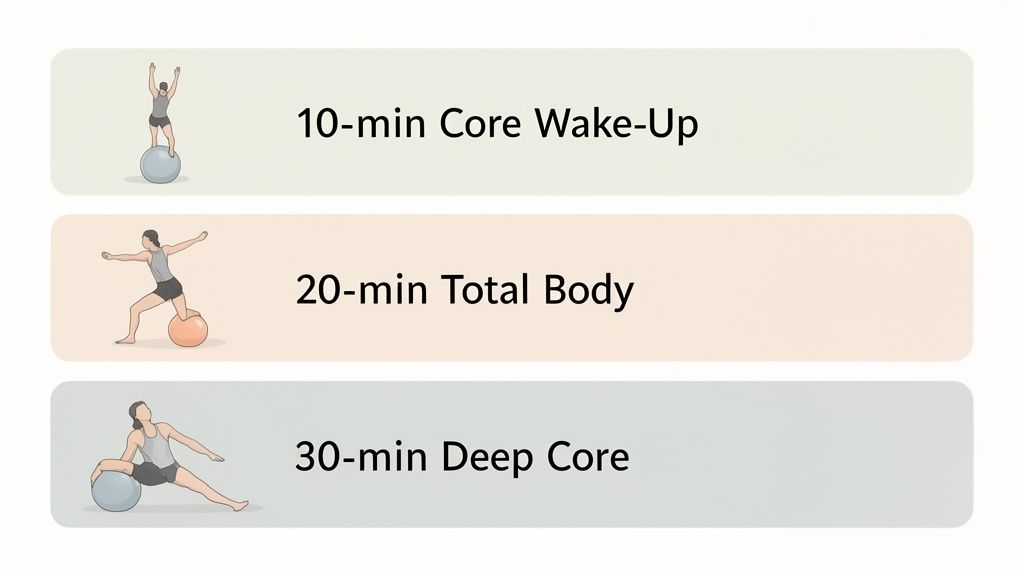
| Duration | Workout Focus | Example Exercise Sequence |
|---|---|---|
| 10 Minutes | Core Activation & Mobility | Pelvic Curl with Squeeze, Abdominal Prep with Ball Support, Thoracic Spine Extensions over Ball. |
| 20 Minutes | Total-Body Integration | Start with the 10-min sequence, then add Push-Ups with Hand on Ball, Standing Lunges with Back Foot on Ball. |
| 30+ Minutes | Deep Core & Muscular Endurance | Perform the 20-min sequence, then add Side-Lying Leg Lifts and finish with a Plank Challenge with the ball under shins. |
These templates are just a starting point. Feel free to mix and match exercises based on what your body is craving that day.
The 20-Minute Total Body Toner
When you have more time, you can build on that core foundation to condition your entire body. This routine layers movements to build heat and challenge your stability and strength from a full-body, anatomical perspective.
First, run through the 10-Minute Core Wake-Up as your warm-up. Then, layer in these movements:
- Push-Up with Hand on Ball: Place one hand on the ball for 5-8 push-ups. This unstable surface forces your serratus anterior and rotator cuff muscles to work overtime to stabilize the shoulder joint. Switch sides and repeat.
- Standing Lunge with Foot on Ball: Place your back foot on the ball for 10 lunges per side. This will challenge your balance and light up your gluteus medius and maximus in a new way.
- Side-Lying Leg Lifts with Ball: Lie on your side and place the ball between your ankles. Perform 12-15 small, controlled lifts, squeezing the ball the entire time to engage both your adductors (inner thighs) and abductors (outer thighs).
The 30-Minute Deep Core Challenge
Ready to really turn up the dial? This longer workout is designed to build serious muscular endurance and challenge your deepest stabilizing muscles. It’s perfect for those days when you want to feel that satisfying muscle burn and deepen your mind-body connection.
The key to progress isn't just adding more reps; it's about refining your form and control. Slower movements eliminate momentum and force your muscles—from the deep multifidus to the larger glutes—to do all the work.
Follow the 20-minute sequence, maybe increasing your reps slightly. Then, add the ultimate finisher: a one-minute plank with the ball under your shins. This advanced variation will put your core control, stability, and total-body strength to the test.
Ready to take your home practice to the next level? Once you've gotten the hang of working with your small Pilates ball, you can start layering in other props to mimic the dynamic, multi-dimensional feel of a studio workout.
This isn't just about making things harder. It's about introducing different kinds of resistance and feedback to challenge your muscles in brand new ways and seriously deepen that mind-muscle connection.
The home fitness movement has shown us how essential these props are. We're even seeing this trend in the larger Pilates reformer market, which is projected to grow from USD 7,645.5 million in 2025 to a staggering USD 16,814.3 million by 2035. With home use already accounting for 45% of the revenue, it’s obvious that building a powerful home setup is a priority. And since direct sales channels are expected to make up 40% of those sales, it's easier than ever to get a complete system delivered to your door. You can see more on this growing trend from Future Market Insights.
Pairing the Ball with a Resistance Ring
One of my favorite combinations is the small ball and a Pilates ring. This duo is a powerhouse for targeting your adductors (inner thighs) and abductors (outer thighs) simultaneously. The result? Your core has to work overtime to keep your pelvis completely stable.
Here's how you can try it:
- For the Inner and Outer Thighs: Lie on your back and place the ball between your knees. Then, slip the ring around your outer thighs. As you squeeze the ball inward, you’ll simultaneously press outward against the ring.
- What's Happening in Your Body: This move brilliantly engages the adductor magnus on the inside and the gluteus medius on the outside. To keep your pelvis from tilting, your deep transverse abdominis has to fire intensely, making this an incredible core stability challenge.
Using the Ball with a Resistance Loop
Another fantastic pairing is the small ball with a resistance loop. This setup is a game-changer for glute work because the loop adds targeted resistance that really isolates the muscles, while the ball ensures your alignment stays on point and your inner thighs stay active.
For a glute series that really burns, try this: place a resistance loop just above your knees and pop the small ball between your inner thighs. Lie on your back and lift into a bridge. While keeping a gentle squeeze on the ball, press your thighs out against the loop.
This layered resistance is like asking your body to perform three different motor tasks at once. Your adductors are talking to the ball, your abductors are firing against the loop, and your deep core is working to stabilize the entire operation. It’s total-body neuromuscular integration.
This is exactly how you build a smarter, more connected home practice. You can find more tips on building your ideal setup in our guide to creating the perfect home Pilates kit.
When you intelligently combine your props, you’re not just going through the motions. You’re building a deeper understanding of your own anatomy that translates into real-world strength and control.
Anatomy-Focused Tips for Better Results
Using the small Pilates ball isn't just about going through the motions. It’s about being precise and deeply aware of your own anatomy. This is where you elevate your workout from good to truly effective, focusing on the small details that create big changes. Think of this as your personal coaching session on perfect form.
The first key is maintaining a neutral spine. This means honoring the natural curves of your back—the gentle lordotic curve at your lower back and the cervical curve at your neck. When you place the ball under your sacrum, it should support this natural alignment, not flatten your back or push you into a deep arch.
This anatomical precision is the secret to targeting the intended muscles without letting others, like the hip flexors or neck muscles, compensate.
Breathing for Deeper Core Engagement
In Pilates, your breath is the engine that drives core activation. We practice lateral breathing: inhale deeply into the sides and back of your rib cage while keeping your abdominals drawn in. Imagine your intercostal muscles expanding your ribs outward.
As you exhale, think about your deepest abdominal layer—the transverse abdominis—cinching inward like a corset. This coordinated action stabilizes your pelvis and spine, protecting your back and making exercises exponentially more effective. For a deeper dive, check out our guide on how to activate your transverse abdominis for even better control.
A common mistake is "rib flaring," where the anterior ribcage pops open, disengaging the connection to the pelvis. To fix this, focus on a forceful exhale that knits your ribs down and in, engaging the obliques to connect them to your hips. It’s a game-changer.
Avoiding Common Form Mistakes
Even small errors in form can redirect the work away from your core and into areas that create tension, like your neck and shoulders. Paying attention to these anatomical cues can instantly improve your practice.
Here are a couple of common issues and how to fix them with anatomical awareness:
- Gripping in the Neck: Feel strain in your neck during ab curls? It often means your sternocleidomastoid muscles are overworking. Initiate the curl from your deep core and thoracic spine flexion, always keeping space between your chin and chest. Imagine holding a soft peach there.
- Over-Squeezing the Ball: When the ball is between your knees, the goal is a gentle, sustained engagement of your inner thighs (adductors), not a maximal contraction. Over-squeezing can create tension in your hip flexors (iliopsoas). Think of it as a constant, low-level hum of muscular energy.
Remember, what you do after the workout matters, too. To support your body's repair process, you can explore the best supplements for muscle recovery.
Strategic Use of the Ball
Finally, think of the ball as your versatile coach. It can offer support or it can create instability—it all depends on where you place it and how much air is in it.
A slightly deflated ball gives you a better grip for adductor work, while a firmer ball creates a much bigger balance challenge when placed under your foot.
You can also use it for myofascial release. Try lying on the ball to gently release tight muscles like the piriformis or hip flexors. This anatomical prep work can improve your range of motion before you even start your workout, ensuring you move more freely and effectively.
Your Top Small Ball Questions, Answered
Anytime you bring a new prop into your practice, questions are bound to come up. A small Pilates ball workout is all about nuance and anatomical connection, and getting the details right can be the difference between just going through the motions and truly transforming your strength.
Let’s clear up some of the most common questions I hear from clients.
How Much Air Should I Put in My Pilates Ball?
The ideal inflation really depends on the anatomical goal of the exercise. Think of the ball's firmness as a dial you can turn up or down to change the challenge.
As a general starting point, aim for a squishy feel—you should be able to press into it about an inch. For anything involving grip, like placing the ball between your inner thighs for a Pelvic Curl, a softer ball is best. It allows your adductors to fire deeply without creating joint tension.
On the flip side, if you're using the ball for a stability challenge, like under your hand for a push-up, a firmer ball creates a more unstable surface. This forces the deep stabilizers in your shoulder girdle (rotator cuff, serratus anterior) and core to work overtime to keep you balanced.
Can I Use a Small Pilates Ball for My Back Pain?
Absolutely. When used correctly, a small Pilates ball can be an incredible tool for managing low back pain—as long as your doctor or physical therapist has cleared you for exercise. The key is using it to support your body and provide feedback.
Try placing the ball under your lower back during an Abdominal Prep. It gives you immediate tactile feedback, helping you maintain a neutral pelvic position. This simple cue encourages you to engage your deep core muscles—especially the transverse abdominis, your body's natural corset—to stabilize and support your lumbar spine.
By firing up these deep support muscles, you take the load off the superficial back extensors that tend to get tight and overworked. Of course, if you're dealing with acute or chronic pain, always check in with a physical therapist first.
How Often Should I Do a Small Ball Workout?
Because workouts with the small ball are typically low-impact, you can weave them into your routine more often than high-intensity training. With this kind of work, consistency wins over intensity.
I'd suggest aiming for 2-4 sessions per week. A focused 20-minute routine three times a week will build more deep core strength and neuromuscular control than one long, grueling session. This frequency gives your muscles time to adapt and recover properly.
Is a Small Pilates Ball the Same as a Yoga Ball?
Nope, they're anatomically different tools with very different jobs. A small Pilates ball is usually around 7-10 inches in diameter. It’s designed for very targeted feedback and to add a specific instability challenge, like when you place it between your ankles or under your sacrum.
A large yoga or stability ball is much larger (think 55-75 cm) and is meant for you to sit or lie on completely. While both can challenge balance, the small ball’s purpose is more precise. It’s all about helping you isolate and activate smaller, deeper stabilizing muscles within the framework of a Pilates exercise.
Ready to feel the difference that anatomy-informed movement can make in your own home? The WundaCore collection is designed to give you that studio-quality experience, with expertly crafted props and world-class instruction that build real strength from the inside out. Explore the full collection and start your journey at https://wundacore.com.