
What Is Functional Fitness Training? An Anatomical Guide to Real-World Strength
Let's get straight to it: what exactly is functional fitness training? Simply put, it's a method of exercise that strengthens your body by training movement patterns based on human anatomy, not just isolated muscles. This isn't about sculpting a bicep in the mirror; it's about training for the ‘sport of life.’
The goal is to improve the neuromuscular efficiency of actions like hoisting grocery bags, lifting a child, or climbing a flight of stairs, making them feel easier and biomechanically safer.
Training Your Body as an Integrated System
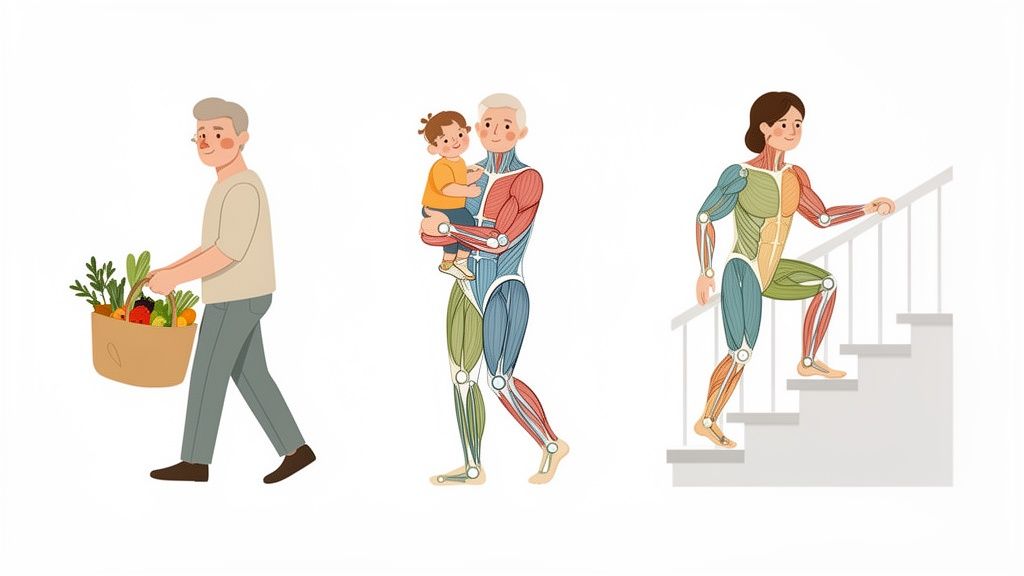
Think of your body as an integrated biomechanical system, not a collection of individual parts. In a traditional gym setting, you might do a bicep curl to isolate the biceps brachii. But in functional fitness, you train the entire "pulling" motion—a movement that recruits the biceps brachii, latissimus dorsi, rhomboids, transverse abdominis, and even your glutes to work together in perfect harmony.
Instead of targeting one muscle, this approach strengthens entire kinetic chains. That’s the interconnected network of muscles, nerves, joints, and fascia that activate in sequence to create movement. Every time you squat, you’re not just using your quadriceps femoris. You’re firing up a complex system involving ankle dorsiflexion, knee flexion, hip flexion, and the deep core stabilizers that maintain a neutral spine.
The Real Purpose Behind the Movements
The core purpose is to improve how this internal neuromuscular system communicates and performs. Functional exercises are specifically designed to mirror the multi-joint, multi-planar movements your anatomy evolved to perform. It's a philosophy that has caused a major, and much-needed, shift in the fitness world.
Functional fitness prepares the body to handle real-life situations by mimicking tasks and challenges you encounter daily. It builds a foundation of strength that is practical, usable, and directly improves your quality of life.
It's no surprise that its popularity is exploding. This isn't just a trend; it's a response to our need for practical, real-world strength. The market for functional fitness equipment, valued at over USD 12 billion recently, is projected to rocket to more than USD 129 billion by 2030.
This incredible growth is fueled by solid evidence. Studies show that its focus on compound, natural movements can slash injury risk by up to 30-50% compared to conventional weight training. You can explore more about these market trends and their drivers to see just how big this shift is.
To put the core ideas in one place, here's a quick summary.
Functional Fitness at a Glance
This table breaks down the fundamental principles that make functional fitness so effective for real-world strength and resilience.
| Core Principle | What It Means for Your Body |
|---|---|
| Integrated Movements | Trains muscles to work together as a system, not in isolation. |
| Multi-Planar Training | Prepares you for movement in all directions—sagittal (forward/backward), frontal (side-to-side), and transverse (rotational). |
| Real-World Application | Exercises mimic daily tasks like lifting, carrying, pushing, and pulling. |
| Core-to-Extremity | Emphasizes a strong, stable core as the foundation for all limb movement. |
| Neuromuscular Efficiency | Improves the communication between your brain and muscles for better coordination. |
By internalizing these principles, you start to see fitness not just as an activity, but as preparation for life itself.
It's About More Than Just Building Muscle
Functional training is really about teaching your muscles to collaborate efficiently. This teamwork builds several crucial physical skills all at once:
- Integrated Strength: Power you can actually use, whether you're moving furniture or playing with your kids.
- Dynamic Balance: The ability to stay stable while you’re moving, which is key for preventing falls.
- Improved Coordination: Better communication between your brain and muscles leads to smoother, more efficient movement.
- Core Stability: A strong, engaged core that protects your spine and acts as the anchor for everything you do.
When you train movement patterns instead of just muscles, you're building a body that’s more capable and far more resistant to injury. This approach doesn't just make you stronger in the gym—it makes you stronger in life. You'll move with confidence, prepared for whatever your day throws at you.
The Anatomical Blueprint of Functional Movement
To really understand functional fitness, we have to look at your body’s anatomical design. Every action—from standing up to tossing a ball—isn’t the work of just one muscle. It's a beautifully coordinated effort between a whole network of muscles, nerves, and bones working together.
This connected network is what we call a kinetic chain, and it’s the secret sauce behind every powerful, efficient movement you make. Functional fitness is simply about training these chains to communicate and activate in the correct biomechanical sequence.
Think about a simple squat. It's so much more than a "leg exercise." It’s a full-body conversation where your ankles, knees, hips, core, and thoracic spine all have to cooperate. This intermuscular coordination is what builds real-world strength.
The Kinetic Chain: Your Body’s Orchestra
I love to think of the body as an orchestra. Each muscle is a musician, and for the performance to sound amazing, everyone has to play their part in perfect harmony, at exactly the right time.
If the violins (quadriceps) are playing way too loud and drowning out the cellos (gluteus maximus), the entire biomechanical symphony falls apart. Functional training is the conductor, making sure every part of your kinetic chain—from agonists and antagonists to stabilizers—performs its role perfectly.
This is why isolating muscles, like doing endless bicep curls, doesn't really make you stronger for daily life. It’s like practicing a single note over and over but never learning to play a song. Real strength comes from integration, not isolation.
The Deep Core: Your Body’s Stability System
Right at the center of this orchestra is your deep core. And no, I'm not just talking about the superficial rectus abdominis (the "six-pack"). I’m talking about the deep, stabilizing muscles that form your body's intrinsic support system.
The most important player here is the transverse abdominis (TVA). This muscle wraps around your midsection like a corset, creating intra-abdominal pressure that gives your lumbar spine foundational support. When you learn to activate it correctly, it creates stability through your entire trunk, allowing your limbs to move with true power and control.
A strong, active deep core is the anchor for all functional movement. It transfers force between your upper and lower body, protects your spine from injury, and is the true source of your power.
So many people deal with back pain or move inefficiently because this deep core system—including the TVA, multifidus, and pelvic floor—is neurologically "asleep." Functional fitness, much like modern Pilates, is all about waking up and strengthening these crucial stabilizers from the inside out. For a closer look, you can learn more about how to activate your transverse abdominis in our detailed guide.
This core-first approach makes sure that all your strength is built on a solid, stable foundation.
Proprioception: Your Internal GPS
Beyond muscles and bones, functional fitness also sharpens a critical sense called proprioception. Think of it as your body's internal GPS—it’s the sense that tells you where your limbs are in space without you having to look.
It’s how you can touch your nose with your eyes closed or walk up a flight of stairs in the dark. This sense relies on tiny receptors in your muscles (muscle spindles) and joints (Golgi tendon organs) that are constantly sending feedback to your brain about your body’s position and movement.
Functional exercises challenge and improve this internal mapping system:
- Multi-Directional Movements: Exercises like twisting lunges force your brain to adapt to movement in multiple planes, just like in real life.
- Balance Challenges: Standing on one leg or using unstable surfaces improves the communication between your brain and the stabilizing muscles in your ankles, hips, and core.
- Mind-Body Connection: By focusing on your form and how a movement feels, you consciously improve the quality of the signals running through your nervous system.
When you improve your proprioception, you're not just getting stronger—you’re becoming more coordinated, agile, and balanced. It’s been shown to dramatically reduce the risk of falls and injuries because it sharpens your body's ability to react instantly when you trip on a curb or slip on a wet floor.
Ultimately, functional fitness is about tapping into this deep anatomical intelligence. It’s about building a body where the kinetic chains are connected, the core is stable, and your internal GPS is tuned up for whatever life throws your way.
Alright, let's unpack where functional fitness sits in a world full of different workout styles. From bicep curls and treadmill runs to Pilates classes, it's easy to get lost. The key isn't to label one as "better," but to understand that they're different tools for different jobs.
Think of it like building a house. Traditional strength training is pouring the concrete foundation and framing the walls—it builds raw material like muscle size and pure strength. Functional fitness is the electrical wiring and plumbing that makes the house livable. It connects everything so it all works together as one efficient system.
Traditional Strength Training: The Muscle Specialist
Traditional strength training, the kind you see all over commercial gyms, is fantastic for hypertrophy—the technical term for making muscles bigger. It usually involves isolating one specific muscle group at a time.
Take a leg extension machine. It does an excellent job of targeting your quadriceps and making that single muscle stronger. But ask yourself this: when in your daily life do you ever sit in a chair and just straighten your leg against resistance? The movement is totally disconnected from how your body actually works.
A functional squat, on the other hand, trains your quadriceps, hamstrings, glutes, adductors, abdominals, and spinal erectors to fire in a coordinated sequence, just like they do when you get out of a chair or pick up a heavy box. One builds a muscle; the other builds a movement.
Functional Fitness: The Movement Integrator
Functional training flips the script by focusing on integrating muscle groups to perform complex, multi-joint movements. It's less about individual muscles and more about teaching your body's entire "team" of muscles how to communicate and work together. The goal is to translate the strength you build into practical, usable power for everything you do.
This focus on real-world results is why functional fitness has exploded in popularity, from personal training to physical therapy. It’s not just a trend; the market hit USD 17 billion recently and is on track to reach USD 28 billion by 2033. This growth is fueled by proven results, offering 15-25% better gains in balance and mobility than traditional cardio, which is a huge win for long-term health. You can discover more insights about this growing market on Future Data Stats.
Functional fitness doesn’t just ask, "How much can you lift?" It asks, "How well can you move?" This simple shift in perspective is what makes it so powerful for improving your quality of life.
Modern Pilates: The Core Conductor
Now, this is where things get really interesting. Modern Pilates, especially the kind that hones in on deep core activation and precise alignment, is the perfect partner for functional fitness. While functional training builds integrated strength through dynamic, full-body patterns, Pilates builds the very foundation of that strength: your deep core.
Pilates teaches you how to fire up and control the deep abdominal and back muscles (transverse abdominis, multifidus, pelvic floor) that stabilize your spine, creating a rock-solid center for all movement. It’s like making sure the conductor of your body's orchestra—your core—is perfectly in control before the rest of the musicians start to play.
When you put the two together, you get the best of both worlds. Pilates builds the stable foundation, and functional training teaches you how to use that stability to create powerful, efficient, and safe movements. It’s a truly complete approach to building a resilient, capable body.
Comparing Fitness Modalities: Functional vs. Traditional vs. Pilates
To make these distinctions crystal clear, let's put these three popular fitness styles side-by-side. Each has a unique focus and delivers different, yet valuable, benefits.
| Aspect | Functional Fitness | Traditional Strength | Modern Pilates |
|---|---|---|---|
| Primary Goal | Improve real-world movement efficiency and reduce injury risk. | Increase muscle size (hypertrophy) and maximal strength. | Build deep core strength, improve posture, and enhance mind-body connection. |
| Typical Exercises | Squats, lunges, deadlifts, kettlebell swings, farmer's walks. | Bicep curls, leg extensions, bench presses, machine exercises. | The Hundred, leg circles with resistance ring, plank variations on mat. |
| Anatomical Focus | Full kinetic chains and integrated muscle systems. | Isolated muscle groups. | Deep core musculature, spinal alignment, and breath control. |
| Key Benefit | Makes daily activities like lifting, carrying, and climbing easier. | Develops significant muscle mass and power. | Creates long, lean strength and improves body awareness. |
Ultimately, the best approach depends on your personal goals. But by understanding what each modality brings to the table, you can build a routine that makes you not just gym-strong, but life-strong.
Core Functional Movements You Can Do Anywhere
Okay, let's get practical. All the theory in the world doesn't matter if you can't put it into practice. Functional fitness is built on just five foundational human movement patterns. Think of these less as "exercises" and more as the blueprints for how your body is designed to move through life, day in and day out.
We're going to break down each one, focusing on what’s actually happening inside your body. This is where the magic happens.
The Squat: Sitting and Standing
The squat is king. It’s the single most essential movement pattern you have. You do it every time you get out of a chair, sit down on the couch, or bend your knees to pick something up off the floor. Honestly, mastering the squat is the key to maintaining your independence for life.
When you do it right, a squat is a full-body neuromuscular conversation:
- Glutes and Hamstrings: These muscles in your posterior chain are the primary engines for hip extension, powering you back up to a standing position.
- Quads: These muscles on the front of your thighs work eccentrically to control your descent and concentrically with your glutes to straighten your legs.
- Deep Core Muscles: Your transverse abdominis, obliques, and multifidus activate to create a natural corset, keeping your spine stable and safe.
- Spinal Erectors: The muscles running along your spine (erector spinae) contract isometrically to hold you upright, preventing spinal flexion (forward slump).
A good squat trains all these parts to fire in perfect harmony, taking the strain off your knee joints and lumbar spine. If you want to really nail the mechanics, you can check out our guide on mastering the basic squat.
This quick visual shows you exactly where functional fitness fits in compared to other popular training styles.
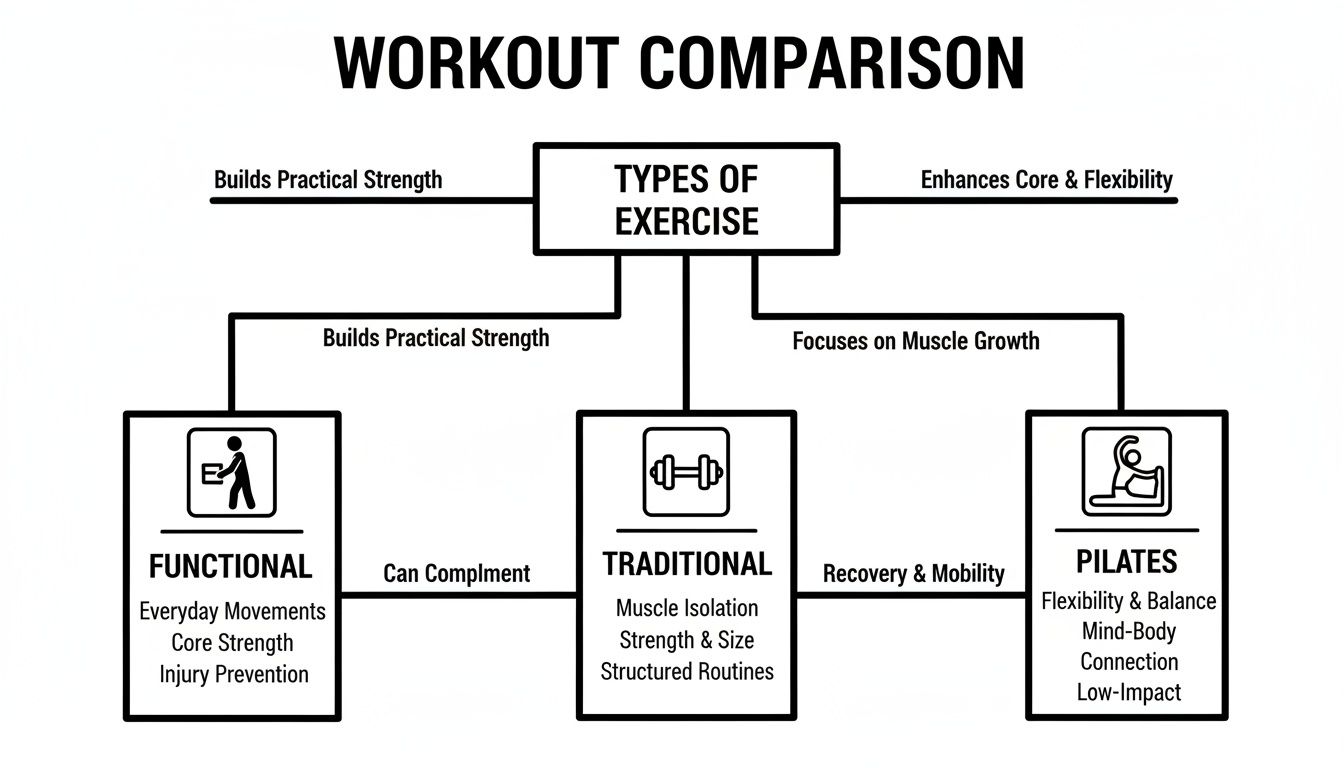
As you can see, functional fitness is all about creating integrated, real-world strength. It's a different goal than isolating a specific muscle like in traditional lifting or the deep core focus you find in Pilates.
The Hinge: Bending and Lifting
Next up is the hinge. This is your body’s built-in safety mechanism for bending over and lifting. The whole point is to create flexion at the hips while keeping your spine long and neutral, which is absolutely critical for preventing disc injuries.
Anatomically, the hinge is all about your posterior chain:
- Hamstrings: These muscles lengthen eccentrically as you fold forward, then contract concentrically with serious power to pull you back up.
- Glutes: This is your primary hip extender, providing the thrust to bring you back to a standing position.
- Back Muscles (Erectors and Lats): Your erector spinae and latissimus dorsi engage isometrically to keep your spine from rounding, creating a stable platform.
Practicing the hinge trains your brain to use your powerful legs and hips for lifting, saving your lumbar spine from doing work it was never meant to do.
The Push and Pull: Upper Body Power
Pushing and pulling are the bread and butter of upper body movement. Training these patterns builds strength you can actually use for pushing a cart or pulling open a heavy door.
The Push: Think about a push-up. You’re firing up your chest muscles (pectoralis major), the front of your shoulders (anterior deltoids), and your triceps. Your core has to kick in, too, to stabilize the trunk and prevent your hips from sagging.
The Pull: Now, think about rowing. This recruits the big muscles of your back—your lats and rhomboids—along with your biceps and the back of your shoulders (posterior deltoids). A strong pull is absolutely essential for scapular stability and good posture.
The Carry: Building Real-World Stability
Finally, the carry. This might be the most "functional" movement of all. Carrying groceries challenges your entire body to stabilize against an asymmetrical load. It’s a true test of integrated strength.
When you carry something, here’s what’s working:
- Grip Strength: Your forearm flexors and extensors light up. This is a vital, and often neglected, part of overall strength.
- Core and Obliques: Your obliques and quadratus lumborum (QL) on the opposite side work overtime to prevent lateral flexion of the spine, keeping your torso locked in and stable.
- Shoulder Stabilizers: The small muscles of your rotator cuff work hard to support the weight and protect the glenohumeral joint.
Even if you’re stuck at a desk all day, you can still sprinkle in these kinds of movements. Finding simple desk exercises for work can be a game-changer for your energy and posture.
It’s no surprise that people are looking for ways to train these patterns at home. The global market for functional training equipment is expected to hit USD 9,355 million by 2033, driven by the boom in home fitness. This isn't just a trend; research shows functional training can lead to 20-30% improvements in functional strength in as little as 12 weeks, which directly supports a healthy metabolism and lowers disease risk.
Building Your First Functional Fitness Routine
Okay, you've got the "what" and the "why" down. Now it’s time to actually do it. Kicking off any new routine can feel like a mountain to climb, but the real secret is focusing on consistency, not crushing yourself with intensity from day one. The goal here is to create a smart, sustainable plan that fits into your real life.
This isn't about marathon gym sessions that leave you wiped out. It's about building a solid habit that works with your body, whether you're navigating menopause, juggling a crazy career, or you just want to pick up your groceries without your back complaining.
Structuring Your Week for Success
A fantastic starting point for anyone new to this is aiming for two to three full-body functional workouts per week. This schedule gives your body enough of a challenge to get stronger and more coordinated, but it also provides plenty of time for your muscles and nervous system to recover. That recovery time? That's when the magic actually happens.
Here’s what a balanced week could look like:
- Day 1: Full-Body Functional Strength
- Day 2: Active Recovery (think a nice walk or some gentle stretching)
- Day 3: Full-Body Functional Strength
- Day 4: Active Recovery
- Day 5: Optional Third Workout or Mobility Work
- Day 6 & 7: Rest
This kind of setup helps you build a strong foundation without burning out. As you feel yourself getting stronger, you can start to dial up the challenge.
A Sample Functional Fitness Workout
Let's walk through a single workout session that blends those big, dynamic movements with the kind of core stability work that makes everything else easier. This is designed to be done right at home with minimal gear, proving you don't need a fancy gym to get effective results.
1. Warm-Up (5 minutes) Get things moving with dynamic stretches. Think leg swings, big arm circles, and gentle torso twists to wake up your joints and muscles.
2. Main Circuit (20-25 minutes) You’ll do each exercise for 45 seconds, then take 15 seconds to rest and transition to the next one. Go through the whole circuit 2-3 times.
- Goblet Squats with Resistance Ring: Holding a weight (or just the ring for tension) at your chest trains that fundamental squat pattern. It also forces your upper back and core to fire up to keep you from slouching forward.
- Bent-Over Rows with Loop: Step on a resistance loop and hold the other end. When you hinge at your hips and pull, you're strengthening that entire "posterior chain"—all the crucial muscles along your backside that are key for good posture and safe lifting.
- Push-Up Variations: Don't be a hero. Start on your knees or even against a wall to nail the pushing pattern with perfect form. This protects your shoulders and builds real strength.
- Alternating Lunges: This is a game-changer for single-leg strength and stability. The direct payoff? Better balance when you’re walking, running, or climbing stairs.
- Plank with Leg Lifts: Get into a solid plank and alternate lifting one leg at a time. This move challenges your deep core muscles to fight against rotation, a skill that’s essential for everyday stability. If you want to dive deeper into this kind of real-world power, you can learn more about how to build functional strength in our detailed guide.
3. Cool-Down (5 minutes) Wind down with some static stretches. Hold each one for about 30 seconds to help improve your flexibility and calm your nervous system.
Progressing Safely and Tracking Your Journey
The key to seeing real, lasting results is something called progressive overload. All that means is gradually making your workouts a little bit harder over time. Once an exercise starts to feel comfortable, it’s time to level up.
The goal is not just to do more, but to do better. Focus on improving your form, increasing control through the full range of motion, and then adding resistance or complexity.
Here are a few simple ways to increase the challenge without risking injury:
- Increase Reps or Duration: Can you do a few more reps or hold that plank for a little longer?
- Add Resistance: This is where tools like a resistance loop or ring come in handy to make the movement more demanding.
- Decrease Rest Time: Shortening your rest periods between exercises is a great way to boost your endurance.
- Increase Complexity: Mastered the basic squat? Try adding an overhead press at the top.
As you start building your routine, think about grabbing a dedicated workout journal to keep track of your exercises, sets, and reps. Writing down what you did helps keep you motivated, shows you just how far you’ve come, and makes it clear when it’s time to progress. It’s a simple tool that creates a powerful feedback loop to keep you moving forward.
Common Questions About Functional Fitness
It’s completely normal to have a few questions before starting something new. Let's tackle some of the most common ones I hear from people just starting their functional fitness journey, giving you the clear, anatomy-informed answers you need to get started with total confidence.
Is Functional Fitness Safe if I Have Bad Knees or a Sore Back?
Absolutely. In fact, it’s often one of the best things you can do for those exact issues. The whole point of functional fitness is to master safe, effective movement, but the secret sauce is always proper form and smart modifications.
Think of it this way: functional fitness strengthens the very muscles that support your joints and protect your spine. If your knees hurt, exercises like glute bridges and controlled, shallow squats aren’t just about your legs. They specifically build up your glutes, hamstrings, and quads—creating a stronger support system around the knee so the joint itself takes on less stress. You’re essentially building muscular armor.
The same idea applies to back pain. The constant focus on deep core engagement creates a natural muscular "corset" that stabilizes your spine. When you train your body to move from a strong center, you take the pressure off your lower back. The key is to always start with just your bodyweight, listen to your body, and follow instruction rooted in anatomy to ensure you’re moving safely.
Can I Build Muscle with Functional Fitness?
Yes, you can absolutely build strong, lean muscle. While you probably won't end up with the bulky physique of a bodybuilder, you'll develop what’s called functional hypertrophy. This is muscle with a purpose—it's not only strong but also coordinated and efficient in your day-to-day life.
Instead of isolating one muscle at a time, like with a bicep curl, you'll perform compound movements like squats, rows, and push-ups. These exercises fire up multiple large muscle groups all at once, which is a fantastic stimulus for muscle growth across your entire body. Adding simple resistance tools, like a resistance ring, just ups the ante. This approach builds a body that's resilient and capable from the inside out.
Functional fitness doesn't just build muscle; it builds better movement. The strength you gain is directly transferable to real-world tasks, making you feel more powerful and competent in your daily activities.
How Often Should I Train to See Results?
When you’re starting out, consistency beats intensity every single time. For most people, aiming for two to four functional fitness sessions per week is the sweet spot. It's a goal you can actually stick with.
This frequency gives your body enough of a challenge to create change, but also allows for adequate recovery time. And that recovery period is crucial—it’s when your body actually gets stronger.
A beginner could start with two full-body sessions a week, just focusing on mastering the form. You'll likely feel a difference in your daily movements within a few weeks. More visible changes in strength, mobility, and body composition usually start showing up after about 6 to 8 weeks of consistent practice. The goal isn't a quick fix; it's building a habit that serves you for life.
Do I Need a Lot of Expensive Equipment?
Not at all. This is one of the best parts about functional fitness—it's incredibly accessible. You can get a phenomenal workout using nothing but your own bodyweight. Your body is a powerful tool for mastering foundational movements like squats, lunges, and planks.
Once you get stronger and want to progress, you can bring in simple, space-saving tools that add a whole new layer of challenge without cluttering up your home. A minimalist setup is incredibly effective. You can get a studio-quality, full-body workout right in your living room.
Ready to build a body that’s strong for life? At WundaCore, we believe in the power of anatomy-informed movement to make you feel capable and confident. Our expertly designed equipment and on-demand classes bring the principles of functional fitness and modern Pilates right to your living room. Start your journey with WundaCore today and discover strength that truly serves you.