
What Is Proprioceptive Training Your Body's Sixth Sense
Ever caught a ball without really looking or walked down a flight of stairs in the dark? That's your body's "sixth sense" in action. It’s an incredible, built-in ability to know exactly where you are in space without having to rely on your eyes.
This isn’t magic—it’s proprioception. Think of it as your body's own internal GPS, constantly mapping your position and movement in real time.
Your Body's Internal GPS
Proprioception is the quiet, automatic feedback loop that lets your nervous system coordinate complex movements seamlessly. It's the reason you can bring a cup to your lips with your eyes closed or instantly adjust your footing when you step on an uneven surface.
This whole system is powered by millions of tiny sensory receptors called proprioceptors, located deep within your muscles, tendons, and joints. These specialized nerve endings are always on, sending a constant stream of information to your brain about every subtle shift in your body's position.
The Foundation of Movement Control
Every single time you move, whether it's a big jump or a tiny twitch, these receptors fire off afferent signals (signals traveling to the brain). They report back on things like muscle length, joint angle, and the amount of tension in your tendons.
So, what is proprioceptive training? It’s simply the process of intentionally challenging this communication system. The goal is to make the conversation between your body and brain faster, clearer, and far more efficient.
A clear understanding of proprioception starts with its three core components, all working together in a fraction of a second.
The Core Components of Proprioception
This table breaks down the three primary components of proprioception, explaining the role each one plays in your body's spatial awareness and movement control.
| Component | What It Senses | Why It Matters |
|---|---|---|
| Sensation | Collects raw data on joint angles, muscle length, and tension. | This is the "Where am I?" signal that provides the initial information from sensory neurons. |
| Integration | The central nervous system processes millions of these signals at once. | Your brain interprets the data to create a coherent map of your body's position. |
| Motor Response | The brain sends efferent commands back to the muscles to make adjustments. | This is what allows for the fine-tuned motor control needed for balance and coordination. |
By targeting these components, we can build a more intelligent and responsive body.
A great way to think about it is like a high-tech thermostat. The proprioceptors (sensors) detect the room's temperature (your body's position). That data goes to the central unit (the brain), which then tells the air conditioner (your muscles) to kick on or off to maintain the perfect temperature (your balance).
When we see it this way, it becomes clear that targeted exercises don't just build muscle—they build a smarter, more connected body from the inside out.
The Anatomy Behind Your Sixth Sense
Proprioception might sound a bit like a superpower—a kind of sixth sense—but it’s all happening deep within your body’s physical wiring. Your ability to know where you are in space comes from a sophisticated network of specialized nerve endings called mechanoreceptors.
Think of these sensors as tiny, tireless reporters embedded throughout your musculoskeletal system. They’re constantly gathering data, converting physical forces like stretch, pressure, and tension into electrical signals your brain can actually read.
This non-stop stream of information is what lets your central nervous system build a dynamic, real-time map of your entire body. Without it, even simple movements would feel clumsy and uncoordinated. The whole system relies on three key types of sensors working together in perfect harmony.
This is your body's internal GPS. The brain is constantly processing data from these sensors to manage your posture, movement, and balance.
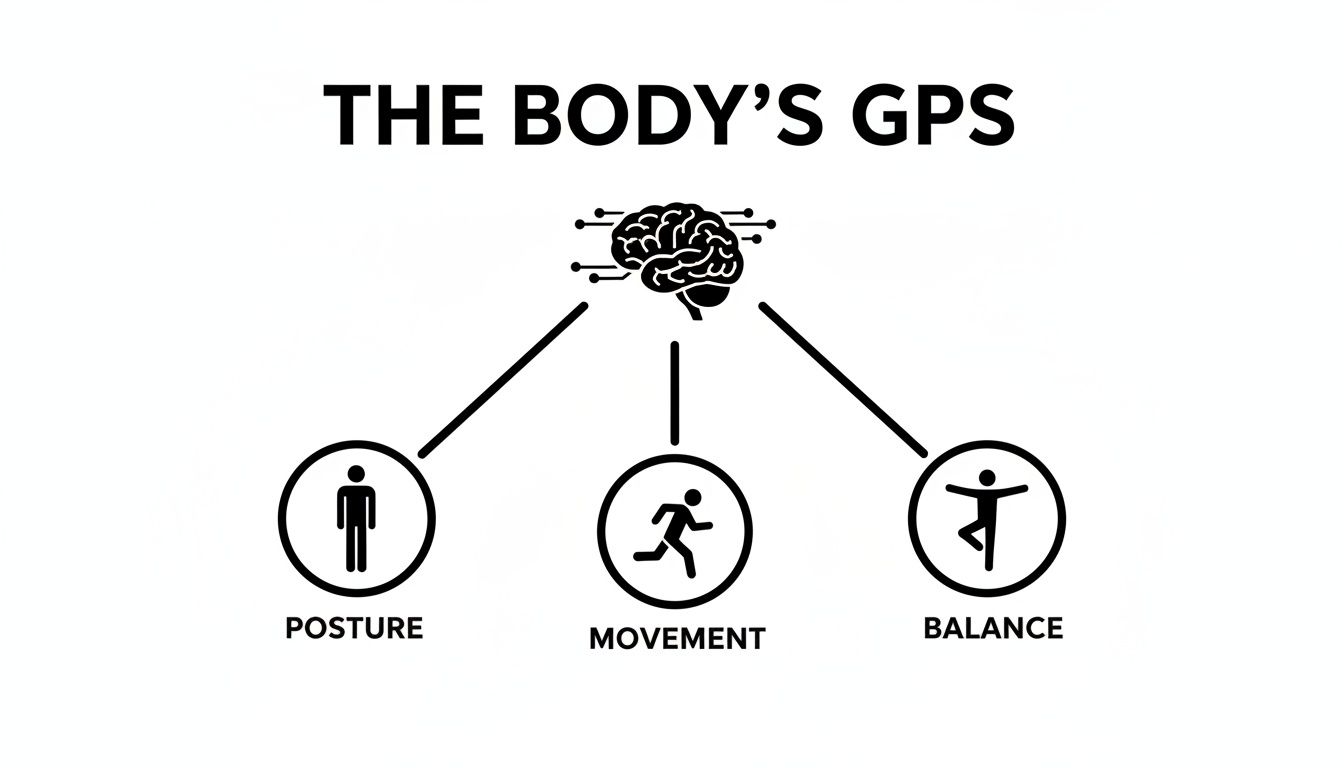
As you can see, these three functions are completely dependent on that constant feedback loop between your body's sensors and your brain.
The Key Players: Muscle Spindles and GTOs
The first and most important sensors are found right inside the muscles themselves. Imagine Muscle Spindles as tiny, intelligent rulers embedded deep within your muscle fibers, specifically within the muscle belly. Their main job is to detect changes in muscle length (stretch) and how fast that change is happening.
When a muscle stretches too far or too quickly, the muscle spindles send an urgent message to the spinal cord. This triggers a protective reflex arc (the myotatic stretch reflex) that causes the muscle to contract, helping prevent strains and maintaining your posture without you ever having to think about it.
Working right alongside them are the Golgi Tendon Organs (GTOs). If muscle spindles are the rulers, then GTOs are the force gauges. You'll find them at the musculotendinous junction (where muscle fibers connect to your tendons), and their job is to monitor how much tension or force a muscle is generating.
If the GTOs sense the force is becoming dangerously high—enough to risk a tear—they send an inhibitory signal that tells the muscle to back off and relax (the inverse myotatic reflex). This is a crucial safety mechanism that protects your musculoskeletal system from its own strength, keeping your movements within a safe range.
Imagine you bend down to lift a box you think is light, but it’s actually full of books. Your muscle spindles instantly sense the rapid stretch in your biceps, while your GTOs register the immense tension. Together, they orchestrate an immediate response, forcing you to drop the box to prevent a serious injury.
This elegant partnership between sensing stretch and sensing tension is the very foundation of muscular control and safety.
The Role of Joint Receptors
The final pieces of this anatomical puzzle are the Joint Receptors, which are located in and around your joint capsules and ligaments. These sensors, including Pacinian and Ruffini corpuscles, provide vital information about your joint position (angle), pressure on the joint, and its velocity of movement.
They are especially sensitive to the extremes of your range of motion, signaling when a joint is getting close to its limit. This is particularly important for joints that face unstable conditions, like the ankles (talocrural joint) and knees (tibiofemoral joint).
For instance, sharp joint receptors in the ankle ligaments can help prevent a sprain by allowing for lightning-fast muscular adjustments when you step on uneven ground. If you're interested in strengthening these specific areas, our guide to ankle resistance band workouts is a great place to start.
Ultimately, your brain takes in all the information from these three sources—muscle spindles, GTOs, and joint receptors—and integrates it. This is what creates the complete, seamless picture of your body's position in space, allowing for the fluid, coordinated, and safe movement that proprioceptive training is all about perfecting.
How Proprioceptive Training Rewires Your Brain-Body Connection
When we talk about proprioceptive training, we're not just building stronger muscles. We’re building a smarter, more responsive nervous system. The goal is to fine-tune the communication lines between your body’s sensors and your brain, leading to movements that are faster, more precise, and feel almost effortless.
Think of it like this: your body's internal GPS starts as a blurry, pixelated map. Every time you do a focused balance or stability exercise, you’re sharpening that image, upgrading it from low-res to brilliant high-definition.
This incredible process is called neuroplasticity—the brain's ability to literally reorganize itself by forging new neural pathways. Consistent proprioceptive work strengthens these connections, creating superhighways for sensory information to zip back and forth.
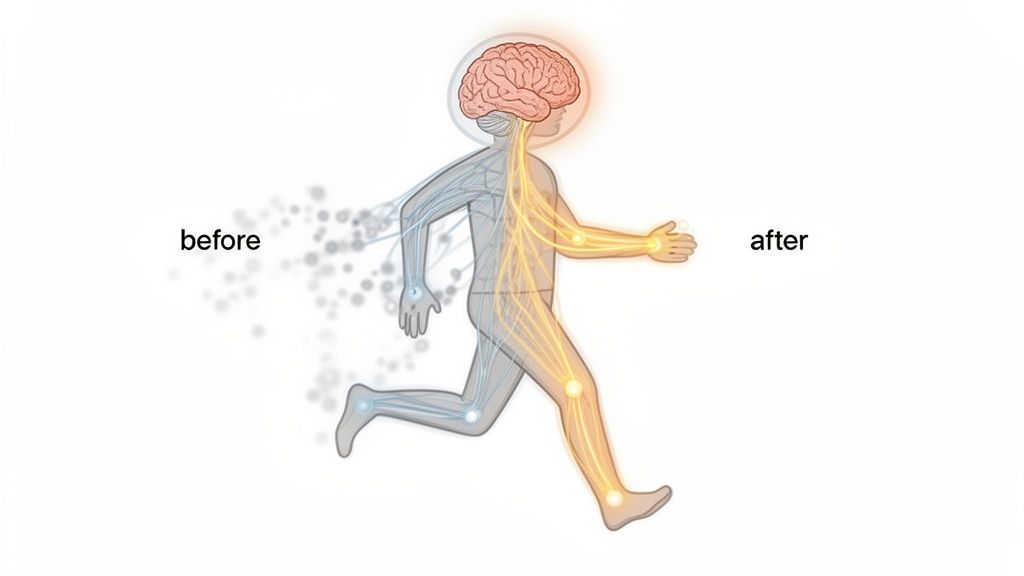
With every repetition, the signals coming from your muscles and joints become clearer. Your brain, in turn, gets much better at interpreting this flood of data and sending back the perfect commands to keep you stable and controlled.
Enhancing Motor Control and Reaction Time
This "rewiring" has a profound impact on what you can do physically. As those neural pathways become more efficient, your reaction time sharpens dramatically. Suddenly, you're making tiny, subconscious adjustments to your posture and balance much faster—which is the secret sauce to preventing stumbles, falls, and injuries.
This heightened awareness is the bedrock of better athletic performance and safer everyday movement. A well-trained nervous system can instantly fire up the stabilizing muscles around your ankle the second you step on uneven ground, stopping a sprain before it even has a chance to happen. This is a perfect example of an improved mind-muscle connection, a concept you can explore more deeply in our article on how to improve your mind-muscle connection.
The real-world results are pretty stunning, especially in elite sports. One study followed 55 professional athletes and found that a dedicated program led to an 81% reduction in ankle sprains. This wasn't just luck; it was accompanied by a 72.2% improvement in proprioceptive control and a 50% improvement in postural control, proving just how powerful this neural adaptation really is. You can dig into the full study about proprioceptive improvements in professional athletes to see the data for yourself.
Building a More Resilient System
Ultimately, this training is an investment in your body's long-term durability. A nervous system that is highly tuned in to its surroundings can handle unexpected curveballs, whether you’re on the court or just walking down a cracked sidewalk.
Proprioceptive training doesn't just teach your body to balance; it teaches your brain to anticipate and react. It turns conscious effort into unconscious competence, making fluid, stable movement your new normal.
By focusing on the quality of this brain-body dialogue, you're building a system that isn't just stronger, but also smarter, safer, and far more capable of handling whatever life throws its way.
Clarifying Movement: Proprioception, Kinesthesia, And Balance
To really get what proprioceptive training is all about, we first need to untangle a few key terms that often get tossed around interchangeably: proprioception, kinesthesia, and balance. They all work together to create graceful, intelligent movement, but each one has its own unique job in your body’s incredible internal guidance system.
Think of proprioception as the raw, unconscious data stream constantly feeding your brain. It’s that quiet, background hum of feedback from millions of tiny sensors in your muscles and joints, telling your brain exactly where your arms, legs, and head are in space. You don't consciously think about it; it’s the automatic signal that lets you stand perfectly still with your eyes closed.
The Feeling Versus The Skill
Kinesthesia, on the other hand, is the conscious cousin of proprioception. This is your awareness of the movement itself—the sensation of your muscles firing and your joints shifting as you swing a golf club or lift a grocery bag. If proprioception is the "where," kinesthesia is the "how it feels to get there."
And finally, balance is the skillful outcome of this whole process. It’s your ability to hold your center of gravity, a seriously complex task that requires your brain to be an expert at multitasking.
To keep you stable, your brain is constantly juggling information from three key sources:
- Proprioceptive Data: Information from your muscles and joints about where your body is.
- Visual Input: What your eyes see to orient you in the room.
- Vestibular System: Signals from your inner ear that sense head movement and gravity.
True balance isn't just about not falling over. It’s a dynamic skill where your brain synthesizes data from your internal GPS (proprioception), your eyes, and your inner ear to make constant, lightning-fast adjustments.
To help clear this up, let’s look at these concepts side-by-side.
Proprioception vs. Kinesthesia vs. Balance
This table breaks down the distinct yet related concepts of proprioception, kinesthesia, and balance.
| Concept | Definition | Example |
|---|---|---|
| Proprioception | The unconscious sense of your body's position and orientation in space. It's your internal GPS. | Touching your finger to your nose with your eyes closed. You don't have to think about it; your brain just knows where your hand and nose are. |
| Kinesthesia | The conscious awareness of your body's movement. It's the sensation of motion itself. | Feeling the smooth, coordinated motion of your arm as you throw a ball or the controlled stretch in your legs during a squat. |
| Balance | The skillful ability to maintain your center of gravity. It’s the result of integrating proprioceptive, visual, and vestibular input. | Standing on one foot, walking on an uneven trail, or holding a yoga pose without wobbling. |
So, you can see how these concepts build on each other. You need good proprioception for sharp kinesthetic awareness, and you need both of those—plus input from your eyes and inner ear—to have great balance.
Understanding how these three intertwine is key. When you train proprioception, you are directly sharpening one of the most critical pillars that makes both kinesthetic awareness and functional balance possible. You’re cleaning up the raw data so the final performance is more precise, controlled, and effortless. This foundational work is at the heart of practices like body balance therapy, which aim to recalibrate this entire system from the ground up.
Actionable Exercises To Sharpen Your Proprioception
Alright, we’ve covered the science. Now it's time to put that knowledge into action and wake up your body's internal GPS. The good news? You don't need a bunch of fancy gym equipment. It all starts with simple, focused movements designed to challenge your stability just enough.
The goal here is to create a little bit of a wobble—enough to make your nervous system sit up, pay attention, and start responding more efficiently. Think of it as recalibrating the connection between your brain and those tiny mechanoreceptors in your joints and muscles.
These foundational exercises are the perfect place to start.
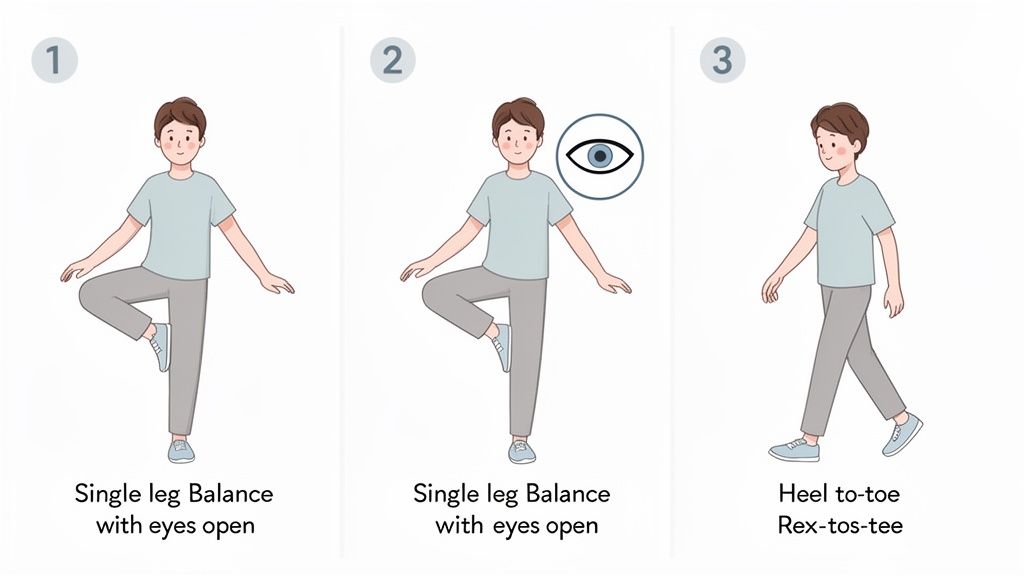
Foundational Bodyweight Exercises
First things first, master these basics on a solid, flat floor. Quality and control are far more important than speed or reps. It’s a good idea to have a chair or wall nearby for a little support if you need it.
- Single-Leg Stance: Stand on one leg, keeping a soft bend in that knee. Your mission is to hold this for 30 seconds without letting your other foot tap the ground. Pay attention to all the tiny, automatic adjustments your ankle and foot are making. That's your proprioception at work! Switch legs and repeat.
- Heel-to-Toe Walk: Picture yourself walking a tightrope. Take ten slow, very deliberate steps forward. Place the heel of your front foot so it's touching the toes of your back foot. By narrowing your base of support like this, you're forcing your internal balancing system to work overtime.
- Tandem Stance: This is like freezing in the middle of the heel-to-toe walk. Stand with one foot placed directly in front of the other, heel-to-toe, like you're on a balance beam. Just hold this static pose for 20-30 seconds. It challenges your stability in a completely different way than the single-leg stance.
Once you feel steady and confident with these movements, you’re ready to dial up the difficulty.
Progressing Your Proprioceptive Training
The secret to getting better at this isn't about adding weight; it's about adding sensory challenges. And the easiest way to do that is by taking away your most dominant sense: your sight.
By closing your eyes during a balance exercise, you force your brain to stop relying on visual cues. This effectively turns up the volume on the signals coming from your muscles and joints, making your proprioceptive system the star of the show.
Here’s how you can safely take your training to the next level:
- Remove Visual Cues: Try the single-leg stance or tandem stance again, but this time with your eyes closed. You'll immediately feel how much harder it is. Start with just 5-10 seconds and gradually build up. That initial wobble is a great sign—it means your nervous system is actively learning.
- Introduce an Unstable Surface: Once you're comfortable with the eyes-closed variations, try the exercises on something a little less stable. A folded yoga mat, a couch cushion, or a foam pad works perfectly. This adds a new variable that demands even faster and more precise communication between your brain and body.
- Add Dynamic Movement: Now, let's challenge your stability while you’re moving. While balancing on one leg, try slowly tracing the letters of the alphabet in the air with your raised foot. This dynamic element is a fantastic way to train your body to stay stable through motion.
These progressions are all designed to continuously fine-tune your body's feedback loop. If you’re looking for more targeted work, especially for crucial joints like the ankles, our guide on a comprehensive ankle band workout can be an excellent addition to your routine.
Ultimately, the goal is to build a body that isn't just strong, but smart and incredibly responsive.
The Real-World Benefits Of Proprioceptive Training
When we talk about proprioceptive training, we're not just discussing feeling a bit more coordinated. We're talking about tangible, real-world results that make your body smarter, more efficient, and incredibly resilient. These benefits show up everywhere—from high-level athletic competition to simply navigating your daily life with more confidence.
One of the biggest wins is a serious drop in injury risk. Think about it: when your brain and body are in constant, clear communication, your muscles can react in a split second to surprises, like stepping off a curb you didn't see. That lightning-fast, automatic stabilization is what shields your joints—especially the vulnerable ankles and knees—from all-too-common sprains and strains.
Enhanced Athletic Performance and Daily Function
For athletes, sharp proprioception is the secret ingredient behind powerful, efficient movement. It’s what allows for those tiny, subconscious adjustments needed to throw a perfect pitch, stick a landing, or change direction on a dime. This heightened body awareness is often what separates the good from the truly great.
But these perks aren't just for the pros. For older adults, proprioceptive work is a cornerstone of fall prevention. It fine-tunes the stability and reaction time needed to move through the world safely and confidently.
The real magic of proprioceptive training is its role in recovery. It’s fundamental in helping people regain motor control and confidence after an injury, creating a stronger, more intelligent system to keep it from happening again.
Measurable Improvements in How You Move
And this isn't just a feeling; the impact is backed by some pretty compelling data. A huge meta-analysis covering 70 different studies found that this type of training led to a 46% improvement in proprioceptive awareness and a 45% boost in motor performance.
Here’s the kicker: this translated directly to a 45% reduction in injury rates. That’s a powerful testament to its effectiveness. You can dig into the full research findings on proprioceptive training efficacy for a closer look.
This is why proprioceptive training is so central to any effective physical rehabilitation treatment. It’s not just about strengthening a muscle; it’s about rebuilding the body’s internal feedback system. You end up with a smarter, more resilient body that’s better prepared for whatever comes its way.
Your Top Proprioception Questions, Answered
As you start to explore proprioceptive training, a few practical questions naturally come up. Let's dig into some of the most common ones I hear from clients, whether they're just starting out or looking to refine their practice.
How Often Should I Do Proprioceptive Training?
The secret here is consistency, not intensity. My recommendation? Aim to weave proprioceptive exercises into your routine 2-3 times per week.
This doesn't mean you need to carve out another hour-long workout. It can be as simple as standing on one leg while you brush your teeth or adding a few balance drills to your warm-up. These small, focused moments add up, dramatically improving your mind-body connection over time.
Can I Do This Training With A Chronic Condition Like Arthritis?
Absolutely, and it can be a game-changer. Proprioceptive work is fantastic for improving joint stability and control, which is incredibly valuable when managing a condition like arthritis.
The key is to start smart. Always check in with your doctor or physical therapist first. Begin with simple, stable exercises on a flat surface, listen closely to your body, and never push through pain. Low-impact, controlled movements are your best friend here.
Does Proprioceptive Training Feel Like A Hard Workout?
Not in the way you might think. You won't be left breathless or dripping in sweat. The challenge is more neurological than muscular—it’s about focus and fine-tuning.
Proprioceptive training is all about precision, control, and subtle adjustments. You're teaching your nervous system to be smarter and more efficient, which requires concentration rather than brute force. Think of it as the perfect complement to your strength or cardio days.
Ready to build a smarter, more resilient body from home? WundaCore gives you the expertly designed equipment and anatomy-informed instruction you need to sharpen your proprioception and build true, functional strength. Discover the difference that mindful, form-focused movement can make.