
Guide to Beginner Pilates Reformer Exercises: An Anatomical Approach to Core Strength
Getting started with Pilates reformer exercises is about forging a deep connection between your mind and your musculature. It’s not about large, forceful movements. Instead, foundational exercises like Footwork and The Hundred are designed to awaken deep core stabilizers through slow, controlled actions, with the reformer providing crucial anatomical feedback.
Your Reformer and Your Core
Before lying down, let's reframe how you see the machine. Think of the reformer less as workout equipment and more as a biofeedback tool. It’s there to give you honest feedback on your alignment and muscle engagement. Its main parts—the moving carriage, the resistance springs, and the stationary footbar—are engineered to guide your body into optimal alignment and facilitate a deeper neuromuscular connection.
The real magic happens when you link the external support from the reformer to your internal anatomy. We talk a lot about the "core," but anatomically, it’s a complex system of deep, stabilizing muscles that must function in harmony.
The Anatomy of a Truly Strong Core
When a Pilates instructor cues you to “engage your core,” they are asking you to consciously activate and coordinate several key muscle groups.
- Transverse Abdominis (TVA): This is your body’s innate corset. As the deepest layer of your abdominal wall, its fibers run horizontally around your midsection, providing critical support to your lumbar spine. Engaging it should feel like you’re gently drawing your hip bones toward each other and your navel toward your spine.
- Pelvic Floor: These muscles form a supportive sling or hammock at the base of your pelvis, supporting your internal organs. Learning to gently lift and engage these muscles is fundamental to creating a stable pelvic base for all movement.
- Multifidus: A series of small but incredibly powerful muscles that run along the length of your spine, attaching from one vertebra to the next. They provide crucial segmental stability to the spinal column.
- Diaphragm: Your primary muscle of respiration is an integral part of your core canister. Proper diaphragmatic breathing helps regulate intra-abdominal pressure, stabilizing your entire torso from the inside out.
The reformer’s spring system is brilliant because it provides both assistance (eccentric control) and resistance (concentric work). This helps you build muscular strength without joint-damaging impact, creating the perfect environment for learning to consciously activate this deep core musculature.
When performing even the simplest beginner pilates reformer exercises, the goal is to initiate the movement from this deep core system. Take Footwork, for example. As you press the carriage away, your focus isn't just on the leg muscles. It’s on maintaining a neutral, stable pelvis by keeping the TVA and pelvic floor active. This deep anatomical awareness is what makes Pilates so effective. You can learn more by exploring what muscles Pilates works in our detailed guide. You're building true, functional strength from the inside out.
Now, let's move from theory to practice. We will dive into five foundational movements that form the bedrock of any solid reformer routine. Think of these not just as exercises, but as dialogues with your anatomy. We’ll break down what’s happening in your body so you can build a smarter, more intuitive practice from day one.
To keep things simple, let's look at the core process of Pilates.
It always comes back to this flow: you connect with the machine, you power the movement with your breath, and everything originates from your deep core musculature. Let's see it in action.
Footwork: The Foundation of Your Practice
Footwork is almost always the first exercise in a reformer class, and for good reason. It may appear simple, but it’s a full-body diagnostic tool. The true challenge is maintaining a perfectly stable pelvis and spine while the legs articulate at the hip, knee, and ankle joints.
Anatomically, you’re strengthening the quadriceps, hamstrings, and glutes through their full range of motion without the compressive load of a standing squat. But the critical work happens in your core. You must actively engage your transverse abdominis (TVA)—that deep internal corset—to prevent the lumbar spine from arching or the pelvis from tucking under.
Picture your torso as a solid, immovable block. As you press the carriage out on an exhale, feel the TVA gently draw inward toward your spine. On the inhale to return, you are controlling the springs; they are not controlling you. This teaches eccentric control of the leg muscles and is your first lesson in initiating all movement from a stable center.
The Hundred: Ignite Your Core Powerhouse
The Hundred is an iconic Pilates exercise. It’s designed to build significant abdominal strength and endurance while demanding precise breath control. It is a true full-body challenge requiring deep, unwavering core activation.
When you flex your upper spine to lift your head and shoulders, your rectus abdominis (the superficial "six-pack" muscles) contract. However, a common beginner mistake is allowing these muscles to dominate, causing the abdomen to bulge or "dome" upwards.
The secret to a powerful Hundred is initiating the movement from your deep TVA. As you pump your arms, visualize knitting your front ribs together and down toward your pelvis. This cue helps maintain thoracic stability and keeps the effort focused in your deep core, preventing strain in the neck and shoulders.
Your breath is the engine here. A rhythmic inhale for five pumps and an exhale for five pumps increases circulation, oxygenates your muscles, and helps you maintain that crucial intra-abdominal pressure for core stability. You are learning to coordinate breath, movement, and deep muscle engagement simultaneously.
Leg Circles: Mobilize Your Hips with Control
Leg Circles are less about the size of the circle and more about the stillness of your pelvis. While one leg performs controlled circumduction at the hip joint, your torso must remain completely locked in place. This is a fantastic exercise for improving hip mobility while strengthening the stabilizing muscles around the pelvis.
The key anatomical lesson here is disassociation—the ability to move one part of your body independently from another. Your obliques and TVA work isometrically to anchor your pelvis to the carriage. If you feel your hips rocking, it’s a clear signal that your core stabilizers have disengaged.
The solution? Make your circles smaller. Focus on the sensation of your sacrum—the flat, triangular bone at the base of your spine—remaining heavy and anchored to the mat. You're teaching your brain and body that true strength originates from a stable center, which in turn allows for freedom and fluidity in the limbs.
Short Spine Stretch: Decompress and Articulate
The Short Spine Stretch is a deeply satisfying movement that helps decompress and articulate the spine. While it feels like a stretch, it is an incredibly active exercise that demands immense core control, particularly during the controlled descent.
As your legs move up and over, you use your lower abdominals to peel your spine off the carriage, one vertebra at a time. This sequential movement is the goal. Once your hips are lifted, the focus shifts to controlling the return journey against the pull of the springs.
On the descent, you must use your abdominals and hamstrings to slowly roll your spine back down. I often cue clients to imagine they’re laying down a pearl necklace, one delicate pearl at a time. This controlled articulation strengthens the small multifidus muscles along the spine and teaches the body how to release tension through mindful, active movement rather than passive stretching.
This growing appreciation for low-impact, joint-friendly workouts isn’t just a feeling; it’s a fact. The Pilates Reformer market has seen incredible growth, which points to a huge influx of beginners looking for workouts that build core strength without punishing their joints. For newcomers, this means accessible exercises like Footwork or The Hundred are perfect, as the spring-loaded carriage provides both support and adjustable resistance. You can read more about the Pilates market growth to see how this trend is reshaping the fitness world.
Mermaid Stretch: Lengthen Your Entire Side Body
Finally, the Mermaid Stretch is a beautiful movement for creating space along the lateral line of the body. It lengthens the muscles between your ribs (the intercostals), your obliques, and the quadratus lumborum (QL), a deep lower-back muscle that is notoriously tight for many people.
The most important anatomical cue is to create length before you bend. As you reach your arm up and over, imagine lifting your ribcage up and away from your pelvis. This axial elongation is what prevents you from simply collapsing or crunching into your side.
Another non-negotiable is keeping both ischial tuberosities (sit bones) firmly anchored on the carriage as you initiate the stretch. This ensures the movement is focused on lateral flexion of the spine rather than creating torque in the lower back. The reformer’s moving carriage provides gentle assistance, allowing you to deepen the stretch with complete control. It’s the perfect way to finish a session, restoring balance and alignment to the spine.
To give you a clearer picture of what these foundational movements are really doing for your body, here's a quick breakdown of their primary targets and benefits.
Anatomy Focus of Foundational Reformer Exercises
| Exercise | Primary Muscle Groups Targeted | Anatomical Benefit |
|---|---|---|
| Footwork | Quadriceps, Hamstrings, Glutes, Transverse Abdominis (TVA) | Builds lower body strength without joint compression; establishes core-to-limb connection. |
| The Hundred | Rectus Abdominis, Obliques, TVA | Develops core strength and endurance; enhances breath control and coordination. |
| Leg Circles | Hip Flexors/Extensors, Obliques, TVA, Inner/Outer Thighs | Improves hip joint mobility and teaches pelvic stability through disassociation. |
| Short Spine Stretch | Lower Abdominals, Hamstrings, Spinal Erectors | Increases spinal articulation and flexibility; decompresses the lumbar spine. |
| Mermaid Stretch | Intercostals, Obliques, Quadratus Lumborum (QL), Lats | Lengthens the entire side body, improves lateral flexion, and releases lower back tension. |
As you can see, each exercise has a distinct anatomical purpose, yet they all reinforce the same core principles: stability, control, and breath. Mastering these five will give you the confidence and body awareness needed to tackle any other exercise.
How to Structure Your First Reformer Workout
Knowing a few exercises is one thing, but stringing them together into a thoughtful, flowing sequence is where the real magic happens. A well-structured workout isn't just a random list of moves; it’s a conversation with your body. It ensures you warm up properly, target key muscle groups effectively, and cool down safely.
The logic behind a good beginner sequence is simple. You always want to start with movements that gently awaken the body, then move into deeper core activation, and finish with stretches that lengthen the muscles you just worked.
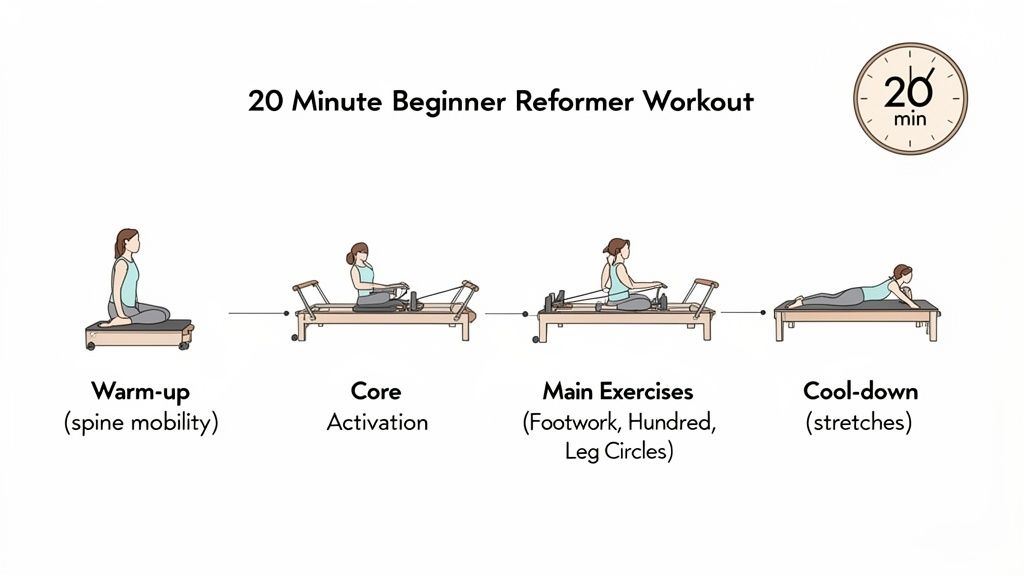
This progression protects you from injury and helps you get the most out of every single exercise.
Your 20-Minute Beginner Sequence
Here is a simple, effective framework to get you started. The goal here is to focus on your form and breath, not speed or a high number of reps. Listen to your body and don't be afraid to adjust.
-
Phase 1: Warm-Up (5 minutes)
- Breathing: Lie on the carriage for a moment. Take 5-10 deep, diaphragmatic breaths to connect with your center. Feel your ribs expand laterally and posteriorly.
- Footwork Series: Go through 10-12 reps of each position (toes, arches, heels). This is the perfect way to gently warm up the ankle, knee, and hip joints while activating the glutes and deep abdominals.
-
Phase 2: Core Activation (10 minutes)
- The Hundred: Aim for the full 100 counts, but modifying is smart. Keep your head down or your knees bent to reduce the lever length and protect your lower back.
- Leg Circles: Do 8-10 circles in each direction with each leg. The real work is maintaining pelvic neutrality and stability on the carriage.
- Short Spine Stretch: Move slowly through 6-8 repetitions. Concentrate on the sequential articulation of your spine, peeling it off the carriage one vertebra at a time, and then rolling it back down with equal control.
-
Phase 3: Cool-Down & Stretch (5 minutes)
- Mermaid Stretch: Hold for 3-4 deep breaths on each side, and repeat twice. This feels incredible for releasing tension in the QL and intercostal muscles.
- Kneeling Stretches: Finish off with a few simple quad or hip flexor stretches using the footbar for support to lengthen the muscles at the front of the hip.
A key part of your practice is learning to adjust spring tension based on how you feel. Lighter springs aren't always easier; sometimes they demand more stability from your core. Heavier springs provide more support but also more resistance. Don't be afraid to experiment to find what feels right for your body on any given day.
This simple structure gives you a reliable template to follow. As you get more comfortable, you can start swapping in new beginner Pilates reformer exercises or increasing your reps. For a deeper dive, check out our complete guide to a beginner Pilates reformer workout for more ideas and inspiration.
If you're just starting your movement journey, the Pilates reformer might look a little intimidating. But trust me, that sophisticated system of springs, straps, and a moving carriage is one of the best tools you can have. It’s designed not just to challenge you, but to provide crucial support and feedback you simply can't get from a mat alone.
This is a huge deal for building strength safely and efficiently. Unlike traditional weight training that can apply compressive forces to your joints, the reformer’s spring system provides both assistance (eccentric loading) and resistance (concentric loading). This allows you to work your muscles through their full range of motion without harsh impact. For anyone navigating an injury, joint sensitivity, or body changes like menopause, this is a game-changer. You're building deep, functional strength without taxing your body.
A Deeper Connection to Your Body
One of the most powerful things the reformer does is enhance your proprioception—your body's internal sense of its position in space. The moving carriage provides instant, undeniable feedback.
Think about doing Leg Circles. If your core isn't stable, you'll immediately feel the carriage start to wobble. This forces you to activate your deep stabilizing muscles, like the transverse abdominis and pelvic floor, to regain control. It’s like having a real-time conversation with your neuromuscular system.
This constant feedback loop helps you build a more intelligent and intuitive practice right from the start. You quickly learn to feel the difference between correct alignment and muscular compensation, which is key to developing efficient and safe movement patterns.
The reformer isn't just a piece of exercise equipment; it's a powerful tool for building a sustainable and intelligent lifelong movement practice. It teaches you to connect with your body on a much deeper anatomical level.
Safe Spinal Mobility and Support
Let's look at an exercise like the Short Spine Stretch to really see the reformer's magic. The goal is to improve spinal mobility by articulating the vertebrae one by one. On a mat, this is incredibly challenging for a beginner.
But on the reformer, the straps support the weight of your legs and the springs assist the movement. This allows you to focus purely on the controlled, sequential peeling of your spine off the carriage without straining your neck or back. It makes a complex, beneficial movement accessible from day one.
This supportive environment is exactly why beginner Pilates reformer exercises are showing up more and more in clinical and rehabilitation settings. It's a gentle yet incredibly effective way to build strength back after an injury. Hospitals and physical therapy clinics are integrating reformers because foundational moves like Short Spine promote mobility with controlled resistance, avoiding joint stress.
In fact, some studies show up to a 30% improvement in core stability for rehab patients after consistent reformer sessions. If you're curious, you can discover more insights about the growing Pilates reformer market and its expanding role in wellness.
Adapting Reformer Exercises for At-Home Practice
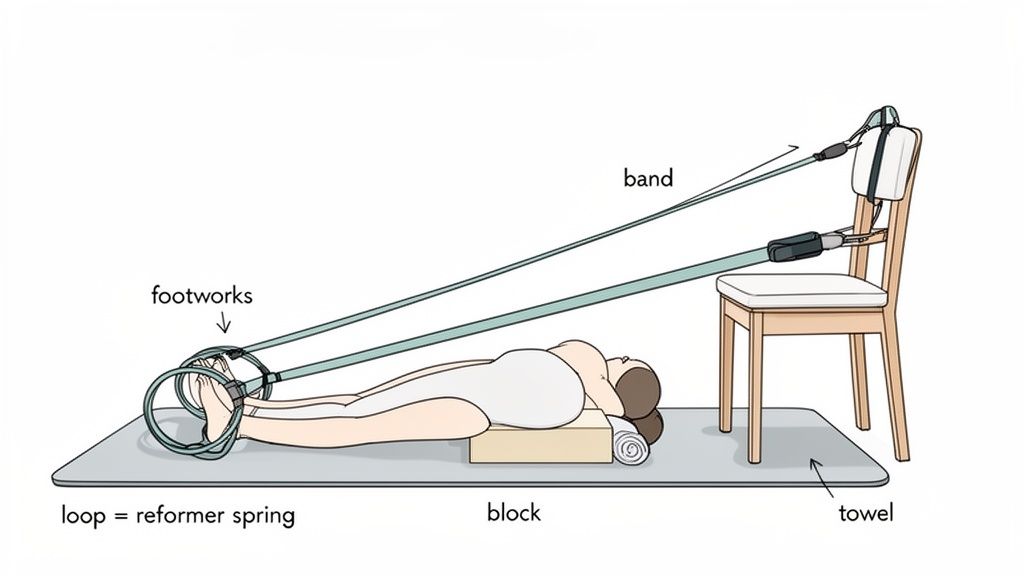
So you don't have a reformer in your living room? That doesn't mean you have to miss out on the deep, anatomy-focused work you get in a studio. With just a few simple props, you can mimic the spring-based tension that makes the machine so incredible for building true core strength.
The whole point is to recreate that constant, controlled resistance. It’s what forces your deep stabilizing muscles to wake up and do their job. Props like a resistance ring or a loop band effectively become your portable spring system, adding just the right challenge to keep your movements honest and precise.
Recreating the Reformer Feel
Believe it or not, you can intelligently adapt many beginner pilates reformer exercises for the mat. The secret is understanding the anatomical goal of the original movement and then using a prop to replicate that specific challenge.
- For Footwork: Lie on your back with a resistance loop around the arches of your feet. When you press out against the band, you're mimicking the push of the reformer's carriage. This instantly forces you to engage your transverse abdominis to prevent your pelvis from tilting.
- For The Hundred: Squeeze a Pilates ring between your inner thighs. This small addition is a game-changer. It activates your adductor muscles and deepens your connection to the pelvic floor, providing the kind of pelvic stability you'd normally get from the carriage.
The essence of reformer work is controlled resistance that trains your muscles to work eccentrically—that is, lengthening while under tension. Bands and rings provide this exact feedback loop, teaching your body stability without needing the whole machine.
The home fitness boom has brought some amazing innovation, making Pilates more accessible than ever. We're seeing more compact, tech-savvy reformers designed for home use, and it's changing the game. In fact, Technavio forecasts the market will grow by $218.52 million between 2025-2030, largely thanks to foldable designs and app-guided classes.
This trend is great for everyone, especially since 60% of people new to Pilates are looking for low-impact workouts. You can explore more insights on the growing Pilates equipment market to see just how much is changing.
By using props thoughtfully, you can continue building that deep anatomical awareness and strength right from your own mat. If you're curious about how to put this all together, you'll love our guide on creating a full reformer-style Pilates workout at home.
Your Top Beginner Reformer Questions, Answered
Starting something new always comes with a few questions. It’s totally normal! Getting the right information upfront helps you walk into your first session feeling confident and ready, so let's tackle some of the most common things beginners wonder about.
How Often Should I Be Doing This?
When you're just starting out, consistency beats intensity every time. I always tell new clients to aim for 2-3 sessions per week. This is the sweet spot.
This frequency gives your body and brain enough time to establish those crucial neuromuscular pathways without causing excessive fatigue. Remember, the goal of those initial beginner pilates reformer exercises is to perfect your form and control. This schedule allows for proper recovery, which is when your deep core muscles—like your transverse abdominis—actually repair and get stronger.
Is This Okay If I Have Back Pain?
So many people come to Pilates because of back pain. The reformer is fantastic for this because it's designed to strengthen the deep core musculature that supports and decompresses the spine. It's low-impact, and the adjustable spring resistance means we can make it incredibly gentle on your joints.
That said, it’s absolutely essential to get clearance from your doctor or physical therapist first. And always, always let your instructor know about your specific condition. We can provide modifications to keep you safe while you build a stronger, more resilient core.
What’s the Best Thing to Wear for a Reformer Workout?
Think comfortable and form-fitting. You want clothing that moves with you but won't get caught in the springs or any of the moving parts of the reformer. Anything too baggy can be a safety hazard.
Many people also swear by grip socks. They're not just for hygiene—they provide crucial traction to prevent your feet from slipping on the carriage or footbar, giving you a much more stable and controlled workout where you can focus on your form.
Ready to bring the anatomy-focused benefits of Pilates into your home? The WundaCore collection, including our patented Resistance Ring and Loop, is expertly designed to help you build deep core strength and mindful movement patterns. Explore the full WundaCore collection and start your journey today.