
Your Guide to a Reformer Pilates at Home Workout
A true reformer pilates at home workout isn't about the machine—it’s about controlled resistance and connecting with your muscles in a very specific way. When you focus on the anatomy behind the movement, you can absolutely get that deep, studio-style core work and joint protection without a big, bulky reformer.
The New Era of At-Home Anatomical Pilates
The fitness world is definitely shifting. More and more people are realizing that the magic of a reformer workout—that constant, challenging tension—doesn't have to be confined to a studio. You can create that same feeling at home with an intelligent, anatomy-first approach.
It's really about understanding why an exercise works, not just mindlessly going through the motions. This method moves past simple imitation and gets right to muscular activation. By using smart props like the WundaCore Resistance Ring and Loop, you can generate the same kind of controlled resistance a reformer’s springs provide, targeting those small, often-neglected muscle groups with incredible precision.
Anatomy is the Foundation
Forget endless crunches. Real, foundational strength comes from waking up your deep core system. This isn't just about your "six-pack" muscles; it's about the entire support structure of your torso.
We’re talking about:
- The Transverse Abdominis (TVA): Think of this as your body’s built-in corset. This deepest abdominal muscle wraps around your midsection, and when you engage it properly, it cinches inward to stabilize your lumbar spine and pelvis.
- The Pelvic Floor: This is a group of muscles that creates a supportive sling at the base of your pelvis. It works in synergy with your TVA and diaphragm to manage intra-abdominal pressure and support your internal organs.
- The Erector Spinae: These are the muscles running right alongside your spine. Keeping them strong is key to maintaining good posture and fighting off back pain.
When you learn to activate these muscles first, every single movement becomes safer and more powerful. You start moving from your center, which takes a ton of unnecessary strain off vulnerable joints like your knees, hips, and shoulders. That’s what makes a practice sustainable for the long haul.
A focus on anatomy turns your workout from a simple routine into a mindful practice. You're not just building muscle; you're re-educating your body on how to move with efficiency and grace, both on and off the mat.
The demand for this kind of mindful movement is exploding. The global Pilates Reformer market is on track to more than double, from USD 8.29 billion in 2026 to a projected USD 16.81 billion by 2035. What’s driving this? A huge factor is that over 70% of fitness enthusiasts now prefer low-impact workouts to build strength without stressing their joints—and the 'Home Use' segment is seeing some of the fastest growth. You can see more stats on the Pilates market boom here.
This infographic really captures the core principles of an effective at-home Pilates practice.
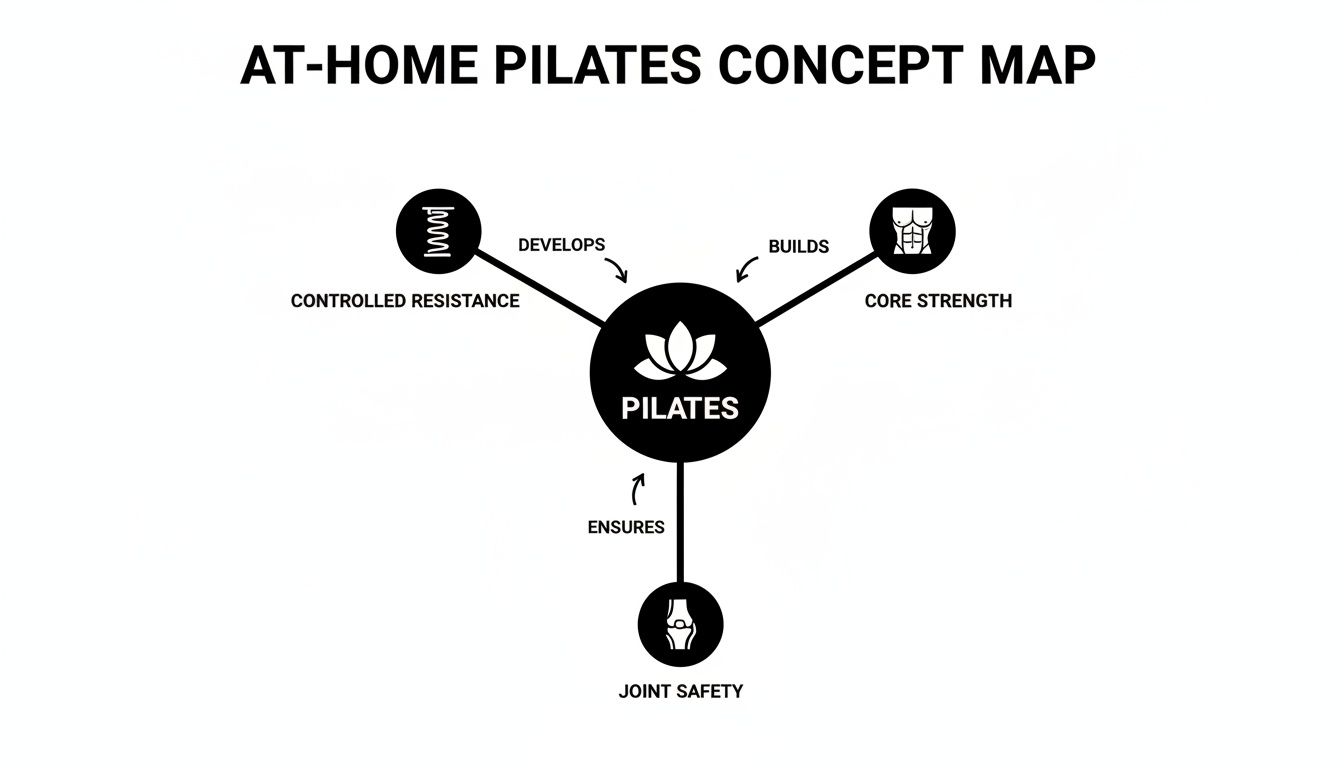
It shows how that synergy between controlled resistance, deep core strength, and joint safety creates the balanced, total-body workout we're all aiming for in a reformer-style session.
Studio Reformer vs At Home Prop Anatomy Focus
So, how do we translate the work from a big studio machine to simple at-home props? It all comes down to targeting the same muscles to achieve the same anatomical goals. It's less about the equipment and more about the intention of the movement.
Here’s a quick look at how a traditional reformer and our WundaCore props can achieve similar results by focusing on the same muscle groups.
| Anatomical Goal | Studio Reformer Action (Example) | WundaCore At-Home Prop Action (Example) |
|---|---|---|
| Deep Core & TVA Activation | Lying on the carriage, pressing out against spring tension (Footwork). | Lying on a mat, pressing out against the WundaCore Resistance Ring. |
| Pelvic & Hip Stability | Using the straps for Feet in Straps, controlling the leg circles. | Placing the Resistance Loop around thighs to maintain alignment in a Bridge. |
| Scapular (Shoulder) Stabilization | Pulling straps in Rowing series, engaging the back against spring resistance. | Using the WundaCore Loop for resisted arm work, focusing on back engagement. |
| Spinal Articulation & Support | Performing a Short Box Round Back, rolling down against the springs. | Using the Resistance Ring for feedback while articulating the spine in a Roll Down. |
As you can see, the actions are different, but the anatomical focus is the same. By understanding which muscles you’re trying to fire up, you can get an incredibly effective workout anywhere.
Creating Your Space for Anatomical Precision
A truly effective reformer pilates at home workout is all about precision, and that starts long before you make your first move. Setting up your workout space isn't just about making it look nice; it's about creating an environment that supports correct anatomical alignment from the very beginning. The real goal here is to eliminate physical distractions so your mind can zero in on what really matters: deep muscular engagement.
The surface you work on is your foundation, and it’s surprisingly critical. A plush, soft carpet might feel cozy, but it can let your spine sink, messing with its natural curve. On the flip side, a rock-hard floor offers zero cushioning for your joints. You're looking for that sweet spot: a surface firm enough to give your spine stable support, but with just enough give to be comfortable during floor work.
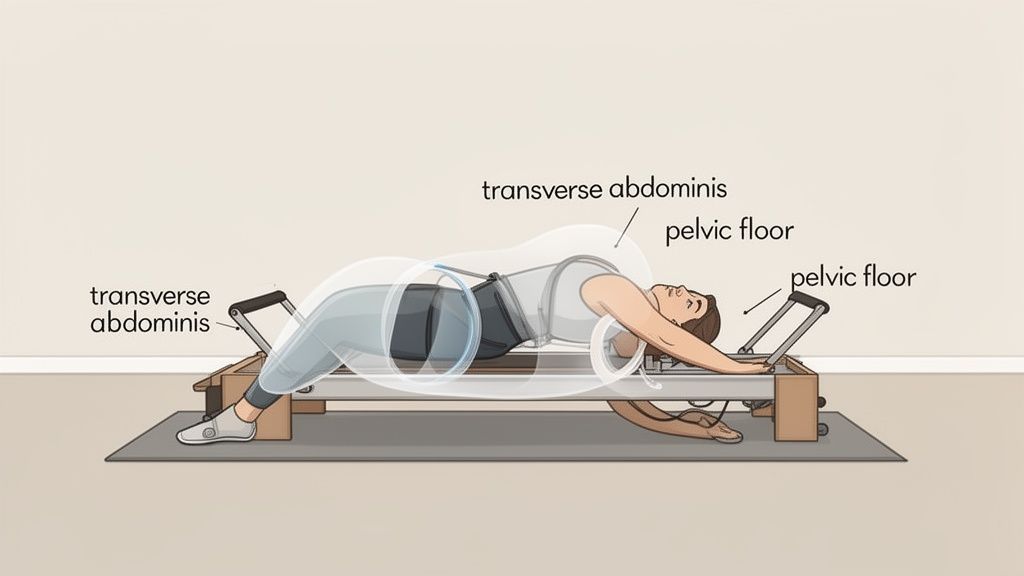
Optimizing Your Mat and Props
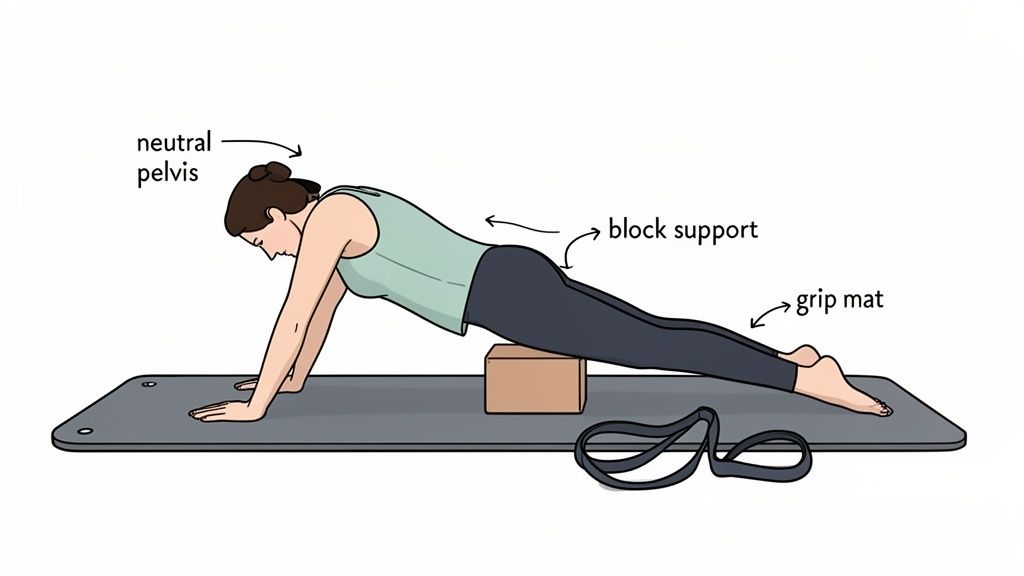
This is exactly where a specialized mat can be a game-changer. A prop like the WundaCore Movement Mat isn’t just about cushion; it's designed for proprioceptive feedback. Its grippy surface means that when you press your hands or feet down, you’re not fighting to keep from sliding around. That stability is everything—it lets you focus on activating the serratus anterior to stabilize your shoulder blades instead of tensing up just to stay in place.
Beyond the mat, even simple props become powerful tools for dialing in your alignment. Think of a basic Pilates block as more than just a cushion—it’s an alignment aid.
- For Pelvic Alignment: When you’re in a bridge, try placing a block between your thighs. This simple trick encourages your adductors (inner thighs) to fire up, which helps keep your pelvis neutral and allows for a much more powerful activation of the gluteus maximus.
- For Cervical Spine Length: A folded towel or a thin block under your head when you're lying on your back can make a world of difference. It helps maintain the natural curve of your neck, stopping that chin-jutting that so many of us do, and keeps your cervical spine long and happy.
By thoughtfully setting up your space with these little details, you're essentially programming your body for better form before you even start. You’re creating an environment where mindful movement and proper anatomical alignment become the path of least resistance.
Taking this proactive approach to your setup is a cornerstone of building a powerful home practice. If you want to build out your toolkit, you can check out our guide on essential at-home Pilates equipment for more ideas on creating that studio feel right at home.
The Role of Proprioceptive Feedback
So, what is proprioception? Think of it as your body's internal GPS—its ability to sense where it is in space without you having to look. A well-designed workout area seriously boosts this sense. The tactile feedback from a grippy mat or the gentle pressure from a block constantly sends information to your nervous system, helping you make those tiny micro-adjustments that perfect your form.
For instance, when your feet are planted firmly during standing work, you can actually feel the weight distribution from your heel to your toes. This sensory input is vital for activating the arches of your feet and engaging the entire kinetic chain all the way up through your legs and into your core. Without that solid feedback, your body might start to compensate in weird ways, leading to less effective work and even potential strain.
Your space shouldn’t be passive. It should be an active partner in your workout, giving you the feedback you need for deep, precise anatomical work.
Foundational Movements and Core Anatomy
To build a powerful and effective reformer pilates at home workout, we need to go deeper than just mimicking shapes. Real, lasting change happens when you understand the why behind each movement—which muscles you’re targeting, how they should feel, and the way they all connect to build stability and strength. This is where you learn to move with true intention.
Let’s break down a few foundational movements, but with a focus on the specific anatomical cues that unlock their real power. Think of this not just as a workout, but as a masterclass in how your body is designed to move.
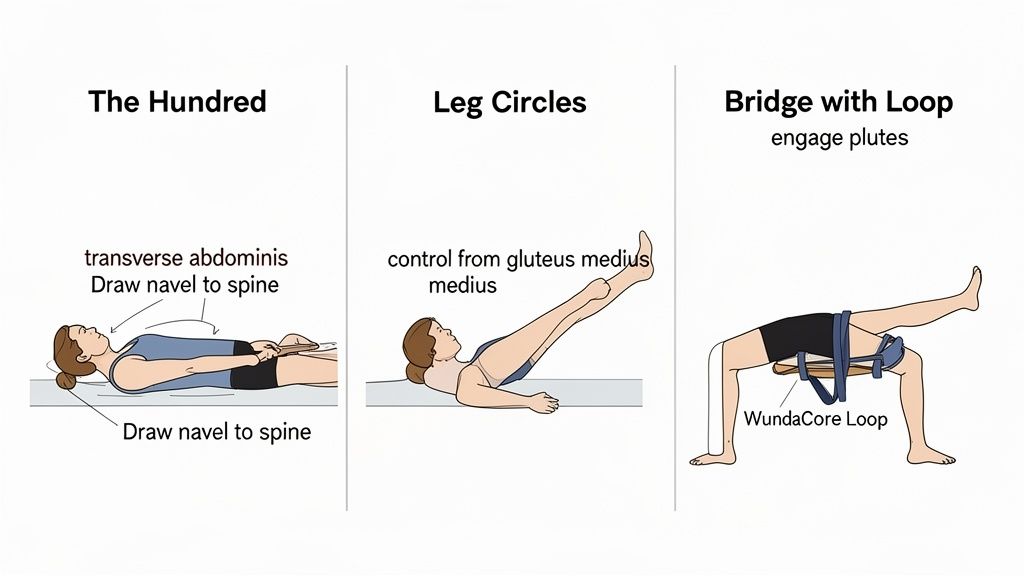
The Hundred: Engaging the Transverse Abdominis
The Hundred is a Pilates signature, but it’s often rushed through with more momentum than control. The real goal here is to challenge your deepest core muscle, the transverse abdominis (TVA). Imagine your TVA as your body’s own internal weight belt; it wraps around your torso and is the absolute key to stabilizing your lower back.
When you lift your head and shoulders off the mat, the common tendency is to push the abs outward, creating a "doming" effect. This puts unnecessary pressure on your linea alba and signals that your superficial ab muscles are taking over. To do it right, the entire focus should be on drawing your navel inward toward your spine.
- Anatomical Cue: Before you even think about pumping your arms, take a full exhale and feel your lower belly gently pull in and up. That’s your TVA firing up.
- Common Error: The lower back arches off the mat.
- Simple Fix: Instead of extending your legs straight out, bend your knees into a tabletop position. This takes the strain off your hip flexors and makes it much easier to keep your lower back connected to the mat, ensuring your TVA is doing the work.
Leg Circles: Controlling with the Gluteus Medius
Leg Circles are fantastic for hip mobility and stability, but only if the movement comes from the right place. The whole point is to isolate movement at the hip joint while keeping your pelvis completely still. This takes a strong and active gluteus medius, a critical stabilizing muscle on the side of your hip.
So many people make the mistake of using their quads or hip flexors to swing the leg around, which causes the pelvis to rock side to side. When you consciously engage that gluteus medius, you create a stable anchor, allowing the leg to circle smoothly from the hip socket.
The stillness of your pelvis is the true indicator of core control during Leg Circles. A stable pelvis means your deep abdominal and gluteal muscles are working in concert to support the movement, which is the essence of Pilates.
A great way to feel this connection is to use a prop like the WundaCore Loop around your thighs during some pre-workout bridges. This helps "wake up" the outer thighs and glutes, making that mind-muscle connection for stable Leg Circles much easier to find.
Bridging: Articulating the Spine
Bridging is so much more than a glute exercise. It’s a masterclass in spinal articulation and posterior chain activation. The goal is to peel your spine off the mat one bone at a time, starting from your tailbone and rolling all the way up to your shoulder blades. This demands a coordinated effort from your glutes, hamstrings, and deep core.
Anatomy in Action During a Bridge:
- Initiation: The movement starts with a posterior pelvic tilt, using your lower abdominals to press your lumbar spine flat into the mat.
- Lift-Off: The gluteus maximus and hamstrings fire up to lift your hips toward the ceiling.
- Stabilization: At the top, your glutes and core must work together to keep your low back from arching and your ribs from flaring out.
People are catching on to the benefits of this kind of joint-friendly, posture-improving exercise. The home Pilates reformer market is projected to grow from $628.88 million in 2025 to a staggering $1,107.25 million by 2032. This isn't a coincidence; it’s driven by a huge consumer shift, with over 70% now prioritizing low-impact workouts. Better yet, research shows a consistent Pilates practice can lead to 20–30% gains in core strength in just eight weeks.
Understanding the anatomy is your first step to a more intelligent practice. To see exactly how to put these principles into action, check out our guide on Pilates reformer beginner exercises for more detailed instruction. When you focus on these details, your at-home workouts will feel safer and deliver much more profound results.
Taking Your At-Home Practice to the Next Level
Once you've really connected with your deep core and you understand the why behind those foundational movements, you can start layering in more complexity. Advancing your reformer Pilates at home workout isn’t about jumping to the craziest-looking exercise you've seen online. It's about asking your body to hold everything stable while you introduce a bigger challenge. This is how we progress intelligently and safely.
True advancement means that every single progression asks more of your stabilizing muscles. As you start moving your limbs, changing your base of support, or adding more resistance, your core has to fire up even more to keep your torso rock-solid and your spine in a happy, neutral position. It's a constant dialogue between finding strength and maintaining control.
From Plank to Pike: Powering Up Your Abs
Let’s look at a classic plank. It's an exercise that already demands a ton of core endurance. To level this up into a 'Plank to Pike,' you’re adding a dynamic and seriously challenging movement that lights up your abdominals while testing that deep core stability we've been building.
Here’s what’s happening in your body:
- The Plank: In your plank, your deep core (transverse abdominis), obliques, and back muscles are all working together to hold your spine long and straight. Your glutes are firing to keep your hips from dipping. It’s a full-body effort.
- The Pike: As you lift your hips up to the sky, the focus shifts. Your rectus abdominis (the "six-pack" muscle) and obliques contract hard to pull your ribcage and pelvis toward each other.
- The Control: The real magic happens on the way back down. This slow, controlled lowering is where your deep core has to work overtime to stop your low back from arching. That control is everything.
The goal isn't just to get your hips high. It's to do it without losing the stability in your shoulders or the length in your spine. It takes serious focus and precision.
Challenging Your Upper Body with Resistance
Progressions aren't just for your core; they're vital for building balanced strength everywhere, especially in your upper back. An exercise like 'Chest Expansion' becomes a game-changer for posture when you add resistance, forcing those back muscles to really wake up and work.
Using a tool like the WundaCore Resistance Ring brings in tension that feels a lot like the springs on a reformer. When you hold the ring and press outward while keeping your posture tall, you're directly challenging the muscles that control your shoulder blades.
Here’s the breakdown for Chest Expansion:
- Rhomboids and Middle Traps: These are the muscles right between your shoulder blades, and they do the heavy lifting here, pulling your shoulder blades in toward your spine.
- Lower Traps: This is a key postural muscle that often gets lazy. It helps pull your shoulder blades down, keeping them from creeping up toward your ears.
- Core Connection: Your abs have to stay engaged the whole time to keep your ribs from flaring out as your arms press back.
Advancing your practice is all about layering complexity on top of stability. You must be able to hold your center before you can safely challenge your periphery. It’s this principle that prevents injury and builds deep, functional strength.
The demand for this kind of smart, progressive workout is a huge reason why at-home Pilates is booming. We’re seeing studio trends move right into our living rooms. In fact, 38% of Reformer Pilates studio owners are planning to expand, but with 46% of them struggling with instructor shortages, more and more people are looking for high-quality at-home options to keep their practice going. You can discover more insights about these studio trends and see how the industry is shifting.
Moving in Multiple Directions
The ultimate progression is getting your body to move through different planes of motion all at once. Life isn't linear, so why should your workouts be? Think about an exercise like a 'Side Bend' or 'Mermaid'—it challenges your body in the frontal plane, moving from side to side.
When you do a Side Bend, you're not just getting a nice stretch. You're actively asking one side of your body to lengthen while the other side contracts to support you.
- Lengthening Side: Your lats and obliques on the top side get a fantastic opening.
- Contracting Side: The obliques and deep back muscles on the bottom side are working hard to control the movement and support your spine.
When you add a reach or a twist to that Side Bend, you bring in the rotational plane, asking even more from those deep core stabilizers. These kinds of integrated movements build real-world strength that helps you move through your day with more ease and grace, making your reformer Pilates at home workout a truly functional practice.
Sample Workouts for Your Real Life Schedule
When it comes to seeing real results from Pilates, consistency beats intensity every single time. The real secret to building that deep, foundational strength is finding a routine that actually fits into your life. To take the guesswork out of it, I’ve put together three of my favorite anatomy-focused plans, designed for different schedules and energy levels.
Each of these workouts is intentionally sequenced to properly warm up your body, fire up that deep core, and finish with movements that leave you feeling both strong and centered. It’s also worth remembering that what you eat can make a huge difference in your performance—knowing the best foods to eat before your workout can give you the focused energy needed to really connect with your muscles.
The 20-Minute Core Activation
This is my go-to for a busy morning. It’s perfect for waking up your body and setting your core for the day ahead. The goal here is precision and deep muscle connection, not speed.
-
Warm-Up: Spinal Articulation
- Cat-Cow: 10 reps to gently wake up the entire spine and start engaging the abdominals.
- Pelvic Curls: 15 reps to activate the glutes and hamstrings while articulating the lower back.
-
Core Work: Engagement Sequence
- The Hundred (modified): 10 full breath cycles. This is all about targeting the deep transverse abdominis for true core stability.
- Dead Bugs: 10 reps per side. A fantastic exercise for challenging pelvic stability and coordinating your core with your limbs.
- Plank Hold: Hold for 30-45 seconds. Focus on building that isometric strength through your entire core, including your obliques and back.
-
Cool-Down: Release & Lengthen
- Kneeling Hip Flexor Stretch: Hold for 30 seconds per side to release that tension in the front of your hips.
- Child's Pose: 5 deep, calming breaths to gently stretch the low back.
The 30-Minute Full Body Flow
When you have a bit more time on your hands, this workout is designed to integrate the whole body, building strength and improving coordination from head to toe. It’s built to flow smoothly from one movement to the next, challenging both your muscular endurance and control.
-
Warm-Up: Dynamic Movement
- Spinal Roll Downs: 5 reps to articulate the spine and warm up the entire back of your body.
- Leg Swings (forward and side): 10 in each direction, per leg, to mobilize your hip joints.
-
Main Work: Strengthening Series
- Bridging with WundaCore Loop: 15 reps. This really fires up the glutes and hamstrings while the loop adds a challenge for your inner and outer thighs.
- Leg Circles: 8 circles in each direction, per leg. The key is keeping the pelvis completely stable while mobilizing the hip.
- Side-Lying Leg Lifts with Loop: 15 reps per side to isolate and strengthen that all-important gluteus medius.
- Chest Expansion with Ring: 12 reps to engage the postural muscles between your shoulder blades.
-
Finishing Sequence
- Mermaid Stretch: 3 beautiful reps per side to lengthen the side body.
- Full Body Stretch: Hold for 30 seconds, releasing any lingering tension.
The real magic of a full-body workout is the seamless transition between exercises. That continuous flow doesn't just save time; it keeps your heart rate slightly elevated, turning your strength session into a much more dynamic experience.
The 45-Minute Advanced Sculpt
This one’s for when you’ve nailed the fundamentals and you’re ready to seriously challenge your strength, stability, and endurance. We’re introducing more complex movements here that demand a high degree of core control and full-body integration. If you love this style and are looking for more guided sessions, exploring virtual Pilates classes is a great next step for real-time feedback and motivation.
| Sequence | Exercise | Repetitions / Duration | Primary Anatomical Focus |
|---|---|---|---|
| Warm-Up | Spine Twist Supine | 8 reps per side | Obliques, spinal rotators |
| Single Leg Stretch | 10 reps per side | Transverse abdominis, hip flexors | |
| Challenge | Plank to Pike | 10 reps | Rectus abdominis, obliques, shoulder stabilizers |
| Teaser (prep or full) | 8 reps | Deep core, rectus abdominis, hip flexors, quads | |
| Side Bend with Rotation | 5 reps per side | Obliques, serratus anterior, latissimus dorsi | |
| Cool-Down | Figure Four Stretch | 30 seconds per side | Glutes, piriformis |
| Hamstring Stretch | 30 seconds per side | Hamstrings, calves |
Your Top Questions About At-Home Reformer Workouts
Jumping into a reformer pilates at-home workout is an amazing feeling, but it’s totally normal to have questions. You want to make sure you're investing your time and energy wisely and, most importantly, moving safely. Let's dig into some of the most common questions I hear from clients.
My philosophy is all about building a sustainable practice that truly nourishes your body, so getting the "why" behind the "what" is everything.
Can At-Home Props Really Match a Studio Reformer?
Yes, they absolutely can. It's a huge misconception that the results only come from a big, pricey machine. The real magic of a reformer workout lies in the consistent, spring-like resistance that challenges your muscles through their entire range of motion.
Intelligently designed props, like the WundaCore Resistance Ring and Loop, are engineered to mimic that exact kind of constant, controlled tension. When you focus on the same core anatomical principles—deep core activation, a stable pelvis, and precise form—you can get profound results. It's not about the size of the equipment; it’s about the quality of your engagement with it.
The heart of any reformer workout is controlled resistance that forces your deep stabilizing muscles to fire. Whether that resistance comes from a $5,000 machine or a well-designed prop is secondary to your focus on form and that deep muscular connection.
When you maintain that focus, you'll build the same foundational strength, improve your flexibility, and enhance your posture, all from your own living room.
How Often Should I Practice to See Results?
Consistency is always going to beat sporadic, super-intense sessions. To see and feel real improvements in core strength, muscle tone, and your overall body awareness, I recommend aiming for two to three focused sessions per week.
Because this style of movement is low-impact and anatomy-informed, you can often practice more frequently without the risk of burnout or injury that comes with other workouts. Think of it as building strength from the inside out.
A dedicated 20-minute session three times a week will give you far better, more lasting results than one grueling hour-long workout that leaves you sore for days. The key is to build a rhythm that feels good and sustainable for your body.
Is This Workout Safe with Back Pain or During Menopause?
In many cases, yes—this method is not only safe but often highly recommended for both. The strong emphasis on engaging the deep core muscles, especially the transverse abdominis, essentially creates a natural corset of support around your lower back. For many types of non-acute back pain, this improved stability can bring significant relief.
For women navigating menopause, the benefits are huge:
- Bone Density: Working with resistance provides a gentle but effective load on your bones, which is crucial for supporting bone density.
- Joint Health: The low-impact nature of the work protects your joints while strengthening all the supporting muscles around them. This improves overall joint stability and function without the harsh impact.
That said, it is always essential to listen to your body’s signals. If you have any pre-existing conditions, please chat with a healthcare professional before starting something new. Your practice should always feel supportive and empowering, never painful.
Ready to build a stronger, more connected body right from home? The WundaCore collection, designed by celebrity trainer Amy Jordan, brings this anatomy-focused, reformer-style workout to you.