
Core Stability Exercises for a Stronger, More Resilient Back
When you hear "core stability," you might picture endless crunches targeting the superficial "six-pack" muscles. But true functional strength originates much deeper. Real core work is about strengthening the intricate system of internal muscles that support your spine, acting like a dynamic, anatomical corset for your entire torso. These exercises aren't about intensity; they're all about precise muscular control.
Understanding Your True Core Anatomy
To build a strong, resilient midsection, you must first understand its architecture. It has very little to do with the rectus abdominis, the most visible abdominal muscle. Instead, it’s about activating a deep, stabilizing system of muscles that protect your spine and create a rock-solid foundation for every single move you make.
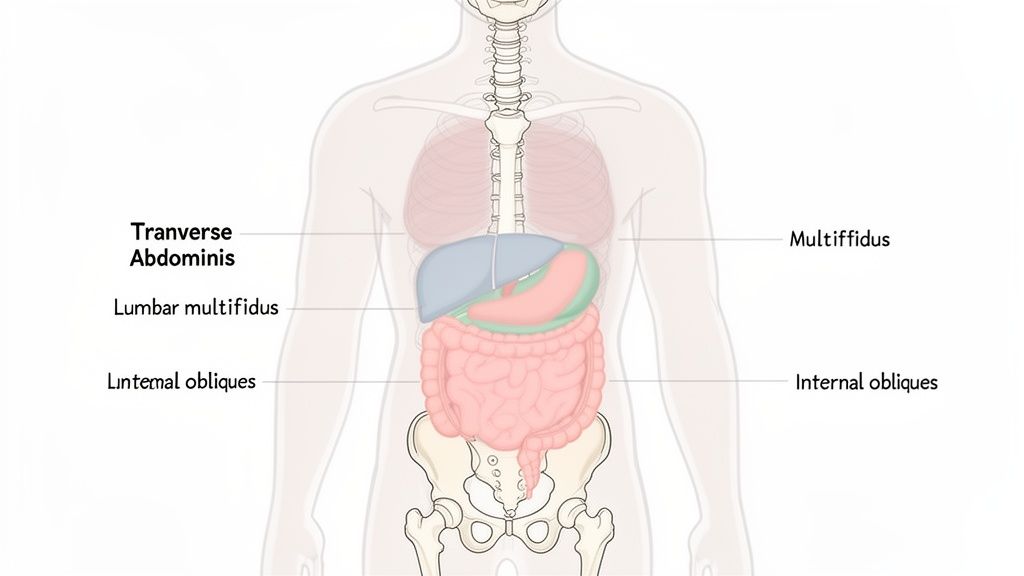
This internal support system is a team of synergistic muscles working together to provide stability from the inside out. Let’s get to know these key anatomical players.
The Deep Stabilizing Muscles
The muscles that truly matter for stability are hidden deep within your torso, working in perfect concert to create intra-abdominal pressure and spinal stiffness.
- Transverse Abdominis (TrA): This is your deepest abdominal muscle. Its fibers run horizontally, wrapping around your torso like a girdle. Its primary function is to contract and cinch the waist, creating tension that stabilizes the lumbar spine and pelvis before you even initiate movement.
- Lumbar Multifidus: These are small but powerful muscles that attach directly to the vertebrae of your spine. Think of them as fine-tuners, providing segmental stability to each individual vertebra, protecting your spinal discs from shearing forces during rotation and flexion.
- Internal Obliques: Tucked under the external obliques, these muscles have fibers that run diagonally upward. While they assist in rotation and side-bending, they also play a vital role in co-contracting with the TrA to secure your entire midsection.
Together, these muscles—along with your pelvic floor at the bottom and the diaphragm at the top—form a pressurized muscular canister. This is the anatomical secret to genuine core stability, and it’s a world away from just chasing a six-pack.
The Deep Core System vs Superficial Abs
It's crucial to understand the anatomical and functional difference between the muscles you see (global movers) and the muscles that truly support you (local stabilizers).
| Muscle Group | Primary Function | Best Activated By |
|---|---|---|
| Deep Core System (Stabilizers) | Segmental spinal stabilization, postural control, creating intra-abdominal pressure | Controlled breathing, pelvic tilts, bird dog, side plank |
| Superficial Abs (Movers) | Trunk flexion, gross rotation, force generation | Crunches, Russian twists, leg raises |
Focusing only on the superficial abs without training the deep core is like building a house on a shaky foundation. It might look good, but it lacks the structural integrity to be strong or resilient.
Activating the Right Muscles
So why do so many traditional ab workouts fall short? Because they almost exclusively target the rectus abdominis—the "six-pack" muscle. It's a powerful spinal flexor, but it does very little to actually stabilize the individual segments of the spine.
Core stability exercises, on the other hand, are designed with specific cues to innervate that deep system. This isn't a new idea; the foundational concepts were being developed back in the late 1960s. Modern research just keeps proving its efficacy.
For example, an ultrasound study of 44 healthy adults found that exercises like the bird dog and side plank, when done with a gentle "hollowing" of the stomach (drawing your navel toward your spine to engage the TrA), created the biggest increase in Transverse Abdominis thickness. This subtle contraction was far more effective at isolating the TrA than traditional abdominal bracing.
This proves that how you perform the exercise matters just as much as what you're doing.
This anatomy-first approach is exactly why practices like Pilates are so effective. You can learn more by checking out our guide on what muscles Pilates works. Once you understand how these muscles function as a cohesive system, you're on your way to building a stronger, more resilient body from the inside out.
Mastering Foundational Core Stability Exercises
Now that you have a clearer anatomical map of your deep core, let's put that knowledge into action. Truly effective core stability work isn't about crunches or speed. It’s all about precision, control, and a mindful connection to the specific muscles you’re targeting. The real goal is to fire up those deep stabilizers—like the transverse abdominis and multifidus—that act as your body's own internal corset.
This all starts by mastering the foundational "hollowing" technique. Before you begin, take a gentle exhale and feel your navel draw softly in and up toward your spine. This is a direct cue to contract the transverse abdominis, creating the foundational stability you need to train effectively and safely.
The Foundational Movements for Core Control
Let's walk through three of the most effective exercises for building core stability. Remember, the mantra here is quality over quantity. Focus on perfect form to ensure the correct muscles are firing.
1. The Dead Bug
This is an absolute powerhouse for teaching your core to maintain a stable lumbopelvic region while your limbs move. It challenges the core to resist extension forces on the spine.
- How to do it: Lie on your back and bring your legs into a "tabletop" position—knees bent, femurs perpendicular to the floor. Reach your arms straight up. On an exhale, use that hollowing cue to engage your TrA, then slowly lower your opposite arm and leg toward the floor. Only go as low as you can without your lumbar spine arching. Inhale as you return to the start, then switch sides.
- What to watch for: The most common mistake is anterior pelvic tilt, causing the lower back to lift. The second you feel that arch, you've lost the TrA engagement and the rectus abdominis or hip flexors have taken over.
- Make it your own: If maintaining a neutral spine feels tough, just start by moving your legs. Looking for more of a challenge? Try holding a light weight or a WundaCore Resistance Ring between your hands.
2. The Bird Dog
The Bird Dog challenges core stability in a quadruped position, forcing your core muscles, particularly the multifidus and obliques, to fight against spinal rotation.
- How to do it: Start on your hands and knees (quadruped), with your hands directly under your shoulders and knees under your hips. Brace your core to create a flat, stable back. Extend one arm straight forward and the opposite leg straight back, keeping your hips and shoulders perfectly square to the floor. Hold for a moment, then return to the starting position with control.
- What to watch for: Avoid lumbar extension (arching the back) or lateral pelvic shifts. The movement should be isolated to the shoulder and hip joints, with the spine remaining rigid and neutral.
- Make it your own: If you're just starting, you can extend just a leg or just an arm at a time. To progress, you can place a resistance loop around your feet to challenge the gluteus medius and deepen the anti-rotation work.
The Essential Side Plank
For targeting the lateral stabilizers like the obliques and quadratus lumborum (QL), nothing beats the Side Plank. These muscles are absolutely critical for frontal plane stability and protecting your spine from lateral flexion forces.
A strong core is the foundation that allows us to safely maximize our potential when it comes to strength, endurance, and flexibility. That's why it's called the core.
– Marissa Showers, PT, DPT
To set up, lie on your side with your elbow directly beneath your shoulder. You can stack your feet or, for a more stable base, place your top foot on the floor in front of the bottom one. Lift your hips, creating one long, straight line from your head to your feet. Hold it right there, breathing steadily.
A common pitfall is letting the hips sag toward the floor, which indicates fatigue in the obliques or QL. To fix this, think about actively pressing your bottom hip up toward the ceiling. If a full plank is too much, perform it with your bottom knee on the floor to shorten the lever.
A similar movement that builds incredible posterior chain and core stability is the Shoulder Bridge. For a complete breakdown, check out our guide to the Shoulder Bridge exercise on the blog.
If you have a real passion for helping people master these kinds of foundational movements, a career in fitness might be a great fit. You can find excellent guidance on becoming a personal trainer to see what it takes to turn that passion into a profession.
Building a Resilient Back and Improving Posture
One of the greatest benefits of a stable core is a healthy, pain-free back. The link between core stability and relief from non-specific low back pain is well-established, and it all comes down to neuromuscular control. When you strengthen muscles like the transversus abdominis and multifidus, you're literally building a natural, dynamic brace around your lumbar spine.
This internal support system works to reduce aberrant joint motion and excessive compressive loads on your intervertebral discs. Think about lifting a heavy bag or sitting at a desk; a strong core engages automatically to maintain a neutral spine, shielding it from poor biomechanics. It’s this constant, subtle stabilization that prevents the micro-traumas that can accumulate into chronic pain.
How a Stable Core Protects Your Spine
Picture your spine without muscular support—it would be an inherently unstable column of vertebrae. Core stability exercises train your central nervous system to activate this deep muscular corset before you even move. This anticipatory action, known as feedforward control, provides a solid base before you lift, twist, or bend, and it's what separates a resilient back from one prone to injury.
Core strengthening is an important part of any exercise routine, as it allows us to maintain an active and independent lifestyle, while preventing injury.
This is exactly why these exercises are so effective. In one study, patients with non-specific low back pain followed a four-week protocol focused on core stability. The results? Significant improvements in balance, proprioception (joint position sense), and even the cross-sectional area of key stabilizing muscles. It’s a clear demonstration of how targeted training directly enhances the anatomical structures that support spinal health.
This simple visual flow shows a few foundational movements that build this essential support.
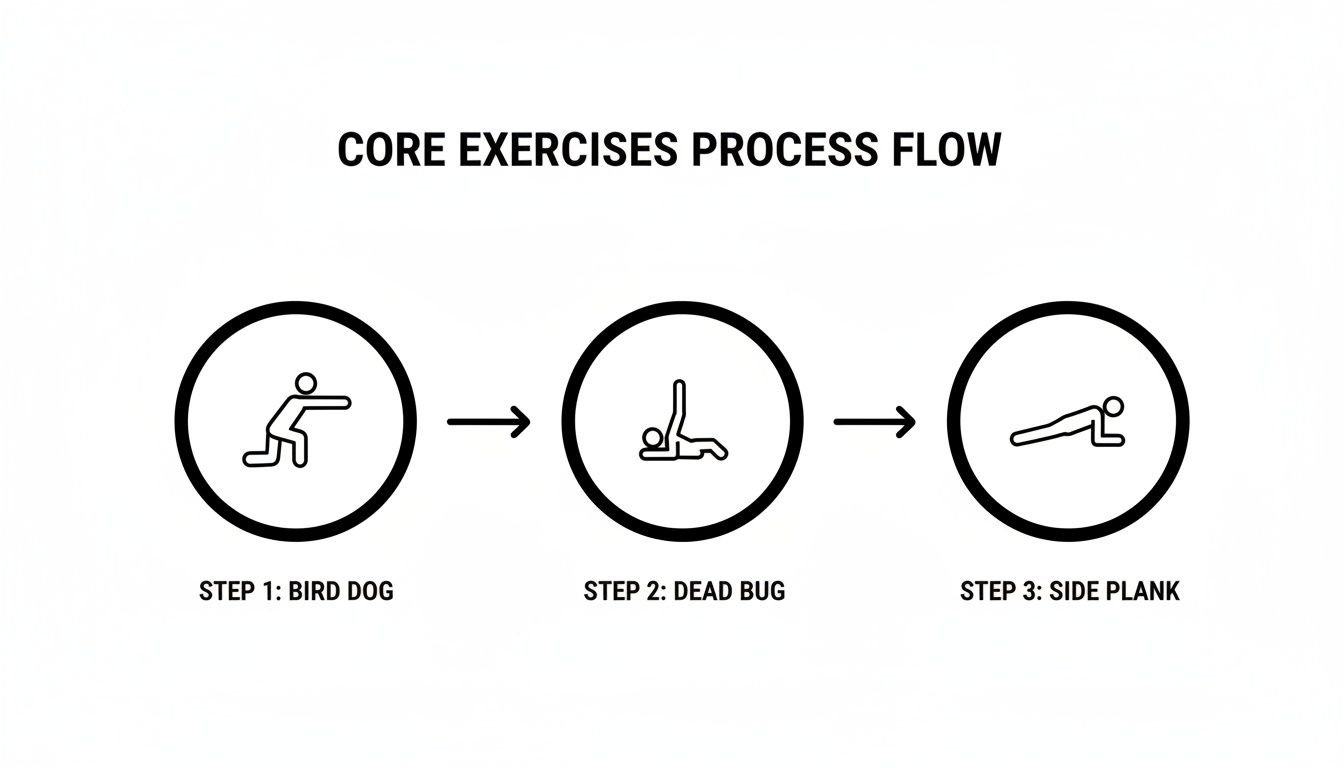
The sequence here—from Bird Dog to Dead Bug to Side Plank—is designed to progressively challenge your core's ability to resist extension, rotation, and lateral flexion, all while maintaining a neutral spine. They look simple, but they are neurologically and anatomically profound.
Standing Taller with Better Posture
Beyond back health, a strong core is the anatomical secret to better posture. It works by creating a stable anchor for both your pelvis and your ribcage, preventing postural faults like anterior pelvic tilt or excessive thoracic kyphosis (slumping). A well-supported core helps you stand taller and move with greater efficiency.
When your pelvis and spine are properly aligned, it's not just about how you look. It allows your entire kinetic chain to function more efficiently and reduces unnecessary wear and tear on your joints. For a deeper look at this connection, check out our article on Pilates and posture.
And if you’re looking for a great complementary practice to strengthen your back, consider incorporating specific yoga poses for lower back pain relief.
How Core Stability Prevents Injury and Enhances Balance
Think of your core as your body’s anatomical center of mass. A stable core is the anchor that prevents injuries from the ground up by providing a fixed point for your limbs to move around. This is all connected through a fascinating process called feedforward neuromuscular control.
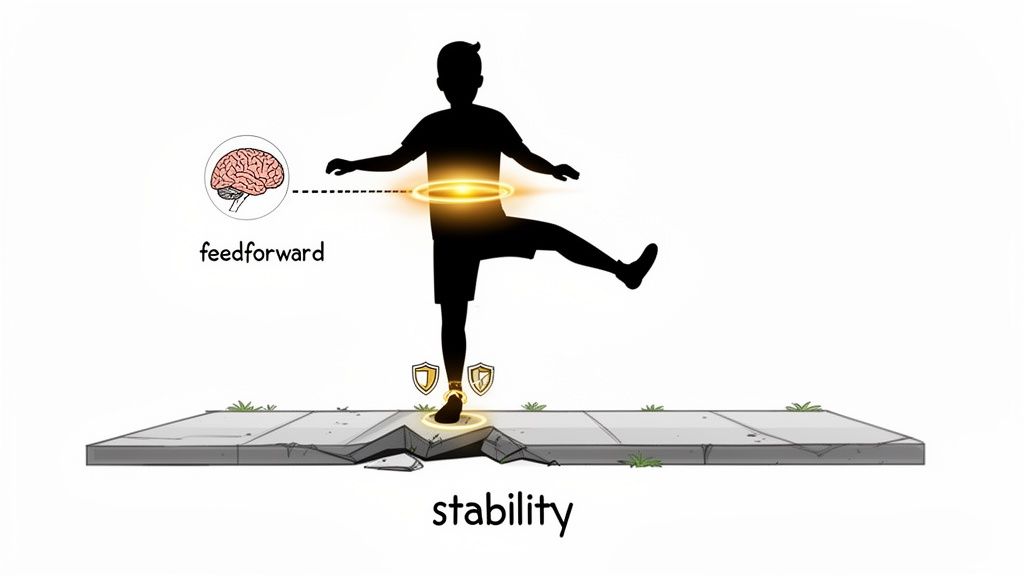
Simply put, it’s your brain’s predictive power. Before your foot even touches the ground, your brain anticipates the movement and sends a signal to your deep core muscles (like the TrA) to contract. This creates a rigid torso, providing a solid foundation that protects the entire kinetic chain, all the way down to your feet.
The Brain-Body Connection in Action
This feedforward system is working all the time, subconsciously. When you walk across an uneven sidewalk, your core engages instantly to stabilize your pelvis and prevent a fall. When you’re performing a single-leg squat, it’s that core stability that prevents hip drop (Trendelenburg sign) and subsequent knee valgus (knock-knees).
Without this automatic stabilization, the joints in your lower body would be forced to handle unstable, excessive loads. That is a direct biomechanical pathway to sprains and strains.
If your core is weak, this entire system becomes delayed and inefficient. The signal to stabilize is late, leaving your joints vulnerable. This is precisely why a consistent routine of core stability exercises is so critical—it sharpens that crucial neuromuscular communication, making your movements safer and more efficient.
A stable core acts as a powerful shock absorber, distributing forces evenly throughout the body instead of allowing them to concentrate in vulnerable joints like the ankles and knees. This preventative action is the key to long-term joint health.
Protecting Your Lower Body
The link between core stability and lower-limb injuries is well-documented in sports medicine. Take functional ankle instability (FAI), a condition affecting 32-47% of people with a history of ankle sprains. Studies have shown that adding core stability work to traditional therapy dramatically improves both static and dynamic balance for people with FAI.
In one six-week trial, participants who performed core exercises showed significant improvements in balance tests compared to those who just did conventional therapy. This is that feedforward mechanism in action: recruiting the deep abdominal muscles directly enhances your postural control and distal joint stability. You can dive deeper into these balance and ankle stability findings if you're curious.
So, when you train your core, you're doing so much more than building a strong midsection. You're building a smarter, more reactive neuromuscular system that keeps your entire body safe and balanced.
Your Weekly Core Stability Training Plan
Understanding the anatomy and biomechanics of core stability is one thing. Turning that knowledge into a consistent practice is where you create real neuromuscular change. This is how you build lasting strength and resilience—not through exhaustion, but through mindful, repeated effort that strengthens neural pathways.
When it comes to deep core work, consistency always wins over intensity. Aim for three to four sessions per week on non-consecutive days. This gives your local stabilizer muscles the perfect rhythm of stimulus and recovery, allowing them to adapt and get stronger without becoming fatigued. A focused, 15-minute session done with precision is far more powerful than a grueling hour-long workout done with poor form.
Foundational Routine for Beginners
This 15-minute routine is your starting point. The goal is simple: build a strong mind-muscle connection and master the fundamentals of lumbopelvic control. Forget about speed or reps—focus entirely on the sensation of your deep abdominals engaging.
- Pelvic Tilts: 60 seconds. Lie on your back, knees bent. On your exhale, gently create a posterior pelvic tilt. On your inhale, release back to a neutral spine.
- Dead Bug: 3 minutes. The key here is slow, controlled reps. Your priority is keeping your pelvis and lumbar spine stable against the mat.
- Bird Dog: 3 minutes. Move with intention. The goal is to resist rotation through the thoracic and lumbar spine.
- Side Plank (on knees): 60 seconds per side. Keep those hips lifted high, engaging the lateral stabilizers like the obliques and gluteus medius.
- Glute Bridge: 3 minutes. Squeeze your glutes to lift your hips, creating a straight line from your shoulders to your knees. Avoid hyperextending the lumbar spine.
This sequence teaches your core its most important job: protecting your spine. Listen to your body and don’t be afraid to rest when you need to.
Advanced Routine with Props
Ready to level up? This routine brings in props like the WundaCore Resistance Ring and Loop to add targeted challenges and recruit more muscle fibers.
"Good form truly makes a difference to get the most out of your workout and avoid injury, focusing on an active core with each exercise is a great place to start."
– Marissa Showers, PT, DPT
This session builds on the stability you’ve already established, adding new layers of neuromuscular challenge.
Here’s a sample routine for those ready for more. It’s a fantastic way to integrate tools to deepen the work.
Sample 15-Minute Core Stability Routine
| Exercise | Duration or Reps | Progression Suggestion |
|---|---|---|
| Dead Bug with Ring | 3 minutes | Squeeze the Resistance Ring between your hands to create isometric contraction in the pectorals and serratus anterior, adding an upper-body stability challenge. |
| Bird Dog with Loop | 3 minutes | Place the Loop around your feet. The resistance as you extend your leg will challenge your glutes and anti-rotation core stabilizers even more. |
| Full Side Plank | 60 seconds per side | Maintain a perfectly straight line from head to heels. For an extra challenge, add a slow, controlled hip dip to challenge the obliques through a range of motion. |
| Glute Bridge March | 3 minutes | Hold a bridge and alternate lifting one foot off the floor at a time, fighting the rotational pull on the pelvis. |
This isn't about just going through the motions. Pay close attention to how the props alter the biomechanics and demand more from your stabilizers.
Finding Your Perfect Workout
These routines are excellent templates, but variety and progressive overload are what keep your body adapting long-term. To keep making progress, you need access to expertly designed workouts that evolve with you.
This is exactly where a library of guided classes becomes so valuable. With Wunda On Demand, you get access to hundreds of sessions designed by anatomy-focused experts. Whether you're a beginner who needs those crucial form cues or an advanced practitioner ready for a dynamic flow, there’s a class waiting for you. This is how you move beyond just reading about exercises and build a powerful, consistent practice that truly delivers results.
Your Top Core Stability Questions, Answered
Starting a new movement practice always brings up questions. Getting clear on the "why" and "how" behind core stability helps you train smarter, stay motivated, and achieve the desired anatomical adaptations. Let's dig into some of the most common ones.
How Long Does It Take to Feel a Difference?
This is usually the first thing people ask, and the answer is probably faster than you think. You'll likely feel a better neuromuscular connection to your deep core—that feeling of "turning on" the right muscles—within just a few sessions.
But what about measurable changes? Research shows that noticeable improvements in deep muscle thickness (hypertrophy), balance, and spinal control can occur in as little as four to six weeks of consistent training.
The secret is consistent, quality practice. Aiming for three to four times a week is a great goal. What matters most is your form. This is exactly why guided instruction is so powerful; it ensures you’re activating the correct deep muscles, like your transverse abdominis, from day one.
Can I Do Core Stability Exercises Every Day?
While you can (and should!) do gentle core activation exercises like pelvic tilts or diaphragmatic breathing every day, your more focused stability workouts require recovery. Think of these deep muscles like any other—they undergo micro-trauma during exercise and need time to repair and adapt to get stronger.
I always recommend aiming for three to five sessions per week. This schedule gives you the perfect balance of stimulus and recovery. On your days off, consider complementary activities like a good walk, some gentle stretching, or mobility work.
The most important rule? Listen to your body. If you’re feeling sore or fatigued, that's your cue to take a rest day. We're building sustainable, long-term strength here, not burning out.
What Is the Difference Between Core Stability and Core Strength?
This is a fantastic and crucial question. The two are related but describe different neuromuscular functions.
-
Core Strength is the ability of the "global" core muscles (like the rectus abdominis and external obliques) to generate force and create movement. It's about torque production, like when you flex your spine forward in a sit-up.
-
Core Stability is the ability of the "local" core muscles (especially the transverse abdominis and multifidus) to prevent unwanted movement at the spinal level. Their job is to create segmental stiffness and maintain a neutral spine against external forces.
Here's how I like to think about it: Stability is the rock-solid foundation that allows for the safe and powerful expression of strength. You need both for true functional fitness, but building that stable base first is non-negotiable for a strong, resilient body.
Ready to build a truly functional core with expertly guided workouts? WundaCore brings the anatomy-focused studio experience right to your home. Explore our patented equipment and start streaming hundreds of effective classes with Wunda On Demand.