
Master How Often You Should Do Pilates: An Anatomy-Focused Guide
For most people, the sweet spot for how often you should do Pilates is two to three times per week. That’s the magic number. It’s rooted in exercise science and the anatomical reality of your muscular system, striking the perfect balance between challenging your deep stabilizing muscles and giving them the crucial downtime they need to repair and strengthen.
Finding Your Ideal Pilates Frequency
Figuring out the right Pilates schedule for you isn't about chasing daily exhaustion. It's about working with your body's anatomy to help it adapt and strengthen in a sustainable way.
Pilates is uniquely designed to recruit the deep postural muscles that form your body's internal support system—a true muscular corset. This system, often called the "powerhouse," has a few key players:
- The transverse abdominis (TVA): The deepest of your six abdominal muscles, its fibers run horizontally around your torso, acting like a natural girdle to stabilize your lumbar spine and pelvis.
- The pelvic floor muscles: This group forms a hammock-like structure at the base of your pelvis, supporting your internal organs and co-contracting with the TVA to create intra-abdominal pressure.
- The multifidus: These small but powerful muscles attach directly to your vertebrae, providing segmental stability along the entire length of your spine.
- The diaphragm: The primary muscle of respiration, which works in synergy with the core to regulate pressure and stabilize the trunk.
These muscles are primarily composed of slow-twitch (Type I) muscle fibers, which are built for endurance and sustained contraction, not explosive power. They respond best to consistent, controlled work followed by adequate rest.
The Science of Muscular Adaptation
The principle of progressive overload is the foundation of building strength. It means you must consistently challenge your muscles beyond their current capacity. In Pilates, this is achieved not with heavy weights, but by increasing the precision of movement, challenging stability, and adding complexity.
A frequency of two to three sessions per week provides the ideal stimulus for these deep stabilizing muscles. This rhythm allows for the repair of microscopic tears in the muscle fibers (a process called muscle protein synthesis), which is what leads to tangible gains in strength, endurance, and motor control.
When you practice too often without rest days, you risk overtaxing these muscles and elevating cortisol levels, which can stall progress and lead to fatigue. Conversely, practicing too infrequently prevents the cumulative effect needed for lasting neuromuscular adaptation.
The two-to-three-day-a-week schedule respects this physiological reality. It creates a sustainable path to building a truly integrated core that transforms how you move, feel, and carry yourself every day.
To make it even clearer, here’s a quick-reference table to help you find the right starting point based on what you want to achieve.
Recommended Pilates Frequency Based on Your Goals
Use this table as a quick reference to determine how often to practice Pilates based on your primary wellness objective.
| Primary Goal | Recommended Frequency | Anatomical Focus and Rationale |
|---|---|---|
| General Fitness & Well-being | 2-3 times per week | This schedule builds foundational strength in the transverse abdominis, multifidus, and pelvic floor, improving posture by supporting the spine. It allows for adequate muscle recovery, ensuring consistent progress. |
| Athletic Cross-Training | 2 times per week | Athletes use Pilates to enhance core stability for power transfer and balance. It focuses on correcting muscular imbalances, such as strengthening weak gluteus medius muscles to prevent knee injuries. |
| Pain Relief & Rehabilitation | 1-2 times per week | For pain management, sessions focus on gentle spinal mobilization and strengthening supporting muscles (like the deep core) to offload stressed joints, often under professional guidance. |
| Stress Reduction & Mindfulness | 1-3 times per week | This frequency uses controlled breathing to engage the diaphragm, which directly influences the vagus nerve and helps shift the nervous system from a "fight-or-flight" to a "rest-and-digest" state. |
This table is your guide, but always remember the most important rule: listen to your body. It will always tell you what it needs.
Why Consistency Beats Intensity in Pilates
To truly understand how often you should do Pilates, we need to reframe the question. It’s not about "how much" but "how well." Pilates isn't about crushing yourself with high-intensity workouts; it's about building a smarter, more connected body by improving the communication between your brain and muscles.
Think of it as building the deep foundation of a skyscraper. You wouldn't pour all the concrete in one day. You pour it in careful, consistent layers, letting each one cure and strengthen. Your deep core muscles—the transverse abdominis, pelvic floor, and multifidus—are your body's foundation, and they require that same patient, steady approach to develop true stability.
Forging Stronger Neuromuscular Connections
Every Pilates session strengthens the communication between your central nervous system (your brain and spinal cord) and your muscular system. When you consciously engage your deep core to guide a movement, you're strengthening the neuromuscular pathways connecting them. These pathways are like neural highways—the more you use them, the more efficient they become.
With regular practice, your brain learns to automatically recruit these deep stabilizers not just during workouts, but in everyday life. This is why you might suddenly notice yourself sitting taller with your scapulae (shoulder blades) properly positioned or lifting groceries by engaging your glutes and core instead of your lower back.
Pilates isn't just exercise; it's neuromuscular re-education. You are rewiring your motor patterns for greater efficiency by strengthening the mind-muscle link, one precise repetition at a time.
This re-patterning is what creates lasting changes in your posture and movement. It doesn't happen with one intense workout a week. It happens through the cumulative effect of consistent practice that solidifies these new, healthier habits.
Respecting Your Body's Recovery Cycle
Strength isn't built during a workout; it's built in the recovery period that follows. Each time you challenge your muscles, you create microscopic tears in the muscle fibers. The magic happens when your body repairs those fibers, building them back slightly stronger. This process is known as muscle protein synthesis.
A schedule of two to three Pilates sessions a week fits perfectly into this natural physiological cycle of stress and adaptation. It gives your muscles enough stimulus to change but also allows the crucial 48 to 72 hours they need to fully recover and rebuild. This rhythm is the key to avoiding overtraining and making sustainable, long-term progress.
If staying on track feels like a struggle, looking into different ways to stay consistent with exercise can give you the blueprint you need. Ultimately, this approach lets you build a practice that feels smart, effective, and energizing—not draining.
Your Weekly Pilates Plan from Beginner to Advanced
Theory is great, but a practical plan makes things click. To get a real feel for how often you should do Pilates, let's walk through some tangible schedules for every experience level. These are designed to smartly weave Pilates into your week, challenging your body's muscular and nervous systems while giving them the recovery time they crave.
The goal is to progress from building foundational stability to achieving advanced, integrated strength. That journey starts by rewiring the communication lines between your brain, your nerves, and your muscles.
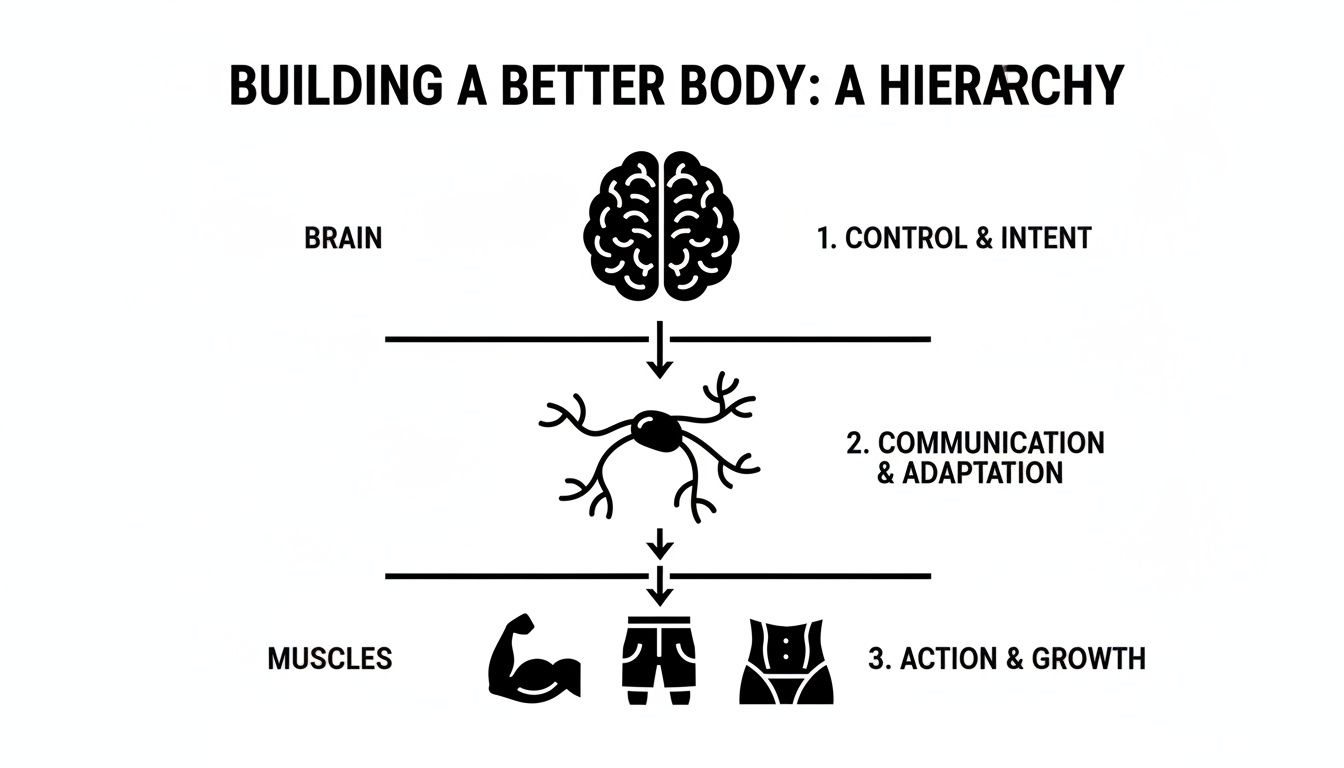
This really brings it home: true strength is a top-down system. Your brain sends the signal, your nerves carry the message, and your muscles execute with precision. That’s the neurological magic of Pilates.
Here are a few sample schedules to give you a clearer picture of what this looks like in a typical week.
Sample Weekly Pilates Schedules
This table shows how you can blend Pilates sessions with other activities and essential rest days as you move from a beginner to a more advanced practice.
| Day | Beginner Plan (2x/week) | Intermediate Plan (3x/week) | Advanced Plan (3-4x/week) |
|---|---|---|---|
| Monday | 45-min Pilates (Foundations) | 50-min Pilates (Full-body flow) | 50-min Pilates (Power and flow) |
| Tuesday | Active Recovery (Walk, stretch) | Other Activity (Strength training, run) | Other Activity (HIIT, heavy lifting) |
| Wednesday | Rest | Rest | 30-min Pilates (Precision/control) |
| Thursday | 45-min Pilates (Control) | 50-min Pilates (Obliques & back) | Rest |
| Friday | Rest | Active Recovery | 50-min Pilates (Full-body challenge) |
| Saturday | Other Activity (Light cardio, yoga) | 50-min Pilates (Dynamic flow with props) | Other Activity or Active Recovery |
| Sunday | Rest | Rest | Rest |
Remember, these are just templates! The best plan is the one that feels good for your body and fits realistically into your life. Now, let’s break down what each level is really focusing on.
H3: Beginner Schedule: Mastering the Foundations
When you're new to Pilates, the main job is to build that mind-body connection. You are learning to consciously recruit deep core stabilizers like the transverse abdominis and pelvic floor that your brain may have forgotten how to activate.
- Frequency: 2 sessions per week is the sweet spot.
- Focus: Mastering core principles—diaphragmatic breathing, maintaining a neutral pelvis, stabilizing the rib cage, and mobilizing the thoracic spine and shoulder girdle.
This isn’t about speed; it’s about precision. Two focused sessions a week give your nervous system enough repetition to learn these new motor patterns without feeling overwhelmed.
Intermediate Schedule: Building Complexity
Once you've established those foundational neuromuscular connections, it's time to build on them. The intermediate plan layers in more complex sequences that challenge your muscular endurance, coordination, and control. This is where you solidify those motor patterns and see visible changes.
- Frequency: 3 sessions per week works beautifully here.
- Focus: Creating flow between movements, building stamina in slow-twitch muscle fibers, and adding props like a resistance ring to challenge stability further.
This frequency hits the perfect balance between stimulus and recovery. In fact, research shows that a consistent schedule of two to three sessions per week delivers significant clinical benefits. Studies have found that doing Pilates just twice a week can lead to major reductions in low-back pain, with many people reporting a 30-50% pain reduction. If you want to geek out on the data, you can read more about how Pilates frequency impacts clinical outcomes.
Advanced Schedule: Challenging Your Control
For seasoned practitioners, the focus shifts from learning exercises to mastering them. The most challenging movements demand an incredible level of core strength, full-body integration, and precise control from both the nervous system and the muscular system.
- Frequency: 3-4 sessions per week is ideal.
- Focus: Executing the advanced repertoire with precision, moving through dynamic transitions seamlessly, and cultivating deep muscular endurance throughout the entire kinetic chain.
This higher frequency allows you to push your physical limits, but it’s still structured to respect your body's need to repair and get stronger. At this stage, you're not just working out—you're honing a deeply ingrained physical skill.
Listening to Your Body to Avoid Overtraining
More isn't always better. In Pilates, where mindful movement is the entire point, listening to your body's physiological signals is the most advanced skill you can develop. Real strength is built during rest and recovery. This allows you to decide how often to practice based on real-time biofeedback, not just a rigid schedule.
It’s absolutely critical to know the difference between healthy muscle soreness and the warning signals of overtraining. One is a sign of adaptation; the other is a sign of distress.
Soreness vs. Pain
Healthy muscle soreness, or Delayed Onset Muscle Soreness (DOMS), is a sign of muscle fiber remodeling. It typically appears 24 to 48 hours after a session and feels like a dull, diffuse ache in the muscles you challenged. This is the natural process of your muscles repairing and rebuilding stronger.
Pain from overtraining is different. It’s often sharp, localized to a specific joint or tendon, or persists for days without improving. This is your body's alarm system, signaling that a tissue is being stressed beyond its capacity to recover.
Your body communicates through sensation. The diffuse ache of DOMS is a productive echo of your workout. Sharp, joint-specific pain is a direct message that you need to modify your approach immediately.
Pushing through that kind of pain can lead to overuse injuries, central nervous system fatigue, and a frustrating plateau. True advancement comes from a sustainable practice that energizes you, not one that drains you.
Actionable Steps for Smart Recovery
When your body signals it needs a break, listening is the smartest thing you can do. This doesn't mean stopping completely; it means adjusting your approach to support physiological recovery while staying consistent.
Here are a few ways to respond when you feel fatigue or strain:
- Take an Extra Rest Day: This allows for complete muscle protein synthesis and hormonal rebalancing.
- Opt for Gentle Movement: Active recovery like a walk or gentle stretching increases blood flow to muscles, which can help clear metabolic byproducts and speed up recovery.
- Choose a Low-Intensity Class: A foundational or restorative session focuses more on diaphragmatic breathing and gentle joint mobilization, which can help down-regulate the nervous system without further taxing the muscles.
This mindful approach helps you build a healthier, more intuitive relationship with exercise, ensuring your Pilates practice remains a source of strength for years to come.
How to Pair Pilates with Other Workouts
Pilates doesn't exist in a vacuum. In fact, it's one of the best complementary practices for every other activity you love, making each one safer and more effective. From an anatomical perspective, Pilates trains the deep postural muscles that most traditional exercise misses, essentially upgrading your body’s internal support system.
Pilates for Weightlifters and Strength Athletes
Lifting heavy demands a rigid, stable trunk. Pilates zeroes in on the transverse abdominis—your body’s natural weightlifting belt—and the tiny multifidus muscles that provide segmental spinal support. Strengthening these creates a rock-solid core that can safely transfer force and handle heavy loads.
This deep core strength prevents "energy leaks," ensuring all your power goes into the lift. Pilates also improves hip mobility and thoracic spine extension, two anatomical prerequisites for a deep squat and a neutral spine during deadlifts. For a closer look, you can learn what specific muscles Pilates works.
Pairing Pilates with weightlifting is like adding a high-performance suspension system to a powerful engine. You build the control and stability to use raw strength without being sidelined by injury.
Schedule your Pilates on non-lifting days to allow both your central nervous system and major muscle groups adequate time to recover.
Pilates for Runners and Endurance Athletes
Running is a high-impact, repetitive motion. Without pelvic stability, you're at risk for common overuse injuries. Pilates directly addresses this by strengthening the gluteus medius and deep external rotators of the hip.
These muscles are key to maintaining a level pelvis, preventing the hip drop (Trendelenburg gait) that puts excessive strain on the IT band and knee joint. A stable pelvis means a more efficient gait and less stress on your joints.
- Scheduling Tip: A 30-minute mat session focused on glute activation and hip mobility is an excellent pre-run warm-up.
- Active Recovery: Use a gentler Pilates flow on rest days to release tight hip flexors (psoas and iliacus) and improve spinal mobility, helping your body recover faster.
Counteracting the Desk Job Posture
Prolonged sitting creates a predictable pattern of muscular imbalance: tight hip flexors and pectoral muscles, and weakened, lengthened glutes and rhomboids. This leads to that common rounded upper back (thoracic kyphosis) and is a recipe for chronic neck and low back pain.
Pilates is the perfect antidote. It systematically strengthens the entire posterior chain (glutes, hamstrings, and spinal erectors) while actively lengthening the anterior chain (chest and hip flexors). This rebalances the forces acting on your skeleton, coaxing your posture back into a more neutral, efficient alignment.
Building a Consistent At-Home Pilates Habit
The transformative power of Pilates lies in consistency. Building that rhythm at home is what truly changes your anatomy and movement patterns, making the question of "how often should I do Pilates?" a natural part of your weekly flow.
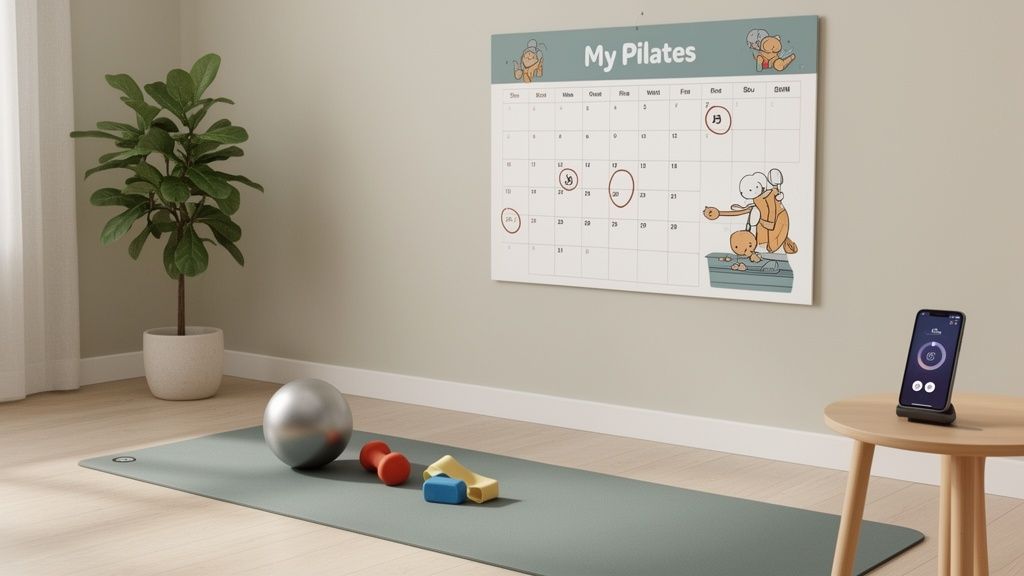
And if you're starting this journey, you're in great company. Nearly 12 million people in the U.S. practiced Pilates in 2023. That’s a 15% jump from the year before and the highest it's been since 2010. It’s clear that millions are finding a way to weave that two-to-three times a week habit into their lives.
Make Your Space Work for You
Your environment significantly impacts your motivation. You don’t need a dedicated studio—just a clean, inviting corner that signals to your brain, "it's time to move."
Keep your mat rolled out and equipment within arm's reach. When your gear is visible, you remove a major barrier to starting. For more ideas, check out our guide on setting up for Pilates at home.
Treat your Pilates sessions like non-negotiable appointments. Block the time in your calendar. This simple act of scheduling protects your time and reinforces your commitment.
Stay Accountable and Inspired
Consistency loves a system. Using one of the best free habit tracking apps can be a game-changer for visualizing your progress and staying on track.
Finally, avoid neuromuscular boredom. Mix up your routine. Try a shorter, more intense class one day and a longer, mobility-focused one the next. Focus on a new muscle group, like the obliques or shoulder stabilizers. Variety keeps things interesting and challenges your body in new ways, turning your fitness goals into a journey you enjoy.
Your Top Pilates Questions, Answered
As you deepen your practice, questions will arise. Getting clear answers helps you set realistic expectations and achieve the results you're seeking.
Can I Do Pilates Every Day?
While a gentle daily stretch is beneficial, the focused, strength-building work in Pilates requires recovery time.
Your muscles—especially deep stabilizers like the transverse abdominis and multifidus—need time for the repair process where strength is actually built. Pushing them every single day without a break can lead to overtraining and diminish your results.
That's why most seasoned instructors recommend 2 to 4 sessions per week. This frequency provides the ideal stimulus-to-recovery ratio, which is essential for seeing anatomical change and avoiding injury.
How Long Should a Pilates Session Be?
Most studio classes are 45 to 60 minutes long. This duration allows for a thorough warm-up to prepare the joints and muscles, a challenging full-body workout, and a cool-down to restore the nervous system.
However, consistency trumps duration. A high-quality, focused 20-30 minute session several times a week can be incredibly effective, especially when starting out. It's the precision of your movement and the quality of muscular engagement that deliver the benefits, not just the time on the mat.
How Long Until I See Results From Pilates?
There's a classic quote from Joseph Pilates: "In 10 sessions you'll feel the difference, in 20 you'll see the difference, and in 30 you'll have a whole new body."
Practicing consistently two or three times a week, you'll likely feel a difference in your body awareness and core connection within a few weeks. The visible changes—like improved posture and better muscle definition (especially in the abdominals and back)—tend to emerge after about 2 to 3 months. This is the point where the neuromuscular re-patterning has taken hold and your newfound core strength becomes second nature.
Ready to build a stronger, more connected body from the inside out? WundaCore brings the studio experience home with expertly designed equipment and on-demand classes that deliver real results. Discover our collection and start your journey today at https://wundacore.com.