
Level up your fitness: how to build lean muscle for women
If you want to build lean muscle, the formula is refreshingly simple. It comes down to three core principles working together: smart resistance training, strategic nutrition, and dedicated recovery. This isn't about endless hours in the gym; it's about applying specific mechanical tension to muscle fibers, providing the amino acids to rebuild them, and allowing the physiological repair processes to occur during rest.
It’s a powerful, sustainable blueprint that works with your female physiology, leveraging your body's innate anatomical strengths.
Your Blueprint for Building Lean Muscle
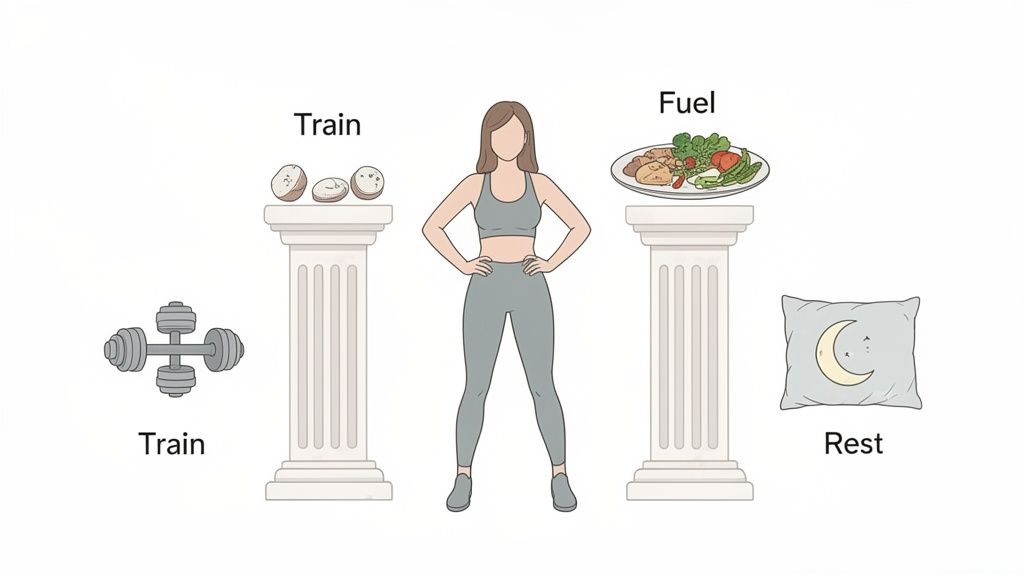
Let’s get one thing straight: lifting weights will not make you "bulky." That's an outdated myth rooted in a misunderstanding of female endocrinology. The real goal is to train smarter by understanding how female anatomy and physiology respond to mechanical stress. When you take an anatomy-informed approach, you realize that key hormonal differences and muscle fiber composition make women incredibly well-suited for building strong, functional muscle. You just have to know which physiological buttons to push.
This guide isn't about generic advice. It’s a clear roadmap built on three non-negotiable pillars. Think of these as the physiological foundation for creating the strong, lean physique you're working toward.
The Three Pillars of Female Muscle Building
Here’s a quick-glance table breaking down the three pillars. Understanding how they work together at a physiological level is the first step to seeing real, lasting results.
| Principle | What It Means | Why It's Essential for Women |
|---|---|---|
| Intelligent Resistance Training | Consistently applying targeted mechanical tension to your muscle fibers to stimulate a process called hypertrophy. | This is the "signal" that creates micro-tears in the muscle, initiating the cellular repair cascade that builds stronger, thicker muscle fibers. |
| Strategic Nutrition | Providing your body with the raw materials (especially protein-derived amino acids) needed to repair and rebuild muscle tissue. | You can't build something from nothing. Fuel ensures the satellite cells in your muscles can fuse with damaged fibers to make them larger and stronger. |
| Prioritized Recovery | Giving your body the downtime—especially through sleep—to repair tissues, regulate anabolic hormones, and solidify gains. | Growth doesn't happen in the gym; it happens during deep sleep when Human Growth Hormone (HGH) peaks and protein synthesis is optimized. |
Ultimately, this synergy is what creates lasting change. It's less about brute force and more about precision—stimulating specific motor units in the muscle, fueling cellular repair, and giving the endocrine system time to work.
An Anatomy-Informed Approach
Understanding your own physiology is your biggest advantage. For instance, research shows that women can match or even exceed men in relative muscle protein synthesis after a workout and a meal. Anatomically, women also tend to have a higher percentage of Type I (slow-twitch) muscle fibers, which are highly resistant to fatigue and respond exceptionally well to metabolic stress and higher-repetition training.
Even more interesting, women naturally produce about three times as much growth hormone as men—a key anabolic player in muscle adaptation. We're primed for this work.
Here’s what that looks like in practice:
- Most women aiming to build muscle see great results with 2–4 resistance sessions per week.
- To support that work, aim for 1.4–2.0 grams of protein per kilogram of body weight daily. This range is where studies show the availability of amino acids for muscle repair and growth is maximized.
This anatomy-aware perspective is woven into our entire approach. We'll focus on the principles of progressive resistance training, which allow you to challenge your musculoskeletal system safely and effectively. More importantly, we’ll break down the "why" behind each technique, so you feel empowered and in control of your journey.
Want a head start? You can learn more about progressive resistance training in our detailed guide to get familiar with the core concepts.
Training Based on Female Anatomy and Biomechanics
If you want to build lean muscle, your training needs to speak your body’s language. Forget generic, one-size-fits-all workout plans. We need to ground every movement in the reality of female anatomy and biomechanics, considering factors like our wider Q-angle (the angle of the femur relative to the pelvis) and natural joint laxity.
It all comes down to creating the right mechanical tension to ask your muscles to grow, then consistently increasing that demand over time.
This core principle is called progressive overload. It sounds technical, but it’s actually an intuitive physiological concept: to force an adaptation (muscle growth), the stimulus must exceed what the muscle is accustomed to. This prevents your neuromuscular system from hitting a plateau. It’s a gradual, intelligent process that makes strength gains feel achievable, not intimidating.
Making Progressive Overload Work for You
Progressive overload isn't just about grabbing a heavier dumbbell. It can take many different forms, all designed to increase the demand on the muscle fibers. The goal is always the same: consistently challenge your muscles to stimulate hypertrophy—the scientific term for an increase in the size of muscle cells.
Here are a few practical ways to apply this principle:
- Add More Resistance: This directly increases the mechanical tension on the muscle fibers, forcing more of them to be recruited for the lift.
- Do More Reps: Pushing for more repetitions increases the total time under tension and metabolic stress within the muscle, another key trigger for hypertrophy.
- Increase Your Sets: Adding another set increases the total training volume, a primary driver of muscle growth over the long term.
- Improve Your Form: Going deeper in your squat increases the range of motion, forcing muscles like the gluteus maximus to work harder through a longer path of contraction. It’s a powerful way to increase the challenge.
- Shorten Your Rest Time: Cutting rest periods increases metabolic stress by not allowing the muscle to fully recover its short-term energy stores, forcing it to adapt.
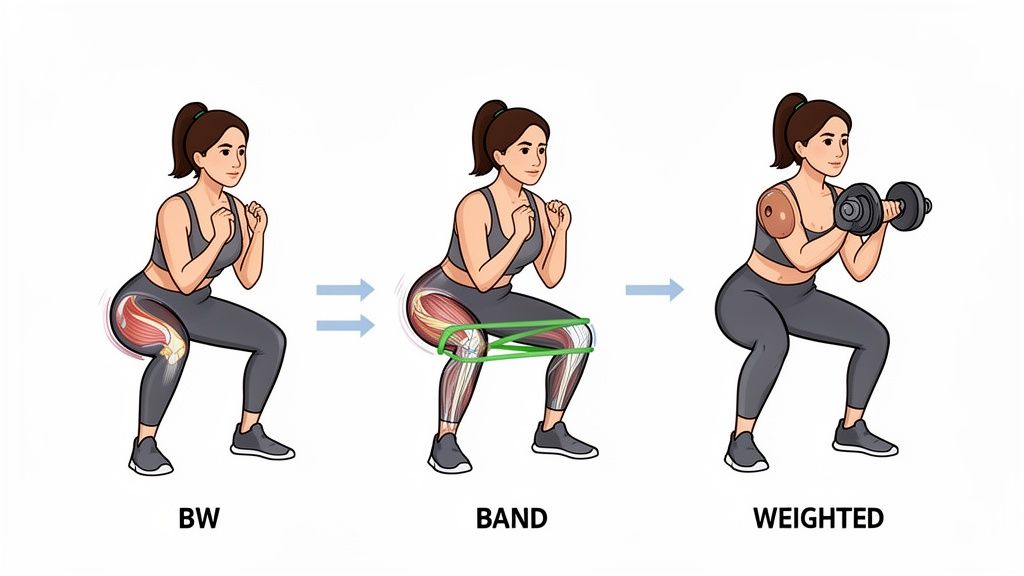
Think about a simple squat. You might start with your own bodyweight. Once you’ve mastered the form, you can loop a resistance band around your thighs. This specifically targets the gluteus medius and minimus, muscles crucial for pelvic stability, forcing them to work harder to prevent your knees from caving inward. From there, you could progress to holding dumbbells, layering on the resistance to keep your body adapting.
Choosing Your Resistance Method
Different tools create different types of mechanical tension. While traditional free weights are fantastic for building raw strength through constant gravitational load, other methods offer unique benefits that align perfectly with the goal of creating long, lean, functional muscle.
Pilates-based equipment, like the resistance rings and loops we use in WundaCore, provides variable tension. This means the resistance actually increases as you move through an exercise, forcing your muscles to work hardest at their peak contraction.
This constant, accommodating tension is incredibly effective for activating those deep stabilizing muscles—like the transverse abdominis and multifidus in your core—and sculpting lean definition, all without high-impact stress on your joints. To learn more about how this works, explore the benefits of resistance training for women in our detailed article.
The science is clear: women respond exceptionally well to resistance training. Research shows muscle growth can increase by 2% to 26% and lower-body strength can soar by up to 140% with consistent training.
Structuring Your Training Week
Consistency beats intensity every single time. I recommend aiming for 2 to 4 resistance training sessions per week. Make sure you allow at least one day of rest between working the same muscle groups so they have time for the physiological repair process (protein synthesis) to occur.
For muscle growth (hypertrophy), the sweet spot is generally 6-12 reps per set. This range gives you the perfect mix of mechanical tension (lifting a challenging weight) and metabolic stress (that "burn" you feel from lactate buildup)—both are key drivers for building lean muscle.
Focus on compound movements—exercises like squats, lunges, and push-ups that work multiple muscle groups and joints at once. They're incredibly efficient and trigger a greater systemic hormonal response (like growth hormone release) that supports muscle growth.
Above all, remember that every session is a conversation with your body. Listen to its feedback and adjust as you get stronger.
Fueling Muscle Growth with Female-Specific Nutrition
Intelligent training creates the stimulus, but nutrition provides the building blocks for physiological change. You simply can't sculpt a strong, lean body without the right raw materials. This is where so many women get stuck, often under-eating out of fear of gaining the "wrong" kind of weight. It’s time to leave that mindset behind for good.
Let's start thinking about food as a powerful tool for cellular repair and hormone regulation. When you understand the specific jobs of proteins, carbohydrates, and fats in muscle anabolism, you can eat with confidence, knowing every meal is a strategic step toward your goals. This isn't about restriction; it's about giving your body exactly what it needs to repair, rebuild, and get stronger.
The Central Role of Protein in Muscle Repair
When you lift weights, you create tiny micro-tears in your muscle fibers' contractile proteins (actin and myosin). This is a good thing! It's the signal for repair. Protein provides the amino acids—the essential building blocks—needed to patch up this damage, which is how muscle grows back stronger and denser. Think of it like repairing a brick wall; you need new bricks (amino acids from protein) to fill the gaps and reinforce the entire structure.
For women who are actively training to build muscle, protein needs are quite a bit higher than for someone who's sedentary. A solid target to maximize muscle protein synthesis—the physiological process of building new muscle—is 1.4 to 2.0 grams of protein per kilogram of body weight each day. For a 140-pound (63.5 kg) woman, this works out to about 89 to 127 grams of protein daily.
Spreading your protein intake evenly throughout the day is far more effective than trying to cram it all into one huge meal. Aiming for 25-35 grams of high-quality protein per meal helps keep a steady supply of amino acids in your bloodstream, keeping your muscles in a constant state of repair and growth.
This consistent amino acid availability ensures your muscle cells always have the materials on hand right when they need them to rebuild tissue after a workout.
Demystifying Carbs: Your Essential Workout Fuel
Carbohydrates have been unfairly demonized for years, but for muscle building, they are a non-negotiable. Carbs are your body's preferred and most efficient energy source for high-intensity work. They get broken down into glucose and stored in your muscles and liver as glycogen. When you train, your body taps into these muscle glycogen stores to produce ATP, the energy currency that powers every single muscle contraction.
Skipping carbs is like trying to drive your car on an empty tank. You won’t have the fuel to generate the force needed to create the mechanical tension your muscles need to grow. What’s more, consuming carbohydrates after your workout triggers an insulin response, which helps shuttle nutrients (like amino acids) into your muscle cells and replenishes those depleted glycogen stores.
Here are some of my go-to carbohydrate sources to fuel your training:
- Complex Carbs: Oats, quinoa, brown rice, sweet potatoes, and whole-grain bread provide that slow-and-steady energy release.
- Fruits and Vegetables: Bananas, berries, and leafy greens offer essential vitamins and minerals alongside their energy.
The key is simply to choose nutrient-dense sources over processed sugars.
Healthy Fats and Hormonal Balance
Fats are absolutely vital for your endocrine system, playing a huge role in producing steroid hormones like estrogen and testosterone, which are involved in muscle growth and metabolism. Healthy fats also form the cell membranes of every cell in your body, including muscle cells, and can reduce inflammation, which is a huge plus for recovery.
Focus on weaving these sources into your diet:
- Avocados: A fantastic source of monounsaturated fats and potassium.
- Nuts and Seeds: Almonds, walnuts, chia seeds, and flaxseeds are powerhouses of healthy fats, fiber, and even some protein.
- Olive Oil: An excellent anti-inflammatory monounsaturated fat to cook with or drizzle on salads.
- Fatty Fish: Salmon and mackerel are packed with anti-inflammatory omega-3 fatty acids.
While getting your nutrients from whole foods should always be the foundation, certain supplements can play a strategic role in supporting muscle growth, as detailed in this guide to muscle growth supplement science. Ultimately, a balanced intake of all three macronutrients creates the perfect internal environment for building lean muscle and supporting your body from the inside out.
Training With Your Body, Not Against It: Hormones and Life Stages
A woman's body isn't static; it's a dynamic, powerful system governed by the cyclical nature of our endocrine system. If you want to build lean muscle effectively—and keep it for the long haul—the secret is to work with these internal hormonal rhythms, not fight them.
This means learning how to adapt your training to your menstrual cycle and navigate the significant hormonal shifts that come with perimenopause and menopause. When you sync your workouts with your unique physiology, you can manage your energy, maximize your strength gains, and turn potential setbacks into smart, strategic progress.
Training in Sync with Your Menstrual Cycle
Your menstrual cycle is so much more than just your period. It’s a monthly hormonal blueprint that has a huge impact on strength, energy, and recovery. By tuning into its two main phases, you can start training smarter almost immediately.
- Follicular Phase (First ~14 days): This phase kicks off on day one of your period. As estrogen climbs, it promotes muscle glycogen storage and reduces protein breakdown. This means you’ll likely feel a surge in energy, a higher pain tolerance, and more raw strength. This is the perfect time to go after a personal best, add more weight, or push the intensity.
- Luteal Phase (Second ~14 days): After ovulation, progesterone starts to rise. Progesterone is more catabolic (breaks down tissue) and can increase your core body temperature and respiratory rate, which can leave many of us feeling a bit more fatigued. This is a great opportunity to shift your focus. Think moderate-intensity training with a focus on form, steady-state cardio, or really dialing in your technique with lighter loads. Low-impact workouts, like WundaCore, are ideal here—they keep your muscles engaged without demanding peak energy.
The most important rule? Listen to your body. If you feel fantastic and full of energy during your luteal phase, by all means, go for it! The goal is awareness and honoring your body’s signals, not rigid rules.
For a deeper dive into your personal hormonal landscape, a comprehensive female hormone blood test guide can offer some incredibly valuable insights.
Navigating Perimenopause and Menopause
As you enter perimenopause and menopause, the decline in estrogen presents a new set of challenges for maintaining muscle. This is precisely when a consistent, strategic resistance training plan becomes non-negotiable.
Dropping estrogen levels are directly linked to anabolic resistance—meaning your muscles become less responsive to the stimulus of exercise and protein. This causes a decrease in muscle mass (sarcopenia) and a shift in metabolism, often making it easier to store visceral fat around your middle. Building and preserving lean muscle is no longer just a fitness goal—it’s a critical pillar of your long-term health. The great news is that your body is still incredibly responsive to the right kind of training.
In fact, research shows just how vital this is. A woman’s muscle mass typically peaks in her mid-30s and can decline by about 5.7% per decade after age 50. But a large-scale analysis confirmed that resistance training triggers significant increases in lean body mass in postmenopausal women. It’s a powerful tool to counteract these natural changes.
This is also the time to make joint and bone health a top priority. Low-impact, bone-loading exercises are exceptionally beneficial. Methods that create mechanical tension without the high-impact stress, like Pilates-based resistance training, are perfect. The tension from the resistance bands pulls on the tendons, which in turn pull on the bones, stimulating osteoblasts (bone-building cells) to improve bone density.
If you're looking for targeted movements, our guide on exercises to address menopause belly fat offers some great ideas.
By adapting your approach, you can continue to build lean muscle, support your metabolism, and feel strong and capable at any age.
Your Weekly Anatomy-Informed Workout Plan
Okay, let's put all this theory into practice. A truly effective workout plan isn't just a random list of exercises. It’s a smart schedule that works with your anatomy, challenges your muscles intelligently, and gives your body the downtime it needs to rebuild and get stronger.
This entire framework is designed to help you build balanced, functional lean muscle across your whole body. We're focused on creating a routine that you can stick with and adapt as you progress. Instead of just going through the motions, you'll understand the "why" behind each movement, connecting the exercise to the specific muscles and anatomical functions you're targeting.
Structuring Your Week for Optimal Growth
If there's one secret to building lean muscle, it's consistency. A well-structured week is your best friend here, ensuring you hit all your major muscle groups without burning out. This sample split is built around the principle of progressive overload, setting you up to gradually increase the challenge as your strength grows.
But remember, this is a template, not a prescription. The most important thing is to listen to your body. If you're feeling incredibly sore, an active recovery day with some light movement will serve you far better than pushing through another high-intensity session.
Sample Weekly Training Split
This table gives you a clear visual of how to organize your week. You can see how the focus shifts as you move from a beginner just starting out to a more advanced lifter looking for specific results.
| Day | Beginner Focus | Intermediate Focus | Advanced Focus |
|---|---|---|---|
| Day 1 | Full Body A (Focus on major compound movements like squats and push-ups) | Lower Body (Glutes & Hamstrings focus with exercises like deadlifts and hip thrusts) | Lower Body Strength (Heavier compound lifts like barbell squats and Romanian deadlifts) |
| Day 2 | Rest or Active Recovery | Upper Body (Push/Pull focus with exercises like dumbbell presses and rows) | Upper Body Push (Chest, Shoulders, Triceps focus with bench presses and overhead presses) |
| Day 3 | Full Body B (Introduce new variations like lunges and dumbbell rows) | Rest or Active Recovery | Rest or Active Recovery |
| Day 4 | Rest or Active Recovery | Full Body (Compound movements with an emphasis on core stability) | Lower Body Hypertrophy (Higher reps on lunges, leg presses, and isolation work) |
| Day 5 | Full Body C (Incorporate bands and bodyweight core work) | Lower Body (Quad & Glute focus with split squats and leg extensions) | Upper Body Pull (Back & Biceps focus with pull-ups, lat pulldowns, and various curls) |
| Day 6 | Rest or Active Recovery | Upper Body (Shoulders & Arms focus with targeted accessory work) | Active Recovery & Core (Low-intensity cardio, mobility, and dedicated core circuits) |
| Day 7 | Rest | Rest | Rest |
Following a structure like this makes sure you're working your muscles often enough to trigger growth while also building in plenty of time for that all-important repair process.
Anatomy in Action: A Beginner Full-Body Workout
If you're new to resistance training, your number one goal is mastering your form. This workout is built on foundational movements that will create a solid base of strength and teach you how to feel the right muscles working.
Workout Focus: Full Body A (Perform 2-3 times per week on non-consecutive days)
-
Goblet Squats: 3 sets of 8-12 reps
- Anatomy Cue: Hold a dumbbell against your chest. As you lower down, think about "spreading the floor" with your feet. This externally rotates the femur at the hip socket, helping to activate your gluteus medius for knee stability. Keeping your torso upright forces your erector spinae muscles to work isometrically to protect your lower back.
-
Incline Push-Ups: 3 sets to near failure (stop 1-2 reps before your form breaks down)
- Anatomy Cue: By placing your hands on a bench, you change the angle of your body, placing more emphasis on the lower fibers of your pectoralis major. As you lower, focus on scapular retraction (pulling shoulder blades together) to fully engage the chest and protect the shoulder joint.
-
Dumbbell Rows: 3 sets of 10-12 reps per side
- Anatomy Cue: Hinge from your hips so your back is flat. Initiate the pull by retracting your scapula first, then drive your elbow up and back. This ensures your latissimus dorsi and rhomboids are doing the work, not just your biceps.
-
Glute Bridges: 3 sets of 12-15 reps
- Anatomy Cue: Lying on your back, drive through your heels and squeeze your glutes to achieve full hip extension. This is a fantastic exercise for isolating the gluteus maximus, your body's most powerful hip extensor, without loading the spine.
-
Plank: 3 sets, hold for 30-60 seconds
- Anatomy Cue: Gently pull your belly button toward your spine to engage your transverse abdominis—your body’s deep, corset-like core muscle. Co-contract your glutes and quads to create full-body tension and protect your lumbar spine.
Training Adaptations for Different Life Stages
Your body’s hormonal environment plays a huge role in how you should train. You wouldn't treat a car the same way at 1,000 miles as you would at 100,000 miles, and your body deserves that same thoughtful approach.
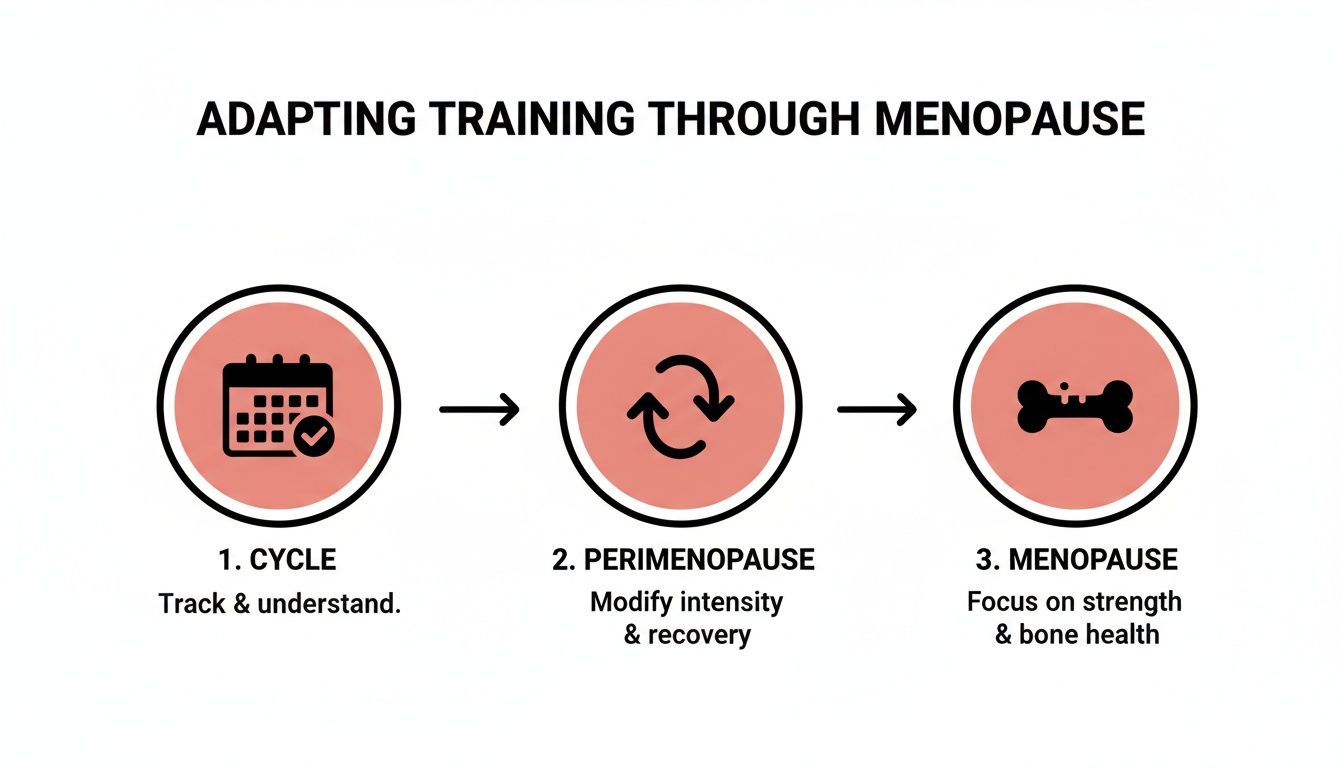
This visual guide shows how your training can (and should!) evolve. It’s not about stopping; it’s about adapting intelligently, whether that means syncing with your cycle or prioritizing bone density post-menopause.
An Intermediate Lower Body Workout
Once you have the basics down, you can start using a "split" routine to give more focused attention to specific muscle groups. This workout is all about targeting the posterior chain—the incredibly powerful network of muscles on the back side of your body, including your glutes, hamstrings, and erector spinae.
Workout Focus: Lower Body (Glutes & Hamstrings)
-
Romanian Deadlifts (RDLs): 4 sets of 8-10 reps
- Anatomy Cue: This is a pure hip hinge, not a squat. Keep a soft bend in your knees as you push your hips back, maintaining a neutral spine. You should feel a deep stretch in your hamstrings as the weight lowers. To stand, drive your hips forward by powerfully contracting your glutes and hamstrings.
-
Hip Thrusts: 4 sets of 10-15 reps
- Anatomy Cue: This exercise trains the gluteus maximus in a shortened position, hitting the fibers differently than a squat or lunge. At the top, ensure full hip extension by squeezing the glutes. A slight posterior pelvic tilt (tucking your tailbone) can intensify this peak contraction.
-
Bulgarian Split Squats: 3 sets of 10-12 reps per side
- Anatomy Cue: This unilateral movement challenges the stabilizers in your hip and core, particularly the gluteus medius of the front leg. Focus on keeping your pelvis level and your front knee tracking over your second toe to ensure proper joint mechanics.
-
Hamstring Curls (with band or machine): 3 sets of 12-15 reps
- Anatomy Cue: This isolates the knee flexion function of the hamstrings (semitendinosus, semimembranosus, and biceps femoris). Focus on a slow, controlled eccentric (lowering) phase, as this is where significant muscle damage and growth occur.
The key to progress isn't just showing up; it's showing up with intention. Focus on the mind-muscle connection—actively thinking about the specific muscle you're working. This simple neurological shift can significantly improve muscle fiber recruitment and growth.
Common Questions About Building Lean Muscle
Stepping into the world of strength training can feel like navigating a maze of conflicting advice and persistent myths. It's totally normal to have questions and wonder if you're doing things "right." So, let's clear the air on some of the most common concerns women have when they start building lean muscle.
Think of this as your personal myth-busting guide. Getting straight, science-backed answers will help you stay focused on what actually works and build the confidence to trust the process.
Will Lifting Weights Make Me Bulky?
This is, without a doubt, the number one fear I hear from women, and it’s time we put it to rest for good. The short answer? No.
Getting "bulky" requires a specific physiological and hormonal environment that most women do not have. Women produce about 5-10% of the testosterone that men do, and testosterone is the primary hormone responsible for significant muscle hypertrophy. Without supraphysiological levels of testosterone, it's biologically very difficult for women to build large, bulky muscles.
Instead, consistent resistance training will increase the density of your muscle fibers and improve neuromuscular efficiency, resulting in a strong, defined, and what most people would call a "toned" physique. You're building dense, functional muscle, not oversized mass.
How Quickly Can I Expect to See Results?
Patience is your best friend on this journey. While you might feel stronger in just a few weeks—that’s your nervous system adapting and getting more efficient at recruiting existing muscle fibers—visible changes in muscle size take more time.
Most women start to see noticeable changes in their body composition after about 8 to 12 weeks of consistent training and solid nutrition. Remember, building new muscle tissue via hypertrophy is a slow biological process involving cellular repair and protein accretion. It doesn't happen overnight.
A pro tip: Ditch the scale and grab your camera instead. Tracking your progress with photos and measurements is far more rewarding. Muscle is about 18% denser than fat, so you might find your clothes fitting better as you build muscle and lose fat, even if the number on the scale doesn't change much.
Do I Need to Take a Lot of Supplements?
Supplements are exactly what their name implies: a supplement to an already great routine. You absolutely do not need them to build lean muscle, but a couple can be genuinely helpful.
- Protein Powder: This is just a convenient way to increase your daily intake of amino acids to support muscle protein synthesis, especially when life gets busy.
- Creatine: As one of the most-studied supplements, creatine monohydrate increases your muscle's phosphocreatine stores. This helps you produce ATP (energy) more rapidly during short, intense bursts of effort, allowing you to get an extra rep or two and create a greater training stimulus.
Honestly, beyond these two, the returns diminish quickly. Focus 95% of your energy on your training, nutrition, and sleep. That’s where the real physiological magic happens.
Can I Build Muscle with Low-Impact Workouts?
Yes, absolutely! This is such an important point, especially for anyone looking to protect their joints. Muscle growth is triggered by mechanical tension, not joint impact.
Low-impact methods like Pilates-based resistance training, using bands, or focusing on slow, controlled movements (increasing time under tension) are incredibly effective. These approaches create sustained tension on the muscle fibers, leading to metabolic stress and muscle protein synthesis, both of which are key drivers for hypertrophy.
The key ingredient is always progressive overload. As long as you are continually challenging your muscles in a safe, controlled way, you are signaling them to adapt and grow stronger.
Ready to build functional, lean muscle from home with an anatomy-informed approach? At WundaCore, we provide the expertly designed equipment and on-demand classes you need to train smarter, not harder. Explore our complete Pilates-based systems and start your journey today at https://wundacore.com.