
Pilates for Posture: Stand Taller with Targeted Core Exercises
Without a doubt, yes. Pilates is incredibly effective for improving posture. It goes straight to the anatomical source of misalignment, strengthening deep postural muscles, re-aligning your spine, and building a powerful neuromuscular connection that completely retrains how you hold and move your body.
Understanding the Anatomy of Good Posture

So, what is good posture, anatomically speaking? Forget just "standing up straight." True posture is the dynamic alignment of your skeleton, where muscles work in a coordinated, efficient manner.
Your spine is the central axis of this structure. Its natural S-curve—cervical, thoracic, and lumbar curves—is engineered for shock absorption and weight distribution. When the correct muscles are strong and neurologically active, they support this structure effortlessly, creating a state of dynamic equilibrium.
But when some muscles become chronically weak (hypotonic) while others become overworked and tight (hypertonic), this delicate biomechanical balance is lost. This leads to common postural faults like kyphosis (hunching), lordosis (overly arched back), or forward head posture.
The Core Muscular Support System
To understand how pilates for posture works, you must first understand the anatomy of your core support system. These are the specific muscles Pilates targets to rebuild your postural foundation from the inside out.
Your spine’s primary support team includes:
- Deep Core Muscles: The transverse abdominis is the star. This deep-set muscle wraps horizontally around your abdomen like a natural corset, providing crucial segmental stability to the lumbar spine and pelvis.
- Spinal Extensors: The erector spinae group runs parallel to your vertebral column. These muscles work tirelessly against gravity to maintain an erect posture and control spinal flexion.
- Gluteal Muscles: The gluteus maximus, medius, and minimus form a powerful base. They stabilize the pelvis in the sagittal and frontal planes, preventing excessive anterior or posterior tilting.
When these powerhouse muscles are weak, smaller, more superficial muscles are forced to overcompensate. Muscles like the upper trapezius, levator scapulae, and lumbar paraspinals become hypertonic, leading directly to pain, stiffness, and misalignment. You can dive deeper into how Pilates methodically strengthens these groups by exploring what muscles Pilates works in our detailed guide.
From Muscle Imbalance to Postural Faults
Postural problems are the physical manifestation of underlying muscle imbalances. For example, that common "forward head posture" is often caused by weak deep neck flexors and rhomboids, which fail to counteract tight, shortened sternocleidomastoid and pectoral muscles.
Likewise, an excessive lumbar curve (lordosis or anterior pelvic tilt) usually indicates weak glutes and abdominals paired with hypertonic hip flexors (psoas and iliacus). Pilates doesn't just cue you to "tuck your tailbone"; it addresses the root anatomical cause by rebalancing the forces acting on the pelvis.
By correcting these muscular force couples, Pilates provides a targeted blueprint for rebuilding your body's structural support from the inside out. It awakens dormant muscles and releases chronic tension, restoring natural skeletal alignment.
And the science backs this up. Research has shown that a consistent Pilates practice can significantly improve thoracic kyphosis and boost transverse abdominis activation. One study even found that it helped people stabilize their core during scapular movements—a key factor in preventing nagging neck and shoulder pain.
How Pilates Retrains Your Postural Muscles
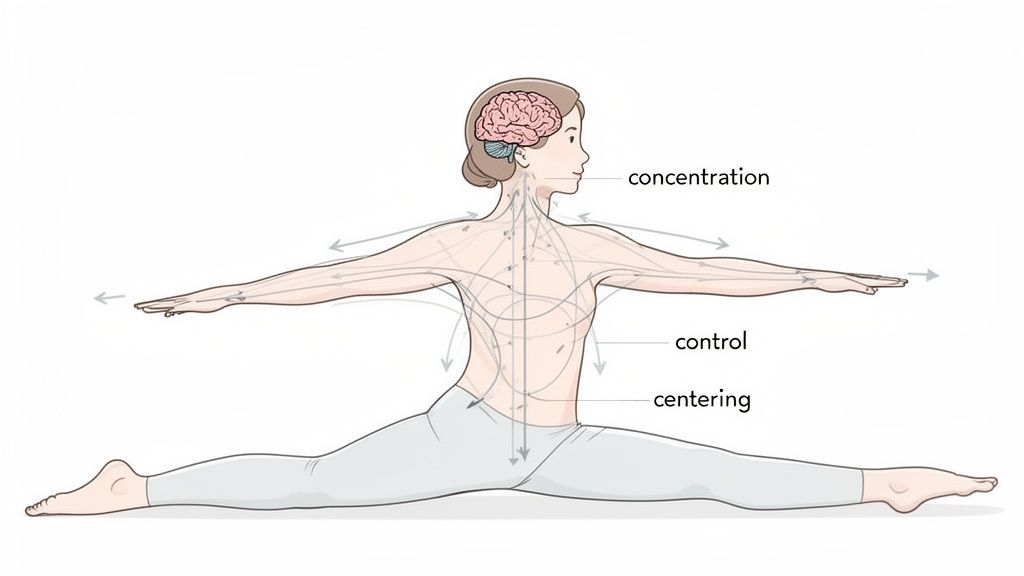
Pilates isn't just a workout; it’s a neuromuscular re-education. It addresses the root cause of poor posture by focusing on principles like concentration, control, and centering, teaching your nervous system to fire muscles in the correct sequence for ideal alignment, making it an automatic process.
Think of your musculoskeletal system as a tensegrity structure. If some cables (muscles) are too tight while others are slack, the entire structure warps. Pilates acts as the master bio-mechanic, meticulously recalibrating muscle tension so none are overworking or underworking. The result is structural integrity.
This process begins by sharpening your proprioception—your nervous system's ability to sense the position and movement of your body in space. Slow, deliberate movements heighten this awareness, making you sensitive to subtle shifts in joint alignment and muscle activation.
The Dual Action of Mobility and Stability
One of the most powerful aspects of using Pilates for posture is its simultaneous focus on mobility and stability. It doesn't just strengthen weak muscles; it actively lengthens and mobilizes tight, shortened ones. This is a game-changer because poor posture is rarely just a weakness problem.
Take rounded shoulders, for instance. Anatomically, this involves two issues:
- Weak Scapular Retractors: The rhomboids and middle trapezius, which pull the shoulder blades toward the spine, have become elongated and weak.
- Tight Pectoral Muscles: The pectoralis major and minor have become short and contracted, pulling the head of the humerus forward and medially rotating the shoulder joint.
Pilates tackles both sides of this equation in the same session. We'll perform movements designed to stretch the pectorals (mobilize the front) while actively engaging and strengthening the rhomboids (stabilize the back), restoring the crucial force balance across the glenohumeral joint.
Pilates doesn’t just chase raw strength; it builds intelligent, functional muscle. It teaches your body to activate deep, local stabilizers (like the transverse abdominis and multifidus) before engaging the larger, global movers. This prevents compensatory patterns that reinforce poor posture.
Building Resilient Muscles with Eccentric Contractions
Another key anatomical component is the focus on eccentric muscle contractions. This occurs when a muscle lengthens under load—think of the control your spinal extensors exert as you slowly roll down from a standing position. This type of contraction is highly effective for building long, resilient muscle fibers and improving neuromuscular control.
Imagine slowly articulating your spine down, one vertebra at a time in a Roll Down. Your rectus abdominis and obliques work eccentrically to control the descent against gravity. This builds incredible core endurance, which is essential for maintaining an upright posture throughout the day. And while you’re improving your posture, you might also wonder how these effective core exercises impact other fitness goals.
The Central Role of the Breath
Finally, we must discuss the diaphragm. In Pilates, breathing is an anatomical tool. A deep, diaphragmatic breath causes the diaphragm to descend, increasing intra-abdominal pressure. This pressure acts like an internal support cushion for the spine and automatically co-contracts the transverse abdominis and pelvic floor muscles.
This coordinated breath also helps down-regulate the sympathetic nervous system, releasing tension in chronically tight muscles like the upper trapezius and sternocleidomastoid. Mastering these foundational breathing techniques for Pilates is often the first step toward finding a posture that is both strong and relaxed.
Alright, now that we’ve unpacked the why behind good posture, let's get into the how. This is where the real magic happens. Different postural habits create very specific muscle imbalances, and Pilates gives us the perfect set of tools to target them one by one.
This isn't about generic, one-size-fits-all fixes. We're going to act like movement detectives, identifying the culprits behind things like slouching or swayback and prescribing the exact exercises needed to bring your body back into balance. This targeted approach is what makes Pilates for posture so incredibly effective.
Undoing the "Desk Slouch"
We all know this one. That classic forward head, rounded-shoulder look that comes from hours hunched over a keyboard. It’s practically an epidemic. This posture is the result of chronically tight chest muscles pulling you forward and weak, overstretched upper back muscles (like your rhomboids and middle traps) that have simply given up the fight.
Our mission is to reverse this pattern completely. We need to open up the front of the body while simultaneously waking up and strengthening the back.
Two of my absolute favorite exercises for this are:
- Swan: Think of this as the ultimate anti-slouch move. Lying on your stomach, you use your back muscles to gently lift your chest off the mat. It’s not about how high you can go, but about the quality of the movement. This directly strengthens the exact muscles that pull your shoulder blades down and back, creating a powerful counterforce to gravity and tight pecs.
- Chest Expansion: You can do this on a Reformer or even just with a resistance band at home. The movement focuses on drawing your arms back while keeping your chest wide and open. It’s a fantastic way to strengthen the entire backside of your body and teach your shoulders where they’re supposed to live—creating a beautiful, broad feeling across your collarbones.
A great tip is to use a simple resistance loop around your wrists during these moves. It gives you instant feedback, helping you find and fire up the right back muscles for a much deeper and more effective connection.
Correcting Swayback and Anterior Pelvic Tilt
Another common pattern I see is an overly arched lower back, often called "swayback" or an anterior pelvic tilt. This happens when tight hip flexors and a weak low back overpower your abdominals and glutes, literally tipping your pelvis forward. To fix this, we need to strengthen the front of your core and your entire posterior chain to gently guide the pelvis back to a neutral, happy home.
Correcting a tilted pelvis isn't about forcefully "tucking your tailbone." It's about restoring the natural partnership between your deep abdominal muscles and your glutes. When they fire up together, they create a natural, supportive sling that holds your pelvis in the perfect position.
Here are the go-to exercises for rebalancing the pelvis:
- Pelvic Curls: This is a fundamental Pilates move, and for good reason. It’s brilliant for teaching your abs and glutes to work as a team. As you lie on your back and peel your spine off the floor one vertebra at a time, you’re strengthening your glutes and hamstrings while your deep core works to keep your spine stable and supported.
- Glute Bridges: A more powerful version of the curl, the bridge zeroes in on waking up your glutes. Strong glutes are non-negotiable for extending your hips and fighting back against the constant pull of tight hip flexors. If you want to dive deeper into this powerhouse move, check out our detailed guide on the shoulder bridge exercise and all its postural benefits.
- The Hundred: This iconic exercise is a masterclass in building deep core endurance. Holding that C-curve shape while pumping your arms forces your transverse abdominis—your body's internal corset—to work overtime stabilizing your spine. This is the core strength that prevents your low back from arching throughout the day.
By practicing these targeted movements consistently, you’re doing so much more than just "working out." You are actively re-educating your body's deeply ingrained patterns. Each repetition reinforces what correct alignment feels like, slowly but surely transforming your posture from something you have to think about to something that feels effortless, strong, and natural.
Pilates Exercises for Postural Correction
To make it even clearer, here’s a quick-reference table that connects common postural issues with the specific Pilates exercises designed to fix them. Think of this as your postural correction cheat sheet.
| Postural Fault | Primary Muscle Imbalance | Corrective Pilates Exercise | WundaCore Equipment Integration |
|---|---|---|---|
| Desk Slouch (Kyphosis) | Tight Pectorals / Weak Rhomboids | Swan, Chest Expansion, Scapular Retraction | Using the WundaCore Resistance Ring for tactile feedback in Swan. |
| Swayback (Lordosis) | Tight Hip Flexors / Weak Abdominals & Glutes | Pelvic Curls, Glute Bridges, The Hundred | Placing the WundaCore Resistance Ring between the knees during Bridges. |
| Forward Head | Tight Neck Extensors / Weak Deep Neck Flexors | Chin Tucks, Neck Stretches (with control) | Lying on the WundaCore mat provides a firm, supportive surface. |
| Rounded Shoulders | Tight Chest & Lats / Weak Serratus Anterior | Book Openings, Wall Angels, Arm Circles | The WundaCore Resistance Ring adds challenge to arm work. |
This table shows just how precise we can be in our approach. By identifying the root cause of the imbalance, we can choose the right tools from our Pilates toolbox to create lasting change, especially when supported by equipment designed to enhance that mind-body connection.
Building Your Daily Posture Improvement Routine
Real, lasting change in your posture doesn’t come from one killer workout. It’s built from small, consistent efforts woven into your daily life. Think of it less as a workout and more as a daily reset—a simple but powerful 15-minute routine can completely re-educate your muscles and reshape how you carry yourself.
The idea is to create a sequence that hits all the key notes for better posture: a dynamic warm-up to get the joints ready, core activation to switch on your internal support system, spinal mobility to undo stiffness, and targeted work to strengthen weak, overstretched muscles. This is your daily postural reset button.
And you're not alone in this. There are over 20 million Pilates enthusiasts globally for a reason. The industry saw 13% annual growth between 2018 and 2022, with data showing that 55% of people practice twice a week. Why? Because consistency gets results, including a reported 62% reduction in stress. You can dive into more of these Pilates trends on Wifitalents.com.
Structuring Your 15-Minute Pilates Routine
To get started, you need a plan. A balanced routine makes sure you’re addressing the body as a whole, rather than just chasing one problem area.
Here’s a simple, effective sequence to try:
- Dynamic Warm-Up (3 minutes): Start on all fours with some gentle Cat-Cow movements to get the spine moving. Follow that with a few slow, controlled arm circles and leg swings to warm up your shoulder and hip joints.
- Core Activation (4 minutes): Flip onto your back for Pelvic Curls. This is fantastic for waking up your glutes and deep abdominal muscles. Follow it with a set of The Hundred (modified to your level, of course!) to build that deep core endurance.
- Spinal Mobility & Strengthening (5 minutes): Now, move onto your stomach for a few reps of Swan to strengthen the muscles of your upper back—the ones that fight against slouching. Then, lie on your side for Book Openings to rotate the thoracic spine and open up your chest.
- Cool-Down & Integration (3 minutes): Finish strong with a gentle Glute Bridge to reinforce that new pelvic stability. Finally, hug your knees into your chest to give your lower back a well-deserved release.
This kind of routine is designed to counteract the common postural faults many of us develop, from desk slouch and swayback to a tilted pelvis.
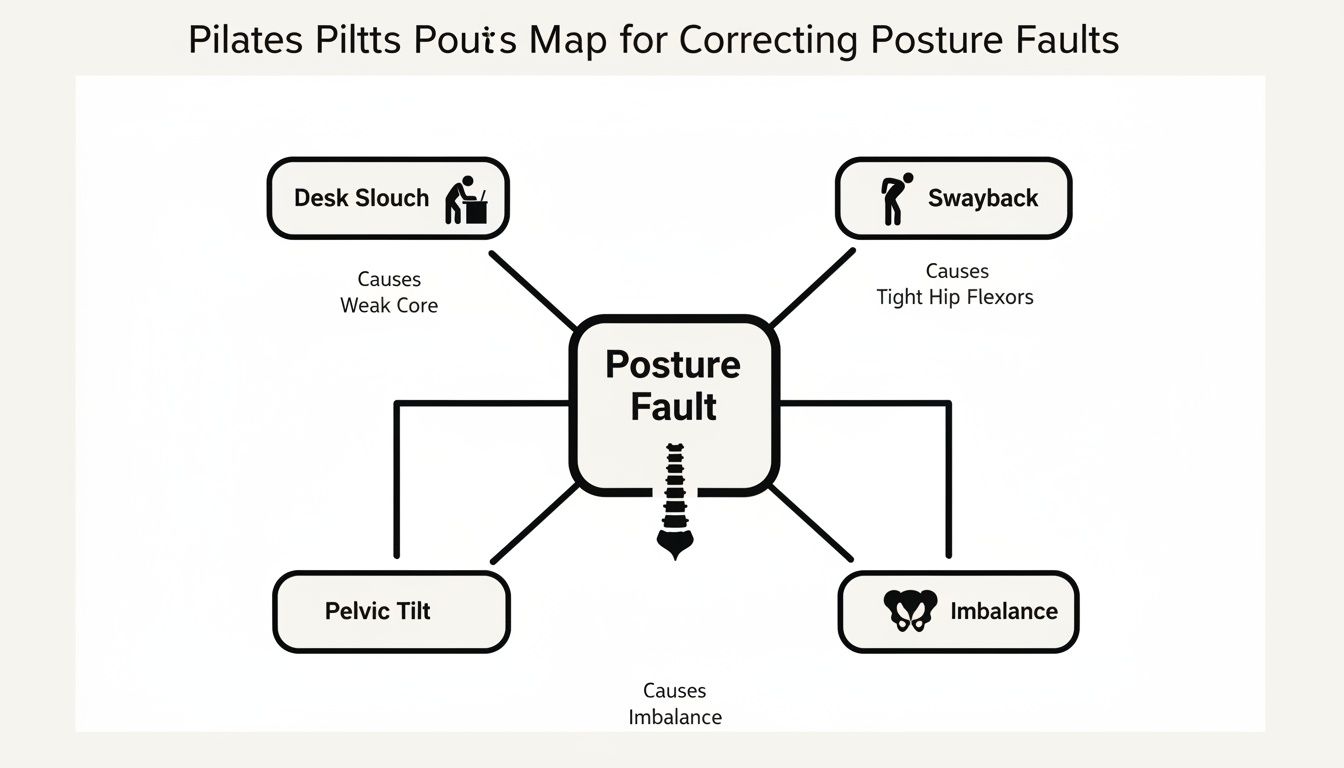
This map helps visualize how specific muscle imbalances create those distinct postural patterns, and it’s exactly these patterns that a well-rounded routine can correct.
Progressing Your Practice Without Hitting a Plateau
The beauty of Pilates is that it grows with you. Once your 15-minute routine starts to feel comfortable, it’s time to add a little challenge so you keep seeing results. This doesn’t mean you need more time, just more intention.
Progress isn't always about adding more exercises. It's about deepening your connection to the movements you're already doing. Focus on precision and control over speed or quantity.
Here are a few simple ways to advance your practice:
- Increase Repetitions: Try adding just 2-4 more reps to each exercise, but only if you can maintain perfect form.
- Introduce Variations: Ready for a balance challenge? Try a single-leg version of the Glute Bridge.
- Add Resistance: Placing the WundaCore Resistance Ring between your knees during Pelvic Curls is a game-changer for glute and inner thigh activation.
As your body gets stronger and more aware, resources like Wunda On Demand can provide a clear path forward. Our on-demand classes are designed with anatomical precision, offering new sequences and challenges that ensure your practice evolves right alongside your posture. This is how you prevent plateaus and keep that mind-body connection getting sharper every day.
Integrating Good Posture into Your Daily Life
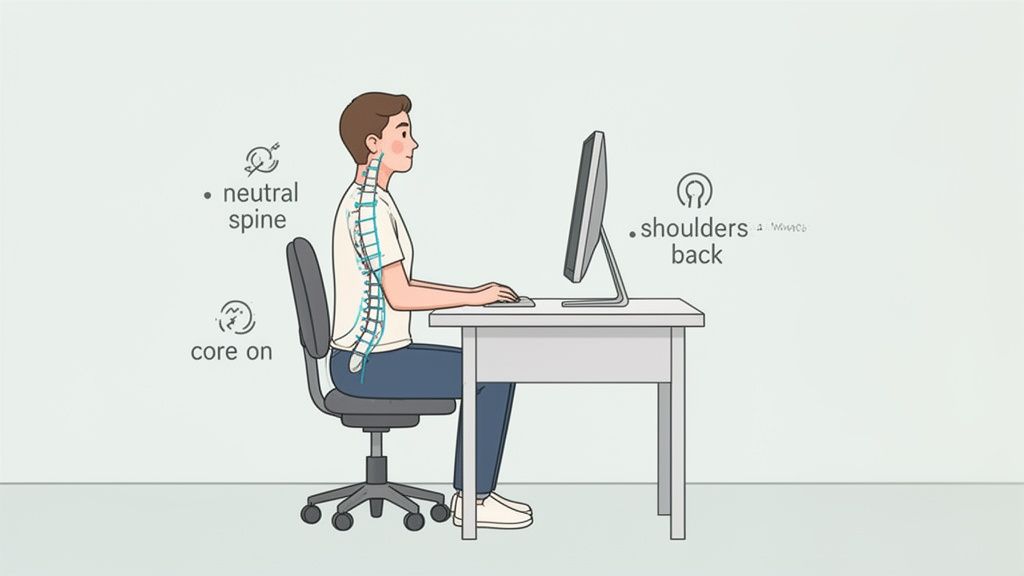
The real magic of using Pilates for posture isn't what happens on the mat—it’s what happens when you take those principles out into the real world. The ultimate goal isn't to hold yourself in a stiff, perfect position all day. It's about retraining your body so that good alignment feels completely natural, becoming your new normal.
Think of your Pilates session as the dress rehearsal. Your daily life—sitting, standing, walking, lifting—is the main performance. Every single movement is a chance to apply what you’ve learned, reinforcing those deep muscular connections until they become second nature.
Posture Cues for Everyday Activities
The key is to use simple mental reminders that switch on your postural muscles without you having to overthink it. A quick internal checklist is all you need to find your alignment, wherever you are.
- Sitting at Your Desk: Instead of letting your spine slump, imagine a string gently lifting the crown of your head toward the ceiling. Feel that length. Now, let your shoulders melt down your back, away from your ears, and lightly draw your abdominals in and up.
- Lifting Groceries: Before you bend, take a quick inhale and brace your core—your powerhouse. Hinge from your hips, not your waist, and let your glutes and legs do the work. This simple shift protects your lower back from taking on the strain.
- Walking with Alignment: As you walk, focus on rolling through your feet from heel to toe. Keep your gaze lifted and your chest open. Let your arms swing freely from the shoulders, not just from the elbows.
The real change happens when your body just knows what good alignment feels like. It’s that moment you catch yourself slouching and instinctively lengthen your spine without even thinking about it.
Reinforcing Your Practice with Knowledge
This mind-body integration works. It's not just a feeling; the results are measurable. A huge 48% of people who practice Pilates regularly report real, noticeable improvements in their posture. Why? Because you’re consistently training the deep stabilizing muscles that hold your spine in place.
Building on that foundation is key. To get the most out of your Pilates routine, it helps to understand the bigger picture of posture correction. Exploring effective strategies for fixing bad posture can complement your work on the mat. When you combine targeted Pilates exercises with mindful daily habits, you create a powerful system for a stronger, more aligned you.
Your Questions About Pilates and Posture, Answered
If you're curious about using Pilates to improve your posture, you're not alone. Getting straight, honest answers is the first step to starting your journey with confidence.
Here are a few of the most common questions we get, with answers rooted in how the human body actually moves.
How Long Does It Take to See Posture Improvements with Pilates?
This is always the first question, and the answer comes down to one word: consistency. While most people feel an immediate difference—a sense of being taller and more aware—after just one session, real, visible changes in your posture usually show up within 4 to 8 weeks of dedicated practice.
Lasting change means retraining the deep, automatic patterns your brain uses to tell your muscles what to do. To build that new muscle memory, you’ll want to aim for 2-3 sessions a week. Remember, when it comes to rebuilding posture, consistency beats intensity every single time.
Can Pilates Fix Structural Conditions Like Scoliosis?
While Pilates can't cure a structural condition like scoliosis, it is an incredible tool for managing it. The practice is second-to-none for strengthening the deep core muscles that act like a natural corset for your spine, which can be a total game-changer for many.
By improving your body awareness and using controlled movements to gently decompress the spine, Pilates can help ease pain, improve how you move, and create a better muscular balance around the curve.
It's absolutely essential to talk with your doctor or physical therapist before you start. They can ensure the exercises you choose are safe and modified perfectly for your body, making your practice both effective and supportive.
Is Mat Pilates Enough for Posture Correction?
Absolutely. Mat Pilates is incredibly powerful for posture because it's just you against gravity. You learn to control and stabilize your own body weight, which is the foundational skill of the entire method.
That said, adding a few simple props can seriously accelerate your progress and help you connect the dots faster. These tools aren't just for making things harder; they're for giving you crucial feedback.
Here's how they help:
- Tactile Feedback: Placing a resistance ring between your knees gives you instant information. You can feel the right muscles turn on.
- Targeted Strengthening: Using resistance bands adds a specific challenge that helps you build strength more efficiently in those key postural muscles, like the ones that run up your back or your glutes.
This kind of targeted work can fast-track your results, helping you build a deeper connection with the very muscles that hold you upright all day long.
Ready to feel the difference for yourself? WundaCore brings the anatomy-informed studio experience home with expertly designed equipment and on-demand classes. Start building a stronger, more aligned you today. Explore our collection at https://wundacore.com.