
What is eccentric muscle contraction? A Guide to Stronger, Safer Training
When you think about a muscle working, what comes to mind? Probably the bulging bicep as you lift something heavy. That powerful shortening action is called a concentric contraction—it’s the “go” phase of a movement, where muscle fibers generate force by shortening.
But every action has an opposite phase, and that’s where the real magic for building strength and stability happens. The controlled, slow lowering of that heavy object is the eccentric contraction.
It’s your body’s built-in braking system, driven by precise actions at the cellular level.
Decoding Your Body's Braking System
Eccentric contractions happen when a muscle lengthens under a load that is greater than the force the muscle is producing. Think about slowly lowering yourself into a chair or walking downhill. Your quadriceps muscles are actively engaged and lengthening to control gravity and absorb shock. This is a fundamental, yet often overlooked, component of functional strength.
This simple graphic breaks down the three ways our muscles work to create, control, and hold a position.
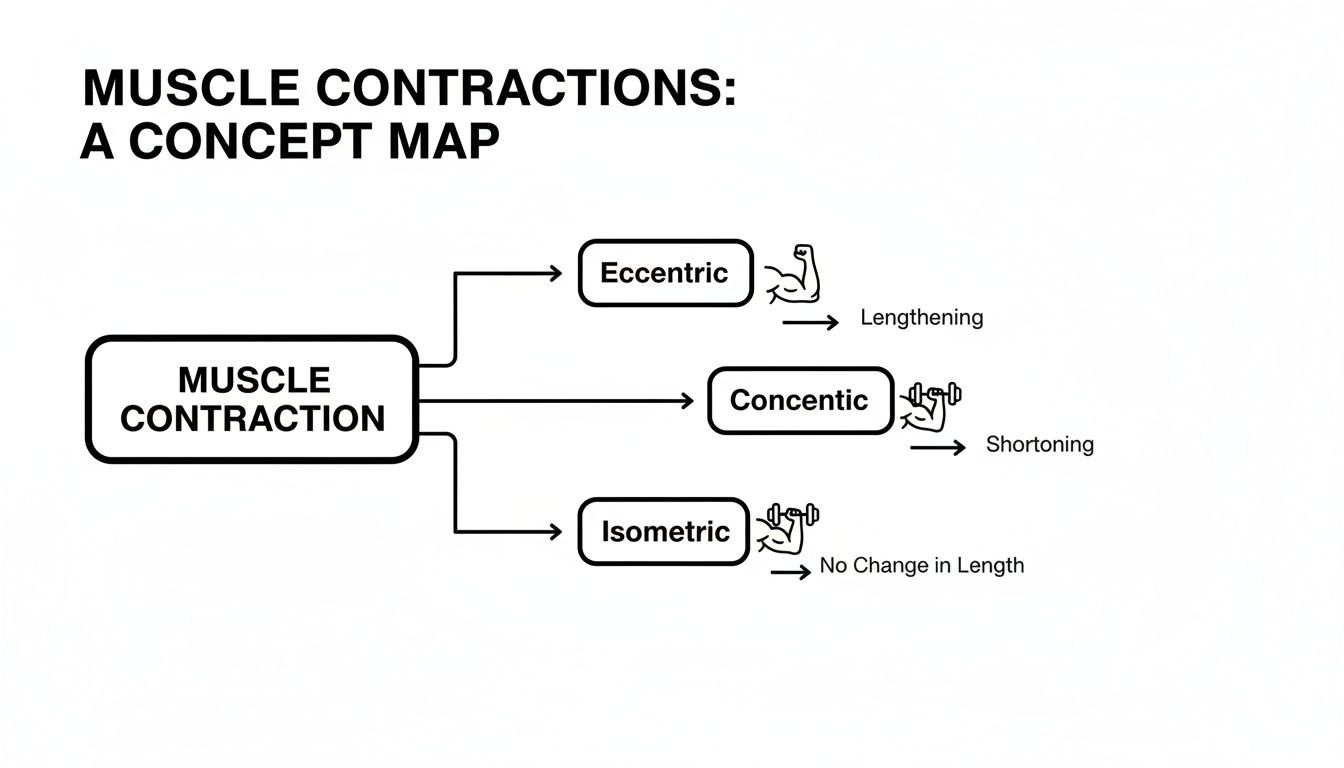
While the concentric part gets all the glory for lifting and pushing, it's the eccentric phase that manages the load on the way back down. This control is absolutely critical for joint health and preventing injury to both muscle fibers and connective tissues.
The Three Contraction Types
To really understand movement, we need to know all three players. Each type of contraction has a very specific job involving the interaction of actin and myosin filaments within your muscle fibers, and learning to harness them is the key to a smarter, more effective workout.
Here's a quick comparison to make it crystal clear.
Three Types of Muscle Contractions at a Glance
| Contraction Type | Muscle Action | Everyday Example |
|---|---|---|
| Eccentric | Lengthens under tension | Slowly lowering a heavy grocery bag, engaging the biceps brachii |
| Concentric | Shortens to produce force | Lifting that grocery bag, engaging the biceps brachii |
| Isometric | No change in length | Holding the heavy grocery bag steady, engaging the biceps brachii |
Each one is essential for well-rounded, functional movement. You can’t have one without the others, but the eccentric phase holds a special secret to building serious strength.
Did you know your muscles are significantly stronger eccentrically? Research shows they can handle 16-53% more load when lengthening than they can when shortening. This incredible capacity is a game-changer for building muscle and resilience.
This is exactly why we focus on control in methods like Pilates. We’re not just lifting and lowering; we’re intentionally managing the load through its entire range of motion.
This principle is also a cornerstone of smart strength programming. In fact, it’s a huge part of what makes progressive resistance training so effective. By emphasizing that controlled, lengthening phase, you tap directly into your body’s greatest potential for strength adaptation. And it’s not just for the gym—this control is what keeps you stable, protects your joints, and prevents falls in everyday life.
The Microscopic Anatomy of Muscle Lengthening
To really understand why eccentric work is such a powerhouse for building strength, we have to zoom in—way, way in—to the microscopic level of a muscle fiber. It’s here, inside the tiniest engines of your muscles, where the real magic of controlled lengthening happens. It’s a fascinating dance of resistance, tension, and release.
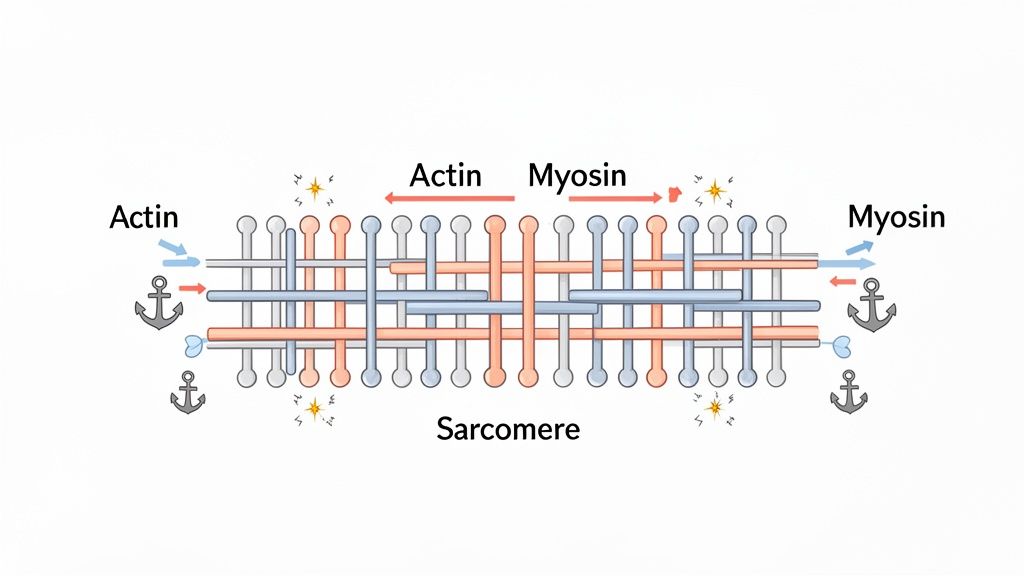
Imagine your muscle fibers (myofibrils) are made of millions of tiny, overlapping protein filaments. These are your actin (the thin ones) and myosin (the thick ones) filaments. Myosin has globular "heads" that form cross-bridges, grabbing onto the actin filaments to pull them closer together. This is a concentric contraction, where the muscle shortens.
But what happens when you're controlling the weight on the way down?
Inside the Sarcomere
The fundamental unit doing all this work is called the sarcomere. Think of it as a microscopic engine. During an eccentric movement, like slowly lowering a dumbbell, an external force is trying to pull those actin and myosin filaments apart, stretching the sarcomere.
Instead of just letting go, the myosin heads desperately cling to the actin, fighting against the stretch. It's like countless tiny hands trying to hold a massive ship against a powerful tide.
An eccentric contraction isn't a passive lengthening. It's an active, high-tension braking action where myosin cross-bridges are forcibly detached from actin filaments while still trying to hold on. This controlled resistance is what makes the muscle lengthen under load.
This intense tug-of-war generates significantly more force than a shortening contraction. It also creates tiny, controlled micro-tears within the muscle fibers and their surrounding structures, particularly at the Z-discs which anchor the actin filaments. This mechanical strain is precisely the stimulus your body needs to adapt.
From Micro-Damage to Major Strength
This microscopic strain is a powerful signal. Your body responds to this controlled damage by kicking off a repair process that doesn't just fix the muscle—it rebuilds it stronger, thicker, and more resilient than before. This is the very essence of building both strength and muscle size, a process known as hypertrophy.
This also has a profound effect on your nervous system. The intense demands of eccentric contractions trigger neurological upgrades, improving your brain's ability to activate and control your muscles. In fact, studies show that after just 50 maximal eccentric reps, a muscle fiber's signaling speed can temporarily drop. This indicates a massive stimulus that tells the nervous system, "Hey, we need to get stronger for next time!" This type of training is a cornerstone for building robust strength. You can explore the detailed findings on how eccentric exercise impacts neural and muscular systems to learn more about these powerful changes.
Here’s a look at the body’s physiological response to this specific type of stress:
- Protein Synthesis: The body ramps up the production of new muscle proteins (like actin and myosin) to repair and reinforce the stressed fibers.
- Structural Reinforcement: Key structural proteins within the muscle cell's cytoskeleton are beefed up to better handle future eccentric loads.
- Neuromuscular Efficiency: The connection between your nerves and muscles becomes more efficient, which improves your coordination and ability to produce force.
Ultimately, the anatomy of an eccentric contraction reveals a clever biological system. By actively resisting a lengthening force, you create the perfect conditions for your body to not only repair itself but to supercharge its capabilities, laying the foundation for a stronger, more resilient you.
How Eccentric Training Supercharges Strength and Hypertrophy
It’s one thing to understand the mechanics of an eccentric contraction, but it’s another to see how it translates into real-world muscle and strength. This is where things get exciting. While a concentric (shortening) contraction is all about generating force, an eccentric contraction is a master at resisting it. This unique skill is the secret to unlocking faster, more significant gains in both strength and size—what we call hypertrophy.
The reason is actually quite simple from an anatomical perspective. Your muscles can handle a much heavier load while they're lengthening than they can while shortening. Think about slowly lowering a heavy box you know you couldn't lift from the ground. That controlled descent? That’s pure eccentric strength in action. This ability to manage more weight creates a far more powerful signal for your muscles to adapt and grow.
The Best Kept Secret for Muscle Growth
Eccentric training puts a unique kind of stress on your muscles. It creates more mechanical tension and causes more of those tiny micro-tears in the muscle fibers compared to just lifting a weight. This isn't the kind of damage you need to worry about; it's the precise trigger your body needs to kickstart a powerful repair cycle. In response, your body doesn’t just patch things up—it rebuilds the myofibrils thicker and stronger to be ready for the next challenge.
This whole process ramps up muscle protein synthesis, which is the biological engine driving all muscle growth. By really focusing on that controlled, lengthening phase of an exercise, you're maximizing the time your muscles spend under this growth-inducing tension.
Eccentric training is incredibly efficient. Research shows that emphasizing the lengthening part of a movement can spark noticeable muscle growth surprisingly fast, often getting ahead of the initial nervous-system gains you see with traditional concentric-focused training.
This makes it a fantastic strategy for anyone looking to get the most out of their workout time. Instead of just muscling through the lift, you essentially double the impact of every single rep by controlling the return journey with just as much focus.
The Science Behind Faster Gains
The evidence backing eccentric training for both strength and hypertrophy is pretty compelling. Study after study shows its ability to create rapid and substantial changes in the body. For example, high-intensity eccentric workouts have been shown to trigger muscle growth up to three times more effectively per session than some other training styles.
One study found that after just eight weeks of eccentric cycling, participants saw the size of their muscle fibers increase by an incredible 52%. Another deep-dive analysis confirmed that eccentric training gives a major boost to upper body strength, especially when it's done with high intensity and at a quick pace. These are the kinds of results that show why truly understanding what is eccentric muscle contraction is a game-changer for anyone serious about building real, how to build functional strength.
Because eccentric movements are high-intensity but low-impact, they’re a fantastic way to build strength and muscle density without hammering your joints. This makes it a smart strategy for people at any fitness level, including older adults who want to maintain muscle and strength safely. For those looking to support these gains even further, adding something like creatine supplementation can help accelerate both strength and hypertrophy.
Building a More Resilient Body Through Eccentrics
Beyond just building bigger muscles, understanding what is eccentric muscle contraction is the secret to creating a body that can handle everything you throw at it, from carrying groceries to hitting a new personal best.
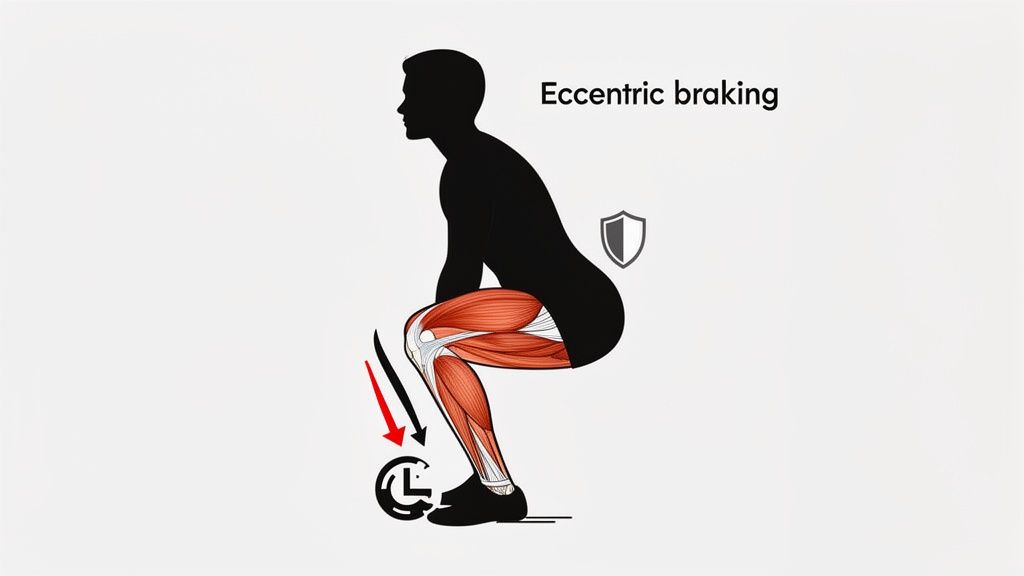
Think of eccentric work as upgrading your body's natural braking system. This ability to control movement and absorb shock is a cornerstone of injury prevention and effective rehabilitation. It's what keeps your anatomy safe and strong.
Every time you decelerate, land from a jump, or slowly lower a heavy object, you're tapping into this powerful contraction. This controlled lengthening is uniquely effective at strengthening not just the muscle bellies but also the connective tissues—the tendons and ligaments that support your joints. By intentionally loading these tissues, eccentric training makes them more robust by stimulating collagen synthesis, directly improving joint stability and resilience.
Upgrading Your Body's Shock Absorbers
This strengthening effect goes way beyond just the muscle fibers. Eccentric training sharpens your neuromuscular control, which is really just the conversation happening between your brain and your muscles. The better that connection, the more efficient your body becomes at anticipating and reacting to force, protecting your joints from unexpected twists or impacts.
For instance, carefully controlling the descent in a squat isn't just a quad exercise; it's training the entire system around the knee—including muscles like the quadriceps, hamstrings, and glutes, plus the associated tendons—to absorb force safely. This makes the joint far more durable and less susceptible to common injuries.
The real magic of eccentric work is its ability to handle immense force. Because an eccentric contraction happens when a muscle lengthens under tension, it can manage significantly more load than when it's shortening. This makes it a powerhouse for building true, functional resilience.
The Science of Injury Prevention
The proof is in the research. Eccentric training is well-documented for protecting against common injuries, especially muscle strains. It works by improving both flexibility and the muscle's ability to produce force at longer lengths—a key factor in preventing tissues from overstretching.
One study on soccer players showed that a four-week eccentric training program increased hamstring and quad optimal lengths by 4° and 6.5°, respectively. That small shift makes a huge difference in protecting muscles during explosive sprints and sudden stops.
This is exactly why eccentric muscle contraction is so central to mindful movement practices like Pilates. Every single time you resist gravity or control the return of a spring on the reformer, you’re not just working your muscles—you’re fortifying your entire musculoskeletal system from the inside out.
By improving your body's ability to brake and absorb shock, you're building a truly resilient foundation for any activity you love. To dig a little deeper, you can discover more insights on eccentric contractions from the ACSM.
Simple Ways to Apply Eccentric Training Today
Knowing the science behind an eccentric muscle contraction is one thing; feeling it in your own body is something else entirely. The great news is you don’t need any fancy equipment or a complete overhaul of your routine to start seeing the benefits.
It all comes down to a simple shift in focus: pay attention to the lengthening, or "braking," phase of the movements you already do.
Think about a classic push-up. The concentric part is pushing the floor away from you. The eccentric part is controlling your body as you lower it back toward the mat. Instead of just letting gravity take over, you’re going to actively resist it, feeling the pectoralis major and triceps lengthen under load.
This simple change in intention transforms a familiar exercise into a powerful tool for building real strength and control. By slowing down that descent, you increase the muscle's time under tension—a key driver for both strength gains and muscle growth.
Bodyweight Eccentric Exercises to Start With
You can start playing with this principle right now, using just your body weight. The goal is to make the lowering phase significantly longer than the lifting phase. A fantastic starting point is a 3-to-1 tempo: take three seconds to lower down, and one second to power back up.
Here are a few examples with clear anatomical cues:
- Eccentric Push-Up: From a plank (on toes or knees), take a full three seconds to lower your chest toward the floor. Feel the triceps and chest muscles lengthening. Keep your core locked in and your body in one straight line. Once you reach the bottom, push back up in one second.
- Eccentric Squat: Stand with your feet about shoulder-width apart. Take three seconds to send your hips down and back, feeling the quadriceps and glutes lengthen to control your descent. Then, drive through your heels to stand back up in one second.
- Eccentric Lunge: Step one foot forward and slowly lower your back knee toward the ground over three seconds. Keep your torso upright and feel the controlled stretch in the forward leg's glute and quad. Push off your front foot to return to the start in one second.
The core idea is simple: Own the "negative" part of the rep. Instead of collapsing or rushing through it, feel your muscles acting like brakes, lengthening with deliberate control against gravity.
Adding Resistance for a Greater Challenge
Once you’ve nailed the control with your body weight, you can apply the exact same principles using simple tools like resistance bands. This adds an external force that your muscles have to manage during that eccentric phase, taking the benefits to the next level.
Take a bicep curl with a band, for instance. The focus isn't just on curling your hand up to your shoulder. The real gold is in the return journey. As you straighten your arm, actively resist the band's pull, feeling the biceps brachii lengthen. Fight that urge to let it snap back; instead, control its retreat over a slow, three-second count. You can find more ideas on how to weave this principle into your workouts by exploring different exercises with resistance bands.
This method works for almost any exercise you can think of. Whether it's the slow, controlled release of a lat pulldown or the deliberate lowering of a dumbbell, the power is in mastering that lengthening phase. By bringing this mindful approach into your routine, you make every single repetition count for more, building a stronger, more resilient body with every controlled movement.
Got Questions About Eccentric Contractions?
Let's dig into some of the most common questions that come up around eccentric work. Getting these answers straight will help you train smarter, move with more confidence, and really make these principles work for you.
Will Eccentric Training Make Me Crazy Sore?
Okay, let's be real: yes, eccentric contractions are the main culprit behind that "next-day" muscle soreness, officially known as DOMS (delayed onset muscle soreness). This is especially true when you first start focusing on them. This soreness stems from the microscopic damage to muscle fibers and connective tissue discussed earlier.
But here’s the good news—it’s a totally normal sign that your muscles are adapting and getting stronger. Your body is incredibly smart and quickly adapts through something called the 'repeated bout effect,' which means the more you do it, the less sore you'll get. The key is to start with controlled, progressive movements to manage that initial soreness while still getting all the benefits.
How Often Should I Do Eccentric-Focused Moves?
You don't need to dedicate entire workouts just to eccentric training. A thoughtfully designed program naturally weaves them into every single movement.
The secret is simply shifting your focus to the 'lowering' or 'lengthening' part of each exercise you already do. Think about taking a slow, three-second count to lower into a squat, and then one second to come back up. Weaving this kind of mindful control into your workouts 2-4 times per week is a great target for seeing real results.
A lot of people think eccentric work means adding a bunch of new, complicated exercises. It's really about changing your mindset and making the "negative" part of the rep just as important as the lift itself.
Can I Do This Kind of Training Without Weights?
Absolutely. In fact, bodyweight exercises are one of the best ways to master eccentric control.
Think about the slow, controlled lowering phase of a push-up, or resisting gravity as you sink into a squat or lunge. While adding external resistance from weights or bands will eventually help you progress, mastering bodyweight eccentrics first is a powerful and super accessible way to build a solid foundation of functional strength right at home.
Ready to master controlled movement from home? The WundaCore collection, including our patented Resistance Ring and Loop, is designed to help you harness the power of eccentric contractions for a stronger, more resilient body. Explore our equipment and On Demand classes at https://wundacore.com to start your journey.