
What is Muscle Activation Technique (what is muscle activation technique)
Ever heard of Muscle Activation Technique, or MAT? It's a game-changer for understanding why some muscles feel tight while others just don't seem to show up to the party. Instead of just stretching what’s tight, MAT goes after the root cause: muscles that aren't firing properly because the central nervous system has put them on standby.
This often happens after an injury or from repetitive stress. When one muscle, like the gluteus medius, checks out, other muscles, such as the tensor fasciae latae (TFL) or quadratus lumborum (QL), have to pick up the slack. This leads to that all-too-familiar feeling of tightness, pain, and compensation.
Unlocking Your Body's True Potential
Here’s a great way to think about it: imagine your nervous system is the electrical grid in your house, and your muscles are the lights. If a light is flickering or just won't turn on, you wouldn't solve the problem by yanking and stretching the power cord, would you? Of course not. You'd go straight to the circuit breaker to restore the connection.
That’s exactly what Muscle Activation Technique is all about. It doesn’t get sidetracked by the symptom (the tight, overworked muscle). Instead, it acts like an electrician for your body, finding and fixing the faulty wiring between your brain, down the spinal cord, and out to the peripheral nerves that innervate the muscles that have gone dormant.
When a muscle can't contract properly, it creates a domino effect of instability and pain. MAT systematically finds these "switched off" muscles and flips the breaker back on.
The Focus on Anatomy and Neurological Signals
At its core, MAT is a precision-based system grounded in a deep understanding of human anatomy and biomechanics. A practitioner uses a thorough musculoskeletal assessment to pinpoint the exact muscles—from large prime movers like the latissimus dorsi to small stabilizers like the rotator cuff muscles—that are underperforming. It’s like a diagnostic test for your entire movement system.
The goal isn't just to relieve a tight spot; it's to restore your body’s ability to handle stress by making sure every single muscle is online and ready to do its job, contracting and relaxing on cue across every joint action. This creates a solid foundation for all other movement.
By finding and reactivating these inhibited muscles, MAT restores the body's natural stability and alignment, allowing it to function as a cohesive and efficient unit.
Developed by Greg Roskopf back in 2000, MAT has a pretty impressive track record. It’s not uncommon for a single session to produce up to a 100% improvement in a muscle’s ability to contract. That means more stability and better function, almost immediately. By restoring these fundamental brain-body connections first, you can then build on that foundation with more advanced training. This is a core concept we explore in our guide on how to build functional strength.
The Neuromuscular Science Behind Your Muscles
To really get what Muscle Activation Technique is all about, we first have to ask: why does a muscle "shut down" in the first place? The answer isn't in the muscle tissue itself. It’s all about the sophisticated communication network between your brain and your body—the neuromuscular system. Your muscles, composed of contractile fibers, don't just decide to get weak on their own; they’re following direct orders from headquarters.
This protective shutdown is a phenomenon called neuromuscular inhibition. Think of your brain as a hyper-intelligent circuit breaker. When proprioceptors—sensory receptors in your muscles and tendons—sense instability, stress, or potential damage around a joint, the brain intentionally cuts the power to a specific muscle to prevent a bigger injury. It's a survival mechanism.
Imagine you step awkwardly off a curb. Your brain instantly detects excessive inversion or eversion in your ankle. To protect the joint ligaments from a nasty sprain, it might "turn off" a key stabilizing muscle like the peroneus longus. While this is a brilliant short-term fix, the problem is that the muscle sometimes stays offline long after the danger has passed. This forces other muscles to pick up the slack and work overtime.
The infographic below shows this fundamental brain-to-muscle connection that MAT works to restore.
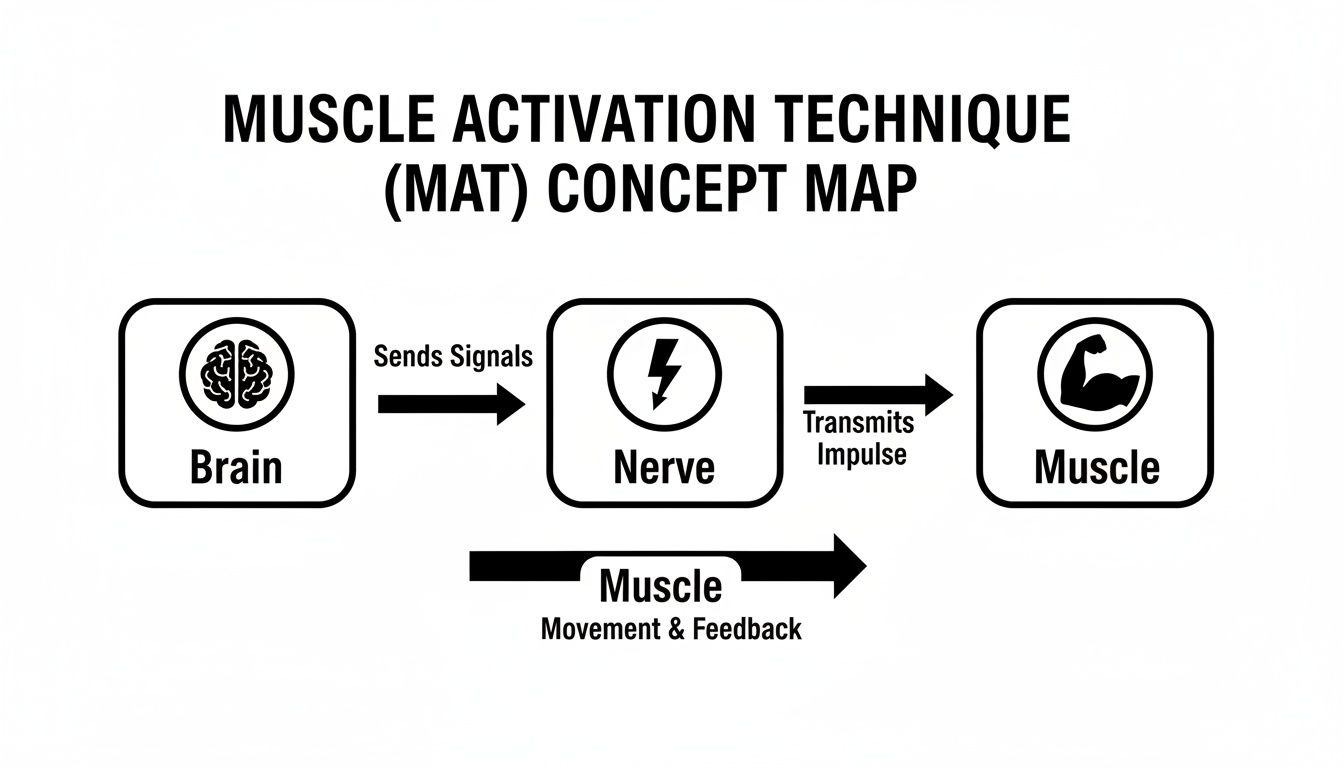
This visual gets to the heart of it: for a muscle to work right, it needs a clear, strong signal from the brain, delivered through the nervous system.
Finding and Fixing the Tripped Circuits
A Muscle Activation Technique practitioner is like a detective for your body, hunting down these "tripped circuits." The diagnostic process is incredibly precise and grounded in a deep understanding of anatomy. They use a meticulous series of muscle-specific strength and range-of-motion tests—evaluating actions like hip flexion, shoulder abduction, or spinal rotation—to pinpoint exactly which muscles have been inhibited.
Once a weak link is found, the goal is to reboot its connection to the nervous system. This is where the hands-on work of MAT comes into play.
A MAT specialist applies precise, targeted pressure directly to the muscle's origin and insertion points. These are the specific bony landmarks where the muscle's tendons attach, and they are packed with sensory nerve receptors called mechanoreceptors.
This targeted stimulation essentially reboots the neurological feedback loop, waking up that sleepy brain-to-muscle connection. It's like hitting the reset button on a frozen computer. The aim is to get the muscle firing on command again so it can start pulling its own weight. To get a better handle on this, you can dive deeper into the mechanics of eccentric muscle contractions in our related guide.
The Ripple Effect of Reactivation
The most amazing part of this process is how immediate the change can be. By switching just one key muscle back on, a practitioner can instantly take the pressure off its overworked synergists or antagonists. Restoring this balance creates a positive ripple effect throughout your body.
- Improved Joint Stability: With the right muscles firing, joints like the shoulder or hip are suddenly better supported by their respective musculature, feeling more secure.
- Reduced Compensation: Those chronically tight, overworked muscles (e.g., upper trapezius) can finally relax because the newly activated muscle (e.g., lower trapezius) is doing its job again.
- Increased Strength and Performance: Your body can move more efficiently and with more power when all its muscular parts are contributing as a team.
This focus on restoring neurological function is what really sets MAT apart from other methods that just chase symptoms like tightness or pain. It gets to the root of the problem, building a more stable and resilient foundation for all your movement.
What to Expect During Your First MAT Session
Stepping into your first Muscle Activation Technique session isn't like hitting the gym for a workout. Think of it more like a detailed diagnostic check for your entire muscular system, where the main goal is to find and fix the neurological weak spots causing instability and pain.
Your practitioner will kick things off with a thorough evaluation. They'll look at your posture, assess your gait cycle, and discuss your movement history to get a clear picture of your body's unique compensation patterns. This first step is all about mapping out where your limitations in joint motion are before any hands-on work begins.
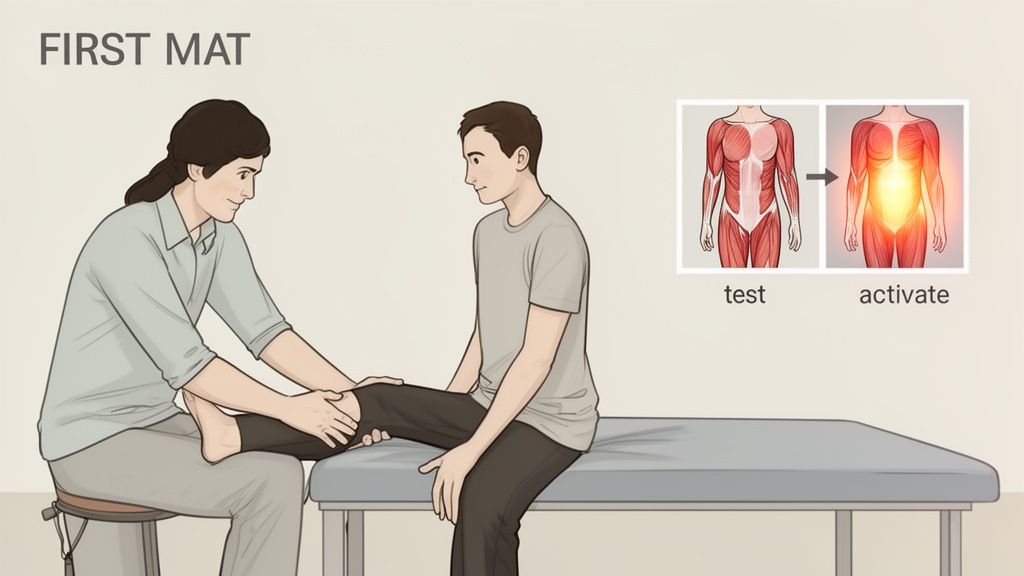
This systematic approach is what makes MAT so powerful. Over the past 25 years, MAT has grown from a niche technique into a globally recognized methodology, with rigorous certification programs training thousands of practitioners. It's become a trusted tool in both professional sports and clinical settings. You can explore the history and growth of MAT to see just how deep its roots go.
The Core MAT Process Unfolded
After that initial assessment, you'll move into the heart of the session: the diagnostic and treatment phase. This is where your practitioner systematically tests individual muscles to find which ones have gone "offline" neurologically. The whole process is incredibly precise, but also gentle.
The entire session follows a clear, repeatable flow:
-
Precise Muscle Testing: You'll be guided into specific positions that isolate one muscle's primary action (e.g., placing the leg in extension and external rotation to test the gluteus maximus). The practitioner will then ask you to gently resist a very light pressure. This isn't about raw strength; it’s about checking the clarity of the brain-to-muscle connection.
-
Identifying Inhibition: If a muscle can't hold a contraction against that minimal force, it's flagged as "inhibited." This is the "tripped circuit" the practitioner is searching for—a clear sign of a communication breakdown with the nervous system.
-
Targeted Activation: Once an inhibited muscle is found, the practitioner applies a precise, digital force to its attachment points (origin and insertion) where the muscle's tendon connects to the periosteum of the bone. This targeted pressure stimulates nerve receptors, essentially rebooting the connection and bringing the muscle back online.
But the most eye-opening part of the session usually happens next, during the re-test.
Feeling the Immediate Difference
The real "magic" of a MAT session happens in the moments right after an activation. The practitioner will re-test the exact same muscle that was just weak, and the change is often stunning.
You will likely feel a clear, undeniable improvement in the muscle's ability to contract and stabilize. This immediate feedback confirms that the neurological connection has been restored, providing tangible proof that the technique is working.
This step-by-step process of test, activate, and re-test is repeated for all the weak spots that were identified. By systematically turning your muscles back on one by one, your practitioner helps your body build a more stable and resilient foundation. The result? Better movement, less pain, and a major boost in performance.
How MAT and Physical Therapy Fit Together
When you're trying to solve pain and move better, you’ll almost certainly hear about physical therapy. But when you start digging into something like Muscle Activation Techniques (MAT), you’re really asking a different, more fundamental question about how the body is wired. While both MAT and traditional physical therapy (PT) want to get you moving well again, they start from completely different places.
Most physical therapy approaches the body from the outside in, focusing on the symptom. Got a tight hamstring? The first step is often to stretch it. Glutes feel weak? You’ll probably get a list of exercises like bridges and squats. This treats the muscle like a piece of hardware that just needs to be forced longer or loaded up to get stronger.
MAT flips that script entirely. It looks at the problem from the inside out—starting with the nervous system. Before anything else, MAT asks a crucial question: Is that "weak" muscle even getting a clear signal from the brain to turn on?
The Difference Between "Weak" and "Switched Off"
This is where the two paths really split. From a MAT perspective, many muscles we think of as “weak” are actually inhibited. The brain has essentially turned down the volume on them as a protective response, often due to stress, injury, or overuse.
Stretching that tight, overworked hamstring might feel good for a moment, but it doesn't solve the real problem. That hamstring was probably tight because it was working overtime for a neighboring muscle that was neurologically "switched off," perhaps an inhibited gluteus maximus that isn't contributing to hip extension.
It’s like being on a group project where one person just stops answering their phone. The rest of the team has to pick up the slack, getting overworked, stressed, and exhausted. Just telling the tired team members to "relax" (or stretch) won't fix anything. You have to get the missing person back online and doing their job.
MAT is the process of finding that missing team member. It uses a system of specific muscle tests to pinpoint which muscles have been inhibited. Then, it uses precise, targeted inputs to essentially reboot that muscle’s connection to the brain.
Once that inhibited muscle is firing on all cylinders again, the over-stressed, tight muscles that were compensating for it can finally let go.
This is why MAT can be such a game-changer when used before other therapies. By getting all the right muscles back online, it creates a solid, stable foundation. This makes everything that comes after—whether it's physical therapy, corrective exercise, or even a WundaCore session—safer and a whole lot more effective. Many people find that PT exercises that used to feel painful or impossible suddenly become accessible once the underlying inhibitions are cleared up.
MAT vs. Traditional Approaches: A Comparative Overview
To make these distinctions even clearer, it helps to see the different philosophies laid out side-by-side. This table breaks down how MAT, traditional PT, and general corrective exercise look at the body and its problems.
| Approach | Primary Focus | Core Philosophy | Typical Methods |
|---|---|---|---|
| Muscle Activation Technique (MAT) | Neuromuscular communication | Restore the brain-muscle connection first. A muscle that can't contract properly can't be strengthened. | Precise muscle contract-and-relax testing; targeted pressure at muscle origins and insertions to restore nerve signals. |
| Traditional Physical Therapy (PT) | Symptoms and functional movement | Improve movement patterns by stretching what’s tight and strengthening what’s weak. | Stretching protocols, strengthening with bands/weights, joint mobilization, and modalities like ultrasound or e-stim. |
| Corrective Exercise | Movement patterns and compensation | Identify and correct faulty movement patterns through targeted exercises that improve posture and biomechanics. | Foam rolling, stretching, activation drills (e.g., glute bridges, band walks), and integrated strength movements. |
Ultimately, MAT and physical therapy aren’t competitors—they can be fantastic partners. Think of a MAT specialist as the electrician, making sure every circuit in the house is properly connected and the power is flowing. The physical therapist is the coach who then teaches you how to use that fully-powered system to perform complex, coordinated movements.
By first addressing the root cause of why a muscle isn’t working, MAT paves the way for more lasting success from every other type of movement work you do.
You might see elite athletes—pro golfers, NHL players—using Muscle Activation Technique to get an edge, but its real magic isn't just for the pros. At its heart, MAT is for anyone who wants to move with more stability, less pain, and better all-around efficiency.
It all comes back to restoring that fundamental conversation between your brain and your muscles. This makes it a powerful tool for a surprisingly wide range of people, from office workers to weekend warriors, because it gets to the root cause of so many common issues that get in the way of daily life.
Everyday Aches and Chronic Pain
So many of us live with that nagging, persistent pain that just never seems to go away. Think about chronic low back pain from sitting at a desk all day, or that recurring shoulder ache you can’t seem to shake. These issues often come from muscular imbalances where some muscles have basically "switched off," forcing others to pick up the slack and become overworked.
This is exactly where MAT shines. Instead of just chasing the tight, sore spots, a practitioner finds and reactivates the muscles that aren't doing their job. This can bring lasting relief for things like:
- Persistent Back and Neck Pain: Often tied to inhibited deep core stabilizers like the transverse abdominis or glutes that have gone on vacation.
- Nagging Joint Discomfort: Like that hip or knee pain caused by imbalances in the muscles surrounding the joint, such as an inhibited vastus medialis obliquus (VMO).
- Sciatica and Tension Headaches: These can be made worse when tight, compensating muscles like the piriformis or upper trapezius put pressure on nearby nerves.
By fixing the neuromuscular signals, MAT helps your body support itself the way it was designed to. This takes the strain off those overworked tissues and helps calm down that chronic irritation for good.
Enhancing Athletic Performance and Recovery
For athletes and anyone serious about their fitness, progress can sometimes hit a wall. You might be dealing with performance plateaus or injuries that keep coming back. A muscle that isn't firing correctly is a huge liability—it can't produce its maximum force, and it fails to properly stabilize a joint, which is a recipe for strains and sprains.
MAT is like a full system tune-up for an athletic body. By making sure every single muscle is neurologically "online" and ready to fire on command, it creates a much more powerful and resilient system.
This is why so many athletes look into what is muscle activation technique when they need to break through a barrier. It helps them build strength on a truly stable foundation, making sure all their hard work in the gym actually translates to better performance. It's also a game-changer for getting back in action after an injury or surgery, helping to wake up muscles that were shut down by trauma and speed up a safe return to the activities you love.
Integrating MAT Principles with Your Workouts
You don’t have to be a certified practitioner to bring the core ideas of muscle activation into your own fitness routine, especially for a form-focused workout like WundaCore. It all boils down to one central principle: making sure your foundational muscles are “awake” and ready to fire before you even start moving.
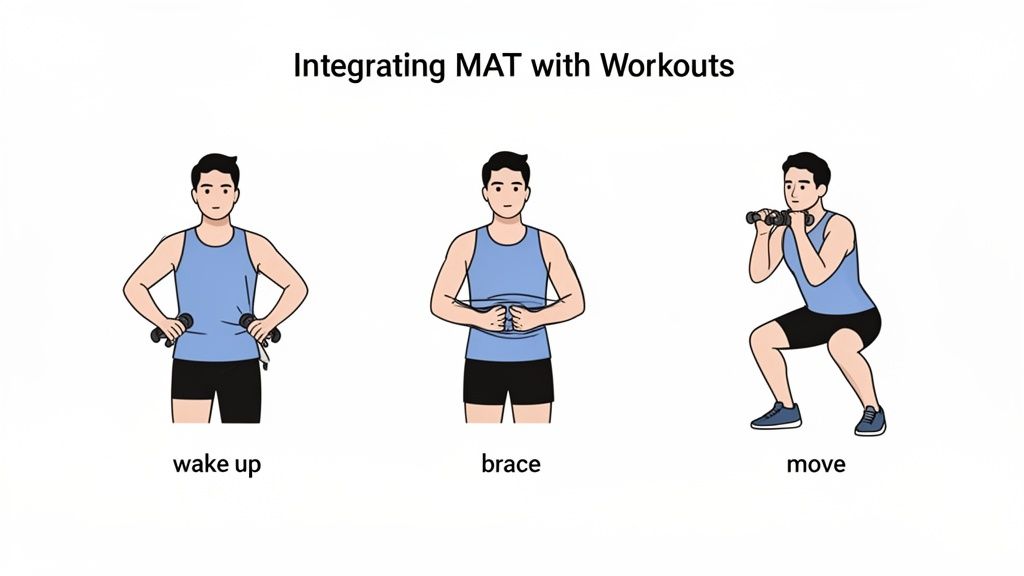
Here's what happens when they're not. When key stabilizers—think of your deep core muscles or the gluteus medius—aren't firing correctly, the bigger, more powerful muscle groups (the prime movers like the quadriceps or hamstrings) are forced to jump in and overcompensate. This is a recipe for poor form, wasted energy, and a much higher risk of injury.
Priming Your Muscles for Peak Performance
Think of this as a pre-workout primer for your body. By using some simple, at-home self-checks and a few gentle isometric contractions, you can send a clear signal from your brain to these essential muscles, basically reminding them it's time to get to work.
This isn't about fatiguing the muscle before your workout even begins. It’s about re-establishing that clean, crisp neurological connection. A few targeted contractions can wake up a sleepy muscle, prepping it for the demands you're about to place on it.
For instance, a simple glute squeeze or an intentional abdominal brace held for just a few seconds can dramatically improve how well those muscles engage during the rest of your workout. This deliberate activation makes every single movement safer and far more effective.
Runners, for example, can weave these activation cues into proven strategies for boosting performance and preventing injuries in runners to get more out of every stride. You can also explore different exercises with resistance bands to specifically target and wake up certain muscle groups before you start your main session.
Your Questions About MAT, Answered
As you start to wrap your head around Muscle Activation Technique, it's natural for a few practical questions to pop up. It’s a very different way of looking at the body, and it’s smart to get the details straight before deciding if it’s the right path for you.
Is Muscle Activation Technique Painful?
Not at all. The muscle testing itself is incredibly gentle and just involves light resistance.
Now, when the practitioner performs the activation—applying focused, deep pressure right where the muscle's tendon attaches to the bone—you might feel some tenderness. It’s a sensation a lot like a deep trigger point release. But that feeling is quick, and it’s a good sign! It means the communication line between your brain and that muscle is firing back up. Most people tell us they feel more stable and notice their usual aches and pains have quieted down almost immediately after.
How Many Sessions Will I Need?
This is completely unique to you and your body’s history. Someone who just tweaked a muscle last week might feel a massive difference after just one or two sessions.
But if you’re dealing with chronic imbalances that have been building up for years, it’s going to take more time. Think of it like peeling back the layers of an onion—we have to undo years of compensation patterns. Your practitioner will be able to give you a clear roadmap after your first assessment.
How Is MAT Different From Massage or Chiropractic?
This is a great question. While all three are designed to help you feel and move better, they focus on completely different systems in the body. MAT is the only one that goes straight to the source: the communication between your brain and your muscles.
Let’s break it down:
- Massage Therapy: This is all about the soft tissues. A massage therapist works on the muscle bellies and fascia to release tension and knots you can physically feel.
- Chiropractic Care: A chiropractor’s world is the skeletal system. They focus on aligning the vertebrae and other joints to make sure the nerve signals coming from the spinal cord are clear.
- Muscle Activation Technique: MAT is laser-focused on the neuromuscular system. It’s about testing and fixing the specific signal from your brain to your muscle, correcting weakness where it truly begins.
At WundaCore, we know that a strong, stable foundation is the secret to powerful, intentional movement. When you understand principles like muscle activation, every workout becomes smarter and more effective. We invite you to explore our anatomy-informed classes and thoughtfully designed equipment to build a kind of strength that starts from the inside out. Discover the WundaCore difference at https://wundacore.com.